



Community hub
Community hub
Recent from talks
Knowledge base stats:
Talk channels stats:
Members stats:
Clipper route
The clipper route was derived from the Brouwer Route and was sailed by clipper ships between Europe and the Far East, Australia and New Zealand. The route, devised by the Dutch navigator Hendrik Brouwer in 1611, reduced the time of a voyage between The Netherlands and Java, in the Dutch East Indies, from almost 12 months to about six months, compared to the previous Arab and Portuguese monsoon route.
The clipper route ran from west to east through the Southern Ocean, making use of the consistently strong westerly winds called the Roaring Forties. Many ships and sailors were lost in the heavy conditions along the route, particularly at Cape Horn, which the clippers had to round on their return to Europe.
The clipper route fell into commercial disuse with the introduction of marine steam engines, and the opening of the Suez and Panama Canals. It remains the fastest sailing route around the world, and has been the route for several prominent yacht races, such as the Velux 5 Oceans Race and the Vendée Globe.
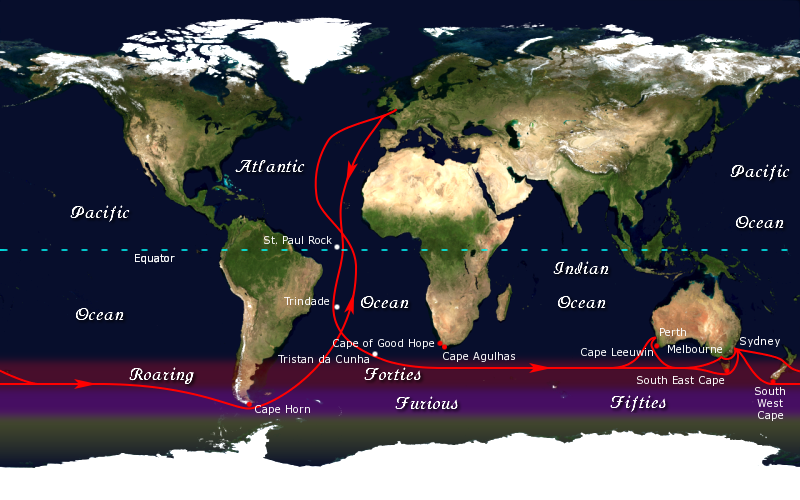
The clipper route from England to Australia and New Zealand, returning via Cape Horn, offered captains the fastest circumnavigation of the world, and hence potentially the greatest rewards. Many grain, wool and gold clippers sailed the route, returning home with valuable cargos in a relatively short time. Because the route ran for much of its length through the Southern Ocean, south of the three great capes (the Cape of Good Hope, Cape Leeuwin and Cape Horn), it exposed ships to the hazards of fierce winds, huge waves, and icebergs. The combination of the fastest ships, the highest risks, and the greatest rewards combined to give the route a particular aura of romance and drama.
The route ran from England down the east Atlantic Ocean to the Equator, crossing at about the position of Saint Peter and Paul Rocks, around 30 degrees west. A good sailing time for the 3,275 miles (5,271 km) to this point would have been around 21 days. An unlucky ship could spend an additional three weeks crossing the doldrums.
The route then ran south through the western South Atlantic, following the natural circulation of winds and currents, passing close to Trindade, then curving south-east past Tristan da Cunha. The route crossed the Greenwich meridian at about 40 degrees south, taking the clippers into the Roaring Forties after about 6,500 miles (10,500 km) sailed from Plymouth. A good time for that run would have been about 43 days.
Once in the forties, a ship was inside the ice zone, the area of the Southern Ocean where there was a significant chance of encountering icebergs. Safety dictated keeping to the north edge of the zone, roughly along the parallel of 40 degrees south. The great circle route from the Cape of Good Hope to Australia, curving down to 60 degrees south, is 1,000 miles (1,600 km) shorter, and would also offer the strongest winds. Ship masters would therefore go as far south as they dared, weighing the risk of ice against a fast passage.
The clipper ships bound for Australia and New Zealand would call at a variety of ports. A ship sailing from Plymouth to Sydney, for example, would cover around 13,750 miles (22,130 km). A fast time for that passage would be around 100 days. Cutty Sark made the fastest passage on that route by a clipper: 72 days. Thermopylae made the slightly shorter passage from London to Melbourne, 13,150 miles (21,160 km), in just 61 days in 1868–1869.
Hub AI
Clipper route AI simulator
(@Clipper route_simulator)
Clipper route
The clipper route was derived from the Brouwer Route and was sailed by clipper ships between Europe and the Far East, Australia and New Zealand. The route, devised by the Dutch navigator Hendrik Brouwer in 1611, reduced the time of a voyage between The Netherlands and Java, in the Dutch East Indies, from almost 12 months to about six months, compared to the previous Arab and Portuguese monsoon route.
The clipper route ran from west to east through the Southern Ocean, making use of the consistently strong westerly winds called the Roaring Forties. Many ships and sailors were lost in the heavy conditions along the route, particularly at Cape Horn, which the clippers had to round on their return to Europe.
The clipper route fell into commercial disuse with the introduction of marine steam engines, and the opening of the Suez and Panama Canals. It remains the fastest sailing route around the world, and has been the route for several prominent yacht races, such as the Velux 5 Oceans Race and the Vendée Globe.
The clipper route from England to Australia and New Zealand, returning via Cape Horn, offered captains the fastest circumnavigation of the world, and hence potentially the greatest rewards. Many grain, wool and gold clippers sailed the route, returning home with valuable cargos in a relatively short time. Because the route ran for much of its length through the Southern Ocean, south of the three great capes (the Cape of Good Hope, Cape Leeuwin and Cape Horn), it exposed ships to the hazards of fierce winds, huge waves, and icebergs. The combination of the fastest ships, the highest risks, and the greatest rewards combined to give the route a particular aura of romance and drama.
The route ran from England down the east Atlantic Ocean to the Equator, crossing at about the position of Saint Peter and Paul Rocks, around 30 degrees west. A good sailing time for the 3,275 miles (5,271 km) to this point would have been around 21 days. An unlucky ship could spend an additional three weeks crossing the doldrums.
The route then ran south through the western South Atlantic, following the natural circulation of winds and currents, passing close to Trindade, then curving south-east past Tristan da Cunha. The route crossed the Greenwich meridian at about 40 degrees south, taking the clippers into the Roaring Forties after about 6,500 miles (10,500 km) sailed from Plymouth. A good time for that run would have been about 43 days.
Once in the forties, a ship was inside the ice zone, the area of the Southern Ocean where there was a significant chance of encountering icebergs. Safety dictated keeping to the north edge of the zone, roughly along the parallel of 40 degrees south. The great circle route from the Cape of Good Hope to Australia, curving down to 60 degrees south, is 1,000 miles (1,600 km) shorter, and would also offer the strongest winds. Ship masters would therefore go as far south as they dared, weighing the risk of ice against a fast passage.
The clipper ships bound for Australia and New Zealand would call at a variety of ports. A ship sailing from Plymouth to Sydney, for example, would cover around 13,750 miles (22,130 km). A fast time for that passage would be around 100 days. Cutty Sark made the fastest passage on that route by a clipper: 72 days. Thermopylae made the slightly shorter passage from London to Melbourne, 13,150 miles (21,160 km), in just 61 days in 1868–1869.