Hubbry Logo
search
logo
1861537

Clipper route

logo
Community Hub0 Subscribers
Read side by side
from Wikipedia

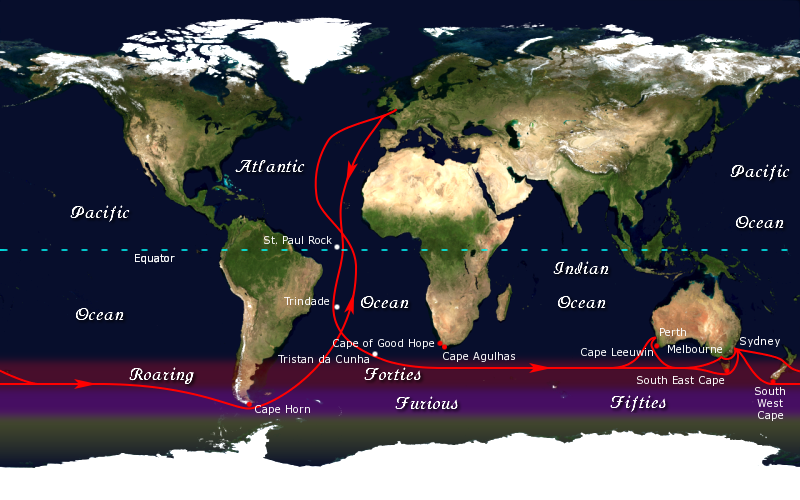
The clipper route, followed by ships sailing between Europe and Australia or New Zealand
In the Age of Sail, the Brouwer Route reduced the time of a voyage from The Netherlands to the Dutch East Indies from almost 12 months to about six months.

The clipper route was derived from the Brouwer Route and was sailed by clipper ships between Europe and the Far East, Australia and New Zealand. The route, devised by the Dutch navigator Hendrik Brouwer in 1611, reduced the time of a voyage between The Netherlands and Java, in the Dutch East Indies, from almost 12 months to about six months, compared to the previous Arab and Portuguese monsoon route.

The clipper route ran from west to east through the Southern Ocean, making use of the consistently strong westerly winds called the Roaring Forties. Many ships and sailors were lost in the heavy conditions along the route, particularly at Cape Horn, which the clippers had to round on their return to Europe.

The clipper route fell into commercial disuse with the introduction of marine steam engines, and the opening of the Suez and Panama Canals. It remains the fastest sailing route around the world, and has been the route for several prominent yacht races, such as the Velux 5 Oceans Race and the Vendée Globe.

Australia and New Zealand

[edit]

The clipper route from England to Australia and New Zealand, returning via Cape Horn, offered captains the fastest circumnavigation of the world, and hence potentially the greatest rewards. Many grain, wool and gold clippers sailed the route, returning home with valuable cargos in a relatively short time. Because the route ran for much of its length through the Southern Ocean, south of the three great capes (the Cape of Good Hope, Cape Leeuwin and Cape Horn), it exposed ships to the hazards of fierce winds, huge waves, and icebergs. The combination of the fastest ships, the highest risks, and the greatest rewards combined to give the route a particular aura of romance and drama.[1]

Outbound

[edit]
Unidentified sailing ship rounding Cape Horn

The route ran from England down the east Atlantic Ocean to the Equator, crossing at about the position of Saint Peter and Paul Rocks, around 30 degrees west. A good sailing time for the 3,275 miles (5,271 km) to this point would have been around 21 days. An unlucky ship could spend an additional three weeks crossing the doldrums.[2]

The route then ran south through the western South Atlantic, following the natural circulation of winds and currents, passing close to Trindade, then curving south-east past Tristan da Cunha.[3] The route crossed the Greenwich meridian at about 40 degrees south, taking the clippers into the Roaring Forties after about 6,500 miles (10,500 km) sailed from Plymouth. A good time for that run would have been about 43 days.[4]

Once in the forties, a ship was inside the ice zone, the area of the Southern Ocean where there was a significant chance of encountering icebergs. Safety dictated keeping to the north edge of the zone, roughly along the parallel of 40 degrees south. The great circle route from the Cape of Good Hope to Australia, curving down to 60 degrees south, is 1,000 miles (1,600 km) shorter, and would also offer the strongest winds. Ship masters would therefore go as far south as they dared, weighing the risk of ice against a fast passage.[5]

The clipper ships bound for Australia and New Zealand would call at a variety of ports. A ship sailing from Plymouth to Sydney, for example, would cover around 13,750 miles (22,130 km). A fast time for that passage would be around 100 days.[6] Cutty Sark made the fastest passage on that route by a clipper: 72 days.[7] Thermopylae made the slightly shorter passage from London to Melbourne, 13,150 miles (21,160 km), in just 61 days in 1868–1869.[8]

Homeward

[edit]

The return passage continued east from Australia.[citation needed] Ships stopping at Wellington would pass through the Cook Strait. Otherwise, that tricky passage was avoided, with ships passing instead around the south end of New Zealand.[9] Once again, eastbound ships would be running more or less within the ice zone, staying as far south as possible for the shortest route and strongest winds. Most ships stayed north of the latitude of Cape Horn, at 56 degrees south, following a southward dip in the ice zone as they approached the Horn.[10]

The Horn itself had, and still has, an infamous reputation among sailors. The strong winds and currents, which flow perpetually around the Southern Ocean without interruption, are funnelled by the Horn into the relatively narrow Drake Passage. Coupled with turbulent cyclones coming off the Andes, and the shallow water near the Horn, that combination of factors can create violently hazardous conditions for ships.[11]

After surviving the Horn, ships made the passage back up the Atlantic, following the natural wind circulation up the eastern South Atlantic and more westerly in the North Atlantic. A good run for the 14,750 miles (23,740 km) from Sydney to Plymouth was around 100 days. Cutty Sark made it in 84 days and Thermopylae in 77 days.[12] In 1854–1855, Lightning made the longer passage from Melbourne to Liverpool in 65 days, completing a circumnavigation of the world in 5 months, 9 days, which included 20 days spent in port.[13]

The later windjammers, which were usually large four-masted barques optimized for cargo and handling rather than running, usually made the voyage in 90 to 105 days. The fastest recorded time on Great Grain Races was for the Finnish four-masted barque Parma: 83 days in 1933.[14] Her master on the voyage was the Finnish captain Ruben de Cloux.[15]

Decline and end

[edit]

Already dwindling rapidly due to the advent of modern engines, use of the clipper route was halted entirely by World War II and the consequent near-total interruption of commercial shipping. A few commercial ships using the route still sailed in 1948 and 1949.[16]

Eric Newby chronicled the 1938 final voyage of the four-masted barque Moshulu in his book The Last Grain Race.

Variations

[edit]
Garthneill

The route sailed by a sailing ship was always heavily dictated by the wind conditions, which are generally reliable from the west in the latitude of the forties and fifties. Even there, winds can be variable, and the precise route and distance sailed depended on the conditions on a particular voyage. Ships in the deep Southern Ocean could find themselves faced with persistent headwinds, or even becalmed. Sailing ships attempting to go against the route, however, could have even greater problems.

In 1922, Garthwray attempted to sail west around the Horn carrying cargo from the Firth of Forth to Iquique, Chile. After two attempts to round the Horn the "wrong way", her master gave up and sailed east, reaching Chile from the other direction.[17]

In 1919, attempting to sail from Melbourne to Bunbury, Western Australia, a distance of 2,000 miles (3,200 km), the Garthneill was unable to make way against the forties winds south of Australia, and was faced by strong westerly winds again when she attempted to pass through the Torres Strait to the north. She finally turned and sailed the other way, passing the Pacific, Cape Horn, the Atlantic, the Cape of Good Hope, and the Indian Ocean, to finally arrive in Bunbury after 76 days at sea.[17]

Joshua Slocum, the first person to complete a solo circumnavigation in the Spray, from 1895 to 1898, rounded Cape Horn from east to west. His was not the fastest circumnavigation on record, and he took more than one try to get through Cape Horn.

Modern use of the route

[edit]

The introduction of steam ships, and the opening of the Suez and Panama Canals, spelled the demise of the clipper route as a major trade route. It remains the fastest sailing route around the world, and so the growth in recreational long-distance sailing has brought about a revival of sailing on the route.

The first person to attempt a high-speed circumnavigation of the clipper route was Francis Chichester. Chichester was a notable aviation pioneer, who had flown solo from London to Sydney, and also a pioneer of single-handed yacht racing, being one of the founders of the Single-Handed Trans-Atlantic Race (the OSTAR). After the success of the OSTAR, Chichester started looking into a clipper-route circumnavigation. He wanted to make the fastest ever circumnavigation in a small boat, but specifically set himself the goal of beating a "fast" clipper-ship passage of 100 days to Sydney.[18] He set off in 1966, and completed the run to Sydney in 107 days; after a stop of 48 days, he returned via Cape Horn in 119 days.[19]

Chichester's success inspired several others to attempt the next logical step: a non-stop single-handed circumnavigation along the clipper route. The result was the Sunday Times Golden Globe Race, which was not only the first single-handed round-the-world yacht race, but the first round-the-world yacht race in any format. Possibly the strangest yacht race ever run, it culminated in a successful non-stop circumnavigation by just one competitor, Robin Knox-Johnston, who became the first person to sail the clipper route single-handed non-stop. Bernard Moitessier withdrew from the race after rounding Cape Horn in a promising position. He completed his circumnavigation south of Cape Town and continued to Tahiti, completing another half-circumnavigation.

Today, there are several major races held regularly along the clipper route. The Volvo Ocean Race is a crewed race with stops which sails the clipper route every four years. Two single-handed races, inspired by Chichester and the Golden Globe race, are the Around Alone, which circumnavigates with stops, and the Vendée Globe, which is non-stop.

In March 2005, Bruno Peyron and crew, on the catamaran Orange II, set a new world record for a circumnavigation by the clipper route, of 50 days, 16 hours, 20 minutes, and 4 seconds.[20]

Also in 2005, Ellen MacArthur set a new world record for a single-handed non-stop circumnavigation in the trimaran B&Q/Castorama. Her time along the clipper route of 71 days, 14 hours, 18 minutes, and 33 seconds was the fastest ever circumnavigation of the world by a single-hander.[21] While this record still leaves MacArthur as the fastest female singlehanded circumnavigator, the current fastest singlehanded circumnavigator is François Gabart with a time of 42 days, 14 hours, 40 minutes, and 15 seconds.[22]

See also

[edit]

References

[edit]
Revisions and contributorsEdit on WikipediaRead on Wikipedia
from Grokipedia
The Clipper route was a fast and perilous sailing path utilized by clipper ships during the mid-19th century, primarily to transport high-value cargoes such as tea from Chinese ports like Fuzhou to London, covering roughly 14,000 to 16,000 miles in about 90 to 100 days.[1] This route capitalized on prevailing westerly winds in the southern oceans, known as the Roaring Forties, to achieve unprecedented speeds for the era, revolutionizing global trade before the advent of steamships and the Suez Canal in 1869.[2] Originating from earlier trade paths like the Brouwer Route discovered in 1611, the Clipper route gained prominence between 1840 and 1870 amid intense commercial competition between British and American shipbuilders, who designed sleek, narrow-beamed vessels capable of carrying up to 26,000 square feet of canvas and reaching speeds of 16 knots.[1] The typical eastward leg from China involved navigating south through the South China Sea, across the Indian Ocean, rounding the Cape of Good Hope, and ascending the Atlantic to the English Channel, while outbound voyages from Europe followed a similar arc via the Cape of Good Hope to reach the Far East, Australia, or New Zealand.[1] These journeys were fraught with dangers, including typhoons, icebergs, heavy seas, and shoals, leading to numerous shipwrecks, particularly near the southern capes.[2] The route's significance peaked in the tea trade, where being first to market commanded premium prices—a premium of 10 shillings per ton for the first ship to arrive, along with bonuses for captains and crew—fueling legendary races that epitomized the golden age of sail.[1] The most famous, the 1866 Tea Race among leading clippers including the British ships Ariel and Taeping, departed Fuzhou on May 28; after about 99 days at sea, Taeping and Ariel arrived on September 6, with Taeping docking in London first by 28 minutes, though the premium was shared in a virtual tie, both with cargoes valued at tens of thousands of pounds.[1] Other iconic vessels like Cutty Sark and Fiery Cross also competed on this route, their exploits driving innovations in ship design and underscoring the clippers' role in expanding global commerce until steam power rendered the path obsolete.[3]

Overview and History

Definition and Characteristics

The clipper route refers to a 19th-century sailing path primarily used by clipper ships for rapid maritime travel between Europe and destinations in the Far East, Australia, and New Zealand, strategically exploiting global wind systems such as the trade winds, the strong westerly winds known as the "Roaring Forties" between 40° and 50° south latitude, and favorable ocean currents to minimize transit times.[4][5] This route emerged as an optimization over earlier paths like the Brouwer Route, emphasizing continuous high-speed passages without frequent stops, particularly after the 1840s when clippers adopted great circle sailing principles to harness the Southern Ocean's consistent gales.[5][6] Key characteristics of the clipper route included its greater overall distance compared to more direct commercial alternatives, yet significantly faster completion times due to superior wind utilization; for instance, the return leg from Australia to the United Kingdom via Cape Horn spanned approximately 16,000 nautical miles but could be navigated in 90 to 120 days, versus over 200 days on slower routes via the Cape of Good Hope that encountered calms and variable winds.[7][5] It relied on specialized clipper ships featuring sharp, raked hulls for reduced drag, multiple masts (typically three or more) with extensive square-rigged sail areas exceeding 3,000 square meters, enabling bursts of speed up to 22 knots in optimal conditions.[4][6] These vessels prioritized velocity over cargo capacity, averaging voyage reductions of about 25 days from the mid-19th century onward through route refinements and hull advancements.[5] Geographically, the outbound leg from Europe involved sailing south across the Atlantic or Indian Oceans—often east of the Cape Verde Islands to leverage northeast trade winds—before descending to the Roaring Forties for an eastward push toward Australia, covering roughly 6,500 nautical miles to reach these westerlies.[5][6] The homeward journey from Australia utilized the same Southern Ocean westerlies eastward to Cape Horn, then proceeded northward through the South Atlantic, transitioning into southeast trade winds and the horse latitudes (variables) for the final approach to Europe.[7][6] This design proved ideal for time-sensitive cargoes such as tea from China, wool from Australia, or grain from southern ports, where delays could lead to spoilage or market losses, underscoring the route's economic imperative for perishable goods trade.[4][7]

Origins and Development

The origins of the clipper route can be traced to 18th-century maritime explorations that mapped key wind patterns, particularly those conducted by Captain James Cook during his voyages in the Pacific, which informed faster sailing paths around the globe.[8] These efforts built on earlier transitions from traditional square-rigged vessels to sharper, more maneuverable designs, exemplified by the Baltimore clippers developed in the United States around the 1810s for privateering and coastal trade, featuring V-shaped hulls and raked masts for enhanced speed. By the 1830s, shipbuilders began refining these prototypes, with vessels like the Ann McKim (launched 1833) introducing longer, finer hull lines that foreshadowed full clipper characteristics, driven by the need for rapid transoceanic voyages amid growing global commerce.[8] Key innovations emerged in the 1840s through American naval architects, notably John W. Griffiths, who designed the Rainbow (launched 1845) as the first extreme clipper, optimized for the China trade with a sharp bow, concave waterlines, and extensive sail plan to achieve unprecedented speeds.[9] This design prioritized velocity over cargo capacity, enabling passages like New York to Canton in 102 days, and influenced subsequent builds such as the Flying Cloud (1851) by Donald McKay, which set a record of 89 days from New York to San Francisco.[10] British shipbuilders adopted and adapted these concepts after the Opium Wars (1839–1842 and 1856–1860), which opened Chinese ports and intensified demand for swift tea transport to beat competitors and reduce spoilage risks, leading to composite-hulled clippers like the Ariel (1860).[8] The clipper route's development peaked during the "Clipper Ship Era" from 1845 to 1857, a period of rapid construction spurred by economic booms, including the California Gold Rush of 1848, which necessitated fast supply lines around Cape Horn, and the Australian Gold Rush of 1851, prompting the construction of approximately 270 clippers in U.S. yards between 1843 and 1853.[11] These events amplified route adoption, as insurers offered lower premiums for speedier vessels that minimized time at sea and exposure to perils, further incentivizing extreme designs.[10] Technologically, ship evolution progressed from the agile Baltimore clippers to medium clippers balancing speed and load in the 1850s, and culminating in extreme variants like the Cutty Sark (launched 1869), with its iron-framed wooden hull and towering sail area exceeding 32,000 square feet for harnessing winds like the Roaring Forties.[8] This progression reflected a broader shift toward hydrodynamic efficiency, with sharp hulls featuring high deadrise (typically 30 to 40 inches at half floor) and multiple mast configurations, solidifying the clipper route as a hallmark of mid-19th-century maritime optimization.[12][8]

Primary Routes

Europe to Far East

The classic clipper route from Europe to the Far East primarily served the lucrative tea trade, departing from major British ports such as London and proceeding southward through the English Channel and along the African coast to the Cape of Good Hope. From there, ships ventured into the Indian Ocean, pushing south to approximately 40°S latitude to harness the strong westerly winds of the Roaring Forties, before heading east toward Indonesia and then north through the Sunda or Malacca Strait to reach Chinese ports like Foochow (modern Fuzhou). This outbound leg covered roughly 14,000 nautical miles and demanded precise timing to align with the seasonal tea harvest, typically arriving in spring to load the prized first-flush green teas from the Fujian province.[2][1] The return voyage reversed the path in key ways, starting from Foochow southward across the South China Sea, navigating the Sunda Strait to enter the Indian Ocean, and then sailing westward across its expanse to round the Cape of Good Hope before ascending the Atlantic Ocean back to the UK. This homeward journey, also approximately 14,000 nautical miles, focused on delivering the fragile tea cargo as swiftly as possible to capitalize on higher market premiums for the earliest arrivals, sparking intense informal races among clipper captains during the 1850s and 1860s. A pivotal event was the Great Tea Race of 1866, where the clippers Taeping and Ariel, under Captains MacKinnon and John Keay respectively, raced closely from Fuzhou, with Taeping completing the passage to London in 97 days and beating Ariel by 25 minutes, both arriving on September 6. These races underscored the clippers' role in transporting perishable first-flush teas, which fetched premium prices if delivered before competitors spoiled the market.[1][13] Navigational challenges on this route were formidable, particularly the need to synchronize with monsoon patterns: outbound ships aimed to catch the northeast monsoon in the China Sea for favorable winds, while return voyages relied on the southwest monsoon in the Indian Ocean to propel them toward Africa. Misjudging these seasonal shifts could trap vessels in calms or headwinds, extending passages significantly. Additionally, the South China Sea posed risks from frequent typhoons, which claimed numerous clippers; for instance, the Houqua foundered in a typhoon there in 1865, highlighting the route's perils amid high speeds and heavy weather.[14][15][16] The era saw remarkable improvements in performance, with average passage times from China to London dropping from around 120 days in the early 1850s to about 90 days by the mid-1860s, driven by refined ship designs and daring navigation. Iconic rivalries exemplified this progress, notably the 1872 contest between the Thermopylae and Cutty Sark, where Thermopylae completed the passage from Shanghai to London in 117 days, winning by seven days though Cutty Sark's misfortune with a lost rudder prevented a potential victory; their competition revived the excitement of tea clipper racing into the decade's end. These feats not only accelerated the tea trade but also established benchmarks for sailing efficiency on the Europe-Far East route.[17][18][19]

Europe to Australia and New Zealand

The clipper route to Australia and New Zealand primarily facilitated the transport of emigrants, passengers, and general cargo outbound from European ports, such as Liverpool, while the return voyages carried bulk commodities like wool and later grain. The outbound leg typically departed from England, sailing southward along the Atlantic to the Cape of Good Hope, then eastward across the Indian Ocean to reach Australian ports like Sydney or Melbourne, or New Zealand harbors such as Lyttelton. This path leveraged the southeast trade winds and avoided the contrary westerlies encountered around Cape Horn, with average passage times ranging from 70 to 100 days, though exceptional clippers achieved faster runs.[20][21] The Australian Gold Rush beginning in 1851 significantly intensified traffic on this route, as clippers were chartered to carry thousands of prospectors and emigrants seeking fortune in the colonies, transforming the vessels into floating communities with luxurious accommodations for wealthier passengers. One notable example was the clipper James Baines, which in 1855 set a record outbound passage from Liverpool to Melbourne in just 63 days, showcasing the era's emphasis on speed to capitalize on the gold boom's urgency. Similarly, New Zealand's ports saw increased clipper arrivals for timber exports, with kauri wood being a prized commodity shipped to Europe and Australia for shipbuilding and construction throughout the mid-19th century.[22][23][24] The homeward leg reversed the strategy, sailing eastward from Australia or New Zealand across the Southern Ocean through the Roaring Forties—fierce westerly winds between 40° and 50° south latitude—before rounding Cape Horn and proceeding northward up the Atlantic to Europe. This demanding path, averaging around 80 to 100 days, became synonymous with the "wool race" in the 1850s and 1860s, as clippers competed to deliver Australia's wool clip to British markets before competitors. By the 1880s, it evolved into the "Grain Race," driven by exports of wheat from Australian ports, with clippers like the Cutty Sark achieving a record 72-day passage from Australia to England in 1889. New Zealand contributed to this trade from the late 1880s onward, with clippers transporting frozen meat cargoes after the successful 1882 voyage of the Dunedin, the first sailing ship to deliver refrigerated lamb to Britain intact.[21][25][26] Navigating these routes presented severe challenges, particularly on the homeward passage around Cape Horn, where unrelenting gales, icebergs, and rogue waves in the Drake Passage tested even the most robust clippers. Over 800 ships were lost in the Cape Horn region between 1850 and 1900, claiming around 10,000 lives, due to factors like structural failures under extreme stress and navigational errors in poor visibility. Iconic losses underscored the peril, yet the pursuit of records persisted, as seen in the James Baines' swift but hazardous outbound dash amid the gold rush frenzy.[27]

Route Variations

Alternative Paths

The primary clipper route to Australia and the Far East followed the Cape of Good Hope, spanning approximately 14,000 nautical miles to Sydney, but clipper ships occasionally used longer alternatives such as the Cape Horn passage for certain voyages, though this was far longer (over 18,000 miles) and more perilous for those destinations. This Cape of Good Hope path, originating from European ports like London via Lisbon and Cape Town before crossing the Indian Ocean, was employed both prior to the clipper era and alongside steamships, but often resulted in slower passages due to calms and variable winds in the southern Indian Ocean, with typical durations of 60 to 80 days for well-sailed clippers under favorable conditions.[2][22] In the mid-19th century, particularly during the California Gold Rush of the 1850s, clipper ships and steamers adopted Panama and Nicaragua isthmus crossings as riskier yet faster alternatives to the full Cape Horn circumnavigation for high-value cargo and passengers bound for San Francisco. Travelers would sail to Central America, traverse the isthmus by foot, mule, river steamer, or early rail—such as the 47-mile Panama Railroad completed in 1855—and board another vessel for the Pacific leg north, reducing overall transit times to 40-60 days versus 120-150 days around the Horn. The Nicaragua route, pioneered by Cornelius Vanderbilt's Accessory Transit Company in 1851, utilized the San Juan River and Lake Nicaragua for the overland segment, handling up to 24,000 passengers annually at its peak despite hazards like malaria, floods, and revolutionary unrest.[28][29] Additional variants included direct transatlantic voyages to California via Cape Horn, where American clippers like the Flying Cloud—launched in 1851 by designer Donald McKay—achieved record times of 89 days and 21 hours from New York to San Francisco by leveraging the Roaring Forties westerlies. For the East Indies spice trade, clippers followed Indian Ocean loops departing via the Cape of Good Hope to India before veering southeast to Indonesia, capitalizing on monsoon winds for efficient cargo runs. Factors influencing adoption encompassed weather risks, with the Good Hope route plagued by unpredictable calms and doldrums versus the Horn's consistent but gale-force winds and ice hazards; McKay's vessels, such as the Flying Cloud, exemplified hybrid testing by optimizing hull designs for these variable conditions to balance speed and safety.[30][2][31]

Specialized Trades

The opium trade in the 1830s and 1840s from India to China via eastern routes, including passages through the Indian Ocean and around the southern coasts of Asia, played a pivotal role in accelerating clipper ship development. These fast-sailing vessels, characterized by narrow hulls, large sail areas, and multiple masts, were initially designed to outrun Chinese authorities enforcing bans on the illicit cargo, with opium sourced primarily from Bengal and Malwa regions.[32] American and British merchants, including firms like Jardine-Matheson, deployed such clippers to smuggle thousands of chests annually into ports near Canton, where the drug was exchanged for tea and silks, thereby spurring innovations in ship speed and seaworthiness.[33] By the mid-1840s, these routes had become a testing ground for clipper prototypes, with vessels like the Antelope (built 1843) exemplifying the era's emphasis on rapid transit to maximize profits from high-demand, perishable markets. The California Gold Rush from 1849 to 1855 transformed clipper routes into express services for prospectors and supplies, routing around Cape Horn to San Francisco to capitalize on the mineral boom. Clippers like the Sea Witch, designed by John W. Griffiths, exemplified this adaptation, completing the New York to San Francisco passage in 97 days during her 1850 voyage, a feat that underscored the vessels' ability to shave weeks off traditional sailing times.[34] These runs carried passengers, mining equipment, and return cargoes of gold dust, with shipowners prioritizing lightweight construction and expansive sail plans to meet the urgent demand, often achieving daily runs exceeding 300 nautical miles.[35] The premium on speed not only boosted freight rates but also influenced route optimizations, such as leveraging favorable westerlies in the Roaring Forties latitudes. In the mid-19th century, clipper ships facilitated the guano and nitrate trades along South American legs, transporting these vital fertilizers from remote Pacific islands and coastal deposits to markets in Europe and North America using abbreviated clipper paths that skirted the continent's western shores. Guano, harvested from bird colonies on Peru's Chincha Islands near Callao, was loaded onto vessels like the Black Warrior, which made dedicated runs to Peru in 1855 and 1857, enduring the noxious, dusty cargo to supply agricultural needs amid booming global demand.[36] Similarly, the clipper Galatea under Captain George Blunt Wendell hauled guano from the same Peruvian sites in 1860, navigating direct returns across the Pacific to U.S. ports.[37] Nitrate extraction from Chile's Atacama Desert complemented this trade, with clippers adapting their holds for the salty, explosive mineral used in fertilizers and explosives, often combining loads with guano for efficiency on voyages that prioritized volume over speed due to the bulk commodities' stability. Later adaptations in clipper-era vessels addressed perishable and high-value cargoes, extending the routes' viability into the 1880s. Refrigerated holds were retrofitted into sailing ships like the Dunedin, a full-rigged vessel that in 1882 became the first to deliver a full cargo of frozen New Zealand mutton to England after a 98-day voyage from Port Chalmers, using a Bell-Coleman compression system to preserve 4,900 carcasses and revolutionizing the export of meat from antipodean farms.[26] For high-value loads such as Australian gold during the 1850s rush, insurance policies incorporated speed premiums to mitigate risks, offering reduced rates or bonuses for clippers that minimized exposure time at sea; for instance, the Red Jacket transported 45,000 ounces of gold from Melbourne to Liverpool in 1854 under such incentives, with armed guards and reinforced security ensuring safe delivery of the £1.5 million cargo. These modifications highlighted how specialized trades drove ongoing refinements in clipper design, balancing velocity with cargo protection.

Decline and Modern Relevance

End of the Clipper Era

The advent of steamships in the 1860s marked a pivotal technological shift that began eroding the dominance of clipper ships on long-haul routes. Companies like the Peninsular and Oriental Steam Navigation Company (P&O) introduced reliable steam liners capable of consistent speeds, particularly advantageous after the Suez Canal's opening in 1869, which shortened the Europe-to-Asia voyage from around 21,000 km via the Cape of Good Hope (taking approximately 24 days for steamers) to 12,000 km (about 14 days), effectively halving travel times to Asia and Australia.[38][39] This canal, with its calm waters and lack of strong winds, favored steam vessels that could navigate without reliance on sails, while clippers struggled in the windless conditions and deeper drafts of some designs prevented easy passage. Economic pressures further accelerated the clippers' decline, as the Suez Canal's infrastructure supported steamships through established coal bunkering stations along the route, reducing operational costs for fuel-dependent vessels.[39] The canal's opening in 1869 shifted trade dynamics, with steamers gaining a competitive edge in perishable goods transport due to predictability and reduced exposure to variable winds, while clippers, optimized for speed on Cape routes, became obsolete for the shorter path.[40] Concurrently, expanding rail networks diminished overall sea dependency; for instance, the completion of the U.S. transcontinental railroad in 1869 facilitated faster overland freight across North America, bypassing some transoceanic legs previously served by clippers to California and beyond.[41] The clipper era's twilight unfolded gradually, with the last major commercial competitions—the "grain races" from Australia to Europe—occurring in the 1920s and early 1930s among surviving windjammers, descendants of clipper designs. A notable example was the four-masted barque Parma, which completed the voyage in a record 83 days in 1933, underscoring the enduring but fading prowess of sail in bulk trades like grain.[25][42] By the 1940s, clippers and similar vessels persisted mainly for nautical training, such as the tea clipper Cutty Sark, which served as a cadet training ship through World War II until the mid-1950s. The legacy of the clipper era reflects both innovation and peril, with several hundred clippers constructed between 1840 and 1870 across American and British yards, revolutionizing global trade before their rapid obsolescence. However, the demanding Southern Ocean passages exacted a heavy environmental toll through numerous shipwrecks, which littered the seafloor and altered local marine ecosystems by introducing wooden debris and artificial habitats, though lacking the chemical pollution of later steel vessels.[43] These incidents highlighted the route's inherent risks, contributing to the era's end as safer steam alternatives prevailed.[7]

Contemporary Use in Sailing

In modern sailing, the clipper route has been revived primarily through competitive yacht races that adapt its historical trade wind paths for non-commercial endurance challenges. The Vendée Globe, inaugurated in 1989, features solo circumnavigations that follow a clipper-like southern route, passing key capes such as the Cape of Good Hope, Cape Leeuwin, and Cape Horn to harness the Roaring Forties winds.[44][45] Similarly, the Clipper Round the World Race, launched in 1996, employs crewed fleets on identical 70-foot yachts traversing legs that mirror clipper-era paths, including the Atlantic trade winds from Europe to South America and the Southern Ocean's Roaring Forties toward Australia.[46][47] Educational and tall ship voyages have also drawn inspiration from the clipper route, using replica vessels and partial segments to teach seamanship and maritime history. The Cutty Sark, a preserved clipper ship relocated to a dry dock in Greenwich in 1954, serves as a prominent symbol that motivates contemporary programs recreating historical passages for training and outreach.[48] Organizations conducting such voyages, including those operating tall ships, incorporate clipper legs like transatlantic trade wind routes to provide hands-on experience in traditional sailing techniques for young participants and aspiring sailors.[49] Advancements in technology have transformed these routes, with GPS and sophisticated weather routing software enabling safer and faster passages compared to the 19th-century era. In the Vendée Globe, for instance, record completion times have dipped below 70 days, exemplified by Charlie Dalin's 2024-25 finish in 64 days, 19 hours, and 22 minutes, optimizing paths around dynamic weather systems.[50] This shift emphasizes wind propulsion as an environmentally sustainable alternative to fossil fuel-dependent shipping, aligning with broader efforts to reduce maritime carbon emissions through sail power.[51] Notable events highlight the route's ongoing appeal, such as the 2019-20 Clipper Race's Australian Coast-to-Coast leg, which replicated clipper paths from Fremantle to Airlie Beach, navigating diverse conditions from tropical squalls to Southern Ocean swells.[52] However, contemporary challenges include climate change-induced shifts in wind patterns, which can alter trade wind reliability and intensify storms along these southern latitudes, prompting racers to incorporate adaptive routing for safety.[53][54]

References

User Avatar
No comments yet.