Hubbry Logo
search
logo

Clopen set

logo
Community Hub0 Subscribers
Read side by side
from Wikipedia

In topology, a clopen set (a portmanteau of closed-open set) in a topological space is a set which is both open and closed. That this is possible may seem counterintuitive, as the common meanings of open and closed are antonyms, but their mathematical definitions are not mutually exclusive. A set is closed if its complement is open, which leaves the possibility of an open set whose complement is also open, making both sets both open and closed, and therefore clopen. As described by topologist James Munkres, unlike a door, "a set can be open, or closed, or both, or neither!"[1] emphasizing that the meaning of "open"/"closed" for doors is unrelated to their meaning for sets (and so the open/closed door dichotomy does not transfer to open/closed sets). This contrast to doors gave the class of topological spaces known as "door spaces" their name.

Examples

[edit]

In any topological space the empty set and the whole space are both clopen.[2][3]

Now consider the space which consists of the union of the two open intervals and of The topology on is inherited as the subspace topology from the ordinary topology on the real line In the set is clopen, as is the set This is a quite typical example: whenever a space is made up of a finite number of disjoint connected components in this way, the components will be clopen.

Now let be an infinite set under the discrete metric – that is, two points have distance 1 if they're not the same point, and 0 otherwise. Under the resulting metric space, any singleton set is open; hence any set, being the union of single points, is open. Since any set is open, the complement of any set is open too, and therefore any set is closed. So, all sets in this metric space are clopen.

As a less trivial example, consider the space of all rational numbers with their ordinary topology, and the set of all positive rational numbers whose square is bigger than 2. Using the fact that is not in one can show quite easily that is a clopen subset of ( is not a clopen subset of the real line ; it is neither open nor closed in )

Properties

[edit]
  • A topological space is connected if and only if the only clopen sets are the empty set and itself.
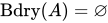
  • A set is clopen if and only if its boundary is empty.[4]
  • Any clopen set is a union of (possibly infinitely many) connected components.
  • If all connected components of are open (for instance, if has only finitely many components, or if is locally connected), then a set is clopen in if and only if it is a union of connected components.
  • A topological space is discrete if and only if all of its subsets are clopen.
  • Using the union and intersection as operations, the clopen subsets of a given topological space form a Boolean algebra. Every Boolean algebra can be obtained in this way from a suitable topological space: see Stone's representation theorem for Boolean algebras.

See also

[edit]

Notes

[edit]

References

[edit]
Revisions and contributorsEdit on WikipediaRead on Wikipedia
from Grokipedia
In topology, a clopen set (a portmanteau of "closed" and "open") is a subset of a topological space that is simultaneously both an open set and a closed set.[1] The empty set and the full space are always clopen in any topological space, as the empty set is open (by definition of a topology) and its complement (the full space) is closed, while the full space is open and its complement (the empty set) is closed.[2] Non-trivial clopen sets exist precisely when the space is disconnected; a topological space is connected if and only if its only clopen subsets are the empty set and the full space.[3] The collection of all clopen subsets of a topological space forms a Boolean algebra under the set operations of union, intersection, and complement (relative to the full space), with the empty set as the zero element and the full space as the unit element.[4] Clopen sets are central to the structure of disconnected and totally disconnected spaces: for instance, the connected components of a space are closed subsets, and in locally connected spaces, these components are open (hence clopen), partitioning the space into maximal connected pieces.[5] Moreover, a space is zero-dimensional if it has a basis for its topology consisting entirely of clopen sets, which equips the space with particularly simple separation properties and links it closely to algebraic structures like Boolean algebras via Stone duality.[6][7]

Fundamentals

Definition

In topology, a topological space consists of a set XX together with a collection τ\tau of subsets of XX, known as the open sets, satisfying the following axioms: τ\emptyset \in \tau and XτX \in \tau; τ\tau is closed under arbitrary unions; and τ\tau is closed under finite intersections.[8] This structure generalizes notions of continuity and limits beyond metric spaces, relying on basic set theory without requiring distances or orders.[8] A subset UXU \subseteq X is open if UτU \in \tau, meaning that for every point in UU, there exists an open neighborhood contained entirely within UU.[8] Equivalently, a subset CXC \subseteq X is closed if its complement XCX \setminus C is open, or if CC contains all its limit points (in spaces where limits are defined).[8] A subset CXC \subseteq X is clopen if it is both open and closed, that is, CτC \in \tau and XCτX \setminus C \in \tau.[8] This dual property highlights sets that exhibit boundary behaviors typical of both openness and closedness in the topology.[2]

Characterization

In a topological space XX, a subset CXC \subseteq X is clopen if and only if its boundary C=\partial C = \emptyset. The boundary of CC is defined as C=Cint(C)\partial C = \overline{C} \setminus \operatorname{int}(C), where C\overline{C} denotes the closure of CC and int(C)\operatorname{int}(C) denotes its interior.[9] If CC is clopen, then int(C)=C=C\operatorname{int}(C) = C = \overline{C}, which immediately implies C=\partial C = \emptyset. Conversely, if C=\partial C = \emptyset, then C=int(C)\overline{C} = \operatorname{int}(C), so CC equals its interior (hence open) and its closure (hence closed).[10] A subset CXC \subseteq X is clopen if and only if its complement XCX \setminus C is also clopen. To see this, note that the complement of any open set is closed by definition, and the complement of any closed set is open. Thus, if CC is open and closed, then XCX \setminus C is closed (as the complement of an open set) and open (as the complement of a closed set). The converse follows symmetrically.[11] Clopen sets serve as a verification tool for the topological structure of a space, particularly in assessing connectedness: a space XX is connected if and only if the only clopen subsets are \emptyset and XX itself. In this context, the existence of a non-trivial clopen set CC (neither empty nor XX) partitions XX into the disjoint clopen subsets CC and XCX \setminus C, both non-empty, thereby confirming disconnection.[9] In Hausdorff spaces, clopen sets satisfy additional constraints due to the separation properties: not every subset is clopen, and singletons are clopen precisely when the space is discrete (where every subset is open).[11]

Examples

In Metric Spaces

In the real line R\mathbb{R} equipped with the standard metric topology (induced by the absolute value metric d(x,y)=xyd(x,y) = |x - y|), the only clopen sets are the empty set \emptyset and R\mathbb{R} itself. This follows from the connectedness of R\mathbb{R}, where any non-trivial clopen set would partition the space into two nonempty disjoint open sets, contradicting connectedness.[12] For instance, the closed interval [0,1][0,1] is closed in R\mathbb{R} because its complement (,0)(1,)(-\infty,0) \cup (1,\infty) is open, but it is not open: the point 0[0,1]0 \in [0,1] has no open ball B(0,ϵ)=(ϵ,ϵ)B(0, \epsilon) = (-\epsilon, \epsilon) entirely contained in [0,1][0,1], as any such ball includes negative numbers outside the interval.[12] Similarly, open intervals like (0,1)(0,1) are open but not closed, since their boundary points 00 and 11 are limit points not included in the set. In the rational numbers Q\mathbb{Q} viewed as a subspace of R\mathbb{R} with the induced metric topology, there exist numerous non-trivial clopen sets, reflecting the total disconnectedness of Q\mathbb{Q}. A representative example is the set W={qQq<2}W = \{ q \in \mathbb{Q} \mid q < \sqrt{2} \}, which is both open and closed in Q\mathbb{Q}. It is open because W=(,2)QW = (-\infty, \sqrt{2}) \cap \mathbb{Q} and (,2)(-\infty, \sqrt{2}) is open in R\mathbb{R}; likewise, its complement in Q\mathbb{Q} is (2,)Q(\sqrt{2}, \infty) \cap \mathbb{Q}, making WW closed in the subspace. The irrationality of 2\sqrt{2} ensures no rational lies exactly on the boundary, allowing this partition. Note that Q\mathbb{Q} itself is neither open nor closed in R\mathbb{R}, as both Q\mathbb{Q} and its complement (the irrationals) are dense in R\mathbb{R}.[13] In a discrete metric space (X,d)(X, d), defined by d(x,y)=1d(x,y) = 1 if xyx \neq y and d(x,x)=0d(x,x) = 0, every subset of XX is clopen. Singletons {x}\{x\} are open, as the open ball B(x,1/2)={x}B(x, 1/2) = \{x\} is contained in {x}\{x\}; thus, every subset SXS \subseteq X is a union of such open singletons, hence open. Each subset is also closed, since its complement is open by the same reasoning. This makes the discrete topology particularly simple, with all subsets clopen regardless of the cardinality of XX.[14] In compact metric spaces such as the closed interval [0,1][0,1] with the standard metric, clopen sets are typically trivial—namely, \emptyset and [0,1][0,1] itself—due to the connectedness of the space. Any non-trivial clopen set would disconnect [0,1][0,1] into two nonempty relatively open subsets, which is impossible in a connected space. While disconnected compact metric spaces (e.g., two disjoint closed intervals) admit non-trivial clopen sets like individual components, connected examples like [0,1][0,1] or the unit circle S1S^1 exhibit only the trivial ones, underscoring the rarity of clopen sets in connected metric spaces.[15]

In Non-Metric Topologies

In certain non-metric topologies, such as those that are not induced by any metric, clopen sets can exhibit interesting behavior in totally disconnected or pathological spaces. The cofinite topology on an infinite set XX, where the open sets are the empty set and all subsets with finite complements, illustrates a contrasting pathology with limited clopen sets. The closed sets consist precisely of the finite subsets of XX and XX itself. Consequently, the complements of finite sets (cofinite sets) are open but generally not closed, as their finite complements are not open unless empty. The only clopen sets are thus the empty set and XX, underscoring the space's hyperconnected nature despite its non-Hausdorff structure.[16] Other examples of clopen sets appear in metrizable spaces under non-metric headings for illustrative purposes, but true non-metrizable cases like the cofinite topology highlight distinctions. For instance, the Cantor set, a subspace of R\mathbb{R} with the induced metric topology, is totally disconnected and compact, with a basis of clopen sets formed by finite unions of basic intervals from its ternary construction.[17] Similarly, in the p-adic numbers Qp\mathbb{Q}_p with the p-adic topology (an ultrametric space), open balls are clopen due to the strong triangle inequality.[18]

Properties

Algebraic Operations

The empty set and the entire space are always clopen in any topological space, serving as the base cases for the algebra of clopen sets.[19] The collection of all clopen subsets of a topological space forms a Boolean algebra under the operations of finite union, finite intersection, and complementation.[20] Specifically, the finite union of clopen sets is clopen because the union of open sets is open and the finite union of closed sets is closed.[21] Similarly, the finite intersection of clopen sets is clopen, as the intersection of open sets is open and the finite intersection of closed sets is closed.[21] The complement of a clopen set is also clopen, since the complement of an open set is closed and the complement of a closed set is open.[21] This closure under complementation, along with the finite union and intersection operations, ensures the structure is a Boolean lattice.[20] However, arbitrary unions or intersections of clopen sets are not necessarily clopen. For example, consider the subspace X={0}{1/nnZ+}X = \{0\} \cup \{1/n \mid n \in \mathbb{Z}^+\} of R\mathbb{R} with the standard topology; each singleton {1/n}\{1/n\} is clopen in XX, but their countable union n=1{1/n}\bigcup_{n=1}^\infty \{1/n\} is open but not closed in XX, hence not clopen.[22]

Topological Invariants

Clopen sets are preserved under homeomorphisms, meaning that if f:XYf: X \to Y is a homeomorphism between topological spaces and CXC \subseteq X is clopen, then f(C)f(C) is clopen in YY. This follows from the definition of a homeomorphism as a bicontinuous bijection: since ff is continuous, it maps open sets to open sets, so if CC is open, f(C)f(C) is open; similarly, since f1f^{-1} is continuous, ff maps closed sets to closed sets, so if CC is closed, f(C)f(C) is closed.[23] The number of connected components in a topological space provides a topological invariant related to clopen partitions. Specifically, the connected components form a partition of the space into maximal connected subsets, and under a homeomorphism, the number of such components remains unchanged because homeomorphisms preserve connectedness and disconnectedness. In spaces where the connected components are open (hence clopen, as they are also closed), this partition consists of clopen sets, and the cardinality of this partition is thus invariant.[24] A topological space is totally disconnected if its only connected subsets are singletons. In such spaces, particularly compact Hausdorff totally disconnected spaces, there exists a basis consisting of clopen sets, allowing for fine separation of points by clopen neighborhoods. For example, the Cantor space, which is compact, metrizable, perfect, and totally disconnected, admits a basis of clopen cylinder sets derived from its product topology on {0,1}N\{0,1\}^\mathbb{N}. These clopen basis elements enable the construction of dense approximations within the space via finite unions, highlighting the richness of clopen structure in totally disconnected settings.[17][25] In compact topological spaces, every clopen set is compact, as it is closed and thus inherits compactness from the ambient space. However, the converse does not hold: compact subsets need not be open (and hence not clopen) unless the space is discrete. For instance, in a compact connected space like the unit interval [0,1][0,1], finite subsets are compact but not open. This one-way relation underscores how clopen sets capture a stricter form of topological regularity in compact environments.[26]

Applications

Connected Components

In topological spaces, connected components are the maximal connected subsets, partitioning the space into disjoint, closed pieces that capture its intrinsic disconnection. These components are always closed, as the complement of a connected component is the union of the other components, each of which is closed. However, they are generally not open—and thus not clopen—in the ambient topology. A misconception arises from assuming components are clopen in the subspace topology they induce; while a component is trivially both open and closed in its own subspace topology (being the entire subspace), this does not imply it is clopen as a subset of the original space. Components become clopen subsets only under additional conditions, such as when the space is a disjoint union of open connected sets, but this does not hold merely from the space being totally disconnected.[27] Totally disconnected spaces represent the extremal case of disconnection, where every connected component is a singleton set, meaning no nontrivial subset is connected. In such spaces, the components (singletons) remain closed—assuming the space is T1T_1—but are clopen only if the singletons themselves are open, which occurs precisely when the space is discrete. The rational numbers Q\mathbb{Q}, equipped with the subspace topology inherited from R\mathbb{R}, provide a canonical example of a totally disconnected space whose singleton components are closed but not open (hence not clopen), as every nonempty open set in Q\mathbb{Q} contains infinitely many points due to the density of rationals.[5] Clopen sets play a pivotal role in analyzing the structure of totally disconnected spaces through the notion of zero-dimensionality, where the topology admits a basis of clopen sets. Any such space is totally disconnected, because for any two distinct points, there exists a clopen basis element containing one but not the other, preventing any larger connected subsets. While the converse does not hold in general—a space may be totally disconnected without a clopen basis—the presence of a clopen basis enables a partition of the space into clopen subsets that finely resolve its disconnected nature, often aligning with the component decomposition in practice. Notably, Q\mathbb{Q} is zero-dimensional, possessing a basis of clopen sets given by intersections of open real intervals with Q\mathbb{Q}; each such set (a,b)Q(a, b) \cap \mathbb{Q} (with a,bRa, b \in \mathbb{R}) is both open and closed in the subspace topology, as its complement in Q\mathbb{Q} is a union of similar clopen pieces.[28] The irrational numbers RQ\mathbb{R} \setminus \mathbb{Q}, also as a subspace of R\mathbb{R}, exemplify another totally disconnected space with singleton components that are closed but not clopen, mirroring the situation in Q\mathbb{Q}. Like the rationals, the irrationals admit a basis of clopen sets—specifically, sets of the form (a,b)(RQ)(a, b) \cap (\mathbb{R} \setminus \mathbb{Q})—which are open and closed in the subspace topology, underscoring their zero-dimensional character. This clarifies a related misconception: the connected components need not be clopen even in totally disconnected spaces with rich clopen structure; instead, clopen sets facilitate the decomposition by providing separating tools that reveal the maximal disconnected pieces without the components themselves being clopen.[29]

Quotient Spaces

In topological spaces, clopen sets are instrumental in constructing quotient spaces with desirable properties, particularly when defining equivalence relations via partitions into clopen subsets. Suppose a topological space XX admits a partition X=iICiX = \bigsqcup_{i \in I} C_i, where each CiC_i is clopen in XX. Define an equivalence relation \sim on XX by identifying all points within each CiC_i (i.e., xyx \sim y if and only if x,yCjx, y \in C_j for some jj). The quotient space X/X / \sim, equipped with the quotient topology, is then homeomorphic to the discrete space on the index set II, because the preimage under the quotient map π:XX/\pi: X \to X / \sim of each singleton {π(Ci)}\{\pi(C_i)\} is CiC_i, which is both open and closed in XX. Thus, every singleton in the quotient is clopen, rendering the topology discrete.[30] A concrete illustration arises in disconnected spaces with clopen components. Consider X=[0,1][2,3]X = [0,1] \sqcup [2,3], the topological disjoint union of two closed intervals as subspaces of R\mathbb{R}. Here, [0,1][0,1] and [2,3][2,3] form a partition into clopen subsets of XX, since each is open (as a union of basis elements from R\mathbb{R}) and closed (as the complement of the other). The quotient X/X / \sim identifying each interval to a point yields the two-point discrete space, where the quotient map is both open and closed. This construction highlights how clopen partitions simplify the topology of the resulting space.[31] Furthermore, clopen sets in XX that are saturated with respect to \sim (i.e., unions of entire equivalence classes CiC_i) map to clopen sets in the quotient. Since each CiC_i is clopen, the quotient map π\pi preserves openness and closedness for such sets: the image π(U)\pi(U) of a saturated clopen UXU \subseteq X satisfies π1(π(U))=U\pi^{-1}(\pi(U)) = U, which is clopen, implying π(U)\pi(U) is both open and closed in X/X / \sim. This preservation property ensures that structural features of clopen partitions carry over to the discrete quotient. In algebraic topology, clopen subsets facilitate quotients under group actions where orbits or fixed-point sets are clopen, yielding discrete models that aid in classifying spaces or orbifold constructions, though the core topological benefit remains the induction of discrete topologies.[31]
User Avatar
No comments yet.