



Community hub
Recent from talks
Contribute something
Nothing was collected or created yet.
Closed set
View on WikipediaIn geometry, topology, and related branches of mathematics, a closed set is a set whose complement is an open set.[1][2] In a topological space, a closed set can be defined as a set which contains all its limit points. In a complete metric space, a closed set is a set which is closed under the limit operation. This should not be confused with closed manifold.
Sets that are both open and closed are called clopen sets.
Definition
[edit]Given a topological space , the following statements are equivalent:

- a set is closed in
- is an open subset of ; that is,
- is equal to its closure in
- contains all of its limit points.
- contains all of its boundary points.


An alternative characterization of closed sets is available via sequences and nets. A subset of a topological space is closed in if and only if every limit of every net of elements of also belongs to In a first-countable space (such as a metric space), it is enough to consider only convergent sequences, instead of all nets. One value of this characterization is that it may be used as a definition in the context of convergence spaces, which are more general than topological spaces. Notice that this characterization also depends on the surrounding space because whether or not a sequence or net converges in depends on what points are present in A point in is said to be close to a subset if (or equivalently, if belongs to the closure of in the topological subspace meaning where is endowed with the subspace topology induced on it by [note 1]). Because the closure of in is thus the set of all points in that are close to this terminology allows for a plain English description of closed subsets:


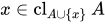


- a subset is closed if and only if it contains every point that is close to it.
In terms of net convergence, a point is close to a subset if and only if there exists some net (valued) in that converges to If is a topological subspace of some other topological space in which case is called a topological super-space of then there might exist some point in that is close to (although not an element of ), which is how it is possible for a subset to be closed in but to not be closed in the "larger" surrounding super-space If and if is any topological super-space of then is always a (potentially proper) subset of which denotes the closure of in indeed, even if is a closed subset of (which happens if and only if ), it is nevertheless still possible for to be a proper subset of However, is a closed subset of if and only if for some (or equivalently, for every) topological super-space of



Closed sets can also be used to characterize continuous functions: a map is continuous if and only if for every subset ; this can be reworded in plain English as: is continuous if and only if for every subset maps points that are close to to points that are close to Similarly, is continuous at a fixed given point if and only if whenever is close to a subset then is close to




More about closed sets
[edit]The notion of closed set is defined above in terms of open sets, a concept that makes sense for topological spaces, as well as for other spaces that carry topological structures, such as metric spaces, differentiable manifolds, uniform spaces, and gauge spaces.
Whether a set is closed depends on the space in which it is embedded. However, the compact Hausdorff spaces are "absolutely closed", in the sense that, if you embed a compact Hausdorff space in an arbitrary Hausdorff space then will always be a closed subset of ; the "surrounding space" does not matter here. Stone–Čech compactification, a process that turns a completely regular Hausdorff space into a compact Hausdorff space, may be described as adjoining limits of certain nonconvergent nets to the space.

Furthermore, every closed subset of a compact space is compact, and every compact subspace of a Hausdorff space is closed.
Closed sets also give a useful characterization of compactness: a topological space is compact if and only if every collection of nonempty closed subsets of with empty intersection admits a finite subcollection with empty intersection.
A topological space is disconnected if there exist disjoint, nonempty, open subsets and of whose union is Furthermore, is totally disconnected if it has an open basis consisting of closed sets.

Properties
[edit]A closed set contains its own boundary. In other words, if you are "outside" a closed set, you may move a small amount in any direction and still stay outside the set. This is also true if the boundary is the empty set, e.g. in the metric space of rational numbers, for the set of numbers of which the square is less than

- Any intersection of any family of closed sets is closed (this includes intersections of infinitely many closed sets)
- The union of finitely many closed sets is closed.
- The empty set is closed.
- The whole set is closed.
In fact, if given a set and a collection of subsets of such that the elements of have the properties listed above, then there exists a unique topology on such that the closed subsets of are exactly those sets that belong to The intersection property also allows one to define the closure of a set in a space which is defined as the smallest closed subset of that is a superset of Specifically, the closure of can be constructed as the intersection of all of these closed supersets.


Sets that can be constructed as the union of countably many closed sets are denoted Fσ sets. These sets need not be closed.
Examples
[edit]- The closed interval of real numbers is closed. (See Interval (mathematics) for an explanation of the bracket and parenthesis set notation.)
- The unit interval is closed in the metric space of real numbers, and the set of rational numbers between and (inclusive) is closed in the space of rational numbers, but is not closed in the real numbers.
- Some sets are neither open nor closed, for instance the half-open interval in the real numbers.
- The ray is closed.
- The Cantor set is an unusual closed set in the sense that it consists entirely of boundary points and is nowhere dense.
- Singleton points (and thus finite sets) are closed in T1 spaces and Hausdorff spaces.
- The set of integers is an infinite and unbounded closed set in the real numbers.
- If is a function between topological spaces then is continuous if and only if preimages of closed sets in are closed in
![{\displaystyle [a,b]}](https://wikimedia.org/api/rest_v1/media/math/render/svg/9c4b788fc5c637e26ee98b45f89a5c08c85f7935)
![{\displaystyle [0,1]}](https://wikimedia.org/api/rest_v1/media/math/render/svg/738f7d23bb2d9642bab520020873cccbef49768d)
![{\displaystyle [0,1]\cap \mathbb {Q} }](https://wikimedia.org/api/rest_v1/media/math/render/svg/b97119403d3148dbf45f6e697c559c2e44fce8a9)


See also
[edit]- Clopen set – Subset which is both open and closed
- Closed map – A function that sends open (resp. closed) subsets to open (resp. closed) subsets
- Closed region – Connected open subset of a topological space
- Open set – Basic subset of a topological space
- Neighbourhood – Open set containing a given point
- Region (mathematics) – Connected open subset of a topological space
- Regular closed set
Notes
[edit]Citations
[edit]- ^ Rudin, Walter (1976). Principles of Mathematical Analysis. McGraw-Hill. ISBN 0-07-054235-X.
- ^ Munkres, James R. (2000). Topology (2nd ed.). Prentice Hall. ISBN 0-13-181629-2.
References
[edit]- Dolecki, Szymon; Mynard, Frédéric (2016). Convergence Foundations Of Topology. New Jersey: World Scientific Publishing Company. ISBN 978-981-4571-52-4. OCLC 945169917.
- Dugundji, James (1966). Topology. Boston: Allyn and Bacon. ISBN 978-0-697-06889-7. OCLC 395340485.
- Schechter, Eric (1996). Handbook of Analysis and Its Foundations. San Diego, CA: Academic Press. ISBN 978-0-12-622760-4. OCLC 175294365.
- Willard, Stephen (2004) [1970]. General Topology. Mineola, N.Y.: Dover Publications. ISBN 978-0-486-43479-7. OCLC 115240.
| Fields |  | |
|---|---|---|
| Key concepts | ||
| Metrics and properties | ||
| Key results | ||


Closed set
View on GrokipediaCore Concepts
Definition
In topology, a subset of a topological space is defined as closed if its complement is open.[6] Equivalently, is closed if it contains all of its limit points.[7] A point is a limit point of if every open neighborhood of intersects at some point other than itself.[7] This condition ensures that encompasses all points that are "arbitrarily close" to it in the topological sense, without relying on distances. The definition assumes familiarity with the basic structure of topological spaces, where open sets form a collection closed under arbitrary unions and finite intersections, and neighborhoods are open sets containing a given point.[7] The concept of closed sets originated in the early 20th-century development of general topology, particularly through Felix Hausdorff's work, which generalized notions from metric spaces to abstract topological spaces.[8] In his 1914 book Grundzüge der Mengenlehre, Hausdorff introduced closed sets as foundational elements, defined axiomatically to preserve topological invariance and overcome the restrictions of metric-based approaches, such as those limited to Euclidean spaces.[8] This framework allowed for the study of continuity and convergence in broader settings.[8]Relation to Open Sets
In any topological space, the collection of closed sets forms precisely the family of complements of open sets, establishing a fundamental duality between the two concepts. Specifically, a subset of the space is closed if and only if its complement is open. This equivalence arises directly from the definition of a topological space, where the open sets satisfy the axioms of including the empty set and the whole space, being closed under arbitrary unions, and closed under finite intersections; the corresponding properties for closed sets—containing the empty set and whole space, closed under arbitrary intersections, and closed under finite unions—follow by taking complements.[9] This duality ensures that the topology is inherently closed under complements, meaning that the complement of any open set is closed and vice versa, which is a key structural axiom underpinning the theory of topological spaces.[9] A special case of this duality occurs with clopen sets, which are subsets that are simultaneously open and closed. The empty set and the entire space are always clopen in any topological space, as their complements are each other and both satisfy the openness axioms. In general, clopen sets represent partitions that respect the topology without boundaries in the open-closed sense.[9] In connected topological spaces, this duality takes on added significance: the only clopen sets are and itself. A space is connected if it cannot be expressed as the union of two nonempty disjoint open sets, which equivalently means it admits no nontrivial clopen subsets; any proper nonempty clopen set would disconnect the space by serving as both an open and closed partition.[10] This uniqueness highlights the role of connectedness in restricting the duality's manifestations. The open-closed duality also lays the groundwork for concepts like the interior and boundary of a set, where the interior is the largest open subset contained within it, and the boundary can be intuitively viewed as the difference between the closure (the smallest closed set containing it) and the interior, though these are explored further elsewhere. This relation reinforces the symmetric framework of topology, allowing proofs and properties to be dualized by complementation.[9]Properties
Set Operations
In topological spaces, closed sets exhibit specific algebraic properties under set operations, forming a family that is stable under certain unions and intersections. The collection of all closed sets in a topological space is closed under arbitrary intersections and finite unions, meaning the result of such an operation remains closed. This stability arises from the duality between closed sets and open sets, where a set is closed if and only if its complement is open.[3] The intersection of any collection of closed sets, whether finite or infinite, is itself closed. To see this, suppose is an arbitrary family of closed subsets of . Then the complements are open sets. The complement of the intersection is given by which is open as an arbitrary union of open sets. Therefore, is closed.[3][11] In contrast, the union of finitely many closed sets is closed, but arbitrary (infinite) unions need not be. For a finite collection of closed sets, the complements are open, and the complement of the union is a finite intersection of open sets, which is open. Thus, is closed. However, in spaces such as the real numbers with the standard topology, an infinite union of closed sets may fail to be closed.[3][11] These properties distinguish closed sets from open sets, which are instead closed under arbitrary unions but only finite intersections.[3]Closure Operator
In a topological space , the closure of a subset , denoted or , is defined as the intersection of all closed sets in that contain . This makes the smallest closed set containing with respect to inclusion. Equivalently, , where is the set of all limit points of . The closure operator satisfies three fundamental properties: it is extensive, idempotent, and monotonic. Extensiveness: For any , .Proof: By definition, is the intersection of all closed sets containing . Each such closed set contains , so their intersection also contains . Thus, .[8] Monotonicity: If , then .
Proof: The family of closed sets containing is a subfamily of the family of closed sets containing , since any closed set containing also contains . The intersection over a smaller family yields a larger or equal set, so .[8] Idempotence: For any , .
Proof: First, by extensiveness. For the reverse inclusion, note that is closed (as an intersection of closed sets) and contains , so it is one of the closed sets in the intersection defining . Thus, , since is the smallest closed set containing , and is already closed and contains itself. Combining both directions gives equality.[8] A subset is closed if and only if . If is closed, then by the definition of closure as the smallest closed set containing . Conversely, if , then equals its closure, which is always closed as an intersection of closed sets, so is closed. The closure operator in a topological space satisfies the Kuratowski closure axioms, which provide a complete axiomatic characterization. These four axioms, formulated by Kazimierz Kuratowski, are:
- (the empty set has empty closure).
- for all (extensiveness).
- for all (idempotence).
- for all (additivity).
Any operator satisfying these axioms defines a unique topology on via the closed sets as the fixed points of the operator (sets with ). Monotonicity follows as a theorem from axioms 2 and 4.