



Community hub
Recent from talks
Contribute something
Nothing was collected or created yet.
Chern class
View on WikipediaIn mathematics, in particular in algebraic topology, differential geometry and algebraic geometry, the Chern classes are characteristic classes associated with complex vector bundles. They have since become fundamental concepts in many branches of mathematics and physics, such as string theory, Chern–Simons theory, knot theory, and Gromov–Witten invariants. Chern classes were introduced by Shiing-Shen Chern (1946).
Geometric approach
[edit]Basic idea and motivation
[edit]Chern classes are characteristic classes. They are topological invariants associated with vector bundles on a smooth manifold. The question of whether two ostensibly different vector bundles are the same can be quite hard to answer. The Chern classes provide a simple test: if the Chern classes of a pair of vector bundles do not agree, then the vector bundles are different. The converse, however, is not true.
In topology, differential geometry, and algebraic geometry, it is often important to count how many linearly independent sections a vector bundle has. The Chern classes offer some information about this through, for instance, the Riemann–Roch theorem and the Atiyah–Singer index theorem.
Chern classes are also feasible to calculate in practice. In differential geometry (and some types of algebraic geometry), the Chern classes can be expressed as polynomials in the coefficients of the curvature form.
Construction
[edit]There are various ways of approaching the subject, each of which focuses on a slightly different flavor of Chern class.
The original approach to Chern classes was via algebraic topology: the Chern classes arise via homotopy theory which provides a mapping associated with a vector bundle to a classifying space (an infinite Grassmannian in this case). For any complex vector bundle V over a manifold M, there exists a map f from M to the classifying space such that the bundle V is equal to the pullback, by f, of a universal bundle over the classifying space, and the Chern classes of V can therefore be defined as the pullback of the Chern classes of the universal bundle. In turn, these universal Chern classes can be explicitly written down in terms of Schubert cycles.
It can be shown that for any two maps f, g from M to the classifying space whose pullbacks are the same bundle V, the maps must be homotopic. Therefore, the pullback by either f or g of any universal Chern class to a cohomology class of M must be the same class. This shows that the Chern classes of V are well-defined.
Chern's approach used differential geometry, via the curvature approach described predominantly in this article. He showed that the earlier definition was in fact equivalent to his. The resulting theory is known as the Chern–Weil theory.
There is also an approach of Alexander Grothendieck showing that axiomatically one need only define the line bundle case.
Chern classes arise naturally in algebraic geometry. The generalized Chern classes in algebraic geometry can be defined for vector bundles (or more precisely, locally free sheaves) over any nonsingular variety. Algebro-geometric Chern classes do not require the underlying field to have any special properties. In particular, the vector bundles need not necessarily be complex.
Regardless of the particular paradigm, the intuitive meaning of the Chern class concerns 'required zeroes' of a section of a vector bundle: for example the theorem saying one can't comb a hairy ball flat (hairy ball theorem). Although that is strictly speaking a question about a real vector bundle (the "hairs" on a ball are actually copies of the real line), there are generalizations in which the hairs are complex (see the example of the complex hairy ball theorem below), or for 1-dimensional projective spaces over many other fields.
See Chern–Simons theory for more discussion.
The Chern class of line bundles
[edit](Let X be a topological space having the homotopy type of a CW complex.)
An important special case occurs when V is a line bundle. Then the only nontrivial Chern class is the first Chern class, which is an element of the second cohomology group of X. As it is the top Chern class, it equals the Euler class of the bundle.
The first Chern class turns out to be a complete invariant with which to classify complex line bundles, topologically speaking. That is, there is a bijection between the isomorphism classes of line bundles over X and the elements of , which associates to a line bundle its first Chern class. Moreover, this bijection is a group homomorphism (thus an isomorphism): the tensor product of complex line bundles corresponds to the addition in the second cohomology group.[1][2]


In algebraic geometry, this classification of (isomorphism classes of) complex line bundles by the first Chern class is a crude approximation to the classification of (isomorphism classes of) holomorphic line bundles by linear equivalence classes of divisors.
For complex vector bundles of dimension greater than one, the Chern classes are not a complete invariant.
Constructions
[edit]Via the Chern–Weil theory
[edit]Given a complex hermitian vector bundle V of complex rank n over a smooth manifold M, representatives of each Chern class (also called a Chern form) of V are given as the coefficients of the characteristic polynomial of the curvature form of V.


The determinant is over the ring of matrices whose entries are polynomials in t with coefficients in the commutative algebra of even-degree complex differential forms on M. The curvature form of V is defined as with ω the connection form and d the exterior derivative, or via the same expression in which ω is a gauge field for the gauge group of V. The scalar t is used here only as an indeterminate to generate the sum from the determinant, and I denotes the n × n identity matrix.

![{\displaystyle \Omega =d\omega +{\frac {1}{2}}[\omega ,\omega ]}](https://wikimedia.org/api/rest_v1/media/math/render/svg/c2f7c4659b6e7352c32510a81c0d9f8afdeab74e)
To say that the expression given is a representative of the Chern class indicates that 'class' here means up to addition of an exact differential form. That is, Chern classes are cohomology classes in the sense of de Rham cohomology. It can be shown that the cohomology classes of the Chern forms do not depend on the choice of connection in V.
If follows from the matrix identity that . Now applying the Maclaurin series for , we get the following expression for the Chern forms:



![{\displaystyle \sum _{k}c_{k}(V)t^{k}=\left[1+i{\frac {\mathrm {tr} (\Omega )}{2\pi }}t+{\frac {\mathrm {tr} (\Omega ^{2})-\mathrm {tr} (\Omega )^{2}}{8\pi ^{2}}}t^{2}+i{\frac {-2\mathrm {tr} (\Omega ^{3})+3\mathrm {tr} (\Omega ^{2})\mathrm {tr} (\Omega )-\mathrm {tr} (\Omega )^{3}}{48\pi ^{3}}}t^{3}+\cdots \right].}](https://wikimedia.org/api/rest_v1/media/math/render/svg/665e6b590402d49117e2ea870d5df279e1d89ef1)
Via an Euler class
[edit]One can define a Chern class in terms of an Euler class. This is the approach in the book by Milnor and Stasheff, and emphasizes the role of an orientation of a vector bundle.
The basic observation is that a complex vector bundle comes with a canonical orientation, ultimately because is connected. Hence, one simply defines the top Chern class of the bundle to be its Euler class (the Euler class of the underlying real vector bundle) and handles lower Chern classes in an inductive fashion.

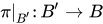
The precise construction is as follows. The idea is to do base change to get a bundle of one-less rank. Let be a complex vector bundle over a paracompact space B. Thinking of B as being embedded in E as the zero section, let and define the new vector bundle: such that each fiber is the quotient of a fiber F of E by the line spanned by a nonzero vector v in F (a point of B′ is specified by a fiber F of E and a nonzero vector on F.)[3] Then has rank one less than that of E. From the Gysin sequence for the fiber bundle : we see that is an isomorphism for . Let





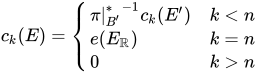
It then takes some work to check the axioms of Chern classes are satisfied for this definition.
See also: The Thom isomorphism.
Examples
[edit]The complex tangent bundle of the Riemann sphere
[edit]Let be the Riemann sphere: 1-dimensional complex projective space. Suppose that z is a holomorphic local coordinate for the Riemann sphere. Let be the bundle of complex tangent vectors having the form at each point, where a is a complex number. We prove the complex version of the hairy ball theorem: V has no section which is everywhere nonzero.


For this, we need the following fact: the first Chern class of a trivial bundle is zero, i.e.,

This is evinced by the fact that a trivial bundle always admits a flat connection. So, we shall show that

Consider the Kähler metric
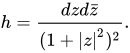
One readily shows that the curvature 2-form is given by
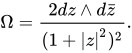
Furthermore, by the definition of the first Chern class
![{\displaystyle c_{1}=\left[{\frac {i}{2\pi }}\operatorname {tr} \Omega \right].}](https://wikimedia.org/api/rest_v1/media/math/render/svg/55b51326e739a3dc716d0f6d9e0d5d095d6c3fe8)
We must show that this cohomology class is non-zero. It suffices to compute its integral over the Riemann sphere: after switching to polar coordinates. By Stokes' theorem, an exact form would integrate to 0, so the cohomology class is nonzero.
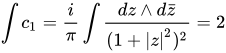
This proves that is not a trivial vector bundle.

Complex projective space
[edit]There is an exact sequence of sheaves/bundles:[4] where is the structure sheaf (i.e., the trivial line bundle), is Serre's twisting sheaf (i.e., the hyperplane bundle) and the last nonzero term is the tangent sheaf/bundle.



There are two ways to get the above sequence:
- [5] Let be the coordinates of let be the canonical projection, and let . Then we have:
In other words, the cotangent sheaf , which is a free -module with basis , fits into the exact sequence
where are the basis of the middle term. The same sequence is clearly then exact on the whole projective space and the dual of it is the aforementioned sequence. - Let L be a line in that passes through the origin. It is an exercise in elementary geometry to see that the complex tangent space to at the point L is naturally the set of linear maps from L to its complement. Thus, the tangent bundle can be identified with the hom bundle where η is the vector bundle such that . It follows:












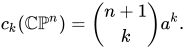
By the additivity of total Chern class (i.e., the Whitney sum formula), where a is the canonical generator of the cohomology group ; i.e., the negative of the first Chern class of the tautological line bundle (note: when is the dual of E.)






In particular, for any ,

Chern polynomial
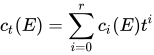
[edit]A Chern polynomial is a convenient way to handle Chern classes and related notions systematically. By definition, for a complex vector bundle E, the Chern polynomial ct of E is given by:

This is not a new invariant: the formal variable t simply keeps track of the degree of ck(E).[6] In particular, is completely determined by the total Chern class of E: and conversely.


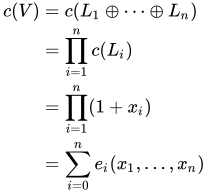
The Whitney sum formula, one of the axioms of Chern classes (see below), says that ct is additive in the sense: Now, if is a direct sum of (complex) line bundles, then it follows from the sum formula that: where are the first Chern classes. The roots , called the Chern roots of E, determine the coefficients of the polynomial: i.e., where σk are elementary symmetric polynomials. In other words, thinking of ai as formal variables, ck "are" σk. A basic fact on symmetric polynomials is that any symmetric polynomial in, say, ti's is a polynomial in elementary symmetric polynomials in ti's. Either by splitting principle or by ring theory, any Chern polynomial factorizes into linear factors after enlarging the cohomology ring; E need not be a direct sum of line bundles in the preceding discussion. The conclusion is






Example: We have polynomials sk with and so on (cf. Newton's identities). The sum is called the Chern character of E, whose first few terms are: (we drop E from writing.)




Example: The Todd class of E is given by:

Remark: The observation that a Chern class is essentially an elementary symmetric polynomial can be used to "define" Chern classes. Let Gn be the infinite Grassmannian of n-dimensional complex vector spaces. This space is equipped with a tautologous vector bundle of rank , say . is called the classifying space for rank- vector bundles because given any complex vector bundle E of rank n over X, there is a continuous map such that the pullback of to along is isomorphic to , and this map is unique up to homotopy. Borel's theorem says the cohomology ring of Gn is exactly the ring of symmetric polynomials, which are polynomials in elementary symmetric polynomials σk; so, the pullback of fE reads: One then puts:





![{\displaystyle f_{E}^{*}:\mathbb {Z} [\sigma _{1},\ldots ,\sigma _{n}]\to H^{*}(X,\mathbb {Z} ).}](https://wikimedia.org/api/rest_v1/media/math/render/svg/01756308bbe78178bd49f25f1e5e2aa297e0c025)

Remark: Any characteristic class is a polynomial in Chern classes, for the reason as follows. Let be the contravariant functor that, to a CW complex X, assigns the set of isomorphism classes of complex vector bundles of rank n over X and, to a map, its pullback. By definition, a characteristic class is a natural transformation from to the cohomology functor Characteristic classes form a ring because of the ring structure of cohomology ring. Yoneda's lemma says this ring of characteristic classes is exactly the cohomology ring of Gn:

![{\displaystyle \operatorname {Vect} _{n}^{\mathbb {C} }=[-,G_{n}]}](https://wikimedia.org/api/rest_v1/media/math/render/svg/a335e563799383694e3073de608043b248286367)

![{\displaystyle \operatorname {Nat} ([-,G_{n}],H^{*}(-,\mathbb {Z} ))=H^{*}(G_{n},\mathbb {Z} )=\mathbb {Z} [\sigma _{1},\ldots ,\sigma _{n}].}](https://wikimedia.org/api/rest_v1/media/math/render/svg/c796a5ea1c5c3e24fabeb95c5cfeef9d7c66150e)
Computation formulae
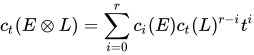
[edit]Let E be a vector bundle of rank r and the Chern polynomial of it.
- For the dual bundle of , .[7]
- If L is a line bundle, then[8][9] and so are
- For the Chern roots of ,[10] In particular,
- For example,[11] for ,
- when ,
- when ,




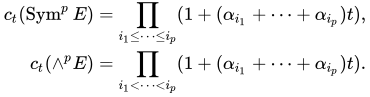






- (cf. Segre class#Example 2.)
Applications of formulae
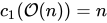
[edit]We can use these abstract properties to compute the rest of the chern classes of line bundles on . Recall that showing . Then using tensor powers, we can relate them to the chern classes of for any integer.


Properties
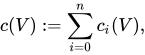
[edit]Given a complex vector bundle E over a topological space X, the Chern classes of E are a sequence of elements of the cohomology of X. The k-th Chern class of E, which is usually denoted ck(E), is an element of the cohomology of X with integer coefficients. One can also define the total Chern class


Since the values are in integral cohomology groups, rather than cohomology with real coefficients, these Chern classes are slightly more refined than those in the Riemannian example.[clarification needed]
Classical axiomatic definition
[edit]The Chern classes satisfy the following four axioms:
- for all E.
- Naturality: If is continuous and f*E is the vector bundle pullback of E, then .
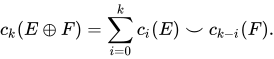
- Whitney sum formula: If is another complex vector bundle, then the Chern classes of the direct sum are given by that is,
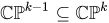
- Normalization: The total Chern class of the tautological line bundle over is 1−H, where H is Poincaré dual to the hyperplane .







Grothendieck axiomatic approach
[edit]Alternatively, Alexander Grothendieck (1958) replaced these with a slightly smaller set of axioms:
- Naturality: (Same as above)
- Additivity: If is an exact sequence of vector bundles, then .
- Normalization: If E is a line bundle, then where is the Euler class of the underlying real vector bundle.




He shows using the Leray–Hirsch theorem that the total Chern class of an arbitrary finite rank complex vector bundle can be defined in terms of the first Chern class of a tautologically defined line bundle.
Namely, introducing the projectivization of the rank n complex vector bundle E → B as the fiber bundle on B whose fiber at any point is the projective space of the fiber Eb. The total space of this bundle is equipped with its tautological complex line bundle, that we denote , and the first Chern class restricts on each fiber to minus the (Poincaré-dual) class of the hyperplane, that spans the cohomology of the fiber, in view of the cohomology of complex projective spaces.


The classes therefore form a family of ambient cohomology classes restricting to a basis of the cohomology of the fiber. The Leray–Hirsch theorem then states that any class in can be written uniquely as a linear combination of the 1, a, a2, ..., an−1 with classes on the base as coefficients.


In particular, one may define the Chern classes of E in the sense of Grothendieck, denoted by expanding this way the class , with the relation:



One then may check that this alternative definition coincides with whatever other definition one may favor, or use the previous axiomatic characterization.
The top Chern class
[edit]In fact, these properties uniquely characterize the Chern classes. They imply, among other things:
- If n is the complex rank of V, then for all k > n. Thus the total Chern class terminates.
- The top Chern class of V (meaning , where n is the rank of V) is always equal to the Euler class of the underlying real vector bundle.


In algebraic geometry
[edit]Axiomatic description
[edit]There is another construction of Chern classes which take values in the algebrogeometric analogue of the cohomology ring, the Chow ring.
Let be a nonsingular quasi-projective variety of dimension . It can be shown that there is a unique theory of Chern classes which assigns an algebraic vector bundle to elements called Chern classes, with Chern polynomial , satisfying the following (similar to Grothendieck's axiomatic approach). [12]

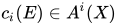

- If for a Cartier divisor , we have , then .
- If is a morphism, then .
- If is an exact sequence of vector bundles on , the Whitney sum formula holds: .


Normal sequence
[edit]Computing the characteristic classes for projective space forms the basis for many characteristic class computations since for any smooth projective subvariety there is the short exact sequence


Quintic threefold
[edit]For example, consider a nonsingular quintic threefold in . Its normal bundle is given by and we have the short exact sequence



Let denote the hyperplane class in . Then the Whitney sum formula gives us that



Since the Chow ring of a hypersurface is difficult to compute, we will consider this sequence as a sequence of coherent sheaves in . This gives us that
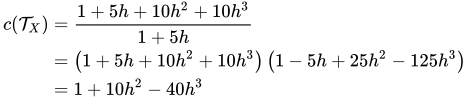
Using the Gauss-Bonnet theorem we can integrate the class to compute the Euler characteristic. Traditionally this is called the Euler class. This is since the class of can be represented by five points (by Bézout's theorem). The Euler characteristic can then be used to compute the Betti numbers for the cohomology of by using the definition of the Euler characteristic and using the Lefschetz hyperplane theorem.

![{\displaystyle \int _{[X]}c_{3}({\mathcal {T}}_{X})=\int _{[X]}-40h^{3}=-200}](https://wikimedia.org/api/rest_v1/media/math/render/svg/1cc53a6bd8f1db3ed43036979c121c553109d53b)

Degree d hypersurfaces
[edit]If is a degree smooth hypersurface, we have the short exact sequence giving the relation we can then calculate this as Giving the total chern class. In particular, we can find is a spin 4-manifold if is even, so every smooth hypersurface of degree is a spin manifold.



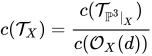
![{\displaystyle {\begin{aligned}c({\mathcal {T}}_{X})&={\frac {(1+[H])^{4}}{(1+d[H])}}\\&=(1+4[H]+6[H]^{2})(1-d[H]+d^{2}[H]^{2})\\&=1+(4-d)[H]+(6-4d+d^{2})[H]^{2}\end{aligned}}}](https://wikimedia.org/api/rest_v1/media/math/render/svg/ca2779c48dbc64c5414a4da97c9f9941accadf3a)


Proximate notions
[edit]The Chern character
[edit]Chern classes can be used to construct a homomorphism of rings from the topological K-theory of a space to (the completion of) its rational cohomology. For a line bundle L, the Chern character ch is defined by

More generally, if is a direct sum of line bundles, with first Chern classes the Chern character is defined additively



This can be rewritten as:[13]

This last expression, justified by invoking the splitting principle, is taken as the definition ch(V) for arbitrary vector bundles V.
If a connection is used to define the Chern classes when the base is a manifold (i.e., the Chern–Weil theory), then the explicit form of the Chern character is where Ω is the curvature of the connection.
![{\displaystyle \operatorname {ch} (V)=\left[\operatorname {tr} \left(\exp \left({\frac {i\Omega }{2\pi }}\right)\right)\right]}](https://wikimedia.org/api/rest_v1/media/math/render/svg/2473fa0b260fc2463468e8b3984a178804ba7ccf)
The Chern character is useful in part because it facilitates the computation of the Chern class of a tensor product. Specifically, it obeys the following identities:


As stated above, using the Grothendieck additivity axiom for Chern classes, the first of these identities can be generalized to state that ch is a homomorphism of abelian groups from the K-theory K(X) into the rational cohomology of X. The second identity establishes the fact that this homomorphism also respects products in K(X), and so ch is a homomorphism of rings.
The Chern character is used in the Hirzebruch–Riemann–Roch theorem.
Chern numbers
[edit]If we work on an oriented manifold of dimension , then any product of Chern classes of total degree (i.e., the sum of indices of the Chern classes in the product should be ) can be paired with the orientation homology class (or "integrated over the manifold") to give an integer, a Chern number of the vector bundle. For example, if the manifold has dimension 6, there are three linearly independent Chern numbers, given by , , and . In general, if the manifold has dimension , the number of possible independent Chern numbers is the number of partitions of .


The Chern numbers of the tangent bundle of a complex (or almost complex) manifold are called the Chern numbers of the manifold, and are important invariants.
Generalized cohomology theories
[edit]There is a generalization of the theory of Chern classes, where ordinary cohomology is replaced with a generalized cohomology theory. The theories for which such generalization is possible are called complex orientable. The formal properties of the Chern classes remain the same, with one crucial difference: the rule which computes the first Chern class of a tensor product of line bundles in terms of first Chern classes of the factors is not (ordinary) addition, but rather a formal group law.
Algebraic geometry
[edit]In algebraic geometry there is a similar theory of Chern classes of vector bundles. There are several variations depending on what groups the Chern classes lie in:
- For complex varieties the Chern classes can take values in ordinary cohomology, as above.
- For varieties over general fields, the Chern classes can take values in cohomology theories such as etale cohomology or l-adic cohomology.
- For varieties V over general fields the Chern classes can also take values in homomorphisms of Chow groups CH(V): for example, the first Chern class of a line bundle over a variety V is a homomorphism from CH(V) to CH(V) reducing degrees by 1. This corresponds to the fact that the Chow groups are a sort of analog of homology groups, and elements of cohomology groups can be thought of as homomorphisms of homology groups using the cap product.
Manifolds with structure
[edit]The theory of Chern classes gives rise to cobordism invariants for almost complex manifolds.
If M is an almost complex manifold, then its tangent bundle is a complex vector bundle. The Chern classes of M are thus defined to be the Chern classes of its tangent bundle. If M is also compact and of dimension 2d, then each monomial of total degree 2d in the Chern classes can be paired with the fundamental class of M, giving an integer, a Chern number of M. If M′ is another almost complex manifold of the same dimension, then it is cobordant to M if and only if the Chern numbers of M′ coincide with those of M.
The theory also extends to real symplectic vector bundles, by the intermediation of compatible almost complex structures. In particular, symplectic manifolds have a well-defined Chern class.
Arithmetic schemes and Diophantine equations
[edit](See Arakelov geometry)
See also
[edit]Notes
[edit]- ^ Bott, Raoul; Tu, Loring (1995). Differential forms in algebraic topology (Corr. 3. print. ed.). New York [u.a.]: Springer. p. 267ff. ISBN 3-540-90613-4.
- ^ Hatcher, Allen. "Vector Bundles and K-theory" (PDF). Proposition 3.10.
- ^ Editorial note: Our notation differs from Milnor−Stasheff, but seems more natural.
- ^ The sequence is sometimes called the Euler sequence.
- ^ Hartshorne, Ch. II. Theorem 8.13.
- ^ In a ring-theoretic term, there is an isomorphism of graded rings: where the left is the cohomology ring of even terms, η is a ring homomorphism that disregards grading and x is homogeneous and has degree |x|.
- ^ Fulton, Remark 3.2.3. (a)
- ^ Fulton, Remark 3.2.3. (b)
- ^ Fulton, Example 3.2.2.
- ^ Fulton, Remark 3.2.3. (c)
- ^ Use, for example, WolframAlpha to expand the polynomial and then use the fact are elementary symmetric polynomials in 's.
- ^ Hartshorne, Appendix A. 3 Chern Classes.
- ^ (See also § Chern polynomial.) Observe that when V is a sum of line bundles, the Chern classes of V can be expressed as elementary symmetric polynomials in the , In particular, on the one hand while on the other hand Consequently, Newton's identities may be used to re-express the power sums in ch(V) above solely in terms of the Chern classes of V, giving the claimed formula.
![{\displaystyle H^{2*}(M,\mathbb {Z} )\to \oplus _{k}^{\infty }\eta (H^{2*}(M,\mathbb {Z} ))[t],x\mapsto xt^{|x|/2}}](https://wikimedia.org/api/rest_v1/media/math/render/svg/2dd6eaeedff045ca1d0fe892e1e494984372baa2)



References
[edit]- Chern, Shiing-Shen (1946), "Characteristic classes of Hermitian Manifolds", Annals of Mathematics, Second Series, 47 (1): 85–121, doi:10.2307/1969037, ISSN 0003-486X, JSTOR 1969037
- Fulton, W. (29 June 2013). Intersection Theory. Springer Science & Business Media. ISBN 978-3-662-02421-8.
- Grothendieck, Alexander (1958), "La théorie des classes de Chern", Bulletin de la Société Mathématique de France, 86: 137–154, doi:10.24033/bsmf.1501, ISSN 0037-9484, MR 0116023
- Hartshorne, Robin (29 June 2013). Algebraic Geometry. Springer Science & Business Media. ISBN 978-1-4757-3849-0.
- Jost, Jürgen (2005), Riemannian Geometry and Geometric Analysis (4th ed.), Springer-Verlag, ISBN 978-3-540-25907-7 (Provides a very short, introductory review of Chern classes).
- May, J. Peter (1999), A Concise Course in Algebraic Topology, University of Chicago Press, ISBN 9780226511832
- Milnor, John Willard; Stasheff, James D. (1974), Characteristic classes, Annals of Mathematics Studies, vol. 76, Princeton University Press; University of Tokyo Press, ISBN 978-0-691-08122-9
- Rubei, Elena (2014), Algebraic Geometry, a concise dictionary, Walter De Gruyter, ISBN 978-3-11-031622-3
External links
[edit]- Vector Bundles & K-Theory – A downloadable book-in-progress by Allen Hatcher. Contains a chapter about characteristic classes.
- Dieter Kotschick, Chern numbers of algebraic varieties
| Fields |  | |
|---|---|---|
| Key concepts | ||
| Metrics and properties | ||
| Key results | ||


| National | |
|---|---|
| Other | |

Chern class
View on GrokipediaFundamentals
Basic Idea and Motivation
Chern classes were introduced by Shiing-Shen Chern in 1946 as characteristic classes for Hermitian manifolds, providing a means to generalize the Euler class from oriented real vector bundles to the complex setting.[2] This development addressed the need to capture topological invariants of complex structures, where the Euler class alone proved insufficient for describing the full range of obstructions in higher-dimensional complex bundles.[7] Intuitively, Chern classes serve as topological measures of the "twisting" or non-triviality in complex vector bundles, linking local holomorphic or geometric data to global topological features. They detect obstructions to the existence of non-vanishing sections, much like how the Euler class identifies zeros of generic sections in oriented real bundles, but extended to encode the complex linear algebra underlying the bundle's fibers.[7] For instance, the top Chern class of a complex bundle coincides with the Euler class of its underlying real oriented bundle, offering a direct analogy to the Euler characteristic, which quantifies orientability and section zeros on manifolds.[7] A key motivation arises from differential geometry, where Chern classes preview the role of connections on bundles: they can be represented by closed differential forms derived from the curvature of such connections, bridging local metric properties with topological invariants without relying on explicit computations.[7] This connection highlights their utility in studying how infinitesimal geometric data, like curvature, aggregates to global topological obstructions in complex geometries.[2] As the simplest case, line bundles illustrate this by having a single non-trivial Chern class that classifies their isomorphism types topologically.[7]Chern Classes of Line Bundles
The first Chern class of a complex line bundle over a smooth manifold is the cohomology class in represented by , where is a local section of . This expression arises from the Čech-de Rham cohomology associated to the transition functions of , viewed as a principal -bundle. The class is independent of the choice of local section or trivialization of , as changes in section correspond to multiplication by a nowhere-vanishing function, whose logarithm contributes an exact form to the cohomology class. Equivalently, in topological terms, equals the Euler class of the underlying oriented real 2-plane bundle .[8] For a holomorphic line bundle over a complex manifold , the first Chern class satisfies , where is a meromorphic section of and denotes the cohomology class of its divisor (zeros minus poles).[9] The trivial line bundle has , as it admits a global nowhere-vanishing section with vanishing divisor.[8] For the tautological line bundle on , , where is the positive generator of (the hyperplane class).[8] Since , its pairing with any 2-cycle in yields an integer.[8]Constructions
Chern–Weil Theory
Chern–Weil theory is a fundamental construction in differential geometry and mathematical physics that associates topological invariants of vector and principal bundles on smooth manifolds to de Rham cohomology classes using connections and curvature forms, developed by Shiing-Shen Chern and André Weil in the late 1940s.[10] The Chern–Weil theory constructs the Chern classes of a complex vector bundle through the geometry of connections and their curvatures. For a smooth complex vector bundle of rank over a smooth manifold , let be a connection on . In a local trivialization, is represented by a -valued 1-form , and the curvature form is the -valued 2-form This curvature measures the failure of to be flat and lies in the space of endomorphism-valued 2-forms globally.[11][12] The total Chern form associated to is defined as the determinant where denotes the identity endomorphism, and each component is a closed -form on . These components arise from the expansion of the determinant in terms of the eigenvalues of , using elementary symmetric polynomials. Equivalently, the Chern forms can be represented using traces of powers of the curvature, where the -th Chern form involves terms like , adjusted via Newton identities to match the symmetric polynomial structure.[11][12] The de Rham cohomology classes are independent of the choice of connection , as the difference is an exact form for any two connections and on . This invariance follows from the fact that the curvature difference corresponds to the Maurer–Cartan structure equation, making the Chern classes topological invariants of the bundle. The normalization by the factor ensures that these classes are integral, lying in the image of the map .[11][12]Axiomatic Approaches
One of the foundational ways to define Chern classes is through an axiomatic characterization that specifies their behavior as natural transformations from the category of complex vector bundles to cohomology groups. In the classical topological setting, Friedrich Hirzebruch provided such a characterization for complex vector bundles over paracompact Hausdorff spaces equipped with integer cohomology .[13] The total Chern class , where , is required to satisfy three key axioms:- Naturality: For any continuous map , the induced map on cohomology pulls back the Chern classes compatibly, i.e., .
- Whitney sum formula: The Chern class is multiplicative under direct sums, , where denotes the cup product in cohomology.
- Normalization: The Chern class of the trivial bundle of rank is the unit , and for the tautological line bundle over , generates negatively.[13]
Properties
General Properties
The total Chern class of a complex vector bundle over a topological space is defined as , where is the rank of and for .[16] This total class is multiplicative under direct sums: for bundles and over , .[16] The individual Chern classes satisfy the Whitney sum formula, , with .[3] Chern classes exhibit functoriality with respect to bundle maps and pullbacks. If is a continuous map and is a complex vector bundle over , then the pullback bundle over satisfies , meaning each .[17] This naturality ensures that Chern classes are well-defined characteristic classes compatible with base change.[18] The splitting principle provides a powerful tool for computations: for any complex vector bundle of rank over , there exists a map to a flag manifold (such as a product of projective spaces) such that splits as a direct sum of line bundles over , and .[16] Consequently, the total Chern class of can be expressed formally as , where the are the formal Chern roots satisfying the symmetric polynomial relations for the elementary symmetric functions in the .[3] This virtual splitting reduces general properties to those of line bundles without altering the ring structure of the cohomology.[19]Top Chern Class
For a complex vector bundle of rank over a space , the top Chern class is the unique component in of the total Chern class .[16] This class coincides with the Euler class of the underlying oriented real vector bundle of rank , up to sign convention, providing a direct link between complex and oriented real characteristic classes.[8] The identification follows from the naturality of both classes and their agreement on line bundles, extended via the splitting principle.[16] Geometrically, represents the Poincaré dual of the homology class of the zero locus of a generic section of , assuming transversality to the zero section; this locus is a closed submanifold of codimension whose fundamental class pairs with cycles to yield intersection numbers determined by .[8] For the tangent bundle of a compact complex -manifold , the pairing equals the Euler characteristic , reflecting the topological invariant via the index of the zero set of a generic holomorphic vector field.[20] This integrality arises from the cohomological definition and the fact that counts signed zeros of sections, consistent with Poincaré duality.[20] The top Chern class vanishes, , if and only if admits a nowhere-zero section, as such a section trivializes the obstruction class in the cohomology group.[8] In terms of other characteristic classes, the Segre classes are defined via the formal inverse of the total Chern class, , so that higher Segre classes incorporate in their expansion through multiplicative relations in the cohomology ring.[16] The Whitney sum formula extends to the top class by setting for , yielding for compatible ranks.[16]Examples
Complex Projective Spaces
The tangent bundle of the complex projective space provides a fundamental example for computing Chern classes, as it arises from a short exact sequence of holomorphic vector bundles known as the Euler sequence:Here, denotes the trivial line bundle, and is the hyperplane line bundle (dual to the tautological line bundle) with first Chern class , the positive generator of .[21][22] Since the Euler sequence is an extension of vector bundles, the total Chern class of the tangent bundle is determined by the multiplicativity of Chern classes: . The trivial bundle has total Chern class 1, while the direct sum of copies of has total Chern class by the Whitney sum formula. Thus,
This formula holds in the cohomology ring .[8][21] Expanding the binomial, the individual Chern classes are
for , with and for . In particular, the first Chern class is , reflecting the degree of the bundle, and the top Chern class is .[8] The integral of the top Chern class over gives the Euler characteristic:
since the fundamental class satisfies . This result aligns with the topological Euler characteristic of , computed via its cell decomposition or otherwise as .[8][21] This computation exemplifies the Chern-Gauss-Bonnet theorem, which equates the Euler characteristic of an even-dimensional oriented Riemannian manifold to the integral of a characteristic form built from the curvature; for complex manifolds like , the theorem identifies this form with the top Chern class of the tangent bundle. Shiing-Shen Chern provided an intrinsic proof of this generalization in 1945, linking local differential geometry to global topology without reference to an embedding.[23]
Hypersurfaces in Projective Space
Hypersurfaces in projective space provide concrete examples for computing Chern classes of tangent bundles using exact sequences from embedding theory. For a smooth hypersurface defined by a degree homogeneous polynomial, the tangent bundle fits into the short exact sequence of the normal bundle:This sequence arises from the adjunction formula in the embedding, where is the normal line bundle to in .[24] The total Chern class of follows multiplicatively from the Whitney sum formula applied to the sequence:
where with the restricted hyperplane class, and . Thus,
This formal power series expansion in yields the individual Chern classes as coefficients up to the dimension of .[24] A prominent example is the smooth quintic threefold, the hypersurface of degree (so ), which is a Calabi–Yau manifold with . The total Chern class is
so the top Chern class is . The topological Euler characteristic is then , since is the degree of .[24][25] For general smooth degree hypersurfaces in , the Chern classes are the degree- coefficients in the expansion of , with . These computations underpin applications in enumerative geometry, such as determining genus constraints or curve counts on hypersurfaces via Hirzebruch–Riemann–Roch.[24][26] The above assumes is smooth, requiring transverse zeros of the defining polynomial. For singular hypersurfaces, the Chern–Schwartz–MacPherson class provides a corrective extension of the tangent Chern class, incorporating terms from the singular locus via the -class to ensure proper transformation under embeddings.[27]