



Community hub
Recent from talks
Knowledge base stats:
Talk channels stats:
Members stats:
Coccolithophore
Coccolithophores, or coccolithophorids, are single-celled organisms which are part of the phytoplankton, the autotrophic (self-feeding) component of the plankton community. They form a group of about 200 species, and belong either to the kingdom Protista, according to Robert Whittaker's five-kingdom system, or clade Hacrobia, according to a newer biological classification system. Within the Hacrobia, the coccolithophores are in the phylum or division Haptophyta, class Prymnesiophyceae (or Coccolithophyceae). Coccolithophores are almost exclusively marine, are photosynthetic and mixotrophic, and exist in large numbers throughout the sunlight zone of the ocean.
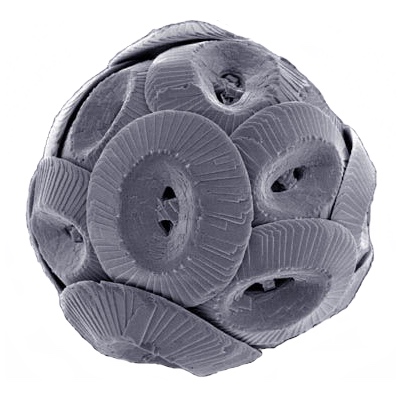
Coccolithophores are the most productive calcifying organisms on the planet, covering themselves with a calcium carbonate shell called a coccosphere. However, the reasons they calcify remain elusive. One key function may be that the coccosphere offers protection against microzooplankton predation, which is one of the main causes of phytoplankton death in the ocean.
Coccolithophores are ecologically important, and biogeochemically they play significant roles in the marine biological pump and the carbon cycle. Depending on habitat, they can produce up to 40 percent of the local marine primary production. They are of particular interest to those studying global climate change because, as ocean acidity increases, their coccoliths may become even more important as a carbon sink. Management strategies are being employed to prevent eutrophication-related coccolithophore blooms, as these blooms lead to a decrease in nutrient flow to lower levels of the ocean.
The most abundant species of coccolithophore, Emiliania huxleyi, belongs to the order Isochrysidales and family Noëlaerhabdaceae. It is found in temperate, subtropical, and tropical oceans. This makes E. huxleyi an important part of the planktonic base of a large proportion of marine food webs. It is also the fastest growing coccolithophore in laboratory cultures. It is studied for the extensive blooms it forms in nutrient depleted waters after the reformation of the summer thermocline. and for its production of molecules known as alkenones that are commonly used by earth scientists as a means to estimate past sea surface temperatures.
Coccolithophores (or coccolithophorids, from the adjective) form a group of about 200 phytoplankton species. They belong either to the kingdom Protista, according to Robert Whittaker's Five kingdom classification, or clade Hacrobia, according to the newer biological classification system. Within the Hacrobia, the coccolithophores are in the phylum or division Haptophyta, class Prymnesiophyceae (or Coccolithophyceae). Coccolithophores are distinguished by special calcium carbonate plates (or scales) of uncertain function called coccoliths, which are also important microfossils. However, there are Prymnesiophyceae species lacking coccoliths (e.g. in genus Prymnesium), so not every member of Prymnesiophyceae is a coccolithophore.
Coccolithophores are single-celled phytoplankton that produce small calcium carbonate (CaCO3) scales (coccoliths) which cover the cell surface in the form of a spherical coating, called a coccosphere. Many species are also mixotrophs, and are able to photosynthesise as well as ingest prey.
Coccolithophores have been an integral part of marine plankton communities since the Jurassic. Today, coccolithophores contribute ~1–10% to inorganic carbon fixation (calcification) to total carbon fixation (calcification plus photosynthesis) in the surface ocean and ~50% to pelagic CaCO3 sediments. Their calcareous shell increases the sinking velocity of photosynthetically fixed CO2 into the deep ocean by ballasting organic matter. At the same time, the biogenic precipitation of calcium carbonate during coccolith formation reduces the total alkalinity of seawater and releases CO2. Thus, coccolithophores play an important role in the marine carbon cycle by influencing the efficiency of the biological carbon pump and the oceanic uptake of atmospheric CO2.
As of 2021, it is not known why coccolithophores calcify and how their ability to produce coccoliths is associated with their ecological success. The most plausible benefit of having a coccosphere seems to be a protection against predators or viruses. Viral infection is an important cause of phytoplankton death in the oceans, and it has recently been shown that calcification can influence the interaction between a coccolithophore and its virus. The major predators of marine phytoplankton are microzooplankton like ciliates and dinoflagellates. These are estimated to consume about two-thirds of the primary production in the ocean and microzooplankton can exert a strong grazing pressure on coccolithophore populations. Although calcification does not prevent predation, it has been argued that the coccosphere reduces the grazing efficiency by making it more difficult for the predator to utilise the organic content of coccolithophores. Heterotrophic protists are able to selectively choose prey on the basis of its size or shape and through chemical signals and may thus favor other prey that is available and not protected by coccoliths.
Hub AI
Coccolithophore AI simulator
(@Coccolithophore_simulator)
Coccolithophore
Coccolithophores, or coccolithophorids, are single-celled organisms which are part of the phytoplankton, the autotrophic (self-feeding) component of the plankton community. They form a group of about 200 species, and belong either to the kingdom Protista, according to Robert Whittaker's five-kingdom system, or clade Hacrobia, according to a newer biological classification system. Within the Hacrobia, the coccolithophores are in the phylum or division Haptophyta, class Prymnesiophyceae (or Coccolithophyceae). Coccolithophores are almost exclusively marine, are photosynthetic and mixotrophic, and exist in large numbers throughout the sunlight zone of the ocean.
Coccolithophores are the most productive calcifying organisms on the planet, covering themselves with a calcium carbonate shell called a coccosphere. However, the reasons they calcify remain elusive. One key function may be that the coccosphere offers protection against microzooplankton predation, which is one of the main causes of phytoplankton death in the ocean.
Coccolithophores are ecologically important, and biogeochemically they play significant roles in the marine biological pump and the carbon cycle. Depending on habitat, they can produce up to 40 percent of the local marine primary production. They are of particular interest to those studying global climate change because, as ocean acidity increases, their coccoliths may become even more important as a carbon sink. Management strategies are being employed to prevent eutrophication-related coccolithophore blooms, as these blooms lead to a decrease in nutrient flow to lower levels of the ocean.
The most abundant species of coccolithophore, Emiliania huxleyi, belongs to the order Isochrysidales and family Noëlaerhabdaceae. It is found in temperate, subtropical, and tropical oceans. This makes E. huxleyi an important part of the planktonic base of a large proportion of marine food webs. It is also the fastest growing coccolithophore in laboratory cultures. It is studied for the extensive blooms it forms in nutrient depleted waters after the reformation of the summer thermocline. and for its production of molecules known as alkenones that are commonly used by earth scientists as a means to estimate past sea surface temperatures.
Coccolithophores (or coccolithophorids, from the adjective) form a group of about 200 phytoplankton species. They belong either to the kingdom Protista, according to Robert Whittaker's Five kingdom classification, or clade Hacrobia, according to the newer biological classification system. Within the Hacrobia, the coccolithophores are in the phylum or division Haptophyta, class Prymnesiophyceae (or Coccolithophyceae). Coccolithophores are distinguished by special calcium carbonate plates (or scales) of uncertain function called coccoliths, which are also important microfossils. However, there are Prymnesiophyceae species lacking coccoliths (e.g. in genus Prymnesium), so not every member of Prymnesiophyceae is a coccolithophore.
Coccolithophores are single-celled phytoplankton that produce small calcium carbonate (CaCO3) scales (coccoliths) which cover the cell surface in the form of a spherical coating, called a coccosphere. Many species are also mixotrophs, and are able to photosynthesise as well as ingest prey.
Coccolithophores have been an integral part of marine plankton communities since the Jurassic. Today, coccolithophores contribute ~1–10% to inorganic carbon fixation (calcification) to total carbon fixation (calcification plus photosynthesis) in the surface ocean and ~50% to pelagic CaCO3 sediments. Their calcareous shell increases the sinking velocity of photosynthetically fixed CO2 into the deep ocean by ballasting organic matter. At the same time, the biogenic precipitation of calcium carbonate during coccolith formation reduces the total alkalinity of seawater and releases CO2. Thus, coccolithophores play an important role in the marine carbon cycle by influencing the efficiency of the biological carbon pump and the oceanic uptake of atmospheric CO2.
As of 2021, it is not known why coccolithophores calcify and how their ability to produce coccoliths is associated with their ecological success. The most plausible benefit of having a coccosphere seems to be a protection against predators or viruses. Viral infection is an important cause of phytoplankton death in the oceans, and it has recently been shown that calcification can influence the interaction between a coccolithophore and its virus. The major predators of marine phytoplankton are microzooplankton like ciliates and dinoflagellates. These are estimated to consume about two-thirds of the primary production in the ocean and microzooplankton can exert a strong grazing pressure on coccolithophore populations. Although calcification does not prevent predation, it has been argued that the coccosphere reduces the grazing efficiency by making it more difficult for the predator to utilise the organic content of coccolithophores. Heterotrophic protists are able to selectively choose prey on the basis of its size or shape and through chemical signals and may thus favor other prey that is available and not protected by coccoliths.