


Community hub
Recent from talks
Contribute something
Nothing was collected or created yet.
Zooplankton
View on Wikipedia
Zooplankton are the heterotrophic component of the planktonic community, having to consume other organisms to thrive. The name comes from Ancient Greek ζῷον (zōîon), meaning "animal", and πλαγκτός (planktós), meaning "drifter, wanderer, roamer", and thus, "animal drifter". Plankton are aquatic organisms that are unable to swim effectively against currents. Consequently, they drift or are carried along by currents in the ocean, or by currents in seas, lakes or rivers.
Zooplankton can be contrasted with phytoplankton (cyanobacteria and microalgae), which are the plant-like component of the plankton community (the "phyto-" prefix comes from Ancient Greek: φῠτόν, romanized: phutón, lit. 'plant', although taxonomically not plants). Zooplankton are heterotrophic (other-feeding), whereas phytoplankton are autotrophic (self-feeding), often generating biological energy and macromolecules through chlorophyllic carbon fixation using sunlight – in other words, zooplankton cannot manufacture their own food, while phytoplankton can. As a result, zooplankton must acquire nutrients by feeding on other organisms such as phytoplankton, which are generally smaller than zooplankton. Most zooplankton are microscopic but some (such as jellyfish) are macroscopic, meaning they can be seen with the naked eye.[1]
Many protozoans (single-celled protists that prey on other microscopic life) are zooplankton, including zooflagellates, foraminiferans, radiolarians, some dinoflagellates and marine microanimals. Macroscopic zooplankton include pelagic cnidarians, ctenophores, molluscs, arthropods and tunicates, as well as planktonic arrow worms and bristle worms.
The distinction between autotrophy and heterotrophy often breaks down in very small organisms. Recent studies of marine microplankton have indicated over half of microscopic plankton are mixotrophs, which can obtain energy and carbon from a mix of internal plastids and external sources. Many marine microzooplankton are mixotrophic, which means they could also be classified as phytoplankton.
Overview
[edit]| Part of a series on |
| Plankton |
|---|
 |

Zooplankton (/ˈzoʊ.əplæŋktən/;[2] /ˌzoʊ.əˈplæŋktən/)[3] are heterotrophic (sometimes detritivorous) plankton. The word zooplankton is derived from Ancient Greek: ζῷον, romanized: zôion, lit. 'animal'; and πλᾰγκτός, planktós, 'wanderer; drifter'.[4]
Zooplankton is a categorization spanning a range of organism sizes including small protozoans and large metazoans. It includes holoplanktonic organisms whose complete life cycle lies within the plankton, as well as meroplanktonic organisms that spend part of their lives in the plankton before graduating to either the nekton or a sessile, benthic existence. Although zooplankton are primarily transported by ambient water currents, many have locomotion, used to avoid predators (as in diel vertical migration) or to increase prey encounter rate.
Just as any species can be limited within a geographical region, so are zooplankton. However, species of zooplankton are not dispersed uniformly or randomly within a region of the ocean. As with phytoplankton, 'patches' of zooplankton species exist throughout the ocean. Though few physical barriers exist above the mesopelagic, specific species of zooplankton are strictly restricted by salinity and temperature gradients, while other species can withstand wide temperature and salinity gradients.[5] Zooplankton patchiness can also be influenced by biological factors, as well as other physical factors. Biological factors include breeding, predation, concentration of phytoplankton, and vertical migration.[5] The physical factor that influences zooplankton distribution the most is mixing of the water column (upwelling and downwelling along the coast and in the open ocean) that affects nutrient availability and, in turn, phytoplankton production.[5]
Through their consumption and processing of phytoplankton and other food sources, zooplankton play a role in aquatic food webs, as a resource for consumers on higher trophic levels (including fish), and as a conduit for packaging the organic material in the biological pump. Since they are typically small, zooplankton can respond rapidly to increases in phytoplankton abundance,[clarification needed] for instance, during the spring bloom. Zooplankton are also a key link in the biomagnification of pollutants such as mercury.[6]
- Typical models featuring zooplankton
-


Ecologically important protozoan zooplankton groups include the foraminiferans, radiolarians and dinoflagellates (the last of these are often mixotrophic). Important metazoan zooplankton include cnidarians such as jellyfish and the Portuguese Man o' War; crustaceans such as cladocerans, copepods, ostracods, isopods, amphipods, mysids and krill; chaetognaths (arrow worms); molluscs such as pteropods; and chordates such as salps and juvenile fish. This wide phylogenetic range includes a similarly wide range in feeding behavior: filter feeding, predation and symbiosis with autotrophic phytoplankton as seen in corals. Zooplankton feed on bacterioplankton, phytoplankton, other zooplankton (sometimes cannibalistically), detritus (or marine snow) and even nektonic organisms. As a result, zooplankton are primarily found in surface waters where food resources (phytoplankton or other zooplankton) are abundant.
Zooplankton can also act as a disease reservoir. Crustacean zooplankton have been found to house the bacterium Vibrio cholerae, which causes cholera, by allowing the cholera vibrios to attach to their chitinous exoskeletons. This symbiotic relationship enhances the bacterium's ability to survive in an aquatic environment, as the exoskeleton provides the bacterium with carbon and nitrogen.[8]
Size classification
[edit]Body size has been defined as a "master trait" for plankton as it is a morphological characteristic shared by organisms across taxonomy that characterises the functions performed by organisms in ecosystems.[9][10] It has a paramount effect on growth, reproduction, feeding strategies and mortality.[11] One of the oldest manifestations of the biogeography of traits was proposed over 170 years ago, namely Bergmann's rule, in which field observations showed that larger species tend to be found at higher, colder latitudes.[12][13]
In the oceans, size is critical in determining trophic links in planktonic ecosystems and is thus a critical factor in regulating the efficiency of the biological carbon pump.[14] Body size is sensitive to changes in temperature due to the thermal dependence of physiological processes.[15] The plankton is mainly composed of ectotherms which are organisms that do not generate sufficient metabolic heat to elevate their body temperature, so their metabolic processes depends on external temperature.[16] Consequently, ectotherms grow more slowly and reach maturity at a larger body size in colder environments, which has long puzzled biologists because classic theories of life-history evolution predict smaller adult sizes in environments delaying growth.[17] This pattern of body size variation, known as the temperature-size rule (TSR),[18] has been observed for a wide range of ectotherms, including single-celled and multicellular species, invertebrates and vertebrates.[17][19][13]
The processes underlying the inverse relationship between body size and temperature remain to be identified.[17] Despite temperature playing a major role in shaping latitudinal variations in organism size, these patterns may also rely on complex interactions between physical, chemical and biological factors. For instance, oxygen supply plays a central role in determining the magnitude of ectothermic temperature-size responses, but it is hard to disentangle the relative effects of oxygen and temperature from field data because these two variables are often strongly inter-related in the surface ocean.[20][21][13]
Zooplankton can be broken down into size classes[22] which are diverse in their morphology, diet, feeding strategies, etc. both within classes and between classes:
| type of zooplankton | size range |
|---|---|
| picozooplankton | 2μm |
| nanozooplankton | 2–20μm |
| microzooplankton | 20–200μm |
| mesozooplankton | 0.2–20 millimeters |

Microzooplankton
[edit]Microzooplankton are defined as heterotrophic and mixotrophic plankton. They primarily consist of phagotrophic protists, including ciliates, dinoflagellates, and mesozooplankton nauplii.[23] Microzooplankton are major grazers of the plankton community. As the primary consumers of marine phytoplankton, microzooplankton consume ~ 59–75% daily of the marine primary production, much larger than mesozooplankton. That said, macrozooplankton can sometimes have greater consumption rates in eutrophic ecosystems because the larger phytoplankton can be dominant there.[24][25] Microzooplankton are also pivotal regenerators of nutrients which fuel primary production and food sources for metazoans.[25][26]
Despite their ecological importance, microzooplankton remain understudied. Routine oceanographic observations seldom monitor microzooplankton biomass or herbivory rate, although the dilution technique, an elegant method of measuring microzooplankton herbivory rate, has been developed for over four decades (Landry and Hassett 1982). The number of observations of microzooplankton herbivory rate is around 1600 globally,[27][28] far less than that of primary productivity (> 50,000).[29] This makes validating and optimizing the grazing function of microzooplankton difficult in ocean ecosystem models.[26]
Mesozooplankton
[edit]Mesozooplankton are one of the larger size classes of zooplankton. In most regions, mesozooplankton are dominated by copepods, such as Calanus finmarchicus and Calanus helgolandicus. Mesozooplankton are an important prey for fish.
As plankton are rarely fished, it has been argued that mesoplankton abundance and species composition can be used to study marine ecosystems' response to climate change. This is because they have life cycles that generally last less than a year, meaning they respond to climate changes between years. Sparse, monthly sampling will still indicate vacillations.[30]
Taxonomic groups
[edit]Protozooplankton
[edit]Protozooplankton refers to protist zooplankton (planktonic protozoans).[31] All protozooplankton are protozoans, but not all protozoans are protozooplankton, since some live in environments like soil or as parasites. Marine planktonic protozoans include zooflagellates, foraminiferans, radiolarians and some dinoflagellates.
Protozoans are protists that feed on organic matter such as other microorganisms or organic tissues and debris.[32][33] Historically, the protozoa were regarded as "one-celled animals", because they often possess animal-like behaviours, such as motility and predation, and lack a cell wall, as found in plants and many algae.[34][35] Although the traditional practice of grouping protozoa with animals is no longer considered valid, the term continues to be used in a loose way to identify single-celled organisms that can move independently and feed by heterotrophy.
Radiolarians
[edit]

Radiolarians are unicellular predatory protists encased in elaborate globular shells usually made of silica and pierced with holes. Their name comes from the Latin for "radius". They catch prey by extending parts of their body through the holes. As with the silica frustules of diatoms, radiolarian shells can sink to the ocean floor when radiolarians die and become preserved as part of the ocean sediment. These remains, as microfossils, provide valuable information about past oceanic conditions.[36]
-
 Like diatoms, radiolarians come in many shapes
 -
 Also like diatoms, radiolarian shells are usually made of silicate
 -
 However acantharian radiolarians have shells made from strontium sulfate crystals
 -
 Cutaway schematic diagram of a spherical radiolarian shell

.jpg)
.jpg)

| External videos | |
|---|---|
 Radiolarian geometry Radiolarian geometry | |
| Ernst Haeckel's radiolarian engravings |
Foraminiferans
[edit]Like radiolarians, foraminiferans (forams for short) are single-celled predatory protists, also protected with shells that have holes in them. Their name comes from the Latin for "hole bearers". Their shells, often called tests, are chambered (forams add more chambers as they grow). The shells are usually made of calcite, but are sometimes made of agglutinated sediment particles or chiton, and (rarely) silica. Most forams are benthic, but about 40 species are planktic.[37] They are widely researched with well-established fossil records which allow scientists to infer a lot about past environments and climates.[36]


-
 section showing chambers of a spiral foram
 -
 Live Ammonia tepida streaming granular ectoplasm for catching food
 -
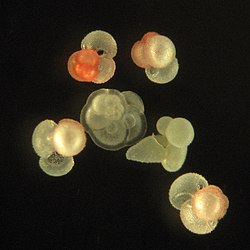 Group of planktonic forams
 -
![The Egyptian pyramids were constructed from limestone that contained nummulites.[38]](//upload.wikimedia.org/wikipedia/commons/thumb/a/af/All_Gizah_Pyramids.jpg/330px-All_Gizah_Pyramids.jpg)


![The Egyptian pyramids were constructed from limestone that contained nummulites.[38]](https://en.wikipedia.org/wiki/File:All_Gizah_Pyramids.jpg)
| External videos | |
|---|---|
| foraminiferans | |
| Foraminiferal networks and growth |
Amoeba
[edit].jpg)

-
 Naked amoeba sketch showing food vacuoles and ingested diatom
 -
 Shell or test of a testate amoeba, Arcella sp.
 -
 Xenogenic testate amoeba covered in diatoms


Ciliates
[edit]-

-
 Holophyra ovum
 -

-
 This ciliate is digesting cyanobacteria. The mouth is at the bottom right.
.jpg)
.jpg)


Dinoflagellates
[edit]Dinoflagellates are a phylum of unicellular flagellates with about 2,000 marine species.[39] Some dinoflagellates are predatory, and thus belong to the zooplankton community. Their name comes from the Greek "dinos" meaning whirling and the Latin "flagellum" meaning a whip or lash. This refers to the two whip-like attachments (flagella) used for forward movement. Most dinoflagellates are protected with red-brown, cellulose armour. Excavates may be the most basal flagellate lineage.[40]


-
 Gyrodinium, one of the few naked dinoflagellates which lack armour
 -
 The dinoflagellate Protoperidinium extrudes a large feeding veil to capture prey
 -
 Nassellarian radiolarians can be in symbiosis with dinoflagellates


_mitra_Ehrenberg_-_160x.jpg)
Dinoflagellates often live in symbiosis with other organisms. Many nassellarian radiolarians house dinoflagellate symbionts within their tests.[41] The nassellarian provides ammonium and carbon dioxide for the dinoflagellate, while the dinoflagellate provides the nassellarian with a mucous membrane useful for hunting and protection against harmful invaders.[42] There is evidence from DNA analysis that dinoflagellate symbiosis with radiolarians evolved independently from other dinoflagellate symbioses, such as with foraminifera.[43]
-
 Tripos muelleri is recognisable by its U-shaped horns
 -
![Oodinium, a genus of parasitic dinoflagellates, causes velvet disease in fish[44]](//upload.wikimedia.org/wikipedia/commons/thumb/8/87/Archives_de_zoologie_exp%C3%A9rimentale_et_g%C3%A9n%C3%A9rale_%281920%29_%2820299351186%29.jpg/330px-Archives_de_zoologie_exp%C3%A9rimentale_et_g%C3%A9n%C3%A9rale_%281920%29_%2820299351186%29.jpg)
-
![Karenia brevis produces red tides highly toxic to humans[45]](//upload.wikimedia.org/wikipedia/commons/thumb/a/a0/Karenia_brevis.jpg/250px-Karenia_brevis.jpg) Karenia brevis produces red tides highly toxic to humans[45]
Karenia brevis produces red tides highly toxic to humans[45] -


![Oodinium, a genus of parasitic dinoflagellates, causes velvet disease in fish[44]](https://en.wikipedia.org/wiki/File:Archives_de_zoologie_exp%C3%A9rimentale_et_g%C3%A9n%C3%A9rale_(1920)_(20299351186).jpg)
![Karenia brevis produces red tides highly toxic to humans[45]](https://en.wikipedia.org/wiki/File:Karenia_brevis.jpg)
_by_Noctiluca_in_Nagasaki.jpg)
Mixoplankton
[edit]Mixoplankton are mixotrophic plankton, capable of both photosynthesis and predation. A mixotroph is an organism that can use a mix of different sources of energy and carbon, instead of having a single trophic mode on the continuum from complete autotrophy at one end to heterotrophy at the other. It is estimated that mixotrophs comprise more than half of all microscopic plankton.[46] There are two types of eukaryotic mixotrophs: those with their own chloroplasts, and those with endosymbionts—and others that acquire them through kleptoplasty or by enslaving the entire phototrophic cell.[47]
The distinction between plants and animals often breaks down in very small organisms. Possible combinations are photo- and chemotrophy, litho- and organotrophy, auto- and heterotrophy or other combinations of these. Mixotrophs can be either eukaryotic or prokaryotic.[48] They can take advantage of different environmental conditions.[49]
Many marine microzooplankton are mixotrophic, which means they could also be classified as phytoplankton. Recent studies of marine microzooplankton found 30–45% of the ciliate abundance was mixotrophic, and up to 65% of the amoeboid, foram and radiolarian biomass was mixotrophic.[50]
Mixotrophic zooplankton that combine phototrophy and heterotrophy – table based on Stoecker et al., 2017 [51]
| ||||||
|---|---|---|---|---|---|---|
| Description | Example | Further examples | ||||
| Called nonconstitutive mixotrophs by Mitra et al., 2016.[52] Zooplankton that are photosynthetic: microzooplankton or metazoan zooplankton that acquire phototrophy through chloroplast retentiona or maintenance of algal endosymbionts. | ||||||
| Generalists | Protists that retain chloroplasts and rarely other organelles from many algal taxa | 
|
Most oligotrich ciliates that retain plastidsa | |||
| Specialists | 1. Protists that retain chloroplasts and sometimes other organelles from one algal species or very closely related algal species | 
|
Dinophysis acuminata | Dinophysis spp. Myrionecta rubra | ||
| 2. Protists or zooplankton with algal endosymbionts of only one algal species or very closely related algal species | 
|
Noctiluca scintillans | Metazooplankton with algal endosymbionts Most mixotrophic Rhizaria (Acantharea, Polycystinea, and Foraminifera) Green Noctiluca scintillans | |||
| aChloroplast (or plastid) retention = sequestration = enslavement. Some plastid-retaining species also retain other organelles and prey cytoplasm. | ||||||
Phaeocystis species are endosymbionts to acantharian radiolarians.[53][54] Phaeocystis is an important algal genus found as part of the marine phytoplankton around the world. It has a polymorphic life cycle, ranging from free-living cells to large colonies.[55] It has the ability to form floating colonies, where hundreds of cells are embedded in a gel matrix, which can increase massively in size during blooms.[56] As a result, Phaeocystis is an important contributor to the marine carbon[57] and sulfur cycles.[58]
- Mixoplankton
-
 Tintinnid ciliate Favella
 -
 Euglena mutabilis, a photosynthetic flagellate
 -
 Zoochlorellae (green) living inside the ciliate Stichotricha secunda
 -
 The dinoflagellate Dinophysis acuta

_(cropped).jpg)
.jpg)


.jpg)
A number of forams are mixotrophic. These have unicellular algae as endosymbionts, from diverse lineages such as the green algae, red algae, golden algae, diatoms, and dinoflagellates.[37] Mixotrophic foraminifers are particularly common in nutrient-poor oceanic waters.[59] Some forams are kleptoplastic, retaining chloroplasts from ingested algae to conduct photosynthesis.[60]
By trophic orientation, dinoflagellates are all over the place. Some dinoflagellates are known to be photosynthetic, but a large fraction of these are in fact mixotrophic, combining photosynthesis with ingestion of prey (phagotrophy).[61] Some species are endosymbionts of marine animals and other protists, and play an important part in the biology of coral reefs. Others predate other protozoa, and a few forms are parasitic. Many dinoflagellates are mixotrophic and could also be classified as phytoplankton. The toxic dinoflagellate Dinophysis acuta acquire chloroplasts from its prey. "It cannot catch the cryptophytes by itself, and instead relies on ingesting ciliates such as the red Myrionecta rubra, which sequester their chloroplasts from a specific cryptophyte clade (Geminigera/Plagioselmis/Teleaulax)".[51]
Planktonic metazoa (animals)
[edit]
Free-living species in the crustacean class Copepoda are typically 1 to 2 mm long with teardrop-shaped bodies. Like all crustaceans, their bodies are divided into three sections: head, thorax, and abdomen, with two pairs of antennae; the first pair is often long and prominent. They have a tough exoskeleton made of calcium carbonate and usually have a single red eye in the centre of their transparent head.[62] About 13,000 species of copepods are known, of which about 10,200 are marine.[63][64] They are usually among the more dominant members of the zooplankton.[65]
In addition to copepods the crustacean classes ostracods, branchiopods and malacostracans also have planktonic members. Barnacles are planktonic only during the larval stage.[66]


Holoplankton and meroplankton
[edit]Ichthyoplankton
[edit]Ichthyoplankton are the eggs and larvae of fish ("ichthyo" comes from the Greek word for fish). They are planktonic because they cannot swim effectively under their own power, but must drift with the ocean currents. Fish eggs cannot swim at all, and are unambiguously planktonic. Early stage larvae swim poorly, but later stage larvae swim better and cease to be planktonic as they grow into juvenile fish. Fish larvae are part of the zooplankton that eat smaller plankton, while fish eggs carry their own food supply. Both eggs and larvae are themselves eaten by larger animals.[67][68]
-
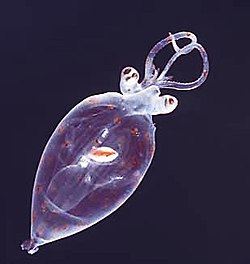 Juvenile planktonic squid
 -
 Ocean sunfish larvae (2.7mm)
 -
 Boxfish larva


Gelatinous zooplankton
[edit]Gelatinous zooplankton include ctenophores, medusae, salps, and Chaetognatha in coastal waters. Jellyfish are slow swimmers, and most species form part of the plankton. Traditionally jellyfish have been viewed as trophic dead ends, minor players in the marine food web, gelatinous organisms with a body plan largely based on water that offers little nutritional value or interest for other organisms apart from a few specialised predators such as the ocean sunfish and the leatherback sea turtle.[69][70]
That view has recently been challenged. Jellyfish, and more gelatinous zooplankton in general, which include salps and ctenophores, are very diverse, fragile with no hard parts, difficult to see and monitor, subject to rapid population swings and often live inconveniently far from shore or deep in the ocean. It is difficult for scientists to detect and analyse jellyfish in the guts of predators, since they turn to mush when eaten and are rapidly digested.[69] But jellyfish bloom in vast numbers, and it has been shown they form major components in the diets of tuna, spearfish and swordfish as well as various birds and invertebrates such as octopus, sea cucumbers, crabs and amphipods.[71][70] "Despite their low energy density, the contribution of jellyfish to the energy budgets of predators may be much greater than assumed because of rapid digestion, low capture costs, availability, and selective feeding on the more energy-rich components. Feeding on jellyfish may make marine predators susceptible to ingestion of plastics."[70] According to a 2017 study, narcomedusae consume the greatest diversity of mesopelagic prey, followed by physonect siphonophores, ctenophores and cephalopods.[72]
-

-
 This free-floating pyrosome is made up of hundreds of individual bioluminescent tunicates
 -
 Salp chain


.jpg)
The importance of the so-called "jelly web" is only beginning to be understood, but it seems medusae, ctenophores and siphonophores can be key predators in deep pelagic food webs with ecological impacts similar to predator fish and squid. Traditionally gelatinous predators were thought ineffectual providers of marine trophic pathways, but they appear to have substantial and integral roles in deep pelagic food webs.[72]
Role in food webs
[edit]Grazing by single-celled zooplankton accounts for the majority of organic carbon loss from marine primary production.[73] However, zooplankton grazing remains one of the key unknowns in global predictive models of carbon flux, the marine food web structure and ecosystem characteristics, because empirical grazing measurements are sparse, resulting in poor parameterisation of grazing functions.[74][75] To overcome this critical knowledge gap, it has been suggested that a focused effort be placed on the development of instrumentation that can link changes in phytoplankton biomass or optical properties with grazing.[73]
Grazing is a central, rate-setting process in ocean ecosystems and a driver of marine biogeochemical cycling.[76] In all ocean ecosystems, grazing by heterotrophic protists constitutes the single largest loss factor of marine primary production and alters particle size distributions.[77] Grazing affects all pathways of export production, rendering grazing important both for surface and deep carbon processes.[78] Predicting central paradigms of ocean ecosystem function, including responses to environmental change requires accurate representation of grazing in global biogeochemical, ecosystem and cross-biome-comparison models.[74] Several large-scale analyses have concluded that phytoplankton losses, which are dominated by grazing are the putative explanation for annual cycles in phytoplankton biomass, accumulation rates and export production.[79][80][75][73]
- Pelagic food web
-
![Pelagic food web and the biological pump. Links among the ocean's biological pump and pelagic food web and the ability to sample these components remotely from ships, satellites, and autonomous vehicles. Light blue waters are the euphotic zone, while the darker blue waters represent the twilight zone.[81]](//upload.wikimedia.org/wikipedia/commons/thumb/1/13/Export_Processes_in_the_Ocean_from_Remote_Sensing.jpg/627px-Export_Processes_in_the_Ocean_from_Remote_Sensing.jpg) Pelagic food web and the biological pump. Links among the ocean's biological pump and pelagic food web and the ability to sample these components remotely from ships, satellites, and autonomous vehicles. Light blue waters are the euphotic zone, while the darker blue waters represent the twilight zone.[81]
Pelagic food web and the biological pump. Links among the ocean's biological pump and pelagic food web and the ability to sample these components remotely from ships, satellites, and autonomous vehicles. Light blue waters are the euphotic zone, while the darker blue waters represent the twilight zone.[81]
![Pelagic food web and the biological pump. Links among the ocean's biological pump and pelagic food web and the ability to sample these components remotely from ships, satellites, and autonomous vehicles. Light blue waters are the euphotic zone, while the darker blue waters represent the twilight zone.[81]](https://en.wikipedia.org/wiki/File:Export_Processes_in_the_Ocean_from_Remote_Sensing.jpg)

Role in biogeochemistry
[edit]In addition to linking primary producers to higher trophic levels in marine food webs, zooplankton also play an important role as "recyclers" of carbon and other nutrients that significantly impact marine biogeochemical cycles, including the biological pump. This is particularly important in the oligotrophic waters of the open ocean. Through sloppy feeding, excretion, egestion, and leaching of fecal pellets, zooplankton release dissolved organic matter (DOM) which controls DOM cycling and supports the microbial loop. Absorption efficiency, respiration, and prey size all further complicate how zooplankton are able to transform and deliver carbon to the deep ocean.[77]
Sloppy feeding and release of DOM
[edit]
DOC = dissolved organic carbon
POC = particulate organic carbon
Adapted from Møller et al. (2005),[82]
Saba et al. (2009)[83] and Steinberg et al. (2017).[77]
Excretion and sloppy feeding (the physical breakdown of food source) make up 80% and 20% of crustacean zooplankton-mediated DOM release respectively.[84] In the same study, fecal pellet leaching was found to be an insignificant contributor. For protozoan grazers, DOM is released primarily through excretion and egestion and gelatinous zooplankton can also release DOM through the production of mucus. Leaching of fecal pellets can extend from hours to days after initial egestion and its effects can vary depending on food concentration and quality.[85][86] Various factors can affect how much DOM is released from zooplankton individuals or populations. Absorption efficiency (AE) is the proportion of food absorbed by plankton that determines how available the consumed organic materials are in meeting the required physiological demands.[77] Depending on the feeding rate and prey composition, variations in AE may lead to variations in fecal pellet production, and thus regulates how much organic material is recycled back to the marine environment. Low feeding rates typically lead to high AE and small, dense pellets, while high feeding rates typically lead to low AE and larger pellets with more organic content. Another contributing factor to DOM release is respiration rate. Physical factors such as oxygen availability, pH, and light conditions may affect overall oxygen consumption and how much carbon is loss from zooplankton in the form of respired CO2. The relative sizes of zooplankton and prey also mediate how much carbon is released via sloppy feeding. Smaller prey are ingested whole, whereas larger prey may be fed on more "sloppily", that is more biomatter is released through inefficient consumption.[87][88] There is also evidence that diet composition can impact nutrient release, with carnivorous diets releasing more dissolved organic carbon (DOC) and ammonium than omnivorous diets.[85]

Naturally iron-fertilized

High nutrient, low chlorophyll
Carbon export
[edit]Zooplankton play a critical role in supporting the ocean's biological pump through various forms of carbon export, including the production of fecal pellets, mucous feeding webs, molts, and carcasses. Fecal pellets are estimated to be a large contributor to this export, with copepod size rather than abundance expected to determine how much carbon actually reaches the ocean floor. The importance of fecal pellets can vary both by time and location. For example, zooplankton bloom events can produce larger quantities of fecal pellets, resulting in greater measures of carbon export. Additionally, as fecal pellets sink, they are reworked by microbes in the water column, which can thus alter the carbon composition of the pellet. This affects how much carbon is recycled in the euphotic zone and how much reaches depth. Fecal pellet contribution to carbon export is likely underestimated; however, new advances in quantifying this production are currently being developed, including the use of isotopic signatures of amino acids to characterize how much carbon is being exported via zooplankton fecal pellet production.[90] Carcasses are also gaining recognition as being important contributors to carbon export. Jelly falls – the mass sinking of gelatinous zooplankton carcasses – occur across the world as a result of large blooms. Because of their large size, these gelatinous zooplankton are expected to hold a larger carbon content, making their sinking carcasses a potentially important source of food for benthic organisms.[77]
See also
[edit]References
[edit]- ^ Sardet, Christian (2015-06-05). Plankton: Wonders of the Drifting World. University of Chicago Press. ISBN 978-0-226-26534-6.
- ^ "zooplankton". Lexico UK English Dictionary. Oxford University Press. Archived from the original on March 1, 2020.
- ^ "zooplankton". Merriam-Webster.com Dictionary. Merriam-Webster.
- ^ Thurman, H. V. (1997). Introductory Oceanography. New Jersey, USA: Prentice Hall College. ISBN 978-0-13-262072-7.
- ^ a b c Lalli, C.M. & Parsons, T.R. (1993). Biological Oceanography An Introduction. Burlington, MA: Elsevier. p. 314. ISBN 978-0-7506-3384-0.
- ^ "How We Do Things at IISD-ELA: Researching Mercury". IISD. 2017-04-05. Retrieved 2020-07-06.
- ^ Everett, J.D., Baird, M.E., Buchanan, P., Bulman, C., Davies, C., Downie, R., Griffiths, C., Heneghan, R., Kloser, R.J., Laiolo, L. and Lara-Lopez, A. (2017) "Modeling what we sample and sampling what we model: challenges for zooplankton model assessment". Frontiers in Marine Science, 4: 77. doi:10.3389/fmars.2017.00077.
 Material was copied from this source, which is available under a Creative Commons Attribution 4.0 International License.
- ^ Jude, B.A.; Kirn, T.J.; Taylor R.K. (2005). "A colonization factor links Vibrio cholerae environmental survival and human infection". Nature. 438 (7069): 863–6. Bibcode:2005Natur.438..863K. doi:10.1038/nature04249. PMID 16341015. S2CID 1964530.
- ^ Litchman, Elena; Ohman, Mark D.; Kiørboe, Thomas (2013). "Trait-based approaches to zooplankton communities". Journal of Plankton Research. 35 (3): 473–484. doi:10.1093/plankt/fbt019.
- ^ Kiørboe, Thomas; Hirst, Andrew G. (2014). "Shifts in Mass Scaling of Respiration, Feeding, and Growth Rates across Life-Form Transitions in Marine Pelagic Organisms". The American Naturalist. 183 (4): E118 – E130. doi:10.1086/675241. PMID 24642502. S2CID 15891709.
- ^ Andersen, K.H.; Berge, T.; Gonçalves, R.J.; Hartvig, M.; Heuschele, J.; Hylander, S.; Jacobsen, N.S.; Lindemann, C.; Martens, E.A.; Neuheimer, A.B.; Olsson, K.; Palacz, A.; Prowe, A.E.F.; Sainmont, J.; Traving, S.J.; Visser, A.W.; Wadhwa, N.; Kiørboe, T. (2016). "Characteristic Sizes of Life in the Oceans, from Bacteria to Whales" (PDF). Annual Review of Marine Science. 8: 217–241. Bibcode:2016ARMS....8..217A. doi:10.1146/annurev-marine-122414-034144. hdl:11336/52445. PMID 26163011.
- ^ Bergmann, Carl (1847). "Über die Verhältnisse der Wärmeökonomie der Thiere zu ihrer Grösse". Göttinger Studien. 3 (1): 595–708.
- ^ a b c Brandão, Manoela C.; et al. (2021). "Macroscale patterns of oceanic zooplankton composition and size structure". Scientific Reports. 11 (1): 15714. Bibcode:2021NatSR..1115714B. doi:10.1038/s41598-021-94615-5. PMC 8333327. PMID 34344925. Material was copied from this source, which is available under a Creative Commons Attribution 4.0 International License.
- ^ Woodson, C. Brock; Schramski, John R.; Joye, Samantha B. (2018). "A unifying theory for top-heavy ecosystem structure in the ocean". Nature Communications. 9 (1): 23. Bibcode:2018NatCo...9...23W. doi:10.1038/s41467-017-02450-y. PMC 5750233. PMID 29295998.
- ^ Brown, James H.; Gillooly, James F.; Allen, Andrew P.; Savage, Van M.; West, Geoffrey B. (2004). "Toward a Metabolic Theory of Ecology". Ecology. 85 (7): 1771–1789. Bibcode:2004Ecol...85.1771B. doi:10.1890/03-9000.
- ^ Gardner, Janet L.; Peters, Anne; Kearney, Michael R.; Joseph, Leo; Heinsohn, Robert (2011). "Declining body size: A third universal response to warming?". Trends in Ecology & Evolution. 26 (6): 285–291. Bibcode:2011TEcoE..26..285G. doi:10.1016/j.tree.2011.03.005. PMID 21470708.
- ^ a b c Angilletta, M. J.; Steury, T. D.; Sears, M. W. (2004). "Temperature, Growth Rate, and Body Size in Ectotherms: Fitting Pieces of a Life-History Puzzle". Integrative and Comparative Biology. 44 (6): 498–509. doi:10.1093/icb/44.6.498. PMID 21676736.
- ^ Atkinson, D. (1994). Temperature and Organism Size—A Biological Law for Ectotherms?. Advances in Ecological Research. Vol. 25. pp. 1–58. doi:10.1016/S0065-2504(08)60212-3. ISBN 978-0-12-013925-5.
- ^ Atkinson, David; Sibly, Richard M. (1997). "Why are organisms usually bigger in colder environments? Making sense of a life history puzzle". Trends in Ecology & Evolution. 12 (6): 235–239. Bibcode:1997TEcoE..12..235A. doi:10.1016/S0169-5347(97)01058-6. PMID 21238056.
- ^ Sunagawa, S.; et al. (2015). "Structure and function of the global ocean microbiome" (PDF). Science. 348 (6237). doi:10.1126/science.1261359. hdl:10261/117712. PMID 25999513. S2CID 206562917.
- ^ Audzijonyte, Asta; Barneche, Diego R.; Baudron, Alan R.; Belmaker, Jonathan; Clark, Timothy D.; Marshall, C. Tara; Morrongiello, John R.; Van Rijn, Itai (2019). "Is oxygen limitation in warming waters a valid mechanism to explain decreased body sizes in aquatic ectotherms?". Global Ecology and Biogeography. 28 (2): 64–77. Bibcode:2019GloEB..28...64A. doi:10.1111/geb.12847. hdl:10536/DRO/DU:30117155. S2CID 92601781.
- ^ Steinberg, Deborah K.; Landry, Michael R. (2017-01-03). "Zooplankton and the Ocean Carbon Cycle". Annual Review of Marine Science. 9 (1): 413–444. Bibcode:2017ARMS....9..413S. doi:10.1146/annurev-marine-010814-015924. ISSN 1941-1405. PMID 27814033.
- ^ Sieburth, John McN.; Smetacek, Victor; Lenz, Jürgen (1978). "Pelagic ecosystem structure: Heterotrophic compartments of the plankton and their relationship to plankton size fractions 1". Limnology and Oceanography. 23 (6): 1256–1263. Bibcode:1978LimOc..23.1256S. doi:10.4319/lo.1978.23.6.1256. S2CID 85568208.
- ^ Calbet, Albert; Landry, Michael R. (2004). "Phytoplankton growth, microzooplankton grazing, and carbon cycling in marine systems". Limnology and Oceanography. 49 (1): 51–57. Bibcode:2004LimOc..49...51C. doi:10.4319/lo.2004.49.1.0051. hdl:10261/134985. S2CID 22995996.
- ^ a b Calbet, Albert (2008). "The trophic roles of microzooplankton in marine systems". ICES Journal of Marine Science. 65 (3): 325–331. doi:10.1093/icesjms/fsn013.
- ^ a b Liu, Kailin; Chen, Bingzhang; Zheng, Liping; Su, Suhong; Huang, Bangqin; Chen, Mianrun; Liu, Hongbin (2021). "What controls microzooplankton biomass and herbivory rate across marginal seas of China?". Limnology and Oceanography. 66 (1): 61–75. Bibcode:2021LimOc..66...61L. doi:10.1002/lno.11588. ISSN 0024-3590. S2CID 224916151. Material was copied from this source, which is available under a Creative Commons Attribution 4.0 International License.
- ^ Chen, Bingzhang; Landry, Michael R.; Huang, Bangqin; Liu, Hongbin (2012). "Does warming enhance the effect of microzooplankton grazing on marine phytoplankton in the ocean?". Limnology and Oceanography. 57 (2): 519–526. Bibcode:2012LimOc..57..519C. doi:10.4319/lo.2012.57.2.0519.
- ^ Schmoker, Claire; Hernández-León, Santiago; Calbet, Albert (2013). "Microzooplankton grazing in the oceans: Impacts, data variability, knowledge gaps and future directions". Journal of Plankton Research. 35 (4): 691–706. doi:10.1093/plankt/fbt023.
- ^ Buitenhuis, Erik T.; Hashioka, Taketo; Quéré, Corinne Le (2013). "Combined constraints on global ocean primary production using observations and models". Global Biogeochemical Cycles. 27 (3): 847–858. Bibcode:2013GBioC..27..847B. doi:10.1002/gbc.20074. S2CID 140628035.
- ^ Mackas, David L.; Beaugrand, Gregory (2010-02-10). "Comparisons of zooplankton time series". Journal of Marine Systems. Impact of climate variability on marine ecosystems: A comparative approach. 79 (3): 286–304. Bibcode:2010JMS....79..286M. doi:10.1016/j.jmarsys.2008.11.030. ISSN 0924-7963.
- ^ Flynn, Kevin J; Mitra, Aditee; Anestis, Konstantinos; Anschütz, Anna A; Calbet, Albert; Ferreira, Guilherme Duarte; Gypens, Nathalie; Hansen, Per J; John, Uwe; Martin, Jon Lapeyra; Mansour, Joost S; Maselli, Maira; Medić, Nikola; Norlin, Andreas; Not, Fabrice; Pitta, Paraskevi; Romano, Filomena; Saiz, Enric; Schneider, Lisa K; Stolte, Willem; Traboni, Claudia (2019-07-26). "Mixotrophic protists and a new paradigm for marine ecology: where does plankton research go now?" (PDF). Journal of Plankton Research. 41 (4): 375–391. doi:10.1093/plankt/fbz026. ISSN 0142-7873. Retrieved 2025-07-06.
- ^ Panno, Joseph (14 May 2014). The Cell: Evolution of the First Organism. Infobase Publishing. ISBN 978-0-8160-6736-7.
- ^ Bertrand, Jean-Claude; Caumette, Pierre; Lebaron, Philippe; Matheron, Robert; Normand, Philippe; Sime-Ngando, Télesphore (2015-01-26). Environmental Microbiology: Fundamentals and Applications: Microbial Ecology. Springer. ISBN 978-94-017-9118-2.
- ^ Madigan, Michael T. (2012). Brock Biology of Microorganisms. Benjamin Cummings. ISBN 978-0-321-64963-8.
- ^ Yaeger, Robert G. (1996). Protozoa: Structure, Classification, Growth, and Development. NCBI. ISBN 978-0-9631172-1-2. PMID 21413323. Retrieved 2018-03-23.
- ^ a b Wassilieff, Maggy (2006) "Plankton – Animal plankton", Te Ara – the Encyclopedia of New Zealand. Accessed: 2 November 2019.
- ^ a b Hemleben, C.; Anderson, O.R.; Spindler, M. (1989). Modern Planktonic Foraminifera. Springer-Verlag. ISBN 978-3-540-96815-3.
- ^ Foraminifera: History of Study, University College London. Retrieved: 18 November 2019.
- ^ Gómez F (2012). "A checklist and classification of living dinoflagellates (Dinoflagellata, Alveolata)". CICIMAR Oceánides. 27 (1): 65–140. doi:10.37543/oceanides.v27i1.111.
- ^ Dawson, Scott C; Paredez, Alexander R (2013). "Alternative cytoskeletal landscapes: cytoskeletal novelty and evolution in basal excavate protists". Current Opinion in Cell Biology. 25 (1): 134–141. doi:10.1016/j.ceb.2012.11.005. PMC 4927265. PMID 23312067.
- ^ Boltovskoy, Demetrio; Anderson, O. Roger; Correa, Nancy M. (2017). Handbook of the Protists. Springer, Cham. pp. 731–763. doi:10.1007/978-3-319-28149-0_19. ISBN 978-3-319-28147-6.
- ^ Anderson, O. R. (1983). Radiolaria. Springer Science & Business Media.
- ^ Gast, R. J.; Caron, D. A. (1996-11-01). "Molecular phylogeny of symbiotic dinoflagellates from planktonic foraminifera and radiolaria". Molecular Biology and Evolution. 13 (9): 1192–1197. doi:10.1093/oxfordjournals.molbev.a025684. ISSN 0737-4038. PMID 8896371.
- ^ "Protozoa Infecting Gills and Skin". The Merck Veterinary Manual. Archived from the original on 3 March 2016. Retrieved 4 November 2019.
- ^ Brand, Larry E.; Campbell, Lisa; Bresnan, Eileen (2012). "Karenia: The biology and ecology of a toxic genus". Harmful Algae. 14: 156–178. Bibcode:2012HAlga..14..156B. doi:10.1016/j.hal.2011.10.020. PMC 9891709. PMID 36733478.
- ^ Collins, Richard (2016-11-14). "Beware the mixotrophs – they can destroy entire ecosystems 'in a matter of hours'". Irish Examiner.
- ^ University, Swansea. "Microscopic body snatchers infest our oceans". phys.org.
- ^ Eiler A (December 2006). "Evidence for the Ubiquity of Mixotrophic Bacteria in the Upper Ocean: Implications and Consequences". Appl Environ Microbiol. 72 (12): 7431–7. Bibcode:2006ApEnM..72.7431E. doi:10.1128/AEM.01559-06. PMC 1694265. PMID 17028233.
- ^ Katechakis A, Stibor H (July 2006). "The mixotroph Ochromonas tuberculata may invade and suppress specialist phago- and phototroph plankton communities depending on nutrient conditions". Oecologia. 148 (4): 692–701. Bibcode:2006Oecol.148..692K. doi:10.1007/s00442-006-0413-4. PMID 16568278. S2CID 22837754.
- ^ Leles, S.G.; Mitra, A.; Flynn, K.J.; Stoecker, D.K.; Hansen, P.J.; Calbet, A.; McManus, G.B.; Sanders, R.W.; Caron, D.A.; Not, F.; Hallegraeff, G.M. (2017). "Oceanic protists with different forms of acquired phototrophy display contrasting biogeographies and abundance". Proceedings of the Royal Society B: Biological Sciences. 284 (1860) 20170664. doi:10.1098/rspb.2017.0664. PMC 5563798. PMID 28768886.
- ^ a b Stoecker, D.K.; Hansen, P.J.; Caron, D.A.; Mitra, A. (2017). "Mixotrophy in the marine plankton" (PDF). Annual Review of Marine Science. 9: 311–335. Bibcode:2017ARMS....9..311S. doi:10.1146/annurev-marine-010816-060617. PMID 27483121. S2CID 25579538. Archived from the original (PDF) on 2019-02-27.
- ^ Mitra, A; Flynn, KJ; Tillmann, U; Raven, J; Caron, D; et al. (2016). "Defining planktonic protist functional groups on mechanisms for energy and nutrient acquisition; incorporation of diverse mixotrophic strategies". Protist. 167 (2): 106–20. doi:10.1016/j.protis.2016.01.003. hdl:10261/131722. PMID 26927496.
- ^ Decelle, Johan; Simó, Rafel; Galí, Martí; Vargas, Colomban de; Colin, Sébastien; Desdevises, Yves; Bittner, Lucie; Probert, Ian; Not, Fabrice (2012-10-30). "An original mode of symbiosis in open ocean plankton". Proceedings of the National Academy of Sciences. 109 (44): 18000–18005. Bibcode:2012PNAS..10918000D. doi:10.1073/pnas.1212303109. ISSN 0027-8424. PMC 3497740. PMID 23071304.
- ^ Mars Brisbin, Margaret; Grossmann, Mary M.; Mesrop, Lisa Y.; Mitarai, Satoshi (2018). "Intra-host Symbiont Diversity and Extended Symbiont Maintenance in Photosymbiotic Acantharea (Clade F)". Frontiers in Microbiology. 9: 1998. doi:10.3389/fmicb.2018.01998. ISSN 1664-302X. PMC 6120437. PMID 30210473.
- ^ Schoemann, Véronique; Becquevort, Sylvie; Stefels, Jacqueline; Rousseau, Véronique; Lancelot, Christiane (2005-01-01). "Phaeocystis blooms in the global ocean and their controlling mechanisms: a review". Journal of Sea Research. Iron Resources and Oceanic Nutrients – Advancement of Global Environmental Simulations. 53 (1–2): 43–66. Bibcode:2005JSR....53...43S. CiteSeerX 10.1.1.319.9563. doi:10.1016/j.seares.2004.01.008.
- ^ "Welcome to the Phaeocystis antarctica genome sequencing project homepage". Archived from the original on 2015-11-20. Retrieved 2020-08-23.
- ^ DiTullio, G. R.; Grebmeier, J. M.; Arrigo, K. R.; Lizotte, M. P.; Robinson, D. H.; Leventer, A.; Barry, J. P.; VanWoert, M. L.; Dunbar, R. B. (2000). "Rapid and early export of Phaeocystis antarctica blooms in the Ross Sea, Antarctica". Nature. 404 (6778): 595–598. Bibcode:2000Natur.404..595D. doi:10.1038/35007061. PMID 10766240. S2CID 4409009.
- ^ J, Stefels; L, Dijkhuizen; WWC, Gieskes (1995-07-20). "DMSP-lyase activity in a spring phytoplankton bloom off the Dutch coast, related to Phaeocystis sp. abundance" (PDF). Marine Ecology Progress Series. 123: 235–243. Bibcode:1995MEPS..123..235S. doi:10.3354/meps123235.
- ^ Marshall, K. C. (2013-11-11). Advances in Microbial Ecology. Springer Science & Business Media. ISBN 978-1-4684-7612-5.
- ^ Bernhard, J. M.; Bowser, S.M. (1999). "Benthic Foraminifera of dysoxic sediments: chloroplast sequestration and functional morphology". Earth-Science Reviews. 46 (1): 149–165. Bibcode:1999ESRv...46..149B. doi:10.1016/S0012-8252(99)00017-3.
- ^ Stoecker DK (1999). "Mixotrophy among Dinoflagellates". The Journal of Eukaryotic Microbiology. 46 (4): 397–401. doi:10.1111/j.1550-7408.1999.tb04619.x. S2CID 83885629.
- ^ Robert D. Barnes (1982). Invertebrate Zoology. Philadelphia, Pennsylvania: Holt-Saunders International. pp. 683–692. ISBN 978-0-03-056747-6.
- ^ "WoRMS - World Register of Marine Species - Copepoda". www.marinespecies.org. Archived from the original on 2019-06-30. Retrieved 2019-06-28.
- ^ Geoff A. Boxhall; Danielle Defaye (2008). "Global diversity of copepods (Crustacea: Copepoda) in freshwater". Hydrobiologia. 595 (1): 195–207. doi:10.1007/s10750-007-9014-4. S2CID 31727589.
- ^ Johannes Dürbaum; Thorsten Künnemann (November 5, 1997). "Biology of Copepods: An Introduction". Carl von Ossietzky University of Oldenburg. Archived from the original on May 26, 2010. Retrieved December 8, 2009.
- ^ Treatise on Zoology – Anatomy, Taxonomy, Biology. The Crustacea
- ^ "What are Ichthyoplankton?". Southwest Fisheries Science Center. 2007-09-03. Archived from the original on 2018-02-18. Retrieved 2011-07-22.
- ^ Allen, Dr. Larry G.; Horn, Dr. Michael H. (15 February 2006). The Ecology of Marine Fishes: California and Adjacent Waters. University of California Press. pp. 269–319. ISBN 978-0-520-93247-0.
- ^ a b Hamilton, G. (2016) "The secret lives of jellyfish: long regarded as minor players in ocean ecology, jellyfish are actually important parts of the marine food web". Nature, 531(7595): 432–435. doi:10.1038/531432a
- ^ a b c Hays, G.C., Doyle, T.K. and Houghton, J.D. (2018) "A paradigm shift in the trophic importance of jellyfish?" Trends in ecology & evolution, 33(11): 874–884. doi:10.1016/j.tree.2018.09.001
- ^ Cardona, L., De Quevedo, I.Á., Borrell, A. and Aguilar, A. (2012) "Massive consumption of gelatinous plankton by Mediterranean apex predators". PLOS ONE, 7(3): e31329. doi:10.1371/journal.pone.0031329
- ^ a b Choy, C.A., Haddock, S.H. and Robison, B.H. (2017) "Deep pelagic food web structure as revealed by in situ feeding observations". Proceedings of the Royal Society B: Biological Sciences, 284(1868): 20172116. doi:10.1098/rspb.2017.2116. Material was copied from this source, which is available under a Creative Commons Attribution 4.0 International License.
- ^ a b c d Menden-Deuer, Susanne; Slade, Wayne Homer; Dierssen, Heidi (2021). "Promoting Instrument Development for New Research Avenues in Ocean Science: Opening the Black Box of Grazing". Frontiers in Marine Science. 8. doi:10.3389/fmars.2021.695938. Material was copied from this source, which is available under a Creative Commons Attribution 4.0 International License.
- ^ a b Stock, Charles; Dunne, John (2010). "Controls on the ratio of mesozooplankton production to primary production in marine ecosystems". Deep Sea Research Part I: Oceanographic Research Papers. 57 (1): 95–112. Bibcode:2010DSRI...57...95S. doi:10.1016/j.dsr.2009.10.006.
- ^ a b Bisson, Kelsey; Siegel, David A.; Devries, Timothy (2020). "Diagnosing Mechanisms of Ocean Carbon Export in a Satellite-Based Food Web Model". Frontiers in Marine Science. 7. doi:10.3389/fmars.2020.00505.
- ^ Worden, A. Z.; Follows, M. J.; Giovannoni, S. J.; Wilken, S.; Zimmerman, A. E.; Keeling, P. J. (2015). "Rethinking the marine carbon cycle: Factoring in the multifarious lifestyles of microbes". Science. 347 (6223). doi:10.1126/science.1257594. PMID 25678667. S2CID 206560125.
- ^ a b c d e Steinberg, Deborah K.; Landry, Michael R. (2017). "Zooplankton and the Ocean Carbon Cycle". Annual Review of Marine Science. 9: 413–444. Bibcode:2017ARMS....9..413S. doi:10.1146/annurev-marine-010814-015924. PMID 27814033.
- ^ Mariani, Patrizio; Andersen, Ken H.; Visser, André W.; Barton, Andrew D.; Kiørboe, Thomas (2013). "Control of plankton seasonal succession by adaptive grazing". Limnology and Oceanography. 58 (1): 173–184. Bibcode:2013LimOc..58..173M. doi:10.4319/lo.2013.58.1.0173.
- ^ Behrenfeld, Michael J. (2010). "Abandoning Sverdrup's Critical Depth Hypothesis on phytoplankton blooms". Ecology. 91 (4): 977–989. Bibcode:2010Ecol...91..977B. doi:10.1890/09-1207.1. PMID 20462113.
- ^ Mignot, A.; Ferrari, R.; Claustre, H. (2018). "Floats with bio-optical sensors reveal what processes trigger the North Atlantic bloom". Nature Communications. 9 (1): 190. Bibcode:2018NatCo...9..190M. doi:10.1038/s41467-017-02143-6. PMC 5768750. PMID 29335403.
- ^ Siegel, David A.; Buesseler, Ken O.; Behrenfeld, Michael J.; Benitez-Nelson, Claudia R.; Boss, Emmanuel; Brzezinski, Mark A.; Burd, Adrian; Carlson, Craig A.; d'Asaro, Eric A.; Doney, Scott C.; Perry, Mary J.; Stanley, Rachel H. R.; Steinberg, Deborah K. (2016). "Prediction of the Export and Fate of Global Ocean Net Primary Production: The EXPORTS Science Plan". Frontiers in Marine Science. 3. doi:10.3389/fmars.2016.00022. Material was copied from this source, which is available under a Creative Commons Attribution 4.0 International License.
- ^ Møller, EF; Thor, P.; Nielsen, TG (2003). "Production of DOC by Calanus finmarchicus, C. Glacialis and C. Hyperboreus through sloppy feeding and leakage from fecal pellets". Marine Ecology Progress Series. 262: 185–191. Bibcode:2003MEPS..262..185M. doi:10.3354/meps262185.
- ^ Saba, GK; Steinberg, DK; Bronk, DA (2009). "Effects of diet on release of dissolved organic and inorganic nutrients by the copepod Acartia tonsa". Marine Ecology Progress Series. 386: 147–161. Bibcode:2009MEPS..386..147S. doi:10.3354/meps08070.
- ^ Saba, Grace K.; Steinberg, Deborah K.; Bronk, Deborah A. (2011). "The relative importance of sloppy feeding, excretion, and fecal pellet leaching in the release of dissolved carbon and nitrogen by Acartia tonsa copepods". Journal of Experimental Marine Biology and Ecology. 404 (1–2): 47–56. Bibcode:2011JEMBE.404...47S. doi:10.1016/j.jembe.2011.04.013.
- ^ a b Thor, P.; Dam, HG; Rogers, DR (2003). "Fate of organic carbon released from decomposing copepod fecal pellets in relation to bacterial production and ectoenzymatic activity". Aquatic Microbial Ecology. 33: 279–288. doi:10.3354/ame033279.
- ^ Hansell, Dennis A.; Carlson, Craig A. (2 October 2014). Biogeochemistry of Marine Dissolved Organic Matter. Academic Press. ISBN 978-0-12-407153-7.
- ^ Moller, E. F. (2004). "Sloppy feeding in marine copepods: Prey-size-dependent production of dissolved organic carbon". Journal of Plankton Research. 27: 27–35. doi:10.1093/plankt/fbh147.
- ^ Møller, Eva Friis (2007). "Production of dissolved organic carbon by sloppy feeding in the copepods Acartia tonsa, Centropages typicus, and Temora longicornis". Limnology and Oceanography. 52 (1): 79–84. Bibcode:2007LimOc..52...79M. doi:10.4319/lo.2007.52.1.0079.
- ^ a b c Halfter, Svenja; Cavan, Emma L.; Swadling, Kerrie M.; Eriksen, Ruth S.; Boyd, Philip W. (2020). "The Role of Zooplankton in Establishing Carbon Export Regimes in the Southern Ocean – A Comparison of Two Representative Case Studies in the Subantarctic Region". Frontiers in Marine Science. 7. doi:10.3389/fmars.2020.567917. S2CID 222003883. Material was copied from this source, which is available under a Creative Commons Attribution 4.0 International License.
- ^ Doherty, S.; Maas, A. E.; Steinberg, D. K.; Popp, B. N.; Close, H. G. (2019). "Compound-Specific Isotope Analysis of Zooplankton Fecal Pellets: Insights into Dietary and Trophic Processes and Characterization of Fecal Pellets as Organic Matter End-Member". American Geophysical Union, Fall Meeting 2019 Abstracts. abstract #PP42C–12. Bibcode:2019AGUFMPP42C..12D.

External links
[edit]- SAHFOS Sir Alister Hardy Foundation for Ocean Science
- Ocean Drifters Short film narrated by David Attenborough about the varied roles of plankton
- Sea Drifters BBC Audio slideshow
- Plankton Chronicles Short documentary films & photos
- COPEPOD: The global plankton database. A global coverage database of zooplankton biomass and abundance data.
- Guide to the marine zooplankton of south eastern Australia, Tasmanian Aquaculture and Fisheries Institute
- Australian Continuous Plankton Recorder Project Archived 2008-12-01 at the Wayback Machine
- An Image-Based Key to Zooplankton of North America

| ||||||||||||||||||||
| ||||||||||||||||||||


Zooplankton
View on GrokipediaIntroduction
Definition and Characteristics
Zooplankton are defined as the heterotrophic or mixotrophic planktonic organisms in aquatic environments, primarily consisting of animals or animal-like protists that drift passively with prevailing water currents due to their limited swimming capabilities.[1][10][11] These organisms inhabit oceans, lakes, rivers, and other water bodies, where their movement is governed by physical forces rather than active propulsion.[2] Key characteristics of zooplankton include their small size, typically ranging from a few micrometers to several centimeters, and a wide array of morphologies such as single-celled forms, colonial aggregates, and more elaborate multicellular bodies adapted to pelagic life.[12][13] To remain suspended in the water column, they possess specialized adaptations for buoyancy, including lipid accumulations for density reduction and gelatinous sheaths that enhance flotation.[14] Physiologically, zooplankton exhibit high metabolic rates scaled to their body size and environmental temperature, enabling efficient energy processing in nutrient-variable conditions.[15][16] Most zooplankton are heterotrophic, relying on filter-feeding mechanisms—such as setae, appendages, or mucus nets—to capture suspended particles like phytoplankton, bacteria, or other small organisms, though mixotrophic species supplement this with photosynthesis.[1][13][11] Their reproduction is often rapid, with short generation times of days to weeks under favorable conditions, supporting high population turnover and resilience in dynamic aquatic systems.[17][18] This contrasts with phytoplankton, which are autotrophic and self-sustaining via photosynthesis, and nekton, which are larger, powerful swimmers capable of overcoming currents for migration or foraging.[14][19]Ecological and Economic Importance
Zooplankton serve as primary consumers in aquatic ecosystems, grazing on phytoplankton and thereby transferring energy from primary production to higher trophic levels, including fish, marine mammals, and birds. This role is crucial for sustaining global fisheries, as over 90% of the world's fisheries catch relies on the diverse food web supported by primary productivity in shelf seas, with zooplankton forming the essential intermediary link for larval and juvenile fish stages. Their rapid reproduction rates enable them to efficiently convert phytoplankton biomass into a form accessible to predators, maintaining the flow of nutrients and energy through the water column.[20] The high species diversity of zooplankton, with over 7,000 described species across various phyla, contributes significantly to ecosystem resilience by providing functional redundancy and adaptability to environmental changes. This biodiversity ensures that ecosystems can buffer against perturbations, such as temperature fluctuations or pollution, through shifts in community composition that preserve overall productivity and trophic stability. Globally, zooplankton biomass in the oceans is estimated at approximately 0.4 petagrams of carbon in the upper 500 meters, equivalent to roughly 4-8 billion tons of wet biomass when accounting for typical carbon content, representing a substantial portion of marine secondary production.[21] This vast biomass underpins ocean productivity, influencing carbon cycling and supporting the health of entire aquatic food webs. Economically, zooplankton are vital as live feeds in aquaculture, offering cost-effective, nutrient-rich options for larval fish rearing that enhance growth and survival rates. Additionally, their communities serve as sensitive indicators of water quality in environmental monitoring programs, reflecting changes in nutrient levels, pollution, and overall ecosystem health through shifts in abundance and composition.Classification
Size-Based Categories
Zooplankton are classified into size-based categories to understand their distribution, abundance, and functional roles in aquatic ecosystems. The primary classes include microzooplankton, mesozooplankton, and macrozooplankton, defined by body length ranges that reflect differences in morphology, physiology, and ecological interactions. These classifications facilitate studies on how size influences feeding, growth, and trophic transfer efficiency. Microzooplankton encompass organisms typically ranging from 20 to 200 μm in size, including heterotrophic protists such as ciliates and dinoflagellates, as well as small metazoans like rotifers and naupliar larvae of larger species.[22] These small-bodied zooplankton dominate numerically in most marine and freshwater systems, often comprising the majority of individuals in plankton assemblages due to their rapid reproduction rates and short generation times.[23] However, their contribution to total biomass is relatively low compared to larger classes, as individual body masses are minimal despite high abundances.[24] Mesozooplankton are defined by sizes from 0.2 to 20 mm, encompassing a diverse array of metazoans such as copepods, cladocerans, and appendicularians.[25] This class often represents the peak in biomass within zooplankton communities, serving as a critical link between primary producers and higher trophic levels due to their substantial total wet weight despite lower numerical densities than microzooplankton.[26] Larger mesozooplankton, like adult copepods, exhibit higher grazing efficiencies on phytoplankton and microzooplankton, influencing energy transfer and nutrient cycling more prominently than smaller sizes.[27] Macrozooplankton include organisms larger than 20 mm, such as euphausiids (krill), chaetognaths, and some gelatinous forms like salps, which can reach lengths of several centimeters.[28] Although numerically rare, macrozooplankton contribute significantly to overall biomass in productive regions, where they act as key prey for fish, seabirds, and marine mammals, thereby shaping higher trophic dynamics.[29] Size gradients across classes affect predation pressures, with smaller zooplankton facing higher mortality from grazing by larger ones, while larger sizes evade small predators but are vulnerable to fish.[30] Size classification of zooplankton is achieved through sampling and analytical methods tailored to capture different scales. Traditional approaches use plankton nets with varying mesh sizes—typically 20-50 μm for microzooplankton, 100-200 μm for mesozooplankton, and larger meshes up to 1 mm or more for macrozooplankton—to fractionate samples during collection.[31] Post-collection, optical imaging systems, such as the ZooScan or Video Plankton Recorder, enable automated measurement of individual sizes and shapes by digitizing images and applying image-processing algorithms for biovolume estimation and categorization.[32] These methods ensure accurate partitioning, though challenges arise with fragile or gelatinous forms that may deform during sieving.[33] Ecologically, size-based categories highlight functional disparities in ecosystem processes. Microzooplankton, despite their numerical dominance, drive a substantial portion of herbivory, often consuming 60-75% of daily phytoplankton production globally through efficient grazing on bacteria, pico- and nanophytoplankton.[34] In contrast, mesozooplankton and macrozooplankton exert top-down control via predation on smaller plankton, with their larger body sizes enhancing biomass accumulation and carbon export to deeper waters.[35] Such size-structured interactions underscore the importance of scaling laws in plankton dynamics, where smaller classes sustain high turnover rates and larger ones facilitate long-term energy storage in food webs.[36]Taxonomic Groups
Zooplankton encompass a diverse array of heterotrophic organisms, with approximately 7,000 described marine species distributed across 15 phyla of holozooplankton that drift with ocean currents throughout their lives.[37] This biodiversity reflects their critical role in marine ecosystems, spanning unicellular protozoans and multicellular metazoans. Protozooplankton consist of unicellular heterotrophic protists that form a significant portion of the microzooplankton community.[38] Key groups include radiolarians, which possess intricate siliceous skeletons for structural support; foraminiferans, characterized by calcareous tests that aid in buoyancy and protection; ciliates, such as tintinnids with loricae for housing, which use cilia for locomotion and feeding; and some dinoflagellates that exhibit heterotrophic nutrition through phagocytosis.[38] Amoebae represent a minor group within protozooplankton, typically less abundant and featuring pseudopodia for movement and prey capture.[39] Metazoan zooplankton comprise multicellular animals that dominate larger size fractions, including the mesozooplankton.[40] The most abundant are copepods, which account for up to 80% of mesozooplankton biomass and serve as primary grazers in pelagic food webs.[41] Other prominent representatives include krill (euphausiids), which form massive swarms in polar and temperate waters; pteropods, shelled molluscs adapted to open-ocean environments; and chaetognaths, predatory arrow worms that prey on smaller zooplankton.[42] Ichthyoplankton, encompassing fish eggs and larvae, also fall within this category, contributing to the meroplanktonic component of metazoan assemblages.[40] Mixotrophs within zooplankton blur nutritional boundaries by combining autotrophy and heterotrophy, enhancing their adaptability in variable marine conditions.[43] Examples include certain dinoflagellates that photosynthesize via acquired chloroplasts while engulfing prey, and some ciliates that retain algal symbionts for supplementary energy.[44] These organisms, often overlapping with protozooplankton groups, can constitute a substantial fraction of planktonic communities in coastal and oceanic waters.[38]Life History and Behavior
Holoplankton versus Meroplankton
Zooplankton are broadly categorized into holoplankton and meroplankton based on their life strategies within the water column. Holoplankton are organisms that spend their entire life cycle as plankton, remaining permanently suspended in the pelagic environment without transitioning to benthic or nektonic phases.[45] In contrast, meroplankton are temporary members of the plankton community, consisting primarily of larval or early developmental stages of organisms that later settle into benthic or nektonic lifestyles, such as the eggs and larvae of fish or invertebrates.[46] Representative examples of holoplankton include copepods, salps, arrow worms (Chaetognatha), and comb jellies (Ctenophora), while meroplankton encompass larvae of crabs, lobsters, bivalves, polychaetes, and fish.[45][46] Holoplankton exhibit specialized adaptations for a lifelong drifting existence in the open water, enabling them to counteract sinking and maintain position in the water column despite lacking strong swimming abilities. These include small body sizes to reduce gravitational settling, flattened or disc-shaped forms for increased drag, formation of chains or spirals to enhance buoyancy, elongated projections or spines that increase surface area, and internal oil droplets for neutral buoyancy. Meroplankton, during their brief planktonic phase, often possess simpler transient adaptations like yolk reserves for nutrition and basic swimming structures for orientation, but rely more on passive dispersal by currents rather than permanent suspension mechanisms.[46] In terms of distribution, holoplankton dominate the open oceans, where they form the core of the pelagic zooplankton assemblage due to the vast, stable offshore environment.[47] Meroplankton, however, constitute a higher proportion in coastal and neritic zones, where they can account for up to 90% of zooplankton biomass seasonally, driven by spawning events from nearby benthic communities, such as barnacle larvae on continental shelves.[48] These life strategies offer distinct evolutionary advantages: holoplankton are optimized for the consistent conditions of the open ocean, providing stability in resource exploitation and predator avoidance through specialized pelagic traits. Conversely, meroplankton leverage their temporary planktonic stage for long-distance dispersal, facilitating gene flow, colonization of new habitats, and avoidance of intense local competition in benthic environments.[46]Diel Vertical Migration and Other Behaviors
Diel vertical migration (DVM) is a prominent behavior in many zooplankton species, involving a synchronized daily ascent to surface waters at dusk for feeding on phytoplankton and a descent to deeper layers at dawn to evade visually hunting predators. This pattern is observed across diverse taxa, including copepods, krill, and pteropods, with migration amplitudes ranging from tens to up to 800 meters in oceanic environments. The behavior enhances survival by balancing foraging opportunities against predation risk, particularly from fish and gelatinous predators active in illuminated surface layers during daylight.[49][50] The primary mechanisms driving DVM include negative phototaxis during the day, where zooplankton orient away from light to seek darker depths, and positive phototaxis at night to approach food-rich surface zones; geotaxis and internal circadian rhythms also contribute to timing and depth preferences. Predation risk serves as a key selective force, with experimental evidence showing that zooplankton adjust migration depths in response to predator presence or light intensity mimicking visual foraging conditions. These migrations impose significant energetic costs due to sustained swimming against gravity and buoyancy challenges.[49][51] Variations in DVM occur across species, with larger zooplankton like euphausiids exhibiting broader amplitudes than smaller copepods, and patterns influenced by habitat depth—more pronounced in epipelagic zones than in deeper mesopelagic layers. Latitudinal differences are evident, as polar species show reduced or reversed migrations during periods of continuous daylight or darkness, adapting to extended seasonal light cycles. Beyond DVM, zooplankton display other adaptive behaviors for defense and survival. Schooling forms tight aggregations in species such as krill and certain copepods, reducing individual predation risk through the dilution effect and predator confusion during attacks. This collective behavior is often triggered by environmental cues like turbulence or predator proximity, enhancing group cohesion via mechanosensory detection.[52] Bioluminescence occurs in select zooplankton, including some copepods and euphausiids, where mechanically stimulated light emission startles predators or attracts secondary predators to interrupt attacks—a "burglar alarm" strategy. Escape responses involve rapid, high-acceleration jumps or trajectory changes upon detecting hydrodynamic disturbances from approaching predators, mediated by setae and antennules acting as remote sensors. These behaviors, varying by taxon and environmental context, underscore zooplankton's reliance on sensory-driven adaptations for predator avoidance.[53][54][55]Distribution and Abundance
Global Patterns
Zooplankton communities exhibit distinct latitudinal gradients in diversity and biomass, with peaks in temperate and subtropical upwelling regions such as the California Current, where enhanced nutrient availability supports elevated standing stocks compared to the lower biomass observed in equatorial oligotrophic waters.[56][21] Global estimates indicate maximal biomass concentrations around 60°N and 55°S, reflecting productive mid-to-high latitude systems, while minima occur in the central oceanic gyres of equatorial regions.[21] Recent modeling as of 2025 estimates global mesozooplankton biomass at approximately 0.4 Pg C in the upper 500 m, with significant contributions from deeper mesopelagic layers.[21][57] Across ocean basins, zooplankton distributions vary markedly; the Atlantic Ocean features higher abundances of copepods, comprising a dominant portion of mesozooplankton biomass, whereas the Southern Ocean is characterized by krill (Euphausiacea) as the prevailing group in terms of overall biomass.[58][42] In the Atlantic, copepod densities can reach several hundred thousand individuals per square meter in productive waters, underscoring the basin's role in supporting substantial zooplankton populations.[59] Vertically, zooplankton biomass is overwhelmingly concentrated in the surface layers, primarily occurring in the epipelagic zone from 0 to 200 m depth across the global ocean.[26] Deeper communities persist in oxygen minimum zones (OMZs), where specialized taxa maintain lower but persistent populations adapted to hypoxic conditions, contributing to stratified vertical structure in tropical and subtropical waters.[60] Seasonal cycles in zooplankton abundance are pronounced in temperate regions, featuring blooms that peak in spring, as seen in the North Atlantic where mesozooplankton biomass surges in response to phytoplankton peaks following winter mixing.[61] These episodic increases can elevate regional biomass by orders of magnitude during the vernal period, driving transient hotspots of productivity.[62]Factors Influencing Distribution
Abiotic factors play a crucial role in determining the distribution and abundance of zooplankton by influencing their metabolic rates, reproduction, and survival. Temperature is a primary driver, with many species exhibiting optimal ranges between 10 and 20°C for postembryonic development and reproduction, beyond which abundance often declines due to increased metabolic stress and reduced fitness.[63] For instance, elevated temperatures have been shown to negatively correlate with zooplankton abundance and biomass in various aquatic systems, reflecting thermal limitations on growth and survival.[64] Salinity gradients further shape distributions, particularly in estuarine and coastal environments, where higher salinity levels reduce zooplankton biomass and favor salt-tolerant species while excluding freshwater taxa.[65] Dissolved oxygen levels are critical, with concentrations below 4.5 mg/L impairing reproduction and survival, leading to avoidance or mortality in hypoxic zones that compress habitable habitats.[66] Nutrient availability, especially phosphorus, indirectly affects zooplankton through food quality and quantity, as deficiencies limit somatic growth and reproductive output in herbivores like Daphnia.[67] Biotic interactions also profoundly influence zooplankton distribution by modulating population dynamics through direct and indirect pressures. Predation pressure from planktivorous fish and invertebrates can collapse zooplankton populations under high intensity, overriding resource availability and driving vertical or horizontal shifts to evade predators.[68] Competition among zooplankton species for shared resources, such as phytoplankton, structures communities by favoring efficient grazers and leading to exclusion of less competitive taxa in resource-limited conditions.[69] Parasitism, including fungal infections, depresses host densities by increasing mortality and reducing foraging efficiency, thereby altering local abundance and facilitating coexistence with predators in some systems.[70] Hydrodynamic processes transport and aggregate zooplankton, affecting their spatial patterns and ecological interactions. Ocean currents and upwelling events advect larvae and juveniles, concentrating them in nutrient-rich coastal zones while potentially dispersing populations offshore, which enhances connectivity but risks stranding.[71] Turbulence influences feeding efficiency by increasing encounter rates with prey at moderate levels, though excessive turbulence disrupts feeding currents and detection, reducing ingestion in sensitive species.[72] These physical forces interact with biological traits, such as swimming behavior, to determine overall distribution. Quantitative models often reveal inverse correlations between temperature and zooplankton abundance, underscoring thermal control in predictive frameworks for community dynamics.[64] Such relations highlight how environmental drivers collectively govern the patchy global spread of zooplankton, from polar to tropical waters.Ecological Roles
Position in Food Webs
Zooplankton occupy a central position in aquatic food webs, primarily functioning as primary consumers at the second trophic level by grazing on phytoplankton. This herbivorous role is crucial for transferring energy from primary producers to higher trophic levels, with individual clearance rates— the volume of water filtered for food—reaching up to several liters per day in larger species such as Antarctic krill (Euphausia superba), which can clear 1–4.5 L ind⁻¹ d⁻¹ depending on food availability and body size.[73] However, omnivory is widespread among zooplankton, particularly in copepods, which frequently consume microzooplankton such as ciliates and flagellates alongside phytoplankton, allowing them to exploit multiple prey types and adapt to varying resource availability.[74] This mixed feeding strategy enhances their resilience in dynamic environments but can also influence phytoplankton community composition by selectively reducing certain microbial populations.[75] As prey, zooplankton support a diverse array of predators across aquatic ecosystems, including planktivorous fish, seabirds, and marine mammals. For instance, herring (Clupea harengus) consume zooplankton equivalent to approximately 6–10% of their body weight daily, exerting significant top-down pressure on zooplankton populations in coastal and open ocean habitats.[76][77] Seabirds and baleen whales, such as humpback whales, also rely heavily on zooplankton swarms, with gelatinous forms like salps and jellyfish serving as alternative prey that can buffer predation pressure on crustacean zooplankton during abundance shifts.[78][79] These interactions highlight zooplankton's role in sustaining commercially important fisheries and top predators. Energy transfer from phytoplankton to zooplankton typically occurs with an efficiency of 10–20%, meaning only a fraction of primary production is assimilated into zooplankton biomass, yet this supports subsequent trophic levels in marine and freshwater systems.[80] In community dynamics, zooplankton abundance is regulated by both bottom-up controls, such as phytoplankton productivity driven by nutrient availability and light, and top-down controls from predation, which can cascade through the food web to affect primary production.[81] In open ocean ecosystems, zooplankton often act as keystone species, mediating energy flow and maintaining biodiversity by linking microbial loops to macrofaunal consumers, with their dynamics influencing the stability of entire pelagic food webs.[82]Contributions to Biogeochemical Cycles
Zooplankton play a pivotal role in the biological carbon pump, facilitating the export of organic carbon from surface waters to the deep ocean primarily through the production and sinking of fecal pellets. These pellets, formed from ingested phytoplankton, can sink rapidly at rates of 10–1000 meters per day, contributing to the sequestration of carbon below the euphotic zone. Studies indicate that fecal pellet flux can account for 23–100% of particulate organic carbon (POC) export in certain regions, such as pre-bloom periods in the subarctic Pacific, where zooplankton processing enhances sinking efficiency. Globally, the biological carbon pump, with fecal pellets contributing significantly (often 10–30% of export flux), exports approximately 5–20% of primary production to depths greater than 100 meters, underscoring zooplankton's influence on long-term carbon storage in ocean sediments.[83][84][85] Additionally, sloppy feeding by zooplankton releases dissolved organic matter (DOM), which can be remineralized in surface waters or contribute to aggregate formation, further modulating carbon cycling. A 2025 meta-analysis confirms fecal pellets contribute 0–100% to POC flux regionally, averaging ~10% in many systems.[86] Through grazing and excretion, zooplankton drive nutrient recycling, particularly of nitrogen and phosphorus, maintaining high nutrient availability in surface waters to support regenerated primary production. Rapid turnover of these nutrients occurs on timescales of days, with zooplankton excretion replenishing dissolved inorganic phosphorus and ammonium pools in less than 70 hours in some freshwater systems, and similar dynamics in marine environments sustaining 21–39% of dissolved phosphorus demands during early summer. In open ocean settings, zooplankton can fulfill 40–50% of phytoplankton nitrogen requirements via remineralization, preventing nutrient limitation and promoting continuous productivity. Vertical migration amplifies this recycling by transporting nutrients upward; for instance, diel migrations of species like Daphnia carry phosphorus from deeper, nutrient-enriched layers to the surface, enriching phytoplankton habitats and enhancing overall ecosystem fertility.[87][88][89] Certain zooplankton taxa contribute to silica and calcium biogeochemical cycles by producing biogenic tests and shells that sink to form ocean sediments. Radiolarians, with their siliceous skeletons, drive silica export, contributing significantly to the silicon cycle in regions like the Arctic Ocean, where their flux rivals that of diatoms and influences deep-sea silica deposition. Planktic foraminiferans and shelled pteropods, meanwhile, produce calcium carbonate shells that account for 23–56% of open-ocean CaCO₃ production, with sinking tests facilitating the export of alkalinity and carbon to the seafloor, thereby regulating ocean pH and the marine carbonate system. These contributions integrate zooplankton into global element fluxes, where their remineralization processes support a significant portion (~25%) of regenerated production by recycling limiting nutrients and supporting the efficiency of the biological pump.[90][91][92]Research and Human Interactions
Sampling and Study Methods
Net sampling remains a foundational technique for collecting zooplankton, particularly mesozooplankton, using plankton nets with mesh sizes typically ranging from 50 to 500 μm to target specific size classes.[93] These nets are towed horizontally or vertically behind research vessels at speeds of 1-3 knots, with depths adjusted via winches to sample discrete water layers, allowing estimation of abundance through calculations of filtered volume based on net mouth area and towing distance.[94] For mesozooplankton, a common mesh size of 200 μm effectively captures copepods and other crustaceans while minimizing clogging, though finer meshes (e.g., 64 μm) are used for smaller taxa to avoid underestimation of density. Optical methods have revolutionized in situ zooplankton observation by providing non-destructive, real-time data on distribution and behavior, complementing traditional net approaches. Underwater video systems, such as the Video Plankton Recorder (VPR), capture high-resolution images of organisms in their natural environment, enabling automated identification and sizing via machine learning algorithms.[95] Holographic imaging, like digital inline holography, reconstructs three-dimensional positions of particles including microzooplankton, offering precise volumetric counts without physical collection.[96] Acoustic Doppler current profilers and multifrequency echosounders detect larger zooplankton aggregates and vertical migrations by analyzing backscatter signatures, particularly useful for gelatinous species that evade nets.[97] For microzooplankton, flow cytometry sorts and enumerates cells based on fluorescence and light scatter, facilitating rapid assessment of protist diversity in water samples.[98] Preservation techniques are essential for post-sampling analysis, with formalin (4-10% buffered) or ethanol (70-95%) commonly used to fix specimens, preventing degradation while maintaining morphological integrity for taxonomic identification.[99] Genetic barcoding via environmental DNA (eDNA) metabarcoding amplifies mitochondrial COI or 18S rRNA genes from bulk samples or filtered water, revealing cryptic diversity and community composition with higher resolution than morphology alone, as demonstrated in studies of marine basins where eDNA detected 3 to 6 times more taxa than morphological methods.[100] Stable isotope analysis, employing δ¹³C and δ¹⁵N ratios in preserved tissues, traces trophic positions and diets by comparing signatures against baseline sources like particulate organic matter, with mass balance correction models accounting for preservation-induced isotopic shifts.[99] Despite advancements, sampling zooplankton presents ongoing challenges, notably the under-sampling of gelatinous forms like jellyfish and salps, which fragment in nets and require gentle optical or acoustic alternatives for accurate quantification.[101] Vertical migrants, such as many copepods performing diel migrations, are often missed by daytime surface tows, leading to biased abundance estimates unless stratified or nocturnal sampling is employed.[102] Historically, reliance on manual net tows dominated until the early 2000s, after which automated systems like the Laser Optical Plankton Counter and imaging profilers proliferated, improving resolution and reducing labor in large-scale surveys.Impacts of Climate Change and Pollution
Climate change is profoundly affecting zooplankton communities through rising ocean temperatures and acidification. Warming oceans are driving poleward shifts in zooplankton distributions, with species and assemblages moving at median rates of approximately 13 km per decade in response to thermal gradients.[103] These shifts reflect adaptations to maintain optimal thermal habitats but disrupt local food webs by altering prey availability and predator-prey dynamics. Ocean acidification, resulting from a 30% increase in acidity since the Industrial Revolution due to CO₂ absorption, further threatens shelled zooplankton such as pteropods, whose aragonitic shells dissolve under lowered pH conditions, impairing calcification and survival.[104][105] Additionally, warming alters mixotrophic strategies in zooplankton, shifting metabolic balances from carbon sinks to sources and creating abrupt tipping points in ecosystem carbon cycling.[106] Recent studies as of 2025 indicate that warming can reduce zooplankton body size nonlinearly (up to 57% at +8°C in mesocosm experiments) and alter diel vertical migration patterns, potentially disrupting carbon export and food web dynamics.[107][108] Pollution exacerbates these pressures, with microplastics posing a direct ingestion risk as zooplankton mistake them for phytoplankton, leading to reduced feeding efficiency and energy intake.[109] In contaminated regions, microplastics can constitute a small fraction of ingested particles in field studies, causing gut blockages and decreased reproduction.[110] Heavy metals like copper, cadmium, and zinc bioaccumulate in zooplankton through dietary uptake and direct absorption, inducing oxidative stress and genotoxicity that impair growth and population dynamics.[111] Eutrophication from nutrient runoff fuels algal blooms that deplete oxygen upon decay, creating hypoxic dead zones where zooplankton abundance plummets due to suffocation and habitat avoidance.[112] These stressors cascade through marine ecosystems, causing declines in key zooplankton species and broader trophic disruptions. In the North Atlantic, populations of the copepod Calanus finmarchicus—a foundational prey for fish and whales—have projected reductions of up to 50% by the late 21st century under high-emissions scenarios, driven by warming and range contractions.[113] Such declines contribute to fishery collapses, as seen in regime shifts where zooplankton scarcity amplifies overfishing effects, reducing fish stocks by altering energy transfer in food webs.[114] Post-2020 research highlights increased jellyfish blooms linked to overfishing, which removes competitors and predators, allowing gelatinous zooplankton to dominate and further suppress traditional copepod and krill populations.[115] Mitigation strategies, including marine protected areas, enhance ecosystem resilience by preserving biodiversity hotspots and buffering against climate and pollution impacts, though their efficacy depends on global emission reductions.[116]References
- https://www.coastalwiki.org/wiki/Marine_Plankton