



Community hub
Recent from talks
Contribute something to knowledge base
Content stats: 0 posts, 0 articles, 1 media, 0 notes
Members stats: 0 subscribers, 0 contributors, 0 moderators, 0 supporters
Subscribers
Supporters
Contributors
Moderators
Hub AI
Code of Hammurabi AI simulator
(@Code of Hammurabi_simulator)
Hub AI
Code of Hammurabi AI simulator
(@Code of Hammurabi_simulator)
Code of Hammurabi
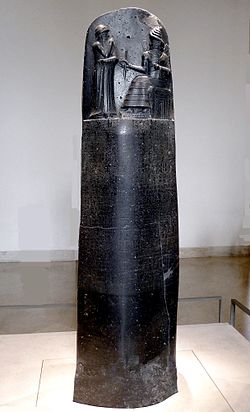
The Code of Hammurabi is a Babylonian legal text composed during 1755–1751 BC. It is the longest, best-organized, and best-preserved legal text from the ancient Near East. It is written in the Old Babylonian dialect of Akkadian, purportedly by Hammurabi, sixth king of the First Dynasty of Babylon. The primary copy of the text is inscribed on a basalt stele 2.25 m (7 ft 4+1⁄2 in) tall.
The stele was rediscovered in 1901 at the site of Susa in present-day Iran, where it had been taken as plunder six hundred years after its creation. The text itself was copied and studied by Mesopotamian scribes for over a millennium. The stele now resides in the Louvre Museum.
The top of the stele features an image in relief of Hammurabi with Shamash, the Babylonian sun god and god of justice. Below the relief are about 4,130 lines of cuneiform text: one fifth contains a prologue and epilogue in poetic style, while the remaining four fifths contain what are generally called the laws. In the prologue, Hammurabi claims to have been granted his rule by the gods "to prevent the strong from oppressing the weak". The laws are casuistic, expressed as "if ... then" conditional sentences. Their scope is broad, including, for example, criminal law, family law, property law, and commercial law.
Modern scholars responded to the Code with admiration at its perceived fairness and respect for the rule of law, and at the complexity of Old Babylonian society. There was also much discussion of its influence on the Mosaic Law. Scholars quickly identified lex talionis—the "eye for an eye" principle—underlying the two collections. Debate among Assyriologists has since centred around several aspects of the Code: its purpose, its underlying principles, its language, and its relation to earlier and later law collections.
Despite the uncertainty surrounding these issues, Hammurabi is regarded outside Assyriology as an important figure in the history of law and the document as a true legal code. The U.S. Capitol has a relief portrait of Hammurabi alongside those of other historic lawgivers. There are replicas of the stele in numerous institutions, including the headquarters of the United Nations in New York City, the Pergamon Museum in Berlin and the University of Chicago's Institute for the Study of Ancient Cultures.
Hammurabi (or Hammurapi), the sixth king of the Amorite First Dynasty of Babylon, ruled from 1792 to 1750 BC (middle chronology). He secured Babylonian dominance over the Mesopotamian plain through military prowess, diplomacy, and treachery. When Hammurabi inherited his father Sin-Muballit's throne, Babylon held little local sway; the local hegemon was Rim-Sin of Larsa. Hammurabi waited until Rim-Sin grew old, then conquered his territory in one swift campaign, leaving his organisation intact. Later, Hammurabi betrayed allies in Eshnunna, Elam, and Mari to gain their territories.
Hammurabi had an aggressive foreign policy, but his letters suggest he was concerned with the welfare of his many subjects and was interested in law and justice. He commissioned extensive construction works, and in his letters, he frequently presents himself as his people's shepherd. Justice is also a theme of the prologue to the Code, and "the word translated 'justice' [ešērum]... is one whose root runs through both prologue and epilogue".
Although Hammurabi's Code was the first Mesopotamian law collection to be discovered, it was not the first written; several earlier collections survive. These collections were written in Sumerian and Akkadian. They also purport to have been written by rulers. There were almost certainly more such collections, as statements of other rulers suggest the custom was widespread. The similarities between these law collections make it tempting to assume a consistent underlying legal system. As with the Code of Hammurabi, however, it is difficult to interpret the purpose and underlying legal systems of these earlier collections, prompting numerous scholars to question whether this should be attempted. Extant collections include:
Code of Hammurabi
The Code of Hammurabi is a Babylonian legal text composed during 1755–1751 BC. It is the longest, best-organized, and best-preserved legal text from the ancient Near East. It is written in the Old Babylonian dialect of Akkadian, purportedly by Hammurabi, sixth king of the First Dynasty of Babylon. The primary copy of the text is inscribed on a basalt stele 2.25 m (7 ft 4+1⁄2 in) tall.
The stele was rediscovered in 1901 at the site of Susa in present-day Iran, where it had been taken as plunder six hundred years after its creation. The text itself was copied and studied by Mesopotamian scribes for over a millennium. The stele now resides in the Louvre Museum.
The top of the stele features an image in relief of Hammurabi with Shamash, the Babylonian sun god and god of justice. Below the relief are about 4,130 lines of cuneiform text: one fifth contains a prologue and epilogue in poetic style, while the remaining four fifths contain what are generally called the laws. In the prologue, Hammurabi claims to have been granted his rule by the gods "to prevent the strong from oppressing the weak". The laws are casuistic, expressed as "if ... then" conditional sentences. Their scope is broad, including, for example, criminal law, family law, property law, and commercial law.
Modern scholars responded to the Code with admiration at its perceived fairness and respect for the rule of law, and at the complexity of Old Babylonian society. There was also much discussion of its influence on the Mosaic Law. Scholars quickly identified lex talionis—the "eye for an eye" principle—underlying the two collections. Debate among Assyriologists has since centred around several aspects of the Code: its purpose, its underlying principles, its language, and its relation to earlier and later law collections.
Despite the uncertainty surrounding these issues, Hammurabi is regarded outside Assyriology as an important figure in the history of law and the document as a true legal code. The U.S. Capitol has a relief portrait of Hammurabi alongside those of other historic lawgivers. There are replicas of the stele in numerous institutions, including the headquarters of the United Nations in New York City, the Pergamon Museum in Berlin and the University of Chicago's Institute for the Study of Ancient Cultures.
Hammurabi (or Hammurapi), the sixth king of the Amorite First Dynasty of Babylon, ruled from 1792 to 1750 BC (middle chronology). He secured Babylonian dominance over the Mesopotamian plain through military prowess, diplomacy, and treachery. When Hammurabi inherited his father Sin-Muballit's throne, Babylon held little local sway; the local hegemon was Rim-Sin of Larsa. Hammurabi waited until Rim-Sin grew old, then conquered his territory in one swift campaign, leaving his organisation intact. Later, Hammurabi betrayed allies in Eshnunna, Elam, and Mari to gain their territories.
Hammurabi had an aggressive foreign policy, but his letters suggest he was concerned with the welfare of his many subjects and was interested in law and justice. He commissioned extensive construction works, and in his letters, he frequently presents himself as his people's shepherd. Justice is also a theme of the prologue to the Code, and "the word translated 'justice' [ešērum]... is one whose root runs through both prologue and epilogue".
Although Hammurabi's Code was the first Mesopotamian law collection to be discovered, it was not the first written; several earlier collections survive. These collections were written in Sumerian and Akkadian. They also purport to have been written by rulers. There were almost certainly more such collections, as statements of other rulers suggest the custom was widespread. The similarities between these law collections make it tempting to assume a consistent underlying legal system. As with the Code of Hammurabi, however, it is difficult to interpret the purpose and underlying legal systems of these earlier collections, prompting numerous scholars to question whether this should be attempted. Extant collections include:
Recent media
Recent media