


Community hub
Recent from talks
Contribute something
Nothing was collected or created yet.
House of Hanover
View on Wikipedia
| House of Hanover | |
|---|---|
 Arms of the House of Hanover | |
.svg) | |
| Parent family | Bonifaci → Obertenghi → Este → Welf |
| Country | |
| Etymology | Hanover |
| Founded | 1634 |
| Founder | George, Duke of Brunswick-Lüneburg |
| Current head | Ernst August, Prince of Hanover |
| Titles | List
|
| Deposition |
|
| Cadet branches | Illegitimate branches
|
The House of Hanover (German: Haus Hannover German pronunciation: [haʊ̯s haˈnoːfɐ]) is a European royal house with roots tracing back to the 17th century. Its members, known as Hanoverians, ruled Hanover, Great Britain, Ireland, and the British Empire at various times during the 17th to 20th centuries. Originating as a cadet branch of the House of Welf (also "Guelf" or "Guelph") in 1635, also known then as the House of Brunswick-Lüneburg, the Hanoverians ascended to prominence with Hanover's elevation to an Electorate of the Holy Roman Empire in 1692. In 1714 George I, prince-elector of Hanover and a descendant of King James VI and I, assumed the throne of Great Britain and Ireland, marking the beginning of Hanoverian rule over the British Empire. At the end of this line, Queen Victoria's death in 1901, the throne of the United Kingdom passed to her eldest son Edward VII, a member of the House of Saxe-Coburg and Gotha, through his father Albert, Prince Consort. The last reigning members of the House of Hanover lost the Duchy of Brunswick in 1918 when Germany became a republic and abolished royalty and nobility.
The formal name of the house was the "House of Brunswick-Lüneburg, Hanover line".[1] The senior line of Brunswick-Lüneburg, which ruled Brunswick-Wolfenbüttel, became extinct in 1884. The House of Hanover is now the only surviving branch of the House of Welf, which is the senior branch of the House of Este. The current head of the House of Hanover is Ernst August, Prince of Hanover.
History
[edit]Dukes and Electors of Brunswick-Lüneburg
[edit]George, Duke of Brunswick-Lüneburg was the first member of the House of Hanover.[2] When the Duchy of Brunswick-Lüneburg was divided in 1635, George inherited the Principality of Calenberg and moved his residence to Hanover. His son, Christian Louis, inherited the Principality of Lüneburg from George's brother. Calenberg and Lüneburg were then shared between George's sons until united in 1705 under his grandson, also called George, who subsequently became George I of Great Britain. All members held the title of Duke of Brunswick-Lüneburg.
- George, Duke of Brunswick-Lüneburg, first member of the House of Hanover.
- Christian Louis, 1st son of Duke George, Prince of Calenberg (1641–1648) and Prince of Lüneburg (1648–1665). He relinquished Calenburg when he became Prince of Lüneburg.
- George William, 2nd son of Duke George, Prince of Calenberg (1648–1665) and Prince of Lüneburg (1665–1705). He relinquished Calenburg when he became Prince of Lüneburg on the death of his brother, Christian Louis.
- John Frederick, 3rd son of Duke George, Prince of Calenberg (1665–1679).
- Ernest Augustus, 4th son of Duke George, Prince of Calenberg (1679–1698). He became Prince of Calenberg on the death of his brother John Frederick. He was elevated to prince-elector of the Holy Roman Empire in 1692. Ernest Augustus's wife, Sophia of the Palatinate, was declared heiress of the throne of England by the Act of Settlement of 1701, which decreed Roman Catholics could not accede to the throne. Sophia was at that time the senior eligible Protestant descendant of James I of England.
- George Louis, son of Duke Ernest Augustus and Sophia, became Elector and Prince of Calenberg in 1698 and Prince of Lüneburg when his uncle George William died in 1705. He inherited his mother's claim to the throne of Great Britain when she died in 1714.
Monarchs of Great Britain, Ireland, and Hanover
[edit].jpg)


George Louis became the first British monarch of the House of Hanover as George I in 1714.[3]: 13 The dynasty provided six British monarchs:
Of the Kingdoms of Great Britain and Ireland (changed in 1801 to the United Kingdom of Great Britain and Ireland):[note 1]
- George I (r. 1714–1727) (Georg Ludwig = George Louis)
- George II (r. 1727–1760) (Georg August = George Augustus)
- George III (r. 1760–1820)
- George IV (r. 1820–1830)
- William IV (r. 1830–1837)
- Victoria (r. 1837–1901).
George I, George II, and George III also served as electors and dukes of Brunswick-Lüneburg, informally, Electors of Hanover (cf. personal union). They served as dual monarchs of Britain and Hanover, maintaining control of the Hanoverian Army and foreign policy. From 1814, when Hanover became a kingdom following the Napoleonic Wars, the British monarch was also King of Hanover.
Upon the death of William IV in 1837, the personal union of the thrones of the United Kingdom and Hanover ended. Succession to the Hanoverian throne was regulated by semi-Salic law (agnatic-cognatic), which gave priority to all male lines before female lines, and so it passed not to Queen Victoria but to her uncle, the Duke of Cumberland.[3]: 13, 14 In 1901, when Queen Victoria, the last British monarch provided by the House of Hanover, died, her son and heir Edward VII became the first British monarch of the House of Saxe-Coburg and Gotha. Edward took his family name from that of his father, Prince Albert of Saxe-Coburg-Gotha.[3]: 14
After end of personal union
[edit]

After the death of William IV in 1837, the following kings of Hanover continued the dynasty:
- Ernest Augustus, King of Hanover (r. 1837–1851)
- George V (r. 1851–1866, deposed)
The Kingdom of Hanover ended in 1866, when it was annexed by the Kingdom of Prussia, and the King of Hanover (and Duke of Cumberland) was forced to go into exile in Austria. The 1866 rift between the houses of Hanover and Hohenzollern was settled by the 1913 marriage of Princess Viktoria Luise of Prussia to Ernest Augustus, Duke of Brunswick, the last king's grandson.
Prince-bishops of Osnabrück
[edit]At the end of the Thirty Years' War, the Peace of Westphalia (1648) awarded the Prince-Bishopric of Osnabrück alternately to a Catholic bishop and to a cadet branch of Brunswick-Lüneburg.[4] Since the treaty gave cadets priority over heirs and reigning princes, Osnabrück became a form of appanage (in alternation) of the House of Hanover.
- Ernest Augustus, Elector of Brunswick-Lüneburg (r. 1662–1698), fourth son of George, Duke of Brunswick-Lüneburg
- Ernest Augustus, Duke of York and Albany (r. 1715–1728), sixth son of Ernest Augustus, Elector of Brunswick-Lüneburg
- Prince Frederick, Duke of York and Albany (r. 1764–1802), second son of George III
Osnabrück was mediatized to Hanover in 1803.
Dukes of Brunswick
[edit].svg)

In 1884, the senior branch of the House of Welf became extinct. By semi-Salic law, the House of Hanover would have acceded to the Duchy of Brunswick, but there had been strong Prussian pressure against having George V of Hanover or his son, the Duke of Cumberland, succeed to a member state of the German Empire, at least without strong conditions including the swearing to the German constitution. By a law of 1879, the Duchy of Brunswick established a temporary council of regency to take over at the Duke's death and, if necessary, to appoint a regent.
The Duke of Cumberland proclaimed himself Duke of Brunswick at the Duke's death, and lengthy negotiations ensued but were never resolved. Prince Albert of Prussia was appointed regent. After his death in 1906, Duke John Albert of Mecklenburg succeeded him. The Duke of Cumberland's eldest son died in a car accident in 1912; the father renounced Brunswick in favour of his younger son Ernest Augustus, who married the Kaiser's daughter Victoria Louise the same year, swore allegiance to the German Empire and was allowed to ascend the throne of the Duchy in November 1913. He was a major-general during the First World War, but he was overthrown as Duke of Brunswick in 1918. His father was also deprived of his British titles in 1919 for "bearing arms against Great Britain".
After having left Brunswick Palace, the duke and his family moved back to their exile seat Cumberland Castle at Gmunden, Austria, but in 1924 he received Blankenburg Castle and some other estates in a settlement with the Free State of Brunswick, and moved there in 1930. A few days before Blankenburg was handed over to the Red Army by British and American forces in late 1945, to become part of East Germany, the family quickly moved to Marienburg Castle (Hanover) with all their furniture, transported by British army trucks by the order of King George VI.[5] Duke Ernest Augustus died at Marienburg Castle in 1953. His Herrenhausen Palace in Hanover had been completely destroyed during World War II. His eldest son, Prince Ernest Augustus, sold his remaining property at Herrenhausen Gardens in 1961 but kept the nearby Princely House, a small palace built in 1720 by George I for his daughter Anna Louise. It is now his grandson Ernest Augustus's private home.
Claimants
[edit]The later heads of the House of Hanover have been:
- George V (1866–1878)
- Ernest Augustus, Crown Prince of Hanover, 3rd Duke of Cumberland and Teviotdale (1878–1923)
- Ernest Augustus, Duke of Brunswick (1923–1953), son of the previous
- Ernest Augustus, Prince of Hanover (1953–1987)
- Ernest Augustus, Prince of Hanover (1987–present)
The family has been resident in Austria since 1866 and thus took on Austrian nationality besides their German and British. Since the later king Ernest Augustus had been created Duke of Cumberland and Teviotdale and Earl of Armagh by his father George III in 1799, these British peerages were inherited by his descendants. In 1914 the title of a Prince of Great Britain and Ireland was additionally granted to the members of the house by King George V. These peerages and titles however were suspended under the Titles Deprivation Act 1917.[note 2] However, the title Royal Prince of Great Britain and Ireland had been entered into the family's German passports, together with the German titles, in 1914. After the German Revolution of 1918–19, with the abolishment of nobility's privileges,[note 3] titles officially became parts of the last name. So, curiously, the British prince's title is still part of the family's last name in their German passports, while it is no longer mentioned in their British documents.[6]
On 29 August 1931, Ernest Augustus, Duke of Brunswick, as head of the House of Hanover, declared the formal resumption, for himself and his dynastic descendants, of use of his former British princely title as a secondary title of pretense, which style, "Royal Prince of Great Britain and Ireland", his grandson, the current head of the house, also called Ernest Augustus, continues to claim.[7] He has the right to petition under the Titles Deprivation Act 1917 for the restoration of his ancestors' suspended British peerages Duke of Cumberland and Teviotdale and Earl of Armagh, but he has not done so. His father, another Ernest Augustus, did, however, successfully claim British nationality after World War II by virtue of a hitherto overlooked (and since repealed) provision of the Sophia Naturalization Act 1705.[8] According to the decision taken by a court of the House of Lords, all family members bear the last name Guelph in the UK and are styled Royal Highnesses in their documents.
Members
[edit]Patrilineal descent
[edit]- Oberto I, 912–975
- Oberto Obizzo, 940–1017
- Albert Azzo I, Margrave of Milan, 970–1029
- Albert Azzo II, Margrave of Milan, died 1097
- Welf I, Duke of Bavaria, 1037–1101
- Henry IX, Duke of Bavaria, 1074–1126
- Henry X, Duke of Bavaria, 1108–1139
- Henry the Lion, 1129–1195
- William of Winchester, Lord of Lunenburg, 1184–1213
- Otto I, Duke of Brunswick-Lüneburg, 1204–1252
- Albert I, Duke of Brunswick-Lüneburg, 1236–1279
- Albert II, Duke of Brunswick-Lüneburg, 1268–1318
- Magnus the Pious, Duke of Brunswick-Lüneburg, 1304–1369
- Magnus II, Duke of Brunswick-Lüneburg, 1328–1373
- Bernard I, Duke of Brunswick-Lüneburg, 1362–1434
- Frederick II, Duke of Brunswick-Lüneburg, 1408–1478
- Otto V, Duke of Brunswick-Lüneburg, 1439–1471
- Heinrich, Duke of Brunswick-Lüneburg, 1468–1532
- Ernest I, Duke of Brunswick-Lüneburg, 1497–1546
- William, Duke of Brunswick-Lüneburg, 1535–1592
- George, Duke of Brunswick-Lüneburg, 1582–1641
- Ernest Augustus, Elector of Hanover, 1629–1698
- George I of Great Britain, 1660–1727
- George II of Great Britain, 1683–1760
- Frederick, Prince of Wales, 1707–1751
- George III of the United Kingdom, 1738–1820
- Ernest Augustus, King of Hanover, 1771–1851
- George V of Hanover, 1819–1878
- Ernest Augustus, Crown Prince of Hanover, 1845–1923
- Ernest Augustus, Duke of Brunswick, 1887–1953
- Ernest Augustus, Prince of Hanover, 1914–1987
- Ernst August, Prince of Hanover, b. 1954
- Prince Ernest Augustus of Hanover, b. 1983
Family tree
[edit]| House of Hanover family tree | |||||||||||||||||||||||||||||||||||||||||||||||||||||||||||||||||||||||||||||||||||||||||||||||||||||||||||||||||||||||||||||||||||||||||||||||||||||||||||||||||||||||||||||||||||||||||||||||||||||||||||||||||||||||||||||||||||||||||||||||||||||||||||||||||||||||||||||||||||||||||||||||||||||||||||||||||||||||||||||||||||||||||||||||||||||||||||||||||||||||||||||||||||||||||||||||||||||||||||||||||||||||||||||||||||||||||||||||||||||||||||||||||||||||||||||||||||||||||||||||||||||||||||||||||||||||||||||||||||||||||||||||||||||||||||||||||||||||||||||||||||||||||||||||||||||||||||||||||||||||||||||||||||||||||||||||||||||||||||||||||||||||||||||||||||||||||||||||||||||||||||||||||||||||||||||||||||||||||||||||||||||||||||||||||||||||||||||||||||||||||||||||||||||||||||||||||||||||||||||||||||||||||||||||||||||||||||||||||||||||||||||||||||||||||||||||||||||||||||||||||||||||||||||||||||||||||||||||||||||||||||||||||||||||||||||||||||||||||||||||||||||||||||||||||||||||||||||||||||||||
|---|---|---|---|---|---|---|---|---|---|---|---|---|---|---|---|---|---|---|---|---|---|---|---|---|---|---|---|---|---|---|---|---|---|---|---|---|---|---|---|---|---|---|---|---|---|---|---|---|---|---|---|---|---|---|---|---|---|---|---|---|---|---|---|---|---|---|---|---|---|---|---|---|---|---|---|---|---|---|---|---|---|---|---|---|---|---|---|---|---|---|---|---|---|---|---|---|---|---|---|---|---|---|---|---|---|---|---|---|---|---|---|---|---|---|---|---|---|---|---|---|---|---|---|---|---|---|---|---|---|---|---|---|---|---|---|---|---|---|---|---|---|---|---|---|---|---|---|---|---|---|---|---|---|---|---|---|---|---|---|---|---|---|---|---|---|---|---|---|---|---|---|---|---|---|---|---|---|---|---|---|---|---|---|---|---|---|---|---|---|---|---|---|---|---|---|---|---|---|---|---|---|---|---|---|---|---|---|---|---|---|---|---|---|---|---|---|---|---|---|---|---|---|---|---|---|---|---|---|---|---|---|---|---|---|---|---|---|---|---|---|---|---|---|---|---|---|---|---|---|---|---|---|---|---|---|---|---|---|---|---|---|---|---|---|---|---|---|---|---|---|---|---|---|---|---|---|---|---|---|---|---|---|---|---|---|---|---|---|---|---|---|---|---|---|---|---|---|---|---|---|---|---|---|---|---|---|---|---|---|---|---|---|---|---|---|---|---|---|---|---|---|---|---|---|---|---|---|---|---|---|---|---|---|---|---|---|---|---|---|---|---|---|---|---|---|---|---|---|---|---|---|---|---|---|---|---|---|---|---|---|---|---|---|---|---|---|---|---|---|---|---|---|---|---|---|---|---|---|---|---|---|---|---|---|---|---|---|---|---|---|---|---|---|---|---|---|---|---|---|---|---|---|---|---|---|---|---|---|---|---|---|---|---|---|---|---|---|---|---|---|---|---|---|---|---|---|---|---|---|---|---|---|---|---|---|---|---|---|---|---|---|---|---|---|---|---|---|---|---|---|---|---|---|---|---|---|---|---|---|---|---|---|---|---|---|---|---|---|---|---|---|---|---|---|---|---|---|---|---|---|---|---|---|---|---|---|---|---|---|---|---|---|---|---|---|---|---|---|---|---|---|---|---|---|---|---|---|---|---|---|---|---|---|---|---|---|---|---|---|---|---|---|---|---|---|---|---|---|---|---|---|---|---|---|---|---|---|---|---|---|---|---|---|---|---|---|---|---|---|---|---|---|---|---|---|---|---|---|---|---|---|---|---|---|---|---|---|---|---|---|---|---|---|---|---|---|---|---|---|---|---|---|---|---|---|---|---|---|---|---|---|---|---|---|---|---|---|---|---|---|---|---|---|---|---|---|---|---|---|---|---|---|---|---|---|---|---|---|---|---|---|---|---|---|---|---|---|---|---|---|---|---|---|---|---|---|---|---|---|---|---|---|---|---|---|---|---|---|---|---|---|---|---|---|---|---|---|---|---|---|---|---|---|---|---|---|---|---|---|---|---|---|---|---|---|---|---|---|---|---|---|---|---|---|---|---|---|---|---|---|---|---|---|---|---|---|---|---|---|---|---|---|---|---|---|---|---|---|---|---|---|---|---|---|---|---|---|---|---|---|---|---|---|---|---|---|---|---|---|---|---|---|---|---|---|---|---|---|---|---|---|---|---|---|---|---|---|---|---|---|---|---|---|---|---|---|---|---|---|---|---|---|---|---|---|---|---|---|---|---|---|---|---|---|---|---|---|---|---|---|---|---|---|---|---|---|---|---|---|---|---|---|---|---|---|---|---|---|---|---|---|---|---|---|---|---|---|---|---|---|---|---|---|---|---|---|---|---|---|---|---|---|---|---|---|---|---|---|---|---|---|---|---|---|---|---|---|---|---|---|---|---|---|---|---|---|---|---|---|---|---|---|---|---|---|---|---|---|---|---|---|---|---|---|---|---|---|---|---|---|---|---|---|---|---|---|---|---|---|---|---|---|---|---|---|---|---|---|---|---|---|---|---|---|---|---|---|---|---|---|---|---|---|---|---|---|---|---|---|---|---|---|---|---|---|---|---|---|---|---|---|---|---|---|---|---|---|---|---|---|---|---|---|---|---|---|---|---|---|---|---|---|---|---|---|---|---|---|---|---|---|---|---|---|---|---|---|---|---|---|---|---|---|---|---|---|---|---|---|---|---|---|---|---|---|---|---|---|---|---|---|---|---|---|---|---|---|---|---|---|---|---|---|---|---|---|---|---|---|
|
House of Brunswick-Lüneburg, Hanover line
Key: : The red border indicates leaders of the House : The bold black border indicates children of leaders : The thin black border indicates other relatives
| |||||||||||||||||||||||||||||||||||||||||||||||||||||||||||||||||||||||||||||||||||||||||||||||||||||||||||||||||||||||||||||||||||||||||||||||||||||||||||||||||||||||||||||||||||||||||||||||||||||||||||||||||||||||||||||||||||||||||||||||||||||||||||||||||||||||||||||||||||||||||||||||||||||||||||||||||||||||||||||||||||||||||||||||||||||||||||||||||||||||||||||||||||||||||||||||||||||||||||||||||||||||||||||||||||||||||||||||||||||||||||||||||||||||||||||||||||||||||||||||||||||||||||||||||||||||||||||||||||||||||||||||||||||||||||||||||||||||||||||||||||||||||||||||||||||||||||||||||||||||||||||||||||||||||||||||||||||||||||||||||||||||||||||||||||||||||||||||||||||||||||||||||||||||||||||||||||||||||||||||||||||||||||||||||||||||||||||||||||||||||||||||||||||||||||||||||||||||||||||||||||||||||||||||||||||||||||||||||||||||||||||||||||||||||||||||||||||||||||||||||||||||||||||||||||||||||||||||||||||||||||||||||||||||||||||||||||||||||||||||||||||||||||||||||||||||||||||||||||||||
Legacy
[edit]Many towns and provinces across the British Empire were named after the ruling House of Hanover and its members. They include the U.S. state of Georgia, U.S. towns Hanover, Massachusetts; Hanover, New Hampshire; Hanover, Pennsylvania; Hanover Township, Jo Daviess County, Illinois, counties Hanover County, Virginia; Caroline County, Virginia; Brunswick County, Virginia; New Hanover County, North Carolina; Brunswick County, North Carolina; King George County, Virginia, places named Georgia in New Jersey (e.g. New Brunswick, NJ), Vermont, Arkansas and South Dakota, seven towns in the U.S. and Canada named after Queen Charlotte. Furthermore the Canadian province of New Brunswick and towns Hanover, Ontario, Guelph; Ontario, and Victoria, British Columbia; in South Africa the town Hanover, Northern Cape, in Australia the state Victoria and the city Adelaide, in the UK six and in the US thirteen towns named Brunswick. Furthermore one each in Australia and New Zealand, and worldwide more than fifty towns named Victoria. There are also numerous streets and squares, such as Hanover Square, Westminster, Hanover Square (Manhattan), Hanover Square, Syracuse or Queen Street, Brisbane with its intersections named after members of the House.
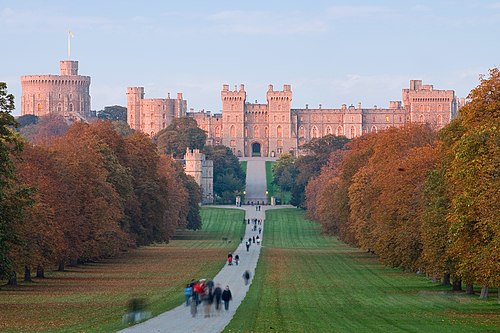
Georgian architecture gives distinction to the architectural styles current between 1714 and 1830 in most English-speaking countries.
-

-

-
-

-

-

-
 The Leine Palace in Hanover (Former Royal Residence of the Kingdom of Hanover)
 -
 Herrenhausen Palace and Gardens in Hanover (c. 1708)
 -

-
 Marienburg Castle (Hanover), present seat of the Princes of Hanover


.jpg)


See also
[edit]- Hanoverian prince for family tree
- King of Hanover
- Georgian era for kings George I, II, III, IV
- History of Hanover
- Electorate of Hanover
- Kingdom of Hanover
- Personal union of Great Britain and Hanover
- German Chancery
Notes
[edit]- ^ In 1801, the British and Irish kingdoms merged, forming the United Kingdom of Great Britain and Ireland.
- ^ Privately however the British Royal Family (of the House of Saxe-Coburg and Gotha, alias House of Windsor) continued to call their German branch the Cumberlands, for instance when Edward VIII described his visit to the family in Gmunden in a letter to his mother in 1937.
- ^ In 1919 royalty and nobility lost their privileges as such in Germany, hereditary titles thereafter being legally retained only as part of the surname, according to Article 109 the Weimar Constitution.
References
[edit]- ^ "Royal Arms of Britain". Heraldica. Archived from the original on 6 December 2008. Retrieved 10 May 2016.
The House of Brunswick Luneburg being one of the most illustrious and most ancient in Europe, the Hanoverian branch having filled for more than a century one of the most distinguished thrones, its possessions being among the most considerable in Germany;
- ^ Orr, Clarissa Campbell, ed. (2002). Queenship in Britain 1660–1837: Royal Patronage, Court Culture and Dynastic Politics (1st ed.). Manchester: Manchester University Press. ISBN 9780719057694.: 195
- ^ a b c Picknett, Lynn; Prince, Clive; Prior, Stephen; Brydon, Robert (2002). War of the Windsors: A Century of Unconstitutional Monarchy. Mainstream Publishing. ISBN 1-84018-631-3..
- ^ Duggan, J. N. (2011). Sophia of Hanover: From Winter Princess to Heiress of Great Britain, 1630–1714. London: Peter Owen Publishers. ISBN 9780720614237.
According to the Peace of Westphalia, the See of Osnabrück was to be held alternately by a Catholic and a Protestant incumbent; the Protestant bishop was to be a younger son of the Brunswick-Lüneburg family.
- ^ Viktoria Luise (Herzogin zu Braunschweig und Lüneburg) (1977). The Kaiser's Daughter: Memoirs of H. R. H. Viktoria Luise, Duchess of Brunswick and Lüneburg, Princess of Prussia. Prenticse-Hall. ISBN 978-0-13-514653-8.
- ^ "In der Prinzenrolle". HAZ – Hannoversche Allgemeine. Archived from the original on 31 August 2019. Retrieved 22 January 2018.
- ^ Ernst August (geb.1954) Prinz von Hannover Archived 21 January 2021 at the Wayback Machine at welfen.de (in German)
- ^ Attorney-General v HRH Prince Ernest Augustus of Hanover [1957] 1 All ER 49
Further reading
[edit]- Black, Jeremy (2003). "Georges I & II: Limited monarchs". History Today. 53 (2): 11+.
- Black, Jeremy (2004). The Hanoverians: The History of a Dynasty.
- Fraser, Flora. (2005). Princesses: The Six Daughters of George III. Knopf.
- Plumb, J. H. (1974). The First Four Georges (Revised ed.). Hamlyn.
- Redman, Alvin (1960). The House of Hanover. Coward-McCann.
- Robertson, Charles (1911). England under the Hanoverians.
- Schweizer, Karl W.; Black, Jeremy (1989). Politics and the Press in Hanoverian Britain. E. Mellon Press.
- Simms, Brendan; Riotte, Torsten, eds. (2009). The Hanoverian Dimension in British History, 1714–1837. Cambridge University Press. doi:10.1017/CBO9780511496936. ISBN 9780511496936.
- Thackeray, William M. (1861). The Four Georges: Sketches of Manners, Morals, Court, and Town Life. Smith, Elder & Co.
- Van der Kiste, John (1992). George III's Children. Sutton Publishing.
Historiography
[edit]- Bultmann, William A. "Early Hanoverian England (1714–1760): Some Recent Writings," in Elizabeth Chapin Furber, ed. Changing views on British history: essays on historical writing since 1939 (Harvard University Press, 1966), pp 181–205
- O’Gorman, Frank (1986). "The Recent Historiography of the Hanoverian Regime". Historical Journal. 29 (4): 1005–1020. doi:10.1017/S0018246X00019178. S2CID 159984575.
- Snyder, Henry L. "Early Georgian England," in Richard Schlatter, ed., Recent Views on British History: Essays on Historical Writing since 1966 (Rutgers UP, 1984), pp. 167–196, historiography
External links
[edit]
- (in German) Official website of the House of Welf
- Succession laws in the House of Welf
- British German Royal Heritage Route 2014
- House of Hanover Archive.org
- British Hanoverian Family tree
| International | |
|---|---|
| National | |
| People | |
| Other | |

House of Hanover
View on GrokipediaThe House of Hanover was a royal dynasty of German origin, descended from the House of Welf, that ruled the Electorate of Hanover from its creation in 1692 until 1814 and the subsequent Kingdom of Hanover from 1814 to 1866, while also providing the monarchs of Great Britain and Ireland from 1714 to 1901.[1][2]
Founded through the elevation of Ernest Augustus, Duke of Brunswick-Lüneburg, to Elector of Hanover by Emperor Leopold I, the house gained prominence in British succession via Sophia of the Palatinate, Ernest Augustus's wife and granddaughter of James I, whom the Act of Settlement 1701 designated as the Protestant heir apparent to ensure the exclusion of Catholic claimants.[3][4]
Their son, George Louis, ascended as George I in 1714 upon the death of Queen Anne, initiating a period of six Hanoverian monarchs—George I, George II, George III, George IV, William IV, and Victoria—who oversaw Britain's transition to a constitutional monarchy with enhanced parliamentary authority.[2]
The dynasty's rule coincided with the entrenchment of cabinet government under figures like Robert Walpole, the first de facto prime minister, the introduction of fiscal innovations such as income tax, and the Great Reform Act of 1832, alongside the expansion of the British Empire to cover a third of the world's surface by Victoria's reign.[2]
Notable challenges included Jacobite rebellions attempting to restore Stuart claimants, George III's bouts of porphyria-induced incapacity leading to the regency of George IV, and the loss of the American colonies in 1783, though offset by victories in the Seven Years' War and acquisitions like Canada and India.[2]
The personal union with Hanover severed in 1837 when Victoria's accession to the British throne excluded her under Hanover's Salic law, which prohibited female inheritance, prompting her uncle Ernest Augustus to become King of Hanover separately until the kingdom's annexation by Prussia in 1866 after defeat in the Austro-Prussian War.[1][5]
Origins and Early Development
Roots in the Guelph Dynasty
The Guelph dynasty, also known as the House of Welf, originated in the 9th century among Frankish nobility in Bavaria, with its earliest discernible progenitor being Count Welf I (died c. 825), who held estates in the region and married Edith, sister of Emperor Louis the Pious, thereby linking the family to Carolingian royalty.[6] This Elder House of Welf initially focused on Swabian and Bavarian territories, expanding influence through strategic marriages and imperial favor, though records from this period remain sparse and primarily derived from monastic chronicles.[6] By the 11th century, the dynasty's prominence surged under Welf IV (c. 1030–1101), appointed Duke of Bavaria in 1070 by Emperor Henry IV as reward for loyalty amid investiture conflicts, ruling intermittently until 1101 and establishing the Younger House of Welf as a major German princely line.[7] Successors like Henry IX the Black (1074–1126) and Henry X the Proud (1108–1139) consolidated power in Saxony and Bavaria, but the pivotal figure was Henry the Lion (c. 1129–1195), grandson of Henry X, who as Duke of Saxony from 1142 and Bavaria from 1156 amassed vast northern territories through conquests against Slavic Wend tribes, founded cities including Munich in 1158, and allied with the English Angevins via his marriage to Matilda, daughter of King Henry II.[8] Henry the Lion's defiance of Emperor Frederick I Barbarossa led to his imperial ban in 1180 and deprivation of duchies, yet his sons retained core patrimonial lands around Brunswick and Lüneburg, preserving Guelph continuity in Lower Saxony.[8] The direct ancestral line to the House of Hanover emerged from these holdings when, in 1235 at the Diet of Windberg, Otto I the Child (1204–1252), a grandson of Henry the Lion through his son William of Lüneburg, was enfeoffed by Emperor Frederick II with the newly erected Duchy of Brunswick-Lüneburg, compensating for lost Saxon titles and formalizing Guelph rule over a consolidated territory of approximately 10,000 square kilometers centered on the Leine and Aller rivers.[9] This duchy, often subdivided among heirs yet repeatedly recombined, became the cradle for later Guelph branches, including the Calenberg line that evolved into the Electorate of Hanover in 1692, thus anchoring the dynasty's enduring German sovereignty and eventual British ties.[10] The Guelphs' rivalry with the Hohenstaufen emperors underscored their imperial ambitions, fostering a tradition of pragmatic alliances and territorial resilience that defined their medieval legacy.[6]Dukes of Brunswick-Lüneburg (1635–1692)
Following the extinction of the senior Lüneburg line with the death of Duke Frederick Ulrich on 11 August 1634, the House of Welf dukes agreed to a territorial redistribution in 1635, assigning the Principality of Calenberg—encompassing the city of Hanover and surrounding lands—to George, a younger son of Duke William of Brunswick-Lüneburg.[11] George, born on 17 February 1582, ruled as Duke of Brunswick-Lüneburg and Prince of Calenberg from 1635 until his death on 12 April 1641.[12] Married to Anne Eleonore of Hesse-Darmstadt, he fathered four sons who would shape the dynasty's future, though his reign occurred amid the disruptions of the Thirty Years' War, limiting territorial consolidation.[11] George's eldest son, Christian Louis, born 25 February 1622, succeeded to Calenberg in 1641 but exchanged it in 1648 for the Principality of Lüneburg-Celle following the death of his great-uncle Augustus the Younger, thereby preserving family unity while adhering to primogeniture customs among the divided Welf branches.[13] Christian Louis, who died childless on 15 March 1665 after a brief marriage to Sophie Dorothea of Schleswig-Holstein-Sonderburg-Glücksburg, left his territories to his next brother, George William.[14] George William, ruling Lüneburg-Celle from 1665 to 1705, reassigned the secondary Calenberg principality to their brother John Frederick to avoid overextension, reflecting pragmatic strategies to maintain viable appanages within the fragmented duchy.[10] John Frederick, born 25 April 1625, governed Calenberg from 1665 until his death on 18 December 1679, exercising absolutist rule characterized by centralized administration and military reforms, though his personal conversion to Roman Catholicism in 1651 created tensions in the predominantly Protestant territory without altering its confessional status.[15] Childless like his predecessor, he was succeeded by the youngest brother, Ernest Augustus, born 20 November 1629, who assumed control of Calenberg in 1679 and pursued unification of Welf lands through diplomacy and strategic marriage.[16] Ernest Augustus's 1658 union with Sophia, daughter of Frederick V of the Palatinate, secured ties to broader Protestant networks, bolstering his position amid Holy Roman Empire politics.[11] In 1692, Emperor Leopold I elevated Ernest Augustus to elector in anticipation of his impending inheritance of the childless George William's Lüneburg territories, marking the transition from princely to electoral status and laying the groundwork for the House of Hanover's expanded influence.[16] This elevation, effective immediately though formalized later, rewarded Ernest Augustus's support for imperial policies during the Nine Years' War and his efforts to consolidate the Calenberg line's holdings, which totaled approximately 1,200 square miles by the late 17th century.[11]Establishment as Electorate of Hanover (1692)
Ernest Augustus, the youngest son of George, Duke of Brunswick-Calenberg-Lüneburg, had assumed effective control over the family's Calenberg territories by the mid-17th century, following the deaths of his elder brothers and strategic inheritances that consolidated the line's holdings in the region around Hanover.[16] By 1679, he formally succeeded as ruling duke, governing a principality that included the city of Hanover as its capital and benefiting from his earlier roles, including as prince-bishop of Osnabrück from 1667.[17] On December 19, 1692, Holy Roman Emperor Leopold I elevated Ernest Augustus and his principality to the status of an electorate, creating the Electorate of Brunswick-Lüneburg—commonly referred to as the Electorate of Hanover after its principal city.[18] This ninth electorate in the Holy Roman Empire was granted in recognition of Ernest Augustus's military contributions, including the provision of 6,000 troops against French forces during the Nine Years' War (1688–1697), and his broader diplomatic alignment with Habsburg interests against Louis XIV of France.[18] [19] The elevation promised enhanced influence for the House of Hanover within imperial politics, allowing Ernest Augustus a vote in selecting future emperors, though it required formal ratification by the Imperial Diet, which occurred only in 1708 after his death.[20] The new electoral dignity marked a pivotal advancement for the Guelph dynasty, transforming a fragmented duchy into a more unified and prestigious entity capable of competing with other major German states like Saxony and Bavaria.[21] Ernest Augustus's policies, including primogeniture enacted in 1682 to prevent further subdivision of territories, had already laid groundwork for this consolidation, ensuring his son George Louis (later George I of Great Britain) inherited an intact electorate.[16] This status quo persisted until the electorate's upgrade to a kingdom in 1814, but the 1692 grant solidified Hanover's role as a Protestant counterweight in the Empire's balance of power.[17]Ascension to the British Throne
The Act of Settlement (1701) and Protestant Succession
The death of William, Duke of Gloucester, on 30 July 1700—the only surviving child of Queen Anne—necessitated legislation to avert a Catholic succession, as Anne had no other legitimate heirs and the next Stuart claimants were Roman Catholics descended from the deposed James II.[22] The Act of Settlement, enacted by the Parliament of England and receiving royal assent on 12 June 1701, reinforced the anti-Catholic provisions of the 1689 Bill of Rights by explicitly barring any Roman Catholic or person married to a Roman Catholic from inheriting or holding the crown.[3] [23] The Act settled the succession, after the deaths of King William III and Queen Anne without further Protestant issue, upon Sophia, Electress of Hanover—granddaughter of James I and a Protestant—and her bodily heirs who remained in communion with the Church of England.[24] [23] Sophia, born in 1630 as the daughter of James I's daughter Elizabeth Stuart and Frederick V, Elector Palatine, had married Ernest Augustus, Duke (later Elector) of Brunswick-Lüneburg, whose territories included Hanover; her selection stemmed from her status as the nearest Protestant descendant of the Stuart line eligible under the religious criteria, bypassing over 50 Catholic claimants including James Francis Edward Stuart, the Jacobite pretender.[24] [3] This provision directly positioned the House of Hanover—through Sophia's Protestant lineage—as the designated successors, ensuring continuity of the Reformation settlement amid persistent Jacobite threats.[3] [22] The Act's succession clauses took effect upon Anne's death on 1 August 1714, shortly after Sophia's own death on 8 June 1714, elevating Sophia's son, George Louis, Elector of Hanover, as King George I and inaugurating the Hanoverian dynasty on the British throne.[24] [3] Originally applying to England and Ireland, the Act was extended to Scotland via the 1707 Acts of Union, solidifying the unified Protestant succession across Great Britain.[24] [3] By prioritizing confessional fidelity over strict primogeniture, the legislation underscored Parliament's authority to define monarchical inheritance, a principle rooted in the Glorious Revolution's rejection of absolute and Catholic rule.[3] [22]George I's Inaugural Reign (1714–1727)
George I, previously Elector George Louis of Hanover, ascended the throne of Great Britain and Ireland on 1 August 1714 upon the death of Queen Anne, in accordance with the Act of Settlement of 1701, which prioritized Protestant succession by naming Sophia of Hanover—granddaughter of James I—and her Protestant heirs over Catholic descendants of James II.[25] [24] Over 50 Catholic Stuart relatives held stronger dynastic claims by blood, but the Act's religious exclusion ensured Hanoverian continuity to avert a Catholic restoration.[25] His coronation took place on 20 October 1714 at Westminster Abbey, marking the first Hanoverian monarch's formal investiture amid Whig parliamentary dominance that had orchestrated the transition.[26] The early reign faced immediate dynastic challenges from Jacobitism, culminating in the 1715 rising. Discontent with the foreign-born king's limited English proficiency and perceived favoritism toward Hanoverian interests fueled support for James Francis Edward Stuart, the Old Pretender.[27] The rebellion ignited on 6 September 1715 when John Erskine, 6th Earl of Mar, raised the standard at Braemar, Scotland, assembling up to 10,000 supporters across Scotland and northern England.[28] Government forces under the Duke of Argyll suppressed the uprising, with decisive action at the Battle of Preston (9–14 November 1715), where approximately 1,500 Jacobites surrendered to 400 royal troops led by General Charles Wills, effectively ending organized resistance.[27] Over 1,000 rebels faced trials, with many executed or transported, solidifying Whig control and prompting the Septennial Act of 1716, which extended parliamentary terms from three to seven years to minimize Tory resurgence through frequent elections.[29][28] Domestically, George I's administration emphasized financial stability and Whig patronage, but the 1720 South Sea Bubble exposed speculative excesses. The South Sea Company, chartered in 1711 to manage national debt through trade concessions with Spanish America, convinced Parliament in 1720 to transfer £16 million in redeemable annuities to its stock, inflating shares from £128 to over £1,000 by June amid rampant speculation.[30] The bubble burst in September, wiping out fortunes and eroding public trust, though George I—serving as company governor since 1718—escaped deposition due to his limited direct involvement.[30] Robert Walpole, appointed Chancellor of the Exchequer in 1715 and later First Lord of the Treasury in April 1721, orchestrated debt restructuring and prosecutions of directors, restoring fiscal order and earning royal favor despite the king's preference for German advisors like Andreas Gottlieb von Bernstorff.[31][32] Foreign policy prioritized European balance and Hanoverian security, exemplified by the 1718 Quadruple Alliance with France, Austria, and the Dutch Republic against Spanish expansionism under Philip V.[33] The ensuing War of the Quadruple Alliance (1718–1720) saw British naval dominance, including Admiral George Byng's victory at Cape Passaro on 31 July 1718, which destroyed 10 Spanish ships and enforced Utrecht Treaty revisions without full-scale land commitment.[33] George I's five visits to Hanover (1716, 1719–1720, 1723, 1725) underscored dual monarchy strains, as his poor English and absolutist inclinations distanced him from Parliament, fostering ministerial autonomy under figures like James Stanhope until his 1721 death.[34] The reign stabilized the post-Union polity, averting Jacobite threats and embedding Whig hegemony, though George's death on 11 June 1727 en route to Hanover from a stroke transitioned power to George II without major rupture.[35]Hanoverian Monarchs of Great Britain
George II (1727–1760): Wars and Consolidation
George II ascended the British throne on 11 June 1727 following the death of his father, George I, and retained Sir Robert Walpole as principal minister to maintain continuity in government. Walpole's influence, bolstered by Queen Caroline's mediation, helped stabilize the Hanoverian regime amid ongoing Jacobite threats and parliamentary opposition, fostering a period of relative domestic calm until the late 1730s. Tensions arose over foreign policy, particularly Britain's commitments to Hanover, leading George II to dismiss Walpole in 1742 after defeats in the War of Jenkins' Ear (1739–1748), which had merged into the broader War of the Austrian Succession (1740–1748).[36][37][38] In the War of the Austrian Succession, George II personally led Allied forces—including British, Hanoverian, and Hessian troops—at the Battle of Dettingen on 27 June 1743, securing a victory against the French army near the Main River in Bavaria; this marked the last occasion a reigning British monarch commanded troops in combat. The battle, involving approximately 30,000 Allies against 34,000 French, resulted in about 500 Allied casualties compared to over 4,000 French losses, though strategic gains were limited as French forces withdrew in good order. Britain’s involvement aimed to defend Hanoverian interests and support Maria Theresa’s Pragmatic Sanction, but the war strained finances and highlighted George II’s preference for continental engagements over colonial priorities.[39][40][41] The 1745 Jacobite Rising posed the most direct challenge to Hanoverian rule, with Charles Edward Stuart landing in Scotland on 23 July and rallying Highland support, culminating in the occupation of Edinburgh and a brief advance into England. Government forces, under the Duke of Cumberland, decisively crushed the rebellion at the Battle of Culloden on 16 April 1746, where Jacobite losses exceeded 1,500 killed or wounded against fewer than 300 Hanoverian casualties, effectively ending Stuart pretensions and consolidating Protestant succession. Harsh reprisals in the Highlands followed, disarming clans and prohibiting traditional attire, which secured long-term loyalty to the crown.[42][36] As the Seven Years' War erupted in 1756, George II initially resisted deeper involvement but acquiesced to parliamentary pressure for alliance with Prussia against France, prioritizing Hanover’s defense amid French invasions. British successes under William Pitt the Elder, including the 1759 victories at Quebec and Minden, expanded imperial holdings and naval dominance, though George II’s death on 25 October 1760 preceded the war’s resolution. These conflicts entrenched Britain’s global position, diminishing rival powers and reinforcing the dynasty’s stability through military triumphs and ministerial evolution, despite the king’s limited direct influence in later years.[37][43][44]George III (1760–1820): Revolution, Regency, and Recovery
George III ascended to the throne on 25 October 1760 following the death of his grandfather, George II, becoming the first monarch of the House of Hanover born in England and a native English speaker.[45] His early reign was marked by efforts to assert greater royal influence over government, appointing Lord Bute as prime minister in 1762 and marrying Charlotte of Mecklenburg-Strelitz on 8 September 1761, with whom he had 15 children.[45] Despite initial popularity, his involvement in policy decisions, including support for taxation measures on the American colonies, contributed to escalating tensions.[46] The American Revolution dominated much of George III's mid-reign, beginning with colonial resistance to acts like the Stamp Act of 1765, which was repealed in 1766 amid protests.[47] Events escalated with the Boston Tea Party on 16 December 1773 and the outbreak of war in April 1775 following the Battles of Lexington and Concord.[47] The Declaration of Independence was issued on 4 July 1776, and British forces surrendered at Yorktown on 19 October 1781, leading to the Treaty of Paris on 3 September 1783, which recognized American independence.[45] [46] George III viewed the loss as a personal failure of duty and briefly considered abdication, though he persisted in governance.[48] Subsequent years saw Britain engage in the French Revolutionary and Napoleonic Wars from 1793, with George III supporting Pitt the Younger's administration, which mobilized national resources effectively despite naval mutinies in 1797 and the Irish Rebellion of 1798.[49] The king's health deteriorated with episodes of mental instability, first prominently in 1788–1789 during the Regency Crisis, when Parliament debated appointing the Prince of Wales as regent; George recovered sufficiently to avert it.[50] The nature of his illness has been debated: a 1969 hypothesis attributed it to variegate porphyria, but subsequent analyses, including examinations of medical records and symptoms like persistent mania without consistent porphyric indicators (e.g., dark urine only in later episodes), argue against this, favoring bipolar disorder or acute mania exacerbated by treatments such as tartar emetic and blistering.[51] [52] By late 1810, recurrent and permanent mental incapacity prompted Parliament to pass the Regency Act on 5 February 1811, empowering the Prince of Wales—later George IV—as Prince Regent to exercise royal prerogatives.[45] [53] Under the Regency, Britain achieved victory over Napoleon at Waterloo on 18 June 1815, marking a recovery from wartime strains through economic stabilization and the Congress of Vienna's territorial settlements.[48] George III, secluded at Windsor Castle, showed no recovery from his final illness, dying on 29 January 1820 from pneumonia after a 59-year reign—the longest for a British male monarch at the time.[45] [48] His era solidified the constitutional monarchy, witnessed the onset of the Industrial Revolution, and transitioned the House of Hanover toward greater British integration, though his Hanoverian electoral duties ended with its elevation to kingdom in 1814.[48]George IV (1820–1830): Regency Excesses and Transition
George IV acceded to the throne on January 29, 1820, following the death of his father, George III, after serving as Prince Regent since 1811 due to the king's mental incapacity.[54] His reign perpetuated the excesses of the Regency period, characterized by personal extravagance, including the lavish redevelopment of the Royal Pavilion in Brighton at a cost exceeding £500,000 by 1823, and accumulation of debts estimated at over £600,000 from earlier indulgences in architecture, art patronage, and entertainments.[55] These habits, coupled with scandals such as his unhappy marriage to Caroline of Brunswick in 1795—arranged partly to secure parliamentary funding for his debts—and a failed attempt to divorce her via the Pains and Penalties Bill in 1820, eroded public esteem, rendering him widely viewed as irresponsible and self-indulgent.[56] Despite patronage of Georgian architecture and Regency style, which influenced enduring cultural elements, his ministers, including Lord Liverpool, often navigated his unreliable interventions in governance.[57] Domestically, George IV's tenure saw reluctant concessions to reform pressures. He opposed but ultimately assented to the Roman Catholic Relief Act on April 13, 1829, under duress from Prime Minister Wellington and Home Secretary Peel, who threatened resignation; this measure removed key civil disabilities for Catholics, allowing them to sit in Parliament and hold most offices, though it imposed an oath of allegiance and excluded them from certain military commands.[58] The king's initial resistance stemmed from his self-professed Protestant convictions, contrasting with earlier regency-era flirtations with Catholic toleration to settle personal debts.[59] His 1822 visit to Scotland, orchestrated by Sir Walter Scott, marked the first by a monarch since 1651, promoting Unionist sentiments through tartan pageantry, though it incurred further expenditure.[60] In foreign affairs, George IV deferred to ministers amid post-Napoleonic congress diplomacy. He received an invitation to the Congress of Verona in October 1822 but was dissuaded by Liverpool's cabinet, prioritizing parliamentary control; Britain's dissent there against continental intervention in Spain presaged Foreign Secretary Canning's isolationist pivot after Castlereagh's suicide in 1822.[61] The reign transitioned without major upheavals, culminating in George IV's death on June 26, 1830, at Windsor Castle from a ruptured abdominal artery causing internal bleeding, aged 67.[62] With no surviving legitimate issue—his daughter Charlotte having died in 1817—the crown passed to his brother, William IV, signaling the nearing end of direct Hanoverian male succession in Britain.[63]William IV (1830–1837): Reform and Final Hanoverian King
William IV ascended the British throne on June 26, 1830, following the death of his elder brother, George IV, becoming the fifth and final monarch of the House of Hanover to rule the United Kingdom.[64] Born on August 21, 1765, as the third son of George III, he earned the nickname "Sailor King" from his extensive naval career, which began at age 13 as a midshipman; he served in the American Revolutionary War, the West Indies, and at the relief of Gibraltar, eventually rising to Lord High Admiral in 1827.[65] [66] Despite his maritime background and reputation for plain-speaking, William's seven-year reign was marked by reluctant acquiescence to constitutional reforms amid growing demands for parliamentary modernization, reflecting tensions between monarchical prerogative and emerging democratic pressures.[64] The defining crisis of William's rule was the push for electoral reform, culminating in the Reform Act of 1832. Upon taking the throne, he initially retained the Tory ministry of the Duke of Wellington, who opposed reform, but public unrest and Whig electoral gains in 1830 forced a change; William dismissed Wellington and appointed Earl Grey's Whig government in November 1830.[64] Grey's Reform Bill, aimed at abolishing "rotten boroughs" and extending the franchise to middle-class property owners while redistributing seats to industrial areas, faced repeated defeat in the House of Lords.[67] William dissolved Parliament twice—in April 1831 and December 1832—to bolster Whig support, and crucially threatened to create sufficient new peers to override Lords' opposition, pressuring enough Tory peers to abstain and allowing the bill's passage on June 7, 1832.[67] Though personally skeptical of reform's necessity, William's pragmatic intervention preserved constitutional monarchy by averting revolution, as Grey later acknowledged the king's role was pivotal.[68] Beyond electoral change, William's reign saw legislative advances in social reform. The Slavery Abolition Act of 1833, receiving royal assent on August 28, ended slavery across most British colonies, mandating a six-year apprenticeship for freed slaves while allocating £20 million in compensation to owners—equivalent to about 40% of the government's annual expenditure.[69] [70] The Factories Act of 1833 restricted child labor in textile mills, prohibiting employment of children under nine and limiting hours for older ones, addressing industrial exploitation amid rapid urbanization.[64] These measures, driven by Whig initiatives and humanitarian campaigns, underscored a shift toward state intervention in economic and moral spheres, though implementation faced resistance from vested interests. William also reformed the poor laws in 1834, centralizing relief administration to curb perceived abuses, reflecting empirical concerns over rising pauperism costs exceeding £7 million annually.[64] As Duke of Cumberland and King of Hanover under the personal union established by the Act of Settlement, William IV maintained nominal authority over the German electorate, but his focus remained British affairs, with Hanover governed by viceroys.[71] The union's end loomed due to Hanover's Salic law, excluding female succession; childless after marrying Adelaide of Saxe-Meiningen in 1818—despite earlier illegitimate offspring—William's death on June 20, 1837, at Windsor Castle from heart failure elevated niece Victoria in Britain but passed Hanover to his brother Ernest Augustus, severing the Anglo-Hanoverian link after 123 years.[71] [68] This divergence highlighted the contingency of dynastic ties, as Britain's semi-Salic succession via Sophia of Hanover contrasted with Hanover's strict male-only rule, ensuring the House of Hanover's British phase concluded without disruption.[71]Divergence of British and Hanoverian Lines
Victoria's Ascension and End of Personal Union (1837)
King William IV died on 20 June 1837 at Windsor Castle from heart failure, aged 71, leaving no surviving legitimate children.[64][72][65] His niece, Princess Alexandrina Victoria, daughter of the late Edward, Duke of Kent and Strathearn (fourth son of George III), immediately succeeded to the throne of the United Kingdom of Great Britain and Ireland as Queen Victoria.[64][65] Victoria, who had reached the age of majority on 24 May 1837, was proclaimed queen later that day at St. James's Palace.[64] The United Kingdom's succession, governed by the Act of Settlement 1701, permitted female heirs in the absence of closer male descendants, provided they were Protestant.[73] In contrast, the Kingdom of Hanover adhered to Salic law, which strictly prohibited female succession to the throne.[74][1] Consequently, the Hanoverian crown passed to William IV's next surviving brother, Ernest Augustus, Duke of Cumberland and Teviotdale (fifth son of George III), who ascended as King Ernest I of Hanover on the same date.[74][75] This split terminated the personal union between the British and Hanoverian crowns, in place since George I's accession in 1714, as the divergent inheritance laws could no longer align the monarchies under a single ruler.[1] Ernest I arrived in Hanover on 28 June 1837 to assume governance, while Victoria's reign in Britain proceeded independently, shifting British foreign policy away from automatic alignment with Hanoverian interests.[75] The separation occasioned minimal public reaction in Britain, reflecting Hanover's peripheral status in British affairs by the 1830s.[73]Independent Kingdom of Hanover (1815–1866)
The Kingdom of Hanover was established in 1815 at the Congress of Vienna, elevating the former Electorate of Brunswick-Lüneburg to sovereign status under King George III of the United Kingdom, with a population of approximately 1.3 million that grew by 200,000 through territorial acquisitions formalized in the peace treaties.[76][77] As part of the German Confederation formed that year, Hanover functioned as a hereditary monarchy governed by an estates system comprising nobility, clergy, and town deputies, which prioritized noble interests in taxation and legislation while limiting middle-class influence.[76] The kingdom's economy remained predominantly agrarian, with slow industrialization relative to Prussian territories, sustaining a conservative rural structure.[78] From 1815 to 1837, the kingdom maintained personal union with Britain, ruled absentee by George III until his death in 1820, followed by George IV until 1830 and William IV until June 20, 1837.[76] William IV had granted a liberal constitution in 1833, expanding parliamentary powers and civil liberties.[79] Upon his death, Britain's semi-Salic succession allowed Queen Victoria's accession, but Hanover's strict Salic law—barring female inheritance—devolved the throne to her uncle, Ernest Augustus, Duke of Cumberland, who became Ernest Augustus I on June 20, 1837, ending the personal union.[75] Ernest Augustus I (r. 1837–1851) immediately revoked the 1833 constitution via royal patent in November 1837, reinstating a more conservative framework akin to the 1819 version and limiting legislative oversight.[75][79] This provoked protests, including from the "Göttingen Seven"—professors like the Brothers Grimm—who were dismissed in 1837 for refusing a new oath of allegiance, highlighting tensions between absolutist monarchy and emerging liberal academia.[79] By 1840, a revised constitution was sanctioned, preserving royal prerogatives while conceding some representative elements, though Ernest's reactionary policies, rooted in his Tory background, maintained noble dominance and suppressed dissent.[80] Ernest's son, George V, succeeded on November 18, 1851, ruling a kingdom marked by conservative governance amid the 1848 revolutions, which prompted temporary withdrawal from the German Confederation before rejoining in 1850.[76] Blinded since 1835 following an 1828 injury, George V relied on advisors but upheld paternal absolutism.[81] In June 1866, aligning with Austria against Prussian expansion in the Austro-Prussian War, Hanover mobilized Confederation forces; Prussian troops swiftly overran Hanoverian defenses, capturing George V at Langensalza on June 29 before Prussian victory at Königgrätz.[76] The kingdom was annexed by Prussia on September 20, 1866, becoming a province without formal abdication, as George V exiled to Austria and France until his death in 1878.[81]Prussian Annexation and Guelph Exile (1866)
The Kingdom of Hanover entered the Austro-Prussian War on the side of Austria, mobilizing approximately 18,000 troops to defend against Prussian aggression.[82] Prussian forces, numbering around 40,000 under generals such as Edwin von Manteuffel and Eduard Vogel von Falkenstein, invaded Hanover on June 15, 1866, prompting King George V to declare neutrality broken and commit to armed resistance.[83] Hanoverian troops achieved a tactical victory at the Battle of Langensalza on June 27, 1866, defeating a Prussian detachment led by Karl Friedrich von Steinmetz, but were subsequently outmaneuvered and compelled to surrender on June 29 after encirclement by superior Prussian numbers.[84] Following the capitulation, Prussian troops occupied Hanover, dissolving its army and government structures. King George V, who had lost his sight in 1833, evacuated the capital with his family on June 29, initially retreating to Hildesheim before fleeing southward to avoid capture.[81] The Prussian annexation was formalized on September 20, 1866, integrating Hanover as a province within the newly established North German Confederation under Prussian dominance, with administrative ceremonies concluding by October 8.[5] In exile, George V settled in Gmunden, Austria, where he commissioned Schloss Cumberland as a residence, refusing Prussian demands to renounce his dynastic claims to the Guelph throne.[85] Prussian authorities confiscated royal properties in Hanover, including the Guelph family estates, while George V maintained a court-in-exile and pursued diplomatic efforts for restoration, though without success amid Bismarck's consolidation of German unification. He died on June 12, 1878, in Paris, marking the effective end of Guelph rule over Hanoverian territories.[86] The annexation eliminated the last independent branch of the House of Hanover's electoral and royal lineage in continental Europe, redirecting Guelph descendants toward British collateral ties.[84]Collateral Branches and Descendants
Dukes of Brunswick Line
The Dukes of Brunswick line, stemming from the senior Wolfenbüttel branch of the House of Brunswick-Lüneburg within the ancient House of Welf, governed the territories centered on Brunswick (Braunschweig) from the medieval period onward.[87] This line originated from the division of the original duchy in 1235, with Wolfenbüttel emerging as a key apanage that consolidated power after earlier subdivisions and extinctions.[7] By the 17th century, following the inheritance of 1635, the Wolfenbüttel dukes represented the primary ducal authority in Brunswick, distinct from but senior to the Calenberg line that evolved into the Electors and later Kings of Hanover.[87] After the Napoleonic Wars, the Congress of Vienna reestablished the Duchy of Brunswick in 1815 under Duke Frederick William, who traced descent from the Wolfenbüttel rulers, marking a brief elevation interrupted by his death in 1815 and subsequent regency until his brother William's minority ended in 1823.[88] The duchy persisted as an independent state within the German Confederation, with its rulers maintaining the Welf tradition amid growing Prussian influence. Duke William (Wilhelm), reigning from 1851, embodied the line's final phase; born December 25, 1806, he died unmarried and without legitimate issue on October 18, 1884, at Sibyllenort Castle, rendering the senior Brunswick-Wolfenbüttel branch extinct.[89] [88] House laws established in 1831 dictated that succession would pass to the House of Hanover upon extinction of the Brunswick line, positioning Ernest Augustus, Crown Prince of Hanover (1845–1923), as heir.[90] However, Prussian authorities, wary of Hanoverian irredentism post-1866 annexation, barred him due to his refusal to renounce claims to the former kingdom; instead, a regency was imposed under Prince Albert of Prussia (1885–1906), followed by others until 1913.[90] [88] This interregnum ended when the younger Ernest Augustus (1887–1953), grandson of King George V of Hanover, married Viktoria Luise of Prussia on May 24, 1913, securing approval to ascend as reigning Duke Ernst August III on November 1, 1913, after pledging allegiance to the German Empire.[91] His brief rule, focused on ceremonial duties amid pre-war tensions, concluded with the November Revolution of 1918, abolishing the duchy.[91] Thus, the Dukes of Brunswick line effectively merged with Hanoverian descendants, preserving Welf continuity through this cadet infusion, though stripped of sovereign power; subsequent family members retained titular claims, underscoring the intertwined dynastic legacies despite geopolitical fractures.[88]Prince-Bishops of Osnabrück
The Prince-Bishopric of Osnabrück operated as an ecclesiastical state in the Holy Roman Empire, where temporal governance was exercised by the bishop alongside spiritual authority. Following the Peace of Westphalia in 1648, the see adopted an alternating system between Catholic and Protestant incumbents to balance confessional interests, with Protestant administrators drawn from German princely houses such as Brunswick-Lüneburg.[92] This arrangement provided the holding house with imperial immediacy, revenues from estates, and influence in the Reichstag, though the bishop's role remained largely administrative for non-resident Protestants. Ernst August (1629–1698), fourth son of George, Duke of Brunswick-Calenberg, secured appointment as Protestant administrator of Osnabrück in 1662 through family influence and imperial favor.[93] He retained the position until his death on January 29, 1698 (O.S.), using it to amass resources that supported his later elevation as elector of Brunswick-Lüneburg in 1692 and founder of the Hanoverian electoral line.[94] During his tenure, Ernst August resided intermittently in Osnabrück, fortifying the bishopric's defenses and integrating its administration with Calenberg interests, which enhanced the dynasty's regional power amid post-Thirty Years' War fragmentation.[95] His youngest son, Ernst August (1674–1728), younger brother to George I of Great Britain, was invested as Protestant prince-bishop on February 28, 1715 (N.S.), following a vacancy after the prior Catholic incumbent.[20] He held the see until his death on August 14, 1728 (N.S.), in Osnabrück, where he maintained a court and oversaw routine governance without major reforms.[96] Notably, George I visited the bishopric in 1727 and died there on June 11 (O.S.), underscoring familial ties to the territory.[97] Ernst August's role served as a provision for a non-inheriting prince, yielding annual revenues estimated at 50,000 thalers while preserving Hanoverian leverage in Westphalian affairs. No further Hanoverians held the dignity after 1728, as the bishopric's alternating system persisted until mediatization under the Reichsdeputationshauptschluss in 1803, transferring its lands to Prussia and Berg. The Osnabrück appointments exemplified how cadet members of the House of Brunswick-Lüneburg leveraged ecclesiastical offices for dynastic consolidation, bridging religious pluralism with secular ambition in the Empire's confessional patchwork.[92]Modern Claimants and Ongoing Family Dynamics
The head of the House of Hanover since 9 December 1987 is Ernst August, Prince of Hanover (born 26 February 1954 in Hanover, Germany), the eldest son of Ernest Augustus, Hereditary Prince of Brunswick (1914–1987), and his wife, Princess Ortrud of Schleswig-Holstein-Sonderburg-Glücksburg (1925–1980).[98] As the senior male-line descendant of King George V of Hanover (1819–1878), Ernst August maintains the titular claim to the abolished Kingdom of Hanover, which adhered to Salic law excluding female succession after its annexation by Prussia in 1866.[98] His position as pretender is recognized in genealogical references tracing patrilineal descent from Ernest Augustus, Elector of Brunswick-Lüneburg (1629–1698), though the claim holds no political or legal force in modern Germany.[99] Ernst August's heir apparent is his eldest son, Ernst August (born 19 July 1983), from his first marriage to Chantal Hochuli (born 1959), which lasted from 23 August 1981 until their divorce on 23 January 1997.[100] The couple had three children: Ernst August Jr., Christian (born 1 June 1985), and Chantal (born 2 June 1999). In 1999, Ernst August married Caroline, Princess of Monaco (born 1957), in a civil ceremony on 23 January followed by a religious one on 29 May; the marriage produced no children and ended in separation by 2009, with divorce proceedings finalized in 2023 amid reported strains.[100] Ernst August Jr. married Ekaterina Malysheva (born 1986) in 2017, with whom he has four children: three daughters (born 2018, 2020, and 2022) and a son (born 2024).[101] Family dynamics have been marked by legal disputes over ancestral properties, including Marienburg Castle near Hanover, which the family acquired in 1860 and which has faced maintenance costs exceeding €50 million since the 2000s. In February 2021, Ernst August sued his son Ernst August Jr. in Hanover Regional Court, alleging breach of trust in the younger prince's sale of the Cumberland Palace (Kumst) in Pattensen for €1 million without paternal consent; the elder claimed the property was bequeathed conditionally to preserve family heritage, while the son argued necessity due to debts and his father's incapacity from a 2006 urinary tract infection leading to kidney failure and legal guardianship since 2020.[101] [102] The lawsuit highlighted broader tensions, with the father describing the sale as "ungrateful" and behind his back, exacerbating rifts amid the house's financial pressures from upkeeping estates without state support post-monarchy.[101] Public incidents have further strained relations, including Ernst August's 1999 assault on a journalist using an umbrella at his Leine Palace residence, for which he was fined, and a 2000 Expo scandal involving urination on a pavilion, drawing media scrutiny on personal conduct.[100] These events, alongside custody bids like his unsuccessful 1988 claim for nephew Otto Heinrich after brother Ludwig Rudolph's family tragedy, underscore ongoing internal conflicts within the cadet branches.[101] Despite such frictions, the family retains cultural ties, with members involved in philanthropy and equestrian activities, though without monarchical restoration prospects.[99]Genealogy and Key Figures
Patrilineal Descent from Ernest Augustus
Ernest Augustus (1629–1698), born 20 November 1629 at Herzberg Castle and died 23 January 1698 at Herrenhausen Palace, served as Duke of Brunswick-Lüneburg from 1679 and Elector of Hanover from 1692, founding the cadet branch that became the House of Hanover through his consolidation of territories and elevation to electoral dignity.[20][94] His patrilineal heirs maintained strict male-line succession, prioritizing agnatic descent per the House of Welf's traditions, which emphasized continuity of the paternal lineage from their Guelph origins. The direct male succession began with his eldest surviving son, George Louis (1660–1727), born 28 May 1660 in Osnabrück, who inherited the electorate in 1698 and ascended as George I of Great Britain in 1714 under the Act of Settlement.[25][103] George I's son, George Augustus (1683–1760), born 10 November 1683 (Old Style), succeeded as George II in 1727, continuing the line through his grandson George William Frederick (1738–1820), son of Frederick, Prince of Wales (1707–1751), who reigned as George III from 1760.[2] George III's sons George IV (1762–1830) and William IV (1765–1837) followed, but both lacked surviving legitimate male issue, ending the senior British patriline.[104] Hanover's semi-Salic law, favoring male lines over females, diverged the succession in 1837 to the next eligible male: Ernest Augustus (1771–1851), born 5 June 1771, the fifth son of George III and thus a direct patrilineal descendant via the same paternal chain from Ernest Augustus the founder.[75][105] As Ernest Augustus I, he reigned until 1851, succeeded by his son George V (1819–1878), born 27 May 1819.[106]| Ancestor | Birth–Death | Key Role and Succession Notes |
|---|---|---|
| Ernest Augustus | 1629–1698 | Founder; Elector from 1692; fathered seven sons, with George I as heir.[20] |
| George I | 1660–1727 | King of Great Britain 1714–1727; eldest surviving son.[25] |
| George II | 1683–1760 | King 1727–1760; son of George I.[2] |
| Frederick, Prince of Wales | 1707–1751 | Father of George III; predeceased George II. |
| George III | 1738–1820 | King 1760–1820; grandson of George II via Frederick.[104] |
| George IV & William IV | 1762–1830 & 1765–1837 | Kings 1820–1830 & 1830–1837; sons of George III, no male heirs. |
| Ernest Augustus I | 1771–1851 | King of Hanover 1837–1851; brother of George IV and William IV.[105] |
| George V | 1819–1878 | King of Hanover 1851–1866; son of Ernest Augustus I.[106] |
| Ernest Augustus (Crown Prince) | 1845–1923 | Head after 1878; son of George V; lost throne in 1866 Prussian annexation. |
| Ernest Augustus (Duke of Brunswick) | 1887–1953 | Head 1923–1953; son of Crown Prince; claimant to Brunswick.[99] |
Simplified Family Tree of Ruling Hanoverians
Ernest Augustus (b. 1629–d. 1698), Elector of Hanover from 1692 until his death.├── George I Louis (b. 1660–d. 1727), Elector from 1698 and King of Great Britain from 1714 until his death.[25]
│ └── George II Augustus (b. 1683–d. 1760), Elector and King of Great Britain from 1727 until his death.[39]
│ └── George III (b. 1738–d. 1820; via son Frederick, Prince of Wales, who predeceased him), Elector from 1760, King of Great Britain from 1760, and King of Hanover from 1814 until his death.[45]
│ ├── George IV (b. 1762–d. 1830), King of the United Kingdom and Hanover from 1820 until his death.
│ ├── William IV (b. 1765–d. 1837), King of the United Kingdom and Hanover from 1830 until his death.[64]
│ └── Ernest Augustus I (b. 1771–d. 1851), King of Hanover from 1837 until his death, succeeding due to Hanover's Salic law excluding female succession after Victoria's accession in Britain.[105][1]
│ └── George V (b. 1819–d. 1878), King of Hanover from 1851 until the Prussian annexation in 1866.[81] This tree outlines the direct patrilineal succession among the rulers of the Electorate (1692–1814) and Kingdom (1814–1866) of Hanover, omitting non-ruling siblings and collateral lines for simplicity. The personal union with Great Britain ended in 1837, after which Hanover followed semi-Salic primogeniture independently.[1]