



Community hub
Recent from talks
Knowledge base stats:
Talk channels stats:
Members stats:
Colocasia
Colocasia is a genus of flowering plants in the family Araceae, native to Southeast Asia and the Indian subcontinent. Some species are widely cultivated and naturalized in other tropical and subtropical regions. The species C. esculenta (taro) is invasive in wetlands along the Gulf Coast of the United States, where it threatens to displace native wetland plants.
The names elephant ear and cocoyam are also used for some other large-leaved genera in the Araceae, notably Xanthosoma and Caladium.
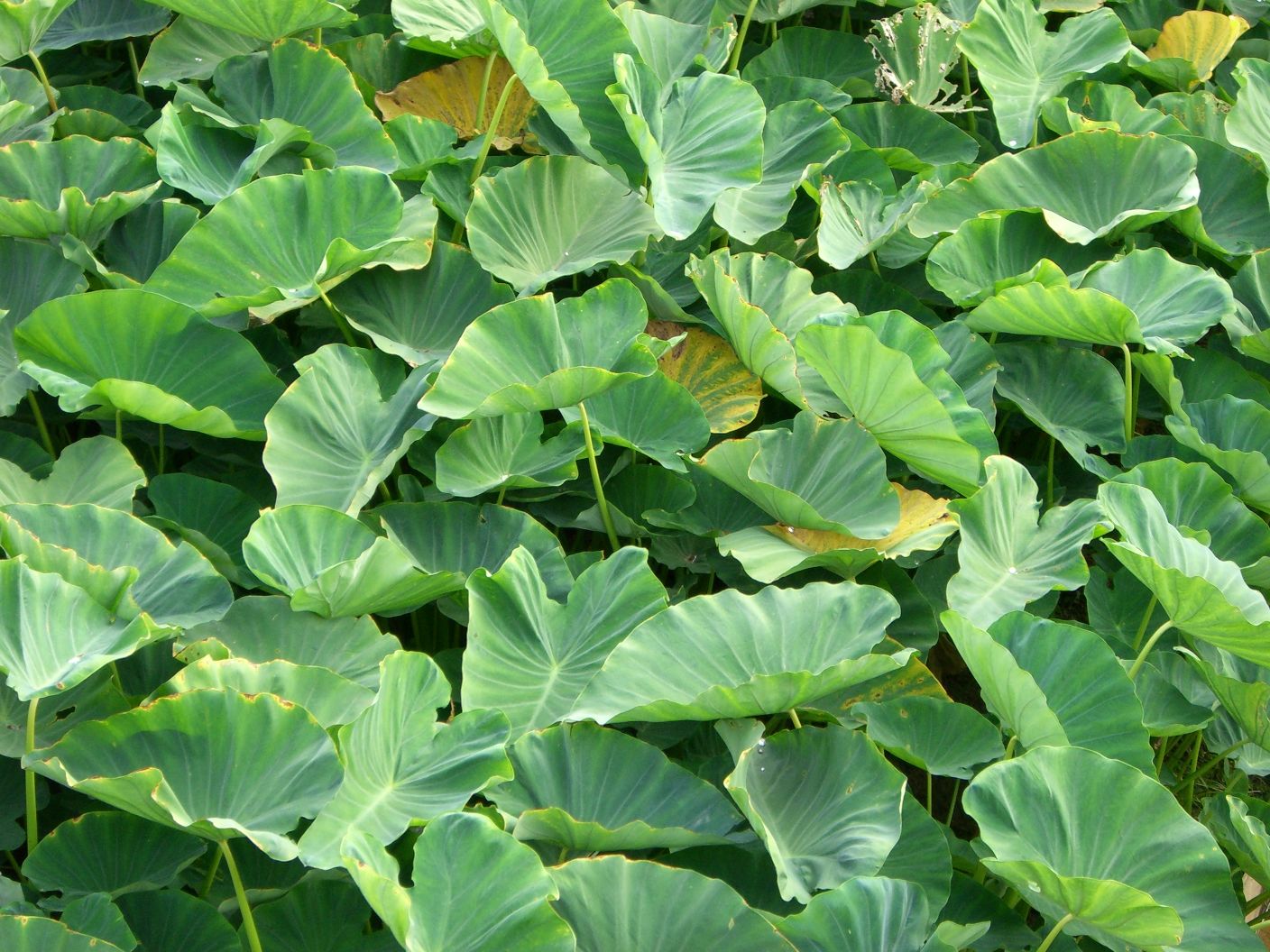
They are herbaceous perennial plants with a large corm on or just below the ground surface. The leaves are large to very large, 20–150 cm (7.9–59.1 in) long, with a sagittate shape. The elephant's-ear plant gets its name from the leaves, which are shaped like a large ear or shield. The plant reproduces mostly by means of rhizomes (tubers, corms), but it also produces "clusters of two to five fragrant inflorescences in the leaf axils". Like other members of the family, the plant contains an irritant which causes intense discomfort to the lips, mouth and throat. This acridity is caused in part by microscopic needle-like raphides of calcium oxalate monohydrate. It must be processed by cooking, soaking or fermenting – sometimes along with an acid (lime or tamarind) – before being eaten.
Colocasia leaves contain phytochemicals, such as anthraquinones, apigenin, catechins, cinnamic acid derivatives, vitexin, and isovitexin.
There are numerous species of Colocasia.
A separate subgroup within the Colocasiae contains one species, which was previously called C. gigantea:
The generic name is derived from the ancient Greek word kolokasion, which in the Koine Greek of the 1st-century CE botanist Pedanius Dioscorides may have meant the edible roots of both taro (C. esculenta) and Nelumbo nucifera.
Colocasia species are used as food plants by the larvae of some Lepidoptera species including two members of Palpifer, P. murinus and P. sexnotatus.
Hub AI
Colocasia AI simulator
(@Colocasia_simulator)
Colocasia
Colocasia is a genus of flowering plants in the family Araceae, native to Southeast Asia and the Indian subcontinent. Some species are widely cultivated and naturalized in other tropical and subtropical regions. The species C. esculenta (taro) is invasive in wetlands along the Gulf Coast of the United States, where it threatens to displace native wetland plants.
The names elephant ear and cocoyam are also used for some other large-leaved genera in the Araceae, notably Xanthosoma and Caladium.
They are herbaceous perennial plants with a large corm on or just below the ground surface. The leaves are large to very large, 20–150 cm (7.9–59.1 in) long, with a sagittate shape. The elephant's-ear plant gets its name from the leaves, which are shaped like a large ear or shield. The plant reproduces mostly by means of rhizomes (tubers, corms), but it also produces "clusters of two to five fragrant inflorescences in the leaf axils". Like other members of the family, the plant contains an irritant which causes intense discomfort to the lips, mouth and throat. This acridity is caused in part by microscopic needle-like raphides of calcium oxalate monohydrate. It must be processed by cooking, soaking or fermenting – sometimes along with an acid (lime or tamarind) – before being eaten.
Colocasia leaves contain phytochemicals, such as anthraquinones, apigenin, catechins, cinnamic acid derivatives, vitexin, and isovitexin.
There are numerous species of Colocasia.
A separate subgroup within the Colocasiae contains one species, which was previously called C. gigantea:
The generic name is derived from the ancient Greek word kolokasion, which in the Koine Greek of the 1st-century CE botanist Pedanius Dioscorides may have meant the edible roots of both taro (C. esculenta) and Nelumbo nucifera.
Colocasia species are used as food plants by the larvae of some Lepidoptera species including two members of Palpifer, P. murinus and P. sexnotatus.