Hubbry Logo
Siemens CombinoSiemens CombinoMain
Open search
Siemens Combino
Community hub
Siemens Combino
logo
8 pages, 0 posts
0 subscribers
Be the first to start a discussion here.
Siemens Combino
Siemens Combino
from Wikipedia

See caption
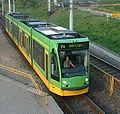
Combino tram in Basel

The Siemens Combino is a low-floor tram produced by Siemens Mobility (formerly Duewag). The first prototype was produced in 1996 at the Duewag works in Düsseldorf; the trams were later built in Krefeld-Uerdingen.[1]

Due to its modular design using standardised components, and the resulting reduced costs, the Combino was for a time one of the most successful tram types. They were sold in six countries and a further development was sold to two others.

In 2007, a new generation of Combinos was sold to Bern, known as the Combino Classic. This was an updated version of the original design intended to correct defects in the joints between modules.[2] Fourteen of these were produced in 2011 with 12 going to Erfurt and two to Nordhausen. Subsequently, the model was again renamed and is now known as the Avenio M.

The original Combino trams were a multi-articulated design with alternating wheeled and suspended sections. For Metro Transportes Sul de Tejo and in Budapest, Siemens developed a new version called the Combino Plus or Combino Supra. Unlike the Combino, it does not have suspended sections but rather two axles under each body section. In essence, it is like a train of two axle cars. This design has been developed into the Avenio.

Technical specifications

[edit]
Bogie with two individual wheels on each side, without axles linking them, and a lower frame in the centre
Combino bogie

The tram is largely made out of aluminium, with a welded underframe to which the body framework is bolted in sections,[1] which means that the Combino can easily be adapted to different lengths, widths and gauges. The length of the trams varies from 20 metres (65 ft 7 in)[3] for the three-section version used in Erfurt, Nordhausen and Melbourne, to a world record 54 metres (177 ft 2 in) for the six-section Combino Plus in Budapest,[4] accommodating between 100 and 250 passengers. All versions are designed to have a 300-millimetre (11.8 in) floor height and a 10-tonne (11-short-ton) axle load and can be built as a one-way or a two-way vehicle.[1]

They usually take 600 V DC overhead power and convert this to 400 V 3-phase AC power for the regenerative low wear motors via 3 IGBT PWM inverters. On board controls, lighting and air conditioning run at 24 V DC.

For Nordhausen, three Combino Duo trams were built with an additional diesel propulsion system,[5] courtesy of a BMW M67 3.9-litre twin-turbocharged V8 engine.[6] They are used on a tram-train service along part of the unelectrified Harzquerbahn.

2004 recall

[edit]
View along entirely flat tram aisle. The seats either side are a mixture of single seats and pairs.
Interior of tram in Poznań

On March 12, 2004, Siemens admitted to problems concerning the stability of the car bodies and, as a precautionary measure, instructed all public transportation services to take all Combinos with a service distance of more than 120,000 kilometres (74,565 mi) out of service.[7] The torsion forces produced when the tram travelled through reverse curves were much higher than anticipated, leading to cracks around the articulations between modules.[4] Subsequently, hairline cracks were found in the joints of the aluminium bodies, which could cause the roof to collapse in the case of an accident.

The problem was acute in Combino cars that had run more than 150,000 km (93,206 mi). Cracks were reported on the connections between the sidewalls and the roof girders such that the safety of passengers in the wheel-less modules could not be assured in the event of a severe collision. These flaws were reported in many cities that had adopted the Combinos, such as Düsseldorf, Freiburg, Augsburg, Erfurt, Hiroshima, Nordhausen, Basel, Potsdam, Bern, Amsterdam and Melbourne.

Siemens launched a three-stage process of rebuilding the 454 vehicles affected. Under this process the Combino modules were reinforced to give an expected 30-year life.[8]

Operators

[edit]

Overview

[edit]
See caption
Control panel of Poznań Combino

Around 500 trams went into service in the following cities:

Locality Operator Type Built Number
Netherlands
Amsterdam
Gemeente Vervoerbedrijf 2005 155[1]
Germany
Augsburg
Stadtwerke Augsburg 2004 41[1]
 Switzerland
Basel
Basler Verkehrsbetriebe BVB 2002 28[1]
 Switzerland
Bern
Bernmobil (formerly called Städtische Verkehrsbetriebe Bern) 2002–2004, 2009–2010 15 + 21[9]
Germany
Düsseldorf
Rheinbahn NF10 2000–2002 36[10]
NF8 2003 15[10]
NF8U 2006–2007, 2010-2012 76[10]
Germany
Erfurt
Erfurter Verkehrsbetriebe 2000–2012 60[10]
Germany
Freiburg im Breisgau
Freiburger Verkehrs 1999–2000, 2004–2006 19[10]
Japan
Hiroshima
Hiroshima Electric Railway(広島電鉄) 5000 2002 12[1]
Australia
Melbourne
Yarra Trams D1 2002–2004 38[11]
D2 2003 21[12]
Germany
Nordhausen
Stadtwerke Nordhausen Verkehrs- und Stadtreinigungsbetrieb GmbH 2000–2011 9[10]
Combino Duo 2004 3[10]
Poland
Poznań
Miejskie Przedsiębiorstwo Komunikacyjne w Poznaniu Sp. z o.o. 2004 14[1]
Germany
Potsdam
Verkehrsbetrieb Potsdam (ViP) 1998–2001 16[10]
Prototype, used in Potsdam since 2002 1996 1[10]
Germany
Ulm
SWU Verkehr 2003–2008 10[10]

Twenty-two trams were ordered for a planned tram network in Verona and ten for the Alicante tram network, but the contracts were cancelled because of the technical problems noted in this article.[8]

The prototype Combino tram was also demonstrated on tram networks in other cities,[1] including Barcelona in 1997.[13]

Potsdam

[edit]

In 1997 the public transportation authorities of the city of Potsdam were the first to purchase Combino cars when they ordered a total of 48 cars, each 30.5 metres (100 ft 1 in) long to be delivered from 1998 to 2009.[14] The advantages of its low-floor technology were stressed during the introduction. A total of 48 cars were to be bought through 2009. The order from Potsdam was of great importance for advertising the Combino in other cities. Cars from Potsdam were frequently used for demonstrations.

After a short period of service, many inhabitants of Potsdam noticed noises during the operation of the cars louder than those of the previously used Tatra cars. In March 2004, the 16 Potsdam cars were taken out of service. As a replacement, several Tatra cars which had been given to museums were taken back into service. The shortage was aggravated by the fact that several old cars had been sold to Hungary just a month before. In June 2004, Potsdam and Siemens "amicably" declared that the at the time 32 outstanding cars were not going to be delivered. This decision is likely to have consequences for other cities.

Between 2017 and 2019 eight of the Potsdam Combinos were extended with an extra two modules, increasing their length to 42 metres (137 ft 10 in).[15]

Amsterdam

[edit]
See caption
Two Combinos in Amsterdam

In June 2004, the first Amsterdam Combinos passed the mileage threshold of 120,000 km (74,565 mi) and were taken out of service. Earlier, Siemens technicians had identified stress fractures in the door segments of two of Amsterdam's oldest cars. But, according to Siemens, those turned out not to be dangerous, which is why the cars continued to be used. At the end of April 2004, it was decided not to call upon the twelve undelivered cars which were outstanding at that time.[citation needed]

Kaohsiung Demonstrator

[edit]
See caption
Combino demonstrator tram in Kaohsiung

A D2-class Melbourne tram was borrowed by Siemens for a demonstrator in Kaohsiung for a three-month period in 2003–2004.[16]

The city did not follow through with purchasing the cars or building a line after the trial. In 2013 the city began construction of the Circular LRT line, which utilises CAF Urbos vehicles.

Poznań

[edit]
See caption
Combino in Poznań

Poznań announced in 2002 a tender for low-floor trams. Siemens won the contract with Combino. Poznań ordered 14 trams, each consisting of five modules, three double doors and three bogies, identical to the Amsterdam version. The first Combino entered service at the end of 2003. Due to flaws in construction, not all trams were in active service. An agreement between Poznań and Siemens provided that the city would pay the fraction (31%) of trams' cost only after the refit of all 14 Combinos. Combinos were usually used on the Poznański Szybki Tramwaj (Poznań Fast Tram) (light rail), that is on lines 14, 15 and 16 until they got replaced by Solaris Tramino trams. Starting from then Combinos are used on different lines to provide access to low-floor trams in other parts of Poznań.

Siemens Combino Supra

[edit]

The original Combino model (Combino MkI) is produced on request but sold as Avenio M. To Budapest (Hungary) and Almada (Portugal), Siemens provided trams based on an older ADtranz design,[citation needed] under the name Combino Supra. These Combinos have thin stainless steel rather than aluminium carbodies. Siemens also expressed a desire to sell the Viennese Ultra Low Floor (ULF), another 100%-low-floor model, to other cities. The first two Combino Supras were delivered on 14 March 2006 to Budapest.

After serious initial teething problems in Budapest, which involved problems with the door mechanism and led the trams being taken out of service, the Combino Supra trams there began regular service during 2006.[17] After they had been repaired, Budapest's government decided that they would return them to Siemens. However, this did not happen because of contractual terms. The local public transport company began using them in 2007 and they eventually began working successfully again.

Overview

[edit]
Locality Operator Type Built Number
Hungary Hungary, Budapest Budapesti Közlekedési Zrt. NF12B (Combino Supra) 2006–2007 40[17]
Portugal Portugal, Almada Metro Transportes do Sul Combino Supra 2005 24[18]
[edit]

References

[edit]
[edit]
Revisions and contributorsEdit on WikipediaRead on Wikipedia
from Grokipedia
The Siemens Combino is a family of modular, low-floor articulated trams developed jointly by Transportation Systems and , first introduced in 1994 as an innovative solution for urban light rail transit. Featuring a 100% low-floor design across its entire length, the Combino utilizes standardized components for flexibility in length, gauge, and configuration, enabling bidirectional or unidirectional operation on tracks of 1,000 mm or 1,435 mm gauge with body widths ranging from 2,300 mm to 2,650 mm. By the mid-2000s, over 480 units had been ordered by 15 operators worldwide, including major fleets in cities such as (48 trams ordered in 1997 as the model's first commercial batch), (59 units delivered from 2002), , and . The Combino's design emphasized accessibility and efficiency, with floor heights of 300 mm, capacities for 100 to 350 passengers depending on the variant, and features like and independently rotating wheelsets for smooth navigation on curved tracks. Early models, such as the Basic and Advanced variants, employed an aluminum bodyshell for construction but encountered structural challenges, including fatigue cracks detected in fleets from 2002 onward in cities like and . Siemens addressed these through a comprehensive three-stage rectification program launched in 2003, involving inspections, reinforcements, and in some cases full rebuilds into the upgraded Combino Plus configuration, ensuring the vehicle's longevity and safety compliance with standards like EN 15227. Specialized variants expanded the Combino's applications, including the bi-mode Combino Duo for mixed street and non-electrified sections, deployed in Nordhausen, and experimental autonomous versions tested in and for driverless depot operations and shunting. The platform's legacy influenced subsequent designs, evolving into the Avenio family by 2007 with enhanced multi-articulated structures and modern safety features, while retaining core Combino elements like modular bogies. Today, Combino trams continue to serve key urban networks, contributing to sustainable in and beyond.

Introduction

Design Concept

The Siemens Combino represents a pioneering modular low-floor system, emphasizing flexibility and efficiency through its construction of standardized sections made from extruded aluminum profiles, which reduces costs and allows easy adaptation to diverse urban transit needs. This approach enables operators to configure vehicles by combining various module types, aligning with the "Combino" philosophy of permuting components such as powered motor modules, unpowered trailer modules, and intermediate sections to form uni-directional or bi-directional trams tailored to specific route requirements. Central to the design is its low-floor configuration, achieving a floor height of approximately 300 mm over 100% of the interior space, which facilitates step-free access and enhances for passengers with disabilities or mobility aids. This is accomplished without relying on traditional bogies throughout the vehicle, instead incorporating innovative independent wheel suspension systems, particularly the SF series bogies, that maintain smooth operation and ride comfort in low-floor environments. The independently rotating wheels in these bogies minimize slippage and wear, contributing to the overall durability and efficiency of the tram's articulation points. This modular and low-floor ethos not only optimizes passenger flow but also supports the vehicle's scalability, from shorter urban shuttles to longer articulated units, while prioritizing lightweight materials for energy savings.

Development History

The development of the Combino originated in the mid-1990s as a collaborative effort between Transportation Systems and , a longstanding rail vehicle manufacturer that had progressively integrated into its operations since acquiring a majority stake in 1989 and full ownership in 1999. The project aimed to create a modular low-floor platform to meet growing European demands for accessible urban transit solutions, influenced by emerging EU directives on equity. The first , a five-section unit, was unveiled on July 3, 1996, at the facility in , , marking the initial realization of this innovative design concept. Key milestones followed rapidly, with the prototype undergoing extensive testing, including demonstrations in , , in 1997 to validate its performance on real-world networks. This led to the platform's first commercial orders: in November 1997, Freiburg im Breisgau's transport authority (VAG Freiburg) placed an order for 18 seven-section units, while 's Verkehrsbetrieb Potsdam (ViP) followed with 48 five-section trams in December 1997, becoming the inaugural operator. Production commenced at the plant in , with initial deliveries to starting in October 1998 and to Freiburg in 1999, establishing the Combino as a frontrunner in low-floor technology amid rising calls for barrier-free mobility to comply with accessibility standards. By 2001, following the closure of the Düsseldorf facility and transfer of operations to Siemens' Krefeld-Uerdingen plant in , production scaled up significantly, with over 500 units ordered across multiple configurations by early 2002. This expansion reflected the tram's appeal for flexible urban solutions, driven by policies like the 2000 eAccessibility initiative under the eEurope , which emphasized inclusive transport design. Cumulative production exceeded 600 vehicles by 2003, serving 17 cities in 10 countries, and surpassed 1,000 units by 2012, with assembly also occurring at partner facilities to support global exports, though primary manufacturing remained centered in .

Technical Specifications

Structure and Dimensions

The Combino tram employs a lightweight aluminum body construction, consisting of a welded underframe with bolted sectional body framework to enhance modularity and ease of assembly. This design contributes to reduced weight while maintaining structural integrity for urban rail operations. The vehicle's modular architecture permits configurable lengths, with standard setups ranging from approximately 20 meters in three-module configurations to 30 meters in five-module versions, and up to 42 meters in seven-module versions, allowing adaptation to diverse network needs. Widths are available from 2.3 meters to 2.65 meters, optimizing space in varied urban environments. The overall typically measures around 3.5 to 3.6 meters above the rail. Specs such as (typically mm, but up to 350 mm in some variants) and minimum curve radius (15-20 m) vary by configuration. A key feature is the 100% low-floor configuration in most variants, with a floor height of 300 mm above the rail and entrance heights around 320 mm, ensuring step-free access for passengers with disabilities or mobility aids. The maximum axle load is limited to 10 tonnes per axle, balancing load distribution with infrastructure compatibility. Passenger capacity reaches up to 200 in the five-module layout, including approximately 65 seated positions, with flexible uni- or bi-directional interior arrangements to suit operational demands. The undercarriage utilizes the SF30 system with independently rotating wheelsets, positioned centrally under modules to support the low-floor profile without raised sections or ramps. This setup provides a low center of gravity and enables tight curve negotiation down to a minimum of 20 meters, ideal for constrained street layouts. Wheel diameters are 600 mm new and 520 mm worn, with a 1,800 mm for standard gauge tracks.

Propulsion and Electrical Systems

The Siemens Combino tram collects electrical power primarily through a or from overhead lines rated at 600-750 V DC, with tolerances typically ranging from +20% to -30% to accommodate voltage fluctuations in urban networks. This DC input is converted onboard to 400 V three-phase AC via (IGBT) pulse-width modulated inverters, enabling efficient power distribution to the traction system while incorporating integrated IGBT brake choppers for support. The propulsion relies on asynchronous three-phase AC induction motors, which are low-maintenance and designed for regenerative operation. In a representative five-module configuration, four motors rated at approximately 110 kW each are employed, mounted on independent wheelsets and driven via cardan shafts for optimal transmission in low-floor bogies. These motors operate at rated voltages around 380 V and speeds up to 1580 rpm, providing smooth and high efficiency in modular setups. Braking combines regenerative and friction mechanisms, with the regenerative system recovering during deceleration and feeding it back to the , achieving up to 30% recuperation to reduce overall consumption. The entire process is managed by a microprocessor-based Train Control and Management System (TCMS), utilizing a 32-bit SIBAS unit with serial bus integration for precise control of traction, braking, and auxiliary functions like 24 V DC onboard supplies. A specialized variant, the Combino Duo for Nordhausen, incorporates a diesel-hybrid propulsion system featuring a BMW M67 3.9-liter twin-turbocharged V8 engine to enable operation on non-electrified sections, seamlessly switching between electric and diesel modes for hybrid tram-train service.

Variants

Standard Combino

The Standard Combino represents the initial production version of the Siemens low-floor tram family, entering series production in 1998 following a 1996 prototype developed at the Duewag works in Düsseldorf, with manufacturing shifting to Krefeld-Uerdingen. These trams were engineered for standard European track gauge of 1,435 mm and targeted urban networks requiring flexible, accessible vehicles. Production ran through 2006, yielding baseline models in uni-directional or bi-directional formats with 3 to 5 articulated modules, emphasizing a modular design for customizable lengths and capacities. Core configurations included the compact NF6 model for shorter routes, as well as the NF8 and NF10 variants tailored for higher-capacity needs, such as those in , where the NF10 featured seven sections measuring nearly 40 meters. Door arrangements supported one or both sides to suit varied platform setups, with all models maintaining 100% low-floor access at 300 mm sill height for passenger convenience. Early deployments highlighted its role in German cities, including 48 units for Potsdam's five-section unidirectional fleet, ordered in 1997 and introduced starting in 1998 and 18 units across Basic and Advanced subtypes for Freiburg starting in 1999. Performance characteristics focused on urban , with a top speed of 70-80 km/h enabled by the SF 30C and an acceleration rate of 1.3 m/s² to handle frequent stops effectively. This setup supported average operational speeds around 22 km/h in dense settings, balancing speed with safety on 1,435 mm infrastructure.

Combino Supra

The Combino Supra, introduced by in 2005, enhanced the original Combino design with structural upgrades aimed at greater stability and suitability for extended configurations. Key improvements included equipping each end module with two powered axles via the SF30 system, delivering 2 × 100 kW of power per bogie to minimize lateral and support lengths up to 30 meters across four modules. This configuration, featuring self-centering stub axles and outboard traction units, lowered the center of gravity while maintaining a maximum speed of 70 km/h and axle loads of 10 tonnes. Engineering features of the Supra preserved the modular aluminum construction of its predecessor but incorporated reinforced joints for superior torsion resistance, ensuring 100% low-floor access at 350 mm above the top of rail and standard bi-directional operation with driver's cabs at both ends. Passive hydraulic stabilization linked the modules, reducing ride disturbances on curved tracks with radii as low as 15 meters. These advancements targeted high-capacity urban routes, with each vehicle accommodating up to 232 passengers through wide 1.3-meter doors and spacious interiors. Major deployments underscored the Supra's applications in demanding environments. In , , Metro Transportes Sul do Tejo received 24 four-module units between March and November 2005, optimized for the network connecting Almada and with enhanced torsion resistance via welded stainless-steel bodies and corrosion-resistant underframes. Similarly, Budapest's BKV ordered 40 six-module NF12B variants, delivered from March 2006 to May 2007, measuring 53.99 meters and serving high-volume lines 4 and 6 with daily capacities exceeding 250,000 passengers; these featured stainless-steel frames to bolster durability. Although the Supra addressed prior vulnerabilities through these reinforcements, early production units encountered cracking at joints, prompting resolutions by 2007 via additional structural enhancements and material optimizations in subsequent builds.

Extended and Modified Versions

In , , eight existing five-section Combino trams were lengthened to seven sections between 2017 and 2019 through the insertion of two additional modules derived from the Avenio M platform, one module and one intermediate module. This modification increased the overall length from 30.5 m to 41.6 m and boosted passenger capacity from 176 (with 68 seats) to 246 (with 77 seats), allowing for greater accommodation of standing passengers in a multi-function area for strollers and bicycles. The refurbishment, conducted at ' Simmering plant in , also included updated passenger compartments with air-conditioning and optimized ride quality via a new hydraulic roll-coupling system. The Combino Plus designation applies to reinforced iterations of the standard Combino design, incorporating enhanced structural elements such as the SF30C to support higher loads of up to 10 tonnes per while maintaining a low-floor height of 350 mm. These upgrades feature a robust frame combining cast, forged, and welded components in a hollow box construction, along with rubber-sprung primary and secondary suspensions for improved load handling and ride comfort at speeds up to 70 km/h. In , the NF8U series exemplifies these reinforced units, built post-2006 with bi-directional capabilities through rear-to-rear coupling and doors on both sides for versatile operation. Other modifications include delivery of bi-directional Combino trams to , , between 2009 and 2010 as part of a fleet upgrade to support efficient turning at endpoints without runarounds. In Nordhausen, Germany, 12 three-section Combino units were produced from 2000 to 2011, with three of them (numbers 201–203) equipped as Combino Duo variants featuring diesel propulsion extensions using a 3.9-litre for operation on unelectrified sections of the Harzquerbahn route. These extended and modified Combinos incorporate integrated control systems for seamless compatibility between original and new components, retaining the standard 600 V DC overhead supply while enhancing efficiency through electro-dynamic systems that feedback energy to the grid during deceleration. The upgrades ensure continued adherence to the original propulsion base, with traction power maintained at 4 × 120 kW across the extended configurations.

Operational Deployment

Overview of Global Operators

The Siemens Combino tram has seen widespread adoption globally, with over 600 units sold by 2004 to operators in 16 cities across nine countries, reflecting its appeal as a modular low-floor suitable for urban networks requiring high . Production continued beyond this period, with additional deliveries including extended variants, contributing to its deployment in high-density . As of 2025, significant fleets remain active, underscoring the model's longevity despite the transition to successor designs. Distribution is concentrated in Europe, encompassing countries such as (e.g., , Nordhausen, ), (, ), the Netherlands (), (), and (), where the trams support extensive urban and interurban routes. Notable non-European outliers include , where in operates a fleet of 59 Combino units introduced in the early 2000s to expand low-floor capacity on the world's largest tram network, and , with running 12 units since 2002 on mixed high- and low-floor lines. Adoption peaked between 2000 and 2006, driven by regulatory mandates for low-floor trams to enhance passenger , particularly for users and those with mobility impairments, aligning with accessibility standards and similar requirements in adopting cities worldwide. The Combino's modular facilitated customization to local needs, enabling ongoing use in dense networks while later upgrades addressed reliability concerns. Approximately 500 units are estimated to remain in active service as of 2025, with recent modernizations in cities like and extending operational life.

European Deployments

In , the Siemens Combino has seen significant adoption, particularly in , where the Rheinbahn AG operates 36 NF10 units delivered between 2000 and 2002 for high-capacity urban core lines such as routes 701 and 709. These seven-section trams, measuring nearly 40 meters in length, provide enhanced passenger capacity and low-floor accessibility, supporting daily operations in the densely populated Rhine-Ruhr region. Additionally, 15 NF8 units from 2003 and 58 NF8U variants from 2006 to 2011 contribute to the fleet, totaling 109 Combinos integrated into the network for efficient urban mobility. In , Verkehrsbetrieb Potsdam GmbH (ViP) deployed 17 Combino units starting in 1996, including one , with eight later extended to seven sections between 2015 and 2017 to boost capacity from 176 to 246 passengers per vehicle for integration and local lines. These modifications addressed growing demand on routes like Line 91, improving with . The fleet remains active, with some units tested for autonomous operations in depot environments. Erfurt's Erfurter Verkehrsbetriebe AG introduced 48 Combino units from 2000 to 2012, comprising both classic and advanced models for the city's network, emphasizing 100% low-floor design to facilitate accessibility on lines like 4 and 5. These trams have played a key role in modernizing service, handling peak loads with modular configurations that allow flexible operation in Thuringia's capital. In the , Gemeentelijk Vervoerbedrijf (GVB) in expanded its network with 155 Combino trams delivered between 2002 and 2005, including 151 five-module unidirectional units and four bidirectional variants for loop-less routes. These 29.2-meter vehicles, with a top speed of 70 km/h, have been integral to the city's tram expansion, carrying passengers on 15 lines and contributing to daily ridership exceeding 200,000 by enhancing capacity and comfort in the historic urban core. Switzerland features notable Combino deployments, with Bernmobil in operating 36 units across variants: 21 seven-section XL models (2009-2010), seven five-section units (2002), and eight very long (VL) seven-section trams (2002-2010). These bi-modal capable trams support lines 9 and 7, offering full low-floor access and for the compact cantonal network, where they handle mixed urban and suburban traffic. In , Basler Verkehrs-Betriebe (BVB) runs 28 Combino units introduced in 2001-2002 on routes 6 and 8, providing reliable service across the tri-national border region despite early technical challenges resolved post-2004. Other European operators include Budapest's BKK, which acquired 40 Combino Supra NF12B units in 2005-2007 for high-volume lines like 4 and 6, these 54-meter, six-module trams boosting capacity in Hungary's busiest network. In , , MPK Poznań operates 14 five-module Combinos since 2004, modernized in 2021-2023 for continued use on urban routes, emphasizing low-floor accessibility. Portugal's Metro Transportes do Sul in deployed 24 Combino Supra units from 2005, featuring bi-modal propulsion for the Lisbon-area , enhancing cross-river connectivity with support for non-electrified sections. Post-2004 modifications have extended the Combinos' to 20-30 years across these fleets, with many units contributing to daily ridership gains through improved reliability and integration into accessibility-focused urban transit systems.

Non-European Deployments

The Combino trams were first exported outside to , , where (formerly M>Tram) introduced 59 low-floor units between 2002 and 2004. These comprised 38 three-section D1-class trams and 21 five-section D2-class trams, each adapted for the city's standard 1,435 mm gauge track and right-hand drive operations to meet high-capacity demands on busy urban routes. The fleet addressed Melbourne's need for accessible, articulated vehicles capable of handling heavy passenger loads, with the longer D2 variants providing up to 180 seats and standing room for over 300 passengers. In , deployed 12 type 5000 "Green Mover" trams based on the Combino design starting in 2002, marking the first such acquisition outside . Built for the operator's standard 1,435 mm gauge network and integrated into its electric streetcar system, these five-module low-floor units featured aluminum bodies and were engineered for resilience in Hiroshima's , including resistance to high humidity and seasonal typhoons. The trams enhanced accessibility on key lines like Route 2, contributing to a low-floor fleet share of about 36% as of 2025. A single Combino demonstrator, a D2-class unit originally bound for , underwent testing in , , in 2004 to assess feasibility for the city's proposed circular line. Adapted temporarily for evaluation on a demonstration track—likely at standard 1,435 mm gauge despite Taiwan's prevalent 1,067 mm narrow gauge—the three-month trial showcased the vehicle's performance in a tropical environment but did not lead to orders, as trams were selected instead. Deployments outside Europe required modifications such as gauge compatibility for standard 1,435 mm systems in both and , alongside enhancements for tropical humidity in and high-volume urban service in . By 2025, 's D-class fleet had seen partial retirements amid ongoing reliability issues and the introduction of newer models, while 's type 5000 units remained active.

Incidents and Safety Issues

2004 Recall

In early 2004, during routine testing in , , cracks were discovered in the aluminum side panels of Combino trams, specifically at the connections between sidewalls and roof girders near the articulated joints. These defects emerged after the vehicles had accumulated over 120,000 km of operation, highlighting vulnerabilities in the structure under prolonged use. The issue stemmed from torsional stresses generated by high forces in the articulations, particularly in designs with longer bogie centers, which were insufficiently reinforced to handle dynamic loads from uneven tracks. The recall affected 454 Combino units produced between 1998 and 2003, representing the early series deployed across multiple operators worldwide. These trams were in service in cities including , , Freiburg, , , Nordhausen, , and , leading to temporary withdrawals that disrupted local networks; for instance, all 16 units in were sidelined, requiring contingency plans. On March 12, 2004, issued a global , instructing operators to immediately withdraw any Combino exceeding 120,000 km and halting production of the model as a precautionary measure. Subsequent inspections revealed a 20% among the affected fleet, prompting to deploy mobile testing teams and collaborate on structural assessments, though long-term remediation was still under evaluation at the time.

Subsequent Modifications and Upgrades

Following the identification of cracks in the bodyshells due to higher-than-expected torsion forces, implemented a three-stage rectification programme to reinforce the affected Combino trams. The final phase focused on structural modifications to the bolted bodyshells, enabling them to withstand remaining forces and extending the overall design life to 30 years. These reinforcements were applied to over 450 units worldwide, with completion on all affected trams by 2006. As part of the upgrades, introduced enhancements to the bogies, including the SF30C series, which improved load distribution through optimized wheelset guidance and reduced unsprung mass. Additionally, software updates to the Control and (TCMS) were rolled out to enable capabilities, allowing for real-time monitoring of structural integrity and operational parameters. Post-modification validation occurred between 2005 and 2007, involving instrumented testing and dynamic simulations that demonstrated a significant reduction in torsion stresses, approximately 50% lower than pre-modification levels. This comprehensive effort not only restored fleet reliability but also contributed to stricter certification standards for low-floor trams, directly influencing the engineering of successor models such as the Combino Supra and Avenio platforms.

Evolution and Legacy

Transition to Successors

Following structural issues identified in early Combino trams around 2002-2003 due to higher-than-expected torsion forces in the aluminum bodyshells, launched a three-stage rectification program in 2003-2005 to over vehicles, including reinforcements and conversions to the Combino Advanced variant (produced 2001-2010) featuring -endurable aluminum bodyshells. In 2007, initiated a further comprehensive redesign to enhance durability and compliance with regulatory standards, leading to the development of the Avenio platform as the next-generation family. The Avenio platform, building on Combino modularity, was introduced in 2009, with the multi-articulated Avenio M version first ordered in 2015 for and deployed in 2017. A pivotal handover project was the 2007 order from Bernmobil for 21 updated Combino trams (known as Combino Classic), valued at €65 million, which served as a bridge by integrating revised electronics and structural reinforcements derived from rectification lessons into existing modular designs. These vehicles featured enhanced bogies and control systems that prefigured Avenio features, marking the gradual shift toward the new platform while fulfilling immediate operational needs in Bern's expanding network. Subsequent projects, such as the Combino Plus deliveries to (2005) and (2006-2007), further tested single-articulated steel variants that informed Avenio's core architecture. Technically, the transition moved away from the original Combino's highly flexible pure modularity toward more standardized platform configurations, allowing for easier customization across global markets while retaining proven elements like independent-wheel bogies. A key advancement was improved crashworthiness, with Avenio M achieving compliance to EN 15227 Category C-IV standards through fully welded aluminum structures and increased longitudinal compressive stiffness of 400 kN, far exceeding prior models. By 2012, Combino production had ended, with over 500 units built worldwide; the last deliveries were 14 units to Erfurt and Nordhausen in 2011, after which Siemens focused resources on Avenio for international exports, emphasizing its modular legacy in safer, more efficient forms.

Current Status and Retirements

As of 2025, the Siemens Combino tram maintains a significant presence in urban transport systems, with major operators sustaining fleets totaling approximately 350 units worldwide. In Amsterdam, the GVB continues to rely on 155 Combino models (types 13G and 14G) as the backbone of its 227-tram fleet, despite the launch of a tender for up to 78 new vehicles to replace aging units and improve accessibility. Similarly, Düsseldorf's Rheinbahn operates 126 Combino variants, comprising 35 NF10 seven-section units, 15 NF8 units, and 76 NF8U unidirectional models, all actively serving the city's light rail network. In Potsdam, the ViP transport company runs eight extended Combino trams, lengthened from 30.5 meters to 41.6 meters in the mid-2000s to boost capacity to 246 passengers per unit, ensuring reliable operation on high-demand lines. Retirements of Combino trams have progressed steadily since 2015, driven by age-related maintenance challenges and fleet renewal initiatives, with over 200 units withdrawn globally over the past decade. In , ' 59 D-class Combinos—introduced between 2002 and 2004—are facing phase-out due to their 20+ years of service, as newer low-floor models like Alstom's NGT are integrated to modernize the network and retire high-wear vehicles. Freiburg's VAG has similarly retired portions of its Combino fleet since the mid-2010s, replacing them with 30 new trams delivered between 2017 and 2024 to enhance low-floor and energy efficiency across its five-line system. Preservation efforts focus on select retired prototypes and units, with examples stored in transport museums such as those associated with Potsdam's ViP operations, where historical Combinos are maintained alongside active fleets. Ongoing maintenance contracts with support life extensions for remaining units, as seen in , where MPK completed modernization of 15 Combinos in 2024, incorporating updated drive systems, passenger information tech, and solar panels to extend service beyond original expectations. Looking ahead, while the Combino's role is diminishing with the adoption of Siemens' Avenio successor in cities like , its proven reliability and lower operational costs ensure prolonged use in secondary urban and regional networks through the 2030s.

References

Add your contribution
Related Hubs
User Avatar
No comments yet.