


Community hub
Recent from talks
Contribute something
Nothing was collected or created yet.
Western Sydney Stadium
View on Wikipedia
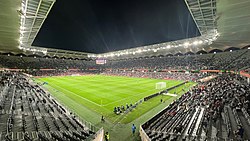
Western Sydney Stadium, also known as CommBank Stadium for sponsorship reasons, is a multi-purpose stadium in the suburb of Parramatta, Sydney, New South Wales, Australia. It replaced the demolished Parramatta Stadium (1986) which in turn was built on the site of the old Cumberland Oval, home ground to the Parramatta Eels since 1947. The current stadium opened in April 2019 and has a 30,000-seat capacity. The stadium is owned by the NSW Government and built at a cost of $300 million.[2][3] The stadium hosts games across the major rectangular field sports in Sydney.
Key Information


The primary uses of the stadium are to host rugby league, association football, rugby union as well as concerts and special events. The foundation teams are National Rugby League club Parramatta Eels and A-League club Western Sydney Wanderers. Other tenants include NRL team Wests Tigers who have used the stadium as an alternate venue between 2019 and 2023 and again for the 2025 NRL season onwards.
Location history
[edit]The area on which the stadium is, was used for leisure and horse racing in the British colony at Parramatta, that was founded along with the harbour settlement of Sydney in 1788. Governor Charles FitzRoy approved the creation of a racecourse on the site in 1847, with a cricket field grown within the racetrack and opened in 1863.[4] After numerous name changes the local cricket club settled on the name Central Cumberland Cricket Club, and from there the site gained the Cumberland Oval name.
Cumberland Oval was used variously for horse racing, cricket, athletics, rugby union, rugby league and motor sports. When in use for motor sports the site was named the Parramatta Speedway, holding events from 1930 through to 1959. When the Parramatta District Rugby League Club were admitted into the NSWRL Premiership in 1947, Cumberland Oval became the club's home ground. In 1981 after Parramatta won their first-ever rugby league premiership supporters packed into the oval and proceeded to burn the grandstand to the ground, and shortly after a decision was made to build a modern stadium.[5]

Parramatta Stadium was designed in 1984, built in 1985 and opened by Queen Elizabeth II on 5 March 1986. The new rectangular stadium continued to host local, state and national sports events as well as concerts. It was converted into an all-seater stadium in 2002, with a reduced capacity of 21,000. In 2012, with the success of the newly formed Western Sydney Wanderers, which included hosting a sell out crowd for the 2014 AFC Champions League Final, and the ongoing desire of the Parramatta Eels to replace the nearly 30-year-old stadium, the NSW Government canvassed expansion options including an increase to capacity in the north and south ends with a second tier or a successive rebuild of all four sides. A minor redevelopment of the main stand was completed in early 2015. In September 2015 the decision was made for a knock down rebuild of the entire stadium.[6][7]
Parramatta Stadium's last A-League match was a semi-final between the Western Sydney Wanderers and Brisbane Roar where the Wanderers came from a 3–0 deficit to win the game 5–4 in extra time.[8] The Parramatta Eels hosted the final game of rugby league, defeating St George Illawarra 30–18, with Bevan French scoring three tries.[9]
Parramatta Memorial Swimming Club was also demolished to make way for the expanded stadium. It was replaced by the Parramatta Aquatic Centre, built on vacant Parramatta Park Trust space that hosted the 9-hole Parramatta Golf Course until the member funded club went into administration and closed in 2015.[10]
Rebuild and design decision
[edit]
In September 2015, the New South Wales Government announced that the stadium would be replaced with a new 30,000-seat venue on the same site.[11] Expressions of interest were requested in June 2016, with four shortlisted to bid:[2] The four groups were Populous & Lendlease, Cox Architecture & John Holland, Hassell & Brookfield Multiplex and, lastly, BVN & Laing O'Rourke. The contract was awarded to the Populous and Lendlease consortium in December 2016, with Aurecon enlisted as engineering consultants.[2][12]
As a requirement of the expanded footprint of the stadium, the adjacent Parramatta War Memorial Pool was also closed and demolished. A small group of protesters disagreed with the decision, gaining a measure of local media coverage to promote their anti-stadium online petitions. A replacement for the pool was announced in March 2017, with the NSW Government confirming that a new aquatic centre would be built on the old Parramatta Golf Course site.[13]
Stadium features
[edit]
The key features of the stadium are a 10,000 increase in capacity from the old stadium, a major increase in corporate facilities, steep grandstands, integrated pedestrian and transport links, local landscaping, a premium field-level members club and a high-quality public address system. The first major installation of modern safe standing in Australia is included in the design, with three bays totalling 1,000 capacity in the Red & Black Bloc active support area, using an interchange system that allows regular seating to be installed during the winter rugby code season before being swapped for the summer A-League season for the Wanderers.[14] It is also designed to have a LEED Gold Energy rating.[15][16]
-
 North terrace
 -
 View from the main grandstand
 -
 View from the north-west corner
 -
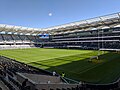 View from the north-east corner
 -
 Main grandstand


Construction
[edit]Demolition work on the old ground began in early 2017 and was completed in February 2017. Site cleanup, excavation and preparatory ground work finished in August. Construction started with concrete foundations being laid down in September 2017, with the main stand complete by mid-2018. The first roof section was assembled and lifted into place at the south end of the ground on 12 February 2018, and complete by late 2018. The structure as a whole was complete in early 2019, with the final internal and landscaping work being completed prior to the opening. The stadium officially opened on 14 April 2019.[17]
-
 September 2017
 -
 September 2017
 -
 March 2018
 -
 May 2018 overview
 -
 May 2018 south-west corner
 -
 September 2018 Main Grandstand rear view
 -
 September 2018 North Terrace construction
 -
 September 2018 O'Connell Street entrance construction


Uses
[edit]

The stadium's main purpose is hosting games for the three major football codes in New South Wales. The two major tenants are the Western Sydney Wanderers and the Parramatta Eels. The Wanderers host all A-League home matches, FFA Cup home games from the quarter-finals onwards and Asian Champions League games in the seasons they qualify. The Parramatta Eels host most of their NRL matches, including finals, at the stadium. The Wests Tigers and Canterbury-Bankstown Bulldogs also use the stadium as an alternative venue while Canterbury ended using the stadium as an alternate venue in 2022. These clubs, alongside the South Sydney Rabbitohs, confirmed they'd use the stadium as a temporary home ground from mid 2020 while Stadium Australia is redeveloped.[18][19] However, this redevelopment never occurred due to the COVID-19 pandemic. As a result of the Sydney Football Stadium redevelopment, the New South Wales Waratahs played 3 Super Rugby matches at the new stadium in their 2019 season.
The dimensions of the pitch meet international standards for soccer and both rugby codes. For rugby union the touch in-goal areas will be 10 metres, at the lower end of the acceptable range of 10 to 22 metres. The stadium is rated to host international matches across the sporting codes. The first rugby test match at the venue took place on 7 September 2019 with the Wallabies playing against Samoa in the lead up to their 2019 Rugby World Cup campaign.[20]
On 2 June 2019, Rugby Australia, the country's national governing body for union, announced that the stadium would become the new host of the country's stops in the men's World Rugby Sevens Series and World Rugby Women's Sevens Series from the 2019–20 season forward.[21]
On 31 August 2019, Football Federation Australia announced that the Australia women's national soccer team ("the Matildas") would play an international friendly match against Chile at the stadium on Saturday 9 November 2019.[22]
The stadium also hosts concerts, the first being Cold Chisel, the Hoodoo Gurus and Birds of Tokyo held on 24 January 2020. This was followed by the final stop of Elton John's Australian tour on 7 March 2020. The Western Grandstand is capable of event hosting on each of the four levels with a maximum single-room capacity of 700 in Level 1 function room.
History
[edit]Sponsors
[edit]When the stadium opened in 2019, it was known as Bankwest Stadium, after Bankwest signed a seven-year deal for the naming rights.[23] In September 2021, Commonwealth Bank, the parent company of Bankwest, secured the naming rights agreement, and the stadium was renamed as CommBank Stadium.[24]
Rugby league
[edit]The stadium opened with a rugby league match between the Parramatta Eels and the Wests Tigers on Easter Monday, 22 April 2019. Eels halfback Mitchell Moses scored the first try, conversion and field goal in the stadium at NRL level. Parramatta won the game 51–6 in front of a sell-out crowd of 29,047.[25] The first official try to be scored at the ground was when Bevan French scored for the Wentworthville Magpies against Western Suburbs in the Canterbury Cup NSW game which was played before the main game.[26][27]
The first NRL finals match at the stadium took place on Sunday, 15 September 2019 with Parramatta defeating the Brisbane Broncos by a record finals margin of 58–0 in front of a stadium-record crowd of 29,372.[28]
International Rugby League hosted the Rugby League World 9s tournament on the weekend of 18 & 19 October 2019.
After the 2020 NRL season restarted due to its stoppage for the COVID-19 pandemic, Bankwest Stadium was announced as one of the three NSW venues, alongside Campbelltown Stadium and Central Coast Stadium, which would initially host games.[29]
Rugby union
[edit]The New South Wales Waratahs hosted the first match of rugby union at the venue against the South African team the Sharks on 27 April 2019 in the Super Rugby competition. The Waratahs lost 15–23 in front of a crowd of 10,605.[30]
The Wallabies played host to Samoa on 7 September 2019 in which the Wallabies won 34–15 in front of 16,091.[31]
On 1–2 February 2020, the venue hosted the 2020 Sydney Sevens.
On 14 November 2020, the venue hosted Argentina versus New Zealand in the 2020 Tri Nations Series. This match was Los Pumas' first win over the All Blacks in 30 attempts.
Soccer
[edit]
The first soccer game held at the new stadium was on 20 July 2019 when Western Sydney Wanderers hosted English side Leeds United.[32] The game was attended by 24,419 which Leeds won 2–1.[33][34] Leeds player Mateusz Bogusz scored the first goal at the ground, Kwame Yeboah scored the first goal for the Wanderers at their home stadium while Pablo Hernández scored the winning goal in the dying seconds of the match. The game was praised for its good atmosphere as both groups of supporters sang and cheered through the 90 minutes.[35]
On 31 August 2019 APIA Leichhardt FC won the 2019 Men's NSW National Premier League Grand Final at the stadium, defeating Sydney United 58 FC 2–1, with Adrian Ucchino scoring the winning goal in extra time.[36]
The Wanderers hosted their first A-League game at the stadium on 12 October 2019, a come from behind 2–1 win against the Central Coast Mariners FC, with captain of the Wanderers, Mitchell Duke, scoring both goals.[37] The attendance figure was 17,091 which is the Wanderers highest-ever A-League regular season crowd, outside of Sydney Derby matches.
The Wanderers' largest crowd attended two weeks later on 26 October 2019 when they hosted Sydney FC in the Sydney Derby. The game was played in front of 28,519 fans and was won by the Wanderers 1–0.[38]
In November 2019, the stadium held its first international game with the Matildas hosting Chile in front of a 20,029 crowd, a record for an international women's game in Australia at the time.[39]
Attendance records
[edit]Transport connections
[edit]Parramatta railway station is serviced by trains of the North Shore & Western Line, Cumberland Line and Blue Mountains Line. The Parramatta River ferry route begins at Circular Quay in the Sydney CBD and includes stops along the river such as Darling Harbour, Meadowbank and Sydney Olympic Park, terminating at the Parramatta ferry wharf. The Parramatta Light Rail will also service the new stadium via the Prince Alfred Square stop.[40] All are located in the Parramatta CBD within a one-kilometre, 15-minute walking distance to the stadium.
References
[edit]- ^ "Bankwest Stadium – The Home of Sport in Western Sydney". Bankwest Stadium.[permanent dead link]
- ^ a b c "Western Sydney Stadium contractor announced". Infrastructure Magazine. 12 December 2016. Archived from the original on 21 September 2017. Retrieved 13 September 2017.
- ^ "The new Western Sydney Stadium". NSW Office of Sport. Archived from the original on 17 June 2019. Retrieved 13 September 2017.
- ^ "Parramatta Park and Old Government House". NSW Government Heritage Office. Archived from the original on 4 March 2017. Retrieved 19 September 2017.
- ^ Lennon, Troy (15 February 2017). "Eels home ground came into being thanks to a local turf club". The Daily Telegraph. Archived from the original on 5 March 2017. Retrieved 20 October 2017.
- ^ "NSW Government to end financial backing for stadia in Sydney's suburbs". Australian Leisure Management. 27 November 2012. Archived from the original on 6 September 2019. Retrieved 13 September 2017.
- ^ "Rebuilding the Major Stadia Network". NSW Office Of Sport. 2015. Archived from the original on 21 September 2017. Retrieved 13 September 2017.
- ^ "Western Sydney Wanderers beat Brisbane Roar to make A-League grand final after extra time". abc.net.au. 25 April 2016. Archived from the original on 29 November 2016. Retrieved 19 September 2017.
- ^ "Bevan French scores hat-trick of tries as Parramatta Eels beat St George Illawarra 30–18". abc.net.au. 29 August 2016.
- ^ Kembrey, Melanie (6 April 2016). "Parramatta's only pool to be demolished to make way for a new sports stadium". The Sydney Morning Herald. Archived from the original on 1 December 2021. Retrieved 1 December 2021.
- ^ Saulwick, Jacob (4 September 2015). "New 30,000-seat Parramatta stadium among premier's $1.6b promises". The Sydney Morning Herald. Archived from the original on 1 April 2018. Retrieved 13 September 2017.
- ^ Wright, Louisa (9 December 2016). "Populous to design Western Sydney Stadium". architectureau.com.au. Archived from the original on 21 September 2017. Retrieved 13 September 2017.
- ^ Visentin, Lisa (31 March 2017). "Berejiklian government pledges $30 million for new Parramatta aquatic centre". smh.com.au. Archived from the original on 21 October 2017. Retrieved 13 September 2017.
- ^ Bossi, Dominic (8 December 2016). "Western Sydney Wanderers set to be given safe standing section in new Parramatta Stadium". smh.com.au. Archived from the original on 12 December 2016. Retrieved 19 September 2017.
- ^ mack (9 December 2016). "New Parramatta Stadium Revealed". WestSydneyFootball.Com. Archived from the original on 6 September 2019. Retrieved 13 September 2017.
- ^ "Winning design unveiled for new Parramatta Stadium". NSW Government. 8 December 2016. Archived from the original on 18 February 2017. Retrieved 13 September 2017.
- ^ "Western Sydney Wanderers' new home, Bankwest Stadium, officially opens its doors | Hyundai A-League". A-league.com.au. 13 April 2019. Archived from the original on 14 April 2019. Retrieved 4 June 2020.
- ^ "Canterbury Bulldogs to move games to Bankwest Stadium and Perth". National Rugby League. 22 July 2019. Archived from the original on 27 July 2019. Retrieved 23 October 2019.
- ^ Solly, Blake (12 June 2019). "Blake Solly's open letter about the redevelopment of ANZ Stadium". South Sydney Rabbitohs. Archived from the original on 23 May 2020. Retrieved 23 October 2019.
- ^ "Qantas Wallabies to host first International Test at Bankwest Stadium against Samoa". Bankwest Stadium. 18 March 2019. Archived from the original on 15 April 2019. Retrieved 15 April 2019.
- ^ "HSBC Sydney 7s heads to Bankwest Stadium" (Press release). Rugby Australia. 2 June 2019. Archived from the original on 4 June 2019. Retrieved 29 July 2019.
- ^ "Westfield Matildas to play Chile in two-match series in November". Matildas. 31 August 2019. Archived from the original on 31 August 2019. Retrieved 4 June 2020.
- ^ "Bankwest secure rights to Western Sydney Stadium". Austadiums. 5 December 2018. Archived from the original on 6 December 2018. Retrieved 6 December 2018.
- ^ "Bankwest Stadium becomes CommBank Stadium as CBA secures naming rights". Mumbrella. 21 September 2021.
- ^ "Eels vs Wests Tigers – NRL match centre". Wide World of Sports. 22 April 2019. Archived from the original on 28 April 2019. Retrieved 22 April 2019.
- ^ "news/2019/04/19/live-coverage--canterbury-cup-nsw-rd-6/". nswrl.com.au. 19 April 2019. Archived from the original on 24 April 2019. Retrieved 24 April 2019.
- ^ "Magpies record first ever win at Bankwest Stadium". Parramatta Eels. 22 April 2019. Archived from the original on 24 April 2019. Retrieved 24 April 2019.
- ^ "Eels v Broncos: Parramatta beat Brisbane in convincing style in NRL 2019 elimination final". National Rugby League. 15 September 2019. Archived from the original on 18 September 2019. Retrieved 15 September 2019.
- ^ "Knights 'home' venue confirmed for NRL restart". Newcastle Knights. 19 May 2020. Archived from the original on 14 November 2020. Retrieved 14 November 2020.
- ^ "NSW Waratahs vs. Sharks | Super Rugby | RUGBY.com.au". rugby.com.au. Archived from the original on 30 April 2019. Retrieved 30 April 2019.
- ^ "Wallabies v Manu Samoa | Austadiums". austadiums.com. Retrieved 1 December 2019.
- ^ "Western Sydney Wanderers to host Leeds United at Western Sydney Stadium in July 2019". Western Sydney Wanderers. Football Federation Australia. 26 November 2018. Archived from the original on 16 April 2019. Retrieved 12 June 2019.
- ^ FC, WS Wanderers (20 July 2019). "Thank you to the 24,419 fans who are here tonight for #WSWvLUFC! #WSWpic.twitter.com/15IIc1WJHV". @wswanderersfc. Archived from the original on 28 August 2019. Retrieved 20 July 2019.
- ^ FC, WS Wanderers (20 July 2019). "A brave effort by the boys in our first match back at Wanderland #WSW #WSWvLUFCpic.twitter.com/qrFZ22BsPN". @wswanderersfc. Archived from the original on 19 August 2019. Retrieved 20 July 2019.
- ^ Howcroft, Johnathan (20 July 2019). "Western Sydney Wanderers 1–2 Leeds United – as it happened". The Guardian. Archived from the original on 24 July 2019. Retrieved 25 July 2019.
- ^ Bossi, Dominic. "APIA clinch NPL NSW title with extra-time win over Sydney United". The Sydney Morning Herald. Archived from the original on 3 May 2021. Retrieved 3 May 2021.
- ^ Rupolo, Nicholas. "Fans react: VAR controversy mars Bankwest return". FTBL. Archived from the original on 19 October 2019. Retrieved 1 December 2019.
- ^ "Western Sydney Wanderers FC v Sydney FC – Hyundai A-League Match Centre". A-league.com.au. 26 October 2019. Archived from the original on 25 December 2019. Retrieved 4 June 2020.
- ^ "Kerr does it again as Matildas beat Chile". ABC News. 9 November 2019. Archived from the original on 9 November 2019. Retrieved 9 November 2019.
- ^ About Parramatta Light Rail Archived 1 December 2019 at the Wayback Machine NSW Government
External links
[edit]- Bankwest Stadium Website Archived 31 July 2021 at the Wayback Machine
- Infrastructure NSW Stadium Website Archived 22 March 2022 at the Wayback Machine
- Venues NSW Stadium Website Archived 19 June 2022 at the Wayback Machine
| Teams | |
|---|---|
| History | |
| Home stadiums |
|
| Training Ground | |
| Honours | |
| Players | |
| Rivalries | |
| Related articles | |


Western Sydney Stadium
View on GrokipediaPlanning and Development
Site History and Selection
The site for the Western Sydney Stadium, situated at O'Connell Street in Parramatta, New South Wales, originated as Cumberland Oval, a multi-purpose sporting ground established in the 1850s during the British colonial period.[8] The oval hosted early leisure activities, horse racing, and diverse sports, including rugby league fixtures for the Parramatta District Rugby League Club—later the Parramatta Eels NRL team—from the club's founding in 1947, establishing it as a foundational venue for Western Sydney sports.[8] In 1986, the New South Wales Government constructed Parramatta Stadium (later sponsored as Pirtek Stadium) directly on the Cumberland Oval footprint, demolishing the original oval to create a 20,000-seat rectangular venue optimized for rugby league and, from 2012, association football via the Western Sydney Wanderers A-League team.[8] This development addressed growing demand in the region's burgeoning population but relied on incremental upgrades rather than full modernization, leading to criticisms of outdated infrastructure by the 2010s.[9] The decision to select the existing site for a complete rebuild, announced by the New South Wales Government on 4 September 2015 as part of a $1.6 billion stadia strategy, prioritized continuity for local teams amid Parramatta's role as a Western Sydney hub.[9] [10] Officials cited the site's entrenched sports heritage, proximity to transport links like Parramatta Railway Station, and capacity to serve a projected regional population exceeding 3 million by 2036 without necessitating a disruptive relocation or greenfield development elsewhere.[9] No alternative locations underwent formal evaluation, as the government's infrastructure review emphasized upgrading established assets over new-site acquisition to minimize costs and logistical challenges.[10] Demolition of the 1986 stadium commenced post-2016 NRL season, enabling construction on cleared foundations.[3]Rebuild Rationale and Design Decisions
The decision to demolish and rebuild Parramatta Stadium, operational since 1986 with a capacity of approximately 20,000 after expansions, stemmed from its outdated infrastructure, including the absence of grandstands at the northern and southern ends and insufficient corporate facilities, which limited its viability for modern professional sports events.[11] Renovation was deemed less cost-effective than a full rebuild, aligning with assessments for comparable venues where reconstruction provided longer-term value and improved functionality over patchwork upgrades.[12] The project formed part of the New South Wales government's 2012 Stadia Strategy, aimed at modernizing facilities to sustain the state's competitiveness in hosting global events and fostering local sports growth, particularly for rugby league and soccer clubs in the rapidly expanding Western Sydney region.[13] The new Western Sydney Stadium was rationalized as essential to double the economic impact of its predecessor through enhanced event hosting, job creation, and regional productivity, while addressing the area's need for infrastructure supporting population growth and sports participation. Government projections emphasized its role as the inaugural venue in a network of contemporary stadia, enabling better alignment with international standards for spectator experiences and operational efficiency.[14] This approach prioritized a purpose-built rectangular design over oval configurations to optimize sightlines and atmosphere for rectangular-field sports dominant in the region, such as NRL and A-League matches. Design decisions by Populous focused on maximizing game-day immersion through a compact layout, full enclosure for weather protection, and proximity to the pitch via steeply raked seating at 34 degrees, creating a unified "wall of noise" effect particularly beneficial for home team advantages in high-attendance contests.[15] The 30,000-seat capacity balanced local demand without overbuilding, incorporating sustainable elements like LEED Gold certification and over 90% material reuse from the demolition to minimize environmental impact and lifecycle costs.[16] [17] Architectural choices, including a lightweight PTFE fabric roof and improved precinct connectivity to public transport and Parramatta Park, reflected a commitment to functionality, regional identity, and long-term adaptability as a multi-purpose venue.[5]Funding Mechanisms, Costs, and Fiscal Debates
The Western Sydney Stadium was funded primarily through allocations from the New South Wales state budget, with a total project cost of $360 million approved by the government in 2016.[18] This funding drew from general state revenues, including proceeds anticipated from the privatization of electricity assets, as part of a broader infrastructure financing approach.[19] The Commonwealth government provided a supplementary contribution of $16.4 million under a specific project agreement, representing a minor portion of the overall outlay.[20] No significant private sector or philanthropic funding was involved, positioning the stadium as a direct public subsidy to support professional sports teams including the Parramatta Eels (NRL) and Western Sydney Wanderers (A-League).[2] Construction costs aligned closely with the initial budget, incorporating demolition of the prior Parramatta Stadium structure and encompassing design, building works by Lendlease, and ancillary developments such as retail spaces, with completion achieved in April 2019 ahead of schedule.[21] Unlike contemporaneous projects such as the Sydney Football Stadium, which experienced a $99 million overrun to reach $828 million, the Western Sydney Stadium avoided major escalations, attributed to streamlined planning and fixed-price contracting.[22] Fiscal debates centered on the stadium's role within the NSW government's $1.6 billion Stadia Strategy, which encompassed multiple venue upgrades and drew widespread scrutiny for prioritizing sports infrastructure amid competing demands on public finances.[23] Opponents, including fiscal conservatives and opposition politicians, contended that the expenditures represented inefficient allocation of taxpayer resources, potentially yielding limited economic multipliers given historical evidence from similar projects showing revenues often insufficient to offset ongoing maintenance and operational subsidies.[24][25] The program's scale, approaching $2 billion across sites, fueled accusations of political favoritism toward influential sports leagues, with public campaigns highlighting opportunity costs for hospitals, schools, and transport in under-resourced Western Sydney.[26] Proponents, led by the Berejiklian government, justified the investment through projected benefits including 1,300 construction jobs, improved regional amenity to stimulate local business, and enhanced competitiveness for hosting national and international events.[27] Government analyses emphasized intangible gains like community pride and talent development in sports, though independent reviews of analogous stadium redevelopments have frequently documented benefit-cost ratios under 1.0, indicating net present value losses when discounting optimistic attendance and revenue assumptions.[28] The absence of private funding mechanisms, such as public-private partnerships with revenue-sharing, amplified critiques of the model as a non-commercial handout, contrasting with international precedents where user fees or leases more directly tie costs to beneficiaries. Despite contention, the project proceeded without referendum or scaled-back scope, underscoring the leverage of sports stakeholders in policy decisions.[29]Construction and Execution
Timeline and Milestones
Demolition of the existing Parramatta Stadium, which dated to 1986, began on 13 February 2017 to facilitate site clearance for the rebuild. This phase involved phased dismantling to minimize disruption, with the process substantially complete by mid-2017, allowing transition to new groundwork.[30] Construction commenced officially on 30 August 2017, following site preparation and enabling works.[20] Groundbreaking ceremonies marked the start of major structural activities on 23 September 2017, with initial focus on foundations and substructure.[31] By November 2017, major construction was underway, including piling and early framework erection.[32] The project reached its mid-point milestone on 30 June 2018, at which stage approximately half of the structural and envelope works were complete.[20] Progress continued through late 2018, encompassing grandstand assembly, roof installation, and fit-out of amenities, under the GC21 collaborative contracting model led by Lendlease.[33] By February 2019, the stadium was 92% complete, with final commissioning and testing phases in progress.[34] Practical completion was targeted for 30 May 2019, though the venue achieved operational readiness earlier, hosting its inaugural NRL match on 22 April 2019 between Parramatta Eels and Wests Tigers.[20][35] This timeline adhered closely to the original schedule despite logistical challenges in a constrained urban site, delivering the 30,000-seat facility under the budgeted $360 million cost.[34]Engineering Challenges and Resolutions
The redevelopment of the existing Parramatta Stadium site presented engineering challenges due to pre-existing ground disturbances from prior foundations and infrastructure, requiring extensive geotechnical assessments to identify and remediate unstable or contaminated soils before new piling and foundation works could proceed.[36] These disturbances, resulting from the original 1980s construction, complicated excavation stability and load-bearing capacity in an area adjacent to the Parramatta River, where groundwater influences added risks of settlement. Resolutions involved targeted soil stabilization techniques, including deep pile foundations driven to competent strata, verified through on-site testing to support the stadium's 30,000-seat bowl structure without long-term differential movement.[36] Spatial constraints from the urban setting—bounded by O'Connell Street, Victoria Road, and nearby residential zones—limited crane access, material laydown areas, and temporary works, necessitating precise just-in-time delivery logistics and off-site prefabrication of key elements like the steel roof trusses and precast concrete seating tiers to reduce on-site duration and disruption.[30] The site's topographic variations, with significant level changes across the footprint, initially challenged seamless integration of the new bowl geometry and access ramps; these were resolved via engineered earthworks, retaining walls, and adaptive subgrade preparation to achieve uniform elevations compliant with the design's steep 34-degree seating rakes for optimal sightlines.[37] Vibration and noise from demolition, piling, and heavy machinery posed risks to adjacent structures, including rail lines and heritage buildings, exceeding typical thresholds in a dense environment. A dedicated Construction Noise and Vibration Management Plan implemented real-time monitoring with seismographs, dynamic compaction controls, and vibration-isolated equipment, alongside night-time restrictions and acoustic barriers, ensuring compliance with NSW environmental guidelines and avoiding structural damage or operational halts.[38] The 24-month timeline from February 2017 demolition commencement to April 2019 substantial completion was achieved through modular steel fabrication—using bolted connections for future adaptability—and phased sequencing that overlapped site prep with superstructure erection, delivering the project without major delays despite these compounded urban pressures.[30] [39]Architectural and Technical Specifications
Core Design Elements
The Western Sydney Stadium, designed by Populous, features a rectangular footprint optimized for intimacy and sightlines, with a fully enclosed 360-degree seating bowl pitched at the steepest permissible angles to enclose the playing field and amplify crowd atmosphere.[5] This configuration prioritizes equitable viewing distances, reducing the farthest seat distance compared to prior iterations while enhancing acoustic performance through the bowl's geometry.[5] The roof structure employs a halo-like fabric canopy spanning 27,939 square meters, comprising 23,398 square meters of PTFE membrane underslung from the steel frame for a clean soffit appearance that conceals structural elements from spectators, and 4,541 square meters of single-skin ETFE panels along the inner rim to permit UV transmission for natural grass growth on the pitch.[40][41] This design achieves Australia's first 100 percent spectator dripline coverage, with the eyelid extension shielding steeper grandstands, and integrates 309 solar panels for energy generation.[42] Structurally, the stadium utilizes modular bolted steel connections over welded joints to facilitate future disassembly and adaptability, with exposed Australian-fabricated steel elements in concourses and facades emphasizing industrial durability and local manufacturing.[43] Precast concrete units form key vertical supports, contributing to the venue's LEED Gold v4 certification through reduced material intensity and sustainability features like water harvesting.[5] The overall form integrates heritage elements from the site, such as curved corner motifs, into modern precast panels for contextual continuity.[44]Capacity, Amenities, and Operational Features
The Western Sydney Stadium, now known as CommBank Stadium, features a fixed seating capacity of 30,000 spectators, with all seats providing undercover protection from the elements.[3][45] This design ensures comprehensive weather coverage while maintaining optimal sightlines through steeply raked grandstands, among the steepest in Australia, to enhance viewing proximity to the field.[21] Amenities include high-quality food and beverage facilities distributed across 16 outlets, supported by 11 kitchens and five bars, facilitating efficient service for large crowds.[46] The venue offers five levels dedicated to premium, corporate, and function spaces, accommodating approximately 3,000 premium seats, including 38 corporate boxes and lounges such as the Cumberland Lounge, which holds up to 700 guests.[3][2] Additional family-friendly features encompass bars, parking, and on-site refreshments, with four change rooms available for teams.[45][1] Operational features incorporate two large video screens for replays and announcements, LED floodlighting for evening events, and advanced broadcast facilities with Wi-Fi connectivity throughout.[1][3] Enhanced security systems and administration support safe, efficient operations, complemented by improved pedestrian plazas and landscaping for better access and crowd flow.[3]