Hubbry Logo
Competitive danceCompetitive danceMain
Open search
Competitive dance
Community hub
Competitive dance
logo
8 pages, 0 posts
0 subscribers
Be the first to start a discussion here.
Competitive dance
Competitive dance
from Wikipedia

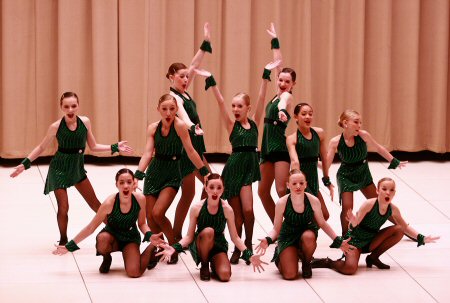
A dance group strikes an ending pose at the conclusion of their competitive performance. Groups such as this are typically formed from students in a dance class. The dancers in this image are members of a tap dance class.

Competitive dance is a popular, widespread sport in which competitors perform dances in any of several permitted dance styles—such as acro, ballet, contemporary, jazz, hip-hop, lyrical, modern, musical theatre, tap, and improv—before a common group of judges. This is in contrast with other activities that involve competition among dancers based on purpose, or specific dance styles or genres, such as pom squad and dancesport (competitive ballroom dance).

The competitive dance industry largely consists of competition production companies—also sometimes called dance competition companies and dance competition lines—that conduct regional competitions at stops along their annual, nationwide tours. Dancers who compete at these regional competitions are students ranging in age from approximately five to eighteen years old. After competing regionally, qualifying routines and studios go on to compete nationally towards the end of their season. Dance schools (often referred to as dance studios) arrange for their classes to compete in a range of disciplines as solos, duets, trios, or in a small group dance in addition to or in place of large group routines. Competitions typically begin in January and end in July or August.

Competitive dancers must be physically fit because even short dances can be physically demanding. Dancers must continuously train to maintain and improve their technique, balance skills, strength and flexibility. Dance studios typically advise their students to avoid activities that put them at risk for injury or illness, especially while attending competitions.[1]

Except for holidays and short breaks during the summer, competitive dancing is typically a year-round activity: dancers attend classes during competition season, to refine their competitive routines, and during off-season to prepare for the next upcoming competition season. Some dancers attend dance intensives during the summer to improve technique. These intensives normally last a few weeks and happen in various locations around the world. Intensives are typically very intense, as the dancers follow rigorous schedules. Twelve hour or more days are extremely likely, as many classes and activities are crammed into each day.[1]

Competition

[edit]

Dance music

[edit]

The music used in competitive dance routines is typically adapted from commercially available songs created by professional recording artists. Dance routines are subject to time limits at most dance competitions, and consequently the original, commercial music is usually edited to conform to such time limits.[2]

Standards

[edit]

There is no industry-wide standard for scoring, but awards are typically awarded in this order: Bronze, High Bronze, Silver, High Silver, Gold, High Gold, Platinum, High Platinum, and Diamond. The maximum number of points issued by each judge, as well as the maximum possible final score, varies among competition production companies. Although it is common for judges to issue a maximum of 100 points each, at least one company implements a system in which judges may issue up to 200 points, based on the rationale that such a scoring system is similar to that employed in public schools.[3] Although scoring at dance competitions vary, judges usually give scores based on score technique, performance, costume, music, and difficulty level of the performance. Each competition's ranks are different. The performances are usually ranked within each dance category.

Most competitions have opportunities for dancers to win title positions. Titles include Mr. and Miss Dance for petites (ages commonly 8 and under), juniors (ages 9–11), teens (12–14), and seniors (15–19). These competitions normally include dancers who choose to pay an extra fee to run for title.

Competitions

[edit]

Competitive dance industry

[edit]

Dance competitions are organized and conducted by independent competition production companies. In 2007 there were at least 150 such companies operating in the United States and Canada alone.[4] Competition production companies move from one metropolitan area to another, stopping for a few days in each area to conduct a regional competition. By touring in this manner, these companies are able to generate profits while at the same time enabling significant numbers of dancers to attend local competitions. Some companies also conduct one or more national competitions after their regional tours have ended.

The competitive dance industry has no oversight body or standards organization, although at least one effort was attempted to establish a limited set of competition rules and safety standards in the industry.[5] Competition production companies seldom coordinate their tours with each other. Tour start and end dates, as well as cities visited, vary from one company to another. Most companies conduct regional tours from approximately January through May, while National competitions generally run from June through August. It is not uncommon for two regional tours to be visiting the same metropolitan area at the same time.

Competitive divisions

[edit]

Dances and performers typically are categorized in various ways so as to create different competitive divisions. These categories are not standardized, and may vary significantly from one competition to another:

  • Age – Each dancer is assigned to a particular age division, wherein each division encompasses a range of ages.
  • Experience – Each dance is assigned to a particular competitive division based on performers' experience.
  • Group size – Dances are also categorized according to the number of performers. Common categories include solo (one performer), duo/trio (two or three performers), and various numbers of group divisions, each of various size.

These divisions are intended to ensure that dancers will compete against others of the same age and experience, and similarly sized groups, and thus avoid unfair comparisons (e.g., beginner vs. advanced).

Videography and photography

[edit]

The choreography of a dance routine—which is the design of movement and flow of steps in the routine—is copyrightable.[6] Consequently, video recording is often prohibited at dance competitions in order to steer clear of copyright infringement issues. Nowadays, most competition companies take photos and videos for dance schools. When no professional videographer is available, competition production companies will sometimes permit each attending dance school to designate a videographer to record performances of students from that school.

Unlike videography, still photography does not infringe copyrighted choreography.[6] Because of this, many competition production companies permit photography at their competitions. Virtually all competitions prohibit flash photography, however, both for the safety of performers and to prevent undesirable distractions. Some competition production companies employ professional photographers to capture and sell photographs of dance performances. In such cases, photography by audience members is typically prohibited so as to provide an exclusive market for the official photographers.

[edit]

Dance competitions became more known to the public after the debut of the television show Dance Moms. Dance Moms featured a competitive dance studio and its dancers as these dancers attended regional and national competitions.

See also

[edit]

References

[edit]
Revisions and contributorsEdit on WikipediaRead on Wikipedia
from Grokipedia
Competitive dance is a structured performance practice in which primarily young dancers from private studios compete by executing routines in diverse styles, including acro, ballet, contemporary, hip-hop, jazz, lyrical, modern, tap, and musical theater, with performances adjudicated based on criteria such as technique, choreography, costuming, and overall presentation. These events emphasize a blend of athleticism, artistry, and entertainment, often featuring solo, duet, small group, and large ensemble categories divided by age, skill level (from novice to elite), and genre to ensure fair competition. Unlike traditional concert dance, competitive dance operates within a commercial framework driven by independent organizations, fostering a culture of high-stakes adjudication, awards, and social recognition that shapes participants' training and aspirations. The origins of modern American competitive dance trace back to the mid-20th century, with early precursors in ballroom competitions emerging in the early 1900s, such as the first international tango tournament in Nice, France, in 1907, followed by championships in major European cities. In the United States, the format evolved through traveling workshops like Dance Caravan, founded in 1959, which combined education and performance opportunities, but it gained widespread popularity in the 1970s with the establishment of dedicated competitions by companies like Showstopper in 1979. By the 1990s, the industry expanded rapidly, influenced by the rise of youth-oriented studio training and media exposure, leading to over 300 competing organizations today that host hundreds of regional events per season across the U.S. and Canada, with major events drawing over 50,000 participants annually as of 2025, thousands of participants annually. Key aspects of competitive dance include its rigorous preparation demands, where elite-level dancers often train 15-25 hours per week, focusing on versatility across styles and incorporating elements like acrobatics, floorwork, and emotional expression to meet judges' expectations. Events typically span 2–3 days at convention centers, with numerical scoring systems that award placements, titles, and special honors, while entry fees range from $150–$200 for solos and $70–$100 per dancer in groups as of 2025, contributing to an industry where deeply involved families may spend over $1,000 monthly on costs as of 2025. The practice has intertwined with popular culture through reality television shows like So You Think You Can Dance, amplifying its visibility and reinforcing ideals of fame, discipline, and achievement, though it lacks a national governing body and continues to evolve with trends in choreography and aesthetics.

History

Origins and Early Development

Competitive dance began to take shape in the late 19th and early 20th centuries, primarily through organized ballroom dancing contests in Europe and the United States, which transformed social dances like the waltz and tango into judged performances. The waltz, which gained widespread popularity across Europe during the 19th century as a couples' dance emphasizing close embrace and fluid movement, laid essential groundwork for competitive formats by shifting social dancing away from formal quadrilles toward more intimate partnerships. Similarly, the tango, originating in Argentina and arriving in Europe around 1900, introduced dramatic flair and sensuality that captivated audiences and prompted early tournaments. These social dances, initially recreational activities in ballrooms and salons, evolved into competitive events as dance teachers and enthusiasts sought to standardize techniques and showcase proficiency. A landmark event was the first international tango tournament in 1907, held in Nice, France, and organized by French entrepreneur Camille de Rhynal, which drew participants from multiple countries and highlighted the growing appeal of competitive partner dancing. This was followed by ballroom championships in Paris, Berlin, and London, establishing annual international events that emphasized precision, timing, and partnership harmony. In 1909, the first unofficial world dance championship occurred in Paris, further solidifying competitive structures. In the United States, the transition from recreational to competitive formats accelerated around the turn of the century, as dance halls were repurposed into venues for contests, influenced by the influx of European immigrants who brought refined ballroom styles. The rise of vaudeville theaters in the late 19th century also contributed by popularizing judged dance acts within variety shows, bridging social dancing with performative evaluation, though these were often solo or group routines rather than strict partner competitions. Early competitive dance focused predominantly on partner styles, distinguishing it from ballet's emphasis on individual or ensemble classical technique in separate performance traditions. Unlike ballet, which had roots in 19th-century court spectacles and later developed its own adjudication for virtuosic solos, ballroom competitions prioritized synchronized couples' execution in social-derived forms. During the 1920s, European nations pioneered the organization of dance as a sport, defining standards and governance that influenced global practices. This culminated in the 1935 founding of the Fédération Internationale de Danse pour Amateurs (FIDA) in Prague by nine European countries, which hosted the first official world amateur championships in 1936 and served as a key precursor to later international bodies.

Modern Evolution and Global Spread

Following World War II, competitive dance in the United States experienced significant expansion through the establishment of standardized organizations and the proliferation of studio-based training programs. The National Dance Council of America (NDCA), formed in 1948, played a pivotal role by setting professional standards for dance teachers and competitions, particularly in ballroom styles, which helped formalize and grow the industry nationwide. By the 1950s and 1960s, the rise of commercial dance studios and traveling workshops, such as Dance Caravan founded in 1959, provided accessible training for aspiring dancers, shifting from elite social events to more inclusive, youth-oriented programs that emphasized technique and performance. Television further amplified this growth; shows like The Arthur Murray Party, which debuted in 1950, brought dance competitions into American homes, inspiring widespread participation and cultural interest. This momentum peaked in the 1970s with the emergence of dedicated youth competitions, including the founding of Showstopper in 1979, fueled by studio expansions and events that drew thousands of young performers annually. The late 1970s and 1980s marked a diversification in competitive dance styles, particularly the rise of non-partnered forms such as jazz and tap, which moved beyond traditional ballroom pairings to emphasize individual expression and athleticism. Commercial studios drove this shift by offering specialized classes tailored to youth programs, where jazz incorporated high-energy routines influenced by popular music and film, while tap highlighted rhythmic precision and improvisation. Attendance in these classes surged during the decade, as movies like Flashdance (1983) and music videos popularized dynamic, solo performances, integrating them into competitive formats at regional and national events. Television continued to influence this evolution; Dance Fever, airing from 1979 to 1987, showcased amateur dancers in varied styles, including jazz and tap, encouraging broader youth involvement and stylistic experimentation in studio training. Starting in the 1990s, competitive dance began its global spread, transitioning from a predominantly North American phenomenon to an international pursuit with major events in Europe, Asia, and Australia. The Blackpool Dance Festival in the United Kingdom, ongoing since 1920 but gaining heightened international prominence in the 1990s, drew competitors from over 50 countries, fostering cross-cultural exchange in ballroom and Latin styles through its annual championships. In Asia, the inaugural World Hip Hop Dance Championship, launched in 2003 by Hip Hop International (with roots in global street dance trends from the late 1990s), united crews from dozens of nations, emphasizing hip-hop's non-partnered, group-based formats and accelerating the style's worldwide adoption. Australia saw parallel growth, with national dancesport championships in the early 1990s and television series like That's Dancin' (1989–1990) promoting competitive formats that blended local and international influences, leading to established youth circuits by the decade's end. From the 2000s onward, the internet and social media profoundly impacted competitive dance by enhancing global participation and enabling style fusion across borders. Platforms like YouTube, emerging in 2005, allowed dancers to upload competition routines and tutorials, democratizing access to training and inspiring hybrid forms that merged jazz, hip-hop, and cultural elements from diverse regions. This digital connectivity boosted participation, as virtual communities shared techniques and event highlights, drawing in participants from underrepresented areas and facilitating collaborations that blurred traditional style boundaries. By the 2010s, social media's role in viral challenges and live-streamed competitions further solidified dance's global reach, with events like the World Hip Hop Dance Championship expanding to include thousands of international entrants annually.

Styles and Genres

Ballroom and Latin

Ballroom and Latin dances form a core pillar of competitive partner dancing, characterized by synchronized movements between two dancers. The Standard category, also known as International Ballroom, consists of five elegant, flowing dances: waltz, tango, Viennese waltz, slow foxtrot, and quickstep. These emphasize partnership and poise, originating from European social dances refined for competition. In contrast, the Latin category features five rhythmic, expressive dances: cha-cha, samba, rumba, paso doble, and jive. Derived from Latin American influences, these styles highlight individual flair within the partnership, with faster tempos and more dynamic interactions. Technical execution in Standard dances relies on precise hold positions and footwork patterns to maintain connection and flow. Partners typically use a closed hold, where the leader's right hand rests on the follower's back at shoulder blade level and left hand clasps the follower's right hand raised to eye level, enabling figures like natural turns and chasses. Rise and fall dynamics are central, involving gradual elevation on the balls of the feet during forward and side steps—achieved through knee flexion and extension—followed by controlled lowering on the heels, which creates undulating body lines especially in waltz and foxtrot. In Latin dances, holds are often more open or variable, such as single-hand connections during spins, to accommodate hip action known as Cuban motion, produced by alternating knee compressions and weight shifts that isolate the hips in a figure-eight pattern. Rhythmic timing drives the style, with syncopated footwork like quick-quick-slow in cha-cha or bouncing actions in samba, emphasizing sharp accents and body isolations for expressive phrasing. The competitive framework for these styles developed in the early 20th century, with the first international tango event held in 1907 and the standardization of techniques by British organizations in the 1920s, culminating in the formation of the Fédération Internationale de Danse pour Amateurs (FIDA) in 1935 to govern amateur events, a predecessor organization that evolved into the modern World DanceSport Federation. Governing bodies like the National Dance Council of America (NDCA) established syllabus levels to structure progression, starting with Newcomer (limited to introductory figures like basic movements) and advancing through Bronze, Silver, and Gold (introducing syncopations and separations) to Novice, Pre-Championship (three to four dances, open figures), and full Championship (all five dances, unrestricted). These levels, detailed in NDCA-approved figures, ensure competitors build foundational technique before open routines, with restrictions like no more than one syncopation per bar in Silver. Costume regulations reinforce the stylistic distinctions, promoting elegance in Standard and vibrancy in Latin while adhering to modesty standards. In Standard, championship competitors wear formal tailsuits for men (black coat with tails, white shirt, bow tie) and long ball gowns for women (floor-length, with subtle embellishments like beads), whereas syllabus levels require simpler attire such as dress pants, shirts, and modest dresses to focus on technique. Latin attire is more flamboyant: men don open-neck shirts, fitted pants, and vests in open levels, while women wear short, form-fitting dresses or two-piece sets with fringes, ruffles, or crystals to accentuate hip movements, though bare midriffs and excessive exposure are prohibited across all levels. Invigilators enforce these rules to maintain presentation aligned with the dances' character, penalizing violations like overly revealing designs.

Contemporary, Jazz, and Tap

Contemporary dance in competitive settings is characterized by its fusion of ballet, modern, and lyrical elements, allowing dancers to convey deep emotion through fluid, expressive movements and structured improvisation within choreographed routines. This style emphasizes personal interpretation and storytelling, often incorporating floorwork, partnering, and acrobatic elements to highlight vulnerability and athleticism. Emerging as a prominent category in the 1970s from influences in theater and concert dance, contemporary has evolved to blend postmodern experimentation with commercial flair, prioritizing individuality over rigid technique. Jazz dance within competitions features high-energy, theatrical movements rooted in African American vernacular traditions, including sharp isolations of body parts, dynamic turns, and powerful leaps that syncopate with the music. Often performed to pop and contemporary tracks, it draws from Broadway and Hollywood choreography, showcasing precision and flair through extensions, kicks, and rhythmic contractions. The style's competitive form amplifies its performative intensity, with routines highlighting speed and synchronization to captivate audiences. Tap dance competitions focus on percussive footwork generated by metal taps affixed to shoes, transforming the dancer's feet into rhythmic instruments that create complex polyrhythms and improvisational solos. Styles such as Broadway tap emphasize clean, showy steps with musicality and elegance, while hoofing prioritizes grounded, forceful stomps and shuffles for raw percussive power. Evolving from African and Irish influences in the 19th century, tap's competitive essence lies in its auditory precision and speed, often challenging dancers through step exchanges and battles. In competitive formats, routines for contemporary, jazz, and tap typically last 2 to 3 minutes for solos, allowing sufficient time to demonstrate technical proficiency and artistic depth without exceeding event schedules. These styles place strong emphasis on choreography innovation, encouraging original compositions that integrate improvisation and narrative to stand out in judging. Their evolution in the 1970s was heavily influenced by theater revivals, including Bob Fosse's stylized jazz in Broadway productions and tap festivals that elevated these forms from vaudeville to concert stages.

Street, Hip-Hop, and Cultural Forms

Street and hip-hop dance emerged from the urban street culture of the Bronx in New York City during the 1970s, rooted in African American and Latino communities amid economic hardship and social marginalization. This period saw the birth of key elements like breaking (also known as b-boying or breakdancing), which features quick footwork, body twists, freezes, top-rocking, down-rocking, and power moves influenced by capoeira, gymnastics, and James Brown's style; popping, involving muscle isolations and tension to funk beats, pioneered in Fresno and Oakland by groups like the Electric Boogaloos; and locking, characterized by sharp poses and self-expressive gestures, developed in Los Angeles by Don Campbell and popularized on Soul Train. Freestyle battles in cyphers at block parties allowed dancers to resolve rivalries through improvised performances, emphasizing community and creativity over formal structure. In competitive settings, hip-hop transitioned from street cyphers to organized formats that preserve its improvisational spirit while introducing judging standards. Hip-Hop International (HHI), founded in 2002 by Howard and Karen Schwartz, launched the World Hip Hop Dance Championship in 2003, innovating crew-based competitions for 5-9 members that highlight synchronized routines and battles in styles like popping, locking, breaking, whacking, and all-styles. These events, held annually in Las Vegas and affiliated with over 55 countries, use standardized criteria developed with dance originators, focusing on musicality, technique, creativity, and team execution to professionalize the form without diluting its roots. A landmark development occurred in 2024 when breaking debuted as an Olympic sport at the Paris Games, featuring one-on-one battles judged on creativity, technique, and musicality, further elevating street dance's global competitive status. Crew dynamics are central to hip-hop competitions, where groups of 2 to 10 dancers perform coordinated sequences in battles, blending individual flair with collective synchronization to outshine opponents. Successful crews, like the historic Rock Steady Crew formed in 1977, rely on standout performers elevating the group through tight formations and innovative combos, fostering a competitive yet collaborative energy. Cultural forms, such as Irish step, Bollywood, and African dances, have been adapted into competitive frameworks, often emphasizing precision in group formations alongside traditional elements. In Irish step competitions (feiseanna), dancers are judged on timing, sharp movements, control, upper-body stillness, and step complexity, with group ceili dances requiring exact synchronization and stamina in lines or sets. Bollywood routines in U.S. contests evaluate technique, choreography, stage presence, and group synchronization, incorporating expressive hand gestures and narrative flair while adapting to competitive timing. African dance styles, performed in circles or lines, prioritize full-body articulation and rhythmic precision in group contexts, with competitions adapting communal rituals into scored events that highlight cultural storytelling through formations. Authenticity remains a core value in representing these cultural forms competitively, where choreographers are encouraged to consult specialists, provide historical context, and compensate experts to avoid superficial stereotypes and ensure respectful execution. The popularity of street and hip-hop surged through media exposure, notably MTV's America's Best Dance Crew (2008-2012), which showcased diverse crews in challenges that popularized the 5-9 member format and attracted global audiences to hip-hop's competitive side. Standardizing these styles poses challenges due to their improvisational nature, as competitions must balance scripted routines with spontaneous elements like battles, often leading to critiques of overly polished choreography that lacks street authenticity or fails to capture musical connection within time limits.

Competition Formats

Structure and Organization

Competitive dance events are typically structured around regional tours that run from January to May, followed by national competitions held from June to August. These events unfold over weekends, often spanning Friday through Sunday, and feature a sequence of performances across various categories such as solos, duets, groups, and lines, culminating in awards ceremonies that recognize top placements in each division. The organizational model for competitive dance relies on independent, for-profit production companies that operate without a central governing body or standardized oversight, allowing each company to set its own rules, formats, and adjudication criteria. A typical regional tour organized by such a company includes 8 to 10 events, enabling studios and independent dancers to select participation based on location and schedule, while national events serve as culminating showcases drawing qualifiers from regionals. Venues for these competitions are commonly convention centers or theaters equipped with professional stages measuring approximately 30 to 40 feet in width and depth, complete with marley flooring, wing space for entrances and exits, adjustable lighting rigs to highlight choreography, and high-quality sound systems for music playback. Participant flow begins with registration deadlines set weeks or months in advance—often requiring online submission of rosters, fees, and music files—followed by on-site check-in where dancers report to designated areas at least 45 minutes before their division starts. Warm-up spaces, such as auxiliary rooms or off-stage areas with mirrors and sprung floors, are provided for rehearsals and stretching under coach supervision, ensuring safety and preparation. Performances progress from preliminary rounds, where large fields of entries are evaluated to advance top scorers, to finals featuring the highest-ranked routines in a more focused showcase. Divisions are often segmented by age groups to ensure fair competition.

Divisions and Categories

Competitive dance competitions organize participants into divisions and categories to promote equitable competition by accounting for differences in physical development, experience, and group size. Age divisions are determined by the average age of the performers in a routine, often calculated as of a specific date like January 1 or the competition day, ensuring dancers compete against peers at similar developmental stages. Many events apply an "age bump rule," requiring routines to compete no more than one or two divisions below the age of the oldest dancer to maintain fairness. Common age divisions for youth competitors vary by organization but typically include categories such as Tiny or Mini (approximately 5-9 years), Junior (10-12 years), Teen (13-15 years), and Senior (16-19 years); for example, The Dance Awards uses Peewee (5-7), Mini (8-10), Junior (11-12), Teen (13-15), and Senior (16-19), while NYC Dance uses Mini (7-10), Junior (11-12), Teen (13-15), Senior (16-18), and Open (19+). Adult or open extensions are offered for participants 19-20 and older, with some events featuring professional categories for trained adults over 19, such as teachers or performers. Some competitions have introduced inclusive divisions, such as for special needs dancers (e.g., ID Dance's Glow division as of 2024), to broaden accessibility. These groupings allow for age-appropriate choreography and technical expectations, such as simpler movements in younger divisions focusing on basic coordination and fun, progressing to more complex routines in senior categories. Adult extensions often include subcategories like amateur or professional based on training intensity. Skill levels further subdivide competitors within age groups to match technical proficiency and experience. Novice level is typically for beginners or first-time competitors with limited training, often 0-1 year of experience; Intermediate for dancers with 2-5 years or moderate prior placements; and Advanced or Elite for those with extensive experience, such as multiple years of competition or high placements in previous events. These levels prevent mismatched competition, with judging criteria adjusted accordingly—for instance, Novice routines emphasize basic technique and performance quality over advanced tricks. Performance types categorize entries by the number of dancers, influencing staging, timing, and scoring emphasis. Solos feature one dancer, duets or trios involve 2-3 performers, small groups consist of 4-9 dancers, large groups 10-19, lines require 20 or more in formation-focused routines, and production numbers are elaborate group pieces with 10+ dancers often exceeding standard time limits for theatrical elements. Smaller formats like solos highlight individual artistry, while lines and productions prioritize synchronization and visual impact across the stage. Most competitive dance events are open to all genders, with no separate divisions based on gender for solos, groups, or lines, fostering inclusivity. In partner styles such as ballroom or Latin, accommodations exist for mixed-gender, same-gender, or non-binary pairs, allowing competitors to register without traditional male-female restrictions, as updated in rules by organizations like USA Dance.

Judging and Standards

Criteria and Scoring Systems

In competitive dance, judges evaluate performances based on a set of core criteria that emphasize technical proficiency, artistic elements, and overall execution. Technique often receives the highest emphasis, typically 30-50% of the total score depending on the competition, assessing elements such as posture, alignment, precision of movements, and control. For example, at The Dance Awards, technique accounts for 50% of the score. Choreography focuses on originality, structure, and effective use of space and transitions, while performance quality, including musicality, expression, and charisma, is also key. Deductions are applied for errors like falls, significant timing deviations, or violations of routine limits, reducing the score by fixed points depending on severity. Scoring is conducted on a numerical scale, commonly 0-100 or 0-300 points per , with routines aggregated from a panel of 3-7 adjudicators to determine final rankings. The or total score determines levels, such as , High , Gold, High Silver, Silver, and , with exact thresholds varying by competition. In cases of ties, the highest individual 's score often serves as the , ensuring a clear winner without shared placements. Awards encompass overall placements (1st through 5th or top 10), high score honors within specific categories like solos or groups, and special titles such as Mr. or Miss Dance, which recognize overall excellence in charisma, poise, and talent across multiple routines. These titles are often awarded in age-based divisions (e.g., Junior, Teen) and carry prestige, including crowns, jackets, or scholarships. Criteria vary by style to reflect genre-specific demands; in ballroom and Latin, emphasis is placed on partnership synchronization, hold quality, floor craft, and rhythmic interpretation, with judges prioritizing couple compatibility and elegant lines. In contrast, contemporary and lyrical routines highlight innovation in choreography, emotional depth, and dynamic execution, with greater focus on artistic communication and difficulty of elements.

Music and Technical Requirements

In competitive dance, music is typically sourced from commercial tracks that are edited to fit specific duration requirements, often ranging from 1:30 to 3:00 minutes for solos, duets, and small groups, with extensions up to 4:00 minutes for larger ensembles. Editing allows for seamless transitions between segments, but must maintain high audio quality without pitch or speed alterations, and vocal removal is optional provided lyrics remain age-appropriate and free of explicit content. Original compositions are generally prohibited unless explicitly permitted by the competition organizer, as routines must adhere to standardized formats using pre-recorded tracks submitted in digital formats like MP3. Technical rules enforce strict parameters to ensure safety and consistency. For ballroom styles, music must conform to prescribed tempos, such as 28-30 measures per minute for waltz and 31-33 for tango, to align with choreographic standards set by governing bodies. Prop usage is limited to freestanding items that can be safely set up and removed within designated time limits—typically 2-3 minutes total—and must not exceed practical stage constraints, such as a maximum height of 15 feet or require external support like rigging. Hazardous elements, including fire, weapons, liquids, or glitter that could damage the floor, are banned, with violations potentially leading to deductions or disqualification. Costume guidelines prohibit dangerous attachments like sharp jewelry or unwieldy accessories, requiring all elements to be secure, family-appropriate, and compliant with midriff coverage rules where applicable. Copyright considerations are paramount, with competitors responsible for using licensed music to avoid infringement; many organizations secure blanket licenses through pools from major performing rights entities, allowing access to approved tracks while prohibiting unauthorized edits or reproductions. Violations, such as employing unlicensed or altered commercial recordings, result in immediate disqualification to protect intellectual property rights. Genre-specific adaptations tailor music choices to stylistic demands, with jazz and hip-hop routines favoring upbeat pop or contemporary tracks at higher tempos for dynamic energy, while cultural forms like ethnic or folk dances often require traditional instrumentals to preserve authenticity and rhythmic integrity. In Latin ballroom, for instance, selections emphasize percussive rhythms like 30-32 measures per minute for cha-cha, contrasting the smoother phrasing in standard ballroom.

Industry and Culture

Production Companies and Major Events

The competitive dance industry in North America relies on a network of production companies that organize and host regional, national, and international events for dancers of all ages and styles. Estimates indicate over 100 active organizers operating across the US and Canada, providing platforms for studios to showcase talent through structured competitions. Prominent US-focused companies include Starbound National Talent Competition, which positions itself as the largest in America with nationwide regional tours and a national finale. Showstopper, established for nearly 50 years, emphasizes high-production-value events and has expanded to 15 new markets in recent years. JUMP, combining conventions with competitions, tours to more than 25 US and international cities annually, fostering both education and performance opportunities. These companies operate on a business model centered on entry fees, which typically range from $65 to $225 per dancer per routine, depending on the event scale and category, with additional revenue from vendor booths, program sales, and sponsorships by brands in apparel, footwear, and music. Participants and studios also incur significant travel and lodging costs, contributing to the industry's overall economic footprint. The sector has experienced steady growth, with US dance competitions alone generating nearly $500 million in revenue as of the early 2020s, driven by increasing participation and event proliferation. North America's competitive dance market, part of a broader global industry, accounted for approximately $850 million in 2024, reflecting robust demand. Major events anchor the competitive calendar, culminating in nationals and international championships that draw thousands of participants. The Dance Worlds, held annually in Orlando, Florida, serves as a premier international showcase for dance teams, attracting over 3,500 athletes from around the world to compete for world titles. The World Dance Pageant, a US-based national event focused on solos, features talent, interview, and modeling components over three days in locations like Secaucus, New Jersey. Internationally, the World Hip Hop Dance Championship, organized by Hip Hop International, brings crews from dozens of countries to Phoenix, Arizona, for mega-crew and junior divisions, emphasizing cultural and stylistic diversity. The industry lacks a single central oversight body, leading to varied rules and standards across organizers, though some align with associations like the National Dance Council of America (NDCA) for dancesport-specific guidelines and the National Dance Alliance (NDA) for school and team events. This decentralized structure allows flexibility but also prompts calls for greater standardization in judging and safety protocols. Videography at competitive dance events is typically restricted to official vendors to protect music copyrights and maintain event integrity. Major competitions such as Starbound National Talent Competition and JUMP Dance Convention prohibit personal video recording, cameras, and unauthorized filming in performance areas, citing concerns over licensed music usage and potential commercial redistribution. Participants and audiences are limited to non-commercial personal use, with event organizers providing professional recordings for purchase, often at $75 per dancer per event, ensuring compliance with performance rights organizations like ASCAP and BMI. These policies stem from federal copyright laws that safeguard choreographic works and accompanying music, preventing unauthorized reproductions that could infringe on performers' and composers' rights. Photography follows similar guidelines, allowing only credentialed professionals to capture images while enforcing rules on equipment and behavior to avoid disrupting performances. Competitions like Showstopper and Jump Dance Challenge permit official photographers to sell packages of prints and digital files, but ban flash photography, obstructive positioning near the stage, and backstage access to minimize distractions and safety risks. Photographers must adhere to high shutter speeds (at least 1/500 second) and appropriate ISO settings to freeze motion without artificial lighting, as outlined in industry standards for stage capture. Television programs have significantly elevated the visibility of competitive dance, transforming it from a niche activity into mainstream entertainment. "So You Think You Can Dance," which aired on Fox from 2005 to 2020 and was revived for its 18th season in 2024, has introduced diverse styles to broad audiences, inspiring a surge in dance participation and professional opportunities by showcasing high-level routines and personal stories. The show's format, blending competition with celebrity choreography, correlates with increased interest in dance classes and styles. Films in the "Bring It On" series, starting with the 2000 original, have further popularized competitive cheer-dance hybrids, highlighting athleticism and team dynamics while sparking cultural discussions on appropriation and innovation in routines. These media portrayals emphasize precision, synchronization, and emotional expression, influencing aspiring dancers to pursue competitive training. Since the 2010s, social media platforms have democratized competitive dance by enabling global sharing of routines, fostering inspiration and community. TikTok and Instagram have become key tools for dancers to post performance clips, tutorials, and behind-the-scenes content, allowing viral dissemination that reaches millions and connects regional competitors worldwide. This shift has amplified visibility for underrepresented styles, with user-generated challenges replicating competition elements and encouraging cross-cultural adaptations, as seen in the rapid spread of hip-hop and contemporary fusions. Platforms' algorithms prioritize engaging content, turning individual routines into inspirational benchmarks and aiding career advancement through direct scout outreach from agents and studios.

Health Impacts and Ethical Issues

Competitive dancers face significant physical health risks due to the demands of intensive training and high-impact performances, with overuse injuries being particularly prevalent. Research indicates that 60% to 90% of dancers experience injuries over their careers, often affecting the lower extremities such as ankles, knees, and feet through strains, sprains, and stress fractures from repetitive motions and inadequate recovery time. In professional and elite settings, injury incidence rates range from 0.62 to 5.6 per 1,000 hours of dance exposure, exacerbated by overtraining in styles requiring extreme flexibility or power. To address these risks, experts recommend incorporating rest days, cross-training for muscular balance, and conditioning programs focused on strength and flexibility to build resilience and prevent long-term joint damage. Mental health challenges are equally pronounced in competitive dance, stemming from the high-stakes environment of judging, parental expectations, and relentless pursuit of perfection. Studies show that approximately 20.8% of dancers exhibit moderate to severe symptoms of depression, generalized anxiety, or eating disorders, with performance anxiety contributing to emotional exhaustion. The pressure to maintain an idealized physique and excel in competitions often leads to neurotic perfectionism, which correlates with increased anxiety, low self-esteem, and emotional exhaustion. Brief mentions of style-specific stressors, such as the physical intensity in hip-hop battles, highlight how these elements amplify mental strain without overshadowing broader issues. Advocacy efforts emphasize access to counseling and stress management training to support dancers' psychological well-being. Ethical concerns in competitive dance revolve around accessibility barriers, potential exploitation, and body image pressures that disproportionately affect young participants. The substantial costs associated with participation—ranging from $1,500 to over $10,000 annually for tuition, costumes, competition fees, and travel—create socioeconomic inequities, limiting opportunities for lower-income families and pressuring parents into financial strain. Some studios exploit this dynamic through coercive practices, such as mandating "dancing through pain" or using revealing costumes that sexualize minors as young as 8-10 years old, fostering body dissatisfaction. These issues are compounded by power imbalances where instructors engage in body shaming, raising questions of child welfare and consent in unregulated environments. Reforms aimed at mitigating these health and ethical challenges have gained momentum through organizations like Dance/USA, which since the 2010s has advocated for inclusive judging criteria, mandatory mental health resources, and safer training protocols. The organization's Task Force on Dancer Health promotes equitable policies, including anti-harassment guidelines and wellness education, to foster a supportive culture that prioritizes participant safety over competitive intensity. These initiatives encourage studios to adopt standardized codes of conduct, reducing exploitation and promoting body positivity to ensure competitive dance benefits all participants without compromising their well-being.

References

Add your contribution
Related Hubs
User Avatar
No comments yet.