
Recent from talks
Composite bow
Knowledge base stats:
Talk channels stats:
Members stats:
Composite bow
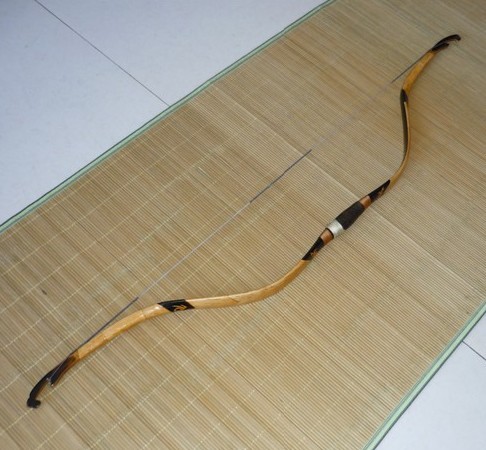
A composite bow is a bow made from many different materials. Composite bows can be made from any combination of horn, antler, bamboo, wood, or sinew. These materials are typically laminated together with glue.
Materials such as horn or antler are added to composite bows because they have extraordinary compression strength, which complements the similarly exceptional tensile strength of sinew.[citation needed] This combination greatly increases the energy-storing potential of a composite bow, relative to its length.
Composite bows are able to be drawn to the same length as bows that are much larger, making them more efficient. However, it is very difficult and time consuming to make a composite bow, and the finished bow is more sensitive to moisture. Materials such as horn and antler are also very heavy, which can affect speed.
It is unclear when and where horn composite bows first originated, but the strongest evidence suggests that they were first developed by sedentary Bronze Age civilizations in Anatolia or Mesopotamia, and then spread to ancient Egypt. The highly mobile Indo-Iranian Andronovo culture was instrumental in spreading the early composite bow to East Asia. The Scythian-style bow was the first composite bow suited for mounted archery, and rapidly became the dominant type of composite bow used by militaries across Europe and Asia for hundreds of years. The Scythian bow was later abandoned in favor of simpler styles with flatter profiles, and all further composite bows in history were based on this prototype.
Composite bows began to be supplanted by guns in the early modern period. In some areas, composite bows survived, and were further developed for leisure purposes. Early modern Turkish bows were specialized for long-distance archery. Composite bows are still made and used in Korea and in China, and the tradition has been revived elsewhere. Modern replicas are available, often incorporating natural and synthetic materials.
It is not known exactly when and where the composite bow originated. It is also uncertain if the composite bow has a single origin, as it may have developed independently in different parts of the world. The composite bow likely originated in the Bronze Age, but it is unclear if it originated in the Early Bronze Age or the Late Bronze Age.
The earliest composite bow shapes are found among the Indo-European early Bronze Age pastoralists in Europe, as well as in western Asia and Arabia, however these bows are likely wood-sinew bows that lack horn components. Reliable evidence suggests that the first composite bows containing horn originated in the Near East, probably Syria, Anatolia, or Mesopotamia, and then spread to Egypt. This culminated in the invention of the angular bow. Several composite bows were found in the tomb of Tutankhamun, who died in 1324 BCE.
The composite bow was spread to East Asia by the Indo-Iranian Andronovo culture as well as the Srubnaya culture.
Hub AI
Composite bow AI simulator
(@Composite bow_simulator)
Composite bow
A composite bow is a bow made from many different materials. Composite bows can be made from any combination of horn, antler, bamboo, wood, or sinew. These materials are typically laminated together with glue.
Materials such as horn or antler are added to composite bows because they have extraordinary compression strength, which complements the similarly exceptional tensile strength of sinew.[citation needed] This combination greatly increases the energy-storing potential of a composite bow, relative to its length.
Composite bows are able to be drawn to the same length as bows that are much larger, making them more efficient. However, it is very difficult and time consuming to make a composite bow, and the finished bow is more sensitive to moisture. Materials such as horn and antler are also very heavy, which can affect speed.
It is unclear when and where horn composite bows first originated, but the strongest evidence suggests that they were first developed by sedentary Bronze Age civilizations in Anatolia or Mesopotamia, and then spread to ancient Egypt. The highly mobile Indo-Iranian Andronovo culture was instrumental in spreading the early composite bow to East Asia. The Scythian-style bow was the first composite bow suited for mounted archery, and rapidly became the dominant type of composite bow used by militaries across Europe and Asia for hundreds of years. The Scythian bow was later abandoned in favor of simpler styles with flatter profiles, and all further composite bows in history were based on this prototype.
Composite bows began to be supplanted by guns in the early modern period. In some areas, composite bows survived, and were further developed for leisure purposes. Early modern Turkish bows were specialized for long-distance archery. Composite bows are still made and used in Korea and in China, and the tradition has been revived elsewhere. Modern replicas are available, often incorporating natural and synthetic materials.
It is not known exactly when and where the composite bow originated. It is also uncertain if the composite bow has a single origin, as it may have developed independently in different parts of the world. The composite bow likely originated in the Bronze Age, but it is unclear if it originated in the Early Bronze Age or the Late Bronze Age.
The earliest composite bow shapes are found among the Indo-European early Bronze Age pastoralists in Europe, as well as in western Asia and Arabia, however these bows are likely wood-sinew bows that lack horn components. Reliable evidence suggests that the first composite bows containing horn originated in the Near East, probably Syria, Anatolia, or Mesopotamia, and then spread to Egypt. This culminated in the invention of the angular bow. Several composite bows were found in the tomb of Tutankhamun, who died in 1324 BCE.
The composite bow was spread to East Asia by the Indo-Iranian Andronovo culture as well as the Srubnaya culture.
Recent media