Hubbry Logo
search
logo
2147299

Composite bow

logo
Community Hub0 Subscribers
Read side by side
from Wikipedia

A massive composite bow drawn by a Qing era archer, northern China, ca. 19th century

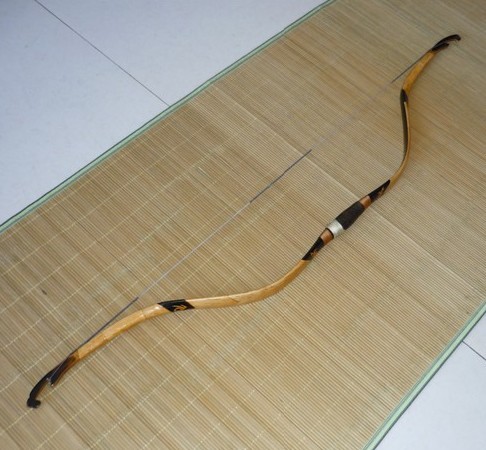
A composite bow is a bow made from many different materials. Composite bows can be made from any combination of horn, antler, bamboo, wood, or sinew. These materials are typically laminated together with glue.[1]

Materials such as horn or antler are added to composite bows because they have extraordinary compression strength, which compliments the equally phenomenal tensile strength of sinew. This greatly increases the energy-storing potential of a composite bow, relative to its length.

Composite bows are able to be drawn to the same length as bows that are much larger, making them more efficient. However, it is very difficult and time consuming to make a composite bow, and the finished bow is more sensitive to moisture. Materials such as horn and antler are also very heavy, which can affect speed.

It is unclear when and where horn composite bows first originated, but the strongest evidence suggests that they were first developed by sedentary Bronze Age civilizations in Anatolia or Mesopotamia, and then spread to ancient Egypt.[1] The highly mobile Indo-Iranian Andronovo culture was instrumental in spreading the early composite bow to East Asia.[1] The Scythian-style bow was the first composite bow suited for mounted archery, and rapidly became the dominant type of composite bow used by militaries across Europe and Asia for hundreds of years.[1][2] The Scythian bow was later abandoned in favor of simpler styles with flatter profiles, and all further composite bows in history were based on this prototype.[1]

Composite bows began to be supplanted by guns in the early modern period. In some areas, composite bows survived, and were further developed for leisure purposes. Early modern Turkish bows were specialized for long-distance archery. Composite bows are still made and used in Korea and in China, and the tradition has been revived elsewhere. Modern replicas are available, often incorporating natural and synthetic materials.

Origins and use

[edit]

It is not known exactly when and where the composite bow originated.[1] It is also uncertain if the composite bow has a single origin, as it may have developed independently in different parts of the world.[1] The composite bow likely originated in the Bronze Age, but it is unclear if it originated in the Early Bronze Age or the Late Bronze Age.[1]

The earliest composite bow shapes are found among the Indo-European early Bronze Age pastoralists in Europe, as well as in western Asia and Arabia, however these bows are likely wood-sinew bows that lack horn components.[1] Reliable evidence suggests that the first composite bows containing horn originated in the Near East, probably Syria, Anatolia, or Mesopotamia, and then spread to Egypt.[1][3] This culminated in the invention of the angular bow.[1] Several composite bows were found in the tomb of Tutankhamun, who died in 1324 BCE.[4]

The composite bow was spread to East Asia by the Indo-Iranian Andronovo culture as well as the Srubnaya culture.[1]

The Scythian bow, ideally suited to mounted archery, likely evolved from the angular bow, showing similar design and construction methods as the Egyptian bows.[1] As the first form of composite bow ideally suited to mounted archery,[5] it became the dominant shape of composite bow in Europe and Asia until the 1st century AD.[1][2]

There are strong indications that Greek Bronze Age cultures were using composite bows on a large scale.[6] By the 4th century BCE, chariotry had ceased to have military importance, replaced by cavalry everywhere (except in Britannia, where charioteers are not recorded as using bows).

The mounted archer became the archetypal warrior of the steppes and the composite bow was his primary weapon, used to protect the herds, in steppe warfare, and for incursions into settled lands.

Classic tactics for horse-mounted archers included skirmishing: they would approach, shoot, and retreat before any effective response could be made.[7] The term Parthian shot refers to the widespread horse-archer tactic of shooting backwards over the rear of their horses as they retreated. The extremely short length of the composite bow made this very convenient.[5]

Composite bows could be used without difficulty by infantry. The infantry archers of classical Greece and the Roman Empire used composite bows. The military of the Han dynasty (220 BCE–206 CE) utilized composite crossbows, often in infantry square formations, in their many engagements against the Xiongnu. Until 1571, archers with composite bows were a main component of the forces of the Ottoman Empire, but in the Battle of Lepanto in that year, they lost most of these troops and never replaced them.[8]

Construction and materials

[edit]

The wooden core gives the bow its shape and dimensional stability. It is often made of multiple pieces, joined with animal glue in V-splices, so the wood must accept glue well. Pieced construction allows the sharp bends that many designs require, and the use of woods with different mechanical properties for the bending and non-bending sections.

The wood of the bending part of the limb ("dustar") must endure intense shearing stress, and denser woods such as hard maples are normally used in Turkish bows.[9] Bamboo, and wood of the mulberry family, are traditional in China. Some composite bows have nonbending tips ("siyahs"), which need to be stiff and light; they may be made of woods such as Sitka spruce.[10]

A thin layer of horn is glued onto what will be the belly of the bow, the side facing the archer. Water buffalo horn is very suitable, as is horn of several antelopes such as gemsbok, oryx, ibex, and that of Hungarian grey cattle.[11] Goat and sheep horn can also be used. Most forms of cow horn are not suitable, as they soon delaminate with use. The horn can store more energy than wood in compression.[10]

The sinew, soaked in animal glue, is then laid in layers on the back of the bow; the strands of sinew are oriented along the length of the bow. The sinew is normally obtained from the lower legs and back of wild deer or domestic ungulates. Traditionally, ox tendons are considered inferior to wild-game sinews since they have a higher fat content, leading to spoilage.[9] Sinew has greater elastic tension properties than wood, again increasing the amount of energy that can be stored in the bow stave.

Hide glue or gelatin made from fish gas bladders is used to attach layers of sinew to the back of the bow, and to attach the horn belly to the wooden core.[10]

Stiffening laths, if used, are attached. Both horn and laths may be bound and glued with further lengths of sinew. After months of drying, the bow is ready for use. Further finishing may include thin leather or waterproof bark, to protect the bow from moisture, and recent Turkish bows were often highly decorated with colourful paints and gold leaf.

Strings and arrows are essential parts of the weapon system, but no type of either is specifically associated with composite bows throughout their history.

Advantages and disadvantages of composite construction

[edit]

Advantages

[edit]

The main advantage of composite bows over self bows (made from a single piece of wood) is their combination of smaller size with high power. They are therefore more convenient than self bows when the archer is mobile, as from horseback, or from a chariot. Almost all composite bows are also recurve bows as the shape curves away from the archer; this design gives higher draw-weight in the early stages of the archer's draw, storing somewhat more total energy for a given final draw-weight. It would be possible to make a wooden bow that has the same shape, length, and draw-weight as a traditional composite bow, but it could not store the energy, and would break before full draw.[10]

For most practical non-mounted archery purposes, composite construction offers no advantage; "the initial velocity is about the same for all types of bow... within certain limits, the design parameters... appear to be less important than is often claimed." However, they are superior for horsemen and in the specialized art of flight archery: "A combination of many technical factors made the composite flight bow better for flight shooting."[12] The higher arrow velocity is only for well-designed composite bows of high draw-weight. At the weights more usual for modern amateurs, the greater density of horn and sinew compared with wood usually cancels any advantage.[9]

Disadvantages

[edit]

Constructing composite bows requires much more time and a greater variety of materials than self bows, and the animal glue used can lose strength in humid conditions; the 6th-century Byzantine military manual, the Strategikon, advised the cavalry of the Byzantine army, many of whom were armed with composite bows, to keep their bows in leather cases to keep them dry. Karpowicz suggests that crafting a composite bow may take a week's work, excluding drying time (months) and gathering materials, while a self bow can be made in a day and dried in a week.[9] Peoples living in humid or rainy regions historically have favoured self bows, while those living in temperate, dry, or arid regions have favoured composite bows.

Medieval Europeans favoured self bows as hand bows, but they made composite prods for crossbows. The prods were usually well protected from rain and humidity, which are prevalent in parts of Europe. Ancient Mediterranean civilizations, influenced by Eastern Archery, preferred composite recurve bows, and the Romans manufactured and used them as far north as Britannia.[13]

The civilizations of India used both self bows and composite bows. The Mughals were especially known for their composite bows due to their Turko-Mongol roots. Waterproofing and proper storage of composite bows were essential due to India's extremely wet and humid subtropical climate and plentiful rainfall today (which averages 970–1,470 mm or 38–58 inches in most of the country, and exceeds well over 2,500 mm or 100 inches per year in the wettest areas due to monsoons).[14]

The civilizations of China also used a combination of self bows, composite recurve bows, and laminated reflex bows. Self bows and laminated bows were preferred in southern China in earlier periods of history due to the region's extremely wet, humid, and rainy subtropical climate. The average rainfall in southern China exceeds 970 mm (38 inches), averaging 1,500–2,500 mm (58–97 inches) in many areas today.[14]

Technical changes in classical times

[edit]

The details of bow construction changed somewhat with time. It is not clear that the various developments of the composite bow led to measurable improvements: "the development of archery equipment may not be a process involving progressive improvements in performance. Rather, each design type represents one solution to the problem of creating a mobile weapon system capable of hurling lightweight projectiles."[12]

West Asian 'duck head' bows

[edit]
On the left, an artistic impression of a 'duck head' bow. The image on the right is a Greek coin depicting a Persian king, probably Darius the Great, holding a similar bow.
A Persian guard at Persepolis, with a bow that terminates in a duck head shape.[15]

In West Asia, composite bows of medium-length, with recurved, 'duck head' tips were common among the Elamite and Assyrian people during the Iron Age.[2] Recurved tips were a new invention in archery, and the 'duck head' bows may have influenced later designs, including the highly recurved, classical "Scythian"-style bow.[2] In the Achaemenid Empire, this type of bow was further developed,[2] adding even more recurved tips, and further decreasing the bow's length, which was possibly an adaptation to mounted archery.[16] Many depictions of such bows exist at the palace of King Darius in Susa,[17] as well as the city of Persepolis.[16]

Scythian bows

[edit]
Scythians shooting with bows, Panticapaeum (known today as Kerch, Crimea), 4th century BCE

Although Scythians used many different kinds of bows,[18] they have come to be associated with an iconic style of composite bow, which has exaggerated serpentine curvature.[18] This bow has come to be known as the classical Scythian design.[1][18] Yet the earliest Scythian bows actually lack the characteristic recurved tips of the "classical" Scythian design.[18] An early Scythian bow from Tuva is described as a "simple" bow, completely lacking the curvy mid-section that is typical of the classical Scythian design.[19]

Variants of the Scythian bow were the dominant form in Asia until approximately the first century BCE.[2]

The size of Scythian bows varied greatly by region.[18] Western Scythian bows in Europe were very short, while those in the eastern Scythian world were longer.[18] A study of Western Scythian bows from the Black Sea region yielded an average length of less than 30 inches.[20]

Western Scythian bows did not include horn; they were made of wood and sinew alone.[18] Many specimens of Scythian-style horn bows have been found in the Eastern Eurasia,[18] such as at Yanghai cemetery in China. These bows are nevertheless attributed to non-Scythian cultures.[1]

Scythian-style bows made in the Caucasus region, often associated with the Koban culture, were made "backwards", with deflexed handles, leading to an "interception" at the stress risers. The bow on the left is strung properly.[21]

It was originally hypothesized that the extremely recurved tips of the classic Scythian design were intended to be flexible, "working" tips, in order to add speed and increase the smoothness of the draw.[2][18] However, archery expert Adam Karpowicz made a reconstruction of a Scythian-style bow, and found that the tips did not flex much at all.[18] He suggests it is doubtful that this was the intended function of the Scythian design, and points out that many Scythian bows actually lack the recurved tips that have become so closely associated with the classical "Scythian" bow in the public imagination.[18]

Siyahs, stiff tips, stiff grips

[edit]

Around 200 B.C. at Yanghai cemetery, a new kind of bow appears with flat, propeller-like limbs, straight tips with bone or antler stiffening plates, and a stiff grip.[1] This type of bow quickly supplanted the older, classical "Scythian" style, and became the foundational model from which all future composite bows would develop,[1] with an ebduring legacy for hundreds of years.[22]

Bone stiffeners are found in association with nomads of the time. They are not found in Achaemenid Persia, in early Imperial Rome, or in Han China.[22]

Siyahs have also been described on the Arabian peninsula, and may have been introduced to Persia by the Sassanids.[23]

Stiffeners likely appeared in Roman militaries around or before 9 CE.[24] Composite bows were made even in the cold and damp of Britannia.[25] They were the normal weapon of later Roman archers, both infantry and cavalry units (although Vegetius recommends training recruits "arcubus ligneis", with wooden bows).[26]

Bone (or antler) reinforcements for stiffening handles developed in Central Asia during the 3rd to 2nd century BCE,[27][28][29] with earliest finds from the area of Lake Baikal. Fittings from this type of bow appear right across Asia[30] from Korea to the Crimea.

Such bows were often asymmetric, with lower limbs shorter than the upper.[22][31][32]

One of the oldest such bows ever discovered is known as the "Yrzi" bow from Dura Europos; it belonged to the Parthian culture.[33] The Qum Darya bow is another such example, and had even more bone plates than the Yrzi bow.[33] Other examples from Niya and Lake Khoton date to roughly the same time period, with excessively wide limbs and a core spliced at the handle region.[34] These bows have attracted considerable attention as their owners were blond haired, "Europoid" males wearing Chinese clothing,[35] possibly making them foreign allies of the Chinese state.[36]

The Qum-Darya bows have also been linked to the so-called Hunnic bows. The type of bow was superseded in the modern area of Hungary by an 'Avar' type, which could have up to 12 laths, with asymmetrical limbs and a stiff, set-back handle. Examples measured in situ suggest bow lengths of 120–140 cm (47–55 inches). When unstrung, the siyahs reversed sharply forward at an angle of 50-60 degrees.[30]

Post-classical development

[edit]
A Persian miniature representing a man with a composite bow

After the fall of the Western Roman Empire, armies of the Byzantine Empire maintained their tradition of horse archery for centuries. Byzantium finally fell to the Turks before the decline of military archery in favour of guns. Turkish armies included archers until about 1591 (they played a major role in the Battle of Lepanto (1571),[8] and flight archery remained a popular sport in Istanbul until the early 19th century.[37] Most surviving documentation of the use and construction of composite bows comes from China and the Middle East; until reforms early in the 20th century, skill with the composite bow was an essential part of the qualification for officers in the Chinese Imperial army.

A Saracen pirate holding a bow of the then-popular short Kipchak (Mamluk) design

The composite bow was adopted throughout the Arab world, even though some Bedu tribesmen in the Hijaz retained the use of simple self bows.[32] Persian designs were used after the conquest of the Sassanid Empire, and Turkish-type bows were widely used after the Turkic expansions. Roughly speaking, Arabs favoured slightly shorter siyahs and broader limbs than the Indo-Persian designs. Sometimes, the protective cover on the back was painted with Arabic calligraphy or geometric patterns.[32] No design was standardized over the vast area of the Arab conquests. It was said that the best Arab composite bows were manufactured in Damascus, Syria.

The first surviving treatise on composite bow construction and archery was written in Arabic under Mamluk rule about 1368.[32][38] Fragments of bone laths from composite bows were found among grave goods in the United Arab Emirates dating from the period between 100 BCE and 150 CE.[39]

Integral wooden siyahs

[edit]

Later developments in the composite bow included siyahs made of separate pieces of wood, attached with a V-splice[40] to the wooden core of the bow, rather than strengthened by external reinforcement.[9] Medieval and modern bows generally have integral wooden siyahs and lack stiffening laths.

String bridges

[edit]

A string "bridge" or "run" is an attachment of horn or wood, used to hold the string a little further apart from the bow's limbs at the base of the siyahs, as well as allowing the siyah to rest at an angle forward of the string. This attachment may add weight, but might give a small increase in the speed of the arrow by increasing the initial string angle and therefore the force of the draw in its early stages. Large string bridges are characteristic of Manchu (Qing dynasty, 1644–1911) bows and late Mongolian bows, while small string bridges are characteristic of Korean, Crimean Tatar, and some Ming dynasty (1368–1644) bows.[41][42][43] String bridges are not present in artwork in the time of Genghis Khan or before.

Modern living traditions

[edit]

All Eurasian composite bows derive from the same nomad origins, but every culture that used them has made its own adaptations to the basic design. The Turkish, Mongolian, and Korean bows were standardized when archery lost its military function and became a popular sport.[44] Recent Turkish bows are optimized for flight shooting.

Perso-Parthian bows

[edit]

The Perso-Parthian bow is a symmetric recurve under high tension when strung. The "arms" of the bow are supposed to reflex far enough to cross each other when the bow is unstrung. The finished bow is covered by bark, fine leather, or in some cases shark skin to keep out moisture.[10]

Perso-Parthian bows were in use as late as the 1820s in Persia (ancient Iran). They were then replaced by muskets.

Turkish bows

[edit]

Turkish bows evolved after the decline of military archery, into highly effective flight bows. Their decoration often included delicate and beautiful multicoloured designs with gold.[9][37]

Chinese bows

[edit]
Zhang Xian shooting a pebble bow at the tiangou causing an eclipse

Some of the oldest possible composite bows found in China are from tombs in Shandong and Hunan provinces, dated to 670-570 BCE.[45] Although results were inconclusive, these bows may have contained horn belly plates and sinew.[45] One bow had a variable cross section, with some regions being ovoid, and others 'D-shaped'. The non-working siyahs had a circular cross section. The bow was reflexed and symmetrical, and its entire body was covered in black lacquer.[45] Bows of this type averaged around 1.15m or 44 inches in length.[45] According to Shelby, bows of this type were used during the warring states period and in the rituals of Confucius.[45] They were 'home-grown' bows indigenous to the Chinese ethnic group.[45] This variant of bow is found at Yanghai cemetery, among many 'Scythian-style' bows.[45]

Some of the Scythian-style bows found at Yanghai cemetery are lacquered like the ancient Chinese bows.[18] Adam Karpowicz has suggested that some of the 'Scythian-style' bows at Yanghai may have been manufactured by Chinese craftsmen, or at least lacquered by Chinese artisans, who sold them to Indo-European-speaking customers.[18]

For millennia, archery has played a pivotal role in Chinese history.[46] Because the cultures associated with Chinese society spanned a wide geography and time range, the techniques and equipment associated with Chinese archery are diverse. Historical sources and archaeological evidence suggest that a variety of bow designs existed throughout Chinese history.[47] For much of the 20th century, only a few Chinese traditional bow and arrow-making workshops were active.[48] However, in the beginning of the 21st century, there has been a revival in interest among craftsmen looking to construct bows and arrows in the traditional Chinese style.[49]

Mongolian bows

[edit]

The Mongolian tradition of archery is attested by an inscription on a stone stele that was found near Nerchinsk in Siberia: "While Genghis Khan was holding an assembly of Mongolian dignitaries, after his conquest of Sartaul (Khwarezm), Yesüngge (the son of Genghis Khan's younger brother) shot a target at 335 alds (536 m)". The Mongol bowmaking tradition was lost under the Qing, who heavily restricted archery practice; only practice with blunt arrows at shorted distances was allowed while most other forms of practice, including mounted archery; was forbidden.[50] The present bowmaking tradition emerged after independence in 1921 and is based on Manchu types of bow.[51] Mounted archery had fallen into disuse and has been revived only in the 21st century.

Archery with composite bows is part of the annual festival of the three virile sports (wrestling, horseriding, archery), called "Naadam".

Hungarian bows

[edit]

The Hungarian bow is a fairly long, approximately symmetrical composite reflex bow with antler stiffeners. Its shape is known from archaeological finds.[52] Modern Hungarians have attempted to reconstruct the composite bows of their ancestors and have revived mounted archery as a competitive sport.

Korean bows

[edit]

A traditional Korean bow, or gakgung, is a small horn-bamboo-sinew composite bow.[44]

Japanese bows

[edit]

Japanese yumi are made by laminating multiple pieces of bamboo and wood.

Native American bows

[edit]

Sinew-backed wood bows were common among Native Americans before European contact.[53] Native Americans also made unique composite bows from horn, antler and possibly rib bones, which differed from Old World composite bows.[54]

An antler-wood-sinew composite bow, likely of Nakota provenance, is found at the Brooklyn Museum in New York City.[55] It consisted of a wooden core with several short 'keys' of antler imbedded on the belly side, and backed with sinew on the other.[55]

The Inuit groups living in North America's northernmost climates often made composite bows using caribou antler, musk ox horn, whale baleen and sinew.[56] Sinew was typically applied to these bows without glue. To accomplish this, sinew was braided in to long, fine cables, suspended along the back of the bow, twisted repeatedly to induce tension, and secured with a series of knots.[1] This technique was also used by Apache tribes in the American Southwest.[1]

It is unclear if horn bow technology developed independently in the Americas, however evidence for antler and bone composite bows does pre-date European contact.[53]

Replicas made with modern materials

[edit]

Modern replicas of traditional composite bows are commercially available; they are usually made with fibreglass or carbon on both belly and back, easier to mass-produce and easier to take care of than traditional composite bows.

See also

[edit]

Bow construction techniques

[edit]

References

[edit]
[edit]
Revisions and contributorsEdit on WikipediaRead on Wikipedia
from Grokipedia
A composite bow is a type of archery weapon constructed by laminating multiple layers of dissimilar materials—typically a wooden core for structural stability, horn on the belly (the side facing the archer) to resist compression, and animal sinew on the back to withstand tension—bonded together with natural glues such as those derived from animal hides or fish bladders, often resulting in a short, recurved design that enhances power and portability.[1][2][3] The origins of the composite bow trace back to the ancient Near East, particularly Mesopotamia and Elam, with iconographic and archaeological evidence suggesting its development around the early second millennium BCE (c. 2000 BCE)—though recent scholarship debates earlier claims—through designs that transitioned into recurved forms.[2][4][5] By the second millennium BCE, the technology had spread across Eurasia, with physical examples appearing in Egyptian contexts, such as two bows found in Tutankhamun's tomb dating to around 1324 BCE, likely introduced via the Hyksos around the 18th century BCE.[3][6] Historically, composite bows became the signature weapon of nomadic steppe cultures, including the Scythians, Huns, Magyars, Mongols, and later the Ottomans and Manchus, enabling rapid horseback archery that revolutionized warfare from the Eurasian steppes to the Middle East and Europe until the 16th century CE.[1][3] Their construction allowed for shorter lengths—often under 1.5 meters—compared to self-bows made from a single piece of wood, making them ideal for mounted combatants while storing and releasing more energy for greater range (up to 300 meters) and penetrating power.[2][1] The bow's efficiency stemmed from the complementary properties of its materials: horn's resistance to compression, sinew's strength under tension, and wood's rigidity, often enhanced by rigid ear-like tips called siyahs that reduced the effort needed for drawing and increased arrow speed.[1][3] This design not only powered the vast conquests of empires like that of Genghis Khan but also influenced archery as both a military technology and cultural practice across Asia and the Mediterranean.[3] Despite their decline with the rise of firearms, composite bows have seen modern revivals in traditional archery and experimental reconstructions.[1]

Construction and Materials

Core Components and Layers

The composite bow consists of three primary layers that work in tandem to provide structural integrity and enhanced performance. The central layer is a wooden core, typically crafted from hardwoods like maple or bamboo, which offers rigidity and maintains the bow's overall shape during use. On the belly, or inner face facing the archer, a layer of horn—often sourced from animals such as ibex or water buffalo—is applied to resist compressive forces effectively. The back, or outer face away from the archer, is reinforced with layers of sinew, derived from animal tendons, to withstand tensile stresses without fracturing. The limbs of the composite bow are structured to optimize energy transfer, featuring distinct sections including rigid siyahs at the tips, a central grip, and string notches. Siyahs, also known as ear tips, are stiffened extensions at the ends of the limbs that project away from the archer at an angle, acting as levers to amplify the bow's power and efficiency during the draw. The grip section forms the handle in the middle of the bow, often ergonomically shaped from the wooden core for secure handling. String notches, integrated into the siyahs, secure the bowstring and ensure precise alignment for consistent shot release. Each layer plays a critical role in the bow's energy storage and release mechanism. During the draw, the sinew on the back elongates under tension, storing potential energy elastically, while the horn on the belly compresses to accommodate the bending without buckling, allowing the bow to achieve greater deflection than a simple wooden bow. The wooden core provides stability, preventing delamination and distributing forces evenly across the layers, which collectively enable higher energy storage—up to significantly more than equivalent self-bows—before release. Upon loosing the string, the layers rapidly return to their undeformed state, converting stored energy into kinetic force that propels the arrow with increased velocity. These layers are bonded using traditional adhesives like fish glue, derived from animal collagen such as fish swim bladders, which provides the necessary strength, pliability, and elasticity to hold the materials together under repeated stress. Fish glue is applied in thin layers between the wood, horn, and sinew, often requiring extended drying periods of several months to achieve full curing and prevent separation during use. This bonding process ensures the composite structure functions as a unified whole, maximizing the bow's durability and performance.

Traditional Materials and Sourcing

The core of traditional composite bows was typically crafted from flexible woods that provided structural stability and allowed for effective bonding with other layers. Maple was commonly used due to its straight grain, elasticity, and strong adhesion properties with glues.[7] In regions like ancient Egypt, ash and olive wood served as cores for their availability and bending qualities.[5] Bamboo emerged as a preferred core material in East Asian traditions, valued for its lightweight flexibility and abundance in forested areas, contributing to the design of recurved bows.[8] Animal-derived components formed the compressive belly and tensile backing, enhancing the bow's power through complementary material properties. The belly layer consisted of horn from bovines, goats, or ibex, selected for its high compression resistance—approximately twice that of wood—which allowed the bow to withstand forces during drawing.[5][9] The backing utilized sinew from deer or cattle, prized for its tensile strength—about four times greater than wood—enabling efficient energy storage and release.[5] Preparation of these materials involved labor-intensive processes to ensure pliability and integration. Horn was softened by soaking in water, steaming, or heating, then shaved, flattened, and cut into thin strips for lamination, a method documented in ancient Near Eastern bowyering techniques.[10][11] Sinew underwent cleaning to remove impurities, followed by shredding into fibers and application in multiple layers using animal-based glues, with each layer allowed to dry partially before the next to prevent delamination.[10] Sourcing these materials presented significant regional challenges, particularly in the arid Eurasian steppes where composite bows proliferated among nomadic cultures. Quality hardwoods like maple or ash were scarce due to limited tree cover, prompting innovations in composite construction to compensate for environmental constraints.[5] Horn, while obtainable from local grazing animals such as goats and bovines, often required trade networks for premium specimens, as seen in Egyptian imports of northern woods and possibly horns to supplement local supplies.[5][9] Environmental factors, including aridity and temperature fluctuations, influenced material quality; for instance, horns from high-altitude ibex provided denser structure but were seasonally limited.[9] The quality of sourced materials directly impacted bow durability, with well-prepared horn and sinew conferring resistance to environmental stresses like humidity when secured with robust glues. Inferior or improperly dried components could lead to weakening in moist conditions, as the organic glues risked softening, though steppe dryness generally preserved integrity during use and storage.[5] High-quality integrations, such as evenly layered sinew, extended service life to years of rigorous campaigning, underscoring the bowyer's skill in overcoming sourcing variability.[10]

Assembly and Gluing Techniques

The assembly of a traditional composite bow begins with meticulous preparation of its core components to ensure compatibility and structural integrity. The wood core, typically crafted from straight-grained hardwoods such as maple, birch, or bamboo, is cut to the desired length—often 48 to 60 inches—and shaped with a thicker central section for the handle, tapering toward the limbs. To impart the characteristic reflex, the wood is steamed or soaked in hot water to soften it, then bent into a gentle curve and clamped in position while drying, a process that may take several days.[12][13] Horn strips for the belly are sourced from the outer layers of water buffalo or cow horns, cut lengthwise into thin rectangles approximately 1/8 to 3/16 inch thick using a hacksaw or knife, and smoothed with files. These strips are then boiled or soaked in hot water to render them pliable, pressed flat between wooden boards or metal plates under clamps to remove curvature, and shaped to match the wood core's contours, allowing time to cool and set.[12][11] Sinew for the back is harvested from deer or elk tendons, particularly leg sinews or backstraps, and processed by pounding with a hammer or stone to separate the fibers into fine, floss-like strands. These fibers are soaked in warm water to soften, combed for evenness, and sometimes twisted into loose bundles or threads to facilitate application, though they are often laid directly in overlapping layers for optimal tensile strength.[14][12] The gluing process employs natural animal-based adhesives, primarily hot hide glue derived from boiled animal skins or sinew scraps, or the more prized fish glue from swim bladders, valued for its flexibility and reversibility. Surfaces are roughened or lightly scored with knives to enhance adhesion, and the glue is heated to a liquid state in pots over low fire, applied generously in thin coats. Assembly starts with attaching the horn strips to the belly of the wood core using V-splices or scarf joints at the ends for seamless integration; the pieces are aligned, glued, and subjected to intense pressure via rope bindings, wooden levers, or custom presses for several days to weeks, ensuring no gaps form as the glue sets.[11][15][13] Once the horn-wood laminate has fully cured—typically after one to two weeks—sinew layers are applied to the back in multiple iterations, often two to four thin coats. Each layer is brushed with warm glue, positioned longitudinally along the limbs, and wrapped tightly with cords or clamped to prevent shifting, drying for 7 to 14 days per layer in a controlled environment to allow the sinew to contract and bond. This iterative process, which exploits the sinew's natural shrinkage, imparts the bow's reflex and power, spanning several weeks overall.[12][15] Finishing involves tillering, where the assembled bow is gradually bent using a temporary string on a tillering frame or tree, inspecting for even limb flexion and adjusting minor asymmetries through localized heating with hot water or steam followed by clamping. The bow is then strung with a permanent cord—often of twisted sinew or silk—shorter than its length by 3 to 4 inches, and tested by drawing to verify balanced performance without twisting. Tools throughout include knives for cutting and scoring, files and rasps for shaping, boiling pots for glue and material softening, and various clamps or presses; the entire construction demands months of labor due to extended drying periods.[12][13]

Performance Advantages and Limitations

Mechanical Benefits

The layered construction of composite bows, with horn facing the belly to handle compression and sinew on the back to manage tension around a wooden core, enables significantly higher energy storage than simple wooden self-bows through optimized distribution of mechanical stresses.[16] This allows for draw weights reaching 100-160 pounds while maintaining structural integrity, delivering arrows with sufficient kinetic energy for maximum ranges exceeding 300 meters with light flight arrows, while effective combat ranges were typically 200-300 meters, surpassing those of many comparable wooden self-bows (often 150-250 meters).[9][17] The inherently compact design, with overall lengths of 1 to 1.5 meters, provides a key mechanical advantage for mounted archery by reducing interference during movement without reducing stored energy or power output relative to longer wooden alternatives.[18][16] The reflexed shape of the limbs, which curve away from the archer when unstrung, preloads the bow with stored elastic energy, contributing to a progressive draw force curve that minimizes archer fatigue and accelerates the arrow to speeds of around 40-60 meters per second upon release—up to twice the efficiency of self-bows in energy transfer to the projectile.[19][16] This material layering also confers greater durability against dry environmental stresses, resisting warping from temperature variations better than homogeneous wooden bows, which are prone to seasonal deformation—though composites require protection from moisture to avoid delamination.[16][19] ==== Shooting rates and comparison to longbows ==== Historical composite recurves allowed rapid fire, especially from horseback, with trained archers achieving bursts of 1–2 arrows in 10 seconds and sustained rates of 6–10+ arrows per minute in mobile combat. Compared to the English longbow (peak 10–12 arrows/min, sustained ~5–7/min), recurves offered similar or slightly higher rates due to shorter length and smoother draw cycle, though longbows compensated with higher absolute draw weights (100–180 lb vs. 75–166 lb for many composites) for raw power. The recurve's energy efficiency (20–30% more storage per pound) enabled comparable or superior velocity with lighter arrows.

Drawbacks in Design and Use

Composite bows, despite their mechanical advantages in power and compactness, present significant challenges in maintenance due to the organic materials used in their construction. The sinew backing, which provides tensile strength, absorbs moisture in wet conditions, leading to loosening and a loss of draw weight that can compromise performance until dried and potentially re-glued.[20] Similarly, the horn on the belly can crack in extreme cold, as the material becomes brittle without proper warming, necessitating frequent inspections and environmental protection during use.[21] These issues require constant expert care, including unstringing the bow when not in use and storing it in shaded, controlled conditions to prevent degradation.[20] The production of composite bows is labor-intensive and costly, relying on rare materials like animal horn and sinew, combined with highly skilled craftsmanship that can take months to years to complete, thereby limiting their suitability for mass production compared to simpler self-bows.[20] This expense historically positioned them as high-status weapons, accessible primarily to elites or well-resourced warriors.[20] Climate sensitivity further hampers their reliability, as humidity and rain can weaken the animal glues binding the layers, causing warping or delamination that reduces efficiency far more than in wooden self-bows, which are more tolerant of environmental variations.[22] Archers often mitigated this by sealing the bow or keeping it warm and dry, such as inside clothing, but prolonged exposure still posed risks.[22] Repairing composite bows is particularly challenging, as delamination or twists demand specialized techniques like heating, re-gluing, and using moulds or jigs in a workshop setting, making on-site fixes more difficult and time-consuming than patching simple wood bows.[20] These vulnerabilities contrast with the bows' superior energy storage, underscoring the trade-offs in their layered design.[20]

Historical Origins and Evolution

Early Development and Chariot Warfare

The composite bow first emerged in the ancient Near East during the fourth millennium BCE, with initial iconographic evidence from Mesopotamia dating to around 3400–3100 BCE, evolving through double-concave and angular profiles by the early second millennium BCE. Early designs featured double-concave profiles (ca. 3800–1900 BCE) in Mesopotamia and Elam, transitioning to angular and recurved forms by the early second millennium BCE.[https://experimentalarchaeology.wordpress.com/wp-content/uploads/2011/06/barton-experimental-approaches-to-near-eastern-archery.pdf] This advanced weapon evolved from earlier simple self-bows made of a single piece of wood, incorporating layered materials such as wood, animal horn for compression, and sinew for tension to achieve greater power and compactness.[https://oracc.museum.upenn.edu/saao/aebp/downloads/archer_ancient_warfare_2010.pdf] By 1700 BCE, the technology had spread to Egypt, marking a significant upgrade in archery capabilities that transformed battlefield dynamics.[https://faculty.uml.edu/ethan_spanier/Teaching/documents/CP3.5CarneyEgyptianchariot.pdf] The introduction of the composite bow coincided closely with the advent of chariot warfare, enhancing the mobility and firepower of ancient armies. In Egypt, the Hyksos invaders around 1700 BCE brought both horse-drawn chariots and the composite bow, integrating them into their military tactics during the Second Intermediate Period.[https://faculty.uml.edu/ethan_spanier/Teaching/documents/CP3.5CarneyEgyptianchariot.pdf] This combination allowed charioteers to deliver rapid volleys from speeding platforms, a tactic soon adopted by Egyptian forces under the New Kingdom pharaohs. Similarly, in Mesopotamia and Anatolia, the Assyrians and Hittites employed composite bows extensively with chariots for mobile archery, enabling archers to maintain continuous fire while evading close combat.[https://www.jstor.org/stable/2842479] Hittite reliefs from the 14th century BCE depict charioteers armed with these bows, underscoring their role in large-scale battles such as the Battle of Kadesh.[https://www.militaryhistorychronicles.org/api/v1/articles/117051-chariot-warfare-in-the-late-bronze-age.pdf] Tactically, the composite bow provided chariot forces with decisive advantages in skirmishing and massed assaults, primarily through its superior rate of fire and effective range. A trained charioteer could loose 10-12 arrows per minute, far outpacing the 6-8 arrows achievable with self-bows, allowing volleys that overwhelmed infantry lines from afar.[https://solar.lowtechmagazine.com/2022/11/what-if-we-replace-guns-and-bullets-with-bows-and-arrows/] With a range extending up to 200-300 meters—double that of simple bows—these weapons enabled hit-and-run maneuvers, where chariots could approach, unleash a barrage, and withdraw before counterattacks.[https://oracc.museum.upenn.edu/saao/aebp/downloads/archer_ancient_warfare_2010.pdf] This firepower was crucial in the chariot-dominated armies of the Late Bronze Age, contributing to the success of empires like the Hittites and early Assyrians in conquering and controlling vast territories. Archaeological evidence confirms the early construction techniques of these bows, particularly through finds from royal tombs. In Tutankhamun's tomb (ca. 1323 BCE), excavators discovered over 30 composite bows, many intact or partially preserved, revealing a core of wood overlaid with ibex horn on the belly and animal sinew on the back, glued with natural adhesives.[https://minds.wisconsin.edu/bitstream/handle/1793/66631/Loew_Thesis.pdf?sequence=1&isAllowed=y] These artifacts, analyzed in detail, demonstrate the bow's reflexed design even in unstrung form, which stored exceptional energy for propulsion, and highlight the sophisticated craftsmanship required for their assembly.[https://oracc.museum.upenn.edu/saao/aebp/downloads/archer_ancient_warfare_2010.pdf] Such discoveries provide direct insight into the weapon's role in elite chariot warfare of the period.

Adoption by Mounted and Foot Archers

The adoption of composite bows by mounted archers marked a significant evolution from their earlier use in chariot warfare, enabling greater mobility on the Eurasian steppes during the 1st millennium BCE. Scythian nomads, active from around 700 BCE, pioneered the integration of these short, recurved composite bows—typically around 74 cm in length and constructed from wood, horn, and sinew—into horseback archery, as evidenced by archaeological finds from northern Black Sea kurgans such as Vodoslavka (4th century BCE).[23] This design allowed Scythian warriors to execute hit-and-run tactics, firing light arrows (6–10 g) at high speed while evading infantry formations, a strategy highlighted in Herodotus' descriptions of their mounted archery prowess and unstrung bows resembling a bowstring. Similarly, innovations by steppe nomads, including the Parthians from the 3rd century BCE onward, refined these tactics, with the "Parthian shot"—firing backward while retreating—becoming emblematic during battles like Carrhae in 53 BCE.[24] Foot archers also increasingly adopted composite bows in the 5th century BCE, particularly following Greek encounters with Persian forces during the Persian Wars (490–479 BCE). After battles like Plataea, where Achaemenid archers deployed coordinated volleys from recurved composite bows (approximately 100 cm long with horn and sinew lamination), Greeks incorporated elements such as Scythian-style socketed trilobal arrowheads into their arsenal, though full bow adoption remained limited to auxiliary roles due to the dominance of hoplite infantry.[25] By the Roman era, auxiliary sagittarii units—often recruited from Syrian or Cretan provinces—standardized shorter composite bows for infantry use, protected in leather cases against damp conditions and tipped with bone for enhanced draw force, allowing foot soldiers to support legions by disrupting enemy lines from protected positions.[26] The cultural spread of composite bows occurred primarily through Achaemenid conquests and Silk Road trade networks from the 6th century BCE onward, disseminating the technology from the Near East across Eurasia. Achaemenid armies, drawing on Scythian influences, equipped mounted and foot archers during expansions into Anatolia, Greece, and beyond, with temple-issued bows (along with 40–60 arrows per archer) facilitating widespread military adoption.[25] Archaeological evidence from Inner Asian sites like Niya (Xinjiang) reveals bows of 142–155 cm, indicating transmission to distant regions via nomadic migrations and commerce, though direct evidence in western European areas like Celtic territories remains sparse for this period.[27]

Classical Era Innovations

During the Classical Era, from the 5th century BCE to the 5th century CE, composite bows underwent significant technological refinements, particularly among nomadic cultures of the Eurasian steppes, enhancing their power, stability, and suitability for mounted archery. These innovations built on earlier designs by addressing limitations in draw mechanics, string retention, and structural integrity under tension. Archaeological evidence from sites in Inner Asia and the Black Sea region reveals a progression toward more efficient weapons, driven by the demands of chariot and horseback warfare. One key advancement was the development of flexible ear extensions, or bending tips, associated with Scythian bow designs around 600 BCE in regions like Xinjiang, northeastern China. These recurved tips, formed from the continuous wooden core extending to the limbs' ends, allowed for a smoother draw by distributing bending stress more evenly across the bow, thereby increasing arrow cast and overall energy transfer without excessive limb compression. Excavations of Scythian-style bows from kurgans in the northern Black Sea region, such as the Vodoslavka burial (third quarter of the 4th century BCE), confirm the presence of these flexible tips, which measured approximately 76-78 cm in total bow length and facilitated rapid, consistent releases essential for mobile combat.[28][29][30] The introduction of siyahs—rigid stiff tips initially crafted from bone or antler—emerged around the 3rd century BCE, with evidence from sites like Shombuuziin-belchir in Mongolia (3rd–2nd century BCE), marking a shift from fully flexible limbs to hybrid designs that prevented string slippage and amplified power through added leverage. These extensions, often curved with U-shaped notches for string retention, stiffened the bow's ends while allowing the working limbs to flex, resulting in higher draw weights and projectile velocities. Evidence from the Shombuuziin-belchir site in Mongolia (3rd-2nd century BCE) includes bone siyah laths up to 38 cm long, integrated into composite structures of wood, horn, and sinew, demonstrating their role in enhancing efficiency for steppe nomads. Similar rigid tips appear in 4th-century BCE Scythian finds from Berel’ in Kazakhstan, where they contributed to the bow's stability during high-tension draws.[27][29] To counter flexing and slippage at the handle, grip stiffening laths were incorporated, typically as paired bone or wooden rods flanking the central grip area for added rigidity and ergonomic stability. These reinforcements, averaging 35-38 cm in length, were roughened for secure gluing to the core and prevented the handle from deforming under draw force, ensuring consistent alignment. Northern Black Sea kurgan excavations from the 4th century BCE highlight reinforced grips in Scythian bows, which improved handling in dynamic combat scenarios. Complementing this, additional side laths—often doubled bone plates along the limbs' sides—were added to resist torsional twisting under tension, maintaining the bow's planar shape and preventing energy loss. At Shombuuziin-belchir, such side reinforcements (up to four per side) altered stiffness zones, with lengths tailored to optimize flex without compromising integrity, as seen in bows from 3rd-century BCE contexts.[27][29]

Medieval and Post-Classical Advancements

Introduction of Rigid Tips and Reinforcements

During the medieval period from the 6th to 15th centuries, composite bows underwent significant enhancements in their tip and reinforcement designs, particularly within the Islamic world under the Abbasid Caliphate (8th-10th centuries), where Turkish horse-archers introduced refinements that improved mechanical efficiency and combat effectiveness. These innovations evolved from earlier classical siyah precursors, adapting rigid tips to better suit mounted and infantry warfare against increasingly armored foes, such as during Crusader encounters in the 12th-13th centuries. Artifacts and treatises indicate a shift toward more integrated structures, enhancing draw weight and arrow velocity while maintaining portability.[9][20] A key advancement was the development of integral wooden siyahs, carved directly from the core wood of the bow's limbs rather than as separate attachments, providing seamless integration and greater structural integrity. In Islamic bow designs, such as those used by Ottoman and Mamluk archers, these siyahs—typically made from hardwoods like maple—extended the non-bending tips as levers, allowing for longer draws without excessive stacking and reducing the archer's effort. This replaced earlier V-spliced attachments, minimizing weak points and enabling higher draw weights up to 100 pounds or more in flight bows. By the 12th century, this integral construction became standard in "smooth" recurved designs, influencing Abbasid military archery traditions.[20][31][9] String bridges emerged as elevated notches or platforms on the siyahs, typically crafted from horn, wood, or bone, to raise the bowstring slightly above the limb's curve and prevent slippage during the draw. This feature increased effective draw length by 2-4 inches in some designs, amplifying stored energy and power stroke for greater arrow speed and range, essential for mounted archers evading close combat. In Mongol-influenced Turkish bows of the 13th century and later, string bridges also damped vibrations and protected the sinew backing from wear, contributing to the bow's reliability in prolonged engagements.[20][32] Enhanced reinforcements involved layering multiple wooden laths or sinew strips over the core, particularly for heavier draw weights required in siege warfare, where composite bows delivered incendiary or bodkin arrows against fortifications. During the 13th-century Crusades, such as the siege of Acre (1291), Mamluk bows with 5-7 layered wooden cores and additional sinew backings achieved draw forces exceeding 120 pounds, outperforming simpler designs in penetration against armor and walls. These multi-lath constructions, often triangular in cross-section for added rigidity, originated in Abbasid workshops and spread through Turkic influences, taking 1-2 years to build due to the drying process.[20][9][31]

Regional Adaptations in String and Grip Design

In medieval composite bows, string designs varied to accommodate different shooting techniques and performance needs, particularly in regions emphasizing thumb-ring archery. Looped strings, which encircled the siyahs (rigid ear-like tips) without additional supports, were common in earlier Central Asian variants for simplicity and quick restringing during mounted combat. In contrast, bridged strings—featuring small platforms or notches on the siyahs, often made of horn, leather, or wood—emerged as an adaptation in post-13th-century designs, allowing higher draw weights (up to 100-150 pounds) while maintaining string stability for thumb-ring draws. These bridges prevented slippage under tension, as seen in Mongol-influenced bows where siyah notches facilitated precise attachment and release with thumb rings crafted from bone or horn to protect the archer's digit.[33][32] Grip adaptations focused on ergonomics for horseback stability, with designs evolving to counter the vibrations and awkward angles of shooting from a galloping mount. Angled grips, often deflexed slightly at the handle to align with the rider's forearm, provided better control and reduced torque during rapid shots, as evidenced in 13th-14th century steppe bows measuring 35-47 inches overall for compactness. Pistol-like grips, protruding perpendicularly from the limb plane, further enhanced one-handed handling in some Middle Eastern and Central Asian variants, allowing archers to maintain balance while maneuvering. Reinforcements such as bone inlays or laths embedded in the wooden core of the grip added rigidity against flexing, though steppe traditions like the Mongol favored lightweight wood cores without bone to optimize energy transfer and arrow velocity.[34][35][33] Material tweaks in Asian variants incorporated bamboo for its superior strength-to-weight ratio, reducing overall bow mass by up to 20-30% compared to horn-wood cores while preserving reflex properties. In Chinese and Korean designs, such as the Ming-era Kaiyuan bow or Gakgung, bamboo formed the primary core, often laminated with sinew backing and horn belly, enabling lighter bows (around 1-2 kg) ideal for prolonged mounted use without fatigue. This integration not only lightened the weapon for cavalry archers but also improved humidity resistance in East Asian climates.[34][33] Cross-cultural exchanges during the 13th-century Mongol invasions significantly influenced these adaptations, disseminating bridged string mechanisms and angled grips from Central Asian steppes to Middle Eastern and Eastern European workshops. As Mongol forces conquered vast territories from 1206-1260, artisans in Persia and China adopted and refined siyah notch designs and thumb-ring compatible strings, blending them with local materials like bamboo to create hybrid variants that enhanced mounted archery efficiency across Eurasia. These influences extended to Byzantine and early Renaissance European contexts, where limited adoption of reinforced grips appeared in mercenary units exposed to Ottoman tactics.[32][35][1]

Regional Traditions and Variants

Central Asian and Middle Eastern Bows

In Central Asia and the Middle East, composite bows evolved into highly specialized tools for mounted warfare, reflecting adaptations to nomadic lifestyles and cavalry tactics from antiquity through the Ottoman era. The Perso-Parthian bows, prominent during the Sassanid Empire (3rd-7th centuries CE), featured asymmetrical designs optimized for right-handed draws, with a longer lower limb to facilitate arrow nocking and drawing while mounted.[36] These bows, constructed from layered wood, horn, and sinew, were integral to Sassanid cavalry operations, enabling archers to execute precise forward-facing shots and the renowned Parthian shot—firing backward while feigning retreat—during battles against Roman and Byzantine forces.[36] Silver plates from the period depict elite horsemen using these bows in royal hunts and combat, underscoring their role in both military dominance and symbolic displays of power.[36] The Mongol bows of the 13th century, wielded by Genghis Khan's armies, were short and exceptionally powerful, typically measuring around 120-140 cm when unbraced, to allow fluid shooting from horseback without encumbrance.[32] Crafted from a core of wood (often birch or bamboo), backed with animal sinew for tension, and faced with horn for compression, these composite designs stored immense energy in a compact form, propelling arrows up to 300 meters with draw weights over 100 lbs.[32][37] This construction enabled Mongol horsemen to maintain high rates of fire—up to 10 arrows per minute—during rapid maneuvers, contributing to their conquests across Eurasia by overwhelming infantry and rival cavalry at range.[32] Turkish and Ottoman bows represented a pinnacle of refinement in the region, characterized by extreme reflex at the ears (siyahs)—rigid, recurved tips that extended well beyond the grip—allowing for draw lengths of up to 32 inches and superior arrow speeds exceeding 200 feet per second.[38] These highly reflexed composites, built from maple or similar woods cored with horn and sinew, achieved draw weights reaching 120 lbs in elite models, demanding rigorous training for the Janissary corps, the Ottoman infantry elite who practiced daily to master their power and accuracy.[38] By the 15th-17th centuries, such bows were central to Ottoman military campaigns, from sieges to field battles, where their long-range capabilities (up to 500 meters for flight arrows) provided a tactical edge over European longbows.[38] Beyond warfare, archery held profound cultural significance across these regions, serving as a rite of passage, a tool for communal hunting, and a ceremonial emblem of nobility and skill. In Mongol society, every able-bodied man was trained from youth in bow use, integrating it into daily nomadic life for provisioning through hunts and into epic tales of heroism preserved in oral traditions.[39] Ottoman ceremonies, such as the annual archery festivals in Istanbul, showcased thumb-ring techniques—using a protective ring on the drawing thumb to handle high tensions—symbolizing discipline and imperial prowess, while Persian and Central Asian elites employed similar methods in courtly hunts that reinforced social hierarchies.[40] This thumb draw, prevalent from Sassanid times onward, allowed for a secure grip on short strings, facilitating rapid releases essential for horseback shooting and embedding archery as a cultural cornerstone of identity and endurance in steppe and desert environments.[40]

East Asian Bows

In East Asian traditions, composite bows evolved distinct adaptations suited to regional warfare, terrain, and cultural practices, often incorporating abundant local materials like bamboo alongside horn and sinew. Chinese composite bows, exemplified by the Manchu qianggong or "strong bow," featured a core of bamboo or hardwood such as mulberry, layered with water buffalo horn on the belly for compression and animal sinew on the back for tension, glued with fish bladder adhesive.[15] These bows, with their prominent rigid siyahs at the tips, were optimized for high draw weights—up to 200 pounds in elite military variants—and long draws around 35 inches, enabling powerful shots in imperial armies from the Han dynasty onward, though the Manchu form peaked during the Qing dynasty (1644–1912) as a standard military weapon.[41] Their design emphasized penetration for hunting and battlefield use, with historical records from 1736 documenting archers drawing 67 to 173 pounds in examinations.[41] Korean composite bows, known as gakgung or "horn bows," represented a refined Asiatic design using water buffalo horn, mulberry or bamboo cores, sinew backing, and wood reinforcements, all bonded with natural glues to create a compact yet high-performance reflex bow.[42] Standardized during the Joseon dynasty (1392–1910), the gakgung featured an asymmetrical shape for mounted archery, with the lower limb longer to accommodate horseback handling, and multiple layered siyahs that enhanced energy storage and release for rapid firing.[43] This configuration allowed effective range and accuracy in defensive fortress warfare and cavalry tactics, serving as the military mainstay and a scholarly pursuit, with kings like Jeongjo demonstrating precision by hitting 24 of 25 targets in rituals.[42] Paired with whistle arrows or pyeonjeon grooved shafts, it symbolized Confucian virtues of discipline and harmony.[42] The Japanese yumi, a hallmark of samurai archery, transitioned to composite construction in the 10th century, incorporating bamboo strips laminated with wood, horn, and sinew for greater durability and power compared to earlier self-bows.[44] Influenced by Korean designs introduced via migrations between the 3rd and 5th centuries CE, the yumi adopted an extreme asymmetrical form—typically 221 cm long, with the lower limb about two-thirds the length of the upper—to facilitate drawing from horseback while minimizing interference with the rider's leg.[45] In later periods, such as the Edo era (1603–1868), enhanced composite elements allowed draw weights suitable for warfare, though prioritized elegance and ritual over raw power, as seen in kyudo practices where archers shot from kneeling or standing positions.[44] Samurai employed the yumi in battles like those of the Sengoku period, valuing its balance for both mounted charges and ceremonial displays.[45]

European and Other Variants

The Hungarian composite bow exemplifies the steppe heritage brought by the Magyar peoples during their 9th-century migrations into the Carpathian Basin. These bows, prominent from the 9th to 11th centuries, featured a short recurved design with rigid ears for enhanced energy transfer, constructed from layered sinew, horn, antler laths, and a wooden core such as maple, typically measuring 1300-1400 mm in length.[46] Archaeological evidence from warrior graves, including bone stiffeners, underscores their role as primary weapons for mounted archers, reflecting Central Asian traditions adapted to local warfare.[46] In broader European contexts, composite bow adoption remained limited in Western Europe, where self bows and crossbows dominated due to climatic challenges in crafting and maintaining layered materials. However, Byzantine influences facilitated greater integration in eastern and southern fringes, with the empire's armies employing composite recurved bows for mounted archery from the 4th to 11th centuries, enabling tactical successes against nomadic foes.[47] In southern Italy, Saracen archers under Norman and Anjou rule introduced "arcu de corno" (horn bows) in the 13th century, blending Byzantine and Islamic designs with horn, sinew, and wood for use in battles like Cortenuova in 1237.[48] Beyond Europe, the Mughal era in India (16th-19th centuries) incorporated composite elements into bows like the kaman or crab bow, a recurved design with pronounced reflex at the tips and stiff siyahs, built from a wooden core layered with horn on the belly and sinew on the back, often decorated with gold.[20] These formed the backbone of Mughal armies, emphasizing archery training for cavalry and infantry.[49] In Africa, Ethiopian horn bows represented a regional variant, utilizing water buffalo or cow horn for the limbs in a simple laminated construction influenced by ancient Nubian traditions, suited to highland hunting and defense.[50] Cross-influences during the Crusades and Ottoman expansions further disseminated composite bow designs across Europe and the Middle East, pitting Turkish recurved bows against Western crossbows in an "arms race" that highlighted the former's superiority in mounted volleys. Ottoman interactions with eastern European forces, including Hungarians and Byzantines, perpetuated these adaptations through captured artisans and battlefield exchanges.

Modern Practices and Reproductions

Living Archery Traditions

In Turkey, the tradition of Ottoman-style composite bowmaking persists in specialized workshops in Istanbul, where artisans revive ancient techniques using organic materials such as horn, sinew, and wood to craft bows that echo the designs of the Ottoman era.[51] The Okçular Vakfı, a cultural foundation established in 2013, maintains a dedicated bowyer workshop within its complex, which includes an archery field and research center, fostering the production and training in these traditional composite bows.[52] This revival supports ongoing competitions, such as the annual Conquest Cup held in Istanbul, where archers demonstrate skills with these bows in events commemorating historical conquests, blending sport with cultural preservation as recognized by UNESCO's listing of traditional Turkish archery as intangible cultural heritage.[53][54] In Korea, gungdo—traditional archery using the gakgung, a composite reflex bow made from water buffalo horn, bamboo, tendon glue, and birch bark—serves as a national sport deeply embedded in cultural identity.[55] Recognized as Intangible Cultural Heritage No. 142, gungdo has seen a modern resurgence, particularly among university students, with over 48 clubs nationwide promoting its practice through rigorous training and dan-level certifications that require authentic gakgung bows for advanced ranks.[55] Cultural festivals preserve and showcase this tradition, including the 8:15 Liberation Day Commemorative event in August and the Second Patriots’ Day Korean Traditional Archery competition in November, where participants honor historical military roots while adapting the sport for contemporary audiences.[55] International events like the World Gungdo Competition in Ulsan further highlight its global appeal, drawing archers to compete with these iconic composite bows.[56] Mongolian archery traditions thrive in the annual Naadam Festival, a national holiday featuring the "Three Games of Men," where standing archery events utilize replica composite recurve bows crafted from bamboo, wood, sinew, and horn to replicate the compact, powerful designs historically used by Mongol warriors, with horseback archery preserved through dedicated training and cultural demonstrations.[57] These bows, typically 1.2 to 1.4 meters long with draw weights of 100 to 160 pounds, enable archers to shoot arrows at targets 75 to 150 meters away while galloping at full speed, preserving the tactical precision of mounted combat in a festive, competitive format.[57] The practice emphasizes childhood training in balance and thumb-ring technique, ensuring the cultural continuity of this skill as a core element of Mongolian identity during Naadam celebrations.[57] In Japan, kyudo—the way of the bow—incorporates elements of the traditional composite yumi in its modern rituals, though contemporary versions primarily use laminated bamboo and wood for resilience and flexibility rather than historical horn and sinew.[58][59] Evolving from samurai-era horseback and combat archery, kyudo now focuses on spiritual discipline and self-improvement, with asymmetrical yumi bows (longer above the grip) shot in dojos and ceremonial events to emphasize form, meditation, and harmony.[58] Integrated into school curricula since 1967 and practiced worldwide through organizations like the International Kyudo Federation, these rituals maintain the bow's cultural significance, drawing on composite layering techniques for bows that balance power and elegance in ritualistic shooting.[58][60]

Contemporary Replicas and Alternative Materials

In the 20th and 21st centuries, efforts to replicate historical composite bows have incorporated advanced manufacturing techniques to achieve greater precision and consistency. Computer numerical control (CNC) machining has become a standard method for shaping wooden cores, allowing for intricate designs that mimic the curved siyahs and reflexed limbs of traditional Eurasian bows while minimizing material waste and human error.[61] For instance, bow makers use CNC routers with multi-axis capabilities to mill exotic or native hardwoods into limb cores, ensuring uniform thickness and symmetry essential for balanced performance.[61] Synthetic adhesives, such as epoxy resins, have largely replaced traditional fish glue, offering superior bonding strength and resistance to environmental factors like humidity, which historically caused delamination in organic composites.[12] These modern glues provide a more reliable lamination process, enabling faster production cycles without compromising structural integrity.[12] Alternative materials have further facilitated accurate replicas by substituting scarce or ethically challenging natural components with durable synthetics. Fiberglass laminates are commonly employed in place of animal sinew for the tensile back layer, providing exceptional elasticity and resistance to fatigue while enhancing the bow's overall durability against repeated stress.[62] Epoxy-resin composites serve as effective horn substitutes for the compressive belly, replicating the material's energy-storing properties through layered resin matrices that compress under draw without cracking.[12] Carbon fiber reinforcements are integrated into siyahs and limb edges to boost torsional stability and reduce weight, allowing replicas to achieve draw weights comparable to historical models (typically 40-60 pounds) with improved handling.[63] These innovations draw from broader composite engineering practices, where fiber-reinforced polymers maintain the reflex-deflex geometry of ancient designs.[64] Modern bowyers, often affiliated with organizations like the Compton Traditional Bowhunters, have pioneered these techniques to preserve the artistry of composite bows while adapting to contemporary needs.[65] Groups such as this national organization support craftsmen who blend historical authenticity with synthetic enhancements, producing replicas for archery enthusiasts and collectors. Performance evaluations of these bows demonstrate that synthetic materials retain much of the energy efficiency of traditional horn-sinew-wood constructions due to reduced limb mass and optimized material properties.[66] This efficiency is evidenced in chronograph tests, where synthetic replicas launch arrows at velocities of 170-190 feet per second with 8-10 grains per pound draw weight, closely matching historical benchmarks while offering greater longevity.[67]

Analogous Designs in the Americas

In pre-Columbian North America, indigenous peoples developed sinew-backed self-bows that paralleled the reflex and power of Eurasian composite bows, but without incorporating horn on the belly, relying instead on layered animal tendons over a wooden core for reinforcement. These designs were widespread among Arctic and subarctic groups, such as the Inuit, who constructed bows using braided sinew strands along the back for tension and elasticity, often paired with a belly of spruce wood or antler to withstand harsh conditions during seal and polar bear hunts.[68] Similarly, Plains tribes like the Lakota and Comanche created short, recurved self-bows from woods such as osage orange or hickory, backed with sinew from deer or buffalo to increase draw weight and prevent wood compression, enabling effective horseback hunting of bison.[69] A prominent example is the Athabaskan bow of northern groups, featuring a core of birch wood backed with moose sinew applied in longitudinal strands and secured with fish glue or transverse lashings, producing a double-curved, reflexed form suited to boreal forests. These bows, measuring around 5 to 6 feet in length, were strung with twisted sinew or rawhide and used primarily for hunting large game like moose and caribou, with archaeological fragments from sites such as Promontory Cave in Utah confirming their presence by the 13th century CE.[70][71] The construction emphasized mobility, with grips often wrapped in hide for handling in cold climates, and represented an adaptation of subarctic technologies that spread southward through migrations around 1200–1450 CE.[70] Unlike Eurasian composites, which layered horn, wood, and sinew for superior tension storage, American sinew-backed bows omitted the horn belly, limiting maximum effective ranges to approximately 200 meters while prioritizing simplicity and local materials. This structure also conferred better humidity resistance in variable North American environments, as the fewer glue joints reduced delamination risks compared to multi-layered Eurasian designs.[70][72] In contemporary times, indigenous communities and traditional archers produce experimental replicas of these bows using authentic methods, such as soaking and layering moose or deer sinew over birch staves with hide glue, to revive cultural practices and evaluate performance in hunting simulations. These efforts, often documented in ethnographic studies, highlight the enduring viability of sinew backing for achieving reflex without synthetic aids.[73][74]

References

User Avatar
No comments yet.