



Community hub
Recent from talks
Knowledge base stats:
Talk channels stats:
Members stats:
Nerve compression syndrome
Nerve compression syndrome, or compression neuropathy, or nerve entrapment syndrome, is a medical condition caused by chronic, direct pressure on a peripheral nerve. It is known colloquially as a trapped nerve, though this may also refer to nerve root compression (by a herniated disc, for example). Its symptoms include pain, tingling, numbness and muscle weakness. The symptoms affect just one particular part of the body, depending on which nerve is affected. The diagnosis is largely clinical and can be confirmed with diagnostic nerve blocks. Occasionally imaging and electrophysiology studies aid in the diagnosis. Timely diagnosis is important as untreated chronic nerve compression may cause permanent damage. A surgical nerve decompression can relieve pressure on the nerve but cannot always reverse the physiological changes that occurred before treatment. Nerve injury by a single episode of physical trauma is in one sense an acute compression neuropathy but is not usually included under this heading, as chronic compression takes a unique pathophysiological course.
Symptoms vary depending on whether the affected nerve contains motor and/or sensory fibers. Sensory nerve entrapment presents with paresthesias. These paresthesias may be painful, such as shooting pain, burning, or a dull ache. They may also be pain-free, such as numbness or tingling. Motor nerve entrapment may present with muscle weakness or paralysis for voluntary movements of the innervated muscles. Entrapment of certain pelvic nerves can cause incontinence and/or sexual dysfunction. Positive sensory symptoms are usually the earliest to occur, particularly tingling and neuropathic pain, followed or accompanied by reduced sensation or complete numbness. Muscle weakness and muscle atrophy may only be present if the entrapped nerve has motor fibers (some nerves are only sensory). Weakness and atrophy is a much less common symptom and usually associated with later stages of nerve entrapment if it is present at all.
The distribution of symptoms is highly specific to the nerve entrapped and the way the nerve courses and branches beyond the entrapment point. The sciatic and pudendal nerves, for example, have documented, common anatomic variations. For a given entrapment neuropathy, symptoms will only present in the areas innervated by that nerve and distal to the entrapment point. The symptom distribution is highly dependent on a patient's neuroanatomy, which may mean that two patients can present differently despite having the same nerve entrapped.
The timing/duration of symptoms may be continuous, intermittent, and/or positional. This is dependent on the underlying cause of entrapment and the specific nerves involved. For example, pain while sitting is associated with inferior cluneal nerve entrapment, pudendal nerve entrapment, and anococcyeal nerve entrapment.
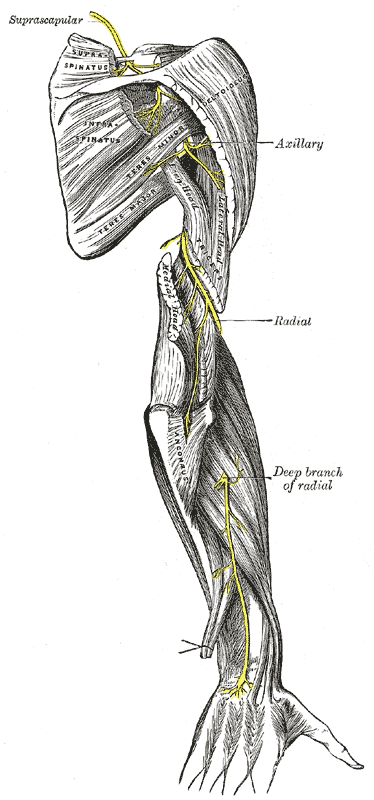
Certain occupations, postures, and activities can put prolonged pressure on a nerve. The term "Saturday night palsy" is used for a radial nerve injury caused by prolonged compression of the nerve at the spiral groove. The origin of the term is due to the association of the condition with a night spent in alcoholic stupor with the arm draped over a chair or bench. Mechanical compression of the radial nerve in the spiral groove can also occur as a result of the continuous use of crutches or prolonged kneeling in a "shooting" position. The so-called "cyclist palsy" is caused by prolonged grip pressures on handlebars, and has been postulated to be an entrapment neuropathy of the ulnar nerve in the Guyon canal of the wrist. Occupational exposure to forceful handgrip work and vibration, such as construction workers, increased the risk for surgical treatment of radial nerve entrapment. Posture induced common peroneal nerve (CPN) palsy is usually produced during the prolonged squatting or habitual leg crossing while seated, especially in Asian culture and is manifested by the onset of foot drop. One sport-related cause of lateral femoral cutaneous nerve entrapment is seen in scuba divers where the weight belt worn around the waist directly compresses the nerve. Prolonged periods of cycling can be associated with pudendal nerve entrapment, as there is often direct compression on the pudendal nerve between the nose of the bicycle seat and pubic bone. Tight fitting goggles can put pressure on the supraorbital nerve, also known as "swimmer's headache". Tight fitting handcuffs can compress the superficial branch of the radial nerve, known by several names such as Cheiralgia paresthetica, Wartenberg's syndrome, and handcuff neuropathy. The use of a thick wallet in the rear pocket can compress the sciatic nerve when sitting.
Nerve compression can be secondary to other medical conditions. Entrapment neuropathies are remarkably common in diabetes. A well defined lesion such as a tumor, hypertrophic muscle, cyst, hernia, hematoma, etc. can increase pressure on surrounding soft tissue, including nerves. Alternatively, there may be expansion of the tissues around a nerve in a space where there is little room for this to occur, as is often the case in carpal tunnel syndrome. This may be due to weight gain or peripheral oedema (especially in pregnancy), or to a specific condition such as acromegaly, hypothyroidism or scleroderma and psoriasis. Abnormal biomechanics can be associated with nerve compression. Ischiofemoral impingement (where the femur and ischium come too close together) can squeeze the sciatic nerve.
Entrapment can be caused by injuries. Surgical injuries can cause entrapment by the development of scar tissue around the nerve as well as the decreased ability of the nerve to glide, increasing strain during movements. Radial nerve entrapment is seen after fracture manipulation when the nerve is unknowingly entrapped between bone and an installed plate, compressed by a bone fragment or if excessive nailing of the bone occurs. Accidents are also associated with nerve entrapment as swelling puts pressure on the nerve and the development of scar tissue nearby may provide a hard surface for the nerve to be squeezed against, such as pudendal neuralgia in cyclists where repetitive trauma creates fibrotic entrapment of the pudendal nerve.
Surgical and anatomic research has shed some light on the proximate causes of entrapment. There are anatomical regions in which segments of peripheral nerves are vulnerable or predisposed to become trapped and suffer from chronic compression. Neural compression occurs especially in osteofibrous tunnels but may also occur at points of passage of the peripheral nerve through the muscles or near a band of fibrous tissue. In sciatic nerve decompression study, compromising structures were piriformis muscle, fibrovascular bundles, and adhesion with scar tissues. In another endoscopic neurolysis study, the presence of fibrovascular bands and bursal tissue was the most common cause, followed by musculotendinous structures.
Hub AI
Nerve compression syndrome AI simulator
(@Nerve compression syndrome_simulator)
Nerve compression syndrome
Nerve compression syndrome, or compression neuropathy, or nerve entrapment syndrome, is a medical condition caused by chronic, direct pressure on a peripheral nerve. It is known colloquially as a trapped nerve, though this may also refer to nerve root compression (by a herniated disc, for example). Its symptoms include pain, tingling, numbness and muscle weakness. The symptoms affect just one particular part of the body, depending on which nerve is affected. The diagnosis is largely clinical and can be confirmed with diagnostic nerve blocks. Occasionally imaging and electrophysiology studies aid in the diagnosis. Timely diagnosis is important as untreated chronic nerve compression may cause permanent damage. A surgical nerve decompression can relieve pressure on the nerve but cannot always reverse the physiological changes that occurred before treatment. Nerve injury by a single episode of physical trauma is in one sense an acute compression neuropathy but is not usually included under this heading, as chronic compression takes a unique pathophysiological course.
Symptoms vary depending on whether the affected nerve contains motor and/or sensory fibers. Sensory nerve entrapment presents with paresthesias. These paresthesias may be painful, such as shooting pain, burning, or a dull ache. They may also be pain-free, such as numbness or tingling. Motor nerve entrapment may present with muscle weakness or paralysis for voluntary movements of the innervated muscles. Entrapment of certain pelvic nerves can cause incontinence and/or sexual dysfunction. Positive sensory symptoms are usually the earliest to occur, particularly tingling and neuropathic pain, followed or accompanied by reduced sensation or complete numbness. Muscle weakness and muscle atrophy may only be present if the entrapped nerve has motor fibers (some nerves are only sensory). Weakness and atrophy is a much less common symptom and usually associated with later stages of nerve entrapment if it is present at all.
The distribution of symptoms is highly specific to the nerve entrapped and the way the nerve courses and branches beyond the entrapment point. The sciatic and pudendal nerves, for example, have documented, common anatomic variations. For a given entrapment neuropathy, symptoms will only present in the areas innervated by that nerve and distal to the entrapment point. The symptom distribution is highly dependent on a patient's neuroanatomy, which may mean that two patients can present differently despite having the same nerve entrapped.
The timing/duration of symptoms may be continuous, intermittent, and/or positional. This is dependent on the underlying cause of entrapment and the specific nerves involved. For example, pain while sitting is associated with inferior cluneal nerve entrapment, pudendal nerve entrapment, and anococcyeal nerve entrapment.
Certain occupations, postures, and activities can put prolonged pressure on a nerve. The term "Saturday night palsy" is used for a radial nerve injury caused by prolonged compression of the nerve at the spiral groove. The origin of the term is due to the association of the condition with a night spent in alcoholic stupor with the arm draped over a chair or bench. Mechanical compression of the radial nerve in the spiral groove can also occur as a result of the continuous use of crutches or prolonged kneeling in a "shooting" position. The so-called "cyclist palsy" is caused by prolonged grip pressures on handlebars, and has been postulated to be an entrapment neuropathy of the ulnar nerve in the Guyon canal of the wrist. Occupational exposure to forceful handgrip work and vibration, such as construction workers, increased the risk for surgical treatment of radial nerve entrapment. Posture induced common peroneal nerve (CPN) palsy is usually produced during the prolonged squatting or habitual leg crossing while seated, especially in Asian culture and is manifested by the onset of foot drop. One sport-related cause of lateral femoral cutaneous nerve entrapment is seen in scuba divers where the weight belt worn around the waist directly compresses the nerve. Prolonged periods of cycling can be associated with pudendal nerve entrapment, as there is often direct compression on the pudendal nerve between the nose of the bicycle seat and pubic bone. Tight fitting goggles can put pressure on the supraorbital nerve, also known as "swimmer's headache". Tight fitting handcuffs can compress the superficial branch of the radial nerve, known by several names such as Cheiralgia paresthetica, Wartenberg's syndrome, and handcuff neuropathy. The use of a thick wallet in the rear pocket can compress the sciatic nerve when sitting.
Nerve compression can be secondary to other medical conditions. Entrapment neuropathies are remarkably common in diabetes. A well defined lesion such as a tumor, hypertrophic muscle, cyst, hernia, hematoma, etc. can increase pressure on surrounding soft tissue, including nerves. Alternatively, there may be expansion of the tissues around a nerve in a space where there is little room for this to occur, as is often the case in carpal tunnel syndrome. This may be due to weight gain or peripheral oedema (especially in pregnancy), or to a specific condition such as acromegaly, hypothyroidism or scleroderma and psoriasis. Abnormal biomechanics can be associated with nerve compression. Ischiofemoral impingement (where the femur and ischium come too close together) can squeeze the sciatic nerve.
Entrapment can be caused by injuries. Surgical injuries can cause entrapment by the development of scar tissue around the nerve as well as the decreased ability of the nerve to glide, increasing strain during movements. Radial nerve entrapment is seen after fracture manipulation when the nerve is unknowingly entrapped between bone and an installed plate, compressed by a bone fragment or if excessive nailing of the bone occurs. Accidents are also associated with nerve entrapment as swelling puts pressure on the nerve and the development of scar tissue nearby may provide a hard surface for the nerve to be squeezed against, such as pudendal neuralgia in cyclists where repetitive trauma creates fibrotic entrapment of the pudendal nerve.
Surgical and anatomic research has shed some light on the proximate causes of entrapment. There are anatomical regions in which segments of peripheral nerves are vulnerable or predisposed to become trapped and suffer from chronic compression. Neural compression occurs especially in osteofibrous tunnels but may also occur at points of passage of the peripheral nerve through the muscles or near a band of fibrous tissue. In sciatic nerve decompression study, compromising structures were piriformis muscle, fibrovascular bundles, and adhesion with scar tissues. In another endoscopic neurolysis study, the presence of fibrovascular bands and bursal tissue was the most common cause, followed by musculotendinous structures.