Hubbry Logo
Consistent and inconsistent equationsConsistent and inconsistent equationsMain
Open search
Consistent and inconsistent equations
Community hub
Consistent and inconsistent equations
logo
7 pages, 0 posts
0 subscribers
Be the first to start a discussion here.
Consistent and inconsistent equations
from Wikipedia

In mathematics and particularly in algebra, a system of equations (either linear or nonlinear) is called consistent if there is at least one set of values for the unknowns that satisfies each equation in the system—that is, when substituted into each of the equations, they make each equation hold true as an identity. In contrast, a linear or non linear equation system is called inconsistent if there is no set of values for the unknowns that satisfies all of the equations.[1][2]

If a system of equations is inconsistent, then the equations cannot be true together leading to contradictory information, such as the false statements 2 = 1, or and (which implies 5 = 6).

Both types of equation system, inconsistent and consistent, can be any of overdetermined (having more equations than unknowns), underdetermined (having fewer equations than unknowns), or exactly determined.

Simple examples

[edit]

Underdetermined and consistent

[edit]

The system

has an infinite number of solutions, all of them having z = 1 (as can be seen by subtracting the first equation from the second), and all of them therefore having x + y = 2 for any values of x and y.

The nonlinear system
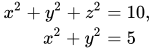
has an infinitude of solutions, all involving

Since each of these systems has more than one solution, it is an indeterminate system .

Underdetermined and inconsistent

[edit]

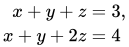
The system

has no solutions, as can be seen by subtracting the first equation from the second to obtain the impossible 0 = 1.

The non-linear system
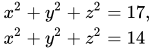
has no solutions, because if one equation is subtracted from the other we obtain the impossible 0 = 3.

Exactly determined and consistent

[edit]

The system

has exactly one solution: x = 1, y = 2

The nonlinear system
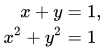
has the two solutions (x, y) = (1, 0) and (x, y) = (0, 1), while
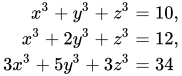
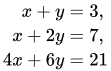
has an infinite number of solutions because the third equation is the first equation plus twice the second one and hence contains no independent information; thus any value of z can be chosen and values of x and y can be found to satisfy the first two (and hence the third) equations.

Exactly determined and inconsistent

[edit]

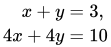
The system

has no solutions; the inconsistency can be seen by multiplying the first equation by 4 and subtracting the second equation to obtain the impossible 0 = 2.

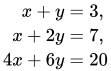
Likewise,
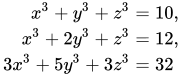
is an inconsistent system because the first equation plus twice the second minus the third contains the contradiction 0 = 2.

Overdetermined and consistent

[edit]

The system

has a solution, x = –1, y = 4, because the first two equations do not contradict each other and the third equation is redundant (since it contains the same information as can be obtained from the first two equations by multiplying each through by 2 and summing them).

The system
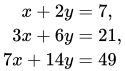
has an infinitude of solutions since all three equations give the same information as each other (as can be seen by multiplying through the first equation by either 3 or 7). Any value of y is part of a solution, with the corresponding value of x being 7 – 2y.

The nonlinear system
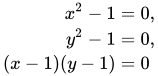
has the three solutions (x, y) = (1, –1), (–1, 1), (1, 1).

Overdetermined and inconsistent

[edit]

The system

is inconsistent because the last equation contradicts the information embedded in the first two, as seen by multiplying each of the first two through by 2 and summing them.

The system
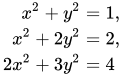
is inconsistent because the sum of the first two equations contradicts the third one.

Criteria for consistency

[edit]

As can be seen from the above examples, consistency versus inconsistency is a different issue from comparing the numbers of equations and unknowns.

Linear systems

[edit]

A linear system is consistent if and only if its coefficient matrix has the same rank as does its augmented matrix (the coefficient matrix with an extra column added, that column being the column vector of constants).

Nonlinear systems

[edit]

References

[edit]
Revisions and contributorsEdit on WikipediaRead on Wikipedia
from Grokipedia
A is defined as consistent if it has at least one solution and inconsistent if it has no solutions. While these concepts apply to both linear and nonlinear systems, this article primarily focuses on linear systems in the field of linear algebra. This distinction is crucial for analyzing the solvability of equations representing real-world problems in , and physics, where consistent systems yield feasible outcomes while inconsistent ones indicate contradictions or impossible conditions. To determine consistency in linear systems, mathematicians employ techniques such as , which transforms the system's into ; an inconsistency is revealed if a row reduces to a form like 0=c0 = c where c0c \neq 0, signaling no solution exists. Alternatively, the rank theorem provides a precise criterion: for a Ax=bAx = b, where AA is the and bb is the constant vector, the is consistent the rank of AA equals the rank of the [Ab][A|b], with inconsistency occurring when the rank of [Ab][A|b] exceeds that of AA. Consistent linear systems may further have a unique solution (if the rank equals the number of variables) or infinitely many solutions (if free variables exist), whereas inconsistent systems are definitively unsolvable. For nonlinear systems, consistency similarly requires at least one common solution, though determination often involves numerical methods rather than rank. Geometrically, for linear systems in two variables, consistent systems correspond to lines that intersect at a point (unique solution) or coincide (infinitely many solutions), while inconsistent systems represent that never meet, embodying an irreconcilable conflict. These concepts extend to higher dimensions via hyperplanes, where consistency hinges on whether the solution space is non-empty. Understanding consistent and inconsistent equations underpins advanced topics like vector spaces and linear transformations, enabling robust computational methods in software and algorithms.

Fundamental Concepts

Definition of Consistency

In mathematics, particularly within the field of linear algebra, a is classified as consistent if it possesses at least one solution that satisfies all equations simultaneously. Conversely, the system is inconsistent if no such solution exists. This binary distinction forms the foundational framework for analyzing the solvability of equation sets, whether linear or nonlinear. The of a consistent is non-empty, potentially containing a unique solution or infinitely many solutions depending on the structure of the equations and variables involved. In contrast, the of an inconsistent is the , indicating an impossibility in satisfying the equations collectively. This characterization underscores the importance of existence in determining viability. For linear systems, the general form is expressed using matrix notation as Ax=bAx = b, where AA is the , xx is the vector of unknowns, and bb is the constant vector. This compact representation facilitates theoretical analysis of consistency without delving into solution techniques. The concepts of consistency and inconsistency trace their origins to early 19th-century developments in linear algebra, notably attributed to , who in his 1809 work Theoria Motus Corporum Coelestium and 1811 Disquisitio de Elementis Ellipticis Palladis recognized that linear systems could yield no solution (inconsistent), a unique solution, or infinitely many solutions through elimination methods applied to astronomical data.

Classification of Systems

Systems of linear equations are classified based on the relationship between the number of equations (m) and the number of unknowns (n). An occurs when m < n, meaning there are fewer equations than unknowns. A square system, also known as exactly determined, has m = n, with an equal number of equations and unknowns. An overdetermined system arises when m > n, featuring more equations than unknowns. The implications for solution uniqueness depend on consistency, where a system is consistent if it has at least one solution. In a consistent , there are typically infinitely many solutions, as the equations do not fully constrain all variables. For a consistent square , there is generally a unique solution, provided the equations are linearly independent. In an , even if consistent, solutions are rare and specific, often requiring the extra equations to be linearly dependent on the others; otherwise, no solution exists. Geometrically, these classifications can be interpreted through the of hyperplanes in n-dimensional . For underdetermined systems, the intersection typically forms lines or planes in 2D or 3D, reflecting the freedom in the solution . Square systems correspond to the intersection of an equal number of hyperplanes at a single point in the . Overdetermined systems are overconstrained, where the additional hyperplanes often fail to pass through a common point, leading to an empty unless specially aligned.

Examples in Linear Systems

Underdetermined Systems

Underdetermined systems arise in linear algebra when the number of equations mm is less than the number of unknowns nn, denoted as m<nm < n. These systems are characterized by having either no solutions or infinitely many solutions, depending on consistency. A classic consistent underdetermined system is given by the single equation x+y=1x + y = 1 in two variables. The solution set forms a line in the xyxy-plane, parameterized as x=tx = t, y=1ty = 1 - t for any real number tt, yielding infinitely many solutions. This occurs because the constraint does not uniquely determine both variables, leaving one degree of freedom. In contrast, an inconsistent underdetermined system lacks any solutions, as illustrated by the equations x+y=1x + y = 1 and x+y=2x + y = 2. These represent parallel lines in the plane that never intersect. Substituting y=1xy = 1 - x from the first equation into the second gives x+(1x)=2x + (1 - x) = 2, simplifying to 1=21 = 2, a contradiction. Thus, no values of xx and yy satisfy both equations simultaneously. In matrix form, an underdetermined system is expressed as Ax=bA\mathbf{x} = \mathbf{b}, where AA is an m×nm \times n matrix with m<nm < n. The system is consistent if and only if rank(A)=rank([Ab])\operatorname{rank}(A) = \operatorname{rank}([A \mid \mathbf{b}]), and in the consistent case, the rank is less than nn, resulting in infinitely many solutions due to the null space dimension being nrank(A)>0n - \operatorname{rank}(A) > 0. For a specific inconsistent example with a 2×32 \times 3 matrix, consider A=(111111),b=(45),A = \begin{pmatrix} 1 & 1 & 1 \\ 1 & 1 & 1 \end{pmatrix}, \quad \mathbf{b} = \begin{pmatrix} 4 \\ 5 \end{pmatrix}, corresponding to x+y+z=4x + y + z = 4 and x+y+z=5x + y + z = 5. Row reducing the [Ab][A \mid \mathbf{b}] yields (11140001),\begin{pmatrix} 1 & 1 & 1 & 4 \\ 0 & 0 & 0 & 1 \end{pmatrix}, where the second row implies 0=10 = 1, a contradiction confirming inconsistency since rank(A)=1<rank([Ab])=2\operatorname{rank}(A) = 1 < \operatorname{rank}([A \mid \mathbf{b}]) = 2.

Square Systems

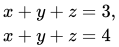
Square systems of linear equations are those in which the number of equations equals the number of unknowns, denoted as m=nm = n. These systems can be represented in matrix form as Ax=bA \mathbf{x} = \mathbf{b}, where AA is an n×nn \times n coefficient matrix, x\mathbf{x} is the vector of unknowns, and b\mathbf{b} is the constant vector. A square system is consistent with a unique solution when the coefficient matrix AA is invertible, which occurs if its determinant is non-zero (det(A)0\det(A) \neq 0). In this case, the solution is given by x=A1b\mathbf{x} = A^{-1} \mathbf{b}. For example, consider the 2x2 system: {x+y=3xy=1\begin{cases} x + y = 3 \\ x - y = 1 \end{cases} Adding the equations yields 2x=42x = 4, so x=2x = 2; substituting gives y=1y = 1. The coefficient matrix is A=(1111)A = \begin{pmatrix} 1 & 1 \\ 1 & -1 \end{pmatrix}, with det(A)=(1)(1)(1)(1)=20\det(A) = (1)(-1) - (1)(1) = -2 \neq 0, confirming the unique solution (x,y)=(2,1)(x, y) = (2, 1). Square systems can also be consistent with infinitely many solutions when the equations are linearly dependent, meaning the rows of AA are scalar multiples and the constants in b\mathbf{b} satisfy the same relation (det(A)=0\det(A) = 0 but the system is consistent). For instance: {x+y=32x+2y=6\begin{cases} x + y = 3 \\ 2x + 2y = 6 \end{cases} The second equation is twice the first, reducing the system to a single equation x+y=3x + y = 3. Solutions are parametrized as x=3tx = 3 - t, y=ty = t for any real tt, yielding infinitely many solutions. Here, det(A)=(1)(2)(1)(2)=0\det(A) = (1)(2) - (1)(2) = 0, indicating dependency. In contrast, a square system is inconsistent—and thus has no solution—when det(A)=0\det(A) = 0 but the equations lead to a contradiction, such as the constants not satisfying the dependency. An example is: {x+y=3x+y=4\begin{cases} x + y = 3 \\ x + y = 4 \end{cases} Subtracting the equations gives 0=10 = -1, a contradiction. The coefficient matrix has det(A)=(1)(1)(1)(1)=0\det(A) = (1)(1) - (1)(1) = 0, but the augmented matrix rank exceeds that of AA, confirming inconsistency. The determinant plays a pivotal role in classifying square systems: a non-zero value guarantees a unique solution via the inverse, while a zero value requires further analysis to distinguish between infinite solutions (dependent and consistent) or no solution (inconsistent).

Overdetermined Systems

An overdetermined system of linear equations is one in which the number of equations mm exceeds the number of unknowns nn, denoted as m>nm > n. Such systems are typically inconsistent, meaning no exact solution exists, because the additional equations impose constraints that generally cannot all be satisfied simultaneously. Consider the following example of an inconsistent with three equations in two variables: x+y=1,xy=1,2x=3.\begin{align*} x + y &= 1, \\ x - y &= 1, \\ 2x &= 3. \end{align*} Adding the first two equations yields 2x=22x = 2, so x=1x = 1 and y=0y = 0, but substituting into the third gives 2(1)=232(1) = 2 \neq 3, revealing a contradiction. To confirm inconsistency via row reduction, form the : [111111203].\begin{bmatrix} 1 & 1 & | & 1 \\ 1 & -1 & | & 1 \\ 2 & 0 & | & 3 \end{bmatrix}.
Add your contribution
Related Hubs
User Avatar
No comments yet.