



Community hub
Recent from talks
Contribute something
Nothing was collected or created yet.
System of polynomial equations
View on WikipediaA system of polynomial equations (sometimes simply a polynomial system) is a set of simultaneous equations f1 = 0, ..., fh = 0 where the fi are polynomials in several variables, say x1, ..., xn, over some field k.
A solution of a polynomial system is a set of values for the xis which belong to some algebraically closed field extension K of k, and make all equations true. When k is the field of rational numbers, K is generally assumed to be the field of complex numbers, because each solution belongs to a field extension of k, which is isomorphic to a subfield of the complex numbers.
This article is about the methods for solving, that is, finding all solutions or describing them. As these methods are designed for being implemented in a computer, emphasis is given on fields k in which computation (including equality testing) is easy and efficient, that is the field of rational numbers and finite fields.
Searching for solutions that belong to a specific set is a problem which is generally much more difficult, and is outside the scope of this article, except for the case of the solutions in a given finite field. For the case of solutions of which all components are integers or rational numbers, see Diophantine equation.
Definition
[edit]
A simple example of a system of polynomial equations is
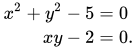
Its solutions are the four pairs (x, y) = (1, 2), (2, 1), (-1, -2), (-2, -1). These solutions can easily be checked by substitution, but more work is needed for proving that there are no other solutions.
The subject of this article is the study of generalizations of such an examples, and the description of the methods that are used for computing the solutions.
A system of polynomial equations, or polynomial system is a collection of equations
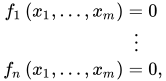
where each fh is a polynomial in the indeterminates x1, ..., xm, with integer coefficients, or coefficients in some fixed field, often the field of rational numbers or a finite field.[1] Other fields of coefficients, such as the real numbers, are less often used, as their elements cannot be represented in a computer (only approximations of real numbers can be used in computations, and these approximations are always rational numbers).
A solution of a polynomial system is a tuple of values of (x1, ..., xm) that satisfies all equations of the polynomial system. The solutions are sought in the complex numbers, or more generally in an algebraically closed field containing the coefficients. In particular, in characteristic zero, all complex solutions are sought. Searching for the real or rational solutions are much more difficult problems that are not considered in this article.
The set of solutions is not always finite; for example, the solutions of the system
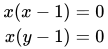
are a point (x,y) = (1,1) and a line x = 0.[2] Even when the solution set is finite, there is, in general, no closed-form expression of the solutions (in the case of a single equation, this is Abel–Ruffini theorem).
The Barth surface, shown in the figure is the geometric representation of the solutions of a polynomial system reduced to a single equation of degree 6 in 3 variables. Some of its numerous singular points are visible on the image. They are the solutions of a system of 4 equations of degree 5 in 3 variables. Such an overdetermined system has no solution in general (that is if the coefficients are not specific). If it has a finite number of solutions, this number is at most 53 = 125, by Bézout's theorem. However, it has been shown that, for the case of the singular points of a surface of degree 6, the maximum number of solutions is 65, and is reached by the Barth surface.
Basic properties and definitions
[edit]A system is overdetermined if the number of equations is higher than the number of variables. A system is inconsistent if it has no complex solution (or, if the coefficients are not complex numbers, no solution in an algebraically closed field containing the coefficients). By Hilbert's Nullstellensatz this means that 1 is a linear combination (with polynomials as coefficients) of the first members of the equations. Most but not all overdetermined systems, when constructed with random coefficients, are inconsistent. For example, the system x3 – 1 = 0, x2 – 1 = 0 is overdetermined (having two equations but only one unknown), but it is not inconsistent since it has the solution x = 1.
A system is underdetermined if the number of equations is lower than the number of the variables. An underdetermined system is either inconsistent or has infinitely many complex solutions (or solutions in an algebraically closed field that contains the coefficients of the equations). This is a non-trivial result of commutative algebra that involves, in particular, Hilbert's Nullstellensatz and Krull's principal ideal theorem.
A system is zero-dimensional if it has a finite number of complex solutions (or solutions in an algebraically closed field). This terminology comes from the fact that the algebraic variety of the solutions has dimension zero. A system with infinitely many solutions is said to be positive-dimensional.
A zero-dimensional system with as many equations as variables is sometimes said to be well-behaved.[3] Bézout's theorem asserts that a well-behaved system whose equations have degrees d1, ..., dn has at most d1⋅⋅⋅dn solutions. This bound is sharp. If all the degrees are equal to d, this bound becomes dn and is exponential in the number of variables. (The fundamental theorem of algebra is the special case n = 1.)
This exponential behavior makes solving polynomial systems difficult and explains why there are few solvers that are able to automatically solve systems with Bézout's bound higher than, say, 25 (three equations of degree 3 or five equations of degree 2 are beyond this bound).[citation needed]
What is solving?
[edit]The first thing to do for solving a polynomial system is to decide whether it is inconsistent, zero-dimensional or positive dimensional. This may be done by the computation of a Gröbner basis of the left-hand sides of the equations. The system is inconsistent if this Gröbner basis is reduced to 1. The system is zero-dimensional if, for every variable there is a leading monomial of some element of the Gröbner basis which is a pure power of this variable. For this test, the best monomial order (that is the one which leads generally to the fastest computation) is usually the graded reverse lexicographic one (grevlex).
If the system is positive-dimensional, it has infinitely many solutions. It is thus not possible to enumerate them. It follows that, in this case, solving may only mean "finding a description of the solutions from which the relevant properties of the solutions are easy to extract". There is no commonly accepted such description. In fact there are many different "relevant properties", which involve almost every subfield of algebraic geometry.
A natural example of such a question concerning positive-dimensional systems is the following: decide if a polynomial system over the rational numbers has a finite number of real solutions and compute them. A generalization of this question is find at least one solution in each connected component of the set of real solutions of a polynomial system. The classical algorithm for solving these question is cylindrical algebraic decomposition, which has a doubly exponential computational complexity and therefore cannot be used in practice, except for very small examples.
For zero-dimensional systems, solving consists of computing all the solutions. There are two different ways of outputting the solutions. The most common way is possible only for real or complex solutions, and consists of outputting numeric approximations of the solutions. Such a solution is called numeric. A solution is certified if it is provided with a bound on the error of the approximations, and if this bound separates the different solutions.
The other way of representing the solutions is said to be algebraic. It uses the fact that, for a zero-dimensional system, the solutions belong to the algebraic closure of the field k of the coefficients of the system. There are several ways to represent the solution in an algebraic closure, which are discussed below. All of them allow one to compute a numerical approximation of the solutions by solving one or several univariate equations. For this computation, it is preferable to use a representation that involves solving only one univariate polynomial per solution, because computing the roots of a polynomial which has approximate coefficients is a highly unstable problem.
Extensions
[edit]Trigonometric equations
[edit]A trigonometric equation is an equation g = 0 where g is a trigonometric polynomial. Such an equation may be converted into a polynomial system by expanding the sines and cosines in it (using sum and difference formulas), replacing sin(x) and cos(x) by two new variables s and c and adding the new equation s2 + c2 – 1 = 0.
For example, because of the identity

solving the equation

is equivalent to solving the polynomial system

For each solution (c0, s0) of this system, there is a unique solution x of the equation such that 0 ≤ x < 2π.
In the case of this simple example, it may be unclear whether the system is, or not, easier to solve than the equation. On more complicated examples, one lacks systematic methods for solving directly the equation, while software are available for automatically solving the corresponding system.
Solutions in a finite field
[edit]When solving a system over a finite field k with q elements, one is primarily interested in the solutions in k. As the elements of k are exactly the solutions of the equation xq – x = 0, it suffices, for restricting the solutions to k, to add the equation xiq – xi = 0 for each variable xi.
Coefficients in a number field or in a finite field with non-prime order
[edit]The elements of an algebraic number field are usually represented as polynomials in a generator of the field which satisfies some univariate polynomial equation. To work with a polynomial system whose coefficients belong to a number field, it suffices to consider this generator as a new variable and to add the equation of the generator to the equations of the system. Thus solving a polynomial system over a number field is reduced to solving another system over the rational numbers.
For example, if a system contains , a system over the rational numbers is obtained by adding the equation r22 – 2 = 0 and replacing by r2 in the other equations.

In the case of a finite field, the same transformation allows always supposing that the field k has a prime order.
Algebraic representation of the solutions
[edit]Regular chains
[edit]The usual way of representing the solutions is through zero-dimensional regular chains. Such a chain consists of a sequence of polynomials f1(x1), f2(x1, x2), ..., fn(x1, ..., xn) such that, for every i such that 1 ≤ i ≤ n
- fi is a polynomial in x1, ..., xi only, which has a degree di > 0 in xi;
- the coefficient of xidi in fi is a polynomial in x1, ..., xi −1 which does not have any common zero with f1, ..., fi − 1.
To such a regular chain is associated a triangular system of equations
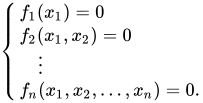
The solutions of this system are obtained by solving the first univariate equation, substituting the solutions in the other equations, then solving the second equation which is now univariate, and so on. The definition of regular chains implies that the univariate equation obtained from fi has degree di and thus that the system has d1 ... dn solutions, provided that there is no multiple root in this resolution process (fundamental theorem of algebra).
Every zero-dimensional system of polynomial equations is equivalent (i.e. has the same solutions) to a finite number of regular chains. Several regular chains may be needed, as it is the case for the following system which has three solutions.
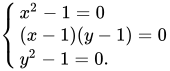
There are several algorithms for computing a triangular decomposition of an arbitrary polynomial system (not necessarily zero-dimensional)[4] into regular chains (or regular semi-algebraic systems).
There is also an algorithm which is specific to the zero-dimensional case and is competitive, in this case, with the direct algorithms. It consists in computing first the Gröbner basis for the graded reverse lexicographic order (grevlex), then deducing the lexicographical Gröbner basis by FGLM algorithm[5] and finally applying the Lextriangular algorithm.[6]
This representation of the solutions are fully convenient for coefficients in a finite field. However, for rational coefficients, two aspects have to be taken care of:
- The output may involve huge integers which may make the computation and the use of the result problematic.
- To deduce the numeric values of the solutions from the output, one has to solve univariate polynomials with approximate coefficients, which is a highly unstable problem.
The first issue has been solved by Dahan and Schost:[7][8] Among the sets of regular chains that represent a given set of solutions, there is a set for which the coefficients are explicitly bounded in terms of the size of the input system, with a nearly optimal bound. This set, called equiprojectable decomposition, depends only on the choice of the coordinates. This allows the use of modular methods for computing efficiently the equiprojectable decomposition.[9]
The second issue is generally solved by outputting regular chains of a special form, sometimes called shape lemma, for which all di but the first one are equal to 1. For getting such regular chains, one may have to add a further variable, called separating variable, which is given the index 0. The rational univariate representation, described below, allows computing such a special regular chain, satisfying Dahan–Schost bound, by starting from either a regular chain or a Gröbner basis.
Rational univariate representation
[edit]The rational univariate representation or RUR is a representation of the solutions of a zero-dimensional polynomial system over the rational numbers which has been introduced by F. Rouillier.[10]
A RUR of a zero-dimensional system consists in a linear combination x0 of the variables, called separating variable, and a system of equations[11]
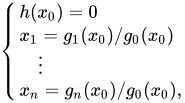
where h is a univariate polynomial in x0 of degree D and g0, ..., gn are univariate polynomials in x0 of degree less than D.
Given a zero-dimensional polynomial system over the rational numbers, the RUR has the following properties.
- All but a finite number linear combinations of the variables are separating variables.
- When the separating variable is chosen, the RUR exists and is unique. In particular h and the gi are defined independently of any algorithm to compute them.
- The solutions of the system are in one-to-one correspondence with the roots of h and the multiplicity of each root of h equals the multiplicity of the corresponding solution.
- The solutions of the system are obtained by substituting the roots of h in the other equations.
- If h does not have any multiple root then g0 is the derivative of h.
For example, for the system in the previous section, every linear combination of the variable, except the multiples of x, y and x + y, is a separating variable. If one chooses t = x – y/2 as a separating variable, then the RUR is
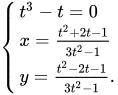
The RUR is uniquely defined for a given separating variable, independently of any algorithm, and it preserves the multiplicities of the roots. This is a notable difference with triangular decompositions (even the equiprojectable decomposition), which, in general, do not preserve multiplicities. The RUR shares with equiprojectable decomposition the property of producing an output with coefficients of relatively small size.
For zero-dimensional systems, the RUR allows retrieval of the numeric values of the solutions by solving a single univariate polynomial and substituting them in rational functions. This allows production of certified approximations of the solutions to any given precision.
Moreover, the univariate polynomial h(x0) of the RUR may be factorized, and this gives a RUR for every irreducible factor. This provides the prime decomposition of the given ideal (that is the primary decomposition of the radical of the ideal). In practice, this provides an output with much smaller coefficients, especially in the case of systems with high multiplicities.
Contrarily to triangular decompositions and equiprojectable decompositions, the RUR is not defined in positive dimension.
Solving numerically
[edit]General solving algorithms
[edit]The general numerical algorithms which are designed for any system of nonlinear equations work also for polynomial systems. However the specific methods will generally be preferred, as the general methods generally do not allow one to find all solutions. In particular, when a general method does not find any solution, this is usually not an indication that there is no solution.
Nevertheless, two methods deserve to be mentioned here.
- Newton's method may be used if the number of equations is equal to the number of variables. It does not allow one to find all the solutions nor to prove that there is no solution. But it is very fast when starting from a point which is close to a solution. Therefore, it is a basic tool for the homotopy continuation method described below.
- Optimization is rarely used for solving polynomial systems, but it succeeded, circa 1970, in showing that a system of 81 quadratic equations in 56 variables is not inconsistent.[12] With the other known methods, this remains beyond the possibilities of modern technology, as of 2022[update]. This method consists simply in minimizing the sum of the squares of the equations. If zero is found as a local minimum, then it is attained at a solution. This method works for overdetermined systems, but outputs an empty information if all local minimums which are found are positive.
Homotopy continuation method
[edit]This is a semi-numeric method which supposes that the number of equations is equal to the number of variables. This method is relatively old but it has been dramatically improved in the last decades.[13]
This method divides into three steps. First an upper bound on the number of solutions is computed. This bound has to be as sharp as possible. Therefore, it is computed by, at least, four different methods and the best value, say , is kept.

In the second step, a system of polynomial equations is generated which has exactly solutions that are easy to compute. This new system has the same number of variables and the same number of equations and the same general structure as the system to solve, .



Then a homotopy between the two systems is considered. It consists, for example, of the straight line between the two systems, but other paths may be considered, in particular to avoid some singularities, in the system
- .

The homotopy continuation consists in deforming the parameter from 0 to 1 and following the solutions during this deformation. This gives the desired solutions for . Following means that, if , the solutions for are deduced from the solutions for by Newton's method. The difficulty here is to well choose the value of Too large, Newton's convergence may be slow and may even jump from a solution path to another one. Too small, and the number of steps slows down the method.


Numerically solving from the rational univariate representation
[edit]To deduce the numeric values of the solutions from a RUR seems easy: it suffices to compute the roots of the univariate polynomial and to substitute them in the other equations. This is not so easy because the evaluation of a polynomial at the roots of another polynomial is highly unstable.
The roots of the univariate polynomial have thus to be computed at a high precision which may not be defined once for all. There are two algorithms which fulfill this requirement.
- Aberth method, implemented in MPSolve computes all the complex roots to any precision.
- Uspensky's algorithm of Collins and Akritas,[14] improved by Rouillier and Zimmermann [15] and based on Descartes' rule of signs. This algorithms computes the real roots, isolated in intervals of arbitrary small width. It is implemented in Maple (functions fsolve and RootFinding[Isolate]).
Software packages
[edit]There are at least four software packages which can solve zero-dimensional systems automatically (by automatically, one means that no human intervention is needed between input and output, and thus that no knowledge of the method by the user is needed). There are also several other software packages which may be useful for solving zero-dimensional systems. Some of them are listed after the automatic solvers.
The Maple function RootFinding[Isolate] takes as input any polynomial system over the rational numbers (if some coefficients are floating point numbers, they are converted to rational numbers) and outputs the real solutions represented either (optionally) as intervals of rational numbers or as floating point approximations of arbitrary precision. If the system is not zero dimensional, this is signaled as an error.
Internally, this solver, designed by F. Rouillier computes first a Gröbner basis and then a Rational Univariate Representation from which the required approximation of the solutions are deduced. It works routinely for systems having up to a few hundred complex solutions.
The rational univariate representation may be computed with Maple function Groebner[RationalUnivariateRepresentation].
To extract all the complex solutions from a rational univariate representation, one may use MPSolve, which computes the complex roots of univariate polynomials to any precision. It is recommended to run MPSolve several times, doubling the precision each time, until solutions remain stable, as the substitution of the roots in the equations of the input variables can be highly unstable.
The second solver is PHCpack,[13][16] written under the direction of J. Verschelde. PHCpack implements the homotopy continuation method. This solver computes the isolated complex solutions of polynomial systems having as many equations as variables.
The third solver is Bertini,[17][18] written by D. J. Bates, J. D. Hauenstein, A. J. Sommese, and C. W. Wampler. Bertini uses numerical homotopy continuation with adaptive precision. In addition to computing zero-dimensional solution sets, both PHCpack and Bertini are capable of working with positive dimensional solution sets.
The fourth solver is the Maple library RegularChains, written by Marc Moreno-Maza and collaborators. It contains various functions for solving polynomial systems by means of regular chains.
See also
[edit]References
[edit]- ^ Bates et al. 2013, p. 4
- ^ Bates et al. 2013, p. 8
- ^ Songxin Liang, J. Gerhard, D.J. Jeffrey, G. Moroz, A Package for Solving Parametric Polynomial Systems. Communications in Computer Algebra (2009)
- ^ Aubry, P.; Maza, M. Moreno (1999). "Triangular Sets for Solving Polynomial Systems: a Comparative Implementation of Four Methods". J. Symb. Comput. 28 (1–2): 125–154. doi:10.1006/jsco.1999.0270.
- ^ Faugère, J.C.; Gianni, P.; Lazard, D.; Mora, T. (1993). "Efficient Computation of Zero-Dimensional Gröbner Basis by Change of Ordering". Journal of Symbolic Computation. 16 (4): 329–344. doi:10.1006/jsco.1993.1051.
- ^ Lazard, D. (1992). "Solving zero-dimensional algebraic systems". Journal of Symbolic Computation. 13 (2): 117–131. doi:10.1016/S0747-7171(08)80086-7.
- ^ Xavier Dahan and Eric Schost. Sharp Estimates for Triangular Sets. Moreover, recent algorithms for decomposing polynomial systems into triangular decompositions produce regular chains with coefficients matching the results of Dahan and Schost. In proc. ISSAC'04, pages 103--110, ACM Press, 2004
- ^ Dahan, Xavier; Moreno Maza, Marc; Schost, Eric; Wu, Wenyuan; Xie, Yuzhen (2005). "Lifting techniques for triangular decompositions" (PDF). Proceedings of ISAAC 2005. ACM Press. pp. 108–105.
- ^ Changbo Chen and Marc Moreno-Maza. Algorithms for Computing Triangular Decomposition of Polynomial Systems.In proc. ISSAC'2011, pages 83-90, ACM Press, 2011 and Journal of Symbolic Computation (to appear)
- ^ Rouillier, Fabrice (1999). "Solving Zero-Dimensional Systems Through the Rational Univariate Representation". Appl. Algebra Eng. Commun. Comput. 9 (9): 433–461. doi:10.1007/s002000050114. S2CID 25579305.
- ^ Saugata Basu; Richard Pollack; Marie-Françoise Roy (2006). Algorithms in real algebraic geometry, chapter 12.4. Springer-Verlag.
- ^ Lazard, Daniel (2009). "Thirty years of Polynomial System Solving, and now?". J. Symb. Comput. 44 (3): 2009. doi:10.1016/j.jsc.2008.03.004.
- ^ a b Verschelde, Jan (1999). "Algorithm 795: PHCpack: A general-purpose solver for polynomial systems by homotopy continuation" (PDF). ACM Transactions on Mathematical Software. 25 (2): 251–276. doi:10.1145/317275.317286. S2CID 15485257.
- ^ George E. Collins and Alkiviadis G. Akritas, Polynomial Real Root Isolation Using Descartes' Rule of Signs. Proceedings of the 1976 ACM Symposium on Symbolic and Algebraic Computation
- ^ Rouillier, F.; Zimmerman, P. (2004). "Efficient isolation of polynomial's real roots". Journal of Computational and Applied Mathematics. 162 (1): 33–50. Bibcode:2004JCoAM.162...33R. doi:10.1016/j.cam.2003.08.015.
- ^ Release 2.3.86 of PHCpack
- ^ Bates et al. 2013
- ^ Bertini: Software for Numerical Algebraic Geometry
- Bates, Daniel J.; Sommese, Andrew J.; Hauenstein, Jonathan D.; Wampler, Charles W. (2013). Numerically solving polynomial systems with Bertini. Philadelphia: Society for Industrial and Applied Mathematics. ISBN 978-1-61197-269-6.
- Cox, David; Little, John; O'Shea, Donal (1997). Ideals, varieties, and algorithms : an introduction to computational algebraic geometry and commutative algebra (2nd ed.). New York: Springer. ISBN 978-0387946801.
- Morgan, Alexander (1987). Solving polynomial systems using continuation for engineering and scientific problems (SIAM ed.). Society for Industrial and Applied Mathematics (SIAM, 3600 Market Street, Floor 6, Philadelphia, PA 19104). ISBN 9780898719031.
- Sturmfels, Bernd (2002). Solving systems of polynomial equations. Providence, RI: American Mathematical Soc. ISBN 0821832514.
System of polynomial equations
View on GrokipediaDefinitions and Fundamentals
Definition of a Polynomial System
A system of polynomial equations consists of a finite collection of equations of the form for , where each is a polynomial in variables with coefficients in a field (such as the rational numbers or the complex numbers ), and the polynomials are typically expressed as sums of monomials with and multi-indices .[1] This formal structure defines the common zeros of the polynomials as the solution set, often studied within the framework of algebraic geometry where the polynomials generate an ideal in the polynomial ring .[1] Standard notation represents the system compactly as , where is a vector of polynomials and is the vector of variables, emphasizing the multivariate nature and facilitating computational approaches.[1] The relationship between the number of equations and variables classifies the system: it is square if , underdetermined if (potentially admitting infinitely many solutions), and overdetermined if (possibly inconsistent).[5] Simple examples illustrate the concept. A linear system, such as and , represents a degenerate case where all polynomials are of degree 1, reducing to the familiar framework of linear algebra.[1] For higher degrees, consider a quadratic system like and , where the first equation defines a circle and the second a line, with solutions at their intersection points.[1] Geometrically, solutions correspond to the intersection of hypersurfaces in -dimensional space.Basic Properties and Terminology
A system of polynomial equations is typically formulated over a polynomial ring, such as , where is a field (e.g., the complex numbers ) and the are indeterminates. The ideal generated by the system is the ideal in consisting of all polynomials that are linear combinations of the given polynomials with coefficients in .[1] The algebraic variety associated with the system is the zero set , which captures the common solutions to the equations in affine space.[6] For a single polynomial , the support is the finite set of exponent vectors such that . The Newton polytope is the convex hull of in , providing a geometric encoding of the monomial structure that influences asymptotic and combinatorial properties of the polynomial. In the context of a system, the supports and Newton polytopes of the individual polynomials inform bounds on solution counts via mixed volumes in sparse settings.[7] The total degree of a polynomial is the maximum of over . For a system , the total degree is conventionally the product of the degrees of the , serving as an upper bound on the number of isolated solutions in projective space under generic conditions. A multilinear polynomial system consists of polynomials that are linear in each group of variables after suitable partitioning, often arising in optimization and exhibiting specialized root isolation properties. Homogeneous systems feature polynomials where all monomials have the same total degree, leading to solutions invariant under scaling and naturally embeddable in projective space; inhomogeneous systems include terms of varying degrees, complicating projective closures but allowing affine interpretations.[1][8] Bézout's theorem states that two plane curves of degrees and in the projective plane intersect in exactly points, counting multiplicities and points at infinity, assuming no common component. This generalizes to hypersurfaces of degrees in , intersecting in points over an algebraically closed field.[1] The dimension of the quotient ring is the Krull dimension, defined as the supremum of lengths of chains of prime ideals in . For an ideal generated by a system, this equals the dimension of the variety , measuring the "size" of the solution set as the length of the longest chain of irreducible subvarieties; the codimension is then .[6][9] For the example system , , the first equation has total degree 2 (from the term), and the second has total degree 2 (from the term, with the constant -1 of degree 0 not affecting the maximum). The total degree of the system is thus , bounding the number of projective solutions by Bézout's theorem.[1]Geometric Interpretation
In algebraic geometry, the solution set of a system of polynomial equations with coefficients in an algebraically closed field , viewed in the affine space , defines an affine variety .[10] This variety represents the common zeros of the polynomials, forming a geometric object that captures the algebraic constraints imposed by the system.[1] To incorporate points at infinity and ensure compactness, the affine system is extended to projective space via homogenization: each polynomial of degree is transformed into a homogeneous polynomial of the same degree by introducing a new variable and multiplying lower-degree terms by appropriate powers of , yielding the projective variety as the set of nonzero solutions in up to scalar multiples.[11] This projective closure provides a complete geometric picture, where the original affine variety embeds as an open subset.[1] Each individual polynomial equation delineates a hypersurface in or , a codimension-one subvariety. The full system then corresponds to the intersection of these hypersurfaces, with the solution set being their common zero locus, whose structure reflects the interplay of these defining components.[12] The dimension of the variety is defined as the Krull dimension of its coordinate ring or equivalently the transcendence degree of the function field over , measuring the maximum number of algebraically independent variables needed to parametrize the variety locally.[13] A variety is irreducible if it cannot be expressed as the union of two proper closed subvarieties, ensuring it forms a connected geometric entity without decomposition into disjoint pieces.[10] Singular points on the variety occur where the Jacobian matrix of the defining polynomials has rank less than the codimension of the variety, indicating points of non-smoothness or higher multiplicity in the geometric structure.[14] These singularities disrupt the local Euclidean-like behavior expected at regular points. A illustrative example is provided by Bézout's theorem, which states that two plane curves of degrees and in intersect at exactly points, counting multiplicities and points at infinity; for two conics (), this yields four intersection points, visualizing the bounded number of solutions for quadratic systems.[15]Understanding and Characterizing Solutions
Nature of Solutions
A solution to a system of polynomial equations consists of values for the variables that satisfy all equations simultaneously, typically considered in the affine space over a field such as the real numbers or complex numbers . Solutions are classified as real or complex depending on whether the values lie in or , with real solutions forming a subset of the complex ones since . They can also be isolated points or part of positive-dimensional components, such as curves (dimension 1) or surfaces (dimension 2), where the solution set corresponds to an algebraic variety of that dimension; isolated solutions occur when the variety has dimension zero. Multiple roots, or solutions with multiplicity greater than one, arise when the variety has singularities or when polynomials share common factors at those points, detectable via the vanishing of discriminants or resultants of the system.[1][16] The number of solutions, counting multiplicities and points at infinity, is bounded by Bézout's theorem: for a system of homogeneous polynomials in variables over an algebraically closed field like , each of degrees , there are at most solutions in projective space. This bound is effective and sharp for generic systems, but actual counts may be lower over or when accounting for multiplicities, which can be adjusted using resultants to eliminate variables or discriminants to identify repeated roots.[17][18][19] Hilbert's Nullstellensatz provides a foundational result on existence: over an algebraically closed field, the variety defined by an ideal is empty if and only if the radical of contains 1 (weak form), and more generally, the ideal of polynomials vanishing on the variety is the radical of (strong form), linking algebraic ideals directly to the geometry of solution sets.[20][21] In applications like chemical reaction networks modeled by mass-action kinetics, interest often focuses on positive solutions, where all variables are positive real numbers, as these correspond to physically meaningful steady states; such systems yield polynomial equations whose positive solutions can be characterized constructively for certain parameter ranges.[22][23] For example, a system of two quadratic equations in two variables has at most four complex solutions by Bézout's theorem (degrees 2 and 2), though typically fewer real solutions, such as two or zero, depending on the specific polynomials.[18]Solvability and Existence Criteria
The existence of solutions to a system of polynomial equations over the complex numbers is governed by Hilbert's Nullstellensatz, which states that for an ideal generated by polynomials in , the corresponding affine variety is empty if and only if the constant polynomial 1 belongs to .[24] For zero-dimensional systems—those where the variety has dimension zero—the number of solutions (counted with multiplicity) is finite, as ensured by the properness of the variety in projective space, though solutions always exist unless the ideal is the unit ideal.[1] Over the real numbers, the real Nullstellensatz provides a criterion for the existence of real solutions: a system of real polynomial equations has no real solution if and only if 1 belongs to the real radical of the ideal.[25] This theorem extends Hilbert's result to non-algebraically closed fields, characterizing the real variety's emptiness through membership in the real radical ideal, which incorporates sums of squares to account for positivity constraints inherent to . Uniqueness of solutions can be assessed locally through the Jacobian criterion: at a solution point, if the Jacobian matrix of the system (with respect to the variables) has full rank equal to the number of equations, the solution is nonsingular and isolated in a neighborhood, implying local uniqueness by the implicit function theorem.[1] For global uniqueness in zero-dimensional cases, additional conditions such as the system being monic (leading coefficients of 1 in a suitable monomial ordering) ensure that solutions are simple and finite without multiple roots, though global uniqueness requires the total number of solutions to be one after accounting for multiplicities.[1] For positive-dimensional systems, where the solution set forms a variety of dimension greater than zero, solutions can often be parameterized rationally using elimination methods, expressing some variables as rational functions of free parameters via resultants or projections that reduce the system to a lower-dimensional one.[1] This parameterization captures the entire variety birationally, allowing description of infinitely many solutions through a finite set of rational maps, provided the variety admits such a representation. The Tarski-Seidenberg theorem further aids in determining existence for systems defining semi-algebraic sets (intersections of varieties with polynomial inequalities): the projection of a semi-algebraic set onto a subspace remains semi-algebraic, preserving properties like non-emptiness under quantifier elimination and enabling algorithmic checks for real solution existence without solving the full system.[26] As a simple example, consider a linear system , a special case of polynomial equations of degree one; solutions exist if and only if the rank of the coefficient matrix equals the rank of the augmented matrix , with uniqueness when the rank equals the number of variables.[27]Algebraic Solution Methods
Symbolic Solving Techniques
Symbolic solving techniques provide exact methods for determining solutions to systems of polynomial equations using algebraic manipulations, without relying on numerical approximations. These approaches, rooted in commutative algebra and computational algebra, transform the system into simpler forms that reveal the solution set precisely, often over fields like the rationals or complexes. Key methods include elimination theory, Gröbner bases, primary decomposition, and characteristic set methods, each offering distinct advantages for handling multivariate polynomials.[28] Elimination theory addresses the problem of removing variables from a polynomial system to obtain conditions on the remaining ones, facilitating the isolation of solutions. Central to this is the concept of the resultant, a determinant that vanishes if and only if the polynomials share a common root. For a bivariate system of two polynomials and of degrees and , the Sylvester matrix is a matrix constructed from their coefficients, with shifted copies of the coefficients filling the rows; its determinant is the Sylvester resultant , a polynomial in the coefficients that encodes the elimination ideal in .[29] For systems in more variables, multi-resultants extend this idea, using higher-dimensional analogs like Macaulay resultants or successive pairwise eliminations to project onto fewer variables, though they can lead to expressions of high degree.[28] Gröbner bases offer a powerful framework for solving polynomial systems by computing a canonical generating set for the ideal they define. A Gröbner basis of an ideal (with respect to a monomial order) is a finite generating set such that the leading terms of elements in generate the leading term ideal of , enabling unique normal forms for polynomial division and ideal membership testing. Buchberger's algorithm constructs such a basis iteratively: starting from an initial generating set, it computes S-polynomials (which cancel leading terms) for pairs of basis elements and reduces them with respect to the current basis; if any nonzero remainder appears, it is added to the basis, repeating until all S-polynomials reduce to zero. The reduced Gröbner basis, with monic leading coefficients and no term divisible by another's leading term, directly describes the variety: solutions satisfy the basis equations, and for zero-dimensional ideals, it triangularizes the system for explicit root extraction via back-substitution or eigenvalue methods on companion matrices. Primary decomposition refines the solution set by breaking the ideal into irreducible components. Any polynomial ideal admits a primary decomposition as an intersection of primary ideals, where each primary ideal has a prime radical , corresponding to an irreducible variety component; minimal such decompositions yield the associated primes, isolating distinct solution branches. Algorithms using Gröbner bases compute this by saturating the ideal with respect to suitable elements and recursing on quotients, providing exact representations of the variety's structure.[30] Wu's characteristic set method, a zero-decomposition technique, simplifies systems by transforming them into triangular forms via pseudo-division and elimination. For an ascending ordered set of polynomials, a characteristic set is a subset in triangular form (with respect to an elimination ordering) that captures the same variety, modulo square-freeness; Wu's algorithm iteratively eliminates leading coefficients using pseudo-remainders to produce such sets, then decomposes into irreducible triangular systems whose zeros union to the original variety. This method excels in geometric applications and avoids full Gröbner computations for certain sparse systems.[31] As an illustrative example, consider the bivariate system To eliminate , treat as polynomials in : (degree 1) and (degree 1). The Sylvester matrix is Setting the resultant to zero gives , whose roots (solvable via Cardano's formula) yield corresponding , providing explicit solutions.[29]Algebraic Representations of Solutions
Algebraic representations provide compact symbolic structures for encoding the entire solution set of a polynomial system without enumerating individual roots explicitly, facilitating further algebraic manipulation and analysis. These representations leverage decomposition techniques to transform multivariate systems into more manageable forms, such as sequences of polynomials that successively reduce dimensionality. They are particularly useful for systems over algebraically closed fields, where solutions form algebraic varieties, and enable certification of solution properties like multiplicity or dimension. Triangular systems decompose a given polynomial system into a collection of triangular sets, each consisting of univariate polynomials in one variable followed by polynomials in subsequent variables that are conditional on roots of the previous ones. This structure arises from algorithms that factor the ideal generated by the system into triangular ideals, allowing the solution set to be described as the union of zero sets of these simpler components. Introduced in the context of characteristic sets by Ritt and extended by Wu for solving purposes, triangular decompositions handle both zero-dimensional and positive-dimensional cases by incorporating square-free parts to manage multiplicities and irreducibility.[32][1] Comprehensive Gröbner systems extend this paradigm to parametric polynomial systems by computing a finite collection of cases defined by conditions on the parameters, each associated with a Gröbner basis for the specialized system under that case. Developed by Weispfenning, these systems ensure that for any admissible parameter specialization, the corresponding Gröbner basis can be directly obtained, providing a uniform algebraic framework for families of equations. They are computed via case distinctions on parametric coefficients, often using Gröbner bases as an underlying tool for non-parametric subsystems.[33][34] In constructing these representations, a key trade-off exists between lazy and eager evaluation strategies: lazy evaluation delays the computation of specialized branches or expansions until required for a specific parameter value or query, reducing initial overhead but potentially increasing latency for repeated accesses, while eager evaluation precomputes all components upfront for faster subsequent retrieval at the cost of higher initial resource demands. This distinction is prominent in symbolic software implementations for parametric or decompositional methods, balancing efficiency in exploration of solution sets.[35] Such representations are intimately linked to elimination ideals, which are obtained by intersecting the original ideal with subrings in fewer variables and capture the projection of the solution variety onto coordinate subspaces; triangular or comprehensive forms facilitate their computation by enabling successive variable elimination, distinguishing zero-dimensional systems (finite solutions) from positive-dimensional ones (infinite solution curves or surfaces). For instance, in a zero-dimensional case, the final elimination ideal is principal, generated by a univariate polynomial whose roots parameterize the solutions.[1][36] A representative example is the quadratic system , over , which can be triangularized to express solutions via a univariate quartic in : solving the first for and substituting yields the conditional equation , simplifying to , but further decomposition isolates a quadratic factor in for the primary branch, with the remaining linear in . This univariate quadratic encodes half the solution set compactly, with the other branch handled similarly.[32]Regular Chains
A regular chain is a sequence of polynomials in a polynomial ring that satisfies specific regularity conditions, enabling a structured representation of the solution set of a system of polynomial equations. Formally, given a field and a polynomial ring with a monomial order where , a subset is a regular chain if it is a triangular set—meaning each with distinct main variables and —and for each , the initial (leading coefficient) with respect to is regular modulo the saturation of the ideal generated by , i.e., not a zero-divisor in the quotient ring.[37] This ensures that the variety defined by , denoted where , is either empty or equidimensional, avoiding inconsistencies in the solution structure.[38] Regular chains are constructed through elimination or completion algorithms in polynomial rings, often starting from an input system and iteratively adding polynomials while checking and enforcing regularity. Elimination involves computing resultants or Gröbner bases to remove variables successively, yielding univariate polynomials in the remaining variables, which are then incorporated if their leading coefficients satisfy the regularity condition modulo prior polynomials. Completion algorithms, such as those based on the Dahan-Schost transform, refine triangular sets into regular chains by localizing at initials and ensuring the saturated ideal properties hold, potentially producing multiple chains to cover different cases.[37] These methods extend to positive-dimensional systems by allowing chains of length less than the number of variables, representing solution components like curves or surfaces.[38] Key properties of regular chains include their relation to quasi-regular sequences and saturation techniques for ideal computations. A sequence is quasi-regular if the product of initials is regular modulo the previous saturated ideal, guaranteeing that the chain defines a pure-dimensional quasi-component of the variety. Saturation, defined as , removes extraneous components where initials vanish, and , with the variety being strongly equidimensional if nonempty. This saturation is crucial for computing radicals of ideals, as in decompositions.[38][37] Regular chains offer advantages in handling parametric systems and computing triangular decompositions, providing a robust framework for solution analysis beyond zero-dimensional cases. In parametric settings over fields like , they localize solutions by treating parameters generically, decomposing into cases based on discriminant conditions. For triangular decompositions, any polynomial system can be factored as into finitely many regular chains , facilitating dimension reduction and equidimensionality.[37][38] As an example, consider the system over . A triangular decomposition into regular chains includes point solutions like , , , and a curve component , where the latter chain captures the positive-dimensional solutions parametrically via .[38][37]Rational Univariate Representations
A rational univariate representation (RUR) of a zero-dimensional ideal , where is a field (typically or ), consists of a univariate polynomial and polynomials such that the variety is parameterized by the roots of , with coordinates for each solution point, counting multiplicities.[39] This representation unifies the description of all roots (real and complex) through a single parameter , often chosen as a separating element that takes distinct values at distinct roots.[40] Construction of an RUR typically proceeds via linear algebra on the quotient algebra . A separating element is selected, and its multiplication map on a monomial basis of the quotient is represented as a matrix; the characteristic polynomial of yields , whose roots are the images for points , while eigenvectors provide the rational expressions for the coordinates.[39] Alternatively, companion matrices associated with the minimal polynomial of modulo can be used to compute efficiently, adjusting for multiplicities via greatest common divisors with derivatives.[40] RURs handle multiplicities naturally, as the degree of equals the dimension of the quotient (Bézout bound), and repeated roots correspond to higher multiplicity factors in .[39] They also facilitate separation of real and complex roots: the real roots of map via the rational functions to real solutions of the system, provided the separating element preserves reality.[41] RURs can be derived from other algebraic representations, such as Gröbner bases, by first computing a monomial basis for the quotient and then applying the multiplication matrix construction on a linear form serving as the separating element.[40] Similarly, starting from a regular chain decomposition of the ideal (which triangularizes the system), an RUR can be computed component-wise by specializing to each triangular set and parameterizing its roots univariately.[39] For example, consider the two-variable system defined by and . An RUR uses the parameter with univariate polynomial and coordinates The four roots of yield the four complex solutions of the system via these rational maps.[42]Numerical Solution Methods
General Numerical Algorithms
General numerical algorithms for solving systems of polynomial equations focus on iterative and direct computational techniques to approximate roots, particularly for zero-dimensional systems where the number of solutions is finite. These methods treat the polynomials as nonlinear functions and leverage tools from numerical analysis to find solutions in the complex or real domain, often requiring initial guesses or domain enclosures to ensure convergence or completeness. Unlike symbolic approaches, they produce approximate solutions but can be certified or refined for accuracy, making them suitable for high-degree or large-scale systems where exact algebra is infeasible. The multivariate Newton-Raphson method extends the classical univariate iteration to systems by using the Jacobian matrix, which captures the partial derivatives of the polynomial functions. Given a system where and , the update is , where is the Jacobian; this requires solving a linear system at each step. Local quadratic convergence holds near a simple root where the Jacobian is nonsingular, meaning the error squares with each iteration under sufficient proximity to the solution. For polynomial systems, the method is particularly effective for local refinement but may diverge or cycle without a good initial guess, and the Jacobian's conditioning relates to geometric singularities where tangent spaces degenerate. Eigenvalue methods transform zero-dimensional polynomial systems into linear algebra problems by linearization, constructing block companion forms or multiplication matrices in the quotient algebra , where is the ideal generated by the polynomials and . The eigenvalues of these matrices, often of size equal to the degree of the system, yield the roots as generalized eigenvectors, allowing the use of robust eigenvalue solvers like the QZ algorithm for dense matrices. This approach is global in the sense that it computes all roots simultaneously but suffers from numerical instability for ill-conditioned systems, where clusters of nearby eigenvalues amplify rounding errors. Seminal implementations demonstrate accuracy for systems up to moderate degrees, with error bounds tied to the condition number of the eigenproblem. Interval methods provide certified enclosures of all real roots using branch-and-bound strategies with subdivision, representing variables as interval boxes and applying tests like the Miranda criterion or Bernstein expansions to exclude empty regions. Starting from an initial bounding box containing potential solutions, the domain is recursively bisected, pruning sub-boxes where the interval evaluation of the polynomials excludes zero; natural interval extensions ensure containment of roots. These methods guarantee completeness and isolation for well-separated roots, with convergence rates depending on the subdivision topology, and are particularly valuable for real solutions in engineering applications where verified bounds are required. Computational cost grows with dimension, but adaptive heuristics reduce evaluations for sparse systems. Hybrid approaches integrate symbolic preprocessing, such as partial Gröbner basis computation or triangular decomposition, to reduce system complexity or isolate components, followed by numerical refinement like Newton iterations on the simplified equations. This preprocessing identifies structure or bounds the number of roots, mitigating the sensitivity of pure numerical methods to initial conditions, while the numerical phase accelerates convergence on low-degree factors. Such methods balance exactness and efficiency, with applications showing orders-of-magnitude speedups for structured systems compared to standalone numerics.[43][43][43] For example, consider the quadratic system , , with real solutions at and . Starting from an initial guess , the Jacobian is ; the first Newton iteration solves , yielding ; further iterations converge quadratically to the positive root in few steps.Homotopy Continuation Methods
Homotopy continuation methods provide a global numerical approach to solving systems of polynomial equations by tracking solution paths from a known start system to the target system through a continuous deformation. The core principle involves constructing a homotopy , where is a start system with explicitly known isolated solutions, and is the target system. For each known solution of , the path satisfying is followed from to using numerical integration of the Davidenko equation , typically via predictor-corrector schemes with Euler-Newton steps.[44] This path-following guarantees, with probability one over random choices, the discovery of all isolated complex solutions, leveraging the properness of generic homotopies in complex space.[5] A common homotopy is the total degree formulation, which uses the Bézout bound on the number of solutions—the product of the degrees —to define the start system. Here, the start system consists of equations like for appropriate indices, with solutions on the unit torus . The homotopy is linear: , where is a random complex constant to ensure generic paths avoid singularities. This tracks up to the Bézout number of paths, providing an exhaustive but potentially inefficient search for sparse systems.[44] To address sparsity and reduce path count, polyhedral homotopy continuation employs Bernstein's mixed volume theorem, which bounds the number of solutions by the mixed volume of the Newton polytopes of the polynomials. The start system is constructed via a Cayley embedding or mixed-cell configuration, deforming through the normal fan of the polytopes, often yielding fewer paths than the total degree bound. Smale's α-theory underpins the reliability, certifying approximate solutions by bounding the Newton iteration's convergence radius via the α-constant, ensuring quadratic convergence near well-conditioned roots.[45][5] For certification of path endpoints as accurate solutions, interval analysis techniques, such as the Krawczyk method, enclose approximate roots in validated intervals where the homotopy residual maps the interval into itself, rigorously confirming isolation and enclosure. This combines with α-theory to provide certified bounds on solution accuracy, essential for applications requiring guaranteed results.[46] As an illustrative example, consider a system of two quadratic equations in two variables, bounded by Bézout's theorem to have four solutions. Using a total degree homotopy with start system , , whose roots lie on the unit circle at , four paths are tracked via , converging to the target's isolated solutions.[44]Numerical Methods from Univariate Representations
Once a rational univariate representation (RUR) has been obtained for a zero-dimensional system of polynomial equations, numerical solutions are extracted by isolating the roots of the univariate polynomial in the representation and evaluating the associated rational functions to obtain the coordinates of each solution.[41] This approach leverages the univariate nature of the RUR to apply efficient, well-established numerical techniques for root finding, followed by coordinate recovery, while ensuring numerical stability through careful error control.[47] Root isolation begins with the univariate polynomial in the RUR, which has degree equal to the number of solutions (counted with multiplicity). Sturm sequences provide a certified method for isolating the real roots of by computing the number of sign variations in the sequence at interval endpoints, enabling subdivision until each root lies in a separating interval.[41] Alternatively, subdivision algorithms recursively bisect intervals based on sign changes or Descartes' rule of signs, refining until isolation with guaranteed separation.[47] These methods yield isolating intervals or disks for both real and complex roots, with bit complexity bounds of in the univariate degree and coefficient bit size .[48] With isolated roots of , the coordinates of the -th solution are recovered by evaluating the rational functions in the RUR, such as for variables , where and are univariate polynomials.[41] Evaluation uses high-precision arithmetic to plug in approximations of , computing the ratios directly. Poles, where , are handled by the construction of the RUR, which selects a primitive element ensuring for all simple roots; for multiple roots, deflation or multiplicity adjustment resolves coincidences. This mapping preserves the one-to-one correspondence between and solutions, allowing certified approximations within the isolating regions.[47] For real solutions, further separation refines the isolating intervals to exclude clusters. Discriminant-based methods compute the discriminant of to bound minimal root separations, providing explicit radii for refinement.[41] Continued fraction expansions of root approximations offer another approach, converging quadratically to isolate real roots with bit complexity per root by expanding partial quotients until separation criteria are met.[49] These techniques ensure disjoint isolating intervals for distinct real roots, facilitating precise numerical refinement. Error analysis quantifies the propagation from univariate root approximations to multivariate solutions via condition numbers. The condition number for a root of measures sensitivity to perturbations, given by , bounding relative errors in .[41] For the full solution, the multivariate condition number incorporates the Jacobian of the rational mapping, propagating univariate errors as , where accounts for denominator sensitivity; this yields backward error bounds of for machine precision . Refinement iterations double precision until errors fall below user-specified tolerances. As an illustrative example, consider a zero-dimensional system yielding an RUR with univariate polynomial of degree equal to the number of solutions and associated rational functions for the coordinates. The roots of are isolated using Sturm sequences or subdivision algorithms to obtain small intervals (or disks for complex roots) containing each root. Evaluating the rational functions at approximations (e.g., midpoints of the isolating intervals) within these regions provides the coordinates of the solutions, with error bounds derived from condition numbers and root separation estimates, ensuring certified accuracy upon convergence.[41]Extensions and Special Cases
Trigonometric and Transcendental Extensions
Systems of trigonometric equations, which involve functions like sine and cosine, can be transformed into algebraic polynomial systems through substitution methods, allowing the application of standard polynomial solving techniques. One prominent approach is the Weierstrass substitution, where for an angle θ, the variable t = tan(θ/2) is introduced, yielding expressions sin(θ) = 2t / (1 + t²) and cos(θ) = (1 - t²) / (1 + t²). This substitution rationalizes the trigonometric functions, converting equations into polynomials in t, often of degree up to four for single equations and higher for systems due to the quadratic nature of the denominators and products involved.[50][51] The resulting polynomial systems exhibit increased degree compared to the original trigonometric form; for instance, a linear trigonometric equation may lead to a quartic polynomial, reflecting the doubling effect from the half-angle parameterization. Solvability follows from algebraic methods such as Gröbner bases or homotopy continuation, but solutions must be filtered for extraneous roots arising from the substitution's multi-valued inverse (e.g., the periodicity of tangent and branch points at t = ±i). In practice, numerical validation, such as checking residuals below 10^{-15}, ensures only valid θ values are retained. This method is particularly useful in applications like robotic kinematics, where systems of multiple trigonometric equations describe joint configurations.[50] For trigonometric equations involving complex variables or periodic extensions, an exponential substitution leverages Euler's formula: e^{iθ} = cos(θ) + i sin(θ), expressing sin(θ) = (e^{iθ} - e^{-iθ}) / (2i) and cos(θ) = (e^{iθ} + e^{-iθ}) / 2. Setting z = e^{iθ} transforms the equation into a Laurent polynomial in z (with both positive and negative powers), which can be cleared to a standard polynomial by multiplying by z^k for appropriate k, often doubling the degree. Solutions in z on the unit circle (|z| = 1) correspond to real θ, with extraneous roots filtered by magnitude checks; this approach integrates well with complex algebraic geometry tools for systems. A representative example is solving the system sin(x) + sin(y) = 1. Applying Weierstrass substitution with t_1 = tan(x/2) and t_2 = tan(y/2), the equation becomes 2t_1 / (1 + t_1²) + 2t_2 / (1 + t_2²) = 1. Clearing denominators yields the polynomial equation of degree four in t_1 and t_2: 2t_1(1 + t_2²) + 2t_2(1 + t_1²) - (1 + t_1²)(1 + t_2²) = 0. This system can be solved algebraically, producing solutions like (x, y) = (π/2, 0) after filtering extraneous t values outside the principal range.[50]Solutions over Finite Fields
A system of polynomial equations over a finite field , where is prime, seeks tuples satisfying for each polynomial . Such systems arise in coding theory for error-correcting codes and in cryptography for analyzing multivariate schemes like UOV.[52] The finite field is the set with addition and multiplication modulo , ensuring every nonzero element has a multiplicative inverse. Polynomials over form a Euclidean domain, allowing unique factorization into irreducibles up to units, but computations must respect modular arithmetic.[53] For univariate polynomials, Berlekamp's algorithm factors a monic square-free polynomial of degree by constructing the Berlekamp subalgebra , which is isomorphic to where is the number of irreducible factors. It uses the Frobenius endomorphism to find a basis for , then computes for basis elements and to split factors iteratively. The deterministic time complexity is , improved to randomized with high probability.[54] For multivariate systems, Gröbner bases provide a canonical form to determine solutions, with adaptations like the F4/F5 algorithms modified for finite fields via hybrid approaches that exhaustively search a subset of variables while computing bases on the rest. These yield asymptotic complexity for variables, outperforming pure exhaustive search exponentially when .[55] Such methods briefly reference general Gröbner computations but adjust for modular reductions and field size constraints. Counting the number of solutions , or points on the zero set , leverages the zeta function , a rational function whose poles and zeros encode point counts over extensions . The Weil conjectures, proved by Deligne, assert rationality, a functional equation ( , topological Euler characteristic), and a Riemann hypothesis where roots have absolute value for . These properties allow recursive computation of from higher extension counts or direct evaluation for low dimensions.[56] p-adic methods, such as lifting solutions modulo higher powers of , further refine counts for henselian approximations when applicable.[57] Challenges include characteristic- phenomena like inseparability, where the derivative vanishes (e.g., for polynomials of degree multiple of ), leading to multiple roots and complicating square-free decompositions via gcd algorithms. In characteristic 2, solving cubics lacks classical formulas due to zero linear term derivatives, requiring Berlekamp discriminants and trace computations to distinguish one versus three roots. Factoring may also face high costs for large , though probabilistic variants mitigate this.[58][54] For example, the equation over has solutions , found by checking quadratic residues modulo 5: pairs sum to 1 only when one is 0 and the other squares to 1, or vice versa. This enumerates the four affine points, illustrating direct verification feasible for small fields.Systems over Number Fields or Composite Finite Fields
Systems of polynomial equations over algebraic number fields extend the classical case over the rationals by considering coefficients in extensions K = ℚ(α), where α is algebraic over ℚ with minimal polynomial m(x) ∈ ℚ. The ring of integers 𝒪_K admits an integral basis {1, β₁, ..., β_{d-1}}, where d = [K:ℚ] = deg(m), allowing polynomials to be represented with coefficients in this basis. Solving such systems often involves reducing to equations over ℚ via norms or traces, but direct methods leverage the structure of K. Factorization of polynomials in K is a key step for solving systems, as it enables decomposition into irreducibles whose roots generate subextensions. Cohen's algorithm factors polynomials over number fields by first factoring modulo primes, lifting via Hensel, and using norms to handle the extension; its runtime is O(d⁴ s k² + 2^d d³), where d is the degree, s the sum of squared subextension degrees, and k the product of degrees. This approach reduces multivariate systems to univariate ones over K by elimination, though coefficient growth poses computational challenges.[59] Cyclotomic fields ℚ(ζ_k), generated by primitive k-th roots of unity ζ_k with minimal polynomial the k-th cyclotomic polynomial Φ_k(x), are crucial for incorporating roots of unity into solutions. These fields facilitate solving systems involving cyclic extensions, as primes p ≡ 1 mod k split Φ_k into linear factors over 𝔽_p, enabling modular solutions lifted via Chinese remaindering or p-adic methods for linear subsystems. For instance, solving Ax = b over ℚ(ζ_k) uses determinant ratios or interpolation, with complexity O(n³ φ(k) + n² φ(k)² log c), where n is the matrix size and c a bound on entries.[60] Over composite finite fields ℤ/p^k ℤ, systems are solved in extensions GF(p^n) = GF(p) / (f(x)), where f(x) is a monic irreducible polynomial of degree n over GF(p). Conway polynomials provide a canonical choice: they are primitive (generating the multiplicative group) and compatible across extensions, ordered lexicographically with compatibility condition f_{p,m}(x^{(p^n-1)/(p^m-1)}) ≡ 0 mod f_{p,n}(x) for m | n. These standardize representations in software like GAP, allowing Gröbner bases or enumeration for small systems.[61] Key challenges include solving norm equations N_{L/K}(β) = γ for β ∈ L, γ ∈ K, which arise in descent methods for Diophantine systems over K; algorithms compute solutions using unit groups of intermediate fields, reducing to relative norm equations via class group computations. Unit groups 𝒪_K^×, finitely generated by Dirichlet's theorem (rank r₁ + r₂ - 1, where r₁, r₂ are real/complex places), determine solvability in principal ideal domains but complicate searches due to infinite units, requiring bounds from Minkowski's geometry of numbers.[62] For example, consider the system x² - 2 = 0, y² - (x + 1) = 0 over K = ℚ(√2); solutions involve adjoining further roots, but factorization shows x² - 2 factors as (x - √2)(x + √2) in K, yielding y = ±√(√2 + 1). Over GF(8) ≅ GF(2)/(x³ + x + 1), the equation x³ + y³ = 1 has solutions found by enumerating the 8 elements, including (1,0) and (0,1), with additional pairs due to the field's structure.[63]Implementation and Applications
Software Packages and Tools
Several major commercial software packages provide robust tools for solving systems of polynomial equations, supporting both symbolic and numerical approaches. Maple includes the Groebner package for computing Gröbner bases of polynomial ideals, enabling ideal membership tests and elimination, and the RegularChains library, which facilitates symbolic triangular decompositions for solving systems of equations and inequalities.[64][65] The PolynomialSystem command in Maple targets small to medium-sized systems, returning solutions over the rationals or complexes when feasible.[66] Similarly, Mathematica's Solve function handles symbolic solutions for polynomial systems using algorithms like factorization and elimination, while NSolve provides numerical approximations, often via internal Gröbner basis computations followed by eigensystem methods for root extraction.[67][68] These tools distinguish between symbolic modes, which aim for exact representations, and numerical modes, which approximate isolated solutions but may intersect infinite solution sets with random hyperplanes.[67] Open-source alternatives like SageMath offer integrated environments for polynomial system solving, leveraging libraries such as msolve for Gröbner basis computations and variety determination of zero-dimensional ideals over finite or rational fields.[69] SageMath supports extensions to finite fields through its polynomial ring implementations, allowing solutions modulo primes, and combines symbolic tools with numerical interfaces for broader applicability.[70] Singular, another prominent open-source system, excels in Gröbner basis calculations using optimized implementations of Buchberger's algorithm and variants like F4, supporting computations over fields including rationals and finite fields.[71] For example, to compute a Gröbner basis for the system , over the rationals, one defines the ring and ideal in Singular as follows:ring r = 0, (x,y), dp;
ideal i = x*y-1, y^2-2;
i = groebner(i);
ring r = 0, (x,y), dp;
ideal i = x*y-1, y^2-2;
i = groebner(i);