


Community hub
Recent from talks
Contribute something
Nothing was collected or created yet.
Deconvolution
View on Wikipedia
In mathematics, deconvolution is the inverse of convolution. Both operations are used in signal processing and image processing. For example, it may be possible to recover the original signal after a filter (convolution) by using a deconvolution method with a certain degree of accuracy.[1] Due to the measurement error of the recorded signal or image, it can be demonstrated that the worse the signal-to-noise ratio (SNR), the worse the reversing of a filter will be; hence, inverting a filter is not always a good solution as the error amplifies. Deconvolution offers a solution to this problem.
The foundations for deconvolution and time-series analysis were largely laid by Norbert Wiener of the Massachusetts Institute of Technology in his book Extrapolation, Interpolation, and Smoothing of Stationary Time Series (1949).[2] The book was based on work Wiener had done during World War II but that had been classified at the time. Some of the early attempts to apply these theories were in the fields of weather forecasting and economics.
Description
[edit]In general, the objective of deconvolution is to find the solution f of a convolution equation of the form:

Usually, h is some recorded signal, and f is some signal that we wish to recover, but has been convolved with a filter or distortion function g, before we recorded it. Usually, h is a distorted version of f and the shape of f can't be easily recognized by the eye or simpler time-domain operations. The function g represents the impulse response of an instrument or a driving force that was applied to a physical system. If we know g, or at least know the form of g, then we can perform deterministic deconvolution. However, if we do not know g in advance, then we need to estimate it. This can be done using methods of statistical estimation or building the physical principles of the underlying system, such as the electrical circuit equations or diffusion equations.
There are several deconvolution techniques, depending on the choice of the measurement error and deconvolution parameters:
Raw deconvolution
[edit]When the measurement error is very low (ideal case), deconvolution collapses into a filter reversing. This kind of deconvolution can be performed in the Laplace domain. By computing the Fourier transform of the recorded signal h and the system response function g, you get H and G, with G as the transfer function. Using the Convolution theorem,

where F is the estimated Fourier transform of f. Finally, the inverse Fourier transform of the function F is taken to find the estimated deconvolved signal f. Note that G is at the denominator and could amplify elements of the error model if present.
Deconvolution with noise
[edit]In physical measurements, the situation is usually closer to

In this case ε is noise that has entered our recorded signal. If a noisy signal or image is assumed to be noiseless, the statistical estimate of g will be incorrect. In turn, the estimate of ƒ will also be incorrect. The lower the signal-to-noise ratio, the worse the estimate of the deconvolved signal will be. That is the reason why inverse filtering the signal (as in the "raw deconvolution" above) is usually not a good solution. However, if at least some knowledge exists of the type of noise in the data (for example, white noise), the estimate of ƒ can be improved through techniques such as Wiener deconvolution.
Applications
[edit]Seismology
[edit]The concept of deconvolution had an early application in reflection seismology. In 1950, Enders Robinson was a graduate student at MIT. He worked with others at MIT, such as Norbert Wiener, Norman Levinson, and economist Paul Samuelson, to develop the "convolutional model" of a reflection seismogram. This model assumes that the recorded seismogram s(t) is the convolution of an Earth-reflectivity function e(t) and a seismic wavelet w(t) from a point source, where t represents recording time. Thus, our convolution equation is

The seismologist is interested in e, which contains information about the Earth's structure. By the convolution theorem, this equation may be Fourier transformed to

in the frequency domain, where is the frequency variable. By assuming that the reflectivity is white, we can assume that the power spectrum of the reflectivity is constant, and that the power spectrum of the seismogram is the spectrum of the wavelet multiplied by that constant. Thus,


If we assume that the wavelet is minimum phase, we can recover it by calculating the minimum phase equivalent of the power spectrum we just found. The reflectivity may be recovered by designing and applying a Wiener filter that shapes the estimated wavelet to a Dirac delta function (i.e., a spike). The result may be seen as a series of scaled, shifted delta functions (although this is not mathematically rigorous):
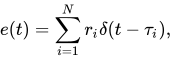
where N is the number of reflection events, are the reflection coefficients, are the reflection times of each event, and is the Dirac delta function.


In practice, since we are dealing with noisy, finite bandwidth, finite length, discretely sampled datasets, the above procedure only yields an approximation of the filter required to deconvolve the data. However, by formulating the problem as the solution of a Toeplitz matrix and using Levinson recursion, we can relatively quickly estimate a filter with the smallest mean squared error possible. We can also do deconvolution directly in the frequency domain and get similar results. The technique is closely related to linear prediction.
Optics and other imaging
[edit]
In optics and imaging, the term "deconvolution" is specifically used to refer to the process of reversing the optical distortion that takes place in an optical microscope, electron microscope, telescope, or other imaging instrument, thus creating clearer images. It is usually done in the digital domain by a software algorithm, as part of a suite of microscope image processing techniques. Deconvolution is also practical to sharpen images that suffer from fast motion or jiggles during capturing. Early Hubble Space Telescope images were distorted by a flawed mirror and were sharpened by deconvolution.
The usual method is to assume that the optical path through the instrument is optically perfect, convolved with a point spread function (PSF), that is, a mathematical function that describes the distortion in terms of the pathway a theoretical point source of light (or other waves) takes through the instrument.[3] Usually, such a point source contributes a small area of fuzziness to the final image. If this function can be determined, it is then a matter of computing its inverse or complementary function, and convolving the acquired image with that. The result is the original, undistorted image.
In practice, finding the true PSF is impossible, and usually an approximation of it is used, theoretically calculated[4] or based on some experimental estimation by using known probes. Real optics may also have different PSFs at different focal and spatial locations, and the PSF may be non-linear. The accuracy of the approximation of the PSF will dictate the final result. Different algorithms can be employed to give better results, at the price of being more computationally intensive. Since the original convolution discards data, some algorithms use additional data acquired at nearby focal points to make up some of the lost information. Regularization in iterative algorithms (as in expectation-maximization algorithms) can be applied to avoid unrealistic solutions.
When the PSF is unknown, it may be possible to deduce it by systematically trying different possible PSFs and assessing whether the image has improved. This procedure is called blind deconvolution.[3] Blind deconvolution is a well-established image restoration technique in astronomy, where the point nature of the objects photographed exposes the PSF thus making it more feasible. It is also used in fluorescence microscopy for image restoration, and in fluorescence spectral imaging for spectral separation of multiple unknown fluorophores. The most common iterative algorithm for the purpose is the Richardson–Lucy deconvolution algorithm; the Wiener deconvolution (and approximations) are the most common non-iterative algorithms.

For some specific imaging systems such as laser pulsed terahertz systems, PSF can be modeled mathematically.[6] As a result, as shown in the figure, deconvolution of the modeled PSF and the terahertz image can give a higher resolution representation of the terahertz image.
Radio astronomy
[edit]When performing image synthesis in radio interferometry, a specific kind of radio astronomy, one step consists of deconvolving the produced image with the "dirty beam", which is a different name for the point spread function. A commonly used method is the CLEAN algorithm.
Biology, physiology and medical devices
[edit]Typical use of deconvolution is in tracer kinetics. For example, when measuring a hormone concentration in the blood, its secretion rate can be estimated by deconvolution. Another example is the estimation of the blood glucose concentration from the measured interstitial glucose, which is a distorted version in time and amplitude of the real blood glucose. [7]
Absorption spectra
[edit]Deconvolution has been applied extensively to absorption spectra.[8] The Van Cittert algorithm (article in German) may be used.[9]
Fourier transform aspects
[edit]Deconvolution maps to division in the Fourier co-domain. This allows deconvolution to be easily applied with experimental data that are subject to a Fourier transform. An example is NMR spectroscopy where the data are recorded in the time domain, but analyzed in the frequency domain. Division of the time-domain data by an exponential function has the effect of reducing the width of Lorentzian lines in the frequency domain.
See also
[edit]References
[edit]- ^ O'Haver, T. "Intro to Signal Processing - Deconvolution". University of Maryland at College Park. Retrieved 2007-08-15.
- ^ Wiener, Norbert (1949). Extrapolation, Interpolation, and Smoothing of Stationary Time Series: With Engineering Applications. MIT Press. ISBN 9780262257190.
{{cite book}}: ISBN / Date incompatibility (help) - ^ a b Cheng, P. C. (2006). "The Contrast Formation in Optical Microscopy". In Pawley, J. B. (ed.). Handbook of Biological Confocal Microscopy (3rd ed.). Berlin: Springer. pp. 189–90. ISBN 0-387-25921-X.
- ^ Nasse, M. J.; Woehl, J. C. (2010). "Realistic modeling of the illumination point spread function in confocal scanning optical microscopy". Journal of the Optical Society of America A. 27 (2): 295–302. Bibcode:2010JOSAA..27..295N. doi:10.1364/JOSAA.27.000295. PMID 20126241.
- ^ Ahi, Kiarash; Anwar, Mehdi (May 26, 2016). Anwar, Mehdi F; Crowe, Thomas W; Manzur, Tariq (eds.). "Developing terahertz imaging equation and enhancement of the resolution of terahertz images using deconvolution". Proc. SPIE 9856, Terahertz Physics, Devices, and Systems X: Advanced Applications in Industry and Defense, 98560N. Terahertz Physics, Devices, and Systems X: Advanced Applications in Industry and Defense. 9856: 98560N. Bibcode:2016SPIE.9856E..0NA. doi:10.1117/12.2228680. S2CID 114994724.
- ^ Sung, Shijun (2013). Terahertz Imaging and Remote Sensing Design for Applications in Medical Imaging. UCLA Electronic Theses and Dissertations.
- ^ Sparacino, Giovanni; Cobelli, Claudio (1996). "Reconstruction of insulin secretion rate by deconvolution: domain of validity of a monoexponential C-peptide impulse response model". Techno Health Care. 4 (1): 87–9511. doi:10.3233/THC-1996-4110. PMID 8773311.
- ^ Blass, W. E.; Halsey, G. W. (1981). Deconvolution of Absorption Spectra. Academic Press. ISBN 0121046508.
- ^ Wu, Chengqi; Aissaoui, Idriss; Jacquey, Serge (1994). "Algebraic analysis of the Van Cittert iterative method of deconvolution with a general relaxation factor". J. Opt. Soc. Am. A. 11 (11): 2804–2808. Bibcode:1994JOSAA..11.2804X. doi:10.1364/JOSAA.11.002804.
| International | |
|---|---|
| National | |
| Other | |

Deconvolution
View on GrokipediaFundamentals
Definition and Motivation
Deconvolution is the process of approximately inverting a convolution operation to recover an original signal from an observed dataset , where denotes convolution, represents the point spread function (PSF) or impulse response of the system, and accounts for noise or measurement errors.[4] This inverse procedure aims to reverse the blurring or distortion introduced by the convolution, which mixes the original signal with the system's response, thereby restoring finer details that would otherwise be lost.[5] The primary motivation for deconvolution arises in scenarios where observed signals are degraded by known or estimated system responses, such as in imaging where atmospheric turbulence or lens aberrations blur details, or in audio processing where echoes distort recordings. It is crucial for enhancing resolution, suppressing noise, and extracting underlying information across scientific domains, enabling clearer interpretations of data that would be obscured by the convolution process. For instance, consider a simple one-dimensional signal, like a sharp pulse representing an event; convolving it with a Gaussian kernel produces a smoothed, blurred version , mimicking real-world spreading due to diffusion or filtering, and deconvolution seeks to reverse this to approximate the original pulse shape.[4] The concept traces its early roots to optics in the late 19th century, particularly Ernst Abbe's 1873 diffraction theory, which described how microscope images are formed through the convolution of object details with the instrument's diffraction-limited PSF, highlighting the inherent blurring in optical systems.[6] The term "deconvolution" itself emerged in the 1950s within signal processing, notably in geophysical applications at MIT, building on foundational work by Norbert Wiener on time-series prediction and filtering during World War II.[7][8] In discrete settings, common for digital signals, the convolution is formulated as , where and are integer indices, and deconvolution estimates the unknown given and .[9]Mathematical Formulation
In the continuous domain, deconvolution is formulated as the inverse problem of recovering an unknown signal from an observed signal and a known system response , where the forward model is the convolution integral This integral represents the linear superposition of the signal shifted and scaled by the impulse response , which characterizes the system's blurring or spreading effect.[8] The ideal point spread function (PSF) is the Dirac delta function , for which , as .[8] In the discrete domain, assuming uniformly sampled signals, the convolution becomes a finite sum where and are integer indices, and the signals are sequences. This can be expressed in matrix form as , where and are vectors representing the discrete signals, and is the convolution matrix constructed from , which has a Toeplitz structure due to the shift-invariance of convolution. Deconvolution then seeks , inverting the lower or upper triangular Toeplitz matrix .[10][8] The convolution theorem provides an alternative frequency-domain formulation using Fourier transforms. The Fourier transform of the convolution is , where and . Thus, deconvolution in the frequency domain is , followed by the inverse Fourier transform to recover . This follows from the linearity of the Fourier transform and its modulation property, where the transform of a shifted signal is , leading to the product form upon integration.[8] Deconvolution is inherently ill-posed in the sense of Hadamard, as the inverse operator (or division by ) is often non-invertible or unstable: small perturbations in the observed data or in the system response can produce arbitrarily large errors in the recovered signal, particularly when has small eigenvalues or approaches zero at high frequencies.[11] This instability arises because the forward convolution smooths the signal, losing high-frequency information that cannot be reliably recovered without additional constraints.[11]Methods and Algorithms
Deterministic Approaches
Deterministic approaches to deconvolution seek to recover the original signal exactly under ideal conditions, assuming the convolution process is perfectly known and reversible. These methods rely on direct inversion of the convolution operator without incorporating probabilistic models or regularization, making them suitable for noise-free scenarios where the point spread function (PSF) or impulse response is stable and invertible. The convolution can be represented in the time domain as a linear system where the observed signal is given by , with denoting the convolution matrix derived from the PSF and the original signal.[12] In the time domain, direct inverse filtering solves for the original signal via matrix inversion: . This approach treats the convolution as a banded Toeplitz matrix , which is inverted using standard linear algebra techniques such as Gaussian elimination. The computational cost is for an matrix, rendering it impractical for large-scale signals due to the cubic scaling with signal length.[12][13] Frequency domain inversion offers a more efficient alternative by leveraging the convolution theorem, which states that convolution in the time domain corresponds to multiplication in the frequency domain. The original signal's Fourier transform is recovered as , where uppercase denotes Fourier transforms, followed by an inverse Fourier transform to obtain . This is implemented using the fast Fourier transform (FFT) for computational efficiency, achieving complexity. The method assumes noise-free data and a stable with no zeros in the frequency domain to avoid division by zero or instability. For a 1D signal, the process can be outlined as follows:1. Compute G = FFT(g), where g is the observed signal of length N.
2. Compute H_freq = FFT(h_padded), where h is the PSF padded with zeros to length 2N-1 to avoid [circular convolution](/page/Circular_convolution) artifacts.
3. Compute F = G ./ H_freq (element-wise division, handling any near-zero values carefully).
4. Compute f = IFFT(F), then crop or adjust to original length N.
1. Compute G = FFT(g), where g is the observed signal of length N.
2. Compute H_freq = FFT(h_padded), where h is the PSF padded with zeros to length 2N-1 to avoid [circular convolution](/page/Circular_convolution) artifacts.
3. Compute F = G ./ H_freq (element-wise division, handling any near-zero values carefully).
4. Compute f = IFFT(F), then crop or adjust to original length N.
Stochastic and Regularized Methods
Stochastic and regularized methods in deconvolution incorporate probabilistic models of noise and constraints to mitigate the instability arising from ill-posed problems, such as sensitivity to measurement errors, thereby yielding more robust estimates of the original signal. These approaches treat the unknown signal and noise as random processes, often assuming Gaussian or Poisson distributions, and seek solutions that minimize expected errors or maximize posterior probabilities while enforcing smoothness or non-negativity. Developed primarily from the 1940s through the 1980s, these techniques uniquely handle additive noise scenarios prevalent in practical applications like imaging and signal processing, contrasting with deterministic methods by explicitly accounting for uncertainty.[16] The Wiener filter represents an optimal linear estimator for deconvolution under stationary Gaussian noise, minimizing the mean square error between the estimated and true signal. In the frequency domain, the filter transfer function is given by where is the Fourier transform of the point spread function (PSF), its complex conjugate, and SNR the signal-to-noise ratio, often defined as the ratio of signal power to noise variance . This formulation arises from the least squares criterion augmented by noise variance: for an observed signal with uncorrelated zero-mean noise of variance , the filter balances fidelity to the data against noise amplification, attenuating high frequencies where SNR is low. Proposed by Norbert Wiener in the 1940s and formalized in 1949, the method assumes known power spectral densities of the signal and noise, making it particularly effective for linear time-invariant systems.[16][17] Regularization techniques, such as Tikhonov regularization, stabilize deconvolution by adding a penalty term to the least squares objective, addressing the amplification of noise in ill-conditioned problems. The regularized problem minimizes where is the regularization parameter controlling the trade-off between data fit and solution smoothness, and the solution satisfies the normal equation . Introduced by Andrey Tikhonov in 1963 for solving ill-posed inverse problems, this method assumes additive Gaussian noise and a priori knowledge that the signal is smooth (e.g., small -norm), with often chosen via methods like L-curve or discrepancy principle to match noise levels. In deconvolution, it effectively damps small singular values of , preventing oscillations in the estimate.[18] Iterative methods like the Richardson-Lucy algorithm extend these ideas to handle Poisson noise, common in photon-limited imaging, by iteratively refining non-negative estimates. The update rule is where denotes convolution, the PSF, and the observed data, preserving total flux and positivity at each step. Derived as a maximum likelihood estimator under Poisson statistics, the algorithm converges monotonically to the true solution for non-negative signals and known PSF, though slowly in practice and prone to noise amplification without stopping criteria. Originally proposed by Richardson in 1972 and adapted by Lucy in 1974 for astronomical applications, it gained prominence in the 1980s for restoring blurred images while maintaining statistical properties like variance. Stochastic aspects of deconvolution are formalized through Bayesian frameworks, which model the signal and noise as random processes to compute maximum a posteriori (MAP) estimates that incorporate prior distributions on , such as Gaussian for smoothness or sparsity-promoting forms. In this setup, the posterior is maximized, where reflects the likelihood (e.g., Gaussian for additive noise), yielding solutions like . These approaches, building on Wiener's probabilistic foundations from the 1940s, provide a unified view of regularization as Bayesian inference, with MAP equivalents to Tikhonov for quadratic priors, and enable handling of non-Gaussian noise via methods like expectation-maximization. Widely adopted since the 1960s, they enhance interpretability by quantifying uncertainty in the deconvolved signal.[17]Fourier-Based Techniques
Fourier-based techniques for deconvolution operate in the frequency domain, exploiting the convolution theorem, which states that the Fourier transform of a convolution is the pointwise product of the individual transforms.[1] This allows deconvolution to be performed as division in the frequency domain, converting the problem from a computationally intensive time-domain operation to a more efficient multiplication or division. These methods are particularly effective for linear shift-invariant systems where the point spread function (PSF) is known or estimable. The discrete Fourier transform (DFT) approximates the continuous Fourier transform for digital signals, enabling frequency-domain deconvolution via the fast Fourier transform (FFT) algorithm, which was practically enabled by the Cooley-Tukey method in 1965.[19] In practice, the DFT assumes periodic signals, leading to circular convolution; to approximate linear convolution and prevent wrap-around artifacts (aliasing), signals are zero-padded to at least twice their original length before transformation.[20] This zero-padding ensures that the inverse transform yields the correct linear deconvolved result without edge distortions, though it increases computational overhead slightly. To mitigate spectral leakage and Gibbs phenomenon artifacts arising from finite signal lengths in DFT-based deconvolution, windowing functions such as Hamming or Blackman are applied prior to transformation, tapering the signal edges to reduce sidelobe contamination in the frequency domain.[21] These artifacts can otherwise amplify noise or introduce ringing in the restored signal, particularly when dividing by small PSF magnitudes. For two-dimensional images, such as in microscopy or astronomy, deconvolution employs the 2D FFT, which is separable into row-wise and column-wise 1D FFTs for efficiency. The process involves computing the 2D DFT of the observed image and PSF , followed by pointwise division , and inverse 2D FFT to recover the estimate .[22] Zero-padding is extended to 2D grids, and windowing is applied similarly to avoid boundary effects in the spatial domain. Homomorphic filtering addresses multiplicative convolutions, common in scenarios like speech or seismic signals where excitation and system response multiply in the time domain. By taking the logarithm, the operation becomes additive: ; the Fourier transform yields . The cepstrum, defined as the inverse Fourier transform of , separates components in the quefrency domain, allowing low-pass or high-pass filtering to isolate signal and PSF before exponentiation and inverse transform for deconvolution.[23] This technique, introduced by Oppenheim and Schafer, excels in separating exponentially decaying echoes or reverberations. An advanced variant, the CLEAN algorithm, iteratively deconvolves sparse signals by identifying peaks in the dirty image (the inverse Fourier transform of observed visibilities), subtracting scaled PSF replicas, and accumulating components in a model, effectively removing sidelobes in Fourier space through repeated transformations.[24] Developed by Högbom for radio interferometry, it assumes the sky is a collection of point sources and converges by gain factors (typically 0.1-0.5) to stabilize against noise, though it requires Fourier operations for each iteration. Fourier-based methods offer significant computational advantages over direct time-domain approaches, achieving complexity per transform via FFT, compared to for naive matrix inversion in deconvolution, making them scalable for large datasets.[25] Additionally, FFT operations are highly parallelizable, particularly on GPUs, where batched 2D/3D transforms can accelerate real-time deconvolution by orders of magnitude for volumetric data.[26]| Aspect | Time-Domain Methods | Frequency-Domain (FFT) Methods |
|---|---|---|
| Computational Complexity | for matrix inversion | for large |
| Artifact Handling | Linear convolution naturally avoids wrap-around | Requires zero-padding and windowing to prevent aliasing and leakage |
| Noise Sensitivity | Stable for iterative regularization | Prone to amplification at zero PSF frequencies; needs regularization |
| Parallelization | Sequential for large kernels | Highly parallel on GPUs/FFTW libraries |
| Suitability | Small signals or exact kernels | Large-scale, shift-invariant systems |
Deep Learning-Based Methods
Since the 2010s, deep learning has emerged as a powerful approach for deconvolution, particularly in image processing, by learning complex mappings from blurred to sharp images without explicit PSF knowledge in some cases. Convolutional neural networks (CNNs), such as DeblurGAN or DnCNN, are trained end-to-end on paired datasets to approximate inverse operations, often outperforming traditional methods in noisy or blind scenarios through implicit regularization via network architecture and loss functions like perceptual loss. These models handle non-linear degradations and generalize across variations, with generative adversarial networks (GANs) enhancing realism in restored outputs. As of 2025, advancements include diffusion models and transformer-based architectures for plug-and-play deconvolution, integrating with iterative solvers for improved stability and resolution in applications like microscopy and astronomy.[28] Despite requiring large training data, these methods achieve real-time performance on GPUs and address ill-posedness via data-driven priors, marking a shift from analytical to learned solutions.[29]Applications
Geophysics and Seismology
In geophysics and seismology, deconvolution is applied to seismic traces to reverse the effects of the source wavelet and propagation distortions, thereby enhancing the resolution of subsurface reflectivity. The observed seismic trace is modeled as the convolution of the source wavelet , the earth's filter (which accounts for absorption and multiples), and the reflectivity series , expressed as . The primary goal of seismic deconvolution is to remove the wavelet effects from to recover the reflectivity series , which represents acoustic impedance contrasts at geological interfaces. This process improves temporal resolution by compressing the wavelet and attenuating reverberations and short-period multiples that obscure primary reflections.[30] Spike deconvolution, a key deterministic approach, aims to transform the seismic trace into a series of sharp spikes corresponding to the reflectivity, assuming a white reflectivity series. It is particularly effective for predictive filtering, where the inverse filter is designed to produce a delta function response, thereby collapsing the wavelet to its minimum-phase equivalent. This method handles mixed-phase wavelets, which arise from non-minimum-phase sources like marine air guns, by estimating the wavelet's phase spectrum and applying a stabilizing inverse filter to avoid instability from zeros outside the unit circle in the z-transform.[31] Unlike broader imaging techniques, seismic deconvolution focuses on one-dimensional trace-level processing to isolate reflectivity without spatial migration.[32] Predictive deconvolution employs an autoregressive (AR) model to predict and subtract multiples generated by the earth's filter, such as water-bottom or interlayer reverberations. The method designs a prediction error filter of length (prediction distance) that minimizes the error between the actual trace and its predicted version, effectively suppressing periodic events while preserving primaries. Filter coefficients are derived by solving the Yule-Walker equations, which relate the AR parameters to the autocorrelation of the trace: for an AR process of order , the coefficients satisfy for , where is the autocorrelation lag. This approach, pioneered by Enders Robinson, assumes a stationary AR model for the trace and is often implemented in the time domain for stability.[33] Historically, seismic deconvolution gained prominence in the 1960s petroleum industry with the advent of digital recording, enabling automated filter design and widespread application in exploration workflows. Enders Robinson's 1967 work on predictive decomposition formalized these techniques, transforming seismic processing from analog to digital paradigms and integrating them with emerging migration algorithms for subsurface imaging. In modern practice, deconvolution remains a preprocessing step before migration, often combined with stochastic methods like the Wiener filter to handle noise. Recent advances include geophysics-steered self-supervised learning approaches for improved deconvolution stability and noise handling as of 2023.[34][35] In oil exploration, deconvolution enhances vertical resolution of 1D traces, facilitating the detection of bright spots—high-amplitude reflections indicative of hydrocarbon-filled reservoirs, such as gas sands. By compressing the wavelet, it sharpens interfaces, allowing interpreters to distinguish fluid effects from lithology and reducing tuning ambiguities in amplitude versus offset analysis.[36] For example, in Gulf of Mexico basins, predictive deconvolution has improved bright spot delineation, leading to higher success rates in drilling prospects.[37] In earthquake analysis, deconvolution recovers source time functions (STFs) from teleseismic records by inverting the convolutional model to isolate the rupture history from path and instrument effects. Multichannel deconvolution techniques, using empirical Green's functions from aftershocks, estimate relative STFs for event pairs, revealing moment release duration and scaling with magnitude.[38] This application, distinct from exploration, aids in characterizing fault dynamics and seismic hazard assessment, as demonstrated in studies of subduction zone events where blind deconvolution retrieves apparent STFs with durations scaling as .[39]Imaging and Optics
In optical imaging systems, deconvolution serves to counteract degradation caused by the point spread function (PSF), which arises from lens aberrations or atmospheric turbulence, thereby restoring higher spatial resolution in captured images. Atmospheric turbulence, in particular, introduces wavefront distortions that broaden the PSF, reducing contrast and detail in ground-based observations; deconvolution algorithms reverse this convolution to sharpen the image while suppressing noise amplification. For instance, prior to the 1993 servicing mission that corrected its primary mirror, the Hubble Space Telescope suffered from severe spherical aberration, resulting in a highly aberrant PSF; researchers applied iterative deconvolution methods, such as the Richardson-Lucy algorithm, to sharpen pre-launch and early images, achieving partial recovery of resolution without hardware intervention.[40][41] In microscopy applications, deconvolution enhances both confocal and widefield imaging by mitigating the effects of diffraction-limited optics and out-of-focus light contributions, effectively pushing resolution beyond the classical Abbe limit in fluorescence-based techniques. The Richardson-Lucy algorithm, a maximum-likelihood iterative method, is widely adopted for processing fluorescence microscopy data due to its ability to handle Poisson noise inherent in photon-limited imaging, yielding clearer visualization of cellular structures. For example, in widefield fluorescence setups, deconvolution removes the blurring from the emission PSF, improving axial and lateral resolution by factors of 1.5 to 2 without altering the optical hardware. Recent developments include ring deconvolution microscopy leveraging symmetry for efficient 3D deblurring, achieving isotropic resolutions down to 5 nm in volumetric samples as of 2025.[42][43][44][29] Motion blur in optical images, often resulting from relative motion between the camera and scene during exposure, is modeled as a linear convolution with a rectangular or motion-specific PSF, enabling restoration via inverse filtering or specialized deblurring kernels. Deconvolution techniques, such as Wiener filtering adapted for motion paths, estimate and invert this PSF to recover sharp details, particularly effective for uniform translational blurs where the kernel length corresponds to the exposure time and velocity. In practice, these methods are applied post-capture to digital photographs, balancing blur removal with noise suppression through regularization.[45] For two-dimensional and three-dimensional imaging, iterative deconvolution algorithms process volume data by alternately estimating the object and refining the PSF, accommodating the increased computational demands of multi-slice datasets. PSF measurement in optics typically involves imaging isolated point sources, such as calibrated beads in microscopy or artificial stars in laboratory setups, to empirically characterize the system's response before applying restoration. The 1990s marked a revival of deconvolution in optical imaging, driven by advances in computational power that enabled real-time iterative processing, paving the way for software-based super-resolution approaches that enhance detail without physical modifications to lenses or detectors.[44][46][47]Astronomy and Spectroscopy
In astronomy, deconvolution plays a crucial role in mitigating the effects of instrumental point spread functions (PSFs) and atmospheric turbulence to reveal fine-scale structures in celestial observations. In radio astronomy, interferometric imaging produces "dirty" maps contaminated by sidelobes from incomplete sampling of the visibility plane, necessitating deconvolution to recover the true sky brightness. The seminal CLEAN algorithm, developed by Högbom in 1974, addresses this by iteratively identifying the brightest peaks in the dirty map, subtracting scaled versions of the PSF (or "dirty beam") centered at those positions, and building a model of sparse point sources that represent the sky. This process assumes the astronomical signal is positive and sparse, typical of radio sources like quasars and supernova remnants, and has become a cornerstone for high-fidelity imaging in arrays such as the Very Large Array. In optical astronomy, ground-based observations are blurred by atmospheric seeing, which convolves the true image with a time-varying PSF, limiting resolution to about 1 arcsecond. Deconvolution techniques restore sharper images by estimating and inverting the PSF; a key advancement is multi-frame blind deconvolution, which jointly estimates the object and unknown PSF from multiple short-exposure frames without prior PSF knowledge, leveraging statistical redundancy across frames to handle photon noise and variability. Pioneered by Schultz and Lane in 1993, this maximum-likelihood approach has enabled diffraction-limited recovery in seeing-limited data, facilitating studies of asteroid shapes and binary star separations. For extended sources, such as galaxies, deconvolution sharpens morphological features like spiral arms and bars, allowing precise classification and measurement of structural parameters that inform galaxy evolution models; for instance, applying Richardson-Lucy deconvolution to Hubble Space Telescope images has refined bulge-disk decompositions in nearby galaxies. Recent applications include physics-informed neural networks for PSF removal in large surveys like the Zwicky Transient Facility, revealing faint sources as of 2025.[48][49] Astronomical spectroscopy relies on deconvolution to retrieve intrinsic line profiles from observed spectra broadened by instrumental resolution, such as spectrograph slit functions or detector sampling. Absorption and emission lines, often modeled as Voigt profiles—the convolution of Gaussian (Doppler and thermal) and Lorentzian (natural and pressure) components—are deconvolved to isolate physical parameters like velocity dispersions and abundances. Fourier-domain methods excel here, transforming the convolution into a multiplication for efficient inversion, as demonstrated in plasma and stellar spectroscopy where Stark or rotational broadening is removed to yield pure Voigt shapes. Least-squares deconvolution further enhances this by averaging thousands of lines into a mean profile, reducing noise and revealing subtle magnetic field effects via Zeeman splitting in stellar atmospheres.[50] Unlike two-dimensional imaging, spectroscopic deconvolution emphasizes one-dimensional line profiles to probe chemical compositions and kinematics, though both domains exploit the positivity and sparsity of astronomical signals. Deconvolution proved essential in the Event Horizon Telescope's 2019 imaging of the M87 black hole shadow, where hybrid algorithms incorporating CLEAN iteratively refined sparse visibility data against the extended PSF, distinguishing the ring-like emission from instrumental artifacts and enabling general relativity tests.Biomedical and Physiological Applications
Deconvolution plays a crucial role in biomedical and physiological applications by reversing the blurring and distortion effects inherent in biological imaging and signal acquisition systems, enabling more accurate diagnostic and analytical insights into living systems. In medical imaging, it addresses partial volume effects (PVE) that arise when the resolution of scanners is insufficient to distinguish fine tissue boundaries, leading to spillover of signal intensities between adjacent structures. For instance, in positron emission tomography (PET) and single-photon emission computed tomography (SPECT), deconvolution enhances spatial resolution for tracer distribution mapping, allowing better quantification of radiotracer uptake in small lesions or organs. A post-reconstruction method using deconvolution with parallel level set regularization has demonstrated improved quantitative performance in PET, particularly when guided by magnetic resonance imaging (MRI) priors to reduce noise while correcting PVE. Similarly, in computed tomography (CT), iterative deconvolution techniques correct PVE by restoring edges and contrast without excessive noise amplification, as shown in evaluations of brain PET studies where such methods improved signal-to-noise ratios post-correction. In MRI, deconvolution mitigates isotropic PVE in white matter voxels during fiber orientation extraction, using constrained spherical deconvolution to incorporate tissue-specific response functions and enhance tractography accuracy. For physiological signals, deconvolution separates underlying neural or cardiac sources from measurement artifacts, which is vital given the non-stationary noise prevalent in biological data. In electrocardiography (ECG) and electroencephalography (EEG), it removes artifacts like those from motion or instrumentation; for example, homomorphic deconvolution combined with independent component analysis (ICA) deconvolves resting EEG to isolate physiological components from distortions. In functional MRI (fMRI), deconvolution estimates the hemodynamic response function (HRF) from BOLD signals, enabling blind recovery of subject-specific responses in resting-state data to better model neural activity timing. In biological contexts, deconvolution facilitates high-resolution analysis of cellular structures and dynamics. Electron microscopy employs 3D multi-energy deconvolution to reconstruct volumetric images of stained bulk samples, suppressing artifacts from beam interactions and achieving qualitative agreement with ground-truth structures at resolutions down to 5 nm. In neuroscience, spike deconvolution infers neuron firing rates from calcium imaging or electrophysiological recordings, where methods like robust non-negative deconvolution improve detection accuracy by accounting for burst spiking and temporal overlaps, enhancing connectivity estimates in neural populations. Device-specific applications include acoustic deconvolution in hearing aids to model and cancel feedback paths between microphones and speakers, using Bayesian blind deconvolution to adapt to varying environments and user anatomy. In ultrasound imaging, deconvolution corrects for frequency-dependent attenuation, restoring waveform amplitudes distorted by tissue propagation to improve diagnostic clarity. Additionally, deconvolving arterial pressure waveforms estimates central aortic pressure from peripheral measurements via blind deconvolution techniques, such as those using Malliavin calculus, to assess cardiovascular dynamics noninvasively. Deconvolution's prominence in biomedical fields surged in the 2000s alongside advances in bioinformatics, particularly for handling non-stationary noise in high-throughput biological data, though cellular deconvolution for transcriptomics saw broader adoption in the 2010s. Recent deep learning-based methods, including systematic reviews of DL-driven cellular deconvolution tools, have further improved performance in estimating cell proportions from bulk data as of 2025. Regularized approaches, often stochastic, are commonly integrated to stabilize solutions against biological variability.[28]Challenges and Limitations
Ill-Posed Problems
Deconvolution problems, formulated as inverting the linear operator in the equation , where is the original signal, the observed data, and noise, are classic examples of ill-posed inverse problems according to Hadamard's criteria. These criteria require that a problem be well-posed if it admits at least one solution (existence), the solution is unique, and the solution depends continuously on the data (stability). In deconvolution, these conditions often fail, particularly in terms of stability: existence and uniqueness may hold under certain assumptions on (for example, when the Fourier transform of the kernel has no zeros, ensuring is injective, as in the Gaussian case), but the solution depends discontinuously on the data due to the amplifying nature of the inverse operator . Uniqueness can be violated if has a non-trivial null space, such as when the kernel's Fourier transform has zeros (e.g., in band-limited low-pass filters), allowing high-frequency components to be annihilated and rendering recovery ambiguous. For instance, even with a Gaussian kernel, which preserves uniqueness, the suppression of high-frequency content makes the recovery of sharp edges or rapid variations in highly sensitive to perturbations in , as small noise can lead to exponentially large errors in the estimated .[1][11] The instability of deconvolution arises from the extreme sensitivity of the inverse operator to perturbations, quantified by the condition number , which is typically much greater than 1 for convolution matrices. For band-limited kernels, where the Fourier transform of the impulse response decays rapidly, grows exponentially with matrix size, often approaching the reciprocal of machine precision (e.g., for double-precision arithmetic in Toeplitz convolution matrices of practical dimensions). This ill-conditioning implies that small changes in , such as measurement noise, lead to exponentially large errors in the estimated , even in the absence of noise, highlighting the inherent instability.[51][52] A deeper analysis via singular value decomposition (SVD) reveals the pathology: , where with , but the singular values decay smoothly to near-zero without a spectral gap, characteristic of mildly to severely ill-posed problems. The naive pseudoinverse solution amplifies noise by factors up to , and the discrete Picard condition—where the coefficients of in the SVD basis decay slower than the singular values—demonstrates this instability visually through Picard plots, showing how noise-dominated components overwhelm the signal for small .[53][54] The theoretical foundations of this ill-posedness trace to functional analysis in the mid-20th century, where Mikhail Lavrentiev and others extended Hadamard's framework to infinite-dimensional operators, proving that compact operators like convolutions in spaces lack bounded inverses, leading to discontinuous solutions even for exact data. This explains why direct inversion fails fundamentally, as the forward convolution operator is compact and smoothing, while the inverse demands unbounded amplification. In contrast to the well-posed forward problem, where small changes in yield proportionally small changes in , deconvolution necessitates prior information on to restore stability.[55][56]Noise and Stability Issues
In deconvolution, noise amplification arises primarily from the inverse filtering process, where the deconvolution operator acts as a high-pass filter. Specifically, the frequency-domain multiplier boosts high-frequency components of the noise, particularly at frequencies where the magnitude of the point spread function (PSF) is small, leading to exaggerated errors in the reconstructed signal.[57] This effect is exacerbated in inverse problems like image restoration, where the low-pass nature of typical imaging systems suppresses signal details while preserving noise, resulting in artifacts such as ringing in spatial domains—oscillatory patterns around edges due to Gibbs-like phenomena in the inverse transform.[58] For instance, in Wiener deconvolution, unregularized application can produce grainy outputs with amplified sensor noise, as the filter gain increases inversely with the signal-to-noise ratio at each frequency.[59] Stability in deconvolution solutions is often quantified through metrics that balance reconstruction fidelity against noise sensitivity, such as mean squared error (MSE) as a function of the regularization parameter . In regularized methods like Tikhonov regularization, increasing reduces noise variance but introduces bias, creating a trade-off visualized in L-curves—log-log plots of the residual norm versus the solution norm for varying , where the "corner" indicates an optimal balance minimizing both overfitting to noise and underfitting the data.[60] This heuristic, introduced by Hansen, aids in parameter selection without prior noise estimates, showing how small amplifies high-frequency noise (high solution norm) while large yields smooth but inaccurate results (high residual norm).[61] Empirical studies demonstrate that L-curve corners correspond to MSE minima in simulated noisy convolutions, enhancing solution robustness across signal-to-noise ratios.[62] Additional error sources compound these issues, including model mismatch from an inaccurate PSF estimate and quantization noise inherent in digital acquisitions. A mismatched PSF, such as errors in its width or asymmetry, can propagate systematic biases, leading to distorted reconstructions where features are either over-sharpened or blurred inconsistently across the field.[63] Quantization noise, arising from finite bit-depth sampling, further degrades stability by introducing discrete-level errors that the inverse operator amplifies similarly to additive noise. Sensitivity to these errors is commonly assessed via Monte Carlo simulations, which generate ensembles of noisy inputs with perturbed PSFs or quantization levels to quantify variance in output metrics like peak signal-to-noise ratio, revealing how PSF inaccuracies can double reconstruction errors in low-signal regimes.[64] Modern challenges in deconvolution stability extend to big data contexts, such as exascale imaging in astronomy or medical scanning, where processing terabyte-scale datasets demands scalable algorithms without numerical instability. Parallel computing implementations, like GPU-accelerated iterative solvers, risk divergence from floating-point precision loss in distributed matrix inversions, necessitating stabilized preconditioners to maintain convergence.[65] Post-2010 advances, including machine learning priors like the deep image prior, have improved stability by implicitly regularizing through network architectures that favor natural image statistics over explicit tuning; as of 2025, systematic reviews highlight further deep learning-based methods, such as end-to-end neural deconvolution, that enhance robustness to noise in low-SNR imaging without traditional regularization.[28] Though classical noise issues persist without such integrations.References
- https://wiki.seg.org/wiki/Seismic_deconvolution
- https://wiki.seg.org/wiki/Spiking_deconvolution
- https://wiki.seg.org/wiki/Model-driven_predictive_deconvolution