Hubbry Logo
Cosmo Clock 21Cosmo Clock 21Main
Open search
Cosmo Clock 21
Community hub
Cosmo Clock 21
logo
8 pages, 0 posts
0 subscribers
Be the first to start a discussion here.
Cosmo Clock 21
Cosmo Clock 21
from Wikipedia
Cosmo Clock 21

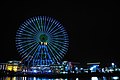
Cosmo Clock 21 is a 112.5-metre-tall (369 ft) Ferris wheel at the Cosmo World amusement park in the Minato Mirai 21 district of Yokohama, Japan. When it first opened, it was the world's tallest Ferris wheel at 107.5 metres (353 ft), until the completion of the 108-metre (354 ft) Igosu 108 in Shiga, Japan, in 1992.

History and specifications

[edit]

Built for the YES '89 Yokohama Exposition at Minato Mirai 21 in 1989,[1] Cosmo Clock 21 was originally constructed with a height of 107.5 metres (353 ft).[2]

In 1997 the structure was dismantled, then in 1999 relocated onto a taller base which increased its overall height to 112.5 metres (369 ft).[3][4]

Cosmo Clock 21 has 60 passenger cars,[5] each capable of carrying up to eight people. One rotation of the 100-metre (330 ft) diameter wheel takes 15 minutes.[6]

In film

[edit]

Cosmo Clock 21 makes a prominent film appearance in the 1992 film Godzilla vs. Mothra, where Godzilla attempts to kill Mothra by toppling it on top of her, only for Battra to catch the wheel and use it as a weapon against the King of the Monsters.

Coordinates

[edit]
[edit]

References

[edit]
Revisions and contributorsEdit on WikipediaRead on Wikipedia
from Grokipedia
Cosmo Clock 21 is a landmark located in the Cosmo World amusement park within the district of , , renowned as the world's largest Ferris wheel equipped with an integrated clock function. Standing at a height of 112.5 meters with a of 100 meters, it features 60 cabins—each accommodating up to eight passengers—for a total capacity of 480 riders, and offers a 15-minute ride providing panoramic 360-degree views of the city, Bay, and on clear days. Originally constructed for the 1989 Yokohama Exposition (YES '89) at a height of 107.5 meters, the wheel was dismantled in 1997 and relocated to its current elevated base in 1999, increasing its overall height and establishing it as a symbol of 's vibrant waterfront. Its distinctive , measuring 12.16 meters by 3.2 meters and displaying 24-hour time, is integrated into the structure, while full-color LED illumination with over 2,700 light units enables spectacular nighttime displays in 16.7 million colors, enhancing its role as a popular and event venue. Among its four see-through cabins and two barrier-free options, Cosmo Clock 21 celebrates its status as an iconic engineering marvel since reopening.

Location

Cosmo World amusement park

Yokohama Cosmo World is an urban-style amusement park in Yokohama, Kanagawa Prefecture, Japan, designed as a multi-level entertainment hub blending thrilling rides, games, and family activities. Opened on August 11, 1990, by SENYO KOGYO CO., Ltd., the park was established in the aftermath of the 1989 Yokohama Exposition (YES '89) to leverage the event's momentum and boost tourism in the emerging waterfront area. It integrates indoor and outdoor spaces across three distinct zones: the Wonder Amuse Zone for high-adrenaline attractions, the Burano Street Zone for casual games and dining, and the Kids Carnival Zone for gentler, child-focused experiences. With over 30 rides and attractions, including game corners, the park caters primarily to families, couples, and groups seeking accessible urban leisure. Key non-Ferris wheel attractions highlight the park's emphasis on diverse, family-oriented entertainment. Thrill-seekers can enjoy roller coasters like the Diving Coaster: Vanish, a steel extreme ride featuring a dramatic plunge into an illusory underwater tunnel, and the milder Family Banana Coaster for younger riders. Complementing these are drop rides such as the Vanishing Tower, which delivers intense free-fall drops from height, alongside other staples like pirate ships, spinning rides, and a log flume. These elements create a balanced mix of excitement and accessibility, drawing visitors for quick, repeatable fun without overwhelming intensity. The park's layout encourages exploration, with attractions clustered to facilitate easy navigation for all ages. Admission to Yokohama Cosmo World is free, operating on a pay-per-ride model where individual tickets are purchased in 100-yen increments, valid for one year and applicable across attractions without age-based pricing differences for riders aged 3 and up. This policy promotes affordability and flexibility, allowing guests to customize their experience based on interests and budget, with ride costs typically ranging from 300 to 700 yen. The park enhances its year-round appeal through seasonal events, including illuminated displays, holiday illuminations, and themed collaborations—such as tie-ins with series like or —that often spotlight the landmark to attract crowds during peak tourism periods. Situated within the expansive district, Cosmo World contributes to the area's vibrant mix of leisure and urban development.

Minato Mirai 21 district

Minato Mirai 21 is a major waterfront redevelopment project in , , initiated in the early to transform a former industrial into a vibrant mixed-use urban district featuring offices, hotels, residential spaces, and entertainment facilities. The project, formally launched as part of Yokohama's "Plan for the 21st Century" in 1981 by the municipal government, aimed to revitalize the city's port area by creating a new central business and leisure hub, with development progressing through public-private partnerships that handled , , and adjustments. By the mid-1980s, systematic construction began, converting over 185 hectares of underutilized land into a futuristic skyline that symbolizes Yokohama's shift toward a knowledge-based economy. Prominent landmarks within the district include the 296-meter , the third-tallest building in as of 2025 and a hub for offices and observation decks, as well as the convention center, which hosts international events and contributes to the area's role as a global conference destination. These structures exemplify the district's emphasis on innovative, high-rise designed to blend commercial functionality with accessibility, fostering through clusters and . As of 2024, the district generates significant economic impact, attracting approximately 82 million visitors annually and supporting around 100,000 jobs in sectors like , IT, and , with annual tax revenues of about 20 billion yen. Cosmo World serves as a key entertainment component integrated into the district's layout, connected via extensive pedestrian pathways such as the Queen Axis promenade that links stations, parks, and waterfront views for seamless urban navigation. The area's evolution from a historic port and industrial zone to a modern economic hub was notably accelerated by the Yokohama Exposition of 1989, which influenced zoning expansions to 74.3 hectares and spurred infrastructure investments like rail extensions and public spaces to accommodate expo-related growth. This event catalyzed the district's transformation, embedding entertainment and cultural elements into its core planning to enhance visitor appeal and long-term vitality.

Design and features

Physical structure

Cosmo Clock 21, situated within the Cosmo World in Yokohama's district, consists of a towering structure designed for panoramic views. Following its 1999 reconstruction, the installation stands at an overall height of 112.5 meters (369 feet), achieved by adding a 5-meter structural base to the original wheel from 1989, which measured 107.5 meters (353 feet). The wheel's diameter spans 100 meters (330 feet), forming a circular rim that encircles the passenger cabins. The framework features 60 radial arms extending from the central hub to the outer rim, providing both and alignment for the 60 cabins suspended along the perimeter. These arms match the number of cabins, ensuring balanced distribution and enabling smooth rotation around the axis. The design emphasizes engineering stability to withstand the wheel's continuous motion, with the entire assembly mounted on a reinforced for enhanced load-bearing capacity post-reconstruction.

Clock and lighting

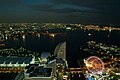
Cosmo Clock 21 features a prominent clock integrated into its central hub, serving as a functional timepiece that displays the current time in 24-hour format via a dedicated LED panel measuring 12.16 meters in width by 3.2 meters in height. This design allows the clock to operate independently of the wheel's rotation, ensuring accurate timekeeping regardless of the 's 15-minute cycles. The structure is recognized as the world's largest equipped with an integrated clock, blending horological precision with amusement engineering. The lighting system enhances the clock's visibility and transforms the entire wheel into a dynamic visual spectacle, utilizing full-color LED technology capable of producing approximately 16.7 million color variations through 2,340 direct bar-type light units and 360 indirect units. Computer-controlled illumination shows occur regularly from sunset until around midnight, featuring geometric patterns, illustrations, and text displays tailored to events and seasonal themes, with sequences lasting up to 5 minutes during peak hourly performances and shorter 1-3 minute bursts at other intervals. These energy-efficient LEDs, numbering over 1 million across the installation, enable vibrant, low-power displays that synchronize with the clock for thematic unity. As both a precise timepiece and an iconic , the clock and lighting system contribute significantly to Yokohama's nighttime , with color-changing patterns activated for holidays and special occasions to heighten its role as a beacon in the district. The independent operation of the clock display ensures uninterrupted functionality, distinguishing Cosmo Clock 21 as a multifaceted attraction that combines utility with aesthetic appeal.

History

Construction and 1989 opening

Cosmo Clock 21 was commissioned as a central for the Yokohama Exotic Showcase '89 (YES '89), an exposition held from March 25 to October 1, , to commemorate the 130th anniversary of the Port of 's opening as an international port. of the began in 1988 in the district, where it served as a symbol of the city's futuristic vision and progress. At 107.5 meters tall, Cosmo Clock 21 debuted on March 25, 1989, as the world's tallest , offering panoramic views that enhanced the exposition's focus on and global connection. The structure played a prominent role in drawing crowds to the event, underscoring Yokohama's emergence as a modern urban hub.

1997 dismantling and 1999 reconstruction

Following the closure of the Exposition in , the site's transformation into the permanent Yokohama Cosmo World amusement park within the expanding district necessitated the temporary dismantling of Cosmo Clock 21 in 1997. The structure was carefully disassembled by its manufacturer, Senyo Kogyo, and stored off-site to accommodate new developments, including the construction of Queen's Square Yokohama. Reconstruction efforts began in at the wheel's current location adjacent to the redeveloped , aiming to integrate it as a lasting feature of the urban amusement complex. The project included elevating the original 107.5-meter structure—built for the exposition—onto a new 5-meter base, resulting in a total height of 112.5 meters. The rebuilt Cosmo Clock 21 reopened to the public on March 18, 1999, coinciding with the full opening of Yokohama Cosmo World as a multi-level hub. This relocation and enhancement marked the transition of the from a temporary exposition exhibit to a of the permanent , enhancing its visibility and appeal within the skyline.

Operations

Capacity and ride experience

Cosmo Clock 21 features 60 air-conditioned cabins, each designed to seat up to eight passengers, providing a total capacity of 480 riders at any given time. Two of these cabins are barrier-free, offering accessibility for guests with mobility needs, ensuring an inclusive experience without height or age restrictions—though children under elementary school age must be accompanied by an adult. The cabins include comfortable bench-style seating and large windows that allow for unobstructed 360-degree views, emphasizing a relaxed, observational ride rather than high-speed thrills. A single rotation of the wheel lasts approximately 15 minutes, during which passengers ascend to a height of 112.5 meters for sweeping panoramas of , the Minato Mirai skyline, and on clear days, distant glimpses of the skyline and . From the top, stunning views of the Minato Mirai area can be seen, particularly the transition from sunset to night lights, enhancing the panoramic experience. This slow-paced journey highlights the observational nature of the attraction, with riders able to spot the wheel's own clock face below as they circle. Tickets for the ride cost 1,000 yen for adults (ages 3 and up), available for purchase on-site or through combo deals with nearby attractions. The boarding process involves queuing at the base station, where staff manage lines efficiently; during peak hours such as weekends and holidays, wait times can exceed 30 minutes, so visitors are advised to arrive early or opt for less crowded weekdays. Upon entry, passengers scan tickets or present QR codes before stepping into assigned cabins, which load continuously as the wheel rotates slowly.

Maintenance and safety

Cosmo Clock 21 undergoes rigorous maintenance protocols overseen by certified engineers, focusing on the inspection of critical components such as motors, cables, and passenger cabins to prevent mechanical failures. Daily visual and functional checks are conducted to monitor wear and operational performance, while annual shutdowns facilitate comprehensive overhauls, including structural assessments and component replacements, ensuring long-term reliability in line with industry best practices for large Ferris wheels. Safety features integrated into the ride include emergency evacuation procedures, which involve trained staff guiding passengers to safe disembarkation points in the event of a malfunction, and designed to mitigate risks from electrical or mechanical sources. Given Japan's proneness to earthquakes, the structure incorporates seismic reinforcements, such as flexible joints and mechanisms, to absorb shocks and protect both the ride and occupants during seismic events. These measures align with broader building standards for earthquake-prone areas in . The ride complies with Japanese amusement ride standards, including the (JIS) A 1701:2006 for inspections, which mandates periodic evaluations of design, operation, and safety systems by qualified personnel. Real-time monitoring via integrated sensors tracks wind speeds, structural , and integrity metrics, automatically halting operations if thresholds for adverse weather or anomalies are exceeded. Cosmo Clock 21 has maintained an exemplary safety record since its 1989 opening, with no major incidents resulting in injuries; a notable 2000 incident in which a became loose stranded no passengers and caused no harm, prompting a several-month closure and overhaul, after which the ride passed all regulatory inspections.

Cultural significance

Landmark status and tourism

Cosmo Clock 21 has served as an iconic symbol of since its debut in 1989 as part of the Yokohama Exposition, prominently featured in city branding materials and skyline imagery on postcards and promotional literature. Its distinctive design, combining a massive with a functional , has made it a staple in representations of the city's vibrant waterfront, drawing crowds eager for panoramic views of the harbor and urban landscape. Integrated into the district, Cosmo Clock 21 enhances tourism by connecting with nearby attractions such as the Landmark Tower, Red Brick Warehouse, and Cup Noodles Museum, creating a cohesive entertainment hub that attracted 77.3 million visitors to the area in 2023. This synergy contributes significantly to Yokohama's visitor economy, with the city's tourism-related consumption reaching ¥380 billion as of 2019, bolstered by Minato Mirai's role as a primary draw for domestic and international travelers. The wheel itself accommodates up to 480 passengers per rotation, supporting high throughput and extending visitor stays in the district. The structure has earned recognition through the district's receipt of the Minister of Construction Prize in the Urban Landscape Award in 1997, highlighting its contribution to exemplary urban development. It also plays a central role in seasonal events, including New Year's illuminations and countdown fireworks displays visible from its gondolas, which amplify its appeal during holiday periods. Culturally, Cosmo Clock 21 embodies Japan's fusion of and , with its clock mechanism nodding to historical timekeeping while its towering, illuminated form represents contemporary in urban entertainment. The Ferris wheel's striking nighttime light shows and elevated vantage points provide prime photo opportunities, fueling its popularity on and further embedding it in global perceptions of as a dynamic destination.

Appearances in media

Cosmo Clock 21 has made notable appearances in Japanese cinema, particularly in the 1992 film , where it plays a central role in the climactic battle set in Yokohama's Minato Mirai district. In the scene, knocks into the base of the and fires his atomic breath at it, prompting Battra to intervene by lifting the entire structure and dropping it onto as an improvised weapon. The sequence was filmed on location at the actual Cosmo Clock 21, highlighting its status as a recognizable landmark even in destruction. The also serves as a backdrop in video games, including the (known as Like a Dragon in some regions) series, where it appears in recreations of Yokohama's Isezaki Ijincho district. In Yakuza: Like a Dragon (2020), Cosmo Clock 21 is visible as a distant yet iconic element of the skyline, reinforcing the game's faithful depiction of the city's urban landscape. Beyond fiction, Cosmo Clock 21 frequently appears in Japanese television, including travel documentaries that showcase 's attractions, such as episodes featuring rides and nighttime views of the wheel. It has also been referenced in various dramas and variety shows set in the Minato Mirai area, capitalizing on its photogenic illuminated design. The structure's distinctive profile has been leveraged in advertisements for tourism, often highlighting its LED light shows and panoramic views to promote the city as a vibrant destination. Corporate promotions, including those for local events and amusement parks, similarly use its glowing clock face to evoke modernity and excitement. Cosmo Clock 21 has influenced local art and in , inspiring countless images that capture its colorful illuminations against the . It is a common subject in photography contests and exhibitions focused on urban landmarks, where participants highlight its role as a symbol of the port city's dynamic energy.

References

Add your contribution
Related Hubs
User Avatar
No comments yet.