Hubbry Logo
Wonder WheelWonder WheelMain
Open search
Wonder Wheel
Community hub
Wonder Wheel
logo
8 pages, 0 posts
0 subscribers
Be the first to start a discussion here.
Wonder Wheel
Wonder Wheel
from Wikipedia

Wonder Wheel
Seen in 2018
Deno's Wonder Wheel Amusement Park
Coordinates40°34′26.5″N 73°58′44.9″W / 40.574028°N 73.979139°W / 40.574028; -73.979139
StatusOperating
Opening dateMay 30, 1920; 105 years ago (1920-05-30)[1]
DesignatedMay 23, 1989[2]
Reference no.1708
Ride statistics
Attraction typeFerris wheel
ManufacturerEccentric Ferris Wheel Company
ModelEccentric wheel
Height150 ft (46 m)
Vehicle typeGondola
Vehicles24
Riders per vehicle6

The Wonder Wheel is a 150-foot-tall (46 m) eccentric Ferris wheel at Deno's Wonder Wheel Amusement Park at Coney Island in the New York City borough of Brooklyn.[3] The wheel is located on a plot bounded by West 12th Street to the west, Bowery Street to the north, Luna Park to the east, and the Riegelmann Boardwalk to the south. As with other eccentric Ferris wheels, some of the Wonder Wheel's passenger cabins are not fixed directly to the rim of the wheel, but instead slide along winding sets of rails between the hub and the rim.

Built in 1920 as one of several Ferris wheels on Coney Island, the Wonder Wheel was designed by Charles Hermann and operated by Herman J. Garms Sr. and his son Fred for six decades. Despite the subsequent economic decline of Coney Island, the Wonder Wheel continued to operate each summer through the 20th century. In 1983, Herman Garms's son Fred sold the ride to the Vourderis family, who restored the attraction and continue to run the wheel as of 2023. The New York City Landmarks Preservation Commission designated the Wonder Wheel as an official New York City landmark in 1989, and minor modifications were subsequently made to the attraction.

History

[edit]

At the time of the Wonder Wheel's construction, Coney Island was one of the largest amusement areas in the United States.[4] The first Ferris wheel in Coney Island was built for nearby Steeplechase Park in 1894 and was erroneously billed as "the world's largest".[5] Several variations of the Ferris wheel were erected in the neighborhood in the 1900s and 1910s. The Wonder Wheel was unusual in that only one-third of its 24 cars were stationary, while the other two-thirds rolled on tracks within the wheel itself.[4]

Garms ownership

[edit]

Development and early years

[edit]
Depiction of Wonder Wheel on the New York Aquarium's south wall

The Wonder Wheel was designed by Charles Hermann[a] as an improvement on G.W.G. Ferris's giant wheel, and it was built for Herman J. Garms Sr. between 1918 and 1920 by the Eccentric Ferris Wheel Company.[4] Coney Island landowner William J. Ward provided the land for the Wonder Wheel's construction. Garms, who had no formal financial experience, sold stock to family, other Coney Island business holders, and steelworkers. Hermann sold all his shares in the wheel to raise money for construction and operation.[6] Alfred (Fred) Garms, Herman Garms's son, recalled that his father employed anyone who was willing to help erect the ride, teaching them how to construct the wheel. After the local ironworkers' union heard about the project, they attempted to force the workers to join the union. The elder Garms named all of the workers as stockholders of the Eccentric Ferris Wheel Company, preventing them from being forced to unionize.[7]

The wheel first opened on Memorial Day in 1920.[8] Hermann originally called it the "Dip-the-Dip", promising to combine in his new invention "the thrill of a scenic railway, the fun of a Ferris wheel, and the excitement of the Chute-the-Chutes".[8] To help with the Wonder Wheel's upkeep, the Garms family lived under the Wonder Wheel during the summers.[6] With the success of the Wonder Wheel, the Eccentric Ferris Wheel Company hoped to build more "wonder wheels" on the East Coast of the United States by the mid-1920s.[9] Fred Garms worked on the ride as a ticket operator during the summer in the 1920s, when he was a child. By the time Fred had graduated high school in the early 1930s, he worked on the ride year-round, maintaining it.[10] After the ride's construction cost had been paid off, Herman Garms bought out most of the Eccentric Ferris Wheel Company's stockholders, then reduced the size of the corporation to a small number of people.[7]

1930s to 1970s

[edit]

The Wonder Wheel was damaged in a 1933 fire that also burned down several attractions nearby.[11] The wheel was also known as the "Eccentric Ferris Wheel" before being renamed the Wonder Wheel by 1940.[12] During World War II, the lights on the Wonder Wheel were turned off due to a blackout order affecting Coney Island.[13] The ride set an all-time daily ridership record on July 4, 1947, when it carried 14,506 passengers.[14] The Wonder Wheel continued to operate through the 1950s,[12] and it recorded its ten-millionth lifetime passenger in 1952.[15] One account from 1953 described the ride as carrying thousands of passengers, with clients coming from the South and along the East Coast. At the time, although Herman Garms still owned the ride, Fred was the manager, and there were multiple longtime employees on payroll.[16] The New York City Department of Buildings inspected the wheel each year, as each amusement ride in Coney Island could operate only with a license that expired every March, and the licenses could not be renewed without a building inspection.[17]

By the 1960s, Fred Garms had taken over operation of the Wonder Wheel.[18] Coney Island started to decline during the mid-20th century, and by 1964, it had seen its lowest number of visitors in 25 years.[19] Despite subsequent attempts to redevelop the area,[20] the Wonder Wheel continued to operate.[21] Furthermore, it had not had any significant incidents in its history, making it a relatively well-off ride when other Coney Island attractions were closing.[22][23] To discourage crime, the wheel and surrounding attractions were protected by two German Shepherds at night: one at the wheel's base and the other on an adjacent roof; during the day, the dogs rode around in one of the Wonder Wheel's cars, where the operator provided food and water for them. Off-duty security officers were also hired to prevent confrontations with the mafia.[6] By the 1970s, the Wonder Wheel had carried more than 20 million lifetime riders.[23][24] To keep up with expenses, the Wonder Wheel raised ticket prices significantly, from $0.50 in 1976 to $1.25 by 1981.[25]

Vourderis ownership

[edit]

1980s and 1990s

[edit]
Wonder Wheel neon sign

Fred Garms was looking to sell the wheel by 1983, as he was getting older and unable to manage the wheel. Denos D. Vourderis had long been interested in buying the wheel from Garms.[22] Vourderis was in a hospital recovering from a stabbing attack when Garms approached Deno's son Dennis on the possibility of purchasing the ride.[22] On June 7, 1983, Vourderis bought the Wonder Wheel from Garms and his cousin Walter Kerner Sr., and it became "Deno's Wonder Wheel".[6] The New York Times wrote that the only maintenance instructions given to the Vourderis family were the words "Good Luck" scribbled on a cardboard cigarette box.[6] The ride cost Vourderis $250,000.[21][26] He stated that part of the wheel's allure had come from when he had proposed to his future wife Lula atop the wheel 36 years prior to the purchase: he had promised to give the wheel to his wife as a future gift.[21][27][28]

The Vourderis family restored the Wonder Wheel and made it the central attraction of Deno's Wonder Wheel Amusement Park,[8] which Denos had acquired in 1980.[26] They spent $250,000 to restore the wheel.[21][27] Vourderis planned to begin allowing couples to host weddings on the ride,[21] and he also rented it out for film shoots.[29] He had paid off the ride's cost by 1985,[26] and a 65th-anniversary celebration for the ride was hosted the same year.[30] Vourderis acquired the land for $150,000 in 1987,[26] and the New York City Landmarks Preservation Commission (LPC) first considered designating the ride as a city landmark in July of that year.[31] Although Vourderis initially supported the designation when it was proposed, Newsday said he became "angry at the city" after learning that the designation would force him to ask the city for permission to repair the ride.[32] Following public hearings in May 1989,[33] the LPC formally designated the ride as a landmark that year.[2][28]

By the early 1990s, the Wonder Wheel had offered free advertising space to the McDonald's fast-food chain, which had two franchises near the wheel. Fearing that the distinctive McDonald's logo would overshadow the Wonder Wheel itself, the LPC voted against allowing a McDonald's logo on the wheel, despite allowing Vourderis to put "Deno's" above the "Wonder Wheel" sign on the wheel's hub.[34] Upon Deno's death in the mid-1990s, control of the wheel and the amusement park passed to Dennis Vourderis.[22]

2000s to present

[edit]

In the 2000s, Deno's grandchildren also became involved in the operation of the wheel.[35] Despite the redevelopment of Coney Island and the erection of the nearby Luna Park in 2010, the wheel and associated amusement park continued to operate.[36][37] The Wonder Wheel received a new solar-powered lighting system in 2012, replacing a lighting system that had been broken for three decades.[38] Even during the aftermath of 2012's Hurricane Sandy, when Deno's Amusement Park was flooded, the Wonder Wheel was only slightly damaged and reopened the next year.[3] The Vourderis family had planned to celebrate the Wonder Wheel's centenary with a three-day celebration in May 2020, but this was postponed due to the COVID-19 pandemic in New York City, which shuttered all businesses deemed non-essential.[39] The 2020 season was the first in which the Wonder Wheel did not operate at all;[40] the Wonder Wheel ultimately reopened in April 2021.[41][42] The centennial celebration was rescheduled for after the 2021 reopening.[43][44]

As of 2024, the Wonder Wheel is the oldest continuous operating ride at Coney Island, and Dennis Vourderis and his brother Steve continue to operate the Wonder Wheel and the amusement park.[6] Deno's Wonder Wheel Amusement Park is the last family-operated amusement park in Coney Island, though several developers have made offers for the amusement park and wheel, the Vourderis family has refused to sell.[37]

Description

[edit]

Design

[edit]
On-ride view, showing one of the cabins on one of the Wonder Wheel's tracks as seen from the cabin behind it

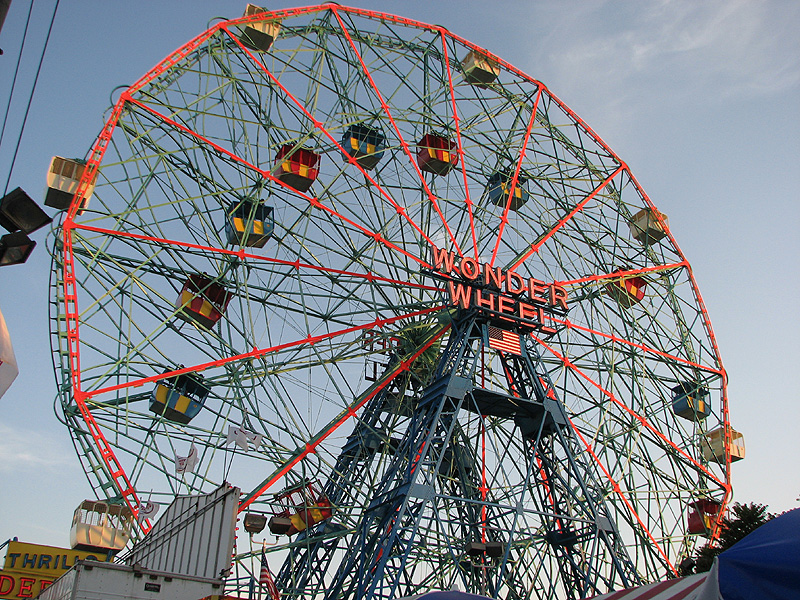
The Wonder Wheel is located at 3059 West 12th Street, just north of the Riegelmann Boardwalk.[2] Its entrance plaza is composed of a steel structure with plywood-and-corrugated metal. The hub of the wheel, supported by two blue-painted legs shaped like the letter "A", contains an illuminated sign with orange letters spelling "wonder wheel" in all capital letters. There are sixteen spokes extending from the hub, each connected at their outer ends by a hexadecagonal frame and braced by green beams, each connected through rivets and gusset plates. The eight stationary cars on the hexadecagonal frame are painted white while the sixteen motion-capable cars are painted red-and-yellow or blue-and-yellow. At West 12th Street is a neon sign weighing 700 pounds (320 kg), overhangs the sidewalk by 7.5 feet (2.3 m), and is raised 10 feet (3.0 m) above the sidewalk; the sign contains letters spelling "wonder wheel" and arrows pointing to the actual wheel. Yet another Wonder Wheel sign with arrows is located on a southern approach to the wheel.[45]

The wheel itself is 150 feet (46 m) tall and weighs 200 short tons (180 t),[4][7] and it is powered by a 40 horsepower (30 kW) motor.[4] It has 24 fully enclosed passenger cars with a total combined capacity of 144.[46][47] The cars each have an official capacity of six people,[47] but they formerly could carry between eight and ten people.[23] Each rotation of the wheel takes ten minutes, giving the ride a total hourly capacity of 864.[47] Sixteen of the cars slide inward on snaking tracks, falling outward as the wheel rotates.[10][22][14] The remaining eight cars are fixed to the rim, giving a traditional Ferris wheel experience to passengers.[4][8][10] Originally, the Wonder Wheel was located on two large concrete footers above a 15-foot (4.6 m) pool of water.[7][48] The concrete footers are pyramids measuring 8 feet (2.4 m) wide, tapering in length from 60 feet (18 m) at their bottoms to 6 feet (1.8 m) at their tops.[7]

Rides

[edit]

There is no height restriction for the Wonder Wheel. In 2015, a Newsday article estimated that 200,000 people ride the Wonder Wheel every year.[14] As of 2018, over 35 million rides had been taken on the wheel since it first opened.[8] There are separate queues for the stationary and moving cars.[14]

A ride on the Wonder Wheel costs 10 credits; the cost of each credit varies depending on how many are purchased, but generally cost $1 if purchased individually.[49] Each ride consists of two rotations around the Wonder Wheel.[14]

Safety

[edit]
Seen at night

The Wonder Wheel has had a strong safety record. The former owner-operator of the ride, Fred Garms, told the New York Daily News in 1981 that "I put my money into maintenance. [...] My father used to say, 'The dollar you don't put in today will cost you $2 tomorrow.'"[48] News outlets reported in 2000 that the Wonder Wheel had not experienced any significant incidents in its history, operating every summer season since its opening;[22][50] this remained true even after Hurricane Sandy flooded the surrounding amusement park in 2012.[3][14] The wheel was also designed with an emergency hand crank in case of power outages.[12]

The ride's first owner-operator, Herman Garms, overhauled and painted the ride each year, to protect it from the harsh weather associated with New York winters.[12] The tradition of winter maintenance continued with the Wonder Wheel's subsequent owners. The only time the wheel stopped while not under the control of the operator was during the New York City blackout on July 13, 1977. The owners hand-cranked the wheel around to evacuate the passengers.[51]

Impact

[edit]

Reception

[edit]

A Science and Invention article said the Wonder Wheel provided a "real thrill like you have probably never had before—at least not at this great height."[8] A Billboard article from 1924 stated that the wheel's "mechanical construction attracts attention from engineers and mechanics, and its novel arrangement does the same for the amusement seeker. The only criticism is that it is very slow in making its revolutions..."[52] The Los Angeles Times, describing the ride's design in 1975, called it a "fabulous construction of metal struts, gears, cables and cages".[23] Another critic wrote that the ride "turns slowly, almost sedately, its enclosed cars swaying" in contrast to the "pandemonium" of the surrounding area.[53]

A writer for the St. Louis Post-Dispatch stated in 2000 that when "the cars begin to swing like a pendulum [...] you swear the entire structure is collapsing."[54] The same year, a writer for the Central New Jersey Home News praised the views from the Wonder Wheel, saying that "a trip would not be complete without a spin on the Cyclone, a trip to the top of Deno's Wonder Wheel or a corn dog at Nathan's."[50] In 2015, a Newsday reporter contrasted the two experiences of the Wonder Wheel's stationary and moving cars: the stationary-car experience was described as being "so pleasant a baby can ride it without alarm", but the swinging-car experience was "more like a catch-your-breath thrill".[14]

Cultural influence

[edit]
Seen in 2016

The New York Times called the Wonder Wheel "the jewel of the showy, boomtown Coney Island that rose along the newly widened beach in the Roaring Twenties".[6] Although the Wonder Wheel was not replicated through the late 20th century,[28] it subsequently inspired at least two replicas.[8] Pixar Pal-A-Round, a 150-foot-tall (46 m) eccentric Ferris wheel at Disney California Adventure,[8] opened in 2001 and was initially known as Sun Wheel and Mickey's Fun Wheel.[55] There was also a replica at Yokohama Dreamland in Japan.[8]

Due to its prominence on Coney Island, the Wonder Wheel has been depicted in numerous movies, such as The Warriors,[14][56] and Remo Williams: The Adventure Begins;[57] and television shows including Mr. Robot[14][56] and The Marvelous Mrs. Maisel.[58] At least one film is named after the attraction: Wonder Wheel (2017), set on Coney Island in the 1950s.[59]

The attraction is the subject of a song by Dan Zanes, "Wonder Wheel",[60][61] as well as The Klezmatics' 2006 album Wonder Wheel, which contains lyrics by onetime Coney Island resident Woody Guthrie.[62] In addition, the Wonder Wheel has been the setting for many engagements and weddings throughout its history.[63][64][65] In August 2020, historian Charles Denson published a book about the Wonder Wheel, titled Coney Island’s Wonder Wheel Park.[6]

See also

[edit]

References

[edit]
[edit]
Revisions and contributorsEdit on WikipediaRead on Wikipedia
from Grokipedia
The Wonder Wheel is a historic ride located at in , , New York, renowned for its unique design featuring 24 cabins—eight stationary and sixteen that slide freely along curved, serpentine tracks for an enhanced thrill during the rotation. Standing 150 feet tall and weighing 200 tons, it was constructed in 1920 using Bethlehem steel forged on the beach and has operated continuously since its public opening on of that year, powered by a 40-horsepower motor. With a capacity of up to 144 passengers across its cabins, each holding six people, the ride has provided over 35 million journeys while maintaining a perfect safety record, including safe evacuation during the 1977 blackout. Designed by Charles Hermann as an innovative "improvement" on traditional —originally named "Dip-the-Dip"—the Wonder Wheel was built by the Eccentric Ferris Wheel Company under the oversight of 18 co-owners to ensure high-quality craftsmanship. It first operated under the ownership of Herman J. Garms Sr., who managed it for six decades until its acquisition by Deno D. Vourderis on June 7, 1983, after which the Vourderis family renamed it Deno's Wonder Wheel and undertook restorations to preserve its functionality. Designated a by the Landmarks Preservation Commission on May 23, 1989 (LP-1708), and added to New York's Historic Business Preservation Registry in September 2025, it symbolizes Coney Island's enduring amusement heritage and has appeared in numerous films, commercials, and cultural references. The ride's influence extends globally, inspiring replicas at and Dreamland in , , while remaining one of the oldest continuously operating attractions in the United States.

History

Construction and early operation

The Wonder Wheel was invented in the late 1910s by Romanian-born engineer Charles Hermann, who sought to create an "eccentric" featuring sliding cars that would swing outward during the ride to provide additional thrills akin to a . Hermann filed a for the design in January 1920, which was granted on September 28, 1920, and assigned to the Eccentric Ferris Wheel Company. His innovation combined the steady rotation of a traditional with the dynamic motion of gravity-based rides, distinguishing it from earlier wheels. Construction began in 1920 under the Eccentric Ferris Wheel Company, with the structure forged from 100% directly on the beach to minimize transportation costs and assembly time. The project was led by Hermann's business partner, Herman J. Garms Sr., who oversaw the fabrication and erection of the wheel's massive frame. At 150 feet tall—equivalent to a 15-story building—the wheel weighed 200 tons and was equipped with 24 passenger cars, of which 16 were designed to swing freely on rails while the remaining 8 stayed stationary. The Wonder Wheel opened to the public on , May 31, 1920, under the operation of Herman J. Garms Sr. and his son, initially named "Dip-the-Dips" before adopting its current moniker. It quickly became a highlight of Coney Island's amusement offerings, powered by a 40-horsepower motor that rotated the wheel at a steady pace, allowing riders to enjoy panoramic views of the Atlantic Ocean and the bustling boardwalk. In its early years, the ride operated seasonally alongside other Ferris wheels and attractions, contributing to Coney Island's reputation as a premier destination for thrill-seeking visitors during the .

Ownership transitions

The Wonder Wheel was originally constructed and operated by Herman J. Garms Sr. starting in 1920, with his family maintaining ownership and management through subsequent decades. During the , the ride endured economic hardships affecting 's amusement industry but remained a popular attraction due to its affordable thrills and reliable operation under the Garms family. Post-World War II, experienced a broader decline driven by major fires, increased automobile travel reducing local visitation, and urban pressures, yet the Garms family, led by Herman's son Fred, continued to run the Wonder Wheel successfully into the , buying out initial partners to consolidate control. In 1983, Fred Garms sold the ride to Greek immigrant Denos D. Vourderis, marking a significant ownership transition after over 60 years with the Garms family. Vourderis, who had worked as a and repairman in since 1939, renamed it Deno's Wonder Wheel in honor of his family and integrated it as the centerpiece of his newly expanded . Under Vourderis family ownership in the and , the ride underwent essential renovations to address wear from decades of use and align with Coney Island's revitalization initiatives, including rebuilding and repainting all 24 cars, sandblasting and repainting the structure, and replacing key components like bearings and rollers in 1985. These efforts culminated in its designation as a Landmark in 1989 by the Landmarks Preservation Commission, ensuring protected status amid ongoing park enhancements. Into the 2000s, the Vourderis family implemented further updates, such as annual overhauls, electrical system modernizations, and structural reinforcements to comply with contemporary safety standards while preserving the ride's historic integrity, allowing it to serve millions of riders without major interruptions.

Modern preservation efforts

Following Superstorm Sandy in October 2012, which caused significant flooding and damage to Coney Island's amusement areas, the Wonder Wheel underwent thorough structural inspections by city officials and engineers to assess its integrity. A Department of Buildings inspector reported no major structural damage from the storm's high winds, though the ride's electrical systems and surrounding infrastructure suffered extensive water damage, necessitating repairs estimated at around $500,000. The Vourderis family, owners since 1983, funded much of the restoration through personal loans and credit, enabling the ride to resume operations by early 2013 after reinforcements to electrical components and corrosion treatment on steel elements. In 1989, the Landmarks Preservation Commission designated it an official Landmark, ensuring protections for its unique design amid urban development pressures. This designation has guided ongoing preservation, including annual overhauls involving the repainting of its 400,000-pound steel structure to combat rust and weathering. In September 2025, Deno's Wonder Wheel Park, encompassing the ride, was added to New York State's Historic Preservation Registry, celebrating over 100 years of continuous operation since 1920 and its contributions to Brooklyn's identity. This recognition, established in 2020 for businesses operating at least 50 years, underscores the ride's endurance and the Vourderis family's stewardship, with descendants like D.J. Vourderis emphasizing it as a "labor of love." Complementing this, the Project hosted seasonal banner exhibits at the park in 2025, including "The Wonder Wheel and the Immigrant Dream," which highlighted the ride's and the family's immigrant roots through free outdoor displays along the walkway and under the adjacent Phoenix Roller Coaster, viewable through October 31. Looking ahead, preservation efforts focus on sustainable maintenance to address climate challenges, such as rising sea levels and intensified storms, building on 's broader resiliency initiatives. The Vourderis family continues rigorous annual inspections and eco-friendly upgrades, like the 2012 installation of solar panels to power lighting, reducing energy demands. In February 2025, announced shoreline enhancements along Coney Island Creek to bolster flood protections for the area, including Deno's Wonder Wheel Park, as part of a comprehensive revival plan integrating 1,500 new housing units with climate-adaptive infrastructure.

Design and features

Mechanical structure

The Wonder Wheel consists of a 135-foot-diameter eccentric centered on a stationary , with its rotating rim supported by two A-shaped, truss-framed leg structures painted . The rim itself forms a 16-sided perimeter, externally painted orange and internally green, enabling smooth rotation around the fixed hub. This overall framework distributes the wheel's load evenly across the supports, ensuring stability during operation. The structure is constructed entirely from , weighing approximately 200 tons in total, which provides the necessary rigidity for its height of 150 feet. Rotation is driven by a 40-horsepower located at the base, powering the rim's continuous movement at a controlled speed. This steel-intensive design, forged on-site during construction, underscores the engineering adaptations made for Coney Island's environment. At its core, the eccentric feature distinguishes the Wonder Wheel: the outer rim rotates steadily while 16 of its cars are mounted on pivots that allow them to swing freely along serpentine tracks, extending from the central hub outward to the rim's edge. Eight additional cars remain fixed to the rim's . This mechanism creates dynamic motion independent of the wheel's primary rotation. In contrast to conventional Ferris wheels, which feature cabins rigidly attached to a rotating frame, the Wonder Wheel's pivoting and track-guided cars enable independent swinging, amplifying the ride's thrilling oscillations without compromising the central structure's integrity.

Ride cars and motion

The Wonder Wheel features 24 passenger cars constructed primarily of steel, each designed to accommodate up to six riders on two wooden benches within an enclosed cabin featuring metal panels on the lower half and wire on the upper half for visibility. Of these, eight cars are stationary, fixed directly to the wheel's outer rim to provide a stable ride experience, while the remaining 16 are pivoting cars capable of independent movement. The pivoting cars are painted in alternating red-and-yellow or blue-and-yellow schemes and include doors on both sides for efficient loading and unloading. The ride's motion is driven by the wheel's continuous rotation, which carries passengers to a height of 150 feet for panoramic views of , the Atlantic Ocean, and the skyline. As the wheel turns, the 16 pivoting cars slide back and forth along curved, serpentine tracks positioned between the wheel's inner hub and outer rim, creating a pendulum-like swinging effect that enhances the sensation of movement and offers varying perspectives during the ascent and descent. This sliding mechanism allows the cars to move alternately toward the center of the wheel and outward to the perimeter, remaining relatively level for the initial portion of the revolution before shifting more dynamically after passing the apex. The stationary cars, by contrast, maintain a fixed position relative to the rim throughout the cycle, appealing to riders seeking less motion. A full ride cycle lasts approximately 10 minutes, including time for loading and unloading at the base platform where are accessed sequentially. During operation, the rotates steadily, completing multiple revolutions per cycle to maximize rider throughput while ensuring a leisurely pace for observation. The overall capacity is up to 144 riders per full load, distributed across all 24 , though operators may limit swinging cars for safety or preference, reducing the total to focus on stationary options. This configuration supports an hourly throughput of around 864 passengers under optimal conditions.

Safety and maintenance

The Wonder Wheel has maintained a perfect safety record since its opening in 1920, with no major accidents or injuries to passengers reported over more than a century of operation. Maintenance practices for the Wonder Wheel include daily pre-operational inspections conducted by park staff to check critical components such as motors, brakes, and restraints, as required by New York City regulations. Annual overhauls are performed by certified engineers, involving comprehensive disassembly, repainting of the 400,000-pound structure, and replacement of worn parts to mitigate weather-related degradation and mechanical wear. Following Hurricane Sandy's flooding in 2012, which damaged electrical systems, the ride underwent extensive repairs and structural reinforcements, including upgrades to electrical and anchoring systems, enabling a safe reopening in 2013. Key safety features of the Wonder Wheel include redundant braking systems on the main wheel and individual car mechanisms to prevent uncontrolled motion, along with lap bar restraints and seat belts in each passenger car to secure riders during swings. The ride complies with standards for amusement devices, such as ASTM F2291 for design and operational safety, as enforced through New York City Department of Buildings inspections conducted multiple times annually. Operators at receive specialized training on ride controls, passenger loading, and emergency response, including the use of hand-cranking mechanisms demonstrated during the 1977 New York City blackout to safely lower stranded cars. Emergency procedures encompass activation of stop switches, evacuation protocols via access ladders and harnesses, and coordination with local authorities, with all staff drilled regularly to ensure rapid response in scenarios like power failures or mechanical issues.

Cultural and historical impact

Iconic status in Coney Island

The Wonder Wheel has served as the centerpiece of since its acquisition by the Vourderis family in 1983, transforming the ride into the park's defining attraction and a focal point for visitors seeking classic experiences. Positioned along the iconic , the 150-foot-tall structure offers sweeping views of the Atlantic Ocean and the skyline, enhancing its appeal as a visual and experiential anchor that integrates seamlessly with the surrounding beachfront environment. This central role has drawn millions of visitors annually to the park, contributing significantly to 's overall tourism, which attracts 5 to 6 million people each year, particularly during the vibrant summer season when amusement rides like the nearby Spook-A-Rama complement the Wheel's allure. Economically, the Wonder Wheel bolsters Coney Island's economy, where total employment in the area doubled to over 35,000 jobs and total wages reached $1.5 billion between 2013 and 2023, with the leisure and hospitality sector playing a key role in sustaining seasonal revenue amid the area's evolving commercial landscape. By providing over 35 million rides since 1920 with a perfect safety record, it has become a reliable draw that supports local businesses and events, fostering in a neighborhood historically reliant on amusement-driven foot traffic. As a of American amusement heritage, the Wonder Wheel embodies resilience, having operated continuously through Coney Island's mid-20th-century urban decline—marked by the closure of major parks like Steeplechase in 1964—and subsequent revitalization efforts, including its designation as a landmark in 1989. This endurance highlights its role in preserving the neighborhood's nostalgic charm, even as broader developments like rezoning for entertainment districts have aimed to modernize the area without diminishing its classic appeal. Integrated into the community fabric, the ride's location fosters a sense of continuity, offering locals and tourists alike a shared vantage point over the and beach that reinforces Coney Island's identity as an enduring seaside playground.

Appearances in media and events

The Wonder Wheel has appeared prominently in several films as an iconic element of the skyline and setting. In the 1979 cult classic The Warriors, directed by , it features in the , symbolizing the gang's home turf in amid the film's gritty urban narrative. Similarly, Woody Allen's 2017 drama Wonder Wheel, starring and set in 1950s , derives its title from the ride and incorporates it as a central backdrop to the story of intertwined lives at the amusement park. In television, the Wonder Wheel has been referenced and depicted in various shows evoking New York City's cultural landscape. It appears in episodes of , such as Episode 1895, where serves as a lively outdoor setting for segments on community and movement, highlighting the area's playful energy. Broader appearances include series like , where it frames hacker collective scenes, and , integrating it into period-specific visuals. In music, the ride inspires tracks like Dan Zanes and Friends' "Wonder Wheel" (2001), a family-oriented song celebrating the Ferris wheel's joyful motion and 's whimsical allure. The Wonder Wheel plays a key role in public events that enhance Coney Island's festive atmosphere. During the annual Friday night displays at , from late June through August, riders enjoy elevated views of the bursts exploding over the beach and boardwalk, turning the wheel into a prime point for the synchronized spectacle. In 2025, the Coney Island History Project hosted exhibits dedicated to the Wonder Wheel at its center in Deno's Wonder Wheel Park, including the banner display "The Wonder Wheel and the Immigrant Dream," which explores its centennial history and cultural significance from Memorial Day weekend through 26. Literary depictions of the Wonder Wheel often tie into broader portrayals of mid-20th-century 's vibrant yet fading eccentricity. Author Joseph Mitchell, in his New Yorker profiles compiled in Up in the Old Hotel (1992), chronicled the area's human tapestry—including its amusement parks and transient crowds—capturing the nostalgic, chaotic essence of places like Coney Island during the wheel's early decades of operation.

Recognition and legacy

The Wonder Wheel received formal recognition as a New York City individual landmark in 1989, when the Landmarks Preservation Commission designated it for its historical and architectural significance as one of Coney Island's oldest operating rides. This designation highlighted its role as a symbol of the community's amusement heritage, preserving its 150-foot steel structure amid urban development pressures. In 2025, Deno's Wonder Wheel Amusement Park, which encompasses the ride, was added to the New York State Historic Business Preservation Registry on September 29, honoring its continuous operation for over 105 years since opening in 1920 and its contributions to Brooklyn's cultural identity. As an engineering marvel, the Wonder Wheel's innovative design, featuring cars that slide along inclined tracks for added thrill, has influenced subsequent amusement rides, demonstrating early 20th-century advancements in Ferris wheel mechanics. Its patented sliding-car system, invented by Charles Hermann and approved in 1920, provided a novel combination of elevation and lateral motion that set a precedent for hybrid thrill elements in modern parks. Only a few contemporary attractions, such as Disney's Mickey's Fun Wheel, have directly emulated this mechanism, underscoring the Wonder Wheel's enduring technical legacy. The ride's broader impact lies in its embodiment of resilience within the amusement industry, having withstood economic downturns, fires, and while remaining a fixture of for over a century. This steadfast presence has inspired preservation initiatives for other historic attractions in the area, reinforcing efforts to maintain the neighborhood's unique entertainment legacy against commercialization and decline.

References

Add your contribution
Related Hubs
User Avatar
No comments yet.