
Hubbry Logo
Current mirrorCurrent mirrorMain
Open search
Current mirror
Community hub
Current mirror
logo
7 pages, 0 posts
0 subscribers
Be the first to start a discussion here.
Current mirror
Current mirror
from Wikipedia

A current mirror is a circuit designed to copy a current through one active device by controlling the current in another active device of a circuit, keeping the output current constant regardless of loading. The current being "copied" can be, and sometimes is, a varying signal current. Conceptually, an ideal current mirror is simply an ideal inverting current amplifier that reverses the current direction as well, or it could consist of a current-controlled current source (CCCS). The current mirror is used to provide bias currents and active loads to circuits. It can also be used to model a more realistic current source (since ideal current sources do not exist).

The circuit topology covered here is one that appears in many monolithic ICs. It is a Widlar mirror without an emitter degeneration resistor in the follower (output) transistor. This topology can only be done in an IC, as the matching has to be extremely close and cannot be achieved with discretes.

Another topology is the Wilson current mirror. The Wilson mirror solves the Early effect voltage problem in this design.

Current mirrors are applied in both analog and mixed VLSI circuits.

Mirror characteristics

[edit]

There are three main specifications that characterize a current mirror. The first is the transfer ratio (in the case of a current amplifier) or the output current magnitude (in the case of a constant current source CCS). The second is its AC output resistance, which determines how much the output current varies with the voltage applied to the mirror. The third specification is the minimum voltage drop across the output part of the mirror necessary to make it work properly. This minimum voltage is dictated by the need to keep the output transistor of the mirror in active mode. The range of voltages where the mirror works is called the compliance range and the voltage marking the boundary between good and bad behavior is called the compliance voltage. There are also a number of secondary performance issues with mirrors, for example, temperature stability.

Practical approximations

[edit]

For small-signal analysis the current mirror can be approximated by its equivalent Norton impedance.

In large-signal hand analysis, a current mirror is usually and simply approximated by an ideal current source. However, an ideal current source is unrealistic in several respects:

  • it has infinite AC impedance, while a practical mirror has finite impedance
  • it provides the same current regardless of voltage, that is, there are no compliance range requirements
  • it has no frequency limitations, while a real mirror has limitations due to the parasitic capacitances of the transistors
  • the ideal source has no sensitivity to real-world effects like noise, power-supply voltage variations and component tolerances.

Circuit realizations of current mirrors

[edit]

Basic idea

[edit]

A bipolar transistor can be used as the simplest current-to-current converter but its transfer ratio would highly depend on temperature variations, β tolerances, etc. To eliminate these undesired disturbances, a current mirror is composed of two cascaded current-to-voltage and voltage-to-current converters placed at the same conditions and having reverse characteristics. It is not obligatory for them to be linear; the only requirement is their characteristics to be mirrorlike (for example, in the BJT current mirror below, they are logarithmic and exponential). Usually, two identical converters are used but the characteristic of the first one is reversed by applying a negative feedback. Thus a current mirror consists of two cascaded equal converters (the first – reversed and the second – direct).

Figure 1: A current mirror implemented with n–p–n bipolar transistors using a resistor to set the reference current IREF; VCC is a positive voltage.

Basic BJT current mirror

[edit]

If a voltage is applied to the BJT base-emitter junction as an input quantity and the collector current is taken as an output quantity, the transistor will act as an exponential voltage-to-current converter. By applying a negative feedback (simply joining the base and collector) the transistor can be "reversed" and it will begin acting as the opposite logarithmic current-to-voltage converter; now it will adjust the "output" base-emitter voltage so as to pass the applied "input" collector current.

The simplest bipolar current mirror (shown in Figure 1) implements this idea. It consists of two cascaded transistor stages acting accordingly as a reversed and direct voltage-to-current converters. The emitter of transistor Q1 is connected to ground. Its collector and base are tied together, so its collector-base voltage is zero. Consequently, the voltage drop across Q1 is VBE, that is, this voltage is set by the diode law and Q1 is said to be diode connected. (See also Ebers-Moll model.) It is important to have Q1 in the circuit instead of a simple diode, because Q1 sets VBE for transistor Q2. If Q1 and Q2 are matched, that is, have substantially the same device properties, and if the mirror output voltage is chosen so the collector-base voltage of Q2 is also zero, then the VBE-value set by Q1 results in an emitter current in the matched Q2 that is the same as the emitter current in Q1[citation needed]. Because Q1 and Q2 are matched, their β0-values also agree, making the mirror output current the same as the collector current of Q1.

The current delivered by the mirror for arbitrary collector-base reverse bias, VCB, of the output transistor is given by:
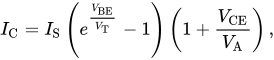
where IS is the reverse saturation current or scale current; VT, the thermal voltage; and VA, the Early voltage. This current is related to the reference current Iref when the output transistor VCB = 0 V by:
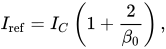
as found using Kirchhoff's current law at the collector node of Q1:

The reference current supplies the collector current to Q1 and the base currents to both transistors – when both transistors have zero base-collector bias, the two base currents are equal, IB1 = IB2 = IB.

Parameter β0 is the transistor β-value for VCB = 0 V.

Output resistance

[edit]

If VBC is greater than zero in output transistor Q2, the collector current in Q2 will be somewhat larger than for Q1 due to the Early effect. In other words, the mirror has a finite output (or Norton) resistance given by the ro of the output transistor, namely:
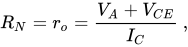
where VA is the Early voltage; and VCE, the collector-to-emitter voltage of output transistor.

Compliance voltage

[edit]

To keep the output transistor active, VCB ≥ 0 V. That means the lowest output voltage that results in correct mirror behavior, the compliance voltage, is VOUT = VCV = VBE under bias conditions with the output transistor at the output current level IC and with VCB = 0 V or, inverting the IV relation above:

where VT is the thermal voltage; and IS, the reverse saturation current or scale current.

Extensions and complications

[edit]

When Q2 has VCB > 0 V, the transistors no longer are matched. In particular, their β-values differ due to the Early effect, with
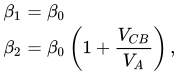
where VA is the Early voltage and β0 is the transistor β for VCB = 0 V. Besides the difference due to the Early effect, the transistor β-values will differ because the β0-values depend on current, and the two transistors now carry different currents (see Gummel–Poon model).

Further, Q2 may get substantially hotter than Q1 due to the associated higher power dissipation. To maintain matching, the temperature of the transistors must be nearly the same. In integrated circuits and transistor arrays where both transistors are on the same die, this is easy to achieve. But if the two transistors are widely separated, the precision of the current mirror is compromised.

Additional matched transistors can be connected to the same base and will supply the same collector current. In other words, the right half of the circuit can be duplicated several times. Note, however, that each additional right-half transistor "steals" a bit of collector current from Q1 due to the non-zero base currents of the right-half transistors. This will result in a small reduction in the programmed current.

See also an example of a mirror with emitter degeneration to increase mirror resistance.

For the simple mirror shown in the diagram, typical values of will yield a current match of 1% or better.

Figure 2: An n-channel MOSFET current mirror with a resistor to set the reference current IREF; VDD is positive voltage.

Basic MOSFET current mirror

[edit]

The basic current mirror can also be implemented using MOSFET transistors, as shown in Figure 2. Transistor M1 is operating in the saturation or active mode, and so is M2. In this setup, the output current IOUT is directly related to IREF, as discussed next.

The drain current of a MOSFET ID is a function of both the gate-source voltage and the drain-to-gate voltage of the MOSFET given by ID = f(VGS, VDG), a relationship derived from the functionality of the MOSFET device. In the case of transistor M1 of the mirror, ID = IREF. Reference current IREF is a known current, and can be provided by a resistor as shown, or by a "threshold-referenced" or "self-biased" current source to ensure that it is constant, independent of voltage supply variations.[1]

Using VDG = 0 for transistor M1, the drain current in M1 is ID = f(VGS, VDG=0), so we find: f(VGS, 0) = IREF, implicitly determining the value of VGS. Thus IREF sets the value of VGS. The circuit in the diagram forces the same VGS to apply to transistor M2. If M2 is also biased with zero VDG and provided transistors M1 and M2 have good matching of their properties, such as channel length, width, threshold voltage, etc., the relationship IOUT = f(VGS, VDG = 0) applies, thus setting IOUT = IREF; that is, the output current is the same as the reference current when VDG = 0 for the output transistor, and both transistors are matched.

The drain-to-source voltage can be expressed as VDS = VDG + VGS. With this substitution, the Shichman–Hodges model provides an approximate form for function f(VGS, VDG):[2]

where is a technology-related constant associated with the transistor, W/L is the width to length ratio of the transistor, is the gate-source voltage, is the threshold voltage, λ is the channel length modulation constant, and is the drain-source voltage.

Output resistance

[edit]

Because of channel-length modulation, the mirror has a finite output (or Norton) resistance given by the ro of the output transistor, namely (see channel length modulation):

where λ = channel-length modulation parameter and VDS is the drain-to-source bias.

Compliance voltage

[edit]

To keep the output transistor resistance high, VDG ≥ 0 V.[nb 1] (see Baker).[3] That means the lowest output voltage that results in correct mirror behavior, the compliance voltage, is VOUT = VCV = VGS for the output transistor at the output current level with VDG = 0 V, or using the inverse of the f-function, f−1:

For the Shichman–Hodges model, f−1 is approximately a square-root function.

Extensions and reservations

[edit]

A useful feature of this mirror is the linear dependence of f upon device width W, a proportionality approximately satisfied even for models more accurate than the Shichman–Hodges model. Thus, by adjusting the ratio of widths of the two transistors, multiples of the reference current can be generated.

The Shichman–Hodges model[4] is accurate only for rather dated[when?] technology, although it often is used simply for convenience even today. Any quantitative design based upon new[when?] technology uses computer models for the devices that account for the changed current-voltage characteristics. Among the differences that must be accounted for in an accurate design is the failure of the square law in Vgs for voltage dependence and the very poor modeling of Vds drain voltage dependence provided by λVds. Another failure of the equations that proves very significant is the inaccurate dependence upon the channel length L. A significant source of L-dependence stems from λ, as noted by Gray and Meyer, who also note that λ usually must be taken from experimental data.[5]

Due to the wide variation of Vth even within a particular device number discrete versions are problematic. Although the variation can be somewhat compensated for by using a Source degenerate resistor its value becomes so large that the output resistance suffers (i.e. reduces). This variation relegates the MOSFET version to the IC/monolithic arena.

Feedback-assisted current mirror

[edit]
Figure 3: Gain-boosted current mirror with op-amp feedback to increase output resistance
MOSFET version of gain-boosted current mirror; M1 and M2 are in active mode, while M3 and M4 are in ohmic mode and act like resistors. The operational amplifier provides feedback that maintains a high output resistance.

Figure 3 shows a mirror using negative feedback to increase output resistance. Because of the op amp, these circuits are sometimes called gain-boosted current mirrors. Because they have relatively low compliance voltages, they also are called wide-swing current mirrors. A variety of circuits based upon this idea are in use,[6][7][8] particularly for MOSFET mirrors because MOSFETs have rather low intrinsic output resistance values. A MOSFET version of Figure 3 is shown in Figure 4, where MOSFETs M3 and M4 operate in ohmic mode to play the same role as emitter resistors RE in Figure 3, and MOSFETs M1 and M2 operate in active mode in the same roles as mirror transistors Q1 and Q2 in Figure 3. An explanation follows of how the circuit in Figure 3 works.

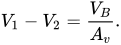
The operational amplifier is fed the difference in voltages V1V2 at the top of the two emitter-leg resistors of value RE. This difference is amplified by the op amp and fed to the base of output transistor Q2. If the collector base reverse bias on Q2 is increased by increasing the applied voltage VA, the current in Q2 increases, increasing V2 and decreasing the difference V1V2 entering the op amp. Consequently, the base voltage of Q2 is decreased, and VBE of Q2 decreases, counteracting the increase in output current.

If the op-amp gain Av is large, only a very small difference V1V2 is sufficient to generate the needed base voltage VB for Q2, namely
Consequently, the currents in the two leg resistors are held nearly the same, and the output current of the mirror is very nearly the same as the collector current IC1 in Q1, which in turn is set by the reference current as
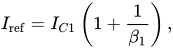
where β1 for transistor Q1 and β2 for Q2 differ due to the Early effect if the reverse bias across the collector-base of Q2 is non-zero.

Output resistance

[edit]
Figure 5: Small-signal circuit to determine output resistance of mirror; transistor Q2 is replaced with its hybrid-pi model; a test current IX at the output generates a voltage VX, and the output resistance is Rout = VX / IX.

An idealized treatment of output resistance is given in the footnote.[nb 2] A small-signal analysis for an op amp with finite gain Av but otherwise ideal is based upon Figure 5 (β, rO and rπ refer to Q2). To arrive at Figure 5, notice that the positive input of the op amp in Figure 3 is at AC ground, so the voltage input to the op amp is simply the AC emitter voltage Ve applied to its negative input, resulting in a voltage output of −Av Ve. Using Ohm's law across the input resistance rπ determines the small-signal base current Ib as:

Combining this result with Ohm's law for , can be eliminated, to find:[nb 3]

Kirchhoff's voltage law from the test source IX to the ground of RE provides:

Substituting for Ib and collecting terms the output resistance Rout is found to be:

For a large gain Avrπ / RE the maximum output resistance obtained with this circuit is

a substantial improvement over the basic mirror where Rout = rO.

The small-signal analysis of the MOSFET circuit of Figure 4 is obtained from the bipolar analysis by setting β = gm rπ in the formula for Rout and then letting rπ → ∞. The result is

This time, RE is the resistance of the source-leg MOSFETs M3, M4. Unlike Figure 3, however, as Av is increased (holding RE fixed in value), Rout continues to increase, and does not approach a limiting value at large Av.

Compliance voltage

[edit]

For Figure 3, a large op amp gain achieves the maximum Rout with only a small RE. A low value for RE means V2 also is small, allowing a low compliance voltage for this mirror, only a voltage V2 larger than the compliance voltage of the simple bipolar mirror. For this reason this type of mirror also is called a wide-swing current mirror, because it allows the output voltage to swing low compared to other types of mirror that achieve a large Rout only at the expense of large compliance voltages.

With the MOSFET circuit of Figure 4, like the circuit in Figure 3, the larger the op amp gain Av, the smaller RE can be made at a given Rout, and the lower the compliance voltage of the mirror.

Other current mirrors

[edit]

There are many sophisticated current mirrors that have higher output resistances than the basic mirror (more closely approach an ideal mirror with current output independent of output voltage) and produce currents less sensitive to temperature and device parameter variations and to circuit voltage fluctuations. These multi-transistor mirror circuits are used both with bipolar and MOS transistors. These circuits include:

Notes

[edit]

See also

[edit]

References

[edit]
[edit]
Revisions and contributorsEdit on WikipediaRead on Wikipedia
from Grokipedia
A current mirror is a fundamental analog circuit that replicates a reference input current to produce one or more output currents of equal or proportional magnitude, typically using matched bipolar junction transistors (BJTs) or metal-oxide-semiconductor field-effect transistors (MOSFETs) in integrated circuits. It operates on the principle that identical transistors sharing the same base-emitter voltage (for BJTs) or gate-source voltage (for MOSFETs) will conduct currents proportional to their device geometries when biased in their active or saturation regions. The reference transistor, often diode-connected, establishes the controlling voltage from the input current, which is then applied to the output transistor(s) to generate the mirrored current, enabling precise current sourcing or sinking with low input impedance and high output impedance. Current mirrors exist in various configurations to address non-idealities such as finite output resistance due to the Early effect in BJTs or channel-length modulation in MOSFETs. In BJT implementations, the simple current mirror uses two matched NPN transistors with connected bases and a diode-connected reference, yielding an output current IOUTIREF(12β)I_{OUT} \approx I_{REF} \left(1 - \frac{2}{\beta}\right), where β\beta is the current gain, though advanced variants like the Wilson or cascode mirrors improve accuracy and output resistance by minimizing voltage differences across the transistors. For MOSFETs, the basic mirror relies on the square-law characteristic ID=12μCoxWL(VGSVT)2I_D = \frac{1}{2} \mu C_{ox} \frac{W}{L} (V_{GS} - V_T)^2, with the output current scaled by width-to-length ratios, while cascode and low-swing cascode types enhance compliance voltage and matching for low-voltage applications. These circuits are indispensable in analog and mixed-signal integrated circuits for tasks like operational amplifiers, amplifiers, and differential pairs, as they provide stable current references insensitive to process, voltage, and variations when properly matched. Layout techniques such as common-centroid or interdigitated patterns minimize mismatch errors, achieving accuracies better than 1% in modern processes. Beyond traditional IC design, current mirrors find use in neuromorphic computing for synaptic emulation and in for current balancing.

Fundamentals

Basic Principle

A current mirror is an analog circuit block that produces an output current proportional to a reference input current, typically achieving a 1:1 ratio in its basic form. This functionality allows the circuit to replicate the input current at the output terminal, serving as a fundamental building block in analog designs for tasks such as current sourcing or sinking. The core mechanism relies on two or more matched transistors operating in the forward for BJTs or saturation region for MOSFETs, where the input branch sets the reference current to establish a shared voltage. The output transistor, biased by this same voltage, mirrors the current due to the identical characteristics of the matched devices, ensuring the output current closely follows the input under ideal conditions. In a simple schematic, the reference current passes through a , which generates the voltage at its or base; this voltage is directly coupled to the or base of the output , enabling it to conduct a corresponding current through its drain or collector. As a prerequisite for broader analog circuitry, current mirrors provide essential biasing and enable efficient amplification by distributing precise currents across multiple stages.

Ideal Characteristics

In an ideal current mirror, the current transfer ratio, defined as k=Iout/Iink = I_{out} / I_{in}, equals 1 for symmetrically matched transistors, ensuring exact replication of the input current at the output. For non-unity ratios, kk can be precisely set to n:mn:m by scaling the emitter areas in bipolar junction transistor (BJT) implementations or the width-to-length (W/L) ratios in metal-oxide-semiconductor field-effect transistor (MOSFET) designs, allowing controlled current multiplication or division. This ratio arises from the identical bias conditions imposed on matched devices, where the shared base-emitter voltage VBEV_{BE} for BJTs or gate-source voltage VGSV_{GS} for MOSFETs enforces equal collector or drain currents, respectively. The output resistance RoutR_{out} of an ideal current mirror approaches , implying that the output current remains completely independent of the load voltage variations across the operating range. This infinite RoutR_{out} eliminates any finite slope in the output current-voltage characteristic, providing a perfect behavior without degradation due to compliance voltage changes. The compliance voltage range in an ideal mirror spans from the minimum voltage required to maintain the forward for BJTs (approximately VBEV_{BE}) or the saturation region for MOSFETs (VGSVthV_{GS} - V_{th}, the overdrive voltage)—up to the , allowing linear operation over an unlimited practical range without current distortion. The fundamental equation for an ideal 1:1 current mirror is Iout=IinI_{out} = I_{in}, derived from the current equations under matched conditions: for BJTs, IC=ISexp(VBE/VT)I_C = I_S \exp(V_{BE}/V_T) ensures equal currents with equal VBEV_{BE}; for MOSFETs in saturation, ID=12μCox(W/L)(VGSVth)2I_D = \frac{1}{2} \mu C_{ox} (W/L) (V_{GS} - V_{th})^2 yields the same result with equal VGSV_{GS}. Theoretically, these characteristics enable precise current replication, facilitating stable in analog circuits without dependence on supply or load voltage fluctuations, thus serving as an ideal building block for differential amplifiers and active loads.

Non-Ideal Behaviors

Practical Approximations

In practical current mirrors, the assumption of infinite output resistance from ideal models is relaxed due to finite output resistance arising from the in bipolar junction transistors or channel-length modulation in metal-oxide-semiconductor field-effect transistors, which causes the output current to vary slightly with changes in the output voltage. This non-ideality results in a model where the output resistance is on the order of tens to hundreds of kΩ, depending on the device parameters and bias conditions. A common approximation for the output current accounts for this voltage dependence symbolically as IoutIin(1+VoutVinVA)I_\text{out} \approx I_\text{in} \left(1 + \frac{V_\text{out} - V_\text{in}}{V_A}\right), where VAV_A represents the Early voltage (or its MOSFET analog, 1/λ1/\lambda). This model highlights how deviations from equal collector-emitter or drain-source voltages between mirror transistors lead to systematic current errors, typically less than 1-5% over the compliance range in well-designed circuits. Temperature variations further introduce non-idealities, as the base-emitter voltage VBEV_\text{BE} in BJTs or gate-source voltage VGSV_\text{GS} in MOSFETs decreases with increasing temperature (approximately -2 mV/°C for VBEV_\text{BE}), causing the mirrored current to decrease without compensation. Basic uncompensated mirrors exhibit a temperature coefficient of approximately 0.1%/°C, reflecting the combined effects of thermal voltage scaling and saturation current changes. To mitigate mismatch errors in integrated circuit implementations, layout techniques such as common-centroid patterns are employed, where matched transistors are arranged symmetrically around the of the layout to average out linear gradients in process parameters like or . This approach reduces systematic deviations to below 0.1% in precision designs by countering intra-die variations without altering the circuit topology. Current mirrors also impose bandwidth limitations, functioning as low-pass filters due to parasitic capacitances at the gates or bases interacting with the finite , yielding a gain-bandwidth product typically in the range of hundreds of MHz for sub-micron processes. This must be considered in high-speed applications to avoid signal , with the dominant pole determined by the output resistance and load .

Error Sources

In current mirrors, transistor mismatch arises from process variations during fabrication, leading to deviations in key parameters that cause systematic offsets between the reference and output currents. For bipolar junction transistors (BJTs), variations in the current gain β result from differences in base doping, emitter area, or geometry, typically introducing relative errors of 1-5% in integrated circuits. Similarly, in metal-oxide-semiconductor field-effect transistors (MOSFETs), mismatches in the transconductance parameter μC_ox (W/L) stem from fluctuations in oxide thickness, mobility, or channel dimensions, yielding comparable 1-5% errors in standard processes for typical device sizes. Supply voltage dependence introduces another error source, as fluctuations in V_DD directly impact the stability of the reference current, particularly when the reference branch relies on a resistive divider from the supply. For instance, if the reference current is generated as I_REF ≈ (V_DD - V_BE)/R for BJTs or (V_DD - V_GS)/R for MOSFETs, a 10% change in V_DD can propagate a similar variation to the output current unless buffered. This sensitivity, quantified as S = (V_DD / I_REF) · (dI_REF / dV_DD), ideally approaches zero but often reaches 0.1-1 in basic mirrors, degrading overall accuracy. Aging and reliability issues further degrade matching over time, especially in high-current applications. Electromigration in metal interconnects or contacts can alter resistance paths, causing gradual current drift in sustained high-current mirrors. In MOSFET-based mirrors, hot-carrier effects accelerate carrier injection into the , shifting and reducing mobility, which may cause output current variations of less than 1% after prolonged stress in studied configurations. Noise contributions from the reference branch also propagate to the output, limiting precision in low-current or high-sensitivity applications. noise, arising from random carrier motion, and flicker (1/f) noise, due to /detrapping at interfaces, generate current fluctuations that mirror directly to the output in well-matched pairs, with the total output approximately twice that of a single . The relative error due to mismatch can be quantified as δI/I ≈ σ_ΔV_BE / V_T, where σ_ΔV_BE is the standard deviation of the base-emitter voltage difference between paired transistors, reflecting the impact of process-induced variations on exponential current relationships in BJTs; similar approximations apply to threshold mismatches, with σ typically 1-5 mV leading to sub-percent errors in large-area devices. dependence exacerbates these effects but is often modeled within practical approximations for overall circuit .

BJT Implementations

Basic BJT Mirror

The basic BJT current mirror employs two matched NPN bipolar junction , Q1 and Q2, with their bases interconnected and emitters connected to ground. The input reference transistor Q1 is diode-connected by shorting its collector to its base, and the reference current IrefI_\text{ref} is injected into this collector-base node. The output current IoutI_\text{out} is sourced from the collector of Q2. The circuit operates by using IrefI_\text{ref} to forward-bias Q1, establishing a base-emitter voltage VBEV_\text{BE} that is shared with Q2 through the connection. This equal VBEV_\text{BE} causes Q2 to conduct a collector current approximately equal to IrefI_\text{ref}, thereby mirroring the current to the output. For matched transistors with high β\beta, IoutIrefI_\text{out} \approx I_\text{ref}. For identical transistors with finite β=βin=βout\beta = \beta_\text{in} = \beta_\text{out}, applying Kirchhoff's current law at the input node yields Iref=IC1+IB1+IB2I_\text{ref} = I_{C1} + I_{B1} + I_{B2}, where IC1=βIB1I_{C1} = \beta I_{B1} and Iout=βIB2I_\text{out} = \beta I_{B2}. Since the shared VBEV_\text{BE} implies IB1=IB2=IBI_{B1} = I_{B2} = I_B and IC1=IoutI_{C1} = I_\text{out}, substitution gives Iref=Iout(1+2β)I_\text{ref} = I_\text{out} \left(1 + \frac{2}{\beta}\right), so Iout=Iref1+2β.I_\text{out} = \frac{I_\text{ref}}{1 + \frac{2}{\beta}}. This equation accounts for base current diversion, with the approximation holding well when β2\beta \gg 2. The output transistor Q2 requires a minimum collector-emitter voltage to remain in the and avoid saturation, known as the compliance voltage, which equals the saturation voltage VCE(sat)0.2VV_\text{CE(sat)} \approx 0.2\,\text{V} for typical NPN BJTs at moderate currents. This simple two- topology is widely employed for current biasing in discrete circuits and integrated analog designs, such as differential amplifiers, where β>100\beta > 100 yields IoutI_\text{out} within approximately 2% of IrefI_\text{ref}.

BJT Mirror Enhancements

To improve the performance of the basic (BJT) current mirror beyond its limitations due to finite β effects, several enhancements address output resistance, compliance voltage, β mismatch, output swing, and linearity. These modifications leverage the current-driven nature of BJTs and their β dependence to achieve higher accuracy and robustness in analog circuits. The output resistance of the basic BJT current mirror, derived from the small-signal hybrid-π model, accounts for the shared base node between the reference and output transistors. With the input treated as an open circuit for small-signal analysis (fixed reference current), applying a test voltage vxv_x at the output collector yields an output current ixi_x influenced by the gmg_m, base-emitter resistance rπr_\pi, and output resistance ror_o of each transistor. The resulting expression simplifies to RoutroR_{out} \approx r_o, where ro=VA/ICr_o = V_A / I_C is the intrinsic output resistance of the output transistor, with VAV_A the Early voltage (typically 50-100 V for standard BJTs). Emitter degeneration resistors added to both the reference and output branches extend the compliance voltage, allowing the mirror to maintain accurate current replication over a wider range of output collector-emitter voltages VCEV_{CE}. In the degenerated configuration, equal resistors RER_E in each emitter create a IEREI_E R_E, shifting the base voltage to approximately VBE+IREFREV_{BE} + I_{REF} R_E. For the output to remain in the (avoiding saturation), VCE>VBE+IEREV_{CE} > V_{BE} + I_E R_E, where VBE0.7V_{BE} \approx 0.7 V and IEICI_E \approx I_C for high β. This raises the minimum headroom required but stabilizes operation against VCEV_{CE} variations by introducing local , with the output resistance further boosted to rOro(1+gmRE)β(ro+RE)r_O \approx r_o (1 + g_m R_E) \approx \beta (r_o + R_E) for large REreR_E \gg r_e (where re=VT/IE26r_e = V_T / I_E \approx 26 mΩ at ). Typical RER_E values of 100-500 Ω suffice for significant improvement in integrated circuits. To compensate for β mismatch between transistors, which causes systematic errors from unequal base currents diverting part of the reference current, a third transistor is added as a β helper or buffer. This auxiliary NPN , configured as an emitter follower with its base connected to the shared base node, collector to the supply, and emitter supplying the bases of the mirror pair, amplifies the available base current by approximately β of the helper. The reference current now primarily sources the collectors of the mirror s, reducing the mirroring error from 2/(β+1)2 / (\beta + 1) in the basic circuit to negligible levels (e.g., <0.1% for β > 100). This technique requires additional headroom of about VBEV_{BE} for the helper but is widely used in precision analog ICs. High-swing versions of the BJT mirror employ buffering to lower the minimum output voltage VoutV_{out} to the transistor's saturation voltage VCE(sat)0.2V_{CE(sat)} \approx 0.2 V, enabling greater signal swing in low-voltage applications. In the buffered configuration, the third isolates the base node, preventing the output collector from pulling the bases into saturation prematurely. Without buffering, VoutV_{out} must exceed VBEV_{BE} to keep VCB>0V_{CB} > 0; the buffer decouples this, allowing VoutV_{out} to approach VCE(sat)V_{CE(sat)} while maintaining active-mode operation and current accuracy within 1%. This is particularly beneficial in op-amp output stages or data converters. For improved linearity in the degenerated mirror, the output current follows IoutIREF(Rsense/Rout)I_{out} \approx I_{REF} \cdot (R_{sense} / R_{out}), where RsenseR_{sense} is the degeneration in the reference branch and RoutR_{out} is that in the output branch (ideally equal for 1:1 ratio). This relation arises from the voltage drops enforcing VBE1+IREFRsense=VBE2+IoutRoutV_{BE1} + I_{REF} R_{sense} = V_{BE2} + I_{out} R_{out}, with VBEV_{BE} nearly equal for matched devices; unequal resistors enable precise ratios (e.g., for Widlar sources), while equal values minimize nonlinearity by desensitizing IoutI_{out} to VCEV_{CE} changes. Simulations show <0.5% deviation over a 5 V VCEV_{CE} range with RE=200R_E = 200 Ω at 1 mA.

MOSFET Implementations

Basic MOSFET Mirror

The basic current mirror consists of two enhancement-mode NMOS s, M1 and M2, with their gates connected together and sources grounded. The input M1 is diode-connected, meaning its drain is shorted to its gate, allowing a reference current IrefI_\text{ref} to flow through it and establish the gate-source voltage VGSV_\text{GS}. The output M2 has its drain serving as the output terminal, from which the mirrored current IoutI_\text{out} is sourced, while the shared VGSV_\text{GS} biases M2 to replicate the current behavior of M1. For proper operation, both transistors must be biased in the saturation region, where the drain-source voltage VDSV_\text{DS} satisfies VDSVGSVthV_\text{DS} \geq V_\text{GS} - V_\text{th} for each device, with VthV_\text{th} being the . The reference current through M1 follows the square-law model for saturation: Iref=12μnCox(WL)in(VGSVth)2,I_\text{ref} = \frac{1}{2} \mu_n C_\text{ox} \left( \frac{W}{L} \right)_\text{in} (V_\text{GS} - V_\text{th})^2, which sets VGSV_\text{GS} based on the applied IrefI_\text{ref}. This VGSV_\text{GS} is then applied to M2, yielding Iout=12μnCox(WL)out(VGSVth)2=Iref(W/L)out(W/L)in,I_\text{out} = \frac{1}{2} \mu_n C_\text{ox} \left( \frac{W}{L} \right)_\text{out} (V_\text{GS} - V_\text{th})^2 = I_\text{ref} \cdot \frac{(W/L)_\text{out}}{(W/L)_\text{in}}, assuming matched threshold voltages and process parameters between the transistors. Equivalently, defining the transconductance parameter k=12μnCox(W/L)k = \frac{1}{2} \mu_n C_\text{ox} (W/L) for each device (where μn\mu_n is electron mobility and CoxC_\text{ox} is gate oxide capacitance per unit area), the output current simplifies to Iout=Iref(kout/kin)I_\text{out} = I_\text{ref} \cdot (k_\text{out} / k_\text{in}). The minimum compliance voltage at the output, or the lowest VDS2V_\text{DS2} for which M2 remains in saturation, is the gate overdrive voltage VOV=VGSVthV_\text{OV} = V_\text{GS} - V_\text{th}, typically ranging from 0.1 V to 0.5 V depending on the bias current and device sizing. This low headroom makes the mirror suitable for low-voltage applications. In CMOS integrated circuits, the mirror's currents can be precisely scaled by adjusting the width-to-length (W/L) ratios of the transistors, enabling programmable reference currents without additional components and benefiting from on-chip matching for high accuracy.

MOSFET Mirror Enhancements

In MOSFET current mirrors, channel-length modulation introduces a non-ideality where the output current varies with the drain-to-source voltage, leading to finite output resistance. The output current can be expressed as Iout=Iref(1+λ(VoutVref))I_{out} = I_{ref} (1 + \lambda (V_{out} - V_{ref})), where λ\lambda is the channel-length modulation parameter, typically ranging from 0.01 to 0.1 V1^{-1} depending on the technology node and bias conditions. This effect results in an output resistance approximated by Rout=1λIoutR_{out} = \frac{1}{\lambda I_{out}}, which enhances the mirror's performance in gain stages but requires compensation in precision applications to maintain current accuracy across varying output voltages. The body effect further degrades matching in mirrors by altering the VthV_{th} when the source-to-body voltage VSBV_{SB} differs from zero, particularly in n-channel devices where the body is tied to the substrate. To compensate, source followers can be employed to buffer the source potentials and minimize VthV_{th} variations, ensuring more uniform gate-to-source voltages across mirrored transistors. Alternatively, in processes supporting isolated wells (such as twin-tub ), connecting the body terminal directly to the source eliminates the body effect, reducing VthV_{th} sensitivity to source voltage changes and improving mirror accuracy in integrated circuits. For low-voltage designs, improving output compliance—the minimum VDSV_{DS} for which the mirror maintains accuracy—is critical to avoid saturation region violations. Level-shifting the gates of output transistors allows the minimum VDSV_{DS} to approach the overdrive voltage VovV_{ov}, enabling operation near 0 V while preserving current fidelity, which is essential for supply voltages below 1 V in modern nanoscale processes. Device mismatch due to process variations limits the precision of MOSFET mirrors, with threshold voltage mismatch following Pelgrom's law: the standard deviation σΔVth1WL\sigma_{\Delta V_{th}} \propto \frac{1}{\sqrt{W L}}
Add your contribution
Related Hubs
User Avatar
No comments yet.