Hubbry Logo
Cyclohexane conformationCyclohexane conformationMain
Open search
Cyclohexane conformation
Community hub
Cyclohexane conformation
logo
8 pages, 0 posts
0 subscribers
Be the first to start a discussion here.
Cyclohexane conformation
from Wikipedia
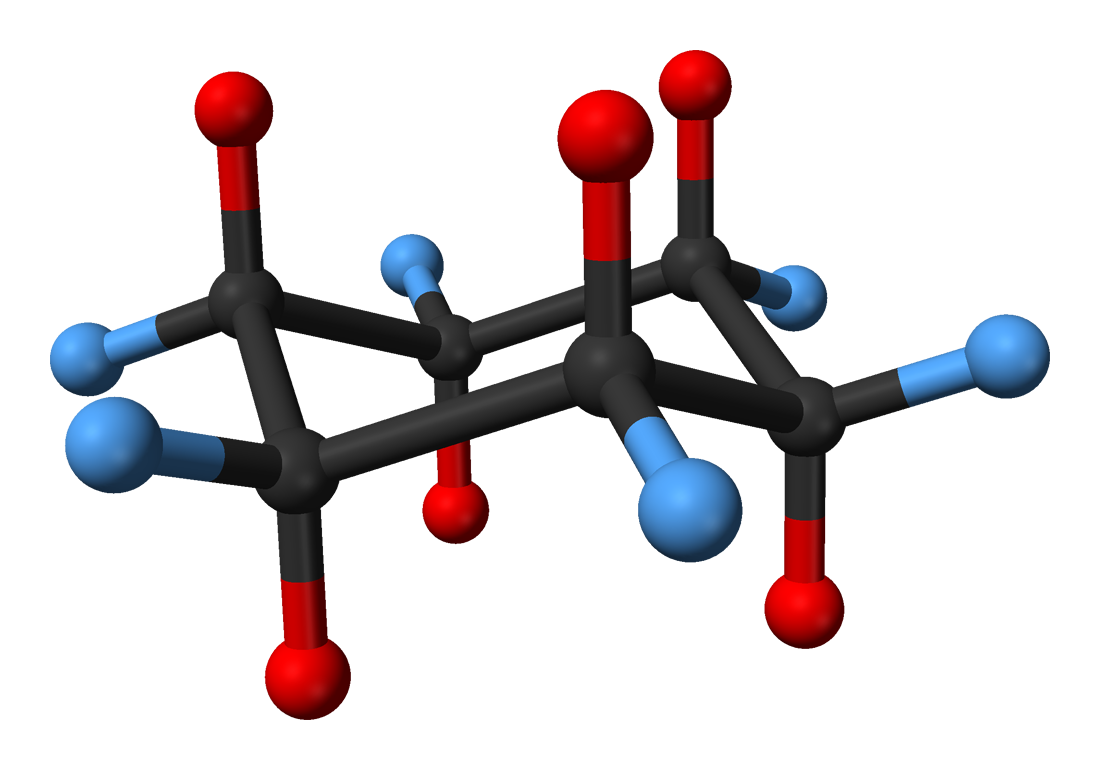
A cyclohexane molecule in chair conformation. Hydrogen atoms in axial positions are shown in red, while those in equatorial positions are in blue.

Cyclohexane conformations are any of several three-dimensional shapes adopted by cyclohexane. Because many compounds feature structurally similar six-membered rings, the structure and dynamics of cyclohexane are important prototypes of a wide range of compounds.[1][2]

The internal angles of a regular, flat hexagon are 120°, while the preferred angle between successive bonds in a carbon chain is about 109.5°, the tetrahedral angle (the arc cosine of −1/3). Therefore, the cyclohexane ring tends to assume non-planar (warped) conformations, which have all angles closer to 109.5° and therefore a lower strain energy than the flat hexagonal shape.

Consider the carbon atoms numbered from 1 to 6 around the ring. If we hold carbon atoms 1, 2, and 3 stationary, with the correct bond lengths and the tetrahedral angle between the two bonds, and then continue by adding carbon atoms 4, 5, and 6 with the correct bond length and the tetrahedral angle, we can vary the three dihedral angles for the sequences (1,2,3,4), (2,3,4,5), and (3,4,5,6). The next bond, from atom 6, is also oriented by a dihedral angle, so we have four degrees of freedom. But that last bond has to end at the position of atom 1, which imposes three conditions in three-dimensional space. If the bond angle in the chain (6,1,2) should also be the tetrahedral angle then we have four conditions. Normally this would mean that there are no degrees of freedom of conformation, giving a finite number of solutions. With atoms 1, 2, and 3 fixed, there are two solutions, called chair (depending on whether the dihedral angle for (1,2,3,4) is positive or negative), but it turns out that there is also a continuum of solutions, a topological circle where angle strain is zero, including the twist boat and the boat conformations. All the conformations on this continuum have a twofold axis of symmetry running through the ring, whereas the chair conformations do not (they have D3d symmetry, with a threefold axis running through the ring). It is because of the symmetry of the conformations on this continuum that it is possible to satisfy all four constraints with a range of dihedral angles at (1,2,3,4). On this continuum the energy varies because of Pitzer strain related to the dihedral angles. The twist-boat has a lower energy than the boat. In order to go from the chair conformation to a twist-boat conformation or the other chair conformation, bond angles have to be changed, leading to a high-energy half-chair conformation. So the relative energies are: chair < twist-boat < boat < half-chair with chair being the most stable and half-chair the least. All relative conformational energies are shown below.[3][4] At room temperature the molecule can easily move among these conformations, but only chair and twist-boat can be isolated in pure form, because the others are not at local energy minima.

The boat and twist-boat conformations, as said, lie along a continuum of zero angle strain. If there are substituents that allow the different carbon atoms to be distinguished, then this continuum is like a circle with six boat conformations and six twist-boat conformations between them, three "right-handed" and three "left-handed". (Which should be called right-handed is unimportant.) But if the carbon atoms are indistinguishable, as in cyclohexane itself, then moving along the continuum takes the molecule from the boat form to a "right-handed" twist-boat, and then back to the same boat form (with a permutation of the carbon atoms), then to a "left-handed" twist-boat, and then back again to the achiral boat. The passage from boat → right-twist-boat → boat → left-twist-boat → boat constitutes a full pseudorotation.

Coplanar carbons

[edit]

Another way to compare the stability within two molecules of cyclohexane in the same conformation is to evaluate the number of coplanar carbons in each molecule.[4] Coplanar carbons are carbons that are all on the same plane. Increasing the number of coplanar carbons increases the number of eclipsing substituents.[5] This increases the overall torsional strain and decreases the stability of the conformation. Cyclohexane diminishes the torsional strain from eclipsing substituents through adopting a conformation with fewer coplanar carbons.[6] For example, if a half-chair conformation contains four coplanar carbons and another half-chair conformation contains five coplanar carbons, the conformation with four coplanar carbons will be more stable.[4]

Principal conformers

[edit]

The different conformations are called "conformers", a blend of the words "conformation" and "isomer".

Chair conformation

[edit]

The chair conformation is the most stable conformer. At 298 K (25 °C), 99.99% of all molecules in a cyclohexane solution adopt this conformation.

Chair comformation of methylcyclohexane with ring flip

The C–C ring of the chair conformation has the same shape as the 6-membered rings in the diamond cubic lattice.[7]: 16  This can be modeled as follows. Consider a carbon atom to be a point with four half-bonds sticking out towards the vertices of a tetrahedron. Place it on a flat surface with one half-bond pointing straight up. Looking from directly above, the other three half-bonds will appear to point outwards towards the vertices of an equilateral triangle, so the bonds will appear to have an angle of 120° between them. Arrange six such atoms above the surface so that these 120° angles form a regular hexagon. Reflecting three of the atoms to be below the surface yields the desired geometry.

All carbon centers are equivalent. They alternate between two parallel planes, one containing C1, C3 and C5, and the other containing C2, C4, and C6. The chair conformation is left unchanged after a rotation of 120° about the symmetry axis perpendicular to these planes, as well as after a rotation of 60° followed by a reflection in the midpoint plane, resulting in a symmetry group of D3d. While all C–C bonds are tilted relative to the plane, diametrically opposite bonds (such as C1–C2 and C4–C5) are parallel to each other.

Six of the twelve C–H bonds are axial, pointing upwards or downwards almost parallel to the symmetry axis. The other six C–H bonds are equatorial, oriented radially outwards with an upwards or downwards tilt. Each carbon center has one axial C–H bond (pointed alternately upwards or downwards) and one equatorial C–H bond (tilted alternately downwards or upwards), enabling each X–C–C–Y unit to adopt a staggered conformation with minimal torsional strain. In this model, the dihedral angles for series of four carbon atoms going around the ring alternate between exactly +60° (gauche+) and −60° (gauche).[7]: 10 

The chair conformation cannot be deformed without changing bond angles or lengths. It can be represented as two linked chains, C1–C2–C3–C4 and C1–C6–C5–C4, each mirroring the other, with opposite dihedral angles. The C1–C4 distance depends on the absolute value of this dihedral angle, so in a rigid model, changing one angle requires changing the other angle. If both dihedral angles change while remaining opposites of each other, it is not possible to maintain the correct C–C–C bond angles at C1 and C4.

The chair geometry is often preserved when the hydrogen atoms are replaced by halogens or other simple groups. However, when these hydrogens are substituted for a larger group, additional strain may occur due to diaxial interactions between pairs of substituents occupying the same-orientation axial position, which are typically repulsive due to steric crowding.[8]

Boat and twist-boat conformations

[edit]

The boat conformations have higher energy than the chair conformations. The interaction between the two flagpole hydrogens, in particular, generates steric strain. Torsional strain also exists between the C2–C3 and C5–C6 bonds (carbon number 1 is one of the two on a mirror plane), which are eclipsed — that is, these two bonds are parallel one to the other across a mirror plane. Because of this strain, the boat configuration is unstable (i.e. is not a local energy minimum).

The molecular symmetry is C2v.

The boat conformations spontaneously distorts to twist-boat conformations. Here the symmetry is D2, a purely rotational point group with three twofold axes. This conformation can be derived from the boat conformation by applying a slight twist to the molecule so as to remove eclipsing of two pairs of methylene groups. The twist-boat conformation is chiral, existing in right-handed and left-handed versions. The xyz positions of the carbon atoms for one of the two enantiomers of the twist-boat giving bond lengths of 1 and tetrahedral bond angles are: In this model, the dihedral angles for the chains 1-2-3-4 and 4-5-6-1 are approximately +70.64°, and for the other four −33.16°, and are the opposites for the other enantiomer. This is a slightly twisted version of a boat conformation:

It is also a twisted version (twisting the opposite way) of the boat obtained by negating the y and z coordinates of the above.

The concentration of the twist-boat conformation at room temperature is less than 0.1%, but at 1,073 K (800 °C) it can reach 30%. Rapid cooling of a sample of cyclohexane from 1,073 K (800 °C) to 40 K (−233 °C) will freeze in a large concentration of twist-boat conformation, which will then slowly convert to the chair conformation upon heating.[9]

Half-chair conformation

[edit]

The half-chair conformation of cyclohexane is an intermediate stage in the "ring flip" between two chair conformations. It's a high-energy state due to torsional and angle strain, making it less stable than both the chair and boat conformations.

Dynamics

[edit]

Chair to chair

[edit]
Cyclohexane chair flip (ring inversion) reaction via boat conformation 4. Structures of the significant conformations are shown: chair 1, half-chair 2, twist-boat 3 and boat 4. When ring flip happens completely from chair to chair, hydrogens that were previously axial (blue H in upper-left structure) turn equatorial and equatorial ones (red H in upper-left structure) turn axial.[3] It is not necessary to go through the boat form.

The interconversion of chair conformers is called ring flipping or chair-flipping. Carbon–hydrogen bonds that are axial in one configuration become equatorial in the other, and vice versa. At room temperature the two chair conformations rapidly equilibrate. The proton NMR spectrum of cyclohexane is a singlet at room temperature, with no separation into separate signals for axial and equatorial hydrogens.

In one chair form, the dihedral angle of the chain of carbon atoms (1,2,3,4) is positive whereas that of the chain (1,6,5,4) is negative, but in the other chair form, the situation is the opposite. So both these chains have to undergo a reversal of dihedral angle. When one of these two four-atom chains flattens to a dihedral angle of zero, we have the half-chair conformation, at a maximum energy along the conversion path. When the dihedral angle of this chain then becomes equal (in sign as well as magnitude) to that of the other four-atom chain, the molecule has reached the continuum of conformations, including the twist boat and the boat, where the bond angles and lengths can all be at their normal values and the energy is therefore relatively low. After that, the other four-carbon chain has to switch the sign of its dihedral angle in order to attain the target chair form, so again the molecule has to pass through the half-chair as the dihedral angle of this chain goes through zero. Switching the signs of the two chains sequentially in this way minimizes the maximum energy state along the way (at the half-chair state) — having the dihedral angles of both four-atom chains switch sign simultaneously would mean going through a conformation of even higher energy due to angle strain at carbons 1 and 4.

The detailed mechanism of the chair-to-chair interconversion has been the subject of much study and debate.[10] The half-chair state (D, in figure below) is the key transition state in the interconversion between the chair and twist-boat conformations. The half-chair has C2 symmetry. The interconversion between the two chair conformations involves the following sequence: chair → half-chair → twist-boat → half-chair′ → chair′.

Twist-boat to twist-boat

[edit]

The boat conformation (C, below) is a transition state, allowing the interconversion between two different twist-boat conformations. While the boat conformation is not necessary for interconversion between the two chair conformations of cyclohexane, it is often included in the reaction coordinate diagram used to describe this interconversion because its energy is considerably lower than that of the half-chair, so any molecule with enough energy to go from twist-boat to chair also has enough energy to go from twist-boat to boat. Thus, there are multiple pathways by which a molecule of cyclohexane in the twist-boat conformation can achieve the chair conformation again.

Conformations: chair (A), twist-boat (B), boat (C) and half-chair (D). Energies are 43 kJ/mol (10 kcal/mol), 25 kJ/mol (6 kcal/mol) and 21 kJ/mol (5 kcal/mol).[3]

Substituted derivatives

[edit]
The conformer of methylcyclohexane with equatorial methyl is favored by 1.74 kcal/mol (7.3 kJ/mol) relative to the conformer where methyl is axial.

In cyclohexane, the two chair conformations have the same energy. The situation becomes more complex with substituted derivatives.

Monosubstituted cyclohexanes

[edit]

A monosubstituted cyclohexane is one in which there is one non-hydrogen substituent in the cyclohexane ring. The most energetically favorable conformation for a monosubstituted cyclohexane is the chair conformation with the non-hydrogen substituent in the equatorial position because it prevents high steric strain from 1,3 diaxial interactions.[11] In methylcyclohexane the two chair conformers are not isoenergetic. The methyl group prefers the equatorial orientation. The preference of a substituent towards the equatorial conformation is measured in terms of its A value, which is the Gibbs free energy difference between the two chair conformations. A positive A value indicates preference towards the equatorial position. The magnitude of the A values ranges from nearly zero for very small substituents such as deuterium, to about 5 kcal/mol (21 kJ/mol) for very bulky substituents such as the tert-butyl group. Thus, the magnitude of the A value will also correspond to the preference for the equatorial position. Though an equatorial substituent has no 1,3 diaxial interaction that causes steric strain, it has a Gauche interaction in which an equatorial substituent repels the electron density from a neighboring equatorial substituent.[11]

Disubstituted cyclohexanes

[edit]

For 1,2- and 1,4-disubstituted cyclohexanes, a cis configuration leads to one axial and one equatorial group. Such species undergo rapid, degenerate chair flipping. For 1,2- and 1,4-disubstituted cyclohexane, a trans configuration, the diaxial conformation is effectively prevented by its high steric strain. For 1,3-disubstituted cyclohexanes, the cis form is diequatorial and the flipped conformation suffers additional steric interaction between the two axial groups. trans-1,3-Disubstituted cyclohexanes are like cis-1,2- and cis-1,4- and can flip between the two equivalent axial/equatorial forms.[2]

Cis-1,4-Di-tert-butylcyclohexane has an axial tert-butyl group in the chair conformation and conversion to the twist-boat conformation places both groups in more favorable equatorial positions. As a result, the twist-boat conformation is more stable by 0.47 kJ/mol (0.11 kcal/mol) at 125 K (−148 °C) as measured by NMR spectroscopy.[10]

Also, for a disubstituted cyclohexane, as well as more highly substituted molecules, the aforementioned A values are additive for each substituent. For example, if calculating the A value of a dimethylcyclohexane, any methyl group in the axial position contributes 1.70 kcal/mol- this number is specific to methyl groups and is different for each possible substituent. Therefore, the overall A value for the molecule is 1.70 kcal/mol per methyl group in the axial position.[12]

1,3 diaxial interactions and gauche interactions

[edit]

1,3 Diaxial interactions occur when the non-hydrogen substituent on a cyclohexane occupies the axial position. This axial substituent is in the eclipsed position with the axial substituents on the 3-carbons relative to itself (there will be two such carbons and thus two 1,3 diaxial interactions). This eclipsed position increases the steric strain on the cyclohexane conformation and the confirmation will shift towards a more energetically favorable equilibrium.[13]

Gauche interactions occur when a non-hydrogen substituent on a cyclohexane occupies the equatorial position. The equatorial substituent is in a staggered position with the 2-carbons relative to itself (there will be two such carbons and thus two 1,2 gauche interactions). This creates a dihedral angle of ~60°.[14] This staggered position is generally preferred to the eclipsed positioning.

Effects of substituent size on stability

[edit]

Once again, the conformation and position of groups (ie. substituents) larger than a singular hydrogen are critical to the overall stability of the molecule. The larger the group, the less likely to prefer the axial position on its respective carbon. Maintaining said position with a larger size costs more energy from the molecule as a whole because of steric repulsion between the large groups' nonbonded electron pairs and the electrons of the smaller groups (ie. hydrogens). Such steric repulsions are absent for equatorial groups. The cyclohexane model thus assesses steric size of functional groups on the basis of gauche interactions.[15] The gauche interaction will increase in energy as the size of the substituent involved increases. For example, a t-butyl substituent would sustain a higher energy gauche interaction as compared to a methyl group, and therefore, contribute more to the instability of the molecule as a whole.

In comparison, a staggered conformation is thus preferred; the larger groups would maintain the equatorial position and lower the energy of the entire molecule. This preference for the equatorial position among bulkier groups lowers the energy barriers between different conformations of the ring. When the molecule is activated, there will be a loss in entropy due to the stability of the larger substituents. Therefore, the preference of the equatorial positions by large molecules (such as a methyl group) inhibits the reactivity of the molecule and thus makes the molecule more stable as a whole.[16]

Effects on conformational equilibrium

[edit]

Conformational equilibrium is the tendency to favor the conformation where cyclohexane is the most stable. This equilibrium depends on the interactions between the molecules in the compound and the solvent. Polarity and nonpolarity are the main factors in determining how well a solvent interacts with a compound. Cyclohexane is considered nonpolar, meaning that there is no electronegative difference between its bonds and its overall structure is symmetrical. Due to this, when cyclohexane is immersed in a polar solvent, it will have less solvent distribution, which signifies a poor interaction between the solvent and solute. This produces a limited catalytic effect.[17] Moreover, when cyclohexane comes into contact with a nonpolar solvent, the solvent distribution is much greater, showing a strong interaction between the solvent and solute. This strong interaction yields a heighten catalytic effect.

Heterocyclic analogs

[edit]

Heterocyclic analogs of cyclohexane are pervasive in sugars, piperidines, dioxanes, etc. They exist generally follow the trends seen for cyclohexane, i.e. the chair conformer being most stable. The axial–equatorial equilibria (A values) are however strongly affected by the replacement of a methylene by O or NH. Illustrative are the conformations of the glucosides.[2] 1,2,4,5-Tetrathiane ((CH2S2)2) lacks the unfavorable 1,3-diaxial interactions of cyclohexane. Consequently its twist-boat conformation is populated; in the corresponding tetramethyl structure, 3,3,6,6-tetramethyl-1,2,4,5-tetrathiane, the twist-boat conformation dominates.[18]

Historical background

[edit]

In 1890, Hermann Sachse [de], a 28-year-old assistant in Berlin, published instructions for folding a piece of paper to represent two forms of cyclohexane he called symmetrical and asymmetrical (what we would now call chair and boat). He clearly understood that these forms had two positions for the hydrogen atoms (again, to use modern terminology, axial and equatorial), that two chairs would probably interconvert, and even how certain substituents might favor one of the chair forms (Sachse–Mohr theory [de]). Because he expressed all this in mathematical language, few chemists of the time understood his arguments. He had several attempts at publishing these ideas, but none succeeded in capturing the imagination of chemists. His death in 1893 at the age of 31 meant his ideas sank into obscurity. It was only in 1918 that Ernst Mohr [de], based on the molecular structure of diamond that had recently been solved using the then very new technique of X-ray crystallography,[19][20] was able to successfully argue that Sachse's chair was the pivotal motif.[21][22][23][24][25][26] Derek Barton and Odd Hassel shared the 1969 Nobel Prize in Chemistry for work on the conformations of cyclohexane and various other molecules.

Practical applications

[edit]

Cyclohexane is the most stable of the cycloalkanes, due to the stability of adapting to its chair conformer.[4] This conformer stability allows cyclohexane to be used as a standard in lab analyses. More specifically, cyclohexane is used as a standard for pharmaceutical reference in solvent analysis of pharmaceutical compounds and raw materials. This specific standard signifies that cyclohexane is used in quality analysis of food and beverages, pharmaceutical release testing, and pharmaceutical method development;[27] these various methods test for purity, biosafety, and bioavailability of products.[28] The stability of the chair conformer of cyclohexane gives the cycloalkane a versatile and important application when regarding the safety and properties of pharmaceuticals.

References

[edit]

Further reading

[edit]
[edit]
Revisions and contributorsEdit on WikipediaRead on Wikipedia
from Grokipedia
Cyclohexane conformation encompasses the dynamic spatial arrangements adopted by the molecule (C₆H₁₂), a saturated six-membered ring, to minimize energetic strain inherent in cyclic structures. Unlike smaller cycloalkanes, avoids significant and torsional strain by assuming non-planar, puckered forms rather than a flat . The predominant and most stable conformation is the chair form, where all carbon-carbon bonds are staggered, bond s approximate the ideal tetrahedral value of 109.5°, and atoms are fully eclipsed-free, resulting in zero net . Less stable conformations include the boat and twist-boat forms, which serve as intermediates or transition states during ring inversion. The boat conformation features four pairs of eclipsed C–H bonds and additional steric repulsion from "flagpole" hydrogens, elevating its energy to approximately 6.5 kcal/mol above the chair. The twist-boat, a slightly distorted variant, alleviates some of this torsional and transannular strain, with an energy of about 5.5 kcal/mol relative to the chair, making it a local minimum but still far less populated at room temperature. These energy differences arise from ab initio computational analyses and underpin the rapid interconversion between equivalent chair forms via a pseudorotation pathway, occurring on the microsecond timescale with a rate constant of about 10^5 s^{-1} at room temperature. The understanding of cyclohexane conformations originated from early 20th-century structural studies, with Norwegian chemist Odd Hassel using to confirm the chair preference in the 1940s, building on Adolf von Baeyer's 19th-century planar model that overestimated . British chemist extended this in the 1950s by applying conformational principles to predict reactivity in complex molecules like steroids, distinguishing axial (perpendicular to the ring plane) and equatorial (roughly parallel) substituent positions in the , where equatorial orientations minimize steric interactions and thus dominate stability. Their foundational work earned the 1969 and established conformational analysis as a cornerstone of organic stereochemistry, influencing predictions of molecular behavior in rings and beyond.

Fundamentals of Cyclohexane

Molecular Structure and Bonding

has the molecular formula C₆H₁₂ and consists of a six-membered ring composed entirely of carbon atoms, each bonded to two hydrogen atoms. All six carbon atoms in the ring are sp³ hybridized, forming a saturated with no multiple bonds. The carbon-carbon (C-C) bond lengths in are approximately 1.54 Å, consistent with single bonds between sp³-hybridized carbons in alkanes. The ideal bond angle for sp³-hybridized carbons is 109.5°, but in the cyclic structure, these angles experience distortion due to the constraints of the ring framework. The bonding in is characterized by a (σ) framework, where all C-C and C-H bonds are formed by the overlap of sp³ hybrid orbitals, resulting in a tetrahedral local around each carbon. Torsional strain arises within this framework from the eclipsing of bonds on adjacent carbons, contributing to the energetic preferences in ring conformations. To visualize the ring structure, is often represented using Newman projections, which depict the molecule by looking along a C-C bond to show the relative positions of substituents, or sawhorse models, which provide a three-dimensional perspective of the carbon skeleton and attached hydrogens. These representations highlight the potential for torsional and angle strain, which drive conformational flexibility in the ring.

Strain and Flexibility in Rings

In cyclic hydrocarbons, ring strain manifests in three primary forms: angle strain, torsional strain, and steric strain. Angle strain results from the deviation of internal bond angles from the ideal tetrahedral value of 109.5° associated with sp³-hybridized carbon atoms. In smaller rings, this deviation is pronounced; for instance, cyclopropane enforces C-C-C bond angles of 60°, leading to significant angle strain that destabilizes the molecule./Alkanes/Properties_of_Alkanes/Cycloalkanes/Ring_Strain_and_the_Structure_of_Cycloalkanes) Torsional strain arises in planar or nearly planar rings due to eclipsing interactions between adjacent bonds, which prevent the preferred staggered conformation and increase electron repulsion. Steric strain occurs from close non-bonded contacts between hydrogen atoms or other groups, exacerbating the overall energy penalty in constrained geometries. These strain types combine to elevate the total ring strain energy, particularly in rings smaller than six members. Quantitative measures of total strain energy highlight the relative stabilities of cycloalkanes. Cyclopentane exhibits a strain energy of about 6.5 kcal/mol, primarily from torsional contributions in its puckered envelope conformation. In contrast, cyclohexane possesses negligible strain energy, approximately 0 kcal/mol, positioning it as the archetypal strain-free cyclic hydrocarbon. To alleviate torsional and angle strains, six-membered rings like employ puckering or non-planar distortions, which enable staggered bond arrangements while maintaining bond angles close to 109.5°. This flexibility allows to achieve minimal overall strain, underscoring its conformational adaptability compared to more rigid smaller rings.

Principal Conformations of Cyclohexane

Chair Conformation

The chair conformation of cyclohexane features a puckered ring structure in which the carbon-carbon bonds alternate between pointing upward and downward relative to a hypothetical plane through the ring, resulting in a three-dimensional shape that resembles a lounge chair. This arrangement allows all C-C-C bond angles to measure approximately 111.5°, which is very close to the ideal tetrahedral angle and minimizes angle strain. Furthermore, the bonds are fully staggered, eliminating torsional strain as there are no eclipsing interactions between adjacent C-H bonds. In this conformation, the twelve atoms are distinctly oriented: six axial hydrogens are aligned parallel to the ring's threefold axis (three pointing upward and three downward), while the six equatorial hydrogens extend roughly to this axis, lying near the ring's equatorial plane. This positioning arises from the chair's inherent , classified under the D3d , which includes a center of inversion, a principal C3 axis, and C2 axes, contributing to its overall stability. The conformation represents the global minimum for , with a relative of 0 kcal/mol compared to higher-energy forms, due to the effective relief of both angle and torsional strain through ring puckering. Although minor steric interactions, such as gauche butane-like overlaps and 1,3-diaxial contacts between hydrogens, are present, they are negligible and do not significantly elevate the . This strain-free profile was first elucidated through studies by Odd Hassel in the , establishing the as the predominant structure in the gas phase.

Boat and Twist-Boat Conformations

The boat conformation of features a structure where four adjacent carbon atoms lie in a plane, with the remaining two carbons elevated above and below this plane at the "bow" and "stern" positions. This arrangement results in significant steric repulsion between the flagpole hydrogens at the bow and , which are approximately 1.8 apart, contributing an estimated 2.7 kcal/mol to the overall . Additionally, the boat exhibits partial eclipsing along the C2–C3 and C5–C6 bonds, introducing torsional strain of about 3.7 kcal/mol, for a total energy approximately 6.5 kcal/mol higher than the chair conformation. The boat possesses C2v , reflecting its molecular plane and a C2 axis bisecting the ring. The twist-boat conformation arises as a of the , where the ring is twisted to alleviate the flagpole steric repulsion by increasing the distance between those hydrogens. This adjustment lowers the energy relative to the , positioning the twist-boat at about 5.5 kcal/mol above the , as determined by direct spectroscopic measurement of the free energy difference. Despite this relief, the twist-boat retains partial bond eclipsing, which sustains some torsional strain, though reduced compared to the . The twist-boat conformation is chiral, lacking a plane of symmetry and belonging to the D2 point group, and thus exists as a pair of enantiomers in right-handed and left-handed forms. At , the high energies of these conformers result in negligible populations: the boat is effectively 0%, while the twist-boat accounts for less than 1% of the equilibrium mixture.

Half-Chair Transition State

The half-chair conformation of is characterized by a in which four consecutive carbon atoms lie approximately in a plane, while the two adjacent carbons are displaced out of this plane in opposite directions—one above and one below—leading to partial eclipsing of bonds along the ring. This arrangement distorts the ideal tetrahedral angles and introduces torsional strain from the eclipsed interactions, distinguishing it from the staggered bonds in the more stable chair form. calculations confirm this structure with C1 symmetry, a puckering of about 0.57 , and dihedral angles such as approximately 35° and -12° around the ring. As a rather than an energy minimum, the half-chair lies approximately 10-12 kcal/mol above the conformation, representing the highest point on the during conformational interconversions. This elevated energy stems primarily from the eclipsing of vicinal hydrogens and angle deformations, making it unstable and short-lived. Computational studies, including those using MP2/6-31G* level, place its energy at around 12 kcal/mol relative to the chair, underscoring its role as a barrier rather than a populated . The half-chair plays a crucial role in the conformational pathways of , serving as the that links the to the and subsequent twist-boat forms during ring inversion. This intermediate facilitates the pseudorotation and overall chair-chair interconversion by allowing the ring to flex without breaking bonds. In the inversion process, the progresses from the through the half-chair to a twist-boat minimum before reaching the symmetric , enabling axial-equatorial exchanges. Spectroscopic evidence for the transient half-chair is derived from NMR studies of cyclohexane and its derivatives, where signal broadening and coalescence occur at low temperatures due to slowing of the inversion process through this high-energy state. For instance, variable-temperature ^1H NMR reveals the barrier height by monitoring the averaging of axial and equatorial protons, with coalescence temperatures indicating rates consistent with a 10.8 kcal/mol activation energy for passage via the half-chair. These observations confirm the half-chair's involvement without direct observation, as its lifetime is too brief for resolution.

Conformational Interconversions

Chair-Chair Inversion Mechanism

The chair-chair inversion mechanism in represents a dynamic that interconverts the two equivalent chair conformations of the , allowing for the exchange of axial and equatorial positions among all hydrogen atoms or substituents. This inversion occurs via a multistep pathway involving transitional forms, beginning with the distortion of the chair into a half-chair , where one carbon atom is elevated out of the ring plane while adjacent carbons adjust accordingly. From the half-chair, the ring progresses to a twist-boat local minimum, followed by a , then another twist-boat local minimum, before returning through a second half-chair to the inverted chair form. Central to this pathway is the involvement of twist-boat intermediates, which facilitate a pseudorotation—a continuous deformation of the ring without breaking bonds—that smooths the transition and avoids higher-energy barriers. During the full inversion, every axial position becomes equatorial, and vice versa, effectively inverting the of substituents around the ring while preserving their relative up or down orientation. This exchange is a direct consequence of the symmetric nature of the chair forms and the transitional geometries. The mechanism has been experimentally observed through low-temperature nuclear magnetic resonance (NMR) spectroscopy, where distinct signals for axial and equatorial protons are resolvable below approximately -60°C, indicating slowed inversion rates that allow the conformers to be distinguished on the NMR timescale. As temperature increases, these signals coalesce due to rapid interconversion, confirming the dynamic equilibrium between the chairs via the described pathway.

Boat-Twist-Boat Pseudorotation

The boat-twist-boat pseudorotation in refers to a concerted, vibration-like motion in which the two adjacent pseudoequatorial carbon atoms that are twisted relative to the plane of the ring migrate continuously around the six-membered ring, interconverting equivalent twist-boat forms without passing through a true intermediate as a stable minimum. This process was first conceptualized as part of the conformational flexibility in six-membered rings, where the ring adopts an infinite number of intermediate geometries along a pseudorotational pathway defined by a phase angle varying from 0° to 360°. The pseudorotation preserves the C2 symmetry inherent to the twist-boat geometry, ensuring that all twist-boat conformers are identical in energy and structure, with no distinct "starting" or "ending" position distinguishable on the ring. In the twist-boat conformation, which features a puckering Q ≈ 0.737 and relieves some of the torsional and steric strain present in the boat form, this migration of twist sites occurs seamlessly. The energy barrier opposing this pseudorotation is notably low at approximately 1.4 kcal/mol, as determined by calculations at the HF/VDZ+P level, allowing for extremely rapid interconversions even at with rates on the order of picoseconds. Theoretical estimates place this barrier in the range of 0.8–1.7 kcal/mol, confirming the fluxional nature of the twist-boat without significant energetic cost. In contrast to a literal ring , pseudorotation involves no net inversion or reorientation of substituents; positions that are pseudoaxial or pseudoequatorial in one twist-boat remain so throughout the cycle, distinguishing it as a pseudorotational rather than rotational process.

Energy Barriers and Rates

The for the –chair interconversion in is 10.8 kcal/mol, determined through low-temperature () spectroscopy by observing the coalescence of proton signals in deuterated . At 25 °C, this barrier corresponds to an interconversion rate of approximately 10^5 s^{-1}, allowing the two equivalent chair forms to equilibrate rapidly on the NMR timescale at . In contrast, the twist-boat conformation serves as a local minimum approximately 5.5 kcal/mol above the , with pseudorotation among equivalent twist-boat forms occurring over a low barrier of 1.3 kcal/mol, rendering this process significantly faster than inversion and facilitating rapid averaging of positions within the twist-boat manifold. The conformation, lying about 6.5 kcal/mol above the , represents a along the pseudorotation pathway, with the barrier for distortion from to adjacent twist-boat forms estimated at around 5 kcal/mol in early conformational analyses, though more recent computations refine this to lower values near 1.6 kcal/mol. These interconversion rates exhibit strong temperature dependence, governed by the k=Aexp(EaRT)k = A \exp\left(-\frac{E_a}{RT}\right), where kk is the rate constant, AA is the (typically 10^{12}–10^{13} s^{-1} for conformational processes), EaE_a is the , RR is the (1.987 cal mol^{-1} ^{-1}), and TT is the absolute temperature; consequently, a 10 °C rise can roughly double the chair inversion rate due to the exponential term. This temperature sensitivity enables experimental probing of barriers via variable-temperature NMR, where rates slow sufficiently at sub-ambient conditions to resolve conformational signals.

Substituted Cyclohexanes

Axial and Equatorial Substituents

In the chair conformation of , each of the six carbon atoms bears two substituents oriented in distinct directions: axial and equatorial positions. Axial bonds are oriented nearly parallel to the ring's axis of , extending vertically upward or downward; there are three axial hydrogens pointing up and three pointing down, alternating around the ring. Equatorial bonds, in contrast, are directed outward at an angle, roughly in the plane of the ring, with a slight tilt to accommodate the tetrahedral . These positions interconvert rapidly through chair inversion, a process with an energy barrier of approximately 45 kJ/mol that occurs on the timescale (rate constant ≈ 10^5 s^{-1}) at , rendering all twelve atoms equivalent on average in unsubstituted —each spending half its time in an axial position and half in an equatorial one. Structural studies reveal subtle differences in bond lengths between these positions. The equilibrium axial C-H bond length is 1.098 ± 0.001 Å, slightly longer than the equatorial C-H bond length of 1.093 ± 0.001 Å, as determined by femtosecond rotational coherence spectroscopy combined with calculations. To visualize these orientations, the chair conformation is commonly represented using a flat hexagonal drawing where axial bonds are depicted as vertical lines (up or down) and equatorial bonds as angled lines slanting outward from the hexagon's edges; alternatively, three-dimensional wedge-dash notation emphasizes the spatial arrangement, with solid wedges for bonds coming out of the plane and dashed lines for those receding behind.

Monosubstituted Derivatives

In monosubstituted derivatives of , a single exhibits a strong preference for the equatorial position in the chair conformation, as the axial orientation incurs unfavorable steric strain from 1,3-diaxial interactions. This preference is quantified by the , defined as the free energy difference ΔG° between the axial and equatorial conformers (with the axial being higher in energy). For , the is 1.74 kcal/mol, resulting in an equilibrium of approximately 95% equatorial conformer at 25°C. The conformational equilibrium is governed by the equation K=[equatorial][axial]=eΔG/RTK = \frac{[\text{equatorial}]}{[\text{axial}]} = e^{-\Delta G^\circ / RT} where KK is the , RR is the (0.001987 kcal/mol·K), and TT is the absolute temperature. This relation, derived from the , directly links the to the conformer ratio and was used to determine preferences via low-temperature NMR spectroscopy. Representative A-values for other common substituents include 0.87 kcal/mol for the hydroxyl group (-OH) and 0.43 kcal/mol for the chloro group (-Cl), indicating progressively weaker equatorial biases compared to methyl but still favoring the equatorial position in the . These values were obtained through integration of separate axial and equatorial proton signals in NMR spectra at approximately -80°C in solvent. The rate of chair-chair inversion in monosubstituted remains largely unaffected by small substituents such as -CH₃, -OH, or -Cl, with activation energies close to that of unsubstituted (10.2 kcal/mol), as measured by NMR coalescence temperatures; for example, has a barrier of 10.8 kcal/mol. In contrast, bulky substituents like t-butyl raise the barrier further (11.0 kcal/mol for t-butylcyclohexane), slowing the inversion rate due to enhanced steric hindrance in the half-chair .

Disubstituted Derivatives

Disubstituted cyclohexanes exhibit cis-trans stereoisomerism, where the relative positions of the substituents influence the preferred chair conformations and overall stability. In these derivatives, the equatorial preference of substituents, as quantified by A-values from monosubstituted analogs, determines the dominant conformer, with diequatorial arrangements generally favored when possible. For 1,2-disubstituted cyclohexanes, the trans isomer adopts a diequatorial conformation in its most stable form, while the alternative diaxial conformer is less populated due to increased steric crowding. In contrast, the cis isomer features one axial and one equatorial substituent in both conformations, which are of equal and interconvert rapidly via ring flipping. A representative example is 1,2-dimethylcyclohexane, where the trans isomer exists as a pair of enantiomers—each with the diequatorial conformation as the predominant form—while the cis isomer is an achiral relative to the trans due to rapid interconversion of its enantiomeric conformations. In 1,3-disubstituted cyclohexanes, the cis isomer prefers the diequatorial conformation for stability, with the diaxial alternative being higher in energy. The trans isomer, however, has one axial and one equatorial substituent in both chair forms, resulting in equivalent conformers. For 1,4-disubstituted cyclohexanes, the trans isomer can adopt either a diequatorial (preferred) or diaxial conformation, with the former dominating due to minimized steric interactions. The cis isomer is restricted to one axial and one equatorial substituent in both chairs, which are equally stable when the substituents are identical.

Steric and Energetic Interactions

1,3-Diaxial Interactions

In the chair conformation of , 1,3-diaxial interactions arise from steric repulsions between axial s (or hydrogens) located at the 1 and 3 positions, as well as the 1 and 5 positions, on the same face of the ring. These pairs are oriented parallel and in close proximity, leading to unfavorable non-bonded contacts that destabilize the axial orientation relative to equatorial. The concept is rooted in early conformational studies, where such interactions were recognized as key to understanding preferences. The distance between the axial hydrogens in a 1,3-diaxial pair is approximately 2.5 , which is approximately equal to the sum of their van der Waals radii (about 2.4 ), resulting in repulsive steric strain. Each such H···H interaction contributes roughly 0.9 to the overall energy penalty, analogous to the gauche interaction in . For an axial methyl substituent, the group experiences two such 1,3-diaxial interactions with the ring hydrogens—one at the 3-position and one at the 5-position—yielding a total strain of about 1.8 (2 × 0.9 ), which closely matches the observed for . This model highlights how the axial methyl's hydrogens mimic the gauche arrangement with the syn-axial C-H bonds. For larger substituents like tert-butyl, the 1,3-diaxial repulsions are amplified due to increased steric bulk. The axial tert-butyl group incurs severe interactions with the two syn-axial hydrogens, with the total cost approximating 4.9 kcal/mol, often conceptualized as four effective gauche-like interactions accounting for the branched structure's extended contacts. This substantial penalty locks the tert-butyl in the equatorial position, providing a rigid anchor for studying other substituents in disubstituted systems. Computational and experimental analyses confirm these values, emphasizing the role of van der Waals overlaps in driving conformational bias. To illustrate the geometry, consider the chair where axial positions align nearly parallel:
  • Axial H at C1 interacts with axial H at C3 (distance ~2.5 ).
  • Similar for C1 and C5.
These close approaches underscore the repulsive nature, with energy scaling roughly with size but dominated by pairwise contacts in the standard model.

Gauche Butane Interactions

In n-butane, the gauche conformation incurs a of approximately 0.9 kcal/mol relative to the anti conformation, arising from the overlap of the methyl groups at a of 60° along the central C2–C3 bond. This interaction serves as a model for vicinal in larger systems, including derivatives. In 1,2-disubstituted cyclohexanes, the gauche interaction manifests in arrangements where the substituents on adjacent carbons adopt a 60° . For the 1,2-trans in its diaxial conformation, the substituents are antiperiplanar (180° dihedral), incurring no such penalty between them. In contrast, the 1,2-cis in its axial-equatorial conformation features one gauche interaction between the substituents, contributing an energetic penalty of about 0.9 kcal/mol for methyl groups, as observed in cis-1,2-dimethylcyclohexane. For larger substituents, these gauche effects can be additive, increasing the overall strain beyond the simple methyl-methyl case, though the precise magnitude depends on the groups' sizes and the ring's constraints. Unlike acyclic alkanes, where rotation can minimize steric overlap by achieving an anti arrangement, the ring rigidly enforces dihedral angles near 60° in equatorial or mixed positions, thereby perpetuating the gauche penalty in preferred conformations.

Substituent Size Effects on Stability

The stability of conformations is significantly influenced by the size of substituents, as larger groups experience greater steric repulsion in axial positions, primarily through amplified 1,3-diaxial and gauche interactions. This effect is quantified by , which represent the free energy difference (ΔG°) between axial and equatorial positions for a monosubstituted , measured in kcal/mol. Small substituents like exhibit minimal preference for the equatorial position, with an A-value of 0.15 kcal/mol, reflecting limited steric hindrance. In contrast, bulkier alkyl groups show progressively larger A-values, indicating stronger destabilization when axial: ethyl (1.75 kcal/mol), isopropyl (2.15 kcal/mol), and tert-butyl (4.9 kcal/mol). These trends arise because increasing substituent volume intensifies non-bonded repulsions with the ring hydrogens, favoring the equatorial orientation to minimize energy. For extremely bulky groups such as tert-butyl, the equatorial preference is nearly absolute (>99.9% equatorial at ), effectively locking the ring in one conformation and preventing observable chair inversion under typical conditions. The large results in the axial tert-butyl conformer being negligibly populated (<0.1%) at , despite the inversion barrier remaining ~11 kcal/mol.
SubstituentA-Value (kcal/mol)
F0.15
CH₃1.70
CH₂CH₃1.75
CH(CH₃)₂2.15
C(CH₃)₃4.9
This conformational rigidity imparted by large substituents has important implications in organic synthesis, where tert-butyl groups are often employed as protecting or directing moieties to fix the cyclohexane ring in a predictable chair form, facilitating stereoselective reactions and simplifying product analysis.

Equilibrium and Influences

Conformational Preferences

The conformational preferences of substituted cyclohexanes are governed by the relative stabilities of their chair conformers, with the population distribution at equilibrium determined by the Boltzmann distribution. For a monosubstituted cyclohexane, the percentage of the equatorial conformer is given by %eq=1001+eΔG/RT\%_{\text{eq}} = \frac{100}{1 + e^{\Delta G / RT}} where ΔG\Delta G is the free energy difference between the axial and equatorial forms (often denoted as the A-value), RR is the gas constant, and TT is the temperature in Kelvin. This equation arises from the equilibrium constant K=neq/nax=eΔG/RTK = n_{\text{eq}} / n_{\text{ax}} = e^{-\Delta G / RT}, allowing direct prediction of conformer ratios from thermodynamic data. In disubstituted cyclohexanes, A-values are approximately additive for independent substituent positions, such as in 1,4-trans or 1,3-cis isomers, where the total ΔG\Delta G is the sum of individual A-values, leading to predictable population distributions via the Boltzmann relation. However, in geminal (1,1-disubstituted) cases, additivity breaks down due to direct interactions between the substituents on the same carbon, which alter the effective energy differences beyond simple summation. For example, in unsymmetrical geminal disubstitution like 1-ethyl-1-methylcyclohexane, the preference for the conformer with the smaller methyl group axial (larger ethyl equatorial) reflects this coupling, resulting in non-additive stabilization. Low-temperature NMR studies have confirmed these equilibria by slowing ring inversion to freeze individual conformers, enabling direct measurement of populations through signal integration. In derivatives like 1,1,4,4-tetramethylcyclohexane, such studies at reduced temperatures reveal a strong preference for chair over twist-boat forms, with axial methyl compressions still disfavoring the axial-rich conformer by observable ratios. These frozen-state observations validate Boltzmann predictions under standard conditions and highlight the dominance of steric factors in dictating conformer abundance. Overall, the major conformer in substituted cyclohexanes is predicted by minimizing the total ΔG\Delta G, calculated from summed A-values for independent cases or adjusted for interactions in coupled systems like geminal substitution, ensuring the lowest-energy arrangement predominates in the equilibrium mixture.

Solvent and Temperature Effects

Polar solvents can significantly influence the conformational equilibrium of monosubstituted cyclohexanes by stabilizing polar axial substituents through enhanced solvation interactions. For instance, in cyclohexanol, the A-value for the OH group shows solvent dependence, increasing from approximately 0.6 kcal/mol in nonpolar solvents or gas phase to 0.9 kcal/mol in polar protic solvents like water, due to better solvation of the equatorial OH through hydrogen bonding, which enhances the energy penalty for the axial orientation compared to non-polar environments. Temperature variations affect conformational equilibria by altering the population distribution according to the Boltzmann factor, with higher temperatures increasing the proportion of the higher-energy minor conformer. This temperature dependence can be analyzed using the van't Hoff equation, which relates the equilibrium constant K=[equatorial][axial]K = \frac{[\text{equatorial}]}{[\text{axial}]} to temperature via lnK=ΔHRT+ΔSR\ln K = -\frac{\Delta H^\circ}{RT} + \frac{\Delta S^\circ}{R}, allowing determination of enthalpic (ΔH\Delta H^\circ) and entropic (ΔS\Delta S^\circ) contributions from plots of lnK\ln K versus 1/T1/T. In practice, for derivatives like chlorocyclohexane, such analyses reveal that the equatorial preference diminishes at elevated temperatures, as the thermal energy overcomes steric barriers. For bulky substituents, entropy plays a notable role in the conformational preference, often favoring the equatorial position due to greater rotational freedom and disorder in the surrounding molecular environment. In the axial orientation, large groups like tert-butyl experience restricted conformations, leading to a lower entropy state compared to the equatorial, where multiple rotameric forms are accessible; for example, the ΔS\Delta S^\circ for tert-butyl is approximately -0.44 cal/mol·K, contributing to the overall equatorial stabilization alongside enthalpic factors. This entropic contribution becomes more pronounced with increasing substituent size, enhancing the disorder in the preferred equatorial conformer.

Extensions and Applications

Heterocyclic Analogs

Heterocyclic analogs of cyclohexane, such as tetrahydropyran and piperidine, exhibit conformational behaviors that parallel the chair preference of the parent hydrocarbon but are modulated by the presence of heteroatoms, leading to alterations in bond angles, inversion barriers, and substituent preferences. In these six-membered rings, the chair conformation remains the dominant form at room temperature, akin to cyclohexane, but the electronegativity and size of the heteroatom introduce deviations that affect stability and dynamics. Tetrahydropyran, the oxygen analog of , strongly favors the chair conformation, with the ring oxygen's high electronegativity stabilizing orientations through reduced dipole interactions and better alignment with adjacent C-H bonds. This preference is evident in substituted derivatives, where the oxygen's electronegativity influences adjacent substituents. The C-O-C bond angle in tetrahydropyran is approximately 110°, narrower than the 111.4°-111.8° CCC angles in , due to the oxygen's sp³ hybridization and lone pair repulsion, which slightly puckers the ring and influences overall torsional strain. Piperidine, the nitrogen analog, also adopts a chair conformation but displays faster inversion dynamics compared to cyclohexane, with the nitrogen inversion barrier around 5-6 kcal/mol versus the 10-12 kcal/mol ring flip barrier in the hydrocarbon, allowing rapid interconversion between conformers even at low temperatures. The nitrogen lone pair shows a preference for the axial position in the predominant conformer (approximately 73% axial at 298 K, corresponding to equatorial N-H), but equatorial orientation occurs in a significant minority (about 27%), due to the lone pair's reduced 1,3-diaxial interactions relative to an axial hydrogen. This axial lone pair population is higher than in alkyl-substituted cyclohexanes, reflecting nitrogen's lower steric bulk and partial p-character in the orbital, which alters A-values for substituents (e.g., N-substituents have A-values of 0.5-1.0 kcal/mol, smaller than methyl's 1.7 kcal/mol). These heterocyclic systems highlight how heteroatom incorporation modifies cyclohexane-like geometry; for instance, the C-N-C bond angle in piperidine is about 111°, similar to CCC in cyclohexane but with greater flexibility due to the lone pair. An analogous deviation appears in cyclohexene, where the endocyclic double bond causes partial flattening of the half-chair conformation, reducing the pseudorotational amplitude with a barrier to pseudorotation of approximately 5-7 kcal/mol.

Role in Organic Synthesis and Spectroscopy

Cyclohexane's chair conformation plays a pivotal role in organic synthesis by guiding the design of protecting groups and enabling stereoselective transformations. In particular, protecting 1,2-diols as cyclohexylidene diacetals (CDAs) exploits the chair geometry to selectively shield vicinal hydroxyl groups in diequatorial positions, locking the ring and preventing unwanted reactivity during multi-step syntheses. This approach has been employed in the preparation of complex natural product fragments, where the CDA enforces conformational rigidity, ensuring high diastereoselectivity in subsequent functionalizations. For instance, in the synthesis of differentially protected saccharides, chiral phosphoric acid catalysts facilitate regioselective CDA formation on cyclohexane-derived diols, leveraging the chair's steric preferences to achieve >95% selectivity for the desired . Stereoselective reactions further highlight the chair's utility, as it dictates approach vectors for reagents in substituted cyclohexanes. In asymmetric epoxidations of allylic alcohols derived from cyclohexane scaffolds, the chair conformation positions bulky groups equatorially, directing nucleophiles to one face and yielding trans-diols with enantiomeric excesses exceeding 90%. Similarly, in aldol additions to enolates, the locked chair minimizes 1,3-diaxial interactions, favoring anti-products in up to 20:1 diastereomeric ratios, a principle central to total syntheses like that of zaragozic acid. In , (NMR) exploits conformational differences to assign axial and equatorial protons via vicinal coupling constants. In the chair form, axial-axial (ax-ax) couplings average ~12 Hz, while equatorial-equatorial (eq-eq) and axial-equatorial (ax-eq) values are ~4 Hz and ~2-5 Hz, respectively, allowing unambiguous stereochemical determination in disubstituted cyclohexanes. These J-values, derived from the Karplus relationship, enable low-temperature NMR studies to quantify conformational equilibria, such as in 4-tert-butylcyclohexanol, where the equatorial conformer predominates by 99% at 25°C. Infrared (IR) and distinguish chair and boat/twist-boat conformers through distinct vibrational modes. The chair's D_{3d} yields inactive symmetric C-H stretches (~2850-2950 cm^{-1}) in IR but active in Raman, while boat forms show additional IR bands near 1000 cm^{-1} due to ring-puckering modes, facilitating detection of minor conformers (<1%) at low temperatures. These spectral signatures confirmed the chair-boat energy gap as 5.5 kcal/mol via temperature-dependent IR measurements. Computational modeling of cyclohexane conformations relies on force fields like MMFF94, which accurately predict the chair as the global minimum with a boat barrier of ~10.8 kcal/mol, matching experimental values within 0.2 kcal/mol. MMFF94's parameterization on ab initio data ensures reliable energy profiles for substituted systems, aiding virtual screening in drug design where equatorial preferences influence binding affinities.

Historical Context

Early Models and Discoveries

In the late 19th century, the understanding of cycloalkane structures, including , was dominated by the assumption of planarity. In 1885, proposed his strain theory to explain the relative stabilities of small-ring cycloalkanes, positing that their rings are flat like , resulting in angle strain due to bond angles deviating from the ideal tetrahedral value of 109.5° toward 60° in , 90° in , and 108° in , with experiencing minimal strain at 120° but still assumed planar. This planar model persisted into the early 20th century despite mathematical challenges to it. In 1890, Hermann Sachse demonstrated through geometric analysis that non-planar conformations of , specifically the chair and boat forms, could achieve strain-free tetrahedral geometry without angle distortion, introducing the concepts of axial and equatorial positions for substituents. However, Sachse's ideas were largely overlooked for decades, as chemists favored the simplicity of Baeyer's planar framework and lacked experimental evidence for puckered rings. In 1918, Ernst Mohr revived these concepts by applying them to the structure of diamond and fused ring systems like trans-decalin, demonstrating that non-planar arrangements better explained observed stabilities, though full experimental validation remained pending. Experimental confirmation of non-planar conformations emerged in the mid-20th century through physical methods. In 1947, Odd Hassel applied electron diffraction to cyclohexane vapor, providing the first direct structural evidence favoring the chair conformation over planar or boat forms due to minimized torsional strain and optimized bond distances. Building on this, Derek H. R. Barton in 1950 analyzed X-ray crystallographic data from steroid crystals, showing that the fused cyclohexane rings adopt chair conformations to accommodate observed bond lengths, angles, and substituent orientations without excessive strain. The visualization of these conformations advanced with the development of physical molecular models in the 1950s. Robert B. Corey and Linus Pauling introduced space-filling atomic models at Caltech, which accurately represented van der Waals radii and allowed construction of the chair form of cyclohexane, highlighting its stability relative to other puckered variants. These models, later refined by Walter Koltun into the widely used Corey-Pauling-Koltun (CPK) system in the early 1960s, facilitated broader acceptance of conformational analysis by enabling tangible demonstrations of ring puckering and substituent effects.

Key Contributors and Milestones

Odd Hassel pioneered the experimental confirmation of the chair conformation of cyclohexane through electron diffraction studies in the late 1940s. His work, including investigations of cyclohexane and its derivatives, demonstrated that the chair form is the preferred stable conformation due to minimized torsional strain, as evidenced by diffraction patterns of gaseous molecules. For these contributions to conformational analysis, Hassel shared the 1969 Nobel Prize in Chemistry with Derek Barton. In 1950, Derek Barton advanced conformational analysis by applying it to natural products, particularly steroids, in his seminal paper "The Conformation of the Steroid Nucleus." Barton illustrated how the chair conformation of cyclohexane rings influences the reactivity and biological activity of molecules like cholesterol and sex hormones, establishing a framework for predicting chemical behavior based on three-dimensional structure. This approach revolutionized organic chemistry and earned Barton a share of the 1969 Nobel Prize in Chemistry. The 1960s saw key developments in probing conformational dynamics using nuclear magnetic resonance (NMR) spectroscopy, notably by Frank A. L. Anet and A. J. R. Bourn. Their 1967 study on -d11 provided the first quantitative NMR evidence for ring inversion rates and activation energies, confirming the low barrier (approximately 10.8 kcal/mol) between chair conformers. Concurrently, Ernest L. Eliel's 1962 textbook Stereochemistry of Carbon Compounds systematized conformational principles, offering a comprehensive resource that integrated experimental data with theoretical insights for and related systems. Computational methods in the 1970s further validated cyclohexane conformations through early quantum mechanical calculations. John R. Hoyland's 1969 ab initio Hartree-Fock study, extended into the decade, calculated relative energies of chair and boat forms, predicting the chair as 5.5-6.0 kcal/mol more stable, aligning with experimental values and supporting the dominance of the chair in equilibrium. These quantum mechanical approaches marked a milestone in theoretically confirming structural preferences without reliance on empirical models.

References

Add your contribution
Related Hubs
User Avatar
No comments yet.