
Hubbry Logo
Strain (chemistry)Strain (chemistry)Main
Open search
Strain (chemistry)
Community hub
Strain (chemistry)
logo
7 pages, 0 posts
0 subscribers
Be the first to start a discussion here.
Strain (chemistry)
Strain (chemistry)
from Wikipedia

In chemistry, a molecule experiences strain when its chemical structure undergoes some stress which raises its internal energy in comparison to a strain-free reference compound. The internal energy of a molecule consists of all the energy stored within it. A strained molecule has an additional amount of internal energy which an unstrained molecule does not. This extra internal energy, or strain energy, can be likened to a compressed spring.[1] Much like a compressed spring must be held in place to prevent release of its potential energy, a molecule can be held in an energetically unfavorable conformation by the bonds within that molecule. Without the bonds holding the conformation in place, the strain energy would be released.

Summary

[edit]

Thermodynamics

[edit]

The equilibrium of two molecular conformations is determined by the difference in Gibbs free energy of the two conformations. From this energy difference, the equilibrium constant for the two conformations can be determined.
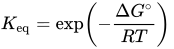
If there is a decrease in Gibbs free energy from one state to another, this transformation is spontaneous and the lower energy state is more stable. A highly strained, higher energy molecular conformation will spontaneously convert to the lower energy molecular conformation.

Examples of the anti and gauche conformations of butane.

Enthalpy and entropy are related to Gibbs free energy through the equation (at a constant temperature):

Enthalpy is typically the more important thermodynamic function for determining a more stable molecular conformation.[1] While there are different types of strain, the strain energy associated with all of them is due to the weakening of bonds within the molecule. Since enthalpy is usually more important, entropy can often be ignored.[1] This isn't always the case; if the difference in enthalpy is small, entropy can have a larger effect on the equilibrium. For example, n-butane has two possible conformations, anti and gauche. The anti conformation is more stable by 0.9 kcal mol−1.[1] We would expect that butane is roughly 82% anti and 18% gauche at room temperature. However, there are two possible gauche conformations and only one anti conformation. Therefore, entropy makes a contribution of 0.4 kcal in favor of the gauche conformation.[2] We find that the actual conformational distribution of butane is 70% anti and 30% gauche at room temperature.

Determining molecular strain

[edit]
Images of cyclohexane and methylcyclopentane.

The standard heat of formationfH°) of a compound is described as the enthalpy change when the compound is formed from its separated elements.[3] When the heat of formation for a compound is different from either a prediction or a reference compound, this difference can often be attributed to strain. For example, ΔfH° for cyclohexane is -29.9 kcal mol−1 while ΔfH° for methylcyclopentane is -25.5 kcal mol−1.[1] Despite having the same atoms and number of bonds, methylcyclopentane is higher in energy than cyclohexane. This difference in energy can be attributed to the ring strain of a five-membered ring which is absent in cyclohexane. Experimentally, strain energy is often determined using heats of combustion which is typically an easy experiment to perform.

Determining the strain energy within a molecule requires knowledge of the expected internal energy without the strain. There are two ways do this. First, one could compare to a similar compound that lacks strain, such as in the previous methylcyclohexane example. Unfortunately, it can often be difficult to obtain a suitable compound. An alternative is to use Benson group increment theory. As long as suitable group increments are available for the atoms within a compound, a prediction of ΔfH° can be made. If the experimental ΔfH° differs from the predicted ΔfH°, this difference in energy can be attributed to strain energy.

Kinds of strain

[edit]

Van der Waals strain

[edit]

Van der Waals strain, or steric strain, occurs when atoms are forced to get closer than their Van der Waals radii allow.[4]: 5  Specifically, Van der Waals strain is considered a form of strain where the interacting atoms are at least four bonds away from each other.[5] The amount on steric strain in similar molecules is dependent on the size of the interacting groups; bulky tert-butyl groups take up much more space than methyl groups and often experience greater steric interactions.

The effects of steric strain in the reaction of trialkylamines and trimethylboron were studied by Nobel laureate Herbert C. Brown et al.[6] They found that as the size of the alkyl groups on the amine were increased, the equilibrium constant decreased as well. The shift in equilibrium was attributed to steric strain between the alkyl groups of the amine and the methyl groups on boron.

Reaction of trialkylamines and trimethylboron.

Syn-pentane strain

[edit]

There are situations where seemingly identical conformations are not equal in strain energy. Syn-pentane strain is an example of this situation. There are two different ways to put both of the bonds the central in n-pentane into a gauche conformation, one of which is 3 kcal mol−1 higher in energy than the other.[1] When the two methyl-substituted bonds are rotated from anti to gauche in opposite directions, the molecule assumes a cyclopentane-like conformation where the two terminal methyl groups are brought into proximity. If the bonds are rotated in the same direction, this doesn't occur. The steric strain between the two terminal methyl groups accounts for the difference in energy between the two similar, yet very different conformations.

Allylic strain

[edit]
Allylic methyl and ethyl groups are close together.

Allylic strain, or A1,3 strain is closely associated to syn-pentane strain. An example of allylic strain can be seen in the compound 2-pentene. It's possible for the ethyl substituent of the olefin to rotate such that the terminal methyl group is brought near to the vicinal methyl group of the olefin. These types of compounds usually take a more linear conformation to avoid the steric strain between the substituents.[1]

1,3-diaxial strain

[edit]

1,3-diaxial strain is another form of strain similar to syn-pentane. In this case, the strain occurs due to steric interactions between a substituent of a cyclohexane ring ('α') and gauche interactions between the alpha substituent and both methylene carbons two bonds away from the substituent in question (hence, 1,3-diaxial interactions).[4]: 10  When the substituent is axial, it is brought near to an axial gamma hydrogen. The amount of strain is largely dependent on the size of the substituent and can be relieved by forming into the major chair conformation placing the substituent in an equatorial position. The difference in energy between conformations is called the A value and is well known for many different substituents. The A value is a thermodynamic parameter and was originally measured along with other methods using the Gibbs free energy equation and, for example, the Meerwein–Ponndorf–Verley reduction/Oppenauer oxidation equilibrium for the measurement of axial versus equatorial values of cyclohexanone/cyclohexanol (0.7 kcal mol−1).[7]

Torsional strain

[edit]

Torsional strain is the resistance to bond twisting. In cyclic molecules, it is also called Pitzer strain.

Torsional strain occurs when atoms separated by three bonds are placed in an eclipsed conformation instead of the more stable staggered conformation. The barrier of rotation between staggered conformations of ethane is approximately 2.9 kcal mol−1.[1] It was initially believed that the barrier to rotation was due to steric interactions between vicinal hydrogens, but the Van der Waals radius of hydrogen is too small for this to be the case. Recent research has shown that the staggered conformation may be more stable due to a hyperconjugative effect.[8] Rotation away from the staggered conformation interrupts this stabilizing force.

More complex molecules, such as butane, have more than one possible staggered conformation. The anti conformation of butane is approximately 0.9 kcal mol−1 (3.8 kJ mol−1) more stable than the gauche conformation.[1] Both of these staggered conformations are much more stable than the eclipsed conformations. Instead of a hyperconjugative effect, such as that in ethane, the strain energy in butane is due to both steric interactions between methyl groups and angle strain caused by these interactions.

Ring strain

[edit]

According to the VSEPR theory of molecular bonding, the preferred geometry of a molecule is that in which both bonding and non-bonding electrons are as far apart as possible. In molecules, it is quite common for these angles to be somewhat compressed or expanded compared to their optimal value. This strain is referred to as angle strain, or Baeyer strain.[9] The simplest examples of angle strain are small cycloalkanes such as cyclopropane and cyclobutane, which are discussed below. Furthermore, there is often eclipsing or Pitzer strain in cyclic systems. These and possible transannular interactions were summarized early by H.C. Brown as internal strain, or I-Strain.[10] Molecular mechanics or force field approaches allow to calculate such strain contributions, which then can be correlated e.g. with reaction rates or equilibria. Many reactions of alicyclic compounds, including equilibria, redox and solvolysis reactions, which all are characterized by transition between sp2 and sp3 state at the reaction center, correlate with corresponding strain energy differences SI (sp2 -sp3).[11] The data reflect mainly the unfavourable vicinal angles in medium rings, as illustrated by the severe increase of ketone reduction rates with increasing SI (Figure 1). Another example is the solvolysis of bridgehead tosylates with steric energy differences between corresponding bromide derivatives (sp3) and the carbenium ion as sp2- model for the transition state.[12] (Figure 2)

Figure 1 B
Figure 2 B
Strain of some common cycloalkane ring-sizes[1]
Ring size Strain energy (kcal mol−1) Ring size Strain energy (kcal mol−1)
3 27.5 10 12.4
4 26.3 11 11.3
5 6.2 12 4.1
6 0.1 13 5.2
7 6.2 14 1.9
8 9.7 15 1.9
9 12.6 16 2.0

In principle, angle strain can occur in acyclic compounds, but the phenomenon is rare.

Small rings

[edit]

Cyclohexane is considered a benchmark in determining ring strain in cycloalkanes and it is commonly accepted that there is little to no strain energy.[1] In comparison, smaller cycloalkanes are much higher in energy due to increased strain. Cyclopropane is analogous to a triangle and thus has bond angles of 60°, much lower than the preferred 109.5° of an sp3 hybridized carbon. Furthermore, the hydrogens in cyclopropane are eclipsed. Cyclobutane experiences similar strain, with bond angles of approximately 88° (it isn't completely planar) and eclipsed hydrogens. The strain energy of cyclopropane and cyclobutane are 27.5 and 26.3 kcal mol−1, respectively.[1] Cyclopentane experiences much less strain, mainly due to torsional strain from eclipsed hydrogens: its preferred conformations interconvert by a process called pseudorotation.[4]: 14 

Ring strain can be considerably higher in bicyclic systems. For example, bicyclobutane, C4H6, is noted for being one of the most strained compounds that is isolatable on a large scale; its strain energy is estimated at 63.9 kcal mol−1 (267 kJ mol−1).[13][14]

Transannular strain

[edit]

Medium-sized rings (7–13 carbons) experience more strain energy than cyclohexane, due mostly to deviation from ideal vicinal angles, or Pitzer strain. Molecular mechanics calculations indicate that transannular strain, also known as Prelog strain, does not play an essential role. Transannular reactions however, such as 1,5-shifts in cyclooctane substitution reactions, are well known.

Bicyclic systems

[edit]

The amount of strain energy in bicyclic systems is commonly the sum of the strain energy in each individual ring.[1] This isn't always the case, as sometimes the fusion of rings induces some extra strain.


Strain in allosteric systems

[edit]

In synthetic allosteric systems there are typically two or more conformers with stability differences due to strain contributions. Positive cooperativity for example results from increased binding of a substrate A to a conformer C2 which is produced by binding of an effector molecule E. If the conformer C2 has a similar stability as another equilibrating conformer C1 a fit induced by the substrate A will lead to binding of A to C2 also in absence of the effector E. Only if the stability of the conformer C2 is significantly smaller, meaning that in absence of an effector E the population of C2 is much smaller than that of C1, the ratio K2/K1 which measures the efficiency of the allosteric signal will increase. The ratio K2/K1 can be related directly to the strain energy difference between the conformers C1 and C2; if it is small higher concentrations of A will directly bind to C2 and make the effector E inefficient. In addition, the response time of such allosteric switches depends on the strain of the conformer interconversion transitions state.[15]

See also

[edit]

References

[edit]
Revisions and contributorsEdit on WikipediaRead on Wikipedia
from Grokipedia
In , strain refers to the destabilizing energetic penalty arising from distortions in a molecule's bond lengths, bond angles, or torsional arrangements relative to their optimal, unstrained geometries, which elevates the molecule's and often enhances its reactivity. This concept, pivotal for explaining the behavior of cyclic and polycyclic compounds, was pioneered by in 1885, who proposed that the instability of small rings stems from the compression of carbon valency angles away from the ideal tetrahedral value of 109° 28′. Molecular strain manifests in several interconnected forms, primarily angle strain, which occurs when bond angles deviate from hybridization-specific ideals such as 109.5° for sp³ carbons or 120° for sp² carbons; torsional strain, resulting from partial overlaps of electron clouds in eclipsed or gauche conformations along bonds; and steric strain, caused by non-bonded repulsive interactions between atoms forced into close proximity. These strain components are most pronounced in three- and four-membered rings, where severe geometric constraints lead to cumulative effects, but they also influence larger rings and non-cyclic structures under specific conditions. The quantification of , typically through experimental methods like heats of or computational approaches such as homodesmotic , reveals its profound impact on molecular properties, including conformational dynamics, spectroscopic signatures, and thermodynamic stability. Strain not only drives synthetically useful transformations—such as ring openings and insertions—but also underpins the design of high-energy materials and bioactive natural products, where controlled strain modulation enhances functionality.

Introduction

Definition and Basic Concepts

In chemistry, molecular strain refers to the excess internal energy of a molecule relative to an unstrained reference structure, primarily arising from deviations in its geometric parameters that destabilize the system. This strain energy is quantified as the difference between the experimental enthalpy of formation and that calculated for an ideal, strain-free model, such as acyclic alkanes with optimal bond lengths and angles. The concept encapsulates the thermodynamic penalty imposed by structural constraints, making strained molecules higher in energy than their relaxed counterparts. The primary causes of molecular strain include distortions in bond angles from their ideal values (typically 109.5° for sp³-hybridized carbons), torsional mismatches due to eclipsed bonds along single bonds, and unfavorable non-bonded interactions such as close approaches between atoms leading to van der Waals repulsions. These factors collectively raise the molecule's , often without external forces, unlike mechanical deformations. For instance, compressed bond angles force atoms into positions that increase repulsion, while eclipsed conformations hinder free and add rotational barriers. Strained molecules exhibit enhanced reactivity because their elevated ground-state energy lowers the activation barrier for reactions that relieve strain, such as ring-opening or bond-breaking processes. This destabilization promotes pathways where the is relatively more stable compared to the reactant, accelerating rates without necessarily altering the transition-state energy significantly. A classic example is , which possesses approximately 27.6 kcal/mol of —primarily from its 60° bond angles and eclipsed hydrogens—compared to unstrained in its staggered conformation, which has negligible strain and serves as a reference for ideal CH₂-CH₂ interactions. In contrast, the term "strain" in denotes the fractional deformation of a bulk material under applied stress, measuring dimensional change rather than intrinsic energetic destabilization.

Historical Development

The concept of molecular strain in chemistry originated in the late with observations of unusual reactivity in cyclic compounds. In 1885, proposed the angle strain theory to explain the instability and high reactivity of small-ring cycloalkanes like and cyclobutane, attributing it to deviations from the ideal tetrahedral bond angle of 109.5° in planar or near-planar rings. This theory, detailed in Baeyer's work on hydroaromatic and compounds, marked the first systematic recognition of geometric distortions contributing to molecular energy. Baeyer's ideas laid the groundwork for understanding as a destabilizing factor, influencing subsequent studies on cyclic structures. The early saw expansions beyond angle strain, particularly in acyclic systems. During the and 1930s, thermodynamic analyses of alkanes revealed additional sources of instability. In 1936–1937, Kenneth S. Pitzer and J. D. Kemp demonstrated through calculations that hindered about the C–C bond in arises from a torsional barrier, introducing the concept of torsional strain due to eclipsing interactions between adjacent bonds. This work, building on spectroscopic and calorimetric data, quantified the energy penalty (approximately 2.9 kcal/mol) for eclipsed conformations and extended the strain paradigm to non-cyclic molecules. Pitzer's contributions highlighted torsional effects as a key component of overall molecular strain in alkanes. In the mid-20th century, conformational advanced the quantitative assessment of strain. Frank H. Westheimer's 1956 analysis of emphasized eclipsing interactions in transition states, providing early models for torsional strain in reactive intermediates and reinforcing Pitzer's ideas through geometric and energetic evaluations. Concurrently, in the , James B. Hendrickson developed computational methods for conformational , using machine calculations to enumerate low-energy ring conformations and incorporate strain minimization via bond angle and torsional parameters. Norman L. Allinger pioneered empirical force fields during this period, with his 1968 generalized model for hydrocarbons explicitly accounting for strain energies through terms for bond stretching, bending, and torsional distortions, enabling predictions of molecular geometries and stabilities. These developments shifted strain evaluation from qualitative theories to systematic computational frameworks. The , beginning in the , integrated quantum mechanical methods for precise strain quantification. Ab initio calculations, employing Hartree–Fock and post-Hartree–Fock approaches, allowed direct computation of strain energies without empirical parameters, revealing subtle electronic contributions in strained systems like small rings and alkenes. For instance, early applications in the computed olefin strain energies in molecules such as , confirming and refining classical estimates through electron correlation effects. This quantum-based evolution complemented force field methods, providing benchmark data for validating strain models across diverse chemical contexts.

Thermodynamic Principles

Components of Strain Energy

The total strain energy, EstrainE_\text{strain}, in a molecule represents the excess internal energy relative to an unstrained reference and is thermodynamically decomposed into contributions from angle strain (EangleE_\text{angle}), torsional strain (EtorsionalE_\text{torsional}), and steric strain (EstericE_\text{steric}), along with minor terms such as bond stretching or transannular interactions. This partitioning arises from force field and quantum chemical analyses, where the total strain is calculated as the difference between the observed molecular energy and the sum of additive group increments from unstrained fragments. The equation for total strain energy is thus expressed as: Estrain=Eangle+Etorsional+Esteric+ΔEminorE_\text{strain} = E_\text{angle} + E_\text{torsional} + E_\text{steric} + \Delta E_\text{minor} where ΔEminor\Delta E_\text{minor} accounts for smaller effects like van der Waals repulsions beyond primary steric contributions. To isolate these components, unstrained acyclic models serve as benchmarks; for example, n-butane or ethane-based fragments provide reference energies for sp3sp^3-hybridized carbon systems in cycloalkanes, allowing the deviation due to ring closure to be quantified. In cyclopropane, for instance, the total strain of approximately 28 kcal/mol is dominated by angle strain from compressed bond angles (around 60° versus the ideal 109.5°), with torsional and steric terms contributing additively based on eclipsed conformations and close non-bonded contacts. Partitioning methods, such as homodesmotic reactions, further refine this decomposition by balancing bond types, hybridization, and between reactants and products, thereby canceling non-strain effects like or polarization to yield isolated strain enthalpies. These reactions, introduced by Pople and further developed for , compare the strained molecule to isomeric unstrained acyclic hydrocarbons (e.g., versus fragments), with reaction enthalpies directly providing EstrainE_\text{strain} that can be computationally dissected into angle, torsional, and steric parts using methods like MM2 force fields or calculations. Thermodynamically, primarily affects the of formation, raising it above expected values for unstrained analogs and destabilizing the molecule, though entropic contributions arise in conformational restrictions that limit rotational freedom in strained systems. For cyclic structures, this enthalpic dominance is evident in elevated heats of , while entropic effects become notable in larger rings where puckering modulates torsional strain.

Methods for Quantifying Strain

Experimental methods for quantifying molecular primarily rely on thermochemical measurements that compare the energy content of strained molecules to unstrained reference compounds. One of the most established techniques is the analysis of , where the total heat released upon complete oxidation to CO₂ and H₂O is measured using bomb calorimetry and compared to the expected value for an unstrained analog with the same number of carbon atoms. For cycloalkanes, the is derived by dividing the observed by the number of CH₂ groups and subtracting this from the value for the strain-free reference, (157.4 kcal/mol per CH₂). A classic example is , whose experimental is 499.8 kcal/mol, yielding a of 27.6 kcal/mol when compared to the expected 472.2 kcal/mol for three unstrained CH₂ units; more refined analyses adjust this to 28.6 kcal/mol to account for subtle reference inconsistencies. Hydrogenation energies provide another experimental avenue, particularly for unsaturated strained systems, by measuring the change upon addition of to form the saturated analog and comparing it to unstrained alkenes like . This method isolates strain contributions from double bonds and ring distortions, with higher-than-expected exothermicity indicating relief of strain; for instance, the hydrogenation of releases approximately 26 kcal/mol more energy than expected, reflecting combined and torsional strain. Equilibrium studies, such as or conformational equilibria, further quantify relative strain by determining free energy differences between strained and relaxed isomers via temperature-dependent measurements, often using van't Hoff analysis on equilibrium constants. These approaches are valuable for conformational strain in acyclic or flexible rings, where direct data may be less discerning. Spectroscopic techniques offer indirect but precise probes of strain components. Vibrational spectroscopy, including (IR) and Raman, detects deviations in bond angles and lengths through shifts in C-H or C-C stretching frequencies; for example, the elevated C-H stretching wavenumber in (around 3100 cm⁻¹) signals compressed angles and heightened s-character, correlating with angle strain contributions of about 12-15 kcal/mol. (NMR) spectroscopy assesses torsional strain via vicinal coupling constants (³J_HH) or rotational barriers in conformational interconversions, as seen in the higher barrier to chair flipping in substituted cyclohexanes due to 1,3-diaxial interactions exceeding 1 kcal/mol per pair. Computational methods complement experimental data by enabling direct calculation of strain energies through energy minimization and reference comparisons. force fields, such as MMFF94, approximate strain via parameterized potentials for bond stretching, angle bending, and torsional terms, providing rapid estimates with errors under 2 kcal/mol for hydrocarbons when validated against experiment. (DFT) offers higher accuracy for electronic effects, often using homodesmotic reactions—balanced equations conserving bond types—to isolate strain as the reaction , with B3LYP or ωB97X-D functionals yielding results within 1 kcal/mol of experimental values for small rings. serves as the canonical zero-strain reference in both experimental and computational workflows, ensuring consistency across methods. Error sources in strain quantification arise from reference compound assumptions and measurement precision; for instance, combustion data can vary by ±0.5 kcal/mol due to impurities, while computational results may overestimate torsional strain by 1-3 kcal/mol if dispersion corrections are omitted. Validation typically involves cross-comparing experimental heats with computed homodesmotic energies, as demonstrated for where both yield near-zero total strain, confirming the approach's reliability for polycyclic systems.

Fundamental Types of Strain

Steric Strain

Steric strain arises from repulsive interactions between non-bonded atoms or groups in a when their separation distance falls below the sum of their van der Waals radii, resulting in destabilization of the molecular structure. This phenomenon is fundamentally driven by the , which prohibits the overlap of clouds from different atoms, generating a strong repulsive force as orbitals approach each other. Complementing this is the repulsive component of van der Waals interactions, which further elevates the potential energy when atoms encroach on each other's effective spatial domains. The Lennard-Jones potential provides a widely adopted mathematical model for these non-bonded repulsions in computational chemistry, capturing both the attractive and repulsive terms as a function of interatomic distance rr: V(r)=4ϵ[(σr)12(σr)6]V(r) = 4\epsilon \left[ \left( \frac{\sigma}{r} \right)^{12} - \left( \frac{\sigma}{r} \right)^6 \right] Here, ϵ\epsilon represents the depth of the potential well, and σ\sigma is the finite distance at which the potential is zero; the r12r^{-12} term dominates at short distances, modeling the steep steric repulsion due to Pauli and van der Waals effects. This formulation is essential for simulating molecular conformations where steric clashes influence stability. A classic example of steric strain is observed in the gauche conformation of , where the two methyl groups are positioned approximately 60° apart around the central C-C bond, incurring a steric energy penalty of about 0.9 kcal/mol compared to the more stable anti conformation. This penalty reflects the close approach of the methyl groups, leading to overlap without any eclipsing of bonds. In more extreme cases, such as the triptycene, the rigid fusion of three rings around a central carbon creates severe crowding, with non-bonded contacts between aromatic hydrogens contributing to substantial overall strain and influencing reactivity at the . The consequences of steric strain typically manifest as geometric distortions to alleviate repulsive contacts, such as bond elongation, torsional twisting, or expansion of molecular volumes, thereby lowering the overall . For instance, in sterically congested systems, these adjustments can prevent otherwise favorable conformations, impacting reaction pathways and molecular packing. Importantly, steric strain differs from other forms of strain in that it involves exclusively non-bonded interactions, without altering the lengths or angles of covalent bonds themselves.

Torsional Strain

Torsional strain originates from the repulsion caused by the overlap of clouds in adjacent bonds, particularly when those bonds are in an eclipsed conformation rather than the preferred staggered arrangement. This interaction increases the of the as the between the bonds deviates from the staggered geometry, where bonding electrons are maximally separated. Newman projections provide a key tool for visualizing torsional strain, illustrating the relative orientations of substituents along a carbon-carbon bond. In , the staggered conformation represents the energy minimum, while rotation by 60° to the eclipsed conformation incurs a torsional strain barrier of 2.9 kcal/mol, arising from the pairwise eclipsing of three C-H bonds. This barrier reflects the energetic cost of aligning the bond orbitals directly over one another, destabilizing the for rotation. The associated with torsional strain in follows a threefold symmetric profile, modeled by the function V(ϕ)=V02(1+cos(3ϕ))V(\phi) = \frac{V_0}{2} (1 + \cos(3\phi)) where ϕ\phi is the and V0V_0 is the barrier height, approximately 2.9 kcal/mol. This cosine form captures the periodic nature of the energy landscape, with minima at staggered angles (ϕ=60,180,300\phi = 60^\circ, 180^\circ, 300^\circ) and maxima at eclipsed positions (ϕ=0,120,240\phi = 0^\circ, 120^\circ, 240^\circ). The threefold symmetry arises from the equivalent positioning of the three atoms on each . In more complex alkanes like , torsional strain contributes to the differences between conformations and the barriers to . The anti conformation (dihedral angle 180°) is the global minimum, while the synclinal (gauche) conformation at 60° is higher in by about 0.9 kcal/mol, with the full rotational barrier from anti to the intervening eclipsed state reaching approximately 3.8 kcal/mol, partly attributable to torsional effects in the eclipsed . This illustrates how torsional strain compounds with other factors to dictate conformational preferences. Torsional strain plays a significant role in the reactivity of highly strained systems, where eclipsed or skewed bond arrangements elevate energy barriers for bond rotations and related processes. For instance, in bullvalene, a trishomocubane-like , inherent torsional distortions within its fluxional structure contribute to heightened barriers, facilitating rapid but energetically costly degenerate Cope rearrangements at elevated temperatures. These dynamics underscore how torsional strain can drive unusual reactivity pathways in polycyclic molecules.

Angle Strain

Angle strain refers to the destabilization in a arising from deviations of its bond angles from the ideal values determined by the hybridization of the constituent atoms, resulting in poorer overlap of atomic orbitals and higher . This type of strain is particularly pronounced in structures where geometric constraints prevent atoms from adopting their preferred bonding configurations, such as in small cyclic systems or rigid frameworks. The energy penalty for such angular distortions is commonly modeled in molecular mechanics using a harmonic potential, approximated as E=k(θθ0)2E = k (\theta - \theta_0)^2, where θ\theta is the actual bond angle, θ0\theta_0 is the equilibrium angle for unstrained hybridization (e.g., 109.5° for sp³ carbons), and kk is the angular force constant that quantifies the resistance to bending. This quadratic form captures the parabolic shape of the potential energy surface near the minimum, providing a simple yet effective way to estimate strain contributions in computational chemistry. In , the equilateral triangular forces all C-C-C bond angles to 60°, far below the 109.5° ideal for sp³ hybridization, making angle strain the dominant factor in its overall energy of about 28 kcal/mol. Similarly, in cumulene systems such as allene (H₂C=C=CH₂), the central sp-hybridized carbon prefers a linear 180° , but in constrained cyclic cumulenes, bending this axis introduces significant angle strain due to the 90° perpendicular orientation of the terminal π bonds. The severity of angle strain varies with hybridization; sp³ atoms tolerate deviations less severely than sp² atoms, which favor 120° angles, leading to amplified effects in heterocyclic rings where mixed hybridizations are present. For example, in three-membered heterocycles like oxirane (), the oxygen's sp³ hybridization results in strained ~60° angles, whereas unsaturated analogs like azirine exhibit even higher strain energies because the sp² nitrogens are forced away from their preferred planar . Angle strain also manifests in spectroscopic properties, particularly (IR) spectra, where distorted bond angles alter vibrational force constants and cause shifts in absorption bands. In small-ring lactones or cyclic ketones, increased angle strain raises the C=O stretching frequency to higher wavenumbers (e.g., above 1750 cm⁻¹), reflecting enhanced bond rigidity.

Strain in Cyclic Structures

Ring Strain Overview

Ring strain represents the cumulative destabilization in cyclic molecules arising from the interplay of angle strain, torsional strain, and steric strain, which collectively elevate the molecule's energy relative to analogous acyclic structures. Angle strain results from deviations in bond angles from the ideal tetrahedral value of 109.5°, torsional strain from eclipsed conformations along the ring bonds, and steric strain from unfavorable non-bonded interactions between atoms or groups within the constrained geometry. This total strain manifests as increased reactivity and thermodynamic instability, particularly in smaller rings where these effects are pronounced. Early conceptualizations, such as the Baeyer model, attributed ring strain primarily to angle distortions, assuming planar ring geometries and predicting instability for rings larger than six members due to imagined "negative" strain from angles exceeding 109.5°. However, this overemphasis on angle strain overlooked torsional and steric contributions, and the assumption of planarity failed to account for conformational flexibility that relieves stress in larger rings. Modern views integrate all three strain components and recognize that rings adopt puckered or chair-like conformations to minimize torsional and steric effects, providing a more accurate description of strain as a multifaceted phenomenon. The magnitude of ring strain varies systematically with molecular features, decreasing as the strain energy per CH₂ group drops from approximately 9.2 kcal/mol in (total ~27.5 kcal/mol) to 0 kcal/mol in , reflecting improved accommodation of ideal geometries in larger rings. Key influencing factors include , which dictates the extent of angular deviation and crowding; incorporation of heteroatoms, such as oxygen or , which can alter bond angles and hybridization to either amplify or mitigate strain; and unsaturation, where double or triple bonds introduce rigidity and pi-orbital overlap issues that modify the overall energy profile. For instance, smaller rings exhibit higher strain due to severe distortions, while heteroatoms in epoxides enhance reactivity by compressing angles further. Total ring strain energy is commonly quantified through isodesmic or homodesmotic reactions, which balance the cyclic compound against acyclic references preserving bond types and hybridization to isolate strain as the reaction enthalpy. In a typical homodesmotic scheme, the ring strain energy (RSE) is calculated as the difference between the energies of the reactant (cyclic) and product (opened acyclic) sides, such as breaking a C-C bond in the ring and appending methyl groups while balancing with to maintain atom and bond counts. This approach yields precise values by canceling systematic errors in computational or experimental .

Strain in Small and Medium Rings

Small rings, particularly those with 3 to 5 members, exhibit significant primarily due to deviations from ideal tetrahedral bond angles and eclipsed torsional interactions. In , the bond angles are compressed to 60°, far below the preferred 109.5°, resulting in dominant angle , while the fully eclipsed hydrogens contribute substantial torsional ; the total ring energy is approximately 28 kcal/mol. Cyclobutane experiences similar issues with bond angles around 90°, leading to a total of about 26 kcal/mol, though it adopts a puckered, folded conformation to partially alleviate torsional by reducing eclipsing. , with milder angle (bond angles near 108°), still has a total of roughly 6 kcal/mol in its planar form due to torsional effects, but it relieves this through a puckered conformation and rapid pseudo-rotation, which averages out the without fixed axial or equatorial positions. Heterocyclic analogs of small rings show comparable strain profiles, with notable differences arising from heteroatom electronegativity. Oxirane (ethylene oxide), the oxygen-containing three-membered ring, has a total strain energy of about 27 kcal/mol, similar to cyclopropane, but the more polar C-O bonds enhance reactivity toward nucleophilic attack compared to the all-carbon system. This strain drives the high reactivity of small rings, making them prone to ring-opening reactions that relieve the energetic penalty; for instance, epoxides are extensively used in for stereoselective introductions of functional groups via nucleophilic ring-opening under acidic or basic conditions. In medium rings of 6 to 8 members, strain diminishes overall but shifts in character. possesses negligible strain (less than 1 kcal/mol) thanks to its flexible conformation, where bond angles are nearly ideal and torsional strain is minimized by staggered arrangements, with or twist-boat forms accessible via low-energy ring flips for adjustments. Larger medium rings like and reintroduce strain, totaling around 6 kcal/mol and 9 kcal/mol, respectively, mainly from transannular steric interactions where non-adjacent atoms crowd across the ring, complicating adoption of low-strain conformations. These effects highlight how influences the balance between angle, torsional, and steric components in cyclic structures.

Bicyclic and Polycyclic Systems

Bicyclic systems, such as (bicyclo[2.2.1]heptane), exhibit significant strain due to their bridged connectivity, which enforces distorted bond angles at the carbons. In , the bridgehead angles are approximately 93°, deviating markedly from the ideal tetrahedral value of 109.5°, contributing to angle strain, while the rigid framework also induces torsional and steric interactions across the molecule. The total of is estimated at 17.2 kcal/mol, reflecting the cumulative effects of these distortions in the compact bicyclic architecture. In fused bicyclic systems like (bicyclo[4.4.0]decane), strain varies with at the ring fusion. Trans-decalin adopts a diequatorial fusion with both rings in chair conformations, resulting in minimal overall strain as the bridgehead hydrogens are trans and torsional interactions are optimized. In contrast, cis-decalin features an axial-equatorial fusion, introducing torsional strain from gauche-like interactions at the junction and preventing full chair-chair adoption without additional distortion, leading to an energy difference of approximately 2.7 kcal/mol relative to the trans . A key consequence of strain in small bridged bicyclic systems is , which states that a double bond cannot stably exist at a carbon if the resulting olefin would be part of a trans-cycloalkene smaller than eight members, due to the inability to achieve planarity and proper p-orbital overlap amid severe angle strain. This prohibition arises because the bridgehead geometry forces the double bond into a twisted configuration, destabilizing the π-system and often leading to rearrangement or instability. Polycyclic systems amplify these effects through multiple fused or bridged units, but strain levels depend on the overall geometry. (tricyclo[3.3.1.1^{3,7}]decane), composed of four fused chair-like units, minimizes strain by maintaining near-ideal bond angles and torsional arrangements, resulting in a low total of about 6.5 kcal/mol and exceptional stability. Conversely, (pentacyclo[4.2.0.0^{2,5}.0^{3,8}.0^{4,7}]octane) imposes extreme angle strain with all carbon-carbon bond angles fixed at 90°, far from the tetrahedral ideal, yielding a total strain energy of 161.5 kcal/mol and rendering it highly reactive despite its symmetric structure. Strain in polycyclic natural products often drives unique reactivity and bioactivity, as seen in taxol (), where the complex fused tetracyclic core—including an eight-membered ring and an —incorporates angle and transannular distortions that contribute to overall molecular strain. This polycyclic framework exemplifies how evolutionary pressures can harness strain for functional rigidity in bioactive scaffolds.

Specialized Strain Interactions

Allylic and Syn-Pentane Strain

Allylic strain, denoted as A^{1,3} strain, is a type of steric repulsion occurring between a at the allylic carbon and the cis- on the adjacent in an unsaturated system. This interaction destabilizes conformations where the allylic group is oriented cis to the olefinic , often leading to a strong preference for alternative geometries that alleviate the strain. In 1,3-butadiene derivatives, for instance, the s-cis conformation incurs significant A^{1,3} strain, favoring the s-trans form by an energy difference of approximately 2-3 kcal/mol. This strain influences rotational barriers and stereoselectivity in reactions involving enones and dienes. For example, in α,β-unsaturated carbonyl compounds, the preference for an s-trans enone conformation minimizes A^{1,3} interactions between the allylic (or substituent) and the carbonyl oxygen, with barriers to typically around 2-4 kcal/mol depending on substituents. In allylic systems, A^{1,3} strain directs kinetic resolutions by enforcing specific geometries, as seen in stereoselective additions to chiral allylic alcohols where the strain controls and enantioselectivity. Such effects are prominent in synthesis, where allylic strain guides the folding of polyene chains to avoid steric clashes. Syn-pentane represents a specialized steric interaction in systems, arising from the close proximity of 1,3-substituents across a five-atom chain in a synclinal (gauche-gauche) arrangement, mimicking the folded conformation of n-pentane. This clash destabilizes conformers with adjacent gauche torsions, with an energetic penalty of about 3.3-3.6 kcal/mol relative to the all-anti arrangement, as determined from surveys and computational analyses. In acyclic hydrocarbons like n-pentane, syn-pentane interactions are virtually absent in observed structures, with over 90% favoring anti/anti conformations to evade the strain. These interactions are additive and play a key role in conformational preferences of larger alkanes and natural products. For representative examples, in terpenes, syn-pentane strain influences the population of bioactive conformers by penalizing folded chains, contributing 1-3 kcal/mol per instance and promoting extended structures essential for molecular recognition. In cis-1,3-disubstituted systems mimicking pentane folds, the strain reinforces preferences for staggered arrangements, enhancing overall stability without invoking cyclic distortions.

1,3-Diaxial and Transannular Strain

In the chair conformation of cyclohexane, 1,3-diaxial strain arises from steric repulsions between an axial substituent and the axial hydrogen atoms at the 1,3-positions (carbons 3 and 5). These interactions mimic the gauche butane conformation, with each methyl-hydrogen 1,3-diaxial pair contributing approximately 0.9 kcal/mol (3.8 kJ/mol) of strain energy, leading to a total of 1.8 kcal/mol (7.6 kJ/mol) for an axial methyl group due to two such pairs. Larger substituents exacerbate this strain; for instance, an axial tert-butyl group incurs about 4.9 kcal/mol of energy penalty, strongly favoring the equatorial position. These additive gauche-like penalties drive conformational preferences, making equatorial orientations predominant for substituents in monosubstituted cyclohexanes. In carbohydrate chemistry, the anomeric effect partially relieves the destabilizing influence of 1,3-diaxial strain at the anomeric carbon (C1) of rings. Normally, steric considerations would favor an equatorial orientation for electronegative substituents like hydroxyl or alkoxy groups to avoid 1,3-diaxial clashes with axial hydrogens or other groups. However, the —a stereoelectronic stabilization arising from or interactions—promotes axial preference in α-anomers of sugars such as glucose, counterbalancing the steric penalty and influencing equilibria. Transannular strain manifests in medium-sized rings (7-12 members) as repulsive interactions between non-adjacent atoms across the ring interior, distinct from vicinal . In , which adopts a boat-chair conformation, the "flagpole" hydrogens at positions 1 and 5 experience close van der Waals contacts, contributing approximately 3 kcal/mol to the total of about 6.5 kcal/mol. This strain complicates medium-ring synthesis, as transannular repulsions increase activation barriers for cyclization, reduce entropic favorability, and lead to kinetically sluggish reactions or alternative pathways like oligomerization. In polycyclic systems like steroids, 1,3-diaxial strain dictates substituent orientations to minimize energy; for example, the angular methyl groups at C10 and C13 in adopt equatorial positions in the fused chair rings to avoid clashes with axial hydrogens, stabilizing the overall conformation. Similarly, transannular effects in medium-ring portions of natural products, such as in some , impose conformational restrictions that challenge biosynthetic mimicry or efforts.

Strain in Allosteric Systems

In allosteric systems, strain plays a pivotal role in modulating protein function by storing and releasing energy during conformational transitions triggered by binding. Allostery refers to the regulation of activity at one site by binding at a distant site, often involving the buildup or relief of strain that alters the energy landscape of the . For instance, in , the tense (T) state maintains a strained quaternary structure that reduces oxygen affinity, while binding induces a shift to the relaxed () state, relieving approximately 7 kcal/mol of free energy difference between the deoxy and oxy forms, thereby enhancing . This distributed strain model, where small mechanical strains accumulate across the protein, accounts for the observed in oxygen transport. Proteins exemplify strain's role in induced fit mechanisms, where substrate binding distorts the to facilitate . In , glucose binding triggers a large-scale closure of the enzyme's cleft, inducing conformational strain that aligns catalytic residues and stresses substrate bonds for phosphate transfer, preventing unproductive . Similarly, in nucleic acids like (tRNA), strained loops contribute to functional dynamics; the anticodon and D-loops adopt conformations with inherent torsional and angle strain that enable precise codon recognition and translocation on the , with gradual strain release driving movement between binding sites. Quantifying strain in these systems relies on techniques that map structural and energetic changes. spectroscopy reveals distance variations indicative of strain-induced shifts in allosteric proteins, while provides atomic-resolution snapshots of strained intermediates, as seen in hemoglobin's T-to-R pathway. Complementary (MD) simulations model strain propagation, computing tensor fields that highlight shear and dilation in response to effectors, offering insights into energy barriers. From an evolutionary perspective, strained conformations have been selected to optimize in allosteric proteins, enabling efficient signal propagation across biological networks. In designed elastic networks mimicking allostery, favors architectures where strain pathways connect regulatory and active sites, enhancing responsiveness without excessive costs, a principle reflected in natural systems like .

References

Add your contribution
Related Hubs
User Avatar
No comments yet.