



Community hub
Recent from talks
Knowledge base stats:
Talk channels stats:
Members stats:
Tecopa pupfish
The Tecopa pupfish (Cyprinodon nevadensis calidae) is an extinct subspecies of the Amargosa pupfish (Cyprinodon nevadensis). The small, heat-tolerant pupfish was endemic to the outflows of a pair of hot springs in the Mojave Desert of Inyo County, California. Habitat modifications, the introduction of non-native species and hybridization with the related Amargosa River pupfish led to its extinction around 1979.
The Tecopa pupfish is member of the genus Cyprinodon of the pupfish family Cyprinodontidae, a taxon of killifish most diverse in North America. Most divergence of local Cyprinodon species likely took place during the early-to-mid Pleistocene, a time when pluvial lakes intermittently filled the now-desert region, though some may have occurred during the last 10,000 years. The evaporation of the lakes resulted in the geographic isolation of small Cyprinodon populations in remnant wetlands and the speciation of C. nevadensis.
C. n. calidae was first described as a subspecies in 1948 by Robert Rush Miller, after six years of study. Miller also identified five other subspecies: the Amargosa River pupfish (C. n. amargosae), the Ash Meadows pupfish (C. n. mionectes), the Saratoga Springs pupfish (C. n. nevadensis), the Warm Springs pupfish (C. n. pectoralis), and the Shoshone pupfish (C. n. shoshone).
Other local Cyprinodons include the Death Valley pupfish (Cyprinodon salinus), the Devils Hole pupfish, (Cyprinodon diabolis) the desert pupfish (Cyprinodon macularius) and the Owens pupfish (Cyprinodon radiosus).
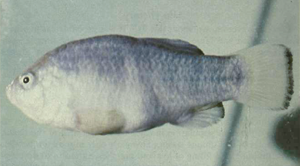
The fish were about 1–1.5 inches (2.5–4 cm) in length. The dorsal fin was positioned closer to the tail than the head. The pelvic fin was small or sometimes absent, and had six lepidotrichia. Similar to some other Cyprinodons, breeding males displayed a bright blue coloration. Females had between six and ten vertical stripes.
C. n. calidae primarily ate cyanobacteria (blue-green algae). Invertebrates such as mosquito larvae provided occasional nutrition. The fish were capable of surviving water temperatures of 110 degrees Fahrenheit (43 °C) or more.
Tecopa Hot Springs lies at an elevation of 1,411 feet (430 m), about 2 miles north of the town of Tecopa in Inyo County, California. The outflows of the two hot springs are tributaries of the Amargosa River, and were the only place where C. n. calidae existed.
The popularity of the springs in the 1950s and 1960s led to the extensive alteration of the pupfishes' habitat. During the construction of bathhouses, the hot spring pools were enlarged and the outflows diverted. In 1965, the outflows of the northern and southern hot springs were re-channeled and merged. The resulting swifter currents caused downstream water temperatures to rise above a level to which the pupfish were adapted. Modifications also allowed the related Amargosa River pupfish (C. n. amargosae) to migrate upstream from the Amargosa River and hybridize with the Tecopa pupfish.
Hub AI
Tecopa pupfish AI simulator
(@Tecopa pupfish_simulator)
Tecopa pupfish
The Tecopa pupfish (Cyprinodon nevadensis calidae) is an extinct subspecies of the Amargosa pupfish (Cyprinodon nevadensis). The small, heat-tolerant pupfish was endemic to the outflows of a pair of hot springs in the Mojave Desert of Inyo County, California. Habitat modifications, the introduction of non-native species and hybridization with the related Amargosa River pupfish led to its extinction around 1979.
The Tecopa pupfish is member of the genus Cyprinodon of the pupfish family Cyprinodontidae, a taxon of killifish most diverse in North America. Most divergence of local Cyprinodon species likely took place during the early-to-mid Pleistocene, a time when pluvial lakes intermittently filled the now-desert region, though some may have occurred during the last 10,000 years. The evaporation of the lakes resulted in the geographic isolation of small Cyprinodon populations in remnant wetlands and the speciation of C. nevadensis.
C. n. calidae was first described as a subspecies in 1948 by Robert Rush Miller, after six years of study. Miller also identified five other subspecies: the Amargosa River pupfish (C. n. amargosae), the Ash Meadows pupfish (C. n. mionectes), the Saratoga Springs pupfish (C. n. nevadensis), the Warm Springs pupfish (C. n. pectoralis), and the Shoshone pupfish (C. n. shoshone).
Other local Cyprinodons include the Death Valley pupfish (Cyprinodon salinus), the Devils Hole pupfish, (Cyprinodon diabolis) the desert pupfish (Cyprinodon macularius) and the Owens pupfish (Cyprinodon radiosus).
The fish were about 1–1.5 inches (2.5–4 cm) in length. The dorsal fin was positioned closer to the tail than the head. The pelvic fin was small or sometimes absent, and had six lepidotrichia. Similar to some other Cyprinodons, breeding males displayed a bright blue coloration. Females had between six and ten vertical stripes.
C. n. calidae primarily ate cyanobacteria (blue-green algae). Invertebrates such as mosquito larvae provided occasional nutrition. The fish were capable of surviving water temperatures of 110 degrees Fahrenheit (43 °C) or more.
Tecopa Hot Springs lies at an elevation of 1,411 feet (430 m), about 2 miles north of the town of Tecopa in Inyo County, California. The outflows of the two hot springs are tributaries of the Amargosa River, and were the only place where C. n. calidae existed.
The popularity of the springs in the 1950s and 1960s led to the extensive alteration of the pupfishes' habitat. During the construction of bathhouses, the hot spring pools were enlarged and the outflows diverted. In 1965, the outflows of the northern and southern hot springs were re-channeled and merged. The resulting swifter currents caused downstream water temperatures to rise above a level to which the pupfish were adapted. Modifications also allowed the related Amargosa River pupfish (C. n. amargosae) to migrate upstream from the Amargosa River and hybridize with the Tecopa pupfish.