
.jpg/250px-DM30AC,_New_Hyde_Park,_Dec_27_2022_(cropped).jpg)


.jpg/2000px-DM30AC,_New_Hyde_Park,_Dec_27_2022_(cropped).jpg)
Community hub
Recent from talks
Contribute something
Nothing was collected or created yet.
EMD DE30AC and DM30AC
View on Wikipedia
| EMD DE30AC/DM30AC | |||||||||||||||||||||||||||||||||||||||||||||||||||||||||||||||||||||||||||
|---|---|---|---|---|---|---|---|---|---|---|---|---|---|---|---|---|---|---|---|---|---|---|---|---|---|---|---|---|---|---|---|---|---|---|---|---|---|---|---|---|---|---|---|---|---|---|---|---|---|---|---|---|---|---|---|---|---|---|---|---|---|---|---|---|---|---|---|---|---|---|---|---|---|---|---|
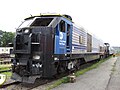
.jpg) DM30AC 501 at New Hyde Park | |||||||||||||||||||||||||||||||||||||||||||||||||||||||||||||||||||||||||||
| |||||||||||||||||||||||||||||||||||||||||||||||||||||||||||||||||||||||||||
| |||||||||||||||||||||||||||||||||||||||||||||||||||||||||||||||||||||||||||
| |||||||||||||||||||||||||||||||||||||||||||||||||||||||||||||||||||||||||||
| |||||||||||||||||||||||||||||||||||||||||||||||||||||||||||||||||||||||||||
| [2] | |||||||||||||||||||||||||||||||||||||||||||||||||||||||||||||||||||||||||||
The EMD DE30AC and DM30AC are a class of 46 locomotives built between 1997–1999 by Electro-Motive Division in the Super Steel Plant in Schenectady, New York, for the Long Island Rail Road of the Metropolitan Transportation Authority (MTA) in New York. Originally divided equally between the two types, the fleet currently consists of 24 DE30AC locomotives (diesel power only) and 20 DM30AC locomotives (diesel or third rail power).
Details
[edit]The DE30AC and DM30AC locomotives replaced aging GP38-2 locomotives, with GP38s used to push and pull diesel trains and other locomotives converted into power packs (cab control) used to provide head-end power for the trains. The bodies of the DE30AC and the DM30AC are extremely similar; the difference is the ability of the DM30AC to use electric third rail while the diesel engine is off, enabling the locomotive to use the East River Tunnels into New York Penn Station. This permits direct service from non-electrified lines in eastern Long Island via the western electrified main lines all the way to Penn Station. A few such trains a day run on the Port Jefferson, Montauk, and Oyster Bay branches, usually during peak times. Due to their height, the DE30AC and DM30AC locomotives, as well as the C3 bilevel railcars that they typically haul, cannot fit through the 63rd Street Tunnel, and are thus unable to serve Grand Central Madison station.[4]
Single engines run with six cars or fewer, in which case the engine is on the east end of the train and a C3 cab car is on the west (Manhattan-facing) end. Generally, two engines are used when there are seven or more cars. Running in electric mode requires two DM30ACs per train regardless of train length.
Accidents
[edit]- DM30AC 503 was damaged in an accident at Huntington on October 23, 2000, when a defective shoe beam caused a 750-volt short circuit with the locomotive's third rail contact shoe, which in turn caused the locomotive to catch fire.[5] It sat in the LIRR's Morris Park Facility and had been stripped for spare parts to maintain the remainder of the fleet until July 2018, when it was scrapped.
- DM30AC 511 was damaged in an accident on May 25, 2019. It hit a 14-unit long train stopped at the siding east of Speonk station, which is 13 units long; this caused the locomotive to lose a third rail shoe and sustain frame damage.[6] It is now sitting in the Morris Park Facility, most likely to be used for parts before being scrapped.[7]
In addition, DM30AC 507 suffered an electrical cabinet failure. Unlike 503 and 511, it was salvaged by being converted into a DE30AC locomotive, renumbered to 423, and returned to service.
Planned replacement
[edit]In December 2020, the Metropolitan Transportation Authority of New York board approved a Federal Transit Administration-funded $335 million contract for 27 dual-mode locomotives, based on the Siemens Charger design. The order also includes additional options for up to 144 more locomotives, of which 66 could go to the LIRR.[8][9] As a part of the Long Island Rail Road's Capital Program, the railroad is exercising Option 3 of the previously awarded contract to order up to 44 new dual-mode locomotives, which would likely replace the older DE30AC and DM30AC locomotives.[10][11]
Gallery
[edit]-
 DE30AC #401
 -
 DM30AC #515
 -
 The cab of engine #513
 -
 Third rail conductor shoe on DM30AC #514.
 -
 The remnants of engine #503
 -
 The cab of engine #503


.jpg)


See also
[edit]References
[edit]- ^ "New 710ECO Repower Products Provide High Performance for Low and Medium Horsepower Applications" (PDF). Electro-Motive Diesel. March 2008. Archived from the original (PDF) on August 28, 2016.
- ^ a b c d "Diesel-Electric Passenger Locomotives DE30AC and DM30AC" (PDF). Siemens AG. Retrieved January 14, 2011.[dead link]
- ^ LaMay, Robert A. (1998). "Long Island Rail Road's DE30 and DM30 Locomotives". Railpace. Archived from the original on June 23, 2018. Retrieved August 31, 2008.
- ^ "Chapter 28: Comments and Responses on the Draft Environmental Impact Statement". East Side Access Environmental Impact Statement (PDF). MTA Capital Construction. March 2001. Archived (PDF) from the original on March 15, 2018. Retrieved February 2, 2018.
- ^ Demoretcky, Tom; Mason, Bill (October 24, 2000). "LIRR Fire Delays Port Jeff Branch". Newsday. p. A.28.
- ^ Castillo, Alfonso A. (October 30, 2019). "Track circuit failure caused LIRR train derailment in Speonk, report states". Newsday. Retrieved August 4, 2023.
- ^ "Long Island Railroad Wrecks". TrainsAreFun. 2006.
- ^ "Joint Metro-North and Long Island Committees Meeting". Metropolitan Transportation Authority. December 2020. pp. 128–132.
- ^ "Metro-North set to buy dual-mode locomotives from Siemens". Trains Magazine. December 14, 2020. Archived from the original on January 31, 2021. Retrieved February 1, 2021.
- ^ "MTA considers $788 million deal for new locomotives". Newsday. December 17, 2024. Retrieved January 3, 2025.
- ^ "MTA Set for Record-Breaking Progress in 2025 after Board Approves Transformational Capital Projects". MTA. Retrieved January 3, 2025.
External links
[edit] Media related to EMD DE30AC locomotives at Wikimedia Commons
- Media related to EMD DM30AC locomotives at Wikimedia Commons
- EMD DE30AC/DM30AC Sell Sheet via Archive.org


| Main routes |   | ||||
|---|---|---|---|---|---|
| Branch services | |||||
| Freight operations |
| ||||
| Defunct branches | |||||
| Acquired railroads | |||||
| Other | |||||
EMD DE30AC and DM30AC
View on GrokipediaOverview
Description
The EMD DE30AC and DM30AC are a series of diesel and dual-mode locomotives built by the General Motors Electro-Motive Division (EMD) for commuter rail service on the Long Island Rail Road (LIRR).[4] These locomotives were produced at EMD's Super Steel Plant in Schenectady, New York, between 1997 and 1999, with a total of 46 units built: 23 DE30AC diesel-electric models (road numbers 400–422) and 23 DM30AC dual-mode variants (road numbers 500–522), one of which (DM30AC 507) was later converted to DE30AC 423.[4][1] Designed for push-pull operations on the LIRR's non-electrified branches, the DE30AC serves diesel-only routes, while the DM30AC incorporates third-rail capability for seamless transitions into electrified tunnels, such as those accessing New York Penn Station. The DE30AC replaced aging diesel locomotives such as GP38-2s on non-electrified branches, while the DM30AC replaced FL9 dual-mode units, enhancing efficiency and reliability in commuter services across the LIRR network.[1] The DE30AC and DM30AC marked EMD's introduction of AC traction technology in production passenger locomotives, representing a significant advancement in the builder's offerings for the North American market.[6] This design choice, combined with integrated head-end power systems, supported the demands of high-density suburban rail operations.[6]Variants
The EMD DE30AC represents the diesel-electric variant of this locomotive class, optimized for service on the Long Island Rail Road's (LIRR) non-electrified lines. Numbered 400–423 (with #423 a conversion from DM30AC #507), these units deliver full diesel power output without third-rail capability, enabling reliable push-pull operations on branches such as the Montauk and Port Jefferson lines.[4][1] In comparison, the DM30AC is the dual-mode variant, numbered 500–522, designed to transition seamlessly between diesel propulsion on non-electrified branches and electric third-rail operation at 750 V DC for accessing electrified infrastructure, including the East River Tunnels to Penn Station.[4] Equipped with third-rail contact shoes rather than pantographs, the DM30AC draws 2,885 hp in electric mode with the diesel engine shut off, supporting direct through-service from eastern Long Island to Manhattan terminals.[4][2] Both variants share a common body design for streamlined production and maintenance, but the DM30AC incorporates adaptations for hybrid operation, including reduced fuel capacity to make space for electrical equipment and an insulated cab to enhance safety during third-rail contact.[4] The DM30AC's electrical systems, supplied by Siemens, facilitate the switch to electric mode while maintaining compatibility with LIRR's 750 V DC overrunning third rail.[7] No additional variants beyond the DE30AC and DM30AC were produced for the LIRR fleet.[4]Development
Background
In the mid-1990s, the Long Island Rail Road (LIRR) faced significant challenges with its aging diesel locomotive fleet, which included EMD GP38-2 units from the 1970s and FL9 locomotives dating back to the 1960s, many of which were over 35 years old and increasingly unreliable for handling growing commuter demand.[8] These older locomotives proved inefficient on the railroad's non-electrified branches, such as the Port Jefferson, Montauk, and Oyster Bay lines, where service volumes were rising but infrastructure limitations prevented full electrification, leading to operational strains and the need for modernization to support expanded push-pull operations.[9] The Metropolitan Transportation Authority (MTA), which oversees the LIRR, prioritized the development of dual-mode locomotives to address environmental regulations prohibiting diesel emissions in the confined tunnels leading to Manhattan's Penn Station, thereby eliminating the need for mid-route train transfers at Jamaica Yard and enabling seamless one-seat rides from diesel territories into the city.[8] This shift was driven by stricter air quality standards and operational bottlenecks at Penn Station, where diesel exhaust posed health and ventilation risks, prompting the MTA to seek locomotives capable of switching seamlessly between diesel power on outlying branches and third-rail electric power in urban areas.[10] Electro-Motive Division (EMD) collaborated with Siemens to incorporate advanced AC traction and electrical systems into the new locomotives, representing a departure from the DC traction used in EMD's prior passenger models and leveraging Siemens' expertise in AC motor technology first demonstrated in freight prototypes like the 1992 SD60MAC.[11] This partnership allowed for improved efficiency and performance tailored to commuter service demands.[12] In 1997, the MTA placed an initial order with EMD for 46 units—comprising both diesel-electric DE30AC and dual-mode DM30AC variants—to pair with existing M3 and M7 multiple-unit cars in push-pull consists, boosting capacity on diesel branches without requiring extensive electrification investments. The locomotives were produced during EMD's transitional period in the late 1990s, utilizing the former Super Steel Plant facility in Schenectady, New York, to achieve cost efficiencies through repurposed manufacturing space.[13]Design and production
The EMD DE30AC and DM30AC locomotives incorporate several key design features tailored for commuter passenger service on the Long Island Rail Road (LIRR). These include a wide-nose safety cab to enhance crew protection in collisions, head-end power (HEP) capability rated at 1,000 kW to supply electricity for train heating, lighting, and auxiliary systems, and microprocessor-based controls for optimizing traction effort, fuel efficiency, and air braking. The DE30AC is a pure diesel-electric model, while the DM30AC adds dual-mode functionality with third-rail pickup shoes for operation on electrified tracks without the diesel engine running.[14][15] A notable innovation in these locomotives was the adoption of three-phase AC traction motors, the first such system in an EMD production passenger model, using GTO-based inverters and motors supplied by Siemens. This AC drive configuration, with four 1TB2624 motors each rated at approximately 720 hp, provided superior adhesion, tractive effort, and reduced maintenance compared to traditional DC systems by eliminating brushes and commutators. EMD integrated the diesel engine, electrical propulsion, and control systems in-house, ensuring seamless compatibility for high-density commuter operations.[15][14][16] Production of the 46-unit fleet—comprising 23 DE30AC and 23 DM30AC locomotives—occurred exclusively at EMD's leased facility in the Super Steel Plant, Schenectady, New York, which occupied the site of the former American Locomotive Company (Alco) works. Assembly began in 1997, with DE30AC units bearing serial numbers 936423-1 through 936423-23 (built in 1998) and DM30AC units 956623-1 through 956623-23 (built in 1999); all deliveries to the LIRR were completed by late 1999. The prime mover across both variants was the 12-cylinder EMD 12-710G3B-EC diesel engine, rated at 3,000 hp for traction.[13][17] Prototype testing for the DE30AC commenced on LIRR tracks in 1997, including evaluation of the AC propulsion system and overload performance up to 3,200 hp for brief high-demand periods, prior to full production rollout. The Metropolitan Transportation Authority (MTA) awarded EMD the contract in the mid-1990s for these locomotives as part of a fleet modernization effort, with EMD responsible for complete system integration of the diesel, electrical, and dual-mode components where applicable.[13]Technical specifications
Prime mover and traction
The prime mover for both the EMD DE30AC and DM30AC is the EMD 12-710G3B, a two-stroke V12 diesel engine rated at 3,000 hp (2,237 kW) at 900 rpm.[18] This engine drives the TA12-QBE alternator, which generates electrical power for the traction system. The traction system employs an AC-DC-AC configuration, utilizing the alternator's output rectified to DC and then inverted to three-phase AC via gate turn-off thyristor (GTO) inverters to power four three-phase AC traction motors, one per axle.[15] These Siemens 1TB2624 motors, rated at 720 hp (540 kW) each, contribute to a starting tractive effort of 80,000 lbf (356 kN).[16] For the DM30AC variant, electric mode operation employs third-rail contact shoes to collect 750 V DC power, which is fed through transformers and the traction inverters to the motors, bypassing the diesel engine and providing up to 2,880 hp (2,150 kW) at a maximum speed of 80 mph (130 km/h). Auxiliary systems include a 1,000 kW head-end power (HEP) alternator driven off the main engine for passenger car supplies, supported by battery backup, with the overall setup achieving fuel efficiency of approximately 2.5 mpg in typical commuter service.[14] The design incorporates modular traction modules, facilitating easier maintenance and helping to resolve early reliability concerns with the GTO inverters through improved modularity and per-truck inverter placement.[19][14]Dimensions and performance
The EMD DE30AC and DM30AC locomotives adopt a B-B wheel arrangement equipped with 40-inch (1,016 mm) diameter wheels, optimized for passenger service on standard gauge track. Overall dimensions include a length over couplers of 75 ft (22.86 m), a height of 14 ft 4 in (4.37 m), and a width of 10 ft 3 in (3.12 m), allowing compatibility with loading gauges on the Long Island Rail Road and similar networks.[14][20] Locomotive weights vary by variant to accommodate operational differences: the DE30AC is approximately 294,000 lb (133,000 kg), while the DM30AC is heavier at approximately 300,000 lb (136,000 kg) owing to the integration of third-rail electrical gear for dual-mode capability.[21][16] These weights distribute evenly across the four axles, with an axle loading of approximately 74,000 to 75,000 lb (33,600 to 34,000 kg), ensuring stability for high-speed commuter runs.[20] In terms of performance, both variants achieve a top speed of 100 mph (160 km/h) in diesel-electric mode, with the DM30AC limited to 80 mph (130 km/h) in electric third-rail mode to align with urban infrastructure constraints. Starting tractive effort reaches 80,000 lbf (356 kN), transitioning to a continuous rating of approximately 60,000 lbf (267 kN) at higher speeds, enabling efficient acceleration for typical 6- to 12-car passenger consists.[22] Fuel and sand capacities support extended operations: the DE30AC carries 3,000 US gal (11,356 L) of diesel fuel and 200 cu ft (5.7 m³) of sand for traction enhancement, whereas the DM30AC is equipped with 2,400 US gal (9,085 L) of fuel to offset space allocated to electrical components.[14] Braking systems combine pneumatic and dynamic mechanisms with blended control, delivering a rated deceleration of 2.5 mph per second for safe stops in dense commuter environments.[16][20]| Parameter | DE30AC | DM30AC |
|---|---|---|
| Weight (lb/kg) | ~294,000 / 133,000 | ~300,000 / 136,000 |
| Fuel Capacity (US gal/L) | 3,000 / 11,356 | 2,400 / 9,085 |
| Sand Capacity (cu ft/m³) | 200 / 5.7 | 200 / 5.7 |
| Top Speed (mph/km/h) | 100 / 160 (diesel) | 100 / 160 (diesel); 80 / 130 (electric) |