Hubbry Logo
DaeodonDaeodonMain
Open search
Daeodon
Community hub
Daeodon
logo
8 pages, 0 posts
0 subscribers
Be the first to start a discussion here.
Daeodon
Daeodon
from Wikipedia

Daeodon
Temporal range: Early Oligocene to Early Miocene
(Arikareean–Early Barstovian)
~29–15.97 Ma
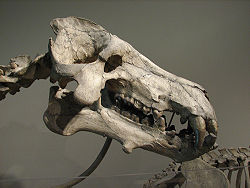
A skull of D. shoshonensis at the Carnegie Museum of Natural History
Scientific classification Edit this classification
Kingdom: Animalia
Phylum: Chordata
Class: Mammalia
Order: Artiodactyla
Family: Entelodontidae
Genus: Daeodon
Cope, 1878
Type species
Daeodon shoshonensis
Cope, 1878
Species
  • D. shoshonensis Cope, 1878
  • D. humerosum? Cope, 1879
Synonyms
Daeodon shoshonensis life restoration
Daeodon (Dinohyus) hollandi, complete skeleton from the Agate Springs Fossil Quarry in Nebraska. See text for nomenclature history

Daeodon is an extinct genus of entelodont even-toed ungulates that inhabited North America about 29 to 15.97 million years ago from the early Oligocene to late early Miocene. The type species is Daeodon shoshonensis, described from a very fragmentary holotype by Cope. Some authors synonymize it with Dinohyus hollandi and several other species (see below), but due to the lack of diagnostic material, this may be questionable.

Another large member of this family, possibly larger than Daeodon, is the Asian Paraentelodon, but it is known by very incomplete material.[1][2]

Taxonomy

[edit]

The genus Daeodon was erected by the American anatomist and paleontologist Edward Drinker Cope in 1878. He classified it as a perissodactyl and thought that it was closely related to Menodus.[3] This classification persisted until the description of "Elotherium" calkinsi in 1905,[4] a very similar and much more complete animal from the same rocks, which was promptly assigned as a species of Dynohyus by Peterson (1909).[5] This led to Daeodon's reclassification as a member of the family Entelodontidae. The exact relationships between Daeodon and other entelodonts are not well understood; some authors (Lucas et al., 1998) consider the greater morphological similarity of Daeodon to Paraentelodon rather than to earlier North American entelodonts, like Archaeotherium, as evidence for Daeodon being a descendant from a Late Oligocene immigration of large Asian entelodonts to North America.[6] However, the existence of distinct specimens of Archaeotherium showing characters reminiscent of those present in both Paraentelodon and Daeodon raises the possibility of both genera actually descending from a North American common ancestor.[1][7] Although not specified in Cope's original description, the name Daeodon comes from the Greek words daios, meaning "hostile" or "dreadful" and odon, meaning "teeth".[8]

Species

[edit]

The type species of Daeodon is D. shoshonensis, which is based on a fragment of a lower jaw from the John Day Formation of Oregon. Several other species were assigned to the genus in the subsequent decades, like D. calkinsi, D. mento[9] and D. minor.[10] Since 1945, it had been suggested that two other taxa were actually junior synonyms of Daeodon,[11] but the formalization of this referral didn't take place until the work of Lucas et al. (1998).[6] Ammodon leidyanum, named by Cope's rival, O. C. Marsh, and Dinohyus hollandi,[12] a complete skeleton from the Agate Springs quarry of Nebraska,[13] were found to be indistinguishable from each other and in turn both were indistinguishable from D. shoshonensis.[6] With the exception of D. calkinsi, which was tentatively excluded from Daeodon, the other previously recognized species of Daeodon were also synonymized to D. shoshonensis.[6] That same year, an obscure entelodont, Boochoerus humerosum, was also synonymized to Daeodon by Foss and Fremd (1998) and, albeit its status as a distinct species was retained, they note that the differences could still be attributed to individual or population variation or sexual dimorphism.[14]

Description

[edit]
Skeletal restoration

Daeodon shoshonensis is the largest-known entelodont;[6] known adult individuals had skulls about 90 cm (3 ft) long and were about 1.77 m (5.8 ft) tall at the shoulders, with large males estimated to have weighed at least 750 kg (1,650 lb).[15][5] Daeodon is differentiated from other entelodonts by a suite of unique dental characters, the shape and relatively small size of the cheekbone flanges of its skull compared to those of Archaeotherium, and the small size of its chin tubercle, as well as features of its carpus and tarsus and the fusion of the bones of the lower leg.[1][5][16] Like other entelodonts, its limbs were long and slender with the bones of the foreleg fused together[6][16] and with only two toes on each foot.[5][6] It also had a relatively lightly constructed neck for the size of its head, whose weight was mostly supported by muscles and tendons attached to the tall spines of the thoracic vertebrae, similar to those of modern-day bison and white rhinoceros.[16]

Paleoecology

[edit]

Habitat

[edit]

Daeodon had a wide range in North America, with many fossils found in Agate Fossil Beds, representing an environment in a transition period between dense forests and expansive prairie, likely a major cause of their extinction in the early Miocene.[17] It adapted to the grassland with a more cursorial body plan than more basal entelodonts like Archaeotherium, losing their dewclaws entirely, proximally fused metacarpals, and similar shoulder musculature to bison.[16][18]

The Agate Springs bonebed was a floodplain environment with wet and dry seasons. Daeodon shared this landscape with small gazelle-like camels Stenomylus, the large browsing chalicothere Moropus, several species of predatory coyote- to wolf-sized amphicyonids that lived in packs, land beavers (Palaeocastor) that filled the ecological niche of modern prairie dogs, and thousands of small herd-living rhinoceros. The rhinos suffered massive periodic die-offs in the dry season, but Daeodon fossils are rare, which suggests they were neither social animals nor especially attracted to carrion.[19]

Diet

[edit]

Daeodon was omnivorous like all other entelodonts. Enamel patterns suggest eating of nuts, roots, and vines, as well as meat and bones. The superficial similarity to peccaries, hippos, and bears implies a wide range in terms of what plants Daeodon may have been eating. The dry seasons of North America at the time could get very harsh, so they may have supplemented their water intake by eating grape vines. The extent of its carnivory is debated, but tooth wear suggests they specialized in crushing bone and ripping meat, and bite marks on chalicothere bones suggest they either hunted or scavenged large herbivores. Foss (2001) argues its head was far too heavy to be effective in taking down large prey so it must have relied exclusively on scavenging, but its bison-like adaptations for running, the stereoscopic vision characteristic of predators, and evidence of predation in entelodonts calls this interpretation into question.[20] The uncertainty of their diets suggests they were likely opportunistic omnivores similar to bears, eating whatever they needed depending on the circumstance.[21]

Behavior

[edit]

Entelodonts partook in intraspecific face biting, known from tooth marks on their skulls. Males would fight for dominance, possibly using their mandibular tubercles as protection in addition to their function as muscle attachments.[21] Sexual dimorphism of the jugal protections exist in Archaeotherium, and with a smaller Daeodon sample size, such dimorphism can't be ruled out for Daeodon. If dimorphic, the function of the expanded jugals was likely for display, supporting large preorbital glands similar to those forest hogs possessed for chemical communication.

References

[edit]
Revisions and contributorsEdit on WikipediaRead on Wikipedia
from Grokipedia
Daeodon is an extinct of entelodont, a family of large, pig-like mammals that roamed during the late to early epochs, approximately 29 to 19 million years ago. Formerly known under synonyms such as Dinohyus, the is characterized by its massive build, with adults reaching shoulder heights of 1.7 to 2 meters (5.6 to 6.6 feet), body lengths up to 3.4 meters (11 feet), and weights estimated at 600 to 1,000 kilograms, comparable to a small . These dimensions made Daeodon the largest known entelodont, featuring a robust up to 1 meter long with powerful jaws equipped for bone-crushing. Despite superficial resemblances to modern pigs—earning it nicknames like "hell pig" or "terrible pig"—Daeodon was not closely related to suids and belonged to the extinct Entelodontidae family within Artiodactyla. Its dentition included sharp canines for tearing and robust molars for grinding, supporting an omnivorous diet that encompassed vegetation such as leaves, fruits, roots, and tubers, as well as scavenging carcasses of other animals like rhinos (Menoceras) and chalicotheres (Moropus). Evidence of bite marks on fossil bones suggests it was capable of processing large prey or remains, functioning primarily as a scavenger but possibly opportunistically predatory. Fossils of Daeodon, including species such as D. shoshonensis and D. hollandi, are primarily known from western North American sites, with significant discoveries in the , including the Harrison Formation at in , where they represent some of the rarest and youngest entelodont remains. These specimens indicate Daeodon inhabited woodland and grassland environments during a period of climatic cooling and faunal turnover in the .

Taxonomy and phylogeny

Classification

Daeodon is classified as a genus within the extinct family and the order Artiodactyla, which encompasses even-toed ungulates. Phylogenetic analyses position within the , one of the major subclades of Artiodactyla, originating in during the middle Eocene around 45–40 million years ago, with dispersal to . Entelodonts are nested within , more closely related to modern cetaceans and hippopotamuses than to suines, though distinctly separate. The family is defined by several key synapomorphies, including a robust postcranial supporting large body masses and specialized cranial adaptations such as enlarged adductor musculature, prominent facial bosses, and a dentary condyle positioned at the level of the tooth row for enhanced bite force. Within this family, Daeodon stands out as the largest North American representative, exemplifying derived traits in size and cranial robusticity. Cladistic studies, such as those incorporating expanded morphological character sampling from Oligo-Miocene specimens, support the monophyly of Entelodontidae through shared derived features of the cranium and dentition, with Daeodon resolved as a derived taxon near the end of the family's temporal range.

Species and synonyms

The genus Daeodon encompasses two primary recognized species: the type species D. shoshonensis from the late Oligocene White River Formation and D. hollandi from early Miocene deposits. The D. shoshonensis was originally described by in 1878 based on a fragmentary lower ( AMNH 6978) collected from the Big Badlands of within the White River Formation. provided an additional description in 1893 under the synonym Ammodon leidyanum, but this was later subsumed into D. shoshonensis. D. hollandi was initially named Dinohyus hollandi by O.A. Peterson in 1905, with its holotype (CM 1594) consisting of a nearly complete skeleton from the Agate Springs quarry in Sioux County, Nebraska, part of the Harrison Formation (early Miocene, Hemingfordian land-mammal age). In a 1998 taxonomic revision, Spencer G. Lucas, Robert J. Emry, and L. Barry Albright established Dinohyus as a junior subjective synonym of Daeodon due to nomenclatural priority (Cope's 1878 name predating Peterson's 1905 genus), thereby transferring D. hollandi to the senior genus. This revision also resolved other junior synonyms such as Ammodon Marsh, 1893, and earlier names like Elomeryx, attributing them to the same taxon based on overlapping morphological features in type material. Species differentiation relies on subtle variations in size and dental morphology, with D. shoshonensis represented by smaller specimens (e.g., dimensions suggesting a more compact build) and D. hollandi characterized by larger overall proportions and robust structures adapted for greater occlusal force, as evidenced by comparisons of referred material from overlapping stratigraphic units. Although some analyses tentatively suggest these may represent a single due to limited diagnostic differences in fragmentary remains, the distinction is maintained in current nomenclature based on stratigraphic separation and proportional variances.

Description

Overall size and build

Daeodon, the largest known entelodont, attained substantial dimensions, with adult individuals reaching shoulder heights of 1.7 to 2 meters (5.6 to 6.6 ft), body lengths up to 3.4 meters (11 ft), and estimated body masses of 600–1000 kg derived from skeletal scaling methods applied to preserved fossils. These proportions positioned it among the largest terrestrial mammals of the Oligocene-Miocene, comparable in scale to a large . The postcranial skeleton of Daeodon emphasized adaptations for efficient , featuring long, slender limbs indicative of capabilities for sustained running across open landscapes. The forelimbs were particularly robust, with a sturdy and supporting powerful extension and flexion, while elongated neural spines along the vertebrae created a prominent dorsal hump reminiscent of modern . These features underscore balanced proportions for speed and stability. Daeodon exhibited a stance typical of , with four functional toes on the forefeet and two on the hindfeet, the latter forming a didactyl configuration with reduced lateral digits II and V. Metacarpals and metatarsals remained unfused, and phalanges were elongate with hoof-like terminals resembling those of camelids, facilitating agile movement over varied terrains without specialized fusions for extreme unguligrady. Overall, its build evoked superficial similarities to pigs in robustness but aligned more closely with in its lean, predatory frame suited to scavenging and opportunistic pursuits.

Skull and dentition

The skull of Daeodon measured up to approximately 90 cm in length, making it one of the largest among entelodonts and indicative of its overall massive cranial structure. This robust cranium featured large temporal fossae, which accommodated expansive temporalis muscles for enhanced jaw adduction during feeding. A prominent ran along the midline of the , providing additional attachment sites for these powerful jaw muscles, while the occipital region was expanded to support anchorage. The facial skeleton of Daeodon included laterally expanded zygomatic arches forming bony flanges on the cheeks, likely serving as anchors for masseter muscles or possibly for intraspecific display. The exhibited a slightly downturned orientation, contributing to a profile reminiscent of modern warthogs, which may have facilitated probing or manipulative behaviors. mechanics were adapted for a wide gape and orthal bite, with a fused and subcylindrical condyles promoting stability during forceful occlusion. Daeodon possessed a complete, unreduced dentition with the formula I 3/3, C 1/1, P 4/4, M 3/3, featuring large incisors and enlarged, tusk-like canines suited for tearing tough materials. The premolars were low-crowned and sectorial anteriorly, transitioning to more robust forms posteriorly, while the molars were bunodont with low, rounded cusps optimized for crushing and grinding a variety of food items including and . Evidence of heavy apical wear on canines and molars in specimens suggests frequent engagement in high-stress biting activities.

Distribution and paleoecology

Temporal and geographic range

Daeodon inhabited during the late to early epochs, from approximately 29 to 18 million years ago, encompassing the and Aquitanian stages of the geologic timescale. This temporal range aligns with the Arikareean and Hemingfordian North American Land Mammal Ages (NALMAs), marking a period of significant faunal turnover following the diversification of early Miocene mammal communities. Fossils of Daeodon are primarily distributed across western , with key occurrences in the and Rocky Mountain regions. Notable sites include the Sharps Formation in , the Harrison Formation at in , and the John Day Formation in , where the type species D. shoshonensis was first described from an unnamed unit above the Haystack Valley Member. Additional finds extend the range eastward, including the basal Kirkwood Formation in , the Loup Fork Beds in , and localities in , , and , indicating a broad continental presence during its existence. The record of Daeodon comprises numerous specimens, predominantly skulls and partial postcranial skeletons, recovered from stratigraphic layers diagnostic of the Arikareean and Hemingfordian NALMAs. These remains provide of its widespread distribution and stratigraphic continuity across multiple formations, with the earliest well-documented occurrences in the early Arikareean of and . Daeodon disappeared from the fossil record around 18 million years ago in the early Hemingfordian NALMA, representing the final phase of entelodont survival in .

Habitat

Daeodon inhabited diverse paleoenvironments across during the late to early , primarily wooded floodplains, savannas, and subtropical forests shaped by a warmer than today. These settings were characterized by seasonal rainfall and volcanic activity, with revealing tuffaceous siltstones, lacustrine deposits, and paleosols indicative of low-relief landscapes with lakes and rivers. records from formations like the John Day in document deciduous hardwood forests dominated by elements such as , Alnus, and Quercus, reflecting a mix of closed-canopy woodlands and open areas during the . In the John Day Formation of central Oregon, Daeodon coexisted with a rich assemblage of mammals in environments transitioning from forested woodlands to more open savannas, influenced by frequent volcanic ashfalls from the ancestral Cascades that suggest episodic wet-dry cycles. Associated biota included oreodonts like Merycoidodon, early camels such as Protylopus, primitive horses (Miohippus), and rhinoceroses, all adapted to these dynamic, ash-enriched floodplains and seasonal wetlands. The cooler, seasonal climate (mean annual temperature ~7–10°C) supported mixed vegetation with hardwoods and conifers, though aridity increased toward the Miocene. Site-specific evidence from the Sharps Formation in points to riverine habitats with waterholes and mudflats amid volcaniclastic sandstones and siltstones, fostering diverse communities in a semi-arid yet wetter than modern conditions. Here, Daeodon shared these fluvial environments with chalicotheres (), rhinoceroses (Menoceras), and camels (Stenomylus), indicative of savanna-like steppes with scattered trees during the late (~29–30 Ma). Paleosols and cross-bedded sands suggest seasonal droughts punctuated by intense rainfall, supporting open grasslands encroaching on earlier forested areas. The broader climatic context featured a late warming peak that sustained subtropical influences, promoting closed-canopy forests before a cooling trend favored the spread of open grasslands across . This shift from humid woodlands to drier savannas aligned with global patterns of decreasing atmospheric CO₂ and increasing seasonality, altering vegetation from dense thermophilous forests to bunchgrass-dominated plains.

Diet and feeding

Daeodon exhibited an opportunistic omnivorous diet, incorporating a mix of matter such as , fruits, and possibly nuts, alongside animal resources including carrion and small . Dental microwear texture of entelodont molars reveals a characterized by numerous scratches indicative of abrasive consumption and fewer pits suggestive of occasional hard-object feeding, such as or bone fragments, but not extensive bone-cracking. This aligns with the bunodont featuring low-crowned molars suited for grinding and sectorial premolars for tearing meat, enabling versatile in varied ecosystems. Stable carbon isotope ratios (δ¹³C) from tooth enamel of related entelodonts like Archaeotherium mortoni average around -9‰, indicating primary reliance on C³ plants from or forested habitats, with no significant input from C⁴ grasses. These values differ from those of contemporaneous strict herbivores, such as oreodonts (Merycoidodon spp.), which show similarly negative δ¹³C but narrower dietary niches focused on browsing without substantial animal matter. In contrast to modern suids like wild boars (Sus scrofa), Daeodon's robust musculature and enlarged temporal fossae suggest greater capacity for disarticulating carcasses, supporting a scavenging strategy supplemented by predation on smaller prey. Fossil evidence, including bite marks on bones of other White River Formation mammals, further supports Daeodon's role as a capable of accessing marrow and soft tissues from carcasses, though not a dominant like contemporary carnivorans. Microwear lacks the deep pitting and gouges seen in bone-crushers such as spotted (Crocuta crocuta), indicating that bone consumption was incidental rather than habitual. Overall, this feeding reflects ecological , allowing Daeodon to exploit both floral and faunal resources in the Oligo-Miocene plains.

Behavior and locomotion

Daeodon, like other entelodonts, displayed a adapted for traversing open woodland and savanna environments during the and epochs. Its postcranial skeleton, resembling that of typical , featured elongated limbs and a lightweight build relative to its massive , enabling efficient movement over distances and bursts of speed for pursuing opportunities or evading threats. This likely involved a bounding or trotting motion common among cursorial ungulates, supported by limb proportions that prioritized stability and endurance over agility in dense terrain. Behavioral inferences from skeletal evidence point to aggressive interactions, particularly intraspecific conflicts facilitated by the robust flanges and enlarged canines. Bite marks observed on entelodont crania, including those of Daeodon, indicate violent encounters possibly related to dominance displays or resource competition, with the bony bosses on the face serving as protective armor during head-to-head clashes. These features suggest a solitary or loosely social lifestyle, where individuals maintained territories through displays of rather than cooperative group hunting. In its , Daeodon functioned primarily as an opportunistic and , exploiting carrion and hard plant material in a niche overlapping with both herbivores and carnivores, which may have intensified competition with contemporaneous predators like amphicyonids. assemblages show Daeodon co-occurring with diverse faunas, underscoring its role as a top-level consumer that contributed to nutrient cycling in subtropical ecosystems, though increasing aridity and faunal turnover likely pressured its populations toward extinction by the early .

References

Add your contribution
Related Hubs
User Avatar
No comments yet.