Hubbry Logo
MoropusMoropusMain
Open search
Moropus
Community hub
Moropus
logo
8 pages, 0 posts
0 subscribers
Be the first to start a discussion here.
Moropus
Moropus
from Wikipedia

Moropus
Temporal range: Early-Middle Miocene, 20.43–13.6 Ma[1]
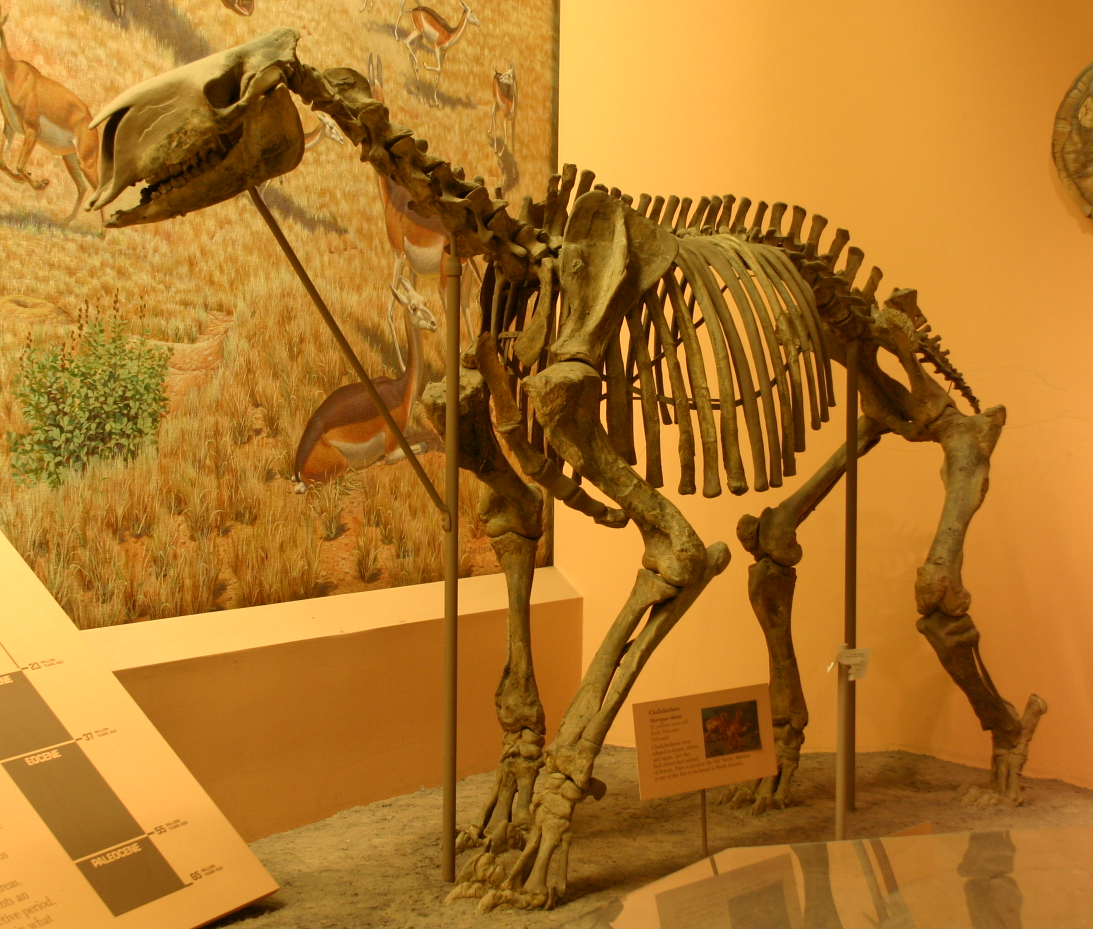
Moropus elatus skeleton at the
National Museum of Natural History,
Washington, DC
Reconstruction of the head of M. elatus
Scientific classification Edit this classification
Kingdom: Animalia
Phylum: Chordata
Class: Mammalia
Order: Perissodactyla
Family: Chalicotheriidae
Subfamily: Schizotheriinae
Genus: Moropus
Marsh, 1877
Type species
Moropus distans
Marsh, 1877
Species
  • M. distans Marsh, 1877
  • M. elatus Marsh, 1877
  • M. hollandi Peterson, 1907
  • M. matthewi Holland & Peterson, 1913
  • M. merriami Peterson, 1913
  • M. oregonensis Leidy, 1873
  • M. senex Marsh, 1877
Synonyms
Synonyms of M. elatus
  • M. cooki Barbour, 1908
  • M. petersoni Holland, 1908
  • M. parvus Barbour, 1909

Moropus (meaning "slow foot")[2] is an extinct genus of large perissodactyl mammal in the chalicothere family. They were endemic to North America during the Miocene from ~20.4–13.6 Mya, existing for approximately 6.8 million years. Moropus belonged to the schizotheriine subfamily of chalicotheres, and has the best fossil record of any member of this group; numbers of individuals, including complete skeletons, have been found. The type species of Moropus, M. distans, was named by Othniel Charles Marsh in 1877, alongside two other species, M. elatus and M. senex. Three more species have been named since. Others have been named, but have either been invalidated for one reason or another, or reclassified to other genera.

Among the largest chalicotheres, some specimens of Moropus stood 2.4 m (8 ft) at the shoulder. One specimen had an estimated body mass of 1,179 kg (2,599 lb). Its dental anatomy was similar to ruminants, suggesting a similar method of cropping vegetation. Retracted nasal bones suggest a long upper lip, and a wide gap between the lower incisors and cheek teeth, called a diastema, would provide room for a long tongue to extend from the mouth at an angle. Together, the upper lip and tongue may have been used to pull down vegetation. Though not as adept at bipedalism as the related Chalicotherium, it may nonetheless have reared up on two legs to browse on vegetation, using its claws to hook into the bark of a tree or using them to pull down leaves that would otherwise have been unreachable. Moropus may have been sexually dimorphic, with the males being larger than the females.

Taxonomy

[edit]

Early history

[edit]

The first of the remains currently assigned to Moropus was a partial right maxilla (YPM 10030), uncovered at some point prior to 1873. In that year, the specimen was described YPM 10030, initially mistakenly attributed to Lophiodon.[3] After its discovery, multiple more complete specimens were discovered in the Miocene strata of the John Day Fossil Beds of Oregon.[4] In 1877, Othniel Charles Marsh formally described the specimens, assigning to them the genus name Moropus. The type species of Moropus, M. distans, was based only on fragments of the hind foot.[4][5] Two other species, M. elatus and M. senex, were also described. At first, Marsh believed that Moropus belonged to the order Edentata, which historically included any mammal that lacked incisor teeth. Though he noted affinities with the African Ancylotherium, he opted to erect a new family, Moropodidae, to exclusively include Moropus.[5] In 1908, geologist and palaeontologist Erwin Hinckley Barbour noted that Moropus had occasionally been treated as a form intermediate between edendates and ungulates, though affirmed that it was definitely a true ungulate.[6]

In 1913, Olof August Peterson named a new species of Moropus, M. hollandi, from limb elements recovered in 1901, at first mistakenly assigned to M. elatus.[7] In a 1913 monograph on chalicothere taxonomy, Moropus in particular, Peterson and William Jacob Holland recognised two additional species, M. matthewi and M. merriami, and reassigned Moropus to Chalicotheriidae.[4]

Invalid or reassigned species

[edit]

In 1892, Barbour came into possession of a partial mammal skeleton from the Agate Fossil Beds National Monument.[8] He assigned the specimen to Moropus, and named a new species, M. cooki (after Harold Cook, who discovered it) based on it. However, Peterson and Holland considered M. cooki a junior synonym of M. elatus.[4] In 1907, Holland named M. petersoni, also from the Agate Fossil Beds, after Peterson.[9] Later, in 1975, Margery Chalifoux Coombs suggested that M. petersoni was instead the same taxon as M. elatus, and that its differences could be explained through sexual dimorphism (see below).[10] In 1935, Soviet palaeontologist K.K. Flerov named an Asian species of Moropus, "M." betpakdalensis from Kazakhstan.[11] This taxon has since been reassigned to a genus of its own, Borissiakia.[12] Another purported Asian Moropus, "M." huangheensis, has also been reassigned to Borissiakia.[13]

Taxonomy

[edit]

Chalicotheres are part of the order Perissodactyla, which includes modern equines, rhinoceroses, and tapirs, as well as extinct groups like brontotheres.[14][15] As the early evolution of perissodactyls is still unresolved, their closest relatives among other perissodactyl groups is obscure.[15] They are generally placed as part of the clade Ancylopoda alongside their close relatives Lophiodontidae. Many studies considered them as closer to Ceratomorpha (which includes tapirs and rhinoceroses) than Equoidea.[16][17] A 2004 cladistic study alternatively recovered Ancylopoda as sister to all modern perissodactyls (which includes Equoidea and Ceratomorpha), with the brontotheres basal to both.[18]

In their 1914 monograph on chalicotheres, Holland and Peterson listed three subfamilies: Moropodinae (Ancylotherium, Moropus, and Nestoritherium), Macrotheriinae (including Chalicotherium, Circotherium, and Macrotherium) and Schizotheriinae (Pernatherium and Schizotherium).[4] Macrotheriinae was subsequently synonymised with the existing Chalicotheriinae. Palaeontologist Arthur Smith Woodward, in 1925, concurred with the system used by Holland and Peterson, and only altered the placements of a few genera.[19] William Diller Matthew instead split chalicotheres into just two subfamilies, Chalicotheriinae and Eomoropinae. The former was divided into two clades based on whether their teeth were brachydont (short-crowned) or hypsodont (high-crowned): Moropus fell into the latter category.[20] In 1935, Edwin H. Colbert retained this system, though divided Chalicotheriinae into the tribes Chalicotheriini and Schizotheriini.[19] Currently, they are both treated as tribes,[12] and eomoropids have been removed from Chalicotheriidae entirely.[21][22] Moropus is currently classified under Schizotheriinae.[23]

Description

[edit]
Size comparison between M.elatus and a human

Some species of Moropus, such as M. elatus, were among the largest chalicotheres,[5] standing about 2.4 m (8 ft) tall at the shoulder and with a body weight around the size of a large rhinoceros.[4] One Moropus specimen has an estimated body mass of 1,179 kg (2,599 lb).[24][25] Smaller specimens have been described as being about the size of a tapir.[4][26]

Skull

[edit]

Moropus' skull was fairly small compared to its body.[27] It was narrow, and bore high nasal bones. The snout had a spoon-shaped tip, a characteristic common to selective browsers. It suggests the presence of mobile lips and possibly a long tongue.[27] William Berryman Scott suggested that the tongue may have been used in conjunction with the upper lip to pull down branches.[28] The lower incisors protruded forwards, and the premaxilla is toothless, similar to in modern ruminants. This would have formed a cropping mechanism for processing vegetation. There was a diastema (gap) separating the incisors from the cheek teeth, which would have allowed the tongue to extrude from the mouth.[27] The maxilla was similar to that of modern horses (Equus).[4] Some specimens (or species) Moropus did not have a sagittal crest,[6] while others did, even as juveniles.[4]

Dentition

[edit]

Moropus had incisors only on the lower jaw.[29] The cheek teeth (the premolars and molars) were robust, covered in thick enamel, and strongly rooted. The first upper premolar is absent, like other chalicotheres. The second upper premolar was triangular, with the protocone and tritocone (cusps) having fused into a single structure, mostly comprising the former. The third upper premolar is more quadrate in shape, and has one tubercle rather than two. The fourth upper premolar is slightly larger but otherwise very similar.[4] The lower incisors, of which there were three on each side,[4] are procumbent (protruding), spatulate, and were separated from the cheek teeth by a long diastema.[29] The first upper molar is very enlarged, the second is one-fifth longer, and the third is only slightly larger. All three are roughly the same in terms of overall structure. The second lower premolar is highly reduced. Third is molariform (molar-like), in a similar fashion to the brontothere Megacerops. The first lower molar is considerably wider than the fourth lower premolar, though they are otherwise quite similar, with the exception that the hypoconid is more well-developed and the cingulum is less so. The second lower molar is longer, and has a more prominent cingulum. The third lower molar lacks its third lobe, similar to other chalicotheres.[4]

Postcranial skeleton

[edit]

Moropus' neck was somewhat like that of a modern horse, albeit considerably stockier.[4] All of Moropus' cervical (neck) vertebrae were somewhat elongated, and the neck was long enough that, when drinking, Moropus would have to splay its forelimbs to reach the ground level, as in modern giraffes. This, and the fact that the dorsal musculature of the neck appears to have been stronger than the ventral musculature, suggest that Moropus held its neck obliquely upright.[27] As in other chalicotheres, Moropus differed from typical ungulates in having large claws, rather than hooves, on the feet. Three large, highly compressed claws were present on each of the front feet, supported inside by fissured bony phalanges. As with all schizotheriines, the articulation of the phalangeal (finger) bones shows that Moropus could retract its claws enough to walk smoothly with the front feet in a normal digitigrade stance, lifting the claws by hyperextension. Moropus was likely more heavily quadrupedal than Chalicotherium. However, while not as extreme as in Chalicotherium, Moropus' pelvis still bore some adaptations for bipedal stance, such as a long ischium, and changes in the structure of the hindfoot (i.e. the shortening and widening of the astragalus) to increase its weight-bearing capabilities without sacrificing limb length.[27]

Palaeobiology

[edit]
Life restoration of a browsing M. oregonensis

Feeding and diet

[edit]

The spoon-shaped snout tip of Moropus suggests that it was a browser.[27] It was suggested by William Diller Matthew that Moropus used its claws to dig for buried plant matter and water sources,[20] though as it did not live in an arid environment, this is unlikely.[27] Russian palaeontologist Alexey Borissiak suggested, based on Borissiakia from Kazakhstan, that schizotheriines may have fed bipedally, wedging their front claws into tree bark for support. The middle claw could be driven directly into the bark, while the first and third could be freely moved as necessary.[30] In 1943, Swiss palaeontologist Samuel Schaub suggested that the related Ancylotherium used its forelimbs to pull down vegetation,[31] much as in chalicotheriines.[27]

Sexual dimorphism

[edit]

There has been some debate over whether Moropus was sexually dimorphic. The matter was discussed by Olof August Peterson and William Jacob Holland in their monograph, in reference to two different mature size groups that had been noted. The larger one was M. elatus, and the other was, at the time, considered M. petersoni. Larger individuals possessed small sagittal crests, whereas smaller individuals did not (and instead retained independent supraorbital ridges), though noted this could be due to sexual dimorphism. They supposed that, if they were females, the smaller specimens would have a larger pelvic cavity with larger foramina for blood supply, which is not observed. Based on the relative subtetly of these differences, which did not, to them, indicate sexual dimorphism, the smaller morph was decided to probably be separate, and Moropus petersoni was retained as a taxon.[4] However, Margery Chalifoux Coombs suggested that there was, in reality, no reason to assume that sexual dimorphism was absent, and opted to sink M. petersoni into M. elatus. She suggested that "M. petersoni", being smaller, may have represented the female of M. elatus. Further, she noted that there were cases of possible sexual dimorphism throughout Chalicotheriidae, and that there would be a strong precedent for it.[10]

References

[edit]
Revisions and contributorsEdit on WikipediaRead on Wikipedia
from Grokipedia
Moropus is an extinct of large, clawed perissodactyl belonging to the Chalicotheriidae, known for its unusual combination of horse-like teeth and edentate-like claws adapted for browsing vegetation. These herbivores inhabited forested environments in during the epoch, approximately 20 to 14 million years ago, with fossil remains primarily discovered in the region, such as the Harrison Formation in . Characterized by a robust build with longer forelimbs than hindlimbs, a sloping back, and an elongated neck reminiscent of a short-necked or , Moropus stood roughly as tall as a modern at the and likely used its large, retractile claws to pull down branches for feeding. The includes several , such as the M. distans and the well-represented M. elatus, with abundant skeletal material from sites like Fossil Beds revealing details of its growth patterns and , where males were larger than females. As one of the last chalicotheres in , Moropus became extinct around 13.6 million years ago, possibly due to environmental changes shifting from forests to more open landscapes.

Overview

Etymology and general characteristics

Moropus is an extinct of large perissodactyl belonging to the family , known from abundant fossil remains primarily in . The was named by in 1877 based on specimens including limb bones and teeth from Miocene deposits in . The name derives from the Greek words mōros (sluggish or slow) and pous (foot), reflecting early interpretations of the animal's limb structure suggesting a lumbering, slow-moving gait. As one of the largest chalicotheres, Moropus reached up to 2.4 meters in shoulder height and approximately 3 meters in body length, with an estimated body mass of 1,000–1,200 kilograms. It exhibited a robust build with an elongated neck, longer forelimbs than hindlimbs, and a sloping back reminiscent of a short-necked giraffe or okapi, adaptations suited for browsing vegetation in forested environments. Unlike typical perissodactyls such as horses or rhinoceroses, which bear weight on hooves, Moropus possessed distinctive large, hook-like claws on the three forward-facing digits of its forelimbs and a hoof-like structure on the central digit of its hindlimbs, facilitating the pulling and stripping of branches and leaves. This unique manus-pes duplex configuration, characteristic of schizotheriine chalicotheres, underscores its role as an odd-toed ungulate specialized for arboreal foraging rather than cursorial locomotion.

Temporal and geographic range

Moropus inhabited during the Early to Middle , corresponding to the Arikareean through Barstovian North American Land Mammal Ages (NALMAs), approximately 20.6 to 15 million years ago (Ma). Fossils attributed to the first appear in late Arikareean assemblages around 20 Ma, with the youngest records from early Barstovian faunas dating to about 15 Ma. This temporal span reflects a period of climatic warming and increasing aridity across the continent, though Moropus persisted in suitable habitats until the mid-. The genus was primarily distributed in North America, with fossil evidence also reported from Eurasia (e.g., Turkey), and no records from other continents. Key localities include the Agate Fossil Beds National Monument in Nebraska, where abundant remains occur in the Harrison Formation; sites in southeastern Wyoming associated with early Hemingfordian conglomerates; the John Day Formation in central Oregon, yielding Hemingfordian specimens from the Rose Creek Member; and Hemingfordian deposits at Flint Hill Quarry in Bennett County, South Dakota. Additional records extend to the Great Basin region, including Nevada and Texas, but the core distribution centered on the Great Plains and intermountain west. Fossils of Moropus are preserved in stratigraphic units such as the Harrison and Anderson Ranch Formations in , the John Day and Sucker Creek Formations in , and the Olcott Formation in , among others. These deposits represent fluvial, lacustrine, and volcanic ash-influenced settings that indicate subtropical to temperate paleoenvironments, characterized by mixed forests, open grasslands, and seasonal river systems supporting diverse mammalian faunas. Such conditions facilitated the lifestyle inferred for Moropus, with and faunal assemblages suggesting warmer, moister climates than today in these regions.

Taxonomy and phylogeny

Discovery and naming

The genus Moropus was established based on fossils collected during the Scientific Expedition of , which recovered limb elements from deposits in and . In 1877, paleontologist formally described the genus and named three species: the M. distans from co-ossified phalanges and a metatarsal of the hind foot found in , M. elatus from larger phalanges and a metatarsal indicating rhinoceros-like size from , and M. senex from additional phalanges. erected the new family Moropidae for these perissodactyls, distinguishing them by their unique claw-bearing digits adapted for a terrestrial lifestyle, though the specimens represented only partial postcranial remains without cranial material. Significant additional discoveries occurred in the early at the Agate Spring Fossil Quarry in Sioux County, Nebraska, a major bonebed in the late Arikareean (early ) Harrison Formation. The site was first identified in 1907 by rancher James H. Cook, who noted exposed bones eroding from a hillside; initial excavations revealed a dense concentration of articulated skeletons preserved in a fluvial deposit, likely resulting from a drought-induced mass death assemblage. The (AMNH) launched systematic field expeditions starting in 1908 under the direction of , yielding over a dozen partial to nearly complete Moropus skeletons, including the first well-preserved skulls and associated , which allowed for better understanding of the animal's anatomy beyond isolated limbs. Osborn's AMNH teams continued work through the 1910s, collecting 17 Moropus specimens from Agate Spring by 1919, which he described as representing a new species, M. cookei, honoring the discoverer (later considered a junior of M. elatus). These finds provided the most complete skeletal material available at the time, including elements with large claws and postcranial proportions suggesting a giraffe-like build. Regarding , Marsh's Moropidae was short-lived; by the early , Osborn and others synonymized Moropus with the based on shared claw morphology and perissodactyl affinities, integrating it into broader studies of evolution during AMNH expeditions.

Valid and invalid species

The genus Moropus encompasses several valid species recognized on the basis of diagnostic morphological features, primarily from North American deposits. The type species is M. oregonensis, originally described from but now including material from following the synonymy of M. distans due to overlapping dental and postcranial traits in fragmentary specimens. Other valid species include M. elatus, the largest known member of the genus from , distinguished by its greater overall size and elongated limb elements; M. hollandi from , characterized by more gracile limb proportions; M. matthewi from , with unique metatarsal robusticity; M. merriami from and , noted for broad astragali and specific patterns of phalangeal fusion; and M. senex from , identified by advanced dental wear and larger humeral dimensions. These species exhibit size variations, with M. elatus reaching shoulder heights of approximately 2.4 m, while smaller forms like M. oregonensis are closer to 2 m. Several proposed species have been invalidated or reassigned through taxonomic revisions. Moropus petersoni, initially described from , was later synonymized with M. elatus and interpreted as representing , specifically the smaller morph, based on consistent proportional differences in canine size and body mass estimates from associated skeletons. Moropus betpakdalensis, known from Asian material, was reassigned to the genus Borissiakia due to distinct cranial features and geographic separation from North American Moropus. Additionally, Moropus prestonensis has been treated as a junior of M. merriami owing to insufficient distinguishing characteristics in the limited type material from western deposits. Validity of Moropus species is determined primarily through morphometric analyses of limb proportions, such as astragalus width relative to length and metatarsal III/IV ratios, alongside dental wear patterns that reflect occlusal differences in premolars and molars. For instance, M. merriami shows early incorporation of the protocone in P4 wear, contrasting with more transverse loph wear in related taxa. However, ongoing debates persist regarding synonymy, particularly for species known from fragmentary remains, where individual variation and taphonomic distortion complicate distinctions; revisions like the synonymy of M. distans highlight how additional specimens can resolve these issues.

Phylogenetic relationships

Moropus is positioned within the extinct family , subfamily Schizotheriinae, as determined by cladistic analyses employing both cranial and postcranial characters to resolve relationships among perissodactyls. Within Schizotheriinae, Moropus forms a with close relatives including Tylocephalonyx and Postschizotherium, sharing derived features such as elongated limbs and specialized manus and pes morphology adapted for . The broader phylogeny of traces its origins to early Eocene chalicotherioids in , with the superfamily Chalicotherioidea diverging from other perissodactyl lineages approximately 50 million years ago during the Ypresian . Moropus, as a late-branching restricted to , exemplifies the Miocene radiation of Schizotheriinae following an initial Eurasian dispersal and subsequent migration across near the Oligocene-Miocene boundary. Seminal cladistic studies from the late , expanded in 2010s analyses incorporating new fossil material, affirm the monophyly of Schizotheriinae through shared synapomorphies like reduced lateral digits and fused phalanges. However, basal perissodactyl relationships remain partially unresolved, with ongoing debates regarding the exact positioning of early chalicotherioids relative to tapiromorphs and other euperissodactyls.

Physical description

Cranial anatomy

The of Moropus is elongated and horse-like in overall morphology, measuring approximately 60 cm in length, with thin walls that suggest a relatively delicate cranial structure relative to the robust postcranial . This form includes a spoon-shaped preorbital region adapted for leaf-stripping, as inferred from the elongated typical of schizotheriines. The large nasal opening indicates the possible presence of a mobile upper lip for selective browsing. Key cranial features include robust zygomatic arches that provided attachment sites for powerful muscles. The orbits are elevated, facilitating panoramic vision to detect predators or . The braincase is relatively small in proportion to the animal's body size, as evidenced by molds of the cavity from preserved specimens. The are large and wide, separated by a deep notch, while the basioccipital lies in the same plane as the palatine and the basisphenoid angles relative to it. The tympanic bone forms an inflated ovoid bulla with its axis parallel to the skull's median line, and the small external auditory is positioned midway between the post-glenoid and occipital processes. Slight variations exist among species; for example, M. elatus exhibits a broader compared to other Moropus taxa. These features collectively reflect adaptations for a in forested or environments during the .

Dentition

The of Moropus consists of reduced and robust posterior cheek teeth specialized for processing fibrous plant material. The molars are low-crowned (brachyodont) and bunoselenodont, with wrinkled enamel on the occlusal surfaces that facilitated grinding of tough through increased surface area and friction during mastication. Premolars exhibit blade-like shearing crests, particularly on the protoloph and metaloph, aiding in initial breakdown of food before molar processing. Incisors are reduced, with the upper row absent due to an edentulous , while the lower incisors (typically three per side) are procumbent and spatulate in form, functioning in cropping rather than precise nipping. Canines are absent in both jaws, a derived condition in schizotheriines that emphasizes reliance on the and lower incisors for prehension. The dental formula of Moropus follows the typical schizotheriine pattern of 0/3 incisors, 0/0 canines, premolars, and molars per quadrant, yielding teeth in total. This configuration reflects evolutionary reduction in the anterior dentition compared to basal perissodactyls, prioritizing cheek tooth efficiency for herbivory. Upper premolars and molars are quadrate to rectangular, with transverse lophs that become more elongate posteriorly; lower counterparts show similar lophid arrangements but with curved entolophids and hypolophids for enhanced grinding. Wear patterns on Moropus teeth reveal heavy microwear, characterized by numerous scratches and pits on enamel surfaces, indicative of an diet involving fibrous foliage and possibly bark or twigs. Mesowear of schizotheriine relatives shows intermediate relief and cusp sharpness, supporting folivory with occasional harder or dust-contaminated browse that accelerated enamel attrition. These features underscore the of Moropus to a selective niche, distinct from perissodactyls with teeth.

Postcranial skeleton

The of Moropus featured a relatively long neck composed of seven , similar in structure to those of equids but stockier and with prominent zygapophyses and spinous processes, facilitating reach toward elevated vegetation. The thoracic region included 15 robust vertebrae with high, stout spinous processes that provided for the animal's large body mass, showing minimal reduction toward the area. The series consisted of six vertebrae, while the was formed by four fused vertebrae, and the caudal vertebrae were long and slender, indicating a substantial . The forelimbs were elongated and robust, exceeding the hindlimbs in length, with a measuring approximately 55 cm long and a shaft diameter of 7.5 cm, and a (partially co-ossified with the ) reaching about 60 cm in length. The manus was tridactyl, bearing three functional digits with large, laterally compressed claws—the central digit being the most prominent—for grasping or hooking; the ungual of these claws measured up to 15.5 cm, and the proximal and middle phalanges of digit II were often fused into a "duplex" structure. Adaptations lacked features for , such as highly robust metacarpals. In contrast, the hindlimbs were slightly shorter overall, featuring a around 65 cm long with a proximal width of 23 cm and shaft diameter of 10 cm, and a measuring 47 cm. The pes was also three-toed, with digits terminating in claw-like hooves that were less pronounced than those on the manus, providing stability on varied terrain; digit II similarly showed phalangeal fusion in known specimens. These proportions contributed to a forelimb-dominant in Moropus, consistent with body size estimates reaching 2.4 m at the and over 1,000 kg in mass.

Locomotion and posture

Moropus, as a member of the schizotheriine chalicotheres, primarily employed a quadrupedal locomotion characterized by a slow, deliberate , reflected in its generic name derived from Greek roots meaning "sluggish" or "slow" foot. This lacked adaptations for speed, such as elongated metapodials seen in contemporary perissodactyls like , and instead emphasized stability suited to forested environments. Forelimbs were somewhat longer than hindlimbs, resulting in a slightly sloping back during quadrupedal progression, though less pronounced than the more pronograde, steeply sloping dorsal profile of chalicotheriines. Skeletal reconstructions indicate that Moropus could assume a semi-erect, bipedal posture for short durations, rearing up on its s while elevating the forelimbs to manipulate branches, though this capability was less pronounced than in chalicotheriines due to less extreme disparity in fore- and lengths. The forelimbs exhibited notable flexibility, facilitated by a protractable and robust joints, enabling precise positioning and grasping motions in such stances. , broader and more robust at the ankle (astragalus), provided primary propulsion and support, contributing to a clinograde body orientation reminiscent of modern large-bodied browsers like during stationary postures. The curved, laterally compressed claws on all digits, rather than being optimized for deep digging as initially hypothesized, likely aided in maintaining balance and traction on uneven, vegetated during both quadrupedal travel and occasional bipedal rearing. This functional interpretation aligns with the overall of schizotheriines, where limb morphology prioritized deliberate, grounded mobility over agility, evoking a terrestrial analog to arboreal sloths but adapted for a fully lifestyle.

Diet and feeding behavior

Moropus was a folivorous browser that primarily consumed leaves, twigs, shrubs, and soft fruits from low- to mid-height , reflecting its to selective in forested or environments. While primarily a browser, it may have occasionally accessed and tubers using its claws, though evidence suggests this was secondary to pulling branches. This dietary niche aligned with the abundant browse available in Miocene North American habitats, such as riparian zones within semiarid savannas. The animal's feeding strategy relied on its specialized to access and process . It used its prominent claws to hook and pull branches toward its mouth, often while rearing up in a semi-bipedal posture, while a long neck and elongated enabled precise selection of foliage. These adaptations, combined with mobile and possibly a prehensile , facilitated efficient without significant reliance on . Dental evidence from stereomicrowear analysis supports consumption of abrasive, fibrous plant matter, including bark and twigs alongside softer leaves, as indicated by low scratch counts, high large pit percentages, and prevalent gouging on molars. wear patterns reveal moderate abrasion consistent with a diet rather than mixed feeding or . Stable carbon isotope data from associated faunas, including Moropus, confirm a dominance of C3 , underscoring its reliance on woodland vegetation over C4 grasses.

Sexual dimorphism and reproduction

Evidence for in Moropus primarily derives from size variations observed in limb bones of M. elatus from the Agate Spring Quarries in . Analysis of and lengths reveals a bimodal distribution, with approximately equal numbers of larger and smaller individuals, indicating that males were substantially larger than females—up to 40% in linear dimensions for postcranial elements. This pattern, combined with otherwise uniform morphology across specimens, supports the interpretation of a single sexually dimorphic rather than multiple taxa; accordingly, the smaller-bodied M. petersoni has been synonymized with M. elatus as representing females. Similar size bimodality has been noted in other chalicotheres, reinforcing that such variation likely reflects sexual differences rather than ontogenetic or ecotypic factors. Recent allometric analyses of M. elatus skeletons indicate prolonged growth periods, supporting interpretations of dimorphism and gregarious in adults. Direct evidence for reproductive biology in Moropus is limited, as no fetal remains or birth-related fossils have been documented. However, inferences from its perissodactyl relatives suggest a period of approximately 11-12 months, comparable to that of equids like (about 340 days), with which Moropus shares a similar body size and . Litters typically consisted of a single precocial offspring, as is standard among large perissodactyls, enabling rapid mobility in potentially forested habitats. Fossil assemblages provide indirect clues to social and reproductive structure. The recovery of seventeen articulated Moropus skeletons, including multiple complete skulls, from the Agate Spring Quarry indicates gregarious habits, with individuals likely living in herds that facilitated seasonal breeding synchronized to environmental cues like cycles. The pronounced sexual size dimorphism further implies a polygynous , where larger males competed for access to females, a commonly associated with such disparities in ungulates.

References

Add your contribution
Related Hubs
User Avatar
No comments yet.