


Community hub
Recent from talks
Contribute something
Nothing was collected or created yet.
Darren McCarty
View on Wikipedia
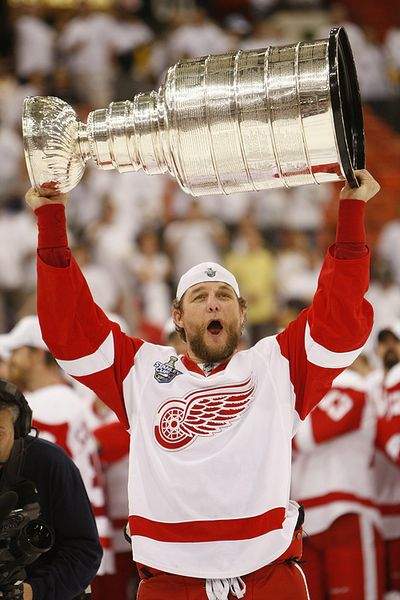
Darren Douglas McCarty (born April 1, 1972) is a Canadian former professional ice hockey forward and professional wrestler, best known for his years playing with the Detroit Red Wings of the National Hockey League (NHL). McCarty has been known for taking on the role of the Red Wings enforcer most of his career, a role in which he played in five Stanley Cup Finals and won the Stanley Cup four times in 1997, 1998, 2002, and 2008, the last of which after resurrecting his career in the Red Wings minor league system.
Key Information


McCarty spent much of his childhood in the small town of Leamington, Ontario, playing for the Southpoint Capitals (OMHA) minor teams.
Playing career
[edit]Belleville Bulls
[edit]McCarty played for the Belleville Bulls of the Ontario Hockey League from 1989 through 1992. As captain of the team during the 1991-92 season, McCarty recorded 55 goals and 72 assists for 127 points in 65 games. He was awarded the Jim Mahon Memorial Trophy as the top scoring right winger.
Detroit Red Wings
[edit]Drafted by the Red Wings in the 1992 NHL entry draft in the 2nd round, 49th overall, McCarty scored 26 points in his rookie season to help the team win the Central Division title. The Red Wings managed to make it to the 1995 Stanley Cup Finals in his second season, McCarty's first overall, against the New Jersey Devils, where the team and the hockey world were stunned to be swept.
During the 1996–97 NHL season, arguably McCarty's most eventful, he managed to score a career-best 19 goals and 42 points. One of McCarty's most infamous moments, or 'famous moment' for Red Wings fans at least, was in the famous "Fight Night at the Joe" on March 26, 1997, where a massive brawl broke out between the Colorado Avalanche and Red Wings. McCarty stunned Avalanche right winger Claude Lemieux with a blistering punch and continued punching Lemieux while Lemieux "turtled" his body to avoid damage. The fight was revenge for a hit that Lemieux inflicted on Kris Draper in the previous years playoffs, that caused significant injuries to Draper, and which also happened in front of McCarty while he was sitting on the bench. McCarty, who managed to stay in the game, ended his eventful night with scoring the overtime goal against Patrick Roy. The fight was considered what brought the team together in time for the playoffs, and helped break the Stanley Cup drought curse over the franchise. The Red Wings managed to make it back to the Cup Final, McCartys second finals appearance, and the Red Wings swept the Philadelphia Flyers for their first Stanley Cup in 42 years; McCarty scored the most famous goal of his career, some comparing the move with a Mario Lemieux play, which also turned out to be the game winning and Cup-clinching goal, on Ron Hextall in Game 4.
The next season, the team made it back the cup final, its second consecutive appearance, and McCarty's third overall, against the Washington Capitals, managing to sweep them as well for their second consecutive, and McCarty's second, Stanley Cup. This season was primarily dedicated to former Red Wings defenceman Vladimir Konstantinov, who, mere days after winning the Cup the previous year, suffered career ending and life altering injuries in a limousine accident.
From the 1997–98 season until his departure from the Red Wings in 2005, but following his return in 2008, McCarty was part of Detroit's famous Grind Line with center Kris Draper and winger Kirk Maltby, which was often matched up against the opponent's top offensive line.
In the 2002 Stanley Cup Playoffs, McCarty registered his first hat-trick in Game One of the Western Conference Finals against the Colorado Avalanche's Patrick Roy. McCarty scored four goals in the series, a career best. Meeting the Carolina Hurricanes in the 2002 Stanley Cup Final, McCarty's fourth final appearance overall, Detroit won the series and their third Stanley Cup in six years, making it McCarty's third Stanley Cup championship.

Calgary Flames
[edit]After 11 seasons with the Red Wings, McCarty and the team parted ways as the lockout cancelled the 2004–05 NHL season. McCarty's contract was bought out by the Red Wings as a result of the newly implemented salary cap. He then signed as a free agent with the Calgary Flames on August 2, 2005. He scored seven goals for the Flames during the regular season. He scored the overtime winning goal in Game 1 of the Flames first round series against the Mighty Ducks of Anaheim, a series Calgary would eventually lose in 7 games. In the 2006–07 season, McCarty appeared in only 32 games and for the first time in his career, failed to register a point.
Flint Generals
[edit]On December 31, 2007, the Flint Generals of the International Hockey League announced that McCarty had signed with the team.[1] The Generals are co-owned by McCarty's former Grind Line linemate Kris Draper, who encouraged McCarty to make a comeback to professional hockey after his career seemed over after falling into alcohol.[2][3] McCarty made his home debut for the Generals on January 12, 2008, and recorded one assist in the 4–3 victory. In ten games with the Generals, McCarty had three goals, two assists, and thirty penalty minutes.
Grand Rapids Griffins and return to the Red Wings
[edit]On January 30, 2008, The Grand Rapids Press reported that McCarty would sign a professional tryout contract with the Grand Rapids Griffins.[4] On February 4, 2008, this was made official.[5] On his Griffins debut at Van Andel Arena, he tallied a hat trick and added an assist to power Grand Rapids to a 6–3 win over the Lake Erie Monsters.
On February 25, McCarty signed a one-year contract with the Red Wings and was called up on March 7.[6] Facing Nashville in the opening round of the 2008 playoffs, McCarty scored the opening goal in Game Two, a 4-2 Detroit win. Making the 2008 Stanley Cup Finals with the team against the Pittsburgh Penguins, the Red Wings eventually won the Stanley Cup in six games, which was McCarty's fifth Finals appearance overall, and his fourth championship all together. This made him, along with teammates Nicklas Lidstrom, Tomas Holmstrom, Kris Draper, and Kirk Maltby the only five players who won all four championships the franchise achieved between 1997 and 2008. McCarty was re-signed to a one-year contract with the Red Wings in the offseason.
Playing just 13 games in the 2008-09 season, he scored his first regular season goal since his comeback but which also turned out to be the last of his career at home against Pittsburgh Penguins goaltender Marc-Andre Fleury on November 11th, 2008, and racked up 25 penalty minutes. On November 18, the Red Wings placed McCarty on waivers, knowing he would not be claimed. McCarty cleared waivers and remained with the team. After being sent to the Griffins for just one game, McCarty was recalled. McCarty later suffered a groin strain, which landed him on injured reserve in late November. On February 24, 2009, the Detroit Red Wings reassigned McCarty to the Griffins after being activated from the injured reserve list. There, he played in 19 games for the Griffins, scoring 5 goals and 6 assists while also collecting 21 penalty minutes. During the Griffins' playoff run, McCarty scored 3 goals, 1 assist, and 8 penalty minutes in 10 games. After the Griffins were eliminated in the playoffs by the Manitoba Moose, McCarty was recalled by the Red Wings along with several other Griffins players on May 10. [1]
On July 1, 2009, McCarty became an unrestricted free agent. One week later, Red Wings' general manager Ken Holland stated that the team would likely move on from McCarty in order to help promote and give more ice time to their rookies and prospects. [2]
Retirement
[edit]On December 7, 2009, McCarty officially retired and had already accepted a job as a color analyst for Versus. A fifteen-season veteran and fan favorite in Detroit, McCarty thanked the Red Wings and Flames organizations as well as the fans for helping him to realize his dream.[7]
Broadcasting
[edit]On November 23, 2009, McCarty made his debut as an NHL Analyst for Versus. McCarty made occasional appearances on the Versus post game show, Hockey Central. McCarty served as a fill-in co-host on WXYT-FM (97.1 The Ticket) in Detroit.
McCarty appeared on the January 24, 2012 episode of the truTV reality series Hardcore Pawn, where he appeared with a friend who was trying to sell an alligator hide. Later, American Jewelry and Loan owners Les and Seth Gold and truTV hired McCarty to do some cameo appearances on the show.
McCarty started his weekly podcast, Grind Time with Darren McCarty, in December 2018. He broadcast weekly from Radio for One Studios featuring guests to discuss topics ranging from hockey to music to life's journey to legalization of cannabis. The "Grind Time with Darren McCarty" team consists of his co-host Perry Vellucci and executive producer / business manager, Nick Antonucci, which has joined Woodward Sports Network in Birmingham, MI as of January 2021.
Professional wrestling career
[edit]McCarty now occasionally appears and wrestles for pro wrestling company ICW No Holds Barred. He was brought in to feud with wrestlers Brandon Kirk and Kasey Kirk.
On March 24, 2023, he was a guest at IMPACT Wrestling's monthly special Sacrifice. After being confronted by Bully Ray, it led to a fight in the ring between the two. The Good Hands (John Skyler and Jason Hoch) and Bully Ray triple powerbombed McCarty through a table.[8] He returned to IMPACT to team with Tommy Dreamer and Yuya Uemura in a six-man tag team match against Bully Ray and the Good Hands on a post-Sactifice edition of IMPACT.[8] The April 6 edition of IMPACT saw McCarty, Dreamer, and Uemura get the win with McCarty getting the pinfall.[9] On the June 29 edition of IMPACT, it was announced that McCarty would be returning at the Slammiversary pay-per-view (PPV). He was announced as the special guest enforcer for Bully Ray and Steve Maclin vs. PCO and Scott D'Amore tag team match.[10]
Personal life
[edit]
McCarty's father, Craig, was diagnosed with multiple myeloma, an incurable cancer of the bone marrow and blood, in 1995. In 1997, Darren McCarty established the McCarty Cancer Foundation to raise funds to finance research for a cure of this type of cancer.
During the early 2000s he was part of an investigative journalism piece for Rob Wolchek of WJBK-TV Fox 2 News in Detroit, Michigan, in which a self-proclaimed masseuse fabricated family ties to McCarty in an attempt to further garner clientele from the local area while practicing without any certifications.
During the offseason, McCarty is the lead singer for the hard rock band "Grinder," which has been in hiatus with the sudden passing of their bass player and friend, James B. Anders from cardiomyopathy.
McCarty appeared on the 2005 ESPN game show Teammates with his teammate on the Red Wings at the time Brendan Shanahan.
McCarty has four kids with first wife, Cheryl: Griffin, Emerson, Avery, and Gracyn.
In 2012, McCarty wed long-time girlfriend Sheryl Sirmons. He lives in Clawson, Michigan.
McCarty's autobiography, 'My Last Fight: The True Story of a Hockey Rock Star', was released on December 1, 2013, by Triumph Books.
McCarty is a proponent for the legalization of cannabis.[11][12] He credits cannabis with helping him overcome his alcohol addiction.[13]
Awards
[edit]- 1992: Ontario Hockey League First All-Star Team
- 1992: Jim Mahon Memorial Trophy
- 1997, 1998, 2002, 2008: Won the Stanley Cup with the Red Wings
- 1998: ESPY Award NHL Play of the Year[14]
- 2003 Named the winner of the NHL Foundation Player Award
Career statistics
[edit]| Regular season | Playoffs | |||||||||||||
|---|---|---|---|---|---|---|---|---|---|---|---|---|---|---|
| Season | Team | League | GP | G | A | Pts | PIM | GP | G | A | Pts | PIM | ||
| 1988–89 | Peterborough Roadrunners | MetJHL | 33 | 11 | 14 | 25 | 103 | — | — | — | — | — | ||
| 1989–90 | Belleville Bulls | OHL | 63 | 12 | 15 | 27 | 142 | 11 | 1 | 1 | 2 | 21 | ||
| 1990–91 | Belleville Bulls | OHL | 60 | 30 | 37 | 67 | 151 | 6 | 2 | 2 | 4 | 13 | ||
| 1991–92 | Belleville Bulls | OHL | 65 | 55 | 72 | 127 | 177 | 5 | 1 | 4 | 5 | 13 | ||
| 1992–93 | Adirondack Red Wings | AHL | 73 | 17 | 19 | 36 | 278 | 11 | 0 | 1 | 1 | 33 | ||
| 1993–94 | Detroit Red Wings | NHL | 67 | 9 | 17 | 26 | 181 | 7 | 2 | 2 | 4 | 8 | ||
| 1994–95 | Detroit Red Wings | NHL | 31 | 5 | 8 | 13 | 88 | 18 | 3 | 2 | 5 | 14 | ||
| 1995–96 | Detroit Red Wings | NHL | 63 | 15 | 14 | 29 | 158 | 19 | 3 | 2 | 5 | 20 | ||
| 1996–97 | Detroit Red Wings | NHL | 68 | 19 | 30 | 49 | 126 | 20 | 3 | 4 | 7 | 34 | ||
| 1997–98 | Detroit Red Wings | NHL | 71 | 15 | 22 | 37 | 157 | 22 | 3 | 8 | 11 | 34 | ||
| 1998–99 | Detroit Red Wings | NHL | 69 | 14 | 26 | 40 | 108 | 10 | 1 | 1 | 2 | 23 | ||
| 1999–2000 | Detroit Red Wings | NHL | 24 | 6 | 6 | 12 | 48 | 9 | 0 | 1 | 1 | 12 | ||
| 2000–01 | Detroit Red Wings | NHL | 72 | 12 | 10 | 22 | 123 | 6 | 1 | 0 | 1 | 2 | ||
| 2001–02 | Detroit Red Wings | NHL | 62 | 5 | 7 | 12 | 98 | 23 | 4 | 4 | 8 | 34 | ||
| 2002–03 | Detroit Red Wings | NHL | 73 | 13 | 9 | 22 | 138 | 4 | 0 | 0 | 0 | 6 | ||
| 2003–04 | Detroit Red Wings | NHL | 43 | 6 | 5 | 11 | 50 | 12 | 0 | 1 | 1 | 7 | ||
| 2005–06 | Calgary Flames | NHL | 67 | 7 | 6 | 13 | 117 | 7 | 2 | 0 | 2 | 15 | ||
| 2006–07 | Calgary Flames | NHL | 32 | 0 | 0 | 0 | 58 | — | — | — | — | — | ||
| 2007–08 | Flint Generals | IHL | 11 | 3 | 3 | 6 | 30 | — | — | — | — | — | ||
| 2007–08 | Grand Rapids Griffins | AHL | 13 | 5 | 5 | 10 | 21 | — | — | — | — | — | ||
| 2007–08 | Detroit Red Wings | NHL | 3 | 0 | 1 | 1 | 2 | 17 | 1 | 1 | 2 | 19 | ||
| 2008–09 | Grand Rapids Griffins | AHL | 19 | 5 | 6 | 11 | 21 | 10 | 3 | 1 | 4 | 8 | ||
| 2008–09 | Detroit Red Wings | NHL | 13 | 1 | 0 | 1 | 25 | — | — | — | — | — | ||
| NHL totals | 758 | 127 | 161 | 287 | 1477 | 174 | 23 | 26 | 49 | 228 | ||||
References
[edit]- ^ "Darren McCarty attempting comeback with Flint Generals". Detroit Free Press. December 31, 2007. Archived from the original on February 5, 2008.
- ^ Sipple, George (December 31, 2007). "Former teammates Kris Draper, Darren McCarty reconnect". Detroit Free Press. Archived from the original on February 5, 2008.
- ^ "FROM GRIND TO GRACE: Darren McCarty tries to find himself and his career again". Detroit Free Press. January 27, 2008.
- ^ "McCarty deal with Griffins imminent". The Grand Rapids Press. January 30, 2008. Archived from the original on February 5, 2008.
- ^ "Darren McCarty signs contract with AHL's Grand Rapids Griffins". NHL.com. February 4, 2008.[permanent dead link]
- ^ "Red Wings call up McCarty". Detroit Free Press. March 7, 2008.
- ^ "Longtime Red Wing McCarty announces retirement". December 7, 2009.
- ^ a b Defelice, Robert (March 25, 2023). "Darren McCarty To Compete In Six-Man Tag On Future Episode Of IMPACT Wrestling". Fightful. Retrieved July 23, 2023.
- ^ "IMPACT! on AXS TV Results: April 6, 2023". Impact Wrestling. April 6, 2023. Retrieved July 23, 2023.
- ^ Carey, Ian (June 29, 2023). "Darren McCarty named special enforcer for Impact Slammiversary tag match". WON/F4W. Retrieved July 23, 2023.
- ^ Stanton, Ryan (April 2, 2016). "Former Red Wings player Darren McCarty speaks up for marijuana at Hash Bash". mlive.com. Retrieved February 21, 2018.
- ^ Skye, Dan (September 9, 2016). "Hockey Great Darren McCarty: Pot Advocate on Ice". High Times. Retrieved February 21, 2018.
- ^ McNeill, Sandra (March 11, 2016). "Darren McCarty Praises Medical Marijuana: 'I'm Finally Becoming The Person That I Can Be'". WWJ-TV. Retrieved February 21, 2018.
- ^ "ESPY Awards".
External links
[edit]- Biographical information and career statistics from NHL.com, or Eliteprospects.com, or Hockey-Reference.com, or The Internet Hockey Database
- Detroit Red Wings profile page
- Darren McCarty - ESPY Nominated Goal on Youtube
- McCarty vs. Lemieux on Youtube
Darren McCarty
View on GrokipediaEarly Life
Upbringing and Entry into Hockey
Darren Douglas McCarty was born on April 1, 1972, in Burnaby, British Columbia.[2] At age two, following his parents' separation, he relocated to the small town of Leamington, Ontario, with his mother, Roberta.[10] There, amid a blue-collar community centered on agriculture and manufacturing, McCarty grew up immersed in the local hockey culture, which emphasized physical play and resilience from an early age.[11] McCarty began playing organized hockey with the Southpoint Capitals teams in the Ontario Minor Hockey Association (OMHA), where he honed his skills in competitive minor leagues.[3] By age 15, his talent and physicality drew attention from junior scouts, leading to his selection by the Belleville Bulls in the fourth round (50th overall) of the 1989 OHL Priority Selection.[3] This marked his entry into major junior hockey, transitioning from local minor hockey to the more demanding Ontario Hockey League environment. Over three seasons with the Bulls from 1989 to 1992, McCarty emerged as a robust right winger, blending scoring ability with enforcer traits; he recorded 97 goals, 124 assists, and 221 points in 188 regular-season games, while accruing 470 penalty minutes that underscored his willingness to engage in on-ice physical confrontations.[12] In his final year (1991–92), he captained the team and led the OHL with 55 goals, earning First All-Star Team honors and the Jim Mahon Trophy as top scoring right winger, which solidified his reputation for combining offensive output with toughness developed in his formative years.[3]Professional Playing Career
Junior and Initial Professional Development
McCarty began his major junior career with the Belleville Bulls of the Ontario Hockey League (OHL) in the 1989–90 season, following his selection in the fourth round (50th overall) of the 1989 OHL Priority Selection.[3] In his rookie year, he recorded 12 goals and 15 assists for 27 points in 63 games, while accumulating 142 penalty minutes, signaling early physicality in his game.[3] The following season, 1990–91, saw improvement with 30 goals and 37 assists for 67 points in 60 games, alongside 151 penalty minutes.[3] McCarty's breakout came in the 1991–92 OHL season, where he captained the Bulls and led the league with 55 goals, adding 72 assists for 127 points in 65 games and 177 penalty minutes.[3] This performance earned him the OHL First All-Star Team honors, the Jim Mahon Memorial Trophy as the top-scoring right winger, and a spot on the CHL First All-Star Team.[3] His scoring prowess combined with high penalty totals highlighted his emergence as a power forward capable of both offense and intimidation.[13] Selected by the Detroit Red Wings in the second round, 46th overall, of the 1992 NHL Entry Draft, McCarty transitioned to professional hockey that fall.[2] He spent his first pro season with the Adirondack Red Wings of the American Hockey League (AHL) in 1992–93, posting 17 goals and 19 assists for 36 points in 73 games, but led the league with 278 penalty minutes, establishing himself as a formidable enforcer.[3] In the Calder Cup playoffs, he contributed 1 assist in 11 games with 33 penalty minutes.[3] McCarty made his NHL debut with Detroit on October 5, 1993, against the Winnipeg Jets, scoring his first NHL goal on October 21, 1993, also versus Winnipeg.[14] In his rookie NHL season of 1993–94, he appeared in 67 games, tallying 9 goals and 17 assists for 26 points with 181 penalty minutes, while adding 4 points in 7 playoff games.[2] This initial stint solidified his role as a gritty, physical right winger blending skill and toughness on a contending Red Wings roster.[3]Detroit Red Wings Primary Tenure
Darren McCarty was selected by the Detroit Red Wings in the second round, 46th overall, of the 1992 NHL Entry Draft.[2] He made his NHL debut during the 1993–94 season, playing in 67 games and registering 9 goals, 17 assists, and 26 points while accumulating 181 penalty minutes, establishing an immediate physical presence on a team poised for contention.[1] In the subsequent lockout-shortened 1994–95 season, McCarty appeared in 31 regular-season games, contributing 5 goals and 8 assists for 13 points alongside 88 penalty minutes, and added 1 goal in 7 playoff games as the Red Wings advanced to the Stanley Cup Finals.[1] McCarty solidified his role on the roster through the mid-1990s, providing gritty forechecking and defensive support that complemented the offensive talents of Steve Yzerman and Sergei Fedorov. By the 1996–97 season, he integrated into the Red Wings' checking unit, later known as the Grind Line alongside Kris Draper and Kirk Maltby, which emphasized heavy physical play, cycle maintenance, and shutdown responsibilities against opponents' top lines.[15] This line's formation, evolving from an initial grouping with Joe Kocur, enhanced Detroit's depth and resilience, allowing skilled players to thrive while McCarty's tenacity deterred aggressive play from rivals.[16] McCarty's contributions peaked in the playoffs during this period, aiding the Red Wings' drive to multiple championships. In the 1997 playoffs, he scored the Cup-clinching goal in Game 4 of the Finals against the Philadelphia Flyers on June 7, 1997, deking past goaltender Ron Hextall in a highlight-reel marker that secured Detroit's first title in 42 years.[17] The team repeated as champions in 1998, with McCarty logging 23 games and providing physical edge in a dominant postseason run. His rising profile continued into 2002, where he notched a playoff hat trick against the Colorado Avalanche in the conference finals, helping propel Detroit to another Stanley Cup victory, and again in 2004, underscoring his value in high-stakes scenarios amid the franchise's sustained success.[18]Calgary Flames Stint and Minor League Challenges
Following the 2004–05 NHL lockout, the Detroit Red Wings bought out McCarty's contract on July 26, 2005, to comply with the league's new salary cap.[13] He signed a one-year deal with the Calgary Flames on August 2, 2005, as a free agent reclamation project.[19] In the 2005–06 season, McCarty appeared in 67 games for Calgary, recording 7 goals, 6 assists, and 117 penalty minutes, reflecting persistent physical play amid limited offensive output.[1] McCarty's performance declined further in the 2006–07 season, limited to 25 games with 0 goals, 2 assists, and 57 penalty minutes, hampered by injuries and inconsistency.[13] These struggles coincided with personal challenges, including substance abuse issues that contributed to financial distress; he filed for bankruptcy on April 12, 2006, listing assets of $1.9 million but debts exceeding $5 million, partly attributed to addiction-related expenditures.[20] McCarty later acknowledged that alcohol and drug dependencies during this period undermined his on-ice reliability and led to off-ice turmoil.[21] After departing Calgary as a free agent following the 2006–07 season, McCarty faced minor league assignments reflective of his diminished NHL standing. He joined the Flint Generals of the IHL in 2007–08, playing 11 games with 3 goals, 3 assists, and 30 penalty minutes, showing continued toughness but reduced scoring.[13] Later that season, he was loaned to the Grand Rapids Griffins of the AHL, Detroit's affiliate, for conditioning, where he recorded 2 goals, 1 assist, and 22 penalty minutes in 13 games, marking a low point in his professional trajectory tied to ongoing recovery from personal adversities.[13]Return to Detroit and Retirement
McCarty rejoined the Detroit Red Wings on February 25, 2008, during the 2007–08 NHL season, appearing in nine regular-season games before contributing to the team's Stanley Cup playoff run.[22] The Red Wings defeated the Pittsburgh Penguins in six games to claim the championship on June 4, 2008, marking McCarty's fourth Stanley Cup win with the franchise.[1] His role emphasized veteran presence and physicality in limited minutes amid a deep forward group. On September 18, 2008, McCarty signed a one-year, two-way contract with the Red Wings worth $575,000 at the NHL level.[23] In the 2008–09 regular season, he played 13 games for Detroit, scoring 1 goal with 25 penalty minutes and averaging 5:17 of ice time per game.[1] The Red Wings reached the Stanley Cup Final but lost to the Pittsburgh Penguins in seven games, with McCarty not featuring in the postseason. McCarty announced his retirement from the NHL on December 7, 2009, via a statement from the NHL Players' Association, concluding a 15-season career at age 37.[24][25] Over 758 regular-season games, primarily with Detroit, he amassed 127 goals and 1,452 penalty minutes, underscoring his enforcer tenure across four championship teams.[1]Enforcer Role and On-Ice Combat
Fighting Style and Key Incidents
McCarty employed a straightforward, power-based fighting style characterized by leveraging his 6-foot-1, 219-pound frame to deliver heavy punches, often targeting opponents' heads with right-hand haymakers while maintaining balance through a low center of gravity.[26] He participated in 187 documented NHL fights across his career, accumulating 1,477 penalty minutes in 915 regular-season games, reflecting a selective approach governed by an enforcer's code that prioritized protecting teammates over random aggression.[2][26] This restraint manifested in dropping the gloves only for perceived injustices, avoiding cheap shots in routine play to preserve on-ice credibility and game flow. A pivotal incident occurred on March 26, 1997, during a regular-season game at Joe Louis Arena against the Colorado Avalanche, when McCarty ambushed Claude Lemieux to avenge Lemieux's brutal hit on Kris Draper in the 1996 playoffs, which had fractured Draper's face and jaw.[27][28] McCarty landed a barrage of unanswered punches, forcing Lemieux to turtle defensively, before both were ejected amid a broader brawl that included 18 fighting majors, 148 total penalty minutes, and a goalie fight between Chris Osgood and Patrick Roy.[27] Although the Red Wings lost the game 6-5, the confrontation is empirically linked to a momentum shift, as Detroit won five of their remaining six regular-season games against Colorado and captured the 1997 Stanley Cup, defeating the Avalanche in the conference finals.[27] Another notable bout highlighted McCarty's readiness to engage premier heavyweights: on December 12, 1996, against the Chicago Blackhawks, he squared off with Bob Probert, a former Red Wings teammate and one of the era's most feared enforcers with over 3,300 career PIM.[29] The fight, initiated by mutual drops, saw exchanges of solid punches without a clear victor, underscoring McCarty's tactical poise against elite competition rather than seeking dominance through volume.[29] Such encounters reinforced his role in deterring targeted physical play against Detroit's skilled forwards, with post-fight game data showing reduced opponent hits in subsequent periods.[26]Role in Team Dynamics and Deterrence
McCarty's enforcer role within the Detroit Red Wings emphasized physical accountability, fostering team dynamics where skilled players could operate with reduced intimidation from opponents. By matching up against adversaries' top lines while shielding Detroit's offensive stars from serious harm, he exemplified the traditional enforcer function of imposing immediate costs on aggressive plays. This approach aligned with deterrence theory in hockey, where the credible threat of retaliation alters opponents' cost-benefit calculations, discouraging cheap shots or targeted hits that could sideline key contributors.[30][31] Integral to the Grind Line with Kris Draper and Kirk Maltby, McCarty's physicality wore down rivals and supported the Red Wings' championship runs in 1997, 1998, and 2002, creating an environment where skill players like Steve Yzerman focused on production amid balanced toughness. McCarty has articulated that such roles enforced hockey's self-regulating nature, preventing anarchy by ensuring players faced consequences for injurious actions, thereby averting escalations into more hazardous stick-based violence. He maintains the league was unequivocally safer under this system, as accountability curbed liberties taken without reprisal.[32][31] Critics of enforcers highlight risks of head trauma from fights, yet McCarty counters that removing this deterrent invites unchecked dirty play, potentially elevating severe injuries from unaddressed slashes or spears. While a peer-reviewed analysis of 2010–2019 NHL data found no statistical reduction in violent penalties following fights—suggesting teams engaging more in combat incurred higher infraction rates overall—the causal logic persists in eras like McCarty's, where unwritten codes of retaliation maintained order absent modern rule enforcement gaps.[33][31]Post-Retirement Pursuits
Broadcasting and Media Work
Following his official retirement from the NHL on December 7, 2009, McCarty transitioned into broadcasting, debuting as a studio analyst for Versus (now part of NBC Sports) on November 23, 2009, during the Detroit Red Wings' game against the Nashville Predators.[34] He contributed analysis to multiple NHL broadcasts on the network in late 2009, drawing on his on-ice experience to provide insights into gameplay and player matchups.[35] McCarty hosts the weekly podcast Grind Time with Darren McCarty, launched post-retirement, where he covers NHL developments, including Red Wings performances and league-wide shifts toward reduced physicality.[36] His style integrates personal enforcer anecdotes—such as his role in high-stakes rivalries—with humor and candid assessments of modern hockey's emphasis on speed over combat, arguing that evolving rules have fostered a perception of the game as "softer" amid heightened concussion reporting.[31] As a co-host on Woodward Sports Network programming in Detroit, McCarty offers regular commentary on local teams, frequently referencing his Stanley Cup-winning tenure with the Red Wings to analyze playoff scenarios and team deterrence strategies. His media presence extends to guest spots on hockey podcasts and shows, where he critiques the decline in fighting's role as a regulator of on-ice behavior, attributing it to rule changes post-2005 lockout that prioritized skill but diminished traditional toughness.[37]Professional Wrestling and Entertainment Ventures
McCarty entered professional wrestling in 2021, leveraging his NHL enforcer background characterized by physical confrontations into scripted brawling matches. His debut occurred on September 11, 2021, at an Independent Championship Wrestling (ICW) event, where he defeated Brandon Kirk in a bout highlighting aggressive strikes and grapples akin to his on-ice style.[38] Subsequent appearances included an August 2021 match against Chinstrap Jesus for IWR Wrestling, featuring intense, crowd-engaging violence that underscored his tough-guy persona.[39] In March 2023, he participated in Impact Wrestling's Sacrifice event in Windsor, Ontario, engaging in a segment where he was powerbombed through a table by Bully Ray, followed by retaliatory involvement that drew on his history of retribution-themed fights.[40] McCarty has described wrestling as a natural extension of his combative instincts, stating he embodied a "wrestler" mindset from childhood, using the ring post-NHL to safely express aggression without real injury risks.[41] Beyond wrestling, McCarty pursued entertainment through autobiography and stand-up comedy. In 2013, he co-authored My Last Fight: The True Story of a Hockey Rock Star with Kevin Allen, a memoir detailing his Red Wings tenure, substance abuse battles, and off-ice excesses, which sold steadily among hockey enthusiasts and contributed to his public persona as a resilient figure.[42] Starting in 2019, he launched the Slapstick Comedy Tour, delivering family-friendly shows at venues like bars and theaters across Michigan, where routines incorporated anecdotes from his fighting career, Stanley Cup victories, and personal recovery to engage audiences with humor rooted in lived grit.[43] These ventures positioned wrestling and comedy as creative outlets, allowing McCarty to repurpose his physical and narrative intensity from hockey into performative entertainment distinct from athletic competition.[44]Recent Business and Alumni Activities
In April 2025, McCarty purchased The House of Truth, a long-established professional wrestling school in Center Line, Michigan, and rebranded it as The Grind Time Wrestling Academy.[7] [45] The acquisition leverages his background as an NHL enforcer to emphasize training in physical resilience, combat fundamentals, and mental toughness for aspiring wrestlers.[46] In June 2025, he hosted an open house event at the academy to promote enrollment and community engagement.[47] McCarty maintained active ties to the Detroit Red Wings alumni through ceremonial and charitable appearances in 2025, including participation in the Stahls' Power Play for Heroes charity hockey game alongside fellow alumni.[48] [49] He joined alumni events such as the July 19 game against local teams, followed by a post-game autograph session open to fans.[50] Additional engagements included autograph opportunities at the Red & White Game in September and interactive sessions during the Hockeytown Centennial FanFest in October, reinforcing his role in preserving team heritage and fan connections.[51] [52]Personal Life
Family Background and Relationships
Darren McCarty was first married to Cheryl, with whom he fathered four children: Griffin, Emerson, Avery, and Gracyn.[53] These children remained in the Detroit area during periods of McCarty's career instability, including his stint with the Calgary Flames.[53] McCarty's current wife, Sheryl Sirmons, is a neonatal intensive care nurse whom he met in 2010; the couple married around 2012 and Sheryl brought two children from a prior relationship into the blended family as stepchildren.[54] Post-retirement in 2010, McCarty and Sheryl established their home in the Detroit suburbs, initially in Clawson, Michigan, fostering family stability amid his earlier nomadic professional relocations between teams like the Detroit Red Wings, Calgary Flames, and Chicago Blackhawks.[55] McCarty's family provided ongoing support through his NHL triumphs, including shared Stanley Cup celebrations where he posed with his son and daughters alongside the trophy filled with ice cream.[56] This relational foundation persisted into retirement, with McCarty prioritizing proximity to his children in Michigan despite occasional relocations.[57]Substance Abuse Struggles and Recovery Methods
Darren McCarty's substance abuse issues began with alcohol consumption starting at age 14, escalating through his NHL career amid the league's pervasive party culture that normalized heavy drinking among players.[5] By the 1990s, he entered rehabilitation for alcohol addiction, but relapses persisted into the 2000s, contributing to financial ruin including $185,000 in casino debts and personal bankruptcy filed in 2005.[58] [59] These struggles correlated with performance inconsistencies, such as his placement on waivers and limited play in the mid-2000s, amid ongoing substance use that he later attributed to coping with the physical toll of on-ice enforcement and cultural pressures favoring alcohol over alternative pain management.[60] While McCarty avoided prescription opioids after a 1999 surgery by opting for marijuana, broader drug involvement, including attempts to tamper with league drug tests, underscored the biochemical grip of addictions intertwined with hockey's high-adrenaline, post-game rituals.[5] [61] Post-retirement in 2010, alcohol consumption intensified to life-threatening levels, with McCarty reaching 280 pounds and blood pressure readings of 265/145 by late 2015, prompting a self-directed intervention on November 11, 2015, supported by his wife during a seven-day garage detox.[5] [62] Prior traditional recovery efforts, including four rehabilitations, over $1 million spent on therapy, and numerous substance-abuse programs, had failed to achieve lasting sobriety, which McCarty contrasted with the biochemical intervention of consuming 10-15 grams of Rick Simpson Oil—a high-THC cannabis concentrate—over the detox period to curb cravings and stabilize withdrawal.[6] [61] McCarty credits cannabis with providing self-awareness and relapse prevention absent in conventional methods like Alcoholics Anonymous, reporting sustained alcohol sobriety for over five years by 2020 and asserting it averted his death.[5] [63] This approach addressed root causes, including pain from career injuries and habitual partying, by substituting cannabis for alcohol without the same addictive escalation, though outcomes remain self-reported and tied to his advocacy for medical marijuana in sports contexts.[64][61]Controversies
Off-Ice Legal Disputes and Harassment Claims
In May 2012, retired NHL player Darren McCarty and his wife, Sheryl, obtained personal protection orders from Oakland County Circuit Court against four former acquaintances—Tonya Juhl (37), Kimberley Mitchell (38), Anne Marie Samulski (22), and Louis Barbato (40)—alleging stalking, harassment, death threats via text messages, online defamation, and efforts to sabotage McCarty's employment opportunities.[65][66][67] The filings described the individuals as prior social contacts who reportedly resisted McCarty's shift away from substance-involved activities, though no criminal charges resulted from these claims.[68][58] Juhl, identified as a former girlfriend of McCarty, contested the order against her, asserting in court that she and her associates were the targets of harassment by the McCartys.[67] The protection orders prohibited contact and required the respondents to stay away from the McCartys' residence and workplace, with initial enforcement spanning several weeks.[69][70] By June 21, 2012, the McCartys dismissed the orders against Barbato and two of the women (Mitchell and Samulski), reducing the active restrictions.[58][71] On July 25, 2012, the final order against Juhl was also dropped in Oakland County court, resulting in full de-escalation without reported incidents of physical violence or further legal proceedings.[72][73] Court records indicate no convictions or ongoing disputes emerged from these civil filings.[74]Criticisms of Enforcer Legacy and Hockey Violence Debates
McCarty and fellow enforcers have argued that fighting functions as a consensual deterrent to non-voluntary aggression, such as blindside hits, by imposing immediate accountability when officials fail to intervene.[31][75] In McCarty's view, this player-driven justice preserved team dynamics and reduced unchecked dirty plays during his era, with heightened concussion reporting attributed to modern awareness rather than rising incidence from fights.[31] Proponents cite anecdotal deterrence effects, as in the 1996-1997 Detroit Red Wings-Colorado Avalanche rivalry, where McCarty's fight with Claude Lemieux followed the latter's hit on Kris Draper, arguably curbing similar incidents through retaliatory credibility.[75] Critics contend that such legacies overlook empirical evidence undermining deterrence claims, with studies showing fights correlate with escalated violence rather than mitigation. A 2022 PLOS ONE analysis of NHL games from 2015-2020 found no reduction in aggressive penalties post-fight, instead observing a 65% increase in violent infractions, suggesting fights normalize or provoke further physicality.[33][76] This challenges first-principles assumptions of retaliation as self-regulating, as causal links favor contagion over restraint in observed data.[77] Long-term injury debates highlight CTE risks from enforcers' punch-induced trauma, though evidence from McCarty's pre-2005 cohort remains mixed compared to modern impacts. A 2024 Boston University autopsy study of 244 deceased male ice hockey players found CTE in 82% overall, with odds rising 34% per year played; among enforcers, 18 of 22 cases confirmed CTE, but differences versus non-enforcers lost statistical significance after controlling for career length and position.[78][79] A separate 2025 analysis reported elevated mortality among NHL enforcers versus non-enforcers, linking it to cumulative trauma including fights, yet emphasized that high-speed hits—not isolated punches—drive most contemporary brain injuries.[80][81] McCarty has rebutted oversimplified anti-violence framings by stressing hockey's inherent physicality and the voluntary nature of fights versus involuntary cheap shots, positioning enforcers as pragmatic risk managers in a contact sport where deterrence relies on credible threats over rulebook ideals.[31][75] While acknowledging health evolution, he maintains that eliminating enforcers has coincided with unchecked hits, as seen in recent unpunished incidents like those prompting calls for player responses, underscoring causal realism over moralized narratives.[82][83]Achievements and Statistics
Stanley Cup Wins and Individual Honors
Darren McCarty won four Stanley Cup championships with the Detroit Red Wings, contributing to the team's dynasty in the late 1990s and early 2000s. His victories came in the 1996–97, 1997–98, 2001–02, and 2007–08 seasons, during which he appeared in 82 playoff games, providing physical enforcement that protected key offensive players like Steve Yzerman and Sergei Fedorov.[1][3] As an enforcer, McCarty's role emphasized intimidation and penalty minutes over primary scoring, allowing the Red Wings' skilled core to thrive amid intense rivalries, such as against the Colorado Avalanche.[4] A highlight of McCarty's playoff contributions occurred in the 1997 Stanley Cup Final against the Philadelphia Flyers, where he scored the clinching goal in Game 4 on June 7, 1997, securing a 2–1 victory and completing a four-game sweep for Detroit's first Cup since 1955. This deke-filled goal, originating from a rush initiated in Sweden during the regular season, underscored his opportunistic finishing in critical moments.[84][17] In the 2002 playoffs, McCarty added secondary scoring with seven goals in 23 games, supporting the Red Wings' second consecutive Cup Final appearance and victory over the Carolina Hurricanes.[1] While McCarty did not receive major on-ice individual awards like the Lady Byng or Selke Trophies, he was honored for off-ice leadership and community service with the NHL Foundation Player Award in the 2002–03 season. This award recognized his charitable efforts, including support for youth programs and recovery initiatives, reflecting his broader impact beyond rink performance.[1][85] Fan appreciation in Detroit often highlighted his grit, with McCarty earning informal acclaim as a cult hero for embodying the enforcer archetype that facilitated the franchise's success.[4]Career Performance Data
Darren McCarty measured 6 feet 1 inch in height and shot right-handed throughout his professional career.[1] In the National Hockey League regular season, he appeared in 759 games across 15 seasons from 1993 to 2009, primarily with the Detroit Red Wings and Calgary Flames, recording 127 goals, 161 assists, 288 points, and 1,467 penalty minutes.[13] His NHL playoff totals included 174 games played, 23 goals, 26 assists, 49 points, and 228 penalty minutes.[13]| Team | Seasons | GP | G | A | PTS | PIM |
|---|---|---|---|---|---|---|
| Detroit Red Wings | 1993–2000, 2004–2009 | 641 | 109 | 127 | 236 | 1,198 |
| Calgary Flames | 2000–2004 | 118 | 18 | 34 | 52 | 269 |
| NHL Career | 1993–2009 | 759 | 127 | 161 | 288 | 1,467 |