
Recent from talks
David B. Steinman
Knowledge base stats:
Talk channels stats:
Members stats:
David B. Steinman
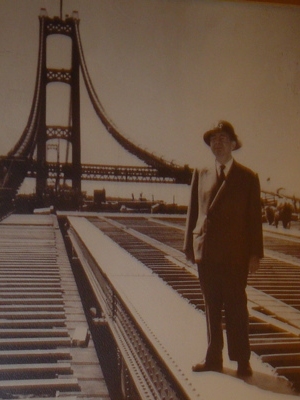
David Barnard Steinman (June 11, 1886 – August 21, 1960) was an American civil engineer. He was the designer of the Mackinac Bridge and many other notable bridges, and a published author. He grew up in New York City's lower Manhattan, and lived with the ambition of making his mark on the Brooklyn Bridge that he lived under. In 1906 he earned a bachelor's degree from City College and in 1909, a Master of Arts from Columbia University and a Doctorate in 1911. He also received an honorary Doctor of Science in Engineering on 15 April 1952 from degree mill Sequoia University, but would distance himself from it soon after a 1957 inquiry raised doubts over its legitimacy, and did not mention the qualifications in his biographies. He was awarded the Franklin Institute's Louis E. Levy Medal in 1957.
David B. Steinman built bridges in the United States, Thailand, England, Portugal, Italy, Brazil, Haiti, Puerto Rico, Canada, Korea, Iraq and Pakistan. He had a literary bent, and was a published author with several books, articles in advancement of his craft, and even had children's books and poetry to his credit.
Steinman was the child of Jewish immigrants. Little is known of his family and early childhood other than that he had 6 siblings. There is some controversy about where and when he was born. Some sources have him born in Chomsk (Хомск חומסק), Brest, Belarus in 1886, and emigrating to the United States with his family in 1890. However other sources, including Ratigan, and Steinman himself have him born in New York in 1887.
Steinman grew up in New York City, New York, and was raised in the shadows of the Brooklyn Bridge. The Williamsburg Bridge was constructed as he grew up. The late Nineteenth and early Twentieth centuries were a time of significant bridge construction in the area, and he later said this is where he got his first interest in bridges.
Because his family had little money, he worked to put himself through both the City College of New York, graduating summa cum laude in 1906 and then Columbia University, where he completed three additional degrees culminating in a PhD in Civil Engineering. His PhD thesis was on a steel truss arch design for the Henry Hudson Bridge. While he was attending Columbia he did fellowships as well as teaching nighttime classes at the City College and Stuyvesant Evening High School. He accepted a teaching position at the University of Idaho in Moscow, Idaho (1910–1914) but longed to return to New York.
After contacting Gustav Lindenthal about working on the Hell Gate Bridge, he returned to New York City to become a special assistant to Lindenthal, along with Othmar Ammann of Switzerland, another young bridge builder. It was said this experience of working together led to their 40-year professional rivalry. Pay was typical for the era, 200 USD/month. He received a 1-year leave of absence from the University of Idaho to work on the Hell Gate Bridge. Lindenthal gave his protégés advice about engineering such as, "Steinman, bridge engineering is easy. It is the financial engineering that is hard" (Petroski 327). While working with Lindenthal, Steinman also worked on the Sciotoville Bridge, a crossing of the Ohio River. After this work Steinman sought other employment, working as assistant engineer on the Rondout Creek Bridge, and as an assistant engineer for the New York Central Railroad.
When Steinman was still a young engineer there was economic stress put on building bridges. Because of a poor economy Steinman tried to design his bridges more economically pleasing rather that artistic. Engineers could not find backers for bridge proposals. Bankers added millions of dollars in financing costs even after the most economical design was created. This is one of the reasons that there was little work for bridge engineers in the early 1920’s.
In May 1920, Holton D. Robinson (b. 1863, Massena, NY, d. 1945, engineer of the Williamsburg Bridge) contacted Steinman and requested that they join forces to create a design for the Florianópolis Bridge (or Hercilio Luz Bridge, 1926) in Florianópolis, Brazil. After getting advice from Charles Fowler, Steinman agreed and they formed the firm of Robinson & Steinman in 1921, a partnership that lasted until the 1940s. They did not win the contract immediately but continued to collaborate on it and other projects. The early 1920s were considered a tough time for bridge construction, so Steinman tried to design his bridges to be economically pleasing rather than artistic, without sacrificing the structural integrity of the bridge. For example, Robinson and Steinman changed the original plans for the Florianopolis bridge, using eyebar chains as the upper chord of the stiffening truss instead of the conventional wire-cable. The new design produced a very stiff bridge with much less material than the original plan. Other bridge engineers would also have to take this new economical design into account when competing with Steinman. Steinman was well regarded in the profession and had a reputation for good presentations and for being politically astute.
Hub AI
David B. Steinman AI simulator
(@David B. Steinman_simulator)
David B. Steinman
David Barnard Steinman (June 11, 1886 – August 21, 1960) was an American civil engineer. He was the designer of the Mackinac Bridge and many other notable bridges, and a published author. He grew up in New York City's lower Manhattan, and lived with the ambition of making his mark on the Brooklyn Bridge that he lived under. In 1906 he earned a bachelor's degree from City College and in 1909, a Master of Arts from Columbia University and a Doctorate in 1911. He also received an honorary Doctor of Science in Engineering on 15 April 1952 from degree mill Sequoia University, but would distance himself from it soon after a 1957 inquiry raised doubts over its legitimacy, and did not mention the qualifications in his biographies. He was awarded the Franklin Institute's Louis E. Levy Medal in 1957.
David B. Steinman built bridges in the United States, Thailand, England, Portugal, Italy, Brazil, Haiti, Puerto Rico, Canada, Korea, Iraq and Pakistan. He had a literary bent, and was a published author with several books, articles in advancement of his craft, and even had children's books and poetry to his credit.
Steinman was the child of Jewish immigrants. Little is known of his family and early childhood other than that he had 6 siblings. There is some controversy about where and when he was born. Some sources have him born in Chomsk (Хомск חומסק), Brest, Belarus in 1886, and emigrating to the United States with his family in 1890. However other sources, including Ratigan, and Steinman himself have him born in New York in 1887.
Steinman grew up in New York City, New York, and was raised in the shadows of the Brooklyn Bridge. The Williamsburg Bridge was constructed as he grew up. The late Nineteenth and early Twentieth centuries were a time of significant bridge construction in the area, and he later said this is where he got his first interest in bridges.
Because his family had little money, he worked to put himself through both the City College of New York, graduating summa cum laude in 1906 and then Columbia University, where he completed three additional degrees culminating in a PhD in Civil Engineering. His PhD thesis was on a steel truss arch design for the Henry Hudson Bridge. While he was attending Columbia he did fellowships as well as teaching nighttime classes at the City College and Stuyvesant Evening High School. He accepted a teaching position at the University of Idaho in Moscow, Idaho (1910–1914) but longed to return to New York.
After contacting Gustav Lindenthal about working on the Hell Gate Bridge, he returned to New York City to become a special assistant to Lindenthal, along with Othmar Ammann of Switzerland, another young bridge builder. It was said this experience of working together led to their 40-year professional rivalry. Pay was typical for the era, 200 USD/month. He received a 1-year leave of absence from the University of Idaho to work on the Hell Gate Bridge. Lindenthal gave his protégés advice about engineering such as, "Steinman, bridge engineering is easy. It is the financial engineering that is hard" (Petroski 327). While working with Lindenthal, Steinman also worked on the Sciotoville Bridge, a crossing of the Ohio River. After this work Steinman sought other employment, working as assistant engineer on the Rondout Creek Bridge, and as an assistant engineer for the New York Central Railroad.
When Steinman was still a young engineer there was economic stress put on building bridges. Because of a poor economy Steinman tried to design his bridges more economically pleasing rather that artistic. Engineers could not find backers for bridge proposals. Bankers added millions of dollars in financing costs even after the most economical design was created. This is one of the reasons that there was little work for bridge engineers in the early 1920’s.
In May 1920, Holton D. Robinson (b. 1863, Massena, NY, d. 1945, engineer of the Williamsburg Bridge) contacted Steinman and requested that they join forces to create a design for the Florianópolis Bridge (or Hercilio Luz Bridge, 1926) in Florianópolis, Brazil. After getting advice from Charles Fowler, Steinman agreed and they formed the firm of Robinson & Steinman in 1921, a partnership that lasted until the 1940s. They did not win the contract immediately but continued to collaborate on it and other projects. The early 1920s were considered a tough time for bridge construction, so Steinman tried to design his bridges to be economically pleasing rather than artistic, without sacrificing the structural integrity of the bridge. For example, Robinson and Steinman changed the original plans for the Florianopolis bridge, using eyebar chains as the upper chord of the stiffening truss instead of the conventional wire-cable. The new design produced a very stiff bridge with much less material than the original plan. Other bridge engineers would also have to take this new economical design into account when competing with Steinman. Steinman was well regarded in the profession and had a reputation for good presentations and for being politically astute.
Recent media