Hubbry Logo
David HunterDavid HunterMain
Open search
David Hunter
Community hub
David Hunter
logo
8 pages, 0 posts
0 subscribers
Be the first to start a discussion here.
David Hunter
David Hunter
from Wikipedia

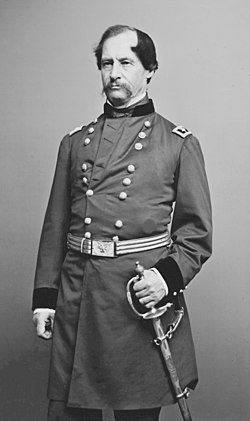
David Hunter (July 21, 1802 – February 2, 1886) was an American military officer. He served as a Union general during the American Civil War. He achieved notability for his unauthorized 1862 order (rescinded a month after it was made) emancipating slaves in three Southern states, for his leadership of United States troops during the Valley Campaigns of 1864, and as the president of the military commission trying the conspirators involved with the assassination of U.S. President Abraham Lincoln.

Key Information

Early life and education

[edit]

Hunter (son of Andrew Hunter and Mary Stockton) was born in Troy, New York,[1] or Princeton, New Jersey.[2] He was the cousin of writer-illustrator David Hunter Strother (who would also serve as a Union Army general). His maternal grandfather was Richard Stockton, a signer of the United States Declaration of Independence.

After graduating from the United States Military Academy in 1822, Hunter was commissioned a second lieutenant in the 5th U.S. Infantry Regiment. Records of his military service prior to the Civil War contain significant gaps. From 1828 to 1831, he was stationed on the northwest frontier, at Fort Dearborn (Chicago). There he met and married Maria Kinzie, a daughter of John Kinzie, considered the city's first permanent white resident. He served in the infantry for 11 years, and was promoted to captain of the 1st U.S. Dragoons in 1833.

He resigned from the army in July 1836 and moved to Illinois, where he worked as a real estate agent[2] or speculator.[1] He rejoined the Army in November 1841 as a paymaster and was promoted to major in March 1842.[2] One source[3] claims that he saw action in the Second Seminole War (1838–42) and the Mexican–American War (1846–48).

In 1860, Hunter was stationed at Fort Leavenworth, Kansas. He began a correspondence with Abraham Lincoln, emphasizing his own strong anti-slavery views. This relationship engendered political influence: after winning election to the presidency, Lincoln invited Hunter to ride on his inaugural train in February 1861 from Springfield, Illinois, to Washington, D.C. During this duty, Hunter suffered a dislocated collarbone at Buffalo due to the crowd pressing the president-elect.

Career

[edit]

American Civil War

[edit]

Soon after the firing on Fort Sumter, Hunter was promoted to colonel of the 6th U.S. Cavalry. Three days later, May 17, 1861, his political connection to the Lincoln administration resulted in his being appointed as the fourth-ranking brigadier general of volunteers, commanding a brigade in the Department of Washington. He was wounded in the neck and cheek while commanding a division under Irvin McDowell at the First Battle of Bull Run in July 1861. In August, he was promoted to major general of volunteers.

He served as a division commander in the Western Army under Major General John C. Frémont, and was appointed as commander of the Western Department on November 2, 1861, after Frémont was relieved of command due to his attempt to emancipate the slaves of rebellious slave holders. Hunter did not last long in this position, and within two months was reassigned to the Department of Kansas, a post where there was little chance of getting into trouble. He did not accept his exile gracefully and wrote a series of fulminating protest letters to the president, who finally gave in to his complaints. In March 1862, Hunter was transferred again to command the Department of the South and the X Corps.

Hunter served as president of the court-martial of Major General Fitz John Porter. (He was convicted for his actions at the Second Battle of Bull Run, but was exonerated by an 1878 Board of Officers.) He also was assigned to the committee that investigated the loss of Harpers Ferry in the Maryland Campaign. He served briefly as the assistant inspector general of the Department of the Gulf.

General Orders No. 7 and 11

[edit]
Historical marker about General Orders No. 7, erected by the Georgia Historical Society in 2008

After the Battle of Fort Pulaski in April 1862, when Hunter's troops bombarded and reclaimed the Confederate-held fort at the mouth of the Savannah River, Hunter issued General Orders 7 and 11. General Orders 7, issued on April 13, freed slaves in the fort and on Cockspur Island. Following the success of this order, Hunter hoped to further his abolitionist cause beyond the confines of this small Georgia island.

Hunter was also a strong advocate of arming black men as soldiers for the Union cause. He planned to form multiple segregated regiments but first needed to grow his recruitment pool. In May 1862, Hunter caused controversy by issuing General Orders 11, an order emancipating slaves in the states of Georgia, South Carolina, and Florida:

The three States of Georgia, Florida and South Carolina, comprising the military department of the south, having deliberately declared themselves no longer under the protection of the United States of America, and having taken up arms against the said United States, it becomes a military necessity to declare them under martial law. This was accordingly done on the 25th day of April, 1862. Slavery and martial law in a free country are altogether incompatible; the persons in these three States — Georgia, Florida, and South Carolina— heretofore held as slaves, are therefore declared forever free.

— Maj. Gen. David Hunter, Department of the South, General Order No. 11, May 9, 1862[4]

President Lincoln rescinded the order on May 19,[5] because he was concerned about its political effects in the border states, which he was trying to keep neutral. Their leaders advocated instead a gradual emancipation with compensation for slave owners.[6] Despite Lincoln's concerns that immediate emancipation in the South might drive some slave-holding Unionists to support the Confederacy, the national mood was quickly moving against slavery, especially within the Army.[7]

The president and Congress had already enacted several laws during the war to severely restrict the institution, beginning with the First Confiscation Act in August 1861 [8] and culminating in Lincoln's own Emancipation Proclamation issued in September 1862, and to take effect January 1, 1863. Concerned Confederate slaveholders had worried since before the war started that its eventual goal would become the abolition of slavery and they reacted strongly to the Union effort to emancipate Confederate slaves. Confederate President Jefferson Davis issued orders to the Confederate army that Hunter was to be considered a "felon to be executed if captured".[3]

Controversy over enlistment of ex-slaves

[edit]

Undeterred by the president's reluctance and intent on extending freedom to potential black soldiers, Hunter again flouted orders from the federal government. He enlisted ex-slaves as soldiers from occupied districts in South Carolina without permission from the War Department.[9] He formed the first such Union Army regiment, the 1st South Carolina (African Descent).[10] He was initially ordered to disband it, but eventually got approval from Congress for his action. This action incensed pro-slavery border state politicians, and Representative Charles A. Wickliffe (D-KY) sponsored a resolution demanding a response.

Hunter sent a defiant letter on June 23, 1862, to Congress, reminding them of his authority as a commanding officer in a war zone:

. . . I reply that no regiment of "Fugitive Slaves" has been, or is being organized in this Department. There is, however, a fine regiment of persons whose late masters are "Fugitive Rebels"--men who everywhere fly before the appearance of the National Flag, leaving their servants behind them to shift as best they can for themselves. . . . So far, indeed, are the loyal persons composing this regiment from seeking to avoid the presence of their late owners, that they are now, one and all, working with remarkable industry to place themselves in a position to go in full and effective pursuit of their fugacious and traitorous proprietors. . . . the instructions given to Brig. Gen. T. W. Sherman by the Hon. Simon Cameron, late Secretary of War, and turned over to me by succession for my guidance,--do distinctly authorize me to employ all loyal persons offering their services in defence of the Union and for the suppression of this Rebellion in any manner I might see fit. . . . In conclusion I would say it is my hope,--there appearing no possibility of other reinforcements owing to the exigencies of the Campaign in the Peninsula,--to have organized by the end of next Fall, and to be able to present to the Government, from forty eight to fifty thousand of these hardy and devoted soldiers."[11]

While the increasingly abolitionist Republicans in Congress were amused by the order, border state pro-slavery politicians, such as Wickliffe and Robert Mallory (D-KY), were not. Mallory described the scene in Congress following the reading of the order as follows:

The scene was one of which I think this House should forever be ashamed . . . A spectator in the gallery would have supposed we were witnessing here the performance of a buffoon or of a low farce actor upon the stage . . . The reading was received with loud applause and boisterous manifestations of approbation by the Republican members of the House . . . It was a scene, in my opinion, disgraceful to the American Congress.[12]

The War Department eventually forced Hunter to abandon this scheme, but the government nonetheless soon took action to expand the enlistment of black men as military laborers. Congress approved the Confiscation Act of 1862, which effectively freed all blacks working within the armed forces by forbidding Union soldiers to aid in the return of fugitive slaves.[13]

In 1863, Hunter wrote a letter to Confederate President Jefferson Davis protesting against the Confederate army's brutal mistreatment of captured black U.S. soldiers. He attacked the Confederates' claims to be fighting for freedom, listing the abuses they committed against human beings under slavery :

You say you are fighting for liberty. Yes you are fighting for liberty: liberty to keep four millions of your fellow-beings in ignorance and degradation;–liberty to separate parents and children, husband and wife, brother and sister;–liberty to steal the products of their labor, exacted with many a cruel lash and bitter tear;–liberty to seduce their wives and daughters, and to sell your own children into bondage;–liberty to kill these children with impunity, when the murder cannot be proven by one of pure white blood. This is the kind of liberty–the liberty to do wrong–which Satan, Chief of the fallen Angels, was contending for when he was cast into Hell.[14][15]

The Valley and "Scorched Earth"

[edit]

In the Valley Campaigns of 1864, Union Maj. Gen. Franz Sigel was ordered by Lt. Gen. Ulysses S. Grant to move into the Shenandoah Valley, threaten railroads and the agricultural economy there, and distract Robert E. Lee while Grant fought him in eastern Virginia. Sigel did a poor job, losing immediately at the Battle of New Market to a force that included cadets from the Virginia Military Institute (VMI). Hunter replaced Sigel in command of the Army of the Shenandoah and the Department of West Virginia on May 21, 1864. Grant ordered Hunter to employ scorched earth tactics similar to those that would be used later in that year during Sherman's March to the Sea; he was to move through Staunton to Charlottesville and Lynchburg, "living off the country" and destroying the Virginia Central Railroad "beyond possibility of repair for weeks." Lee was concerned enough about Hunter that he dispatched a corps under Lt. Gen. Jubal A. Early to deal with him.

On June 5, Hunter defeated Maj. Gen. William E. "Grumble" Jones at the Battle of Piedmont. Following orders, he moved up the Valley (southward) through Staunton to Lexington, destroying military targets and other industries (such as blacksmiths and stables) that could be used to support the Confederacy. After reaching Lexington, his troops burned down VMI on June 11 in retaliation of that institution sending cadets to fight at New Market. Hunter ordered the home of former governor John Letcher burned in retaliation for its absent owner's having issued "a violent and inflammatory proclamation ... inciting the population of the country to rise and wage guerrilla warfare on my troops."[16] Hunter also wreaked havoc on Washington College in Lexington, later Washington and Lee University. According to Fitzhugh Lee's biography of his uncle, Robert E. Lee, "[Hunter] had no respect for colleges, or the peaceful pursuits of professors and students, or the private dwellings of citizens, though occupied by women and children only, and during his three days occupancy of Lexington in June, 1864, the college buildings were dismantled, apparatus destroyed, and the books mutilated."[17]

Hunter's campaign in the Valley came to an end after he was defeated by Early at the Battle of Lynchburg on June 19. His headquarters was at Sandusky House, listed on the National Register of Historic Places in 1982, and now operated as a house museum. After the battle, Hunter retreated across the Allegheny Mountains into West Virginia, thereby taking his army out of the war altogether for a few weeks and allowing Early a free rein in the Valley. Though this retreat was widely criticized, Ulysses Grant in his Memoirs excused it as follows: "General Hunter, owing to a want of ammunition to give battle, retired from before the place. Unfortunately, this want of ammunition left him no choice of route for his return but by the way of the Gauley and Kanawha rivers, thence up the Ohio River, returning to Harper's Ferry by way of the Baltimore and Ohio Railroad." Hunter would maintain until his dying day that it had been a strategically sound move and he wrote a series of persistent letters to Secretary of War Edwin Stanton and President Lincoln arguing that the retreat was entirely justified. He badgered Grant with letters a few months later arguing that the army and officers he inherited from Franz Sigel were below average, and that he had never been told that he had any assignment to defend Washington, D.C. After the war, he wrote a letter to Robert E. Lee asking if he as a fellow soldier did not agree with the soundness of the retreat. Lee, who had a loathing of Hunter, wrote back that he had no clue what the exact strategic value of retreating into West Virginia was, but that it had been extremely helpful to himself and the Confederate cause.

The burning of the Virginia Military Institute by Hunter also angered the Confederates and made them more vengeful than before. After retaking possession of the Valley, Early described the scene as "truly heart-rending. Houses had been burned, and helpless women and children left without shelter. The country had been stripped of provisions and many families left without a morsel to eat. Furniture and bedding had been cut to pieces, and old men and women and children robbed of all the clothing they had except that on their backs. Ladies trunks had been rifled and their dresses torn to pieces in mere wantonness. Even the negro girls had lost their little finery. . . At Lexington he had burned the Military Institute, with all of its contents, including its library and scientific apparatus; and Washington College had been plundered and the statue of George Washington stolen. The residence of Ex-Governor Letcher at that place had been burned by orders, and but a few minutes given Mrs. Letcher and her family to leave the house. . . [A] Mr. Creigh, had been hung, because, on a former occasion, he had killed a straggling and marauding Federal soldier while in the act of insulting and outraging the ladies of his family."[18]

On August 1, Grant placed Maj. Gen Philip Sheridan in command of the effort to destroy Jubal Early's army. The Shenandoah, Maryland, and Washington, D.C., area all fell under Hunter's military department, but Grant had no intention of allowing Hunter any direct command over the campaign against Early. He therefore informed him that he could retain department command on paper while Sheridan did the active field campaigning. Hunter however declined this offer, stating that he had been so beset by contradictory War Department orders that he had no idea where Jubal Early's army even was, and he would rather just turn everything over to Sheridan. Grant immediately accepted and relieved Hunter of his post.[19] He would serve in no more combat commands. He was promoted to brevet major general in the regular army on March 13, 1865, an honor that was relatively common for senior officers late in the war.

Later life and death

[edit]

Hunter served in the honor guard at the funeral of Abraham Lincoln and accompanied his body back to Springfield. He was the president of the military commission trying the conspirators of Lincoln's assassination, from May 8 to July 15, 1865. He retired from the army in July 1866. He was the author of Report of the Military Services of Gen. David Hunter, U.S.A., during the War of the Rebellion, published in 1873.[20]

Hunter died in Washington, D.C., and is buried at the Princeton Cemetery in Princeton, New Jersey.

[edit]

See also

[edit]

References

[edit]

Cited sources

[edit]
  • Berlin, Ira, et al. Free at Last: A Documentary History of Slavery, Freedom, and the Civil War. New York: The New Press, 1992. ISBN 1-56584-120-4.

Further reading

[edit]
[edit]
Revisions and contributorsEdit on WikipediaRead on Wikipedia
from Grokipedia
David Hunter (July 21, 1802 – February 2, 1886) was a career officer who attained the rank of in the Union Army during the . Born in , he graduated from the at West Point in 1822 and served in frontier campaigns and the Mexican-American War before the conflict. In March 1862, Hunter assumed command of the Department of the South, encompassing Union-occupied portions of , Georgia, and , where he issued General Order No. 11 on May 9, 1862, declaring and emancipating slaves in those areas while authorizing the seizure of rebel property—an action President immediately revoked to preserve support among border states. Despite the revocation, Hunter's order highlighted his radical stance on emancipation and influenced later Union policies, including his organization of the 1st Volunteers, one of the first African American regiments in the Union Army. Hunter later commanded the Army of the Potomac's reserve forces and, in 1864, led operations in the Shenandoah Valley, securing a victory at the Battle of Piedmont on June 5 that opened the region to Union advances but retreating from Lynchburg after Confederate reinforcements arrived under Jubal A. Early, a failure that enabled Early's subsequent raid toward Washington, D.C., and prompted Hunter's relief by Philip Sheridan. His campaigns involved systematic destruction of Confederate resources to undermine the Southern war effort, though they drew criticism for excesses and strained relations with subordinates. Post-war, Hunter served on the Army's retiring board until his death in Washington, D.C.

Early Life and Education

Family Background and Childhood

David Hunter was born on July 21, 1802, though historical records disagree on the exact location, with possibilities including Princeton or Woodbury, New Jersey; Troy, New York; or Washington, D.C.. He was the second of five children of Reverend Andrew Hunter, a Presbyterian minister from Virginia who served as a professor of mathematics and astronomy at Princeton University, and Mary Stockton Hunter. Mary Stockton came from a distinguished New Jersey family; her father, Richard Stockton, signed the Declaration of Independence as a delegate from to the Second . Hunter's cousin, David Hunter Strother, later became a noted writer-illustrator and Union Army general during the Civil War. Details of Hunter's childhood are sparse, but his family's clerical, academic, and Revolutionary War heritage—reflected in his father's ministry and his grandfather's patriotic service—likely fostered an environment conducive to discipline and public service, culminating in Hunter's enrollment at the on September 14, 1818, at age 16.

West Point and Early Commission

David Hunter entered the United States Military Academy at West Point on September 13, 1818. He graduated on July 1, 1822, ranking 25th in his class of 40 cadets. Upon graduation, Hunter was commissioned as a brevet second lieutenant in the 5th U.S. Infantry Regiment. His initial assignment involved frontier duty, including service at Fort Dearborn in present-day Illinois. This posting marked the beginning of his active-duty infantry service, focused on operations along the western frontier amid ongoing tensions with Native American tribes.

Pre-Civil War Military Career

Service in Frontier Wars

Hunter was commissioned as a second lieutenant in the 5th U.S. Infantry Regiment upon graduating from the United States Military Academy in 1822, with initial assignments involving frontier duty at posts such as Fort Dearborn, Illinois. His early service included routine garrison and patrol responsibilities along the western frontiers amid ongoing tensions with Native American tribes. Promoted to in the 1st U.S. Dragoons in 1833, Hunter transitioned to mounted operations, which emphasized mobility for , escort duties, and rapid response to frontier disturbances, accumulating over a decade of such experience by the mid-1830s. He resigned his commission in 1836, pursuing civilian ventures in . Hunter rejoined the Army during the Second War (1835–1842), serving in where U.S. forces conducted operations against resistance in swamps and everglades, with engagements aimed at compelling relocation under the . He participated in field actions from approximately 1838 to 1842, contributing to the protracted campaign that resulted in over 4,000 deaths or displacements and cost the U.S. government upwards of $40 million. Contemporary accounts highlight his extended frontier exposure, including "war-path" duties comprising more than half of his pre-Civil War service.

Mexican-American War Participation

David Hunter served in the Mexican–American War (1846–1848) primarily as a major , a staff position he had held since his appointment on March 14, 1842. In this role, he managed the financial operations of U.S. forces, including disbursing pay to troops and supporting logistical needs amid the campaign's demands. As chief paymaster for General John E. Wool's column, Hunter participated in the advance through Chihuahua in 1846, facilitating payments during the column's movements into . He continued in this capacity with the of Occupation from 1847 to 1848, contributing to the stability of rear-area operations following major engagements like Buena Vista. His efforts were noted for maintaining order in army finances, earning recognition for in departmental records, though his non-combat assignment limited direct involvement in field actions. Hunter reportedly volunteered for service in accessible battles, but such participation was unofficial and unrecorded due to his paymaster duties. This logistical focus underscored the essential administrative backbone of the U.S. invasion forces, which numbered over 10,000 in Wool's command alone during the Chihuahua expedition.

American Civil War Service

Initial Commands and Promotions

David Hunter's military career accelerated with the onset of the . On May 14, 1861, shortly after the Confederate attack on , he was promoted to of the 3rd U.S. . Three days later, on May 17, 1861, Hunter received appointment as of volunteers, placing him fourth in seniority among Union brigadiers, influenced by his prior acquaintance with President . In this capacity, Hunter took command of the 2nd Division in Irvin McDowell's Army of Northeastern Virginia, leading the initial Union advance at the on July 21, 1861. His division encountered heavy Confederate resistance from General P. G. T. Beauregard's forces, resulting in significant casualties, and Hunter sustained a severe to the and cheek early in the fighting, forcing his evacuation from the field. While recuperating, Hunter was promoted to of volunteers, effective August 13, 1861, reflecting his service at Bull Run despite the Union defeat. This elevation positioned him for higher departmental responsibilities, including a brief tenure in command of defenses around , before reassignment to the Western Theater in late 1861. His rapid ascent from to within months underscored the urgent expansion of Union command structure amid the war's early crises.

Department of the South Operations

David Hunter assumed command of the Department of the South on March 15, 1862, succeeding Thomas W. Sherman, with headquarters at Hilton Head, . The department encompassed Union-held coastal regions of , Georgia, and , focusing on blockade enforcement, fort captures, and threats to Confederate ports like Savannah and Charleston. Hunter inherited a force of approximately 15,000 troops, including , , and naval support, amid ongoing efforts to expand Union control beyond the Sea Islands secured in late 1861. Upon taking command, Hunter directed the completion of the siege of Fort Pulaski, a key Confederate stronghold at the mouth of the . The siege, initiated in February 1862 by engineer Quincy A. Gillmore's forces on Tybee Island, involved breaching the fort's masonry walls with rifled artillery fire. On April 10–11, 1862, Union batteries bombarded the fort for 30 hours, compelling Confederate Colonel Charles H. Olmstead's garrison of 385 men to surrender on April 11, with minimal Union casualties (one wounded). This victory, under Hunter's departmental oversight, sealed Savannah's harbor to blockade runners and demonstrated the obsolescence of traditional brick fortifications against modern ordnance, influencing subsequent Union siege tactics. In May 1862, Hunter shifted focus to Charleston, aiming to capture the strategic port by advancing overland via James Island. He reinforced the expedition with divisions under Brigadier Generals Horatio G. Wright and Isaac I. Stevens, totaling about 6,000 men, transported by naval vessels under his orders. On June 16, 1862, at the (also known as the assault on Fort Lamar), Union forces under Stevens and Brigadier General Henry W. Benham attacked entrenched Confederate positions held by roughly 1,500 troops under Colonel Johnson Hagood and General William Drayton. The assault failed amid swampy terrain, enfilading fire, and Confederate reinforcements, resulting in 683 Union casualties (killed, wounded, missing) against 204 Confederate losses. The Secessionville repulse exposed coordination issues, inadequate reconnaissance, and Hunter's overextension without sufficient troops, prompting criticism of his leadership. Hunter requested reinforcements from Washington but faced delays, compounded by his declining health. By late July 1862, amid ongoing outbreaks and stalled advances, he was relieved of command on , with authority transferred to subordinates before formal reassignment on August 22, 1862; John P. Hatch assumed interim departmental duties. These operations, while securing peripheral gains like Fort Pulaski, failed to threaten Charleston's defenses meaningfully and highlighted logistical challenges in amphibious campaigns against fortified Confederate positions.

Organization of Black Regiments

In May 1862, following his issuance of General Orders No. 11 on May 9—which declared enslaved people in Georgia, , and "forever free" to enable their recruitment into Union forces—Major General David Hunter began organizing black regiments from former slaves in Union-occupied coastal areas of the Department of the South. Although President Lincoln revoked the emancipation order on May 19, 1862, citing lack of authority, Hunter proceeded with enlistments, drawing primarily from "contrabands"—escaped or liberated slaves—residing on plantations seized by Union forces after operations like the capture of Fort Pulaski on April 11, 1862. Hunter's initial efforts focused on the 1st South Carolina Volunteers (later redesignated the 33rd ), recruiting over 1,000 men, mostly speakers from coastal , Georgia, and , starting in late May 1862. He collaborated with chaplains and agents such as Rev. Abram Murchison to conduct recruitment drives among refugee populations at sites like , emphasizing voluntary service and providing basic arms from captured Confederate stocks. Training commenced at Camp Saxton on Island, where recruits underwent drill in infantry tactics despite limited resources and initial skepticism from white officers regarding black soldiers' combat effectiveness; Hunter justified the units as essential for suppressing rebellion, arguing they could perform labor and guard duties to free white troops for frontline service. Congress retroactively validated Hunter's unauthorized recruitment through the Second Confiscation and Militia Act of July 17, 1862, which permitted enlistment of black men and authorized their arming, leading to federal pay and mustering for the 1st on August 7, 1862, though full official recognition came on January 31, 1863, under Colonel after Hunter's transfer. Hunter expanded to additional units, including the 1st South Carolina Cavalry and elements of the 2nd and 3rd South Carolina Volunteers, totaling around 5,000 black troops by late 1862, organized into companies with white officers selected for abolitionist sympathies. These regiments faced logistical hurdles, such as inadequate uniforms and rifles, but demonstrated viability in early operations like coastal patrols and raids, influencing broader Union policy on black enlistment.

Shenandoah Valley Campaign

In May 1864, following the Union defeat at the on May 15, Major General David Hunter assumed command of Union forces in the , replacing , with orders from Lieutenant General to advance southward and disrupt Confederate supply lines. Hunter's Army of the Shenandoah, numbering approximately 8,500 infantry and artillery supported by cavalry, departed on May 26, moving aggressively toward Staunton while applying a policy of destroying mills, crops, and infrastructure to deny resources to the Confederacy. This scorched-earth approach aimed to weaken Confederate logistics but drew criticism for its severity on civilian property. Hunter's forces engaged Confederate troops under Brigadier General William E. "Grumble" Jones at the on June 5–6, achieving a that resulted in over 1,000 Confederate casualties, including Jones's death, and the capture of three artillery pieces. The Union army then occupied Staunton on June 6 and advanced to Lexington, where Hunter's troops shelled the town and burned the on June 11–14, citing retaliation for VMI cadets' participation at New Market, though this act destroyed irreplaceable educational and cultural assets without direct . From Lexington, Hunter continued toward Lynchburg, a key rail hub, destroying additional Confederate facilities en route to further impair supply networks. Reaching Lynchburg's outskirts on June 17, Hunter's approximately 14,000 troops faced Confederate Lieutenant General Jubal A. Early, who had rushed reinforcements from Richmond, totaling around 8,000–10,000 effectives bolstered by arriving militia and reserves. During the Battle of Lynchburg on June 17–18, Union assaults were repulsed amid heavy skirmishing, with Hunter mistaking empty supply trains for additional enemy troops, exaggerating Confederate strength. Facing critical ammunition and supply shortages after a rapid advance that overstretched logistics, Hunter ordered a retreat on June 18 via difficult mountain routes through West Virginia to Charleston, abandoning the Valley and enabling Early's subsequent northward thrust toward Washington, D.C. This withdrawal, covering over 100 miles in harsh terrain, sidelined Hunter's army for weeks and prompted Grant's dissatisfaction with the failure to hold gains.

Post-War Life

Retirement from Service

Following the , Hunter served as president of the military commission that tried the conspirators in the assassination of President , holding the position from May 8 to July 15, 1865. He had previously performed duties from February 1 to May 9, 1865, during which he received brevet promotions to and in the regular U.S. Army, effective March 13, 1865. Hunter retired from active service in the U.S. Army on July 31, 1866, at the rank of brevet major general, United States Army, after a career spanning over four decades since his West Point graduation in 1822. His retirement occurred amid post-war reductions in the Army's size, with many senior officers transitioning out of active duty as the volunteer forces were demobilized and the regular establishment contracted. Upon retirement, Hunter remained in Washington, D.C., where he later authored Report of the Military Services of Gen. David Hunter, U.S.A., during the War of the Rebellion to document his wartime contributions.

Final Years and Death

Hunter retired from the United States Army in July 1866, retaining the rank of colonel with brevets to and . He resided in , for the rest of his life. In 1873, Hunter compiled and submitted Report of the Military Services of Gen. David Hunter, U.S.A., During the War of the Rebellion to the U.S. War Department, detailing his wartime commands and operations. On February 2, 1886, at age 83, he died in his Washington home. His body was transported to , for burial.

Military Policies and Controversies

Emancipation Efforts

In May 1862, as commander of the Department of the South, David Hunter pursued as a wartime measure to disrupt Confederate labor and bolster Union forces. On April 13, 1862, shortly after Union forces captured Fort Pulaski, Hunter issued an order emancipating enslaved individuals on Cockspur Island adjacent to the fort, citing in the occupied territory. This initial step reflected Hunter's abolitionist stance and his interpretation of departmental authority to free slaves in areas under direct Union control. Hunter escalated these efforts on May 9, 1862, with General Order No. 11, proclaimed from Fort Pulaski, which declared "forever free" all enslaved persons in Georgia, , and —the states comprising his military department—due to their "deliberately declared independence from the " and ongoing rebellion. The order, issued without explicit federal authorization, aimed to undermine the Confederate economy by liberating approximately 1.5 million enslaved people in those states, while enabling their recruitment into Union service. Hunter defended the as essential for suppressing the insurrection, arguing that slaveholding states had forfeited claims to their property through . President revoked No. 11 on May 19, 1862, via Proclamation 90, asserting that the federal government lacked constitutional authority for such a broad at that stage and emphasizing that any slave freeing must align with congressional policy or gradual to preserve Union support in border states. Lincoln explicitly disavowed Hunter's actions to avoid alienating conservative elements, though he privately expressed sympathy for the underlying goal and later incorporated similar principles in the of September 1862. Despite the revocation, Hunter's order highlighted tensions between military exigency and political constraints, prompting public debate and foreshadowing national policy. Hunter continued advocating for arming freed slaves, linking directly to Union victory, though subsequent efforts shifted toward authorized recruitment under federal guidelines.

Scorched Earth Tactics

In May 1864, Union Major General David Hunter, commanding the Department of , received orders from Lieutenant General to advance southward through the while employing scorched earth tactics to deny resources to Confederate forces and civilians, mirroring strategies later used by William T. Sherman in Georgia. These tactics involved supplies from the land, destroying mills, barns, livestock, and such as railroads and bridges to prevent their use by the enemy. Hunter's of approximately 8,500 men implemented this during their advance, subsisting on local provisions while systematically targeting economic assets that supported the Confederacy. On June 5–6, 1864, Hunter's forces defeated Confederate troops at the , enabling further penetration into the Valley and escalation of destructive operations toward Staunton, a key rail hub. By June 10, Hunter's command reached , where troops occupied the town for four days and inflicted significant damage despite Hunter's stated intent to spare non-military private property. Union soldiers looted residences, businesses, and institutions, burning selected structures including the home of former Governor John Letcher in retaliation for guerrilla activity. A focal point of destruction was the (VMI) in Lexington, which Hunter ordered burned on June 12, 1864, viewing it as a Confederate training ground that had produced companies fighting for the South. The institute's barracks, library, laboratory equipment, and two faculty residences were razed, leaving the facility in ruins and prompting widespread Confederate outrage that galvanized resistance. This action, combined with broader property seizures, exemplified Hunter's adherence to Grant's directive but contributed to his subsequent retreat from Lynchburg after encountering Confederate reinforcements under Jubal A. Early on June 17–18, 1864, as the limited scope of his implementation failed to fully neutralize Valley threats. Historians note that while Hunter's tactics inflicted economic hardship, they were less comprehensive than Philip Sheridan's later 1864 Valley campaign, which more thoroughly devastated the region under similar orders.

Enlistment of Former Slaves

In August 1862, Major General David Hunter, commanding the Department of the South, authorized the recruitment of former slaves into Union military service, forming the nucleus of what became the 1st Volunteer Infantry (Colored), the first black regiment organized by federal forces during the Civil War. These enlistments drew primarily from Gullah-speaking former slaves who had fled plantations in the of , Georgia, and , areas under Union control following operations like the capture of in November 1861. Hunter proceeded without explicit federal authorization, interpreting his departmental powers broadly to arm and organize black men amid ongoing debates in Washington over the policy. Recruitment efforts intensified at sites like Camp Saxton near , where approximately 5,000 potential enlistees gathered by late , though initial company formations numbered around 500 men equipped with rudimentary arms seized from Confederate stores. Labor agents and military recruiters, including white officers like C. T. , canvassed camps and plantations, offering freedom and pay—initially $10 monthly plus rations—as incentives, though federal recognition and backpay were delayed until 1863. Hunter's initiative predated President Lincoln's preliminary (September 22, ), which hinted at arming blacks but lacked specifics; Hunter defended his actions in correspondence, arguing that enlisting able-bodied former slaves bolstered Union strength without awaiting policy shifts. The regiments faced logistical hurdles, including shortages of uniforms, trained officers, and drilling manuals adapted from procedures, yet Hunter appointed Northern abolitionists and career officers to command, emphasizing to counter about black soldiers' reliability. By January 31, 1863, the unit received official muster as the 1st Volunteers, later redesignated the 33rd , marking Hunter's enlistments as a pivotal, if unauthorized, step toward integrating over 180,000 black troops into the Union Army by war's end. This effort drew criticism from conservatives fearing it would harden Southern resolve, but Hunter's precedents influenced subsequent federal policies under the Militia Act of 1862 and broader emancipation measures.

Legacy and Evaluations

Achievements in Union War Effort

As commander of the Department of the South from March 1862, Hunter directed operations that secured key coastal positions for the Union, including the bombardment and capture of Fort Pulaski on April 10–11, 1862. Union artillery, under Quincy A. Gillmore, fired over 5,000 rounds, breaching the fort's walls within 30 hours and demonstrating the superiority of rifled cannons over traditional fortifications. This victory closed Savannah's harbor to Confederate shipping, tightened the , and provided a base for further incursions into Georgia and . Hunter's recruitment of African American troops significantly bolstered Union manpower shortages. In May 1862, following his departmental emancipation order, he authorized the formation of the 1st South Carolina Volunteers (later Colored Infantry), the first official black regiment in the Union Army, mustering over 1,000 men by November 1861 under his predecessor but expanded under Hunter. These units participated in raids and operations that diverted Confederate resources and proved black soldiers' combat effectiveness, paving the way for the enlistment of 180,000 African Americans by war's end. During the Shenandoah Valley campaign in spring 1864, Hunter advanced 90 miles from Martinsburg to Lexington, destroying Confederate infrastructure including 37 locomotives, 86 rail cars, bridges, and mills, which hampered supply lines to Robert E. Lee's . His forces captured over 700 prisoners and inflicted economic damage estimated in millions, forcing the Confederacy to redirect troops and contributing to the Union's strategic pressure despite his subsequent retreat from Lynchburg.

Criticisms and Strategic Failures

Hunter's most notable strategic failure occurred during the Lynchburg Campaign in June 1864, where his Union forces, after initial successes including the victory at on June 5, advanced toward Lynchburg but retreated following the inconclusive engagement on June 17–18 against Confederate reinforcements under Lt. Gen. Jubal A. Early. Despite outnumbering the Confederates and having the opportunity to sever vital rail lines north of the city, Hunter hesitated, citing perceived enemy superiority and ammunition shortages, ultimately withdrawing westward into rather than pressing southward or reinforcing other Union objectives. This decision allowed Early to pivot unopposed into the , threatening , and forcing President Lincoln to mobilize defenses, including , on July 11–12, 1864. Critics, including military historians, have attributed the retreat to Hunter's caution and misjudgment of Confederate strength, arguing it squandered momentum from prior advances through Staunton and Lexington, where Union troops had applied destructive tactics but failed to consolidate gains. The maneuver exemplified broader Union command issues in the Valley, as Hunter's evasion of decisive battle enabled Confederate forces to raid and disrupt federal logistics, prolonging vulnerability in the region until Maj. Gen. Philip Sheridan's replacement in August. While later rationalized the withdrawal due to logistical constraints, contemporaries and analyses viewed it as a pivotal lapse that undermined Grant's coordination. Earlier in the war, Hunter's performance at the on July 21, 1861, drew rebuke for disorganized Union advances and failure to exploit initial breakthroughs, contributing to the rout that exposed federal vulnerabilities. His 1862 command in the Department of the South yielded limited territorial gains against Confederate positions at Charleston and Savannah, hampered by inadequate naval support and internal rivalries, though strategic critiques focused less on bold errors than on persistent operational inertia. These episodes reinforced perceptions of Hunter as a capable administrator but strategically indecisive in high-stakes maneuvers, a view echoed in evaluations of his operations as emblematic of Union peripheral strategy shortcomings.

Historiographical Perspectives

Historians' evaluations of David Hunter have shifted over time, transitioning from predominant criticism of his tactical shortcomings to recognition of his innovative antislavery initiatives amid the Civil War. Early postwar accounts and turn-of-the-century military histories often depicted Hunter as a reckless and ineffective , emphasizing defeats such as his retreat from Lynchburg on June 18, 1864, which enabled Confederate General Jubal A. Early to menace , and highlighting his overextension in the campaign that May. These assessments portrayed his aggressive maneuvers, including the destruction of infrastructure under Special Order No. 37, as strategically flawed and contributorily to Union vulnerabilities, with contemporaries like Secretary of War viewing him as unreliable. By the mid-20th century, scholarly focus broadened to Hunter's role in emancipation policy, framing his unauthorized No. 11 of May 9, 1862—which declared slaves in Georgia, , and free—as a bold precursor to the , despite its prompt revocation by President Lincoln to avoid alienating border states. This perspective positioned Hunter as an advocate whose actions, including the organization of the 1st Volunteers (the Union's first African American regiment) in August 1862, exerted pressure on federal authorities to integrate black troops, influencing the eventual authorization under the Second Confiscation and Militia Act of July 17, 1862. Recent historiography, exemplified by John David Smith's 2012 biography Lincoln's Abolitionist General, reevaluates Hunter more favorably as a principled Unionist whose antislavery stance mirrored Lincoln's pragmatic prioritization of preserving the nation while eroding slavery, crediting him with advancing causal mechanisms for black enlistment that bolstered Union manpower by war's end. Smith's analysis draws on Hunter's correspondence and official records to argue that his field-level decisions, though militarily contentious, catalyzed policy shifts toward total war aims. Nonetheless, regional studies of the Shenandoah Valley persist in critiquing his scorched-earth approach—destroying mills, barns, and crops across 2,000 square miles—as emblematic of excessive retribution, sustaining a narrative of local devastation that fueled postwar Southern resentment. This duality reflects ongoing debates: Hunter as tactical liability yet emancipatory innovator, with assessments varying by emphasis on operational versus ideological impacts.

Depictions in Culture

[Depictions in Culture - no content]

References

Add your contribution
Related Hubs
User Avatar
No comments yet.