Hubbry Logo
David TangDavid TangMain
Open search
David Tang
Community hub
David Tang
logo
8 pages, 0 posts
0 subscribers
Be the first to start a discussion here.
David Tang
David Tang
from Wikipedia

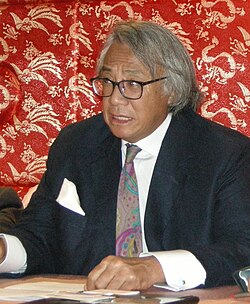
Sir David Wing-cheung Tang, KBE (Chinese: 鄧永鏘; pinyin: Dèng Yǒngqiāng; Sidney Lau: Dang6Wing5Cheung1; 2 August 1954 – 29 August 2017), was a Hong Kong businessman, philanthropist and socialite. He was best known for founding the Shanghai Tang fashion chain in 1994, which he sold in 1998 to Richemont.[1]

Key Information

Early life and education

[edit]

Tang was born into a prominent, affluent family in Hong Kong. His grandfather, Sir Shiu-Kin Tang (鄧肇堅), co-founded the Kowloon Motor Bus Company and was considered "one of Hong Kong's greatest philanthropists".[2] At the age of 12, he moved with his parents to England. Following his primary education at La Salle Primary School, Tang was sent to board at The Perse School, Cambridge: he later claimed that he was then "aged 13, hardly able to speak a word of English".[3] After leaving Perse in 1973 he went to King's College London to read Philosophy and then Law at the University of Cambridge.

Career

[edit]

Tang started his career at his grandfather's solicitor firm. He joined the London law firm Macfarlanes as a trainee solicitor, where he was described by the then senior partner Vanni Treves as being "confident, quick witted and funny", as well as being "charmingly undisciplined and unreliable". By mutual agreement he left the firm after a couple of months without completing his training contract, and instead changed career path and joined Swire Pacific Limited. He was the founder of the China Club in Hong Kong, Beijing, and Singapore[3] the Shanghai Tang stores,[4][5] Havana House and Pacific Cigar Company Ltd (the exclusive distributor for all Cuban cigars in Asia Pacific).[6] More recently[when?] Tang opened the Cipriani in Hong Kong and the China Tang restaurant at the Dorchester Hotel. Tang was also a director and advisor to a number of boards, including Tommy Hilfiger.[4]

In 1983–84, Tang taught English literature and philosophy at Peking University in Beijing, China.[7]

Awards

[edit]

Tang was promoted from OBE to Knight Commander of the Order of the British Empire (KBE) in the 2008 New Year Honours.[5] He was also honoured by the French Government as Chevalier of the Ordre des Arts et des Lettres (1995).[8] He received the award for Outstanding Achievement in Art and Design at the Asian Awards in 2014.[9]

Other roles

[edit]

Sir David was the Honorary Consul of Cuba in Hong Kong.[10][11] From time to time, he contributed articles for newspapers.[12]

Tang was patron of the Hong Kong Youth Arts Festival from 1993.[13]

Tang was invited to provide a weekly English column for the Chinese-language Hong Kong newspaper Apple Daily. A selection of his articles has been published in a book An Apple a Week (published in 2006).[14][15] He also contributed an "agony uncle" column to the weekend Financial Times, in which he responded to readers' social dilemmas.[16]

In 2011, Tang founded a website, ICorrect.com, where celebrities can post fixes and refutations of incorrect information spreading over the internet.[17]

Support for Hong Kong democracy

[edit]

Tang was unrestrained in speaking, at times scathingly, in opposition to the Hong Kong Government. He was particularly incensed by its intransigence on democratic reform. In a speech, on 18 February 2016, to the Foreign Correspondents Club, Hong Kong, in reference to the Chief Executive's policy address, he said,

"Whoever wrote that first sentence for the chief executive, if he himself did not write it, must be a comedian; or perhaps a monkey who accidentally typed up those words on a typewriter. What it all means to me is the disingenuousness of our chief executive and government, and the contempt with which they hold us, the citizens of Hong Kong. ... Our government has been growing apart from the people of Hong Kong and they must anticipate trouble. Already, there are over one million people in Hong Kong who are trapped by poverty, and they cannot be too pleased about the government. It is simply invidious that in a prosperous community such as Hong Kong, over 15 percent of our population should be living below the breadline. It is a shameful state, scandalous if you ask me. Then there was the Umbrella Movement, which clearly demonstrated the resolution of many ordinary people taking real democratic power seriously, and their dissatisfaction can only be increased by the defeat of the universal suffrage motion in LegCo."[18]

Later life

[edit]

In August 2017, Asia Times reported that Tang planned a farewell party at the Dorchester Hotel in London as doctors had given him only a month or two to live.[19] However, before the farewell party could occur,[20] Tang died on 29 August 2017 from liver cancer, four weeks after his 63rd birthday, leaving behind his wife Lucy and two children from his first marriage to Susanna Cheung.[21]


Lawsuits

[edit]

The China Club (China Investment Incorporations) Limited filed a lawsuit against the estate of the late Sir David Tang in the High Court, alleging breaches of fiduciary duty. The suit claims that Tang improperly transferred over HK$100 million from the company's funds to his personal accounts or those of related companies, violating his responsibilities as a director.


Key allegations include: 1. Cash Transfers: Between 2016 and 2017, Tang allegedly transferred more than HK$51.87 million from the club's account to his personal or controlled accounts.

2. Art Auction Proceeds: From 2007 to 2014, Tang is accused of auctioning artworks belonging to the club and depositing the HK$56.29 million proceeds into his own account.

3. Dividend Misappropriation: Between 1998 and 2016, he reportedly distributed over HK$6.74 million to himself during shareholder dividend distributions.

Books

[edit]
  • Rules for Modern Life: A Connoisseur's Survival Guide, Portfolio Penguin, 2016
  • A Chink in the Armour, Enrich Publications, 2010 (second edition)
  • An Apple a Week, Next Publications, 2007 (third edition)
  • East Meets West: Global Design for Contemporary Interiors, Conran, 1998 (Kelly Hoppen), foreword.
  • Quotations from Chairman Uncle Dave, privately printed

References

[edit]
[edit]
Revisions and contributorsEdit on WikipediaRead on Wikipedia
from Grokipedia

Sir David Wing-cheung Tang KBE (2 August 1954 – 29 August 2017) was a Hong Kong-born entrepreneur and socialite renowned for founding the luxury fashion brand Shanghai Tang, which popularized modern chinoiserie aesthetics in high-end apparel.
Born into a wealthy family of Shanghai origins in British Hong Kong, Tang was educated in the United Kingdom before returning to establish a series of upscale ventures, including the exclusive China Club restaurant chains in Hong Kong, Beijing, and Singapore, as well as the Pacific Cigar Company, which held exclusive distribution rights for Cuban cigars in the Asia-Pacific region.
A flamboyant bon vivant and art collector, Tang also served as a columnist and advice columnist for the Financial Times, knighted for his philanthropic contributions including endowments to hospitals, schools, and the University of Hong Kong's School of Chinese Studies; he succumbed to liver cancer at age 63.

Early Life and Education

Family Background and Upbringing

David Tang was born on August 2, 1954, in to a prominent and affluent family of origin. His grandfather, Sir Shiu-kin Tang, played a foundational role in the family's commercial success by establishing the Company in the early , which became one of Hong Kong's primary transport operators and a key entrepreneurial venture in the region's burgeoning economy. This legacy of and —Sir Shiu-kin was knighted for his contributions—provided the empirical basis for the family's wealth, though Tang, as the eldest grandson, was reportedly not positioned to inherit the fortune directly under family traditions. Tang's upbringing occurred in post-World War II , a British colony experiencing rapid industrialization and population influx, which exposed him to the interplay of traditional Chinese familial values and colonial governance structures. The city's status as a free port and trading hub fostered an environment of commercial dynamism, mirroring the pragmatic entrepreneurial precedents set by his grandfather's generation amid earlier economic disruptions like wartime occupation. This setting cultivated Tang's early awareness of hybrid cultural dynamics, blending Confucian emphases on hierarchy and education with British-influenced and international , without reliance on romanticized narratives of unearned privilege. From a young age, Tang displayed interests in intellectual pursuits such as , influenced by the family's affluent resources that supported access to diverse ideas, alongside an innate draw toward rooted in observing Hong Kong's market-driven growth. These formative experiences in a stable, post-war household—marked by the grandfather's emphasis on , as Tang later recounted—laid a causal foundation for his worldview, prioritizing empirical opportunity over entitlement.

Academic Pursuits

Tang initially pursued studies in at during the 1970s, following his at in . This program provided foundational exposure to and ethical inquiry, disciplines that shaped his later toward rigid ideologies. He subsequently enrolled in the law program at the , graduating with a . Cambridge's rigorous emphasized critical debate and logical argumentation, contrasting with Tang's upbringing amid Chinese cultural traditions and fostering a pragmatic informed by both Eastern heritage and Western intellectual traditions. Tang held no advanced degrees beyond the master's, though he engaged in self-directed study of and economic principles, as referenced in his personal reflections on cultural synthesis and market dynamics. In 1983–1984, he lectured on and English literature at , applying his academic training to bridge Western philosophical concepts with contemporary Chinese contexts.

Business Ventures

Founding and Growth of Shanghai Tang

David Tang founded in 1994 in , establishing it as the first luxury brand to blend traditional Chinese cultural elements—such as silk embroidery, silhouettes, and Tang dynasty-inspired jackets—with modern, vibrant interpretations aimed at international appeal. The inaugural opened in the Pedder Building in Hong Kong's Central district, initially catering to affluent locals and Western tourists seeking distinctive "China chic" attire that evoked 1920s–1930s glamour without literal historical replication. Tang, leveraging his personal networks as a established Hong Kong entrepreneur, self-funded the venture from modest beginnings, producing custom pieces like velvet Tang jackets for elite clientele before scaling to retail. The brand's early strategy emphasized theatrical retail experiences, with stores featuring bold red-and-gold interiors, uniformed staff in period costumes, and curated displays of cheongsams, mandarin-collar shirts, and accessories to create an immersive "Eastern opulence" narrative. This approach resonated in Asia, where quickly gained among Hong Kong's and high-society circles, evidenced by high profit margins reported in the mid-1990s exceeding 60% in subsequent years after initial . Visibility surged following endorsements like actress Cheung's appearance in a signature from the brand in Wong Kar-wai's 1990 film , driving demand among Asian consumers for its fusion of heritage motifs with wearable luxury. By 1997, buoyed by strong sales and regional traction in , Tang expanded internationally with a flagship store on in , marking the brand's push beyond local markets while maintaining focus on Asian-inspired designs for global elites. This period of growth solidified Shanghai Tang's position as a pioneer in exporting stylized Chinese aesthetics, with early revenue streams supporting further boutique developments in prime Asian locations before broader challenges emerged.

Expansion Challenges and Adaptations

The expansion of Shanghai Tang into international markets encountered early setbacks, most notably with its New York flagship on , opened in November 1997 to capitalize on the brand's vibrant, chinoiserie-infused designs. However, the store's ostentatious style—characterized by bold colors, dresses, and Mao memorabilia—proved mismatched with the restrained elegance preferred by affluent shoppers, leading to persistently low sales despite promotional buzz. High operational rents exacerbated the financial strain, culminating in the store's closure on July 31, 1999, just as broader Asian fashion trends began emerging in New York. This outcome stemmed from market dynamics, including cultural disconnects and premature scaling without localized demand validation, rather than inherent product deficiencies, yielding net losses but instructive pivots toward selective market entry. Richemont's acquisition of a controlling stake in 1998 marked a turning point, injecting capital and expertise to mitigate such expansion risks while David Tang retained creative input until later years. By 2008, with securing full ownership, the brand adapted by refining its aesthetics—eschewing early gaudiness for subtler, high-quality interpretations of Chinese motifs—to align with evolving luxury consumer expectations beyond tourist novelty. This recalibration prioritized , where rapid fostered demand for heritage-infused premium goods, enabling store proliferation in cities like and amid rising disposable incomes. Profitability rebounded as these changes addressed prior over-reliance on exoticism, transforming into a more sustainable luxury entity, though ongoing challenges like the "" stigma persisted in Western perceptions. Brand evolution data underscores this adaptation: initial Hong Kong-centric sales, peaking at tourist-driven volumes in the mid-1990s, stagnated internationally until post-2000 refinements yielded compounded growth in revenues, with Richemont-era investments in and elevating perceived authenticity over mere spectacle. Critiques from industry analyses note that early expansions undervalued sustained against fast-changing tastes, yet these pivots empirically validated causal factors like regional affluence disparities and branding maturation over personal missteps.

Additional Enterprises

In 1991, David Tang founded the in Hong Kong's Bank of China Building, establishing an exclusive private members' club that integrated traditional Chinese aesthetics with contemporary dining and networking facilities, attracting business leaders and elites as a venue for high-level deal-making and cultural exchange. The club expanded to and , maintaining a selective membership model that emphasized Tang's vision of blending heritage with modern commerce, generating revenue through membership fees, restaurant operations, and event hosting amid Hong Kong's booming 1990s economy. Tang diversified into luxury tobacco distribution by founding Pacific Cigar Company Ltd., securing exclusive rights to import and distribute across , , and the South Pacific in the early , capitalizing on rising demand for premium imports in affluent markets where Cuban cigar exports to the region reportedly exceeded millions in annual value by the mid-. He also launched Havana House as a retail arm, with Tang serving as chairman until his death, enabling risk mitigation through focused high-margin sales of authenticated amid global trade fluctuations. Further ventures included restaurant operations such as introducing Cipriani in and opening China Tang at London's Dorchester Hotel in 2005, targeting upscale clientele with in opulent settings to leverage Tang's expertise for steady revenue streams beyond apparel. These enterprises exemplified Tang's strategy of concentrating on elite consumer sectors, including selective art curation for club interiors that enhanced ambiance without primary reliance on sales, thereby spreading portfolio exposure across and niche imports.

Public Engagement

Writing and Commentary

David Tang established himself as a public intellectual through regular contributions to , including his "Hong Kong Notebook" column, and as the agony uncle for the from around 2010 until his death in 2017. His writings drew on direct experiences in global business and elite social circles to deliver candid commentary on cultural and societal norms. In the Financial Times, Tang's agony uncle role involved addressing readers' queries on etiquette, relationships, fashion, and lifestyle quandaries with a blend of humor and unvarnished realism. He favored practical observations over speculative ideals, as seen in advice preferring authentic three-star hotels to impersonal five-star luxury and dismissing the notion that harder pillows universally promote better sleep. This approach critiqued modern pretensions while promoting grounded, experience-based decision-making in daily conduct. Tang extended his insights into book form with Rules for Modern Life: A Connoisseur's Survival Guide, published on November 3, 2016, which anthologized selections from his columns. The volume offers pragmatic guidance on social navigation, from dining protocols to personal presentation, eschewing abstract ideology in favor of distilled, real-world lessons applicable across contexts. Across topics spanning fashion choices, interpersonal dynamics, and cultural practices, Tang's commentary emphasized from lived encounters, fostering a connoisseur's perspective that valued authenticity and wit over conformity to transient trends.

Philanthropic Efforts and Recognitions

Tang founded the Cancer Fund, an organization providing emotional, practical, and financial support to cancer patients and their families in , thereby addressing gaps in public healthcare services through targeted private initiatives. He also served as vice-chair of the European Organization for Research and Treatment of Cancer, contributing to international efforts in advancing research and treatment protocols. Following his personal diagnosis with , Tang intensified for related causes, leveraging his networks to direct resources toward patient care and awareness campaigns. In the arts sector, Tang acted as a trustee of the Royal Academy of Arts in , supporting exhibitions and educational programs that preserved and promoted visual arts heritage. He additionally advised the London Symphony Orchestra, aiding in its operational sustainability and performance initiatives that enhanced public access to . These roles exemplified his preference for direct, privately funded contributions over expansive governmental programs, which he raised substantial sums for diverse causes including such as the China Tiger Revival project. Tang's philanthropic endeavors earned him recognition as Knight Commander of the (KBE) in the 2008 , specifically for services to charity in the and —a promotion from his prior Officer of the (OBE). This honor, shared with his grandfather, underscored peer acknowledgment of his effective, non-bureaucratic approach to societal benefits amid critiques of institutional inefficiencies in aid distribution.

Social and Cultural Roles

David Tang established the in in 1991, creating an exclusive members-only venue that served as a nexus for elite social and cultural exchanges among business leaders, artists, and international dignitaries. Housed in the historic Building, the club blended 1930s Shanghai-era antiquities with contemporary Chinese artworks, fostering interactions that bridged Eastern traditions and global networks; notable attendees included figures such as Princess Diana during her visits in the 1990s. Tang extended this model by launching similar China Clubs in and , which similarly emphasized curated environments for high-level networking without overt commercial agendas. Through hosting lavish private parties and events at these venues and his residences from the into the , Tang positioned himself as a cultural broker, drawing in attendees like Prince Charles and Hong Kong's business elite to discuss art, commerce, and society amid opulent settings evoking pre-Communist . Media coverage highlighted these gatherings' role in sustaining Hong Kong's cosmopolitan vibrancy, with attendee lists often featuring cross-cultural influencers who valued the club's discretion and aesthetic focus over formal . This extended to , where Tang orchestrated comparable elite soirées, reinforcing transcontinental ties rooted in shared appreciation for refined living. As a discerning collector of modern , Tang amassed works by artists including Zhang Xiaogang, Liu Xiaodong, Yu Youhan, and Duan Jianwei, alongside pieces by 20th-century master Zhang Daqian, emphasizing personal taste over institutional trends to spotlight overlooked talents from the post-Cultural Revolution era. His curation, displayed prominently in the China Clubs, promoted a revival of Chinese artistic identity by integrating contemporary expressions with historical motifs, influencing private collectors and elevating awareness of these artists internationally without reliance on state-backed narratives. Tang's approach prioritized eclectic acquisitions—spanning paintings, sculptures, and —acquired through direct engagements with creators, underscoring a broker's eye for cultural continuity amid rapid modernization. Tang's curation and social venues indirectly bolstered Hong Kong's global cultural footprint by exporting a stylized vision of its hybrid heritage—merging colonial elegance with Chinese opulence—through experiential hubs that attracted expatriates and tourists, distinct from mercantile promotion. This , embodied in the clubs' ambiance and Tang's public persona, projected Hong Kong as a of East-West fusion, drawing sustained international media interest in the and 2000s for its authentic yet accessible portrayal of urban sophistication.

Political Perspectives

Affinity for Chinese Heritage

Tang founded in as a luxury brand dedicated to reviving the pre-communist aesthetics of Chinese fashion, particularly the and influences of the and , which he viewed as emblematic of Shanghai's era of peak and elegance. The label incorporated motifs like qipaos, silk jackets, and vibrant Tang-style patterns, reinterpreting them for global markets to assert Chinese cultural sophistication without deference to Western tastes. This initiative positioned as the first Chinese-originated luxury house, countering historical dismissals of Chinese design as derivative by emphasizing its inherent ingenuity in blending tradition with luxury. In public commentary, Tang extolled China's civilizational longevity—spanning over 4,000 years of continuous history—and its inventive legacy, including advancements in silk production, , and architectural scale, as evidence of a resilient cultural ingenuity often undervalued in Eurocentric narratives. He argued for a "muscular and confident" presentation of these elements, as noted in tributes reflecting his own advocacy, to reclaim pre-communist glamour from narratives of stagnation. Through such efforts, Tang aimed to immortalize the epic breadth of Chinese heritage, fostering pride in its pre-1949 cosmopolitan achievements amid global luxury discourse. Tang's immersion in Chinese traditions manifested authentically in ventures like the 1991 China Club in , a private venue adorned with antique furnishings and serving classical , where he hosted gatherings celebrating heritage as lived experience rather than spectacle. His personal collection of , spanning imperial artifacts to modern works, further underscored this affinity, integrating historical ingenuity into contemporary spaces without ideological overlay.

Critiques of Authoritarian Structures

David Tang frequently criticized the opaque nature of decision-making in , describing it as a "blanket of opacity" that persisted since the Communist Party's takeover in and hindered public trust and progress. In a 2012 South China Morning Post column, he argued that this lack of transparency in major policy choices created inherent distrust among the populace, impeding the open dialogue necessary for , as evidenced by recurring cycles of policy reversals without accountability. Tang extended this critique to assert that such centralization stifled entrepreneurial innovation, contrasting China's model with more transparent systems where verifiable enabled risk-taking and adaptation, drawing on comparisons of GDP growth rates that he deemed artificially inflated by state controls rather than genuine market freedoms. In his 2013 opposition to the proposition "This House Believes the Belongs to " at an debate, Tang contended that the era would favor open, accountable systems over authoritarian centralization, citing economic indicators like the inconvertibility of the yuan and falsified environmental data as barriers to long-term competitiveness. He highlighted how opacity fostered inefficiencies, such as suppressed dynamism—evident in 's reliance on state-directed yielding , with official growth figures masking costs estimated at 3-10% of GDP annually during that period—while entrepreneurial hubs in freer economies demonstrated higher outputs . Tang's reasoning emphasized causal links between transparency and , arguing that without institutional reforms prioritizing individual agency over top-down edicts, 's model risked stagnation despite short-term gains. While acknowledging the stabilizing role of centralized authority in maintaining and enabling rapid infrastructure buildup—such as the high-speed rail network expanded to over 20,000 km by 2016—Tang maintained that verifiable freedoms, including independent and property rights, were indispensable for enduring wealth creation, as opaque power concentrated risks and misallocation without corrective mechanisms. This balanced perspective underscored his view that stability alone could not substitute for the adaptive resilience bred by openness, a point reinforced by cross-national data showing higher filings and inflows in rule-of-law adherent economies versus centralized ones.

Stance on Hong Kong Governance

In a February 18, 2016, speech at the Foreign Correspondents' Club of Hong Kong titled "Hong Kong's Future," David Tang lambasted Chief Executive Leung Chun-ying as a "puppet on a string, dancing obsequiously to the tunes and echoes of Zhongnanhai," accusing him of prioritizing Beijing's "One Belt, One Road" initiative—mentioned 48 times in Leung's policy address—over addressing local grievances such as poverty affecting over 1 million residents (15% below the breadline). Tang specifically faulted Leung for refusing to meet Umbrella Movement protesters in 2014, noting that even Li Peng had engaged Tiananmen demonstrators in 1989, and criticized the administration's preconditions for dialogue as evasive, while describing the movement itself as the most significant political event in Hong Kong since the 1966 riots, demonstrating ordinary citizens' resolve for democratic accountability. Tang urged open, peaceful negotiations between pan-democrats and the establishment to bridge divides and resolve the political , implicitly questioning the movement's disruptive tactics by emphasizing over , without endorsing radical escalation. He affirmed Hong Kong's "holy trinity" of an independent , low , and genuine press freedoms as essential to its model, arguing these institutions distinguished the territory from mainland counterparts like , whose systems he deemed inferior due to and restricted freedoms. Advocating preservation of "" until at least 2047, Tang contended it underpinned Hong Kong's post-1997 resilience against doomsayers' predictions of inevitable decline, citing the territory's role as the "greatest and freest Chinese " that draws 50 million mainland visitors annually and sustains economic primacy through institutional integrity rather than mainland-style centralization. This stance balanced demands—such as confronting Beijing's via proxies like Leung—with recognition that eroding Hong Kong's autonomous systems would undermine its competitive advantages, positioning the framework as a potential influence on broader Chinese reforms.

Personal Affairs and Enduring Influence

Lifestyle and Character

David Tang earned the moniker "serious " for his flair in lavish entertaining among elites, royalty, and celebrities, yet this masked a disciplined regimen underscoring his achievements. He balanced social extravagance with tireless dedication, often working with ruthless efficiency alongside long-term collaborators. Despite a penchant for simple hearty breakfasts like topped with a , Tang cultivated habits reflecting self-imposed rigor, using premium possessions daily to refine personal standards. As a dedicated , Tang smoked large Cohiba cigars, owning international cigar divans and distributing Cuban varieties across , embodying unapologetic appreciation for luxury as aspirational rather than excess. His bon vivant style extended to eclectic personal aesthetics, favoring tailored suits amid opulent homes adorned with chandeliers, Roman busts, and diverse collections, promoting refined without puritan restraint. This approach countered stereotypes of by integrating sensory pleasures with purposeful curation, training and habits toward excellence. Tang's personality, shaped by a degree from the , fueled bold, independent decision-making free from conventional deference. Described as irrepressible and outrageous by peers, he prioritized and , viewing —such as hosting charity events—as core to identity, encapsulated in his motto: "We are what we give." This philosophical grounding fostered resilience, enabling him to challenge norms while sustaining disciplined pursuits amid a vibrant social life.

Final Years and Passing

Tang was diagnosed with liver cancer in the years preceding his death and battled the disease for an extended period. Despite the progression of his illness, he maintained involvement in charitable initiatives, including efforts to raise funds for cancer support via the Cancer Fund, and continued contributing to public discourse, such as penning a column praising the UK's amid his treatment at following a hemorrhage in August 2017. His condition eventually led to a marked decline, prompting care at the Royal Marsden Hospital in . Tang died on August 29, 2017, at age 63, with his wife at his bedside. Tributes from figures including correspondent John Simpson underscored his embodiment of 's dynamic spirit, while institutions like the Consulate in and the London Symphony Orchestra highlighted his generosity and partnerships in business and culture. Tang's family life was conducted largely out of the public eye. He was married first to Susanna Cheung from 1983 to 1994, with whom he had two children, son and daughter Victoria; his second marriage, in 2003, was to Lucy Wastnage, a British-born former model, and produced no additional children.

Posthumous Developments and Assessments

In November 2022, (China Investment Incorporations) Limited initiated legal proceedings in Hong Kong's High Court against the estate of Sir David Tang, administered by his widow Lucy Del North, seeking repayment of HK$115 million for alleged breaches of fiduciary duty during Tang's tenure as director. The claim centered on three counts, including the improper transfer of over HK$100 million from club funds to Tang's personal accounts or those of associated companies between 2009 and 2016, which the suit described as unauthorized diversions lacking proper documentation or board approval. Subsequent litigation in December 2022 involved two London-based firms, including Cipriani entities, filing suit against the estate for HK$37.8 million over similar alleged breaches, claiming unauthorized transfers totaling HK$35.27 million from their funds to Tang-controlled accounts. These actions, totaling over HK$150 million in disputed claims, underscored vulnerabilities in Tang's enterprises, characterized by centralized control that enabled unchecked personal financial flows without independent audits or diversified oversight, patterns echoed in prior reports of his ventures' operational opacity. Shanghai Tang, the luxury brand Tang founded in 1994 and sold to Richemont in 1998, has sustained commercial viability under subsequent management, expanding to dozens of flagship stores worldwide and maintaining its core aesthetic of contemporary Chinese-inspired . This endurance validates Tang's original entrepreneurial blueprint for blending with global , even as posthumous financial disputes reveal risks of founder-centric structures prone to accountability lapses. Tang's enduring assessment positions him as an exemplar of Hong Kong's entrepreneurial adaptability amid post-1997 integration with , where ventures like his demonstrated private-sector dynamism could thrive under sovereign oversight—provided robust institutional checks mitigate personalization of corporate assets. The estate litigations, however, serve as cautionary evidence of how unchecked executive discretion in family-influenced firms can precipitate fiduciary erosion, mirroring systemic critiques of over-concentration in Hong Kong's business landscape as a potential fragility under evolving pressures.

References

Add your contribution
Related Hubs
User Avatar
No comments yet.