Hubbry Logo
DeansgateDeansgateMain
Open search
Deansgate
Community hub
Deansgate
logo
8 pages, 0 posts
0 subscribers
Be the first to start a discussion here.
Deansgate
Deansgate
from Wikipedia

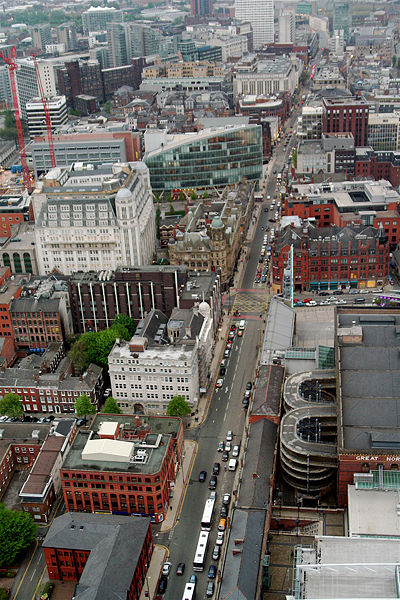
Deansgate is a main road (part of the A56) through Manchester City Centre, England. It runs roughly north–south in a near straight route through the western part of the city centre and is the longest road in the city centre at over one mile in length.[1]

Key Information

History

[edit]

Deansgate is one of the city's oldest thoroughfares. In Roman times its route passed close to the Roman fort of Mamucium and led from the River Medlock where there was a ford and the road to Deva (Chester). Along it were several civilian buildings and a mansio in the vicinity of the Hilton Hotel.[2] Part of it was called Aldport Lane from Saxon times. (Aldport was the Saxon name for Castlefield.) Until the 1730s the area was rural but became built up after the development of a quay on the river.[3]

The road is named after the lost River Dene, which may have flowed along the Hanging Ditch connecting the River Irk to the River Irwell at the street's northern end.[4] (‘Gate’ derives from the Norse gata, meaning way).

By the late 19th century Deansgate was an area of varied uses: its northern end had shopping and substantial office buildings while further south were slums and a working-class area around St John's Church (St John Street remaining upper middle class). The Wood Street Mission began to address the social problems in 1869 and its work continues in a very different form.[5] From Peter Street southwards the eastern side was dominated by the viaducts of the Great Northern and Manchester South Junction Railways, whilst the Rochdale Canal crossed below Deansgate to connect with the other waterways beyond. In the late 20th century Deansgate was home to the head office of the Manchester Evening News newspaper, now replaced by part of the Spinningfields development. In early 2023, the road had cycle lanes and cycle laybys installed on the road.

Geography

[edit]

Deansgate begins at Victoria Street, a 19th-century creation. Its east side was occupied by the Victoria Buildings built on a triangular site by Manchester Corporation in 1876, but destroyed during a bomb raid in the Manchester Blitz in December 1940.[6] A statue of Oliver Cromwell at the northern corner commemorated Manchester's support for Parliament in the English Civil War. The statue was a gift to the city by Mrs Abel Heywood in memory of her first husband, Thomas Goadsby and was the first large statue of Cromwell to be raised in the open anywhere in England.[7]

At the northern end of Deansgate is Victoria Street, on which lies Manchester Cathedral, and at the southern end is Deansgate railway station. At this point Deansgate connects with Bridgewater Viaduct and Chester Road (Whitworth Street West meets it at this point). The section to the south of Peter Street was known as Aldport Street until the end of the 18th century.[8]

The street contains many shops including a House of Fraser department store (known as Kendals from the 1830s until 2005), and Waterstones along with many public houses and bars including the Moon Under Water, formerly the Deansgate Cinema (or ABC Deansgate). At 820 square metres (8,800 sq ft), able to accommodate 1,700 customers, and employing 60 staff, it has been listed in The Guinness Book of Records as the largest public house in Britain.[9] Elliot House was the Manchester Registry Office and before that the offices of the corporation's Education Department.

The northern end of the street adjoined the Shambles and was badly damaged in the 1996 Manchester bombing. The area was redeveloped and houses several new buildings, including No. 1 Deansgate and the Manchester branch of Harvey Nichols. Other buildings in the Deansgate area include the Royal Bank of Scotland, the Beetham Tower and the redeveloped Great Northern Warehouse. Historic buildings include the John Rylands Library and the Barton Arcade shopping mall. The disused Manchester and Salford Junction canal runs underneath Deansgate below the Great Northern Warehouse.

Deansgate electoral ward within Manchester City Council

Transport

[edit]
Deansgate railway station: station frontage which features the previous "Knott Mill" name

Today, the main transport links on Deansgate are the National Rail and Manchester Metrolink stations and a number of bus routes, including the Metroshuttle services.

Deansgate Station was opened at Knott Mill on 20 July 1849 by the Manchester, South Junction and Altrincham Railway. It is linked to Deansgate-Castlefield Metrolink station on the Metrolink system.

In the first half of the 20th century, Deansgate was a route for trams operated by Manchester Corporation Tramways, and subsequently carried numerous bus services. During the 1970s, many bus routes were diverted or separated into two services terminating in the city centre and adjoining streets such as King Street were pedestrianised.

In 2009, there were calls for traffic to be banned on Deansgate and for it to be pedestrianised.[10] The calls were triggered in response to road works that closed parts of Deansgate. Some argued that the disablement of a major traffic route in the city centre could have a damaging economic effect,[11] while others argued that a vehicle-free Deansgate would attract more shoppers. Victoria Street, the short section at the North end of the road by Manchester Cathedral has been pedestrianised.

In 2019, Extinction Rebellion occupied a section of the road from St Mary’s Gate to John Dalton Street for four days, with tents and organised talks on climate change, sustainable living and resistance. This reignited calls for it to be pedestrianised.[12]

In 2022, widened cycle lanes were put in place, and a bus lane opened at the junction of Blackfriars Street and Deansgate for southbound buses, taxis and bicycles. From Bridge Street to Quay Street it will be permanently one-way only, in a southbound direction.[13]

The 'free bus' services 1, 2 and 3 operate around the city centre and all three routes have stops on Deansgate.[14]

Events

[edit]
Jenson Button drives a McLaren F1 car down Deansgate.

Deansgate is a long straight street which has provided a venue for sporting events in the city centre. In 2006, A1 Racing cars visited the city to launch A1 Grand Prix, and used Deansgate as part of the route.[15] In August 2011, thousands packed the street as Jenson Button drove a McLaren MP4-23 along Deansgate as part of the Vodafone Vip Live Manchester festival.

In 2001, the inaugural Great City Games took place on Deansgate, which featured a 150-metre sprinting track. The event has become an annual fixture on the Great Manchester Run weekend during mid-May. Usain Bolt set a world record for the 150 m straight in 2009 and Tyson Gay ran the 200 m straight in record time in 2010.[16][17]

References

[edit]

Further reading

[edit]
Revisions and contributorsEdit on WikipediaRead on Wikipedia
from Grokipedia
Deansgate is a major thoroughfare in central , , renowned as one of the city's most historic streets, with origins tracing back to a Roman route linking two river crossings during the occupation of the area. Stretching approximately one mile as the longest and straightest street in the city centre, it serves as a vital connector between key districts, accommodating a mix of commercial, cultural, and transport functions. Prominent landmarks along Deansgate include the neo-Gothic Library, a Grade I housing rare manuscripts and books, and the nearby , underscoring its architectural and . Historically evolving from a medieval lane possibly named after the lost River Dene, Deansgate has transformed through industrial and post-war developments, including tram and bus routes, into a bustling hub of shops, restaurants, and bars. In recent years, has prioritized regeneration initiatives to enhance pedestrian safety, active travel, and public spaces, aiming to reduce vehicular dominance and foster a more vibrant urban environment amid ongoing conservation efforts in the Deansgate/Peter Street area.

Etymology

Origin and Historical Naming

Deansgate derives its name from the and Norse influences prevalent in medieval , specifically denoting "the street (gata) of the dean," referring to the boundary or access route to the lands held by the Dean of the of St. Mary, St. George, and St. Denys (now ). This ecclesiastical association underscores the street's proximity to the church's domain, where the dean oversaw spiritual and temporal affairs in the manor of from at least the onward. The term gata, borrowed from via Viking settlements in the region, commonly denoted a paved or principal in Anglo-Scandinavian place names. The name first emerged in the Anglo-Saxon era, postdating the street's prehistoric and Roman foundations as a north-south thoroughfare linking crossings of the Rivers Irwell and Medlock, but predating widespread medieval documentation. Initially, it applied to the section between the present-day junctions of Cateaton Street (near the cathedral) and Peter Street, marking the edge of church-controlled territory amid a transitioning settlement from Roman Mamucium to Saxon Mameceaster. Earlier designations included Aldport Lane, interpreted as "old town lane" from Old English ald (old) and port (town or gate), suggesting continuity from pre-Norman administrative divisions. Scholars have proposed competing origins, such as linkage to a conjectural lost River —hypothesized to have connected the Irk and Irwell but lacking archaeological confirmation—or "Dane's gate" ( gata), evoking Viking incursion routes through the area. These alternatives, while evocative of Manchester's layered invasions (Roman, Anglo-Saxon, Norse, Norman), receive less substantiation than the deanery theory, which coheres with surviving records of the Old at 66 Deansgate and the church's manorial extents documented from the 13th century. No single charter provides an unequivocal first attestation, reflecting the oral-to-written transition in early medieval .

History

Pre-Industrial Development

Deansgate originated as a Roman road during the occupation of Britain, serving as a key route linking the fort at Mamucium (modern ) to the north with the fort at Ribchester via crossings of the Rivers Irwell and Medlock. The road's alignment, evident on later maps labeled as "Roman Road," facilitated military and trade movement southward toward , with its narrow width accommodating approximately four soldiers abreast. Archaeological evidence indicates continuity of use post-Roman withdrawal in the , though settlement remained sparse amid surrounding farmland and woodland. In the medieval period, Deansgate formed part of Manchester's extramural thoroughfares, extending from the core settlement around the (now ) southward as a vital link for regional in woollen cloth and agricultural . The area featured limited timber-framed structures, such as inns catering to travelers and merchants en route to markets in and beyond, within a manor-dominated landscape under the control of local lords and the church. By the late medieval era, around the , Manchester's population supported basic commerce along the route, but Deansgate itself saw no significant urban expansion, preserving its character as a linear path through open fields. Excavations confirm minimal deposits from this era, underscoring low-density occupation. During the (16th–18th centuries), Deansgate continued as a principal for coaches and packhorses, with gradual infilling by isolated buildings including dwellings and places of worship. A Quaker stood at the corner of what is now Jackson's Row by the , rebuilt in to accommodate growing nonconformist communities. By the mid-18th century, as depicted on contemporary maps, prominent merchants' mansions backed onto the street, signaling emerging elite presence amid Manchester's pre-industrial status, where the population hovered around 10,000 in 1750. The route's role in local textile trade—focusing on wool processing—laid groundwork for later , but the vicinity retained rural aspects with orchards and until industrial pressures intensified after 1760.

Industrial Revolution and Expansion

During the late 18th and 19th centuries, Deansgate transformed into a critical artery for Manchester's sector, serving as a corridor flanked by warehouses that handled the storage and distribution of goods. Manchester's industry expanded rapidly following innovations like steam-powered mills, with the first such mill erected in the city during the 1780s, enabling mechanized production that outpaced manual methods. By 1830, the city hosted 99 steam mills, many reliant on cheap coal transported via nearby canals to power operations along routes like Deansgate. This growth positioned Manchester as the global hub of processing, where private enterprise drove efficiencies in spinning and weaving, such as the adoption of the power loom, fostering unprecedented output from imported raw . The area's infrastructure adapted to support this boom, particularly through canal connections that linked Deansgate to broader transport networks. The , opened in 1761 by private initiative under the Duke of Bridgewater, halved coal prices in Manchester by enabling bulk shipments from Worsley mines, which fueled textile mills and warehouses proximate to Deansgate. Extensions and locks in the vicinity, including those later associated with Deansgate Locks on the canal system, facilitated the movement of raw imports and finished exports, underpinning Manchester's role in channeling goods to ports for overseas markets. By the mid-19th century, constituted about half of Britain's merchandise exports, with Manchester's warehouses—numbering over 1,700 by 1855—acting as trading nodes rather than primary sites, emphasizing the city's function as a commercial . Demographically, the textile surge along Deansgate drew a voluntary influx of laborers seeking wages unattainable in agrarian economies, boosting 's population from roughly 89,000 in 1801 to 255,000 by 1841 across Manchester and . Census data reflect this density spike in central wards, including those abutting Deansgate, as workers migrated from rural , , and later during the 1840s famine, prioritizing employment in warehouses and ancillary trades over subsistence farming. While conditions involved long hours and poor sanitation, the sector's expansion created millions of jobs across , with 's output representing around 40% of global textiles by 1850, attributing growth to market-driven rather than coercion. Empirical records underscore that such migration patterns stemmed from perceived economic gains, as real wages in textiles rose amid surges from 1760 onward.

Post-War Decline and Regeneration

Following the end of , Deansgate shared in 's broader , as the city's textile sector—once a global powerhouse—faced intensifying competition from overseas producers, leading to a sharp contraction after a temporary rebound in output during the . By the and , closures accelerated amid national economic restructuring, with losing approximately 207,000 manufacturing jobs between 1972 and 1984, driving unemployment rates to around 20% and leaving many of Deansgate's historic warehouses and commercial buildings underutilized or derelict. This decline reflected causal factors like technological shifts, labor cost disadvantages, and policy environments that discouraged industrial retention, rather than isolated local mismanagement, resulting in persistent vacancy in central properties through the late . The Provisional IRA's detonation of a 1,500 kg bomb in on 15 June 1996 inflicted widespread structural damage and prompted evacuations across affected zones, including areas proximate to Deansgate, which compounded existing by disrupting commerce and highlighting vulnerabilities in aging . While immediate impacts included shattered facades and temporary business halts, the event exposed high vacancy levels in warehouses—often exceeding 20-30% in comparable periods of the —and catalyzed a pivot from decline, as private capital, unburdened by prior state-heavy models that had yielded mixed results, began targeting brownfield reclamation over public subsidies. Regeneration gained momentum in the late 1990s through market-led initiatives, exemplified by the private redevelopment of the adjacent district, where derelict mill sites and warehouses were converted into premium office spaces, hotels, and retail by developers like Allied London, generating over 10,000 jobs and injecting more than £1 billion into the local economy by fostering high-value professional services rather than subsidizing legacy industries. This approach, prioritizing and investor returns amid post-Thatcher , contrasted with earlier failed interventions and drove property value surges, with Deansgate benefiting from spillover effects like increased and adjacent office growth. Key milestones included the completion of Deansgate Square's South Tower in 2018—a 64-storey, 201-metre residential by Renaker and New Jackson—followed by phased handovers of the full 1,508-unit complex by 2021, transforming former rail yards into high-density housing that supported population inflows without relying on government backstops. In , infrastructure enhancements underscored ongoing adaptive urbanism, as Deansgate concluded on 4 April, introducing segregated cycle lanes, additional pedestrian crossings, and southbound-only traffic reconfiguration to prioritize non-motorized access from the Chester Road to the core, reducing prior congestion bottlenecks and aligning with empirical gains in from private-sector density increases. These developments, backed by billions in cumulative private investments since the , demonstrate how decentralized decision-making outperformed centralized planning in reversing vacancy and spurring employment, with Deansgate evolving from a faded arterial route into a node of economic resilience.

Geography and Layout

Location and Boundaries

Deansgate forms a primary north-south arterial route through the western portion of , , , as a segment of the A56 trunk road. The street extends over approximately 1.6 kilometres (1 mile), linking key districts and running parallel to the River Irwell, which marks the boundary with to the west. The Deansgate electoral ward, encompassing the street and adjacent high-density urban developments, spans 1.957 s with a of 6,998 inhabitants per as of the 2021 Census. Established under the 2018 ward boundary revisions by the Local Government Boundary Commission for , the ward replaces segments of the prior ward and is delineated on official maps, generally bounded by the River Irwell westward, central commercial zones eastward, and adjacent wards including to the north and Castlefield influences to the south.

Topography and Key Features

Deansgate exhibits a predominantly flat to gently sloping north-south alignment through central , with ground elevations varying from approximately 28 meters to 34 meters above , as observed in adjacent sites like Great Jackson Street. This subtle topography facilitates straightforward urban navigation and development but is shaped by the nearby valley to the west, which funnels airflow and contributes to localized microclimatic effects such as elevated urban heat islands and moisture retention during precipitation events. Sections of the historic , running parallel to parts of Deansgate, function as enduring water features that historically supported drainage in the low-lying terrain but introduce vulnerability to flooding from canal overflow or Irwell surges. Heavy rainfall in December 2020 led to significant Irwell rises adjacent to Deansgate, underscoring these risks through inundation of nearby lowlands and temporary disruptions to surface usability. Green space integration remains sparse within Deansgate's immediate corridor, limited to small-scale pockets like Parsonage Gardens amid dense built fabric, which collectively mitigate some heat buildup but do little to alter the area's overall constrained environmental footprint. High-rise prevails, accommodating vertical expansion in this terrain-constrained zone and sustaining a of approximately 7,000 persons per square kilometer across the Deansgate ward, equivalent to 13,697 residents in 1.957 square kilometers as of the 2021 census.

Architecture and Landmarks

Historic Structures

The , located at 150 Deansgate, stands as a prominent Grade I listed Gothic Revival building designed by Basil Champneys and constructed from 1890 to 1899, originally commissioned by Enriqueta Rylands as a to her husband and housing one of the finest collections of rare books and manuscripts in the UK. Its neo-Gothic facade features intricate stonework, flying buttresses, and a reading room modeled after the medieval libraries of and , reflecting Victorian-era philanthropy and scholarly ambition amid Manchester's industrial wealth. Barton Arcade, integrated into Barton's Building at numbers 51-63 Deansgate, is a Grade II* listed Victorian shopping arcade completed in 1871 to designs by Corbett, Raby & Sawyer, characterized by its wrought-iron and glass canopy, ornate terracotta detailing, and galleried structure that facilitated retail expansion during the city's commercial boom. The arcade's iron-framed construction exemplifies early adoption of prefabricated techniques in architecture, linking it to the engineering innovations of the . Further along Deansgate, the Great Northern Warehouse at numbers 235-249, erected around 1898 by the Great Northern Railway Company, comprises a robust five-storey edifice with cast-iron framing and a prominent , serving originally as a goods depot connected to the adjacent railway before its as a mixed-use complex. This structure highlights the integration of rail infrastructure with urban warehousing, a hallmark of Manchester's 19th-century dominance. Kendal Milne department store, occupying numbers 98-116 Deansgate, is a Grade II listed edifice from the late , featuring a symmetrical facade with Renaissance Revival elements including pilasters, cornices, and large plate-glass windows that catered to the growing retail demands of the middle class. Nearby, Hayward's Building at numbers 62-66 exemplifies similar Victorian commercial architecture with its detailed brickwork and shopfronts, while the Sawyers Arms public house at number 138 retains its historic pub frontage dating to the early . These buildings, protected under the Deansgate/Peter Street Conservation Area, underscore the street's evolution from medieval route to Victorian commercial artery, with many surviving due to statutory listing by since the 1970s. Deansgate Goods Station, a Grade II* listed rail facility spanning the street's southern end, originated in the 1840s with expansions through the Victorian period, incorporating iron viaducts and warehouses that facilitated freight handling until closure in 1969, now repurposed within the modern Deansgate station environs. Its surviving elements, including arched openings and brick arches, represent Manchester's pivotal role in Britain's rail network expansion post-1830 Railway Act.

Modern Developments and Skyscrapers

The Beetham Tower, completed in 2006, marked a pivotal shift in Deansgate's skyline as Manchester's tallest structure at 169 meters with 47 floors, incorporating a Hilton and residential apartments. This pioneered high-rise construction in the area, utilizing steel and glass framing that set precedents for subsequent projects. Deansgate Square, developed by Renaker, represents the most significant post-2000 transformation, comprising four residential towers completed between 2018 and 2020. The South Tower, standing at 201 meters across 64 floors, surpassed the Beetham as the UK's tallest building outside upon its 2018 completion, housing 496 apartments. The complex adds over 1,000 residential units overall, emphasizing glass and steel facades for modern aesthetics and targeting Very Good sustainability ratings through energy-efficient designs. These developer-led initiatives have elevated Deansgate's profile, with engineering feats including advanced structural systems enabling heights previously unseen in the region. Complementary landmarks like Manchester Central, repurposed from a Victorian railway station into a convention centre in 1986 and renovated in 2008–2009, integrate with the vertical growth by hosting events that amplify economic activity around the new builds. By 2025, completion of extensive roadworks enhanced pedestrian realms adjacent to these , introducing wider footways, raised crossings, and segregated cycle lanes along Deansgate to improve and urban flow post-construction disruptions.

Economy and Commerce

Retail and Business Districts

Deansgate functions as a key commercial artery in 's , hosting a diverse array of retail outlets, professional offices, and service-oriented businesses that contribute to the local economy. The street features luxury shopping options alongside high-end restaurants and bars, drawing significant footfall from both locals and visitors. This commercial vibrancy supports 's broader economic growth, with Deansgate forming part of the adjacent to areas like . A prominent retail anchor is the , originally established as Kendal Milne in the , which offers upscale , home goods, and beauty products across multiple floors. The store's enduring presence underscores Deansgate's historical role in premium retail, evolving from Victorian-era trading hubs to modern luxury commerce. Surrounding boutiques and independent shops provide specialized offerings, including and artisanal goods, enhancing the district's appeal as a destination for discerning shoppers. On the business front, Deansgate accommodates numerous financial, legal, and media firms in its spaces, reflecting high demand driven by the area's central location and connectivity. Commercial property rents averaged £35 per square foot annually in 2023, indicative of robust market conditions and low vacancy rates. Recent initiatives, such as the Transforming Deansgate project, aim to further integrate retail and functions by improving access and public realm enhancements, fostering sustained economic activity. New developments like incorporate ground-floor retail units alongside residential towers, injecting additional commercial space into the district and supporting over 3,500 new residents who bolster local . These mixed-use projects align with Manchester's to diversify its beyond traditional sectors, emphasizing knowledge-intensive industries and experiential retail.

Residential and Office Growth

The Deansgate area has undergone rapid residential expansion driven by private developers responding to demand from young professionals and investors, with high-rise projects adding substantial housing stock to the city center. , a flagship development completed in phases starting in , comprises 1,508 luxury apartments and penthouses across four towers, including Manchester's tallest residential structure at 200 meters. This addition of units, primarily one- to three-bedroom configurations, has achieved near-full occupancy, as evidenced by the project's sell-out status and sustained lettings at premiums reflecting market equilibrium rather than artificial constraints. Such private-led builds demonstrate supply elasticity, where increased volumes have accommodated population pressures without relying on regulatory interventions that might distort affordability signals. Office development in the adjoining district, integral to Deansgate's commercial fabric, has similarly surged post-2010, incorporating over 2 million square feet of Grade A space within a broader 4 million square foot masterplan. Key contributions include No.1 Spinningfields, delivering 343,000 square feet of flexible office accommodation upon completion in 2019. 's central office vacancy rates fell from a peak of 24% in late 2008 to 5.9% by late 2024, directly tied to this floorspace expansion meeting tenant demand. inflows, with securing 44 projects in 2024 alone—the highest outside —have causally propelled this growth by generating employment in sectors like software, IT services, and finance, thereby necessitating premium office environments. Demographic shifts underscore the area's appeal, with an influx of professionals elevating the local economy; Manchester's population grew 9.7% from 503,100 in 2011 to 551,900 in 2021 per figures, concentrated in central zones like Deansgate amid broader economic revitalization. This migration has verified rises in high-density wards, enhancing the tax base through higher earners drawn to proximate and workspaces, as detailed in city economic assessments linking new accommodations to sustained professional retention.

Transport Infrastructure

Road and Cycling Networks

Deansgate constitutes the central section of the A56 trunk road, a primary arterial route extending from in northward through into and beyond. In , the A56 follows Deansgate's near-straight north-south alignment, facilitating high-volume vehicular traffic between the city core and to the west. The road accommodates multiple lanes for motor vehicles, with junctions connecting to key cross-streets such as Whitworth Street West and Bridgewater Viaduct, supporting commercial and commuter flows. Ongoing upgrades, including junction improvements on the A56 Manchester Road segment, aim to enhance capacity and safety amid persistent congestion challenges. Recent infrastructural modifications have prioritized by converting portions of Deansgate to one-way operation for motor traffic, particularly the lower half from the southward, to allocate space for enhanced and facilities. This reconfiguration, part of the Deansgate and Whitworth Street West Active Travel Scheme initiated in 2023, introduced protected two-way cycle lanes along the central reservation and adjacent to the Great Northern Warehouse, completed in spring 2025 following roadworks that spanned over four years. The scheme integrates with broader networks, such as the Chorlton to Cycleway, providing continuous segregated paths to encourage modal shift from cars. These provisions feature smooth asphalt surfacing and physical barriers to separate users from motor , though implementation has sparked debate over reduced vehicular capacity and access for businesses and buses. Temporary pop-up lanes on the A56 preceded permanent protected , reflecting to balance urban mobility demands. Trial closures, such as between King Street West and Blackfriars Street limited to delivery vehicles from 6am to 8am, further test restrictions to promote active travel. Despite criticisms of construction-related disruptions, the updated layout has demonstrably improved cyclist safety and route continuity through the .

Rail and Tram Connections

Deansgate-Castlefield serves as a key Metrolink tram stop on the network operated by (TfGM), facilitating connections to major stations including and Victoria. During peak hours, the stop handles up to 40 trams per direction hourly, with services departing every 45 seconds due to overlapping lines from , Eccles, and Airport branches. This high-frequency service, part of the Bee Network's integrated transport framework, supports daily ridership contributing to Metrolink's overall post-pandemic recovery, with system-wide passenger numbers exceeding pre-2020 levels on weekdays. The adjacent Manchester Deansgate National Rail station provides proximity to heavy rail services, with platforms accessible via lifts and serving operators like and for regional and intercity routes. In 2023/2024, the station recorded 1,059,228 entries and exits, reflecting its role in commuter flows to and from central . Metrolink's development through public-private partnerships, including early involvement in system expansion, has enhanced intracity connectivity, enabling economic productivity gains by reducing travel times and integrating with . Tram journeys from Deansgate-Castlefield to take approximately 29 minutes, with services every 30 minutes, underscoring the network's efficiency as an economic enabler for business and freight-linked travel. services from Deansgate station reach in an average of 24 minutes, further bolstering access. Proposed HS2 extensions, initially eyed for improved northern access via , faced cancellation of Phase 2b in 2023, with remaining links delayed until at least 2040, limiting anticipated capacity boosts for Deansgate-area connectivity.

Culture and Events

Nightlife and Entertainment Venues

Deansgate has historically served as a hub for Manchester's , particularly through the Deansgate Locks area, where Victorian railway arches along the were repurposed into bars and clubs in the late . This development transformed the waterfront into a vibrant , attracting crowds with venues offering live , cocktails, and themed nights, peaking in popularity during the and early . Key establishments in the area include Ark Manchester, a multi-level club in Deansgate Locks emphasizing electronic , sophistication, and varied nightly themes since its establishment, drawing patrons for its canal-side location and capacity for large crowds. Nearby, persists as one of the few remaining Locks venues, focusing on pop anthems and retro entertainment. Along the main Deansgate thoroughfare, cocktail bars such as Dirty Martini and Manahatta offer upscale experiences; Dirty Martini features live and martini flights, while Manahatta emulates a New York-style party atmosphere with bottomless brunches extending into evenings. Traditional pubs contribute to the mix, with Mulligans claiming status as Manchester's oldest on Deansgate, operational for over 200 years and known for live sports screenings and traditional ales. However, by May 2025, Deansgate Locks had declined significantly, with only two operational businesses in its 12 arches amid closures of former staples like Baa Bar, attributed to rising rents, post-pandemic shifts, and competition from other city districts. This has prompted discussions on revitalization, though core Deansgate bars continue to host events like themed parties and DJ sets into the late hours.

Public Celebrations and Festivals

Deansgate has long functioned as a primary thoroughfare for Manchester's public parades and festivals, channeling large crowds through its central position in the city. Victory celebrations for Manchester United Football Club, particularly following major triumphs, have drawn massive spontaneous gatherings, underscoring the street's role in communal expressions of local pride. The 1999 Treble-winning parade, celebrating the club's conquest of the , , and , attracted an estimated 500,000 supporters lining the streets, with routes encompassing key areas like Deansgate amid widespread jubilation. Similarly, the 2013 parade marking the club's 20th title proceeded directly down Deansgate, drawing tens of thousands of fans in a from to Albert Square, complete with an open-top bus displaying the trophy. Annual civic events further utilize Deansgate for structured yet participatory festivals. parades have incorporated the street as a core segment of their route since at least the mid-2010s, starting from Liverpool Road and proceeding via Deansgate before looping through Peter Street and Oxford Road, with hundreds marching and thousands spectating in recent years. The Manchester Day parade, an annual celebration of city identity held on the last Sunday of , features a along Deansgate, including a "Mini Parade" at noon led by fantastical creatures, live bands, and drummers, which in 2025 drew over 50,000 attendees to the city center. Following the , events on Deansgate resumed with enhanced crowd management by , incorporating capacity controls and hybrid formats to accommodate gatherings while mitigating risks, as seen in the continuity of and Manchester Day parades without major disruptions reported in official accounts. These occasions echo Deansgate's historical use in public processions, such as 1970s ceremonial marches by local police, symbolizing the street's enduring function as a conduit for 's collective resilience and shared triumphs rooted in its working-class heritage.

Controversies and Criticisms

Gentrification and Displacement

Deansgate has experienced pronounced since the 2010s, driven by large-scale residential developments on brownfield sites, including the complex of four skyscrapers completed between 2018 and 2022, which added over 1,100 luxury apartments primarily marketed to high-income professionals and investors. These projects, often featuring amenities like private gyms and services, have capitalized on proximity to Manchester's commercial core, fostering a shift toward transient, affluent occupancy rather than long-term local residency. The Gentrification Index, published by the think tank Common Wealth in 2025 using 2013–2023 data, ranks Deansgate third among wards for gentrification intensity, with scores derived from indicators such as house price , reductions in neighborhood deprivation, declines in Black, Asian, and minority ethnic (BAME) shares, and elevated residential turnover. city center areas like Deansgate exhibit some of the region's highest pressures, exceeding the average score of 41.5 (on a 0–100 scale where scores above 60 denote severe ), attributed to a build-to-rent boom that prioritizes market-rate over social needs. Rising property costs have intensified affordability challenges, with average monthly rents along Deansgate reaching £3,766 in 2024, positioning it among the UK's pricier streets outside and contributing to broader trends of 81% house price growth over the prior decade and over 40% rent increases in the three years to 2025. This economic escalation, compounded by platforms like whose listings surged in central Manchester including Deansgate post-2010, has prompted concerns over indirect displacement, where lower-wage residents face involuntary relocation due to unaffordable housing rather than direct evictions. Empirical analyses of gentrification's displacement effects remain contested; while some research highlights household-level out-migration from upgrading neighborhoods, a 2020 LSE study of UK areas found residential mobility rates far exceed in-situ demographic shifts but yield small net population losses among low-income groups, suggesting displacement is often overstated relative to voluntary moves or broader market dynamics. In Deansgate's case, development on underused industrial land has avoided widespread demolitions of existing homes, yet the absence of affordable units in projects like the 15,000 new city-center dwellings built since 2010 has amplified pricing-out risks for original working-class communities. Critics, including local housing advocates, argue this pattern entrenches inequality by concentrating investment in the core while peripheral areas lag, though proponents emphasize economic revitalization and job creation from inbound wealth.

Crime, Safety, and Urban Management

In the 1990s, Manchester experienced widespread gang-related violence, including turf wars between groups from areas like , Cheetham Hill, and central districts, with Deansgate's nightlife venues often sites of confrontations involving doormen and elements. This era saw elevated rates of shootings and assaults city-wide, though specific Deansgate incidents were tied more to protection rackets than territorial dominance elsewhere. Post-regeneration efforts since the early 2000s, including urban redevelopment around Deansgate Locks and high-rise developments, have correlated with enhanced safety measures such as extensive CCTV networks and private security deployments, credited by local analyses for deterring opportunistic crimes in high-footfall zones. data indicate overall crime reductions in central , with violence against the person offences showing variability but supported by public-private partnerships that improved detection rates. Private guards and monitored CCTV have proven effective in reducing violent incidents by up to 20-30% in monitored urban hotspots, per , outperforming public policing alone in density-driven environments like Deansgate's commercial strips. Despite these gains, Deansgate postcodes report crime rates significantly above the national average—around 492 incidents per 1,000 residents in areas like M3 4LQ—primarily driven by , , and alcohol-related violence from transient nightlife crowds rather than resident-perpetrated offences. Affluent demographics in newer tower blocks contribute to lower baseline offending, enabling self-policing dynamics that alleviate public resource strains, as evidenced by fewer crimes in upscale residential clusters compared to broader wards. Urban management involves collaborations with developers for rapid response protocols, achieving average 999 call answer times of four seconds by 2023, alongside targeted patrols that prioritize high-density zones. Critics, including 2021 urban policy reviews, argue amplifies reliance on privatized systems, potentially exacerbating divides, yet empirical metrics affirm CCTV and guard efficacy in curbing persistent issues like public disorder. Isolated 2024 incidents, such as neighbour feuds in towers, highlight domestic tensions in luxury high-rises but remain outliers amid overall stabilized trends.

References

Add your contribution
Related Hubs
User Avatar
No comments yet.