


Community hub
Recent from talks
Contribute something
Nothing was collected or created yet.
Debbie Does Dallas
View on Wikipedia
| Debbie Does Dallas | |
|---|---|
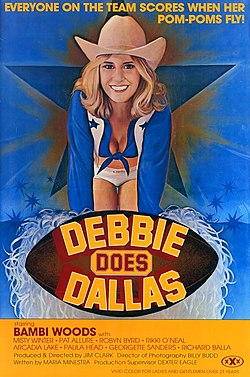
 Theatrical poster | |
| Directed by | Jim Clark |
| Written by | Maria Minestra |
| Produced by | Jim Clark |
| Starring |
|
| Cinematography | Billy Budd |
| Edited by | Hals Liptus |
| Music by | Gerald Sampler |
Production company | School Day Films |
| Distributed by | VCX[1] |
Release date |
|
Running time | 84 minutes[1] |
| Country | United States |
| Language | English |
Debbie Does Dallas is a 1978 American pornographic film produced and directed by Jim Clark, and starring Bambi Woods.[2] The plot focuses on a team of cheerleaders attempting to earn enough money to send the title character to Dallas, Texas, to try out for the famous Texas Cowgirls cheerleading squad.[3] The fictional name "Texas Cowgirls" was seen as an allusion to the real-life Dallas Cowboys Cheerleaders.[2][3] Woods had previously tried out for the Dallas Cowboys Cheerleaders in real life, but she was cut during auditions.[2]
The film was highly successful, selling 50,000 copies on videotape, making it the most successful pornographic video release of its time.[4] It is regarded as one of the most important releases during the so-called Golden Age of Porn (1969–1984),[5] and became one of the best-known pornographic films of the 1980s.[6] The film is in the public domain following a US court ruling in 1987 that declared its copyright to be lost.[7]
The enormous success spawned a number of sequels and spin-offs,[8] and a 2002 off-Broadway musical of the same name.
Plot
[edit]Debbie Benton, captain of her high school cheerleading squad, has been accepted to try out for the Texas Cowgirls.[9] Her parents disapprove and refuse to pay her fare to Texas. In a bid to help Debbie, her squadmates Lisa, Roberta, Tammy, Pat, and Annie decide to accompany her to Texas. With two weeks to raise the money, they swear off sexual activity with their boyfriends and form a company called Teen Services.
Tammy takes a job in the local record store run by Nick. Debbie gets a job at a sports store run by Mr. Greenfeld. Roberta convinces Mr. Hardwick to give her a job at the candle store with Mrs. Hardwick. Rikki and Annie agree to wash Mr. Bradly's car.
The football team is annoyed by a lack of sex. Roberta's boyfriend Rick and his teammates join Roberta and Pat in the showers, where they have group sex. While working for Mr. Greenfeld at the sports store, Debbie is talked into allowing Mr. Greenfeld to see her breasts for $10 and fondle her breasts for another $10. Then, he sucks them for an additional $20.
Realizing they will not be able to raise enough money by legitimate means, Debbie convinces the other girls to engage in sexual activities for more money. They agree, but only if it is on their terms.
After Roberta is caught masturbating by Mrs. Hardwick, Roberta engages in sexual activity with Mr. and Mrs. Hardwick, earning extra money. Rikki and Annie go to see Mr. Bradly, to wash his car. Mr. Bradly is not home, but they wash his car anyway. When Mr. Bradly returns home, he asks them in to dry off their wet clothes. They undress for him for $10 each. He performs cunnilingus on them, they each fellate him and then he has anal sex with Annie.
At the library, Donna flirts with Mr. Biddle, the librarian. Visiting her at work, her boyfriend Tim tries to have sex with her. She fellates him but is caught by Mr. Biddle. Donna allows him to spank so he won't tell her parents. Hamilton and his friend Ashly are in the tennis club sauna after a tennis game, and Hamilton convinces Lisa to fellate him while Ashly penetrates her.
At the record store, Tammy has been avoiding Tony's advances; she calls Lisa, who joins them at the record store. Lisa offers Tony "anything" and she begins to fellate him, and then Tammy joins in, and he ejaculates on Tammy's breasts.
In the final scene, Debbie arrives at Mr. Greenfeld's store after hours, in a Texas Cowgirls uniform as he requested. Greenfeld, dressed in a green-and-white number 12 football jersey (a trademark of Joe Namath[10]), reveals his dream of being the quarterback who makes love to the head cheerleader, and she obliges. She fellates him, and he penetrates her vagina with his finger and performs cunnilingus on her. Then they engage in vaginal sex, first in the missionary position, then doggy style, and then with Debbie on top. They finish in the missionary position with Mr. Greenfeld pulling out right before ejaculating.
Cast
[edit]
- Bambi Woods as Debbie Benton
- Richard Balla as Mr. Greenfeld
- Christie Ford (as Misty Winter) as Roberta
- Robyn Byrd as Mrs. Hardwick
- Eric Edwards as Mr. Hardwick
- Rikki O'Neal (as Sherri Tart) as Rikki
- Jenny Cole as Annie
- David Pierce (as David Suton) as Mr. Bradly
- Merle Michaels (as Merril Townsend) as Donna
- Jake Teague as Mr. Biddle
- Herschel Savage as Tim
- Georgette Sanders as Lisa
- Peter Lerman as Hamilton
- Ben Pierce as Ashly
- Arcadia Lake as Tammy
- Tony Mansfield as Nick
- David Morris as Rick
- Kasey Rodgers as Pat
- Debbie Lewis as Girl in Shower
- Steve Marshall as Boy in Shower
- Graham Silcock as "The other boy in the shower"
Production
[edit]The movie was produced and directed by Jim Clark.[1] Some scenes were shot at the Brooklyn College athletic field and the Pratt Institute library in Brooklyn, New York.[1] An urban legend claimed that certain scenes were shot at the State University of New York, Stony Brook, including the library scene. However, this was declared unlikely after an investigation with alumni, and the president of the film's distributor VCX called the rumor "purely inconclusive".[11]
Legal issues
[edit]Trademark
[edit]
New York's Pussycat Theater was enjoined in 1979 from showing the film by the Dallas Cowboys Cheerleaders under the Lanham Act, arguing that their uniforms were mimicked by the film's producers and used in advertising, infringing on their trademarks.[3] The theater argued that uniforms are strictly functional items, but in affirming the lower court's decision, the United States Court of Appeals for the Second Circuit found that "[i]t is well established that, if the design of an item is nonfunctional and has acquired secondary meaning, the design may become a trademark even if the item itself is functional."[3] The decision has been criticized on free speech grounds, but the Seventh Circuit has cited it for the proposition that "confusion about sponsorship or approval, even when the mark does not mislead consumers about the source of the goods," may be sufficient to state a claim under Lanham Act 43(a).[12]
Copyright
[edit]When the film opened in October 1978, it was exhibited without a copyright notice. In 1979, rights-holder M & A Associates entered into an exclusive worldwide video distribution deal with VCX, whereby VCX agreed to pay M & A an advance and make royalty payments on each sale. Upon receiving a print of the film, VCX president Norman Arno contacted M & A president Arthur Weisberg to request copyright protection. Arno also retained the services of attorneys John Lappen and Peter Berger to combat unauthorized copying of the film. Before litigation could commence, VCX was required to add copyright notices to all copies of the film and file registration with the United States Copyright Office; however, VCX could not protect the rights by just adding a notice to the video cassette, since one also needed to be added to the theatrical prints. In 1981, Berger informed Weisberg of the need to add a copyright notice to the prints that had been sent to various theaters, but Weisberg refused. Both Lappen and Berger concluded the copyright had been lost, and in 1982, VCX terminated their contract with M & A and ceased making royalty payments, but continued to distribute the film. In 1987, M & A brought a case against VCX in the United States District Court for the Eastern District of Michigan for breach of contract. VCX argued that the contract was void due to M & A's failure to comply with the Copyright Act of 1976. The court found in favor of VCX, and the judge ruled that "Weisberg's actions had thrust the film irretrievably into the [United States] public domain."[13][14]
Obscenity
[edit]In 1983, a court case in New York, United States v. Various Articles of Obscene Merchandise, found the film not to be obscene.[15][16]
The 1986 publication of the Meese Report contains graphic descriptions of sex scenes and uncensored dialogue from Debbie Does Dallas as well as from other movies, including the hit movie Deep Throat. The Report gives a clinical account of pictures in magazines like Tri-Sexual Lust, and provides a list of 2,370 film titles and 725 book titles ranging from Horny Holy Roller Family to Thoroughly Amorous Amy. The explicit content made the Meese Report a best seller.[17]
Legacy
[edit]Debbie Does Dallas inspired numerous sequels, remakes and spin-offs in the decades since its release. Journalist David Slayden is quoted as saying, "No other pornographic film has been remade more often than Debbie Does Dallas."[18] The sequels include:
- Debbie Does Dallas Part II (1981)
- Debbie Does Dallas III [the Final Chapter] (1985)[19]
- Debbie Does Dallas IV (1988)
- Debbie Does Dallas V (1988)
- Debbie Does Dallas Again (1993)
- Debbie Does Dallas 20th Anniversary Edition (1994)
- Debbie Does Dallas: The Next Generation (1998)
- Debbie Does Dallas '99 (1998)
- Debbie Does Dallas: The Revenge (2003)
- Debbie Does Dallas: East Vs West (2004)
- Debbie Does Dallas ... Again (2007)
Spin-offs include:[18]
- Debbie Duz Dishes (1986)
- Debbie Does 'Em All (1986)
- Debbie Does Wall Street (1991)
- Debbie Loves Dallas (2007)
Stage musical
[edit]In 2001, Debbie Does Dallas: The Musical was created by Susan L. Schwartz for the New York International Fringe Festival.[20] In 2002, it went off-Broadway.[21] Unlike the original film, the musical did not contain any actual sex or nudity.[21] Since, the show has been performed globally, often with racier direction and more explicit choreography. The story, dialogue and characters are fairly faithful, with musical numbers standing in for sex scenes or added for comic effect. As recent as 2015, it continues to be performed.[22]
Television
[edit]In 2005, a documentary called "Debbie Does Dallas Uncovered" was produced and shown on British television.
Remasters and re-releases
[edit]In 2006, VCX employed Media Blasters to digitally re-master from the original 35-millimeter negative into a Definitive Collectors’ Edition 2-Disc set on DVD and single-disc Blu-ray Disc.
On April 11, 2007, Vivid Entertainment Group began including the original feature alongside a new release, Debbie Does Dallas ... Again in DVD, Blu-ray and HD DVD formats.
See also
[edit]

References
[edit]- ^ a b c d e Manbeck, John B.; Singer, Robert, eds. (2003). The Brooklyn Film: Essays in the History of Filmmaking. Jefferson, N.C.: McFarland & Co. p. 193. ISBN 978-0-7864-1405-5.
- ^ a b c Mansour, David (2005). From Abba to Zoom: A Pop Culture Encyclopedia of the Late 20th Century. Kansas City, Mo.: Andrews McMeel Publishing. p. 114. ISBN 978-0-7407-5118-9.
- ^ a b c d Miller, Jeffrey (2002). Ardor In The Court!: Sex and the Law. Toronto: ECW Press. pp. 152–153. ISBN 978-1-55490-528-7.
- ^ Harless, James D. (1985). Mass Communication: An Introductory Survey. Dubuque, Iowa: Wm. C. Brown Publishers. p. 355. ISBN 978-0-697-00124-5.
- ^ Stall, Sam; Harry, Lou; Spalding, Julia (2004). The Encyclopedia of Guilty Pleasures: 1,001 Things You Hate to Love. Philadelphia: Quirk Books. p. 182. ISBN 978-1-931686-54-9.
- ^ Williams, Linda (1989). Hard core: power, pleasure, and the "frenzy of the visible". University of California Press. p. 170. ISBN 978-0-520-06652-6.
- ^ Hull, Tim (October 21, 2011). "A Tidy End to 'Deep Throat' Ownership Fight". Courthouse News Service. Retrieved January 5, 2025.
- ^ Kenny, Glenn (August 19, 2023). "The Problematics: 'Debbie Does Dallas' and The Birth of a Porn Legend". Decider. Retrieved January 5, 2025.
- ^ Kelly, Christopher (July 1, 2008). "Porn Yesterday". Texas Monthly. Retrieved October 31, 2023.
- ^ "Namath Turns Down a $5 Million W.f.l. Offer—is Broadway Joe All Wet?". People. June 9, 1975. ISSN 0093-7673. Retrieved January 5, 2025.
- ^ Mellides, Chris; Aminy, Najib (July 20, 2008). "Debbie Did Not Do Stony Brook". The Stony Brook Press. Archived from the original on June 27, 2009 – via WordPress.
- ^ Farmany, Tony (2001). "Dallas Cowboys Cheerleaders v. Pussycat Cinema". Journal of Contemporary Legal Issues. 12: 275 ff. ISSN 0896-5595.
- ^ Gardner, Eriq (October 26, 2011). "How a Nasty Legal Fight Over 'Deep Throat,' 'Debbie Does Dallas' Was Settled". The Hollywood Reporter. Archived from the original on August 21, 2014. Retrieved August 20, 2014.
- ^ M & A Associates v. VCX, 657 F. Supp. 454, Conclusions para 27 (E.D. Mich. April 8, 1987) ("Although Arno asked Weisberg for copyright protection of the film in early 1979, Weisberg first became aware of the legal significance of the omission of the copyright notice from the film in January of 1981. Weisberg thus received 'notice' of the defect at that latter date. See M. Kramer Mfg. Co. v. Andrews, 783 F.2d 421, 443 & n. 21 (4th Cir. 1986). Weisberg's failure to take reasonable [657 F.Supp. 463] efforts resulted in the film being irretrievably injected into the public domain 'several months' later.").
- ^ "United States v. Various Articles of Obscene Merchandise" (PDF). Opinions of the United States Court of Appeals for the Third Circuit: 2000 Decisions. 226. Retrieved September 28, 2024 – via Villanova University Charles Widger School of Law Digital Repository.
- ^ Lipschultz, Jeremy Harris (2008). "Adult Entertainment". Broadcast and Internet Indecency: Defining Free Speech. New York: Routledge. p. 69. ISBN 978-1-135-59628-6.
- ^ Stengel, Richard (July 21, 1986). "Sex Busters". Time. Retrieved September 28, 2024.
- ^ a b Schaschek, Sarah (2013). Pornography and Seriality: The Culture of Producing Pleasure. New York: Palgrave Macmillan. pp. 66, 91. doi:10.1057/9781137359384. ISBN 978-1-137-35938-4.
- ^ "Debbie Does Dallas Part III: The Final Chapter (1985)". Mubi. n.d. Retrieved January 5, 2025.
- ^ Coleman, Bud (2008). "New horizons: the musical at the dawn of the twenty-first century". In Everett, William A.; Laird, Paul R. (eds.). The Cambridge Companion to the Musical (2nd ed.). Cambridge University Press. p. 299. ISBN 978-0-521-86238-7.
- ^ a b Adams, Natalie G.; Bettis, Pamela (2003). Cheerleader!: An American Icon. New York: Palgrave Macmillan. pp. 70, 72. ISBN 978-1-4039-6184-6.
- ^ Davies, Bree (March 4, 2015). "Debbie Does Dallas: The Musical". Westword. Denver, Colo. Archived from the original on February 18, 2015.
External links
[edit]


Debbie Does Dallas
View on GrokipediaSynopsis and Cast
Plot Summary
Debbie Benton serves as captain of her high school cheerleading squad and receives an invitation to audition for the Texas Cowgirls, a professional cheerleading team based in Dallas, Texas. Her parents refuse to finance the trip, prompting Debbie and her teammates—Donna, Patty, Lisa, and others—to form "Teen Services," a nominally legitimate errand-running business that functions as a front for providing sexual services to local men in their small town.[7][8] The squad's fundraising efforts unfold through a series of vignettes depicting explicit sexual encounters: one cheerleader seduces a football equipment manager in a laundromat, another engages with a married man at home, and group scenes involve interactions with a photographer and a soda shop owner named Mr. Green. These acts target affluent residents and business owners, with the women leveraging their cheerleading uniforms and enthusiasm to solicit payments ranging from small tips to larger sums.[9][10] Despite initial challenges and a pact to abstain from personal sex until the goal is met, the group amasses sufficient funds through persistent solicitation, enabling Debbie's departure for Dallas while highlighting the film's thin narrative pretext for its pornographic sequences.[11][12]Principal Cast and Performers
The lead performer in Debbie Does Dallas (1978) was Bambi Woods, portraying the title character Debbie Benton, a cheerleader organizing fundraising efforts for her squad's trip to try out for the fictional Texas Cowgirls cheerleading squad (an allusion to the Dallas Cowboys Cheerleaders). Woods, born July 12, 1955, in Pierre, South Dakota, entered the adult film industry as an exotic dancer and this marked her primary screen credit before largely withdrawing from public view. Woods had previously tried out for the Dallas Cowboys Cheerleaders in real life, but she was cut during auditions.[13][14][15] Supporting roles included Christie Ford as Roberta, Debbie's teammate involved in key plot sequences; Robert Kerman, credited as R. Bolla in some works, as Mr. Greenfield, the athletic director; Robin Byrd as Mrs. Hardwick, a school official; and Eric Edwards as Mr. Hardwick. Additional cheerleader performers such as Rikki O'Neal and Arcadia Lake filled ensemble roles emphasizing the film's group dynamics.[3][16][17]| Performer | Role |
|---|---|
| Bambi Woods | Debbie Benton |
| Christie Ford | Roberta |
| Robert Kerman | Mr. Greenfield |
| Robin Byrd | Mrs. Hardwick |
| Eric Edwards | Mr. Hardwick |
Production
Development and Financing
Schoolday Productions, Inc., established in 1974 by David Buckley along with his brothers Jim and Frederick Buckley, developed Debbie Does Dallas as a low-budget entry in the Golden Age of Porn, capitalizing on the cultural prominence of the Dallas Cowboys Cheerleaders to create a satirical, explicit parody.[11] David Buckley, under the pseudonym Jim Clark, handled production, direction, and writing duties, with principal photography beginning on July 4, 1978.[11] The screenplay, credited to Maria Minestra, centered on a group of cheerleaders fundraising through sexual acts to fund a trip to Dallas, reflecting the era's trend toward narrative-driven adult films following successes like Deep Throat.[1][12] Financing aligned with the independent adult industry's structure at the time, relying on minimal upfront costs and advance guarantees from distributors rather than traditional studio investment.[11] Buckley later confirmed in a 1975 interview that operations benefited from organized crime affiliations in distribution networks, which provided reliable payments for theater bookings and ensured market access amid limited mainstream funding options for pornography.[11] This mob-linked ecosystem, prevalent in New York-based adult film production, facilitated quick capitalization on timely themes without requiring large capital outlays, though exact budget figures remain undocumented in primary accounts.[11] The film's production under School Day Films emphasized cost efficiency, including unauthorized use of locations like Pratt Institute and Brooklyn College by posing as an educational project.[11][18]Filming Process
Debbie Does Dallas was filmed primarily in New York City during 1978 under the direction of Jim Clark, who also produced and wrote the screenplay under the pseudonym David Buckley for Schoolday Productions.[11] The production employed low-budget techniques, completing principal photography over a few days with minimal resources and rapid execution to minimize costs.[15][19] Key locations included Pratt Institute in Clinton Hill, Brooklyn, where a hardcore sex scene was shot in the library on Independence Day, July 4, 1978, after production staff deceived school authorities into granting access by misrepresenting the project's nature.[11] Cheerleader practice and sports field sequences were captured at Brooklyn College in Brooklyn, while additional exteriors and interiors utilized sites on Long Island, New York.[11][15][20] Lead actress Bambi Woods, portraying Debbie Benton, received $400 for her participation and described the on-campus shoots as unexpectedly amusing despite the film's explicit content, noting the crew's efforts to blend into educational settings for authenticity.[15] The process emphasized narrative elements like cheerleading routines alongside adult scenes, with cast members performing in custom uniforms that later sparked legal disputes, though no major on-set interruptions from authorities were reported during filming.[11]Technical Specifications
Debbie Does Dallas runs for 80 minutes and was filmed in color with a mono sound mix.[21] The aspect ratio is 1.37:1, corresponding to the Academy ratio standard for 35mm theatrical prints distributed to cinemas.[21] Color processing occurred at Cineffects Color Laboratory in New York City, utilizing spherical optics typical of the era's low-budget productions.[21] The negative format employed 35mm film stock, enabling the production of standard 35mm prints despite the film's origins in the adult genre, where cost constraints often favored 16mm shooting for similar titles—though evidence for Debbie Does Dallas specifically confirms 35mm usage for its release prints.[22] No advanced optical effects or specialized lenses were documented, aligning with the straightforward cinematography of 1970s adult features shot primarily indoors and on limited exterior locations.[23]Release and Commercial Success
Distribution and Marketing
Debbie Does Dallas was initially distributed to adult theaters across the United States beginning in late 1978, primarily through independent channels managed by producer David Buckley's Schoolday Productions, Inc.[11] Distribution relied heavily on assistance from organized crime figures, including Sicilian-American mobster Mickey Zafferano, who controlled chains of pornographic cinemas and provided upfront payments and guaranteed theater bookings, a practice Buckley described as reliable compared to mainstream industry alternatives.[11] Marketing strategies emphasized the film's exploitation of the cheerleader archetype and its parody of the Dallas Cowboys, utilizing posters and advertisements that featured performers in revealing uniforms to attract audiences seeking titillating content amid the post-Deep Throat pornographic boom.[11] This approach leveraged word-of-mouth and the era's limited but effective promotional tactics for adult films, such as targeted ads in underground publications and theater marquees, without reliance on mainstream media. The provocative branding contributed to nationwide theatrical runs but also sparked early legal scrutiny from the Dallas Cowboys organization over trademarked imagery.[24] By the early 1980s, as home video emerged, the film transitioned to videotape distribution, selling approximately 50,000 copies and becoming one of the top-selling pornographic videos of its time, further amplified by the adult industry's role in driving VCR adoption.[11] Later re-releases, including VCX's 1997 VHS edition, capitalized on its cult status, though the original prints' lack of copyright notices rendered it public domain by the 2010s, enabling unrestricted copying and online dissemination.[25][26]Box Office Earnings and Sales Figures
Debbie Does Dallas generated substantial revenue relative to its low production costs, estimated in the range of $25,000 to $30,000. The film amassed more than $100 million in combined theatrical and home video sales, underscoring its exceptional profitability within the adult film industry.[27] Following its late 1978 release, the movie sustained a highly successful theatrical run across the United States, bolstered by distribution networks that ensured broad adult theater exposure.[11] In the home video market, it sold 50,000 copies on videotape, establishing it as the top-selling pornographic video of its time and contributing significantly to its long-term earnings.[11] Precise box office tracking was unavailable, as adult films from the era were not systematically reported by mainstream aggregators like those monitoring conventional cinema.[17]Initial Public Reception
Upon its release in late 1978, Debbie Does Dallas drew substantial public interest and audience turnout, becoming a box office phenomenon in adult theaters amid the "Golden Age of Porn," with reports of long lines and repeat viewings fueled by its cheeky parody of the Dallas Cowboys Cheerleaders' wholesome image.[27] The film's provocative premise—cheerleaders funding their Texas trip through sexual favors—tapped into the era's cultural fascination with NFL cheerleaders, amplified by the Cowboys' rising popularity, leading to widespread word-of-mouth buzz and media coverage that boosted its visibility despite limited mainstream distribution.[12] Critics offered mixed to negative assessments, often decrying the film's exploitative elements while acknowledging its playful satire. On the PBS program Sneak Previews in early 1979, Gene Siskel and Roger Ebert designated it a "Dog of the Week," with Ebert lambasting its thin plot and reliance on cheerleader tropes as derivative smut lacking artistic merit, though Siskel rated it 2.5 stars for occasional humorous moments.[28] [29] Public discourse quickly turned controversial, as the film's Dallas-centric theme prompted outrage from conservative groups and the NFL franchise, sparking debates over obscenity and commercialization of sexuality that further propelled its notoriety among audiences seeking taboo entertainment.[30] Audience enthusiasm contrasted sharply with critical dismissal, positioning the film as a populist hit that resonated with viewers for its accessible, narrative-driven approach to adult content—eschewing hardcore excess for comedic vignettes—helping it outsell contemporaries like Deep Throat in initial theatrical runs.[11] This reception underscored a divide between elite reviewers and everyday patrons, who appreciated its escapist fantasy amid post-sexual revolution norms, though some expressed unease over its objectification of young women emulating real-life cheerleaders.[31]Legal Controversies
Trademark Disputes with Dallas Cowboys
Dallas Cowboys Cheerleaders, Inc., a subsidiary of the Dallas Cowboys Football Club, Inc., filed suit against Pussycat Cinema, Ltd. and producer Michael Zaffarano on January 31, 1979, in the U.S. District Court for the Southern District of New York (Case No. 79 Civ. 514), alleging that Debbie Does Dallas infringed trademarks associated with the cheerleaders' uniforms and name.[5] The film, released in late 1978, depicted characters aspiring to join the Dallas Cowboys Cheerleaders, wearing uniforms nearly identical to the trademarked design—white crop tops, white hot pants, and go-go boots—and engaging in sexual acts to fund their trip to Dallas, with advertising referencing "Dallas Cheerleaders" and "Texas Cowgirls."[4] Plaintiffs claimed violation of Section 43(a) of the Lanham Act (15 U.S.C. § 1125(a)) through false designation of origin creating likelihood of confusion, unfair competition, and dilution of the trademarks under New York General Business Law § 368-d, arguing the pornographic context tarnished the cheerleaders' wholesome reputation.[5] On February 13, 1979, the district court granted a preliminary injunction prohibiting further exhibition, distribution, and advertising of the film, finding the uniforms served as a valid service mark with secondary meaning due to public association, and the film's use exploited this goodwill without parody protection, as it aimed to profit from confusion rather than comment on the mark.[5] The injunction was extended to Zaffarano individually on February 16, 1979, after evidence showed his involvement, leading to the film's removal from theaters by February 15, 1979.[5] Defendants appealed, arguing First Amendment protections and lack of confusion, but the Second Circuit Court of Appeals affirmed the injunction on August 14, 1979, following oral arguments on April 6, 1979, holding that the explicit sexual content in association with the mimicked uniform constituted tarnishment and infringement, outweighing expressive defenses.[4] The ruling established precedent that even expressive works could infringe trademarks if they diluted or confused consumers regarding source or endorsement, particularly when exploiting a mark's goodwill for commercial gain in a degrading manner.[4] Although Debbie Does Dallas later entered the public domain in 1981 due to lapsed copyright renewals, the trademarks on the cheerleaders' uniforms and associated goodwill remain enforceable, constraining commercial re-releases or adaptations that evoke the infringing elements.[24] Subsequent distributors have faced ongoing restrictions, as the Dallas Cowboys organization retains veto power over publications implying endorsement or confusion with their branded image.[6]Copyright and Public Domain Status
Debbie Does Dallas entered the public domain in the United States upon its 1978 theatrical release because the distributed prints lacked a copyright notice, as mandated by Section 19 of the Copyright Act of 1909 for published works.[32] Under pre-1989 U.S. copyright law, such omission generally forfeited federal protection unless a cure was registered within five years and unpublished copies retained notice—conditions not met by producer Schoolday Productions or distributor Calvin Anderson.[32][33] In the mid-1980s, video distributor VCX, Inc. sought to enforce copyrights on cassette derivatives by affixing notices to those versions and claiming ownership via a purchase agreement with M&A Associates, the purported rights holder.[32] The U.S. District Court for the Eastern District of Michigan rejected this in M&A Associates, Inc. v. VCX, Inc. (657 F. Supp. 454, 1987), holding that the underlying motion picture's public domain status precluded protection for faithful video reproductions, as no new authorship justified derivative rights.[32] The film's public domain standing persists, enabling unrestricted copying and distribution of the original content in the U.S., though international protections vary and may adhere under Berne Convention rules for unregistered works.[33] Subsequent litigation, such as ownership disputes mirroring those over Deep Throat, has reaffirmed the absence of enforceable copyright in the core footage.[33]Obscenity Trials and Challenges
In the early 1980s, Debbie Does Dallas faced obscenity prosecutions under state and federal laws, primarily tested against the Miller v. California (1973) standard requiring material to appeal to prurient interest, depict sexual conduct in a patently offensive way, and lack serious literary, artistic, political, or scientific value, as judged by contemporary community standards. In United States v. Various Articles of Obscene Merchandise, 709 F.2d 132 (2d Cir. 1983), the U.S. Court of Appeals for the Second Circuit reviewed a district court forfeiture action involving imported copies of the film alongside others like Deep Throat. The court held that Debbie Does Dallas was not obscene, finding insufficient evidence that it lacked serious value or offended the average New York community's standards, despite explicit depictions of sexual acts including fellatio and intercourse.[34] A parallel challenge arose in New York state courts when Erie County authorities, following an investigator's viewing of the film on October 3, 1983, obtained a warrant to seize videocassettes from P.J. Video, Inc., charging violations of New York Penal Law § 235.05.[35] The Justice Court suppressed the evidence for lack of probable cause, as affidavits described only excerpts rather than the full film, a ruling affirmed by the County Court and New York Court of Appeals, which emphasized the need for comprehensive review to avoid overbroad seizures.[36] The U.S. Supreme Court reversed in New York v. P.J. Video, Inc., 475 U.S. 868 (1986), holding that magistrates need not conduct adversary hearings or view entire works for warrants; affidavits detailing "fair probability" of obscenity—such as repeated explicit scenes in Debbie Does Dallas—sufficed under the Fourth Amendment.[35] The case remanded for trial, but no obscenity conviction followed, consistent with federal precedents protecting the film.[34] Additional local efforts, such as in Florida during 1990 obscenity crackdowns, led to store withdrawals of Debbie Does Dallas and similar titles amid jury trials over video rentals, though specific convictions for this film remain undocumented and reflected broader retreats from prosecuting mainstream adult videos post-Miller.[37] These challenges highlighted tensions in applying subjective community standards to commercially distributed pornography, with courts prioritizing procedural safeguards and often deferring to protected speech absent unanimous prurient appeal.[36]Cultural Legacy and Impact
Influence on Adult Film Genre
Debbie Does Dallas (1978) exemplified the production of feature-length hardcore films during the Golden Age of Porn (approximately 1969–1984), which emphasized narrative structures, cinematic ambitions, and 35 mm filming to elevate adult content toward mainstream theatrical viability.[38] Widely screened domestically and internationally, it joined canonical works like Deep Throat (1972) and The Opening of Misty Beethoven (1976) in fostering "porno chic," a period of cultural publicity and artistic experimentation that briefly blurred lines between adult and conventional cinema.[38] This approach contrasted with pre-1970s stag films and later 1980s video-era output, prioritizing extended plots—such as the film's cheerleading squad fundraising via sexual acts—over immediate explicitness, with intercourse deferred until the 70-minute mark in its 83-minute runtime.[27] The film's commercial achievements underscored its genre impact, grossing estimates exceeding $100 million lifetime while selling 50,000 videotape units, marking it as the era's top pornographic home video release.[11][27] This success demonstrated the profitability of narrative-driven adult features, influencing producers to invest in similar story-oriented projects amid rising theater attendance and early home video adoption via Beta and VHS formats.[27] By exploiting cultural fascinations like Dallas Cowboys cheerleader iconography, it popularized ensemble casts and satirical elements, contributing to trope development in subsequent films, though the genre later pivoted toward plot-minimal gonzo styles indebted to its coed-fantasy motifs.[27] Its enduring canonical status has shaped historiographies of pornography, evoking nostalgia for a pre-video phase of relative production polish and influencing retrospective media like Boogie Nights (1997), which romanticized the era's creative ethos.[38] However, the film's micro-budget origins and mob-linked distribution highlighted underlying economic precarity, tempering claims of wholesale genre transformation amid broader shifts toward consumer accessibility.[11]Adaptations, Parodies, and Media Extensions
"Debbie Does Dallas: The Musical," a comedic stage adaptation parodying the original film's plot of high school cheerleaders fundraising for a trip to Dallas, premiered Off-Broadway in 2002, starring Sherie Rene Scott as Debbie.[39] The production, which omits explicit sexual content and nudity, satirizes the source material through exaggerated camp and musical numbers, and has been staged by various regional theaters, including Venice Theatre in Florida in 2018 and productions as recent as 2025.[40][41] The film spawned multiple sequels and remakes within the adult film industry, extending its narrative of cheerleader-themed scenarios. These include "Debbie Does Dallas Part II" released in 1981, focusing on continued explicit encounters, and "Debbie Does Dallas III: The Final Chapter" in 1985.[42] Later entries feature "Debbie Does Dallas: The Next Generation" (1998), a remake centering on a stripper auditioning for a basketball team, and "Debbie Does Dallas... Again" (2007), presented as a direct sequel with performers including Monique Alexander and Savanna Samson.[43] "Debbie Does Dallas: The Revenge" (2003) further extends the storyline with revenge motifs.[44] Parodies appear in animated sketch comedy, such as a segment in the Adult Swim series "Robot Chicken" Season 1, Episode 9, which humorously reinterprets the film's cheerleader premise.[45] The original film's cultural footprint has inspired broader media references, though non-adult extensions remain limited primarily to the musical format due to its explicit origins.[46]Broader Societal and Critical Perspectives
Debbie Does Dallas has been cited in empirical research examining pornography's influence on attitudes toward sexual violence and women. In a study by psychologist Edward Donnerstein, male participants exposed over two weeks to non-violent X-rated films, including Debbie Does Dallas, rated hypothetical rape victims as five times more worthless than did unexposed controls and perceived half as much injury to victims, despite the films lacking depictions of force.[47] These findings, drawn from experimental designs measuring attitudinal shifts, informed 1980s anti-pornography campaigns, such as the Minneapolis ordinance, which classified materials like the film as civil rights violations for promoting women's subordination through objectification and unequal power dynamics.[47] Academic critiques have focused on the film's reinforcement of gender stereotypes, particularly via its cheerleader premise. Media scholar Emma A. Jane contends that Debbie Does Dallas, as a foundational example of cheerleading in pornography, perpetuates representations of such women as promiscuous and available, potentially contributing to desensitization or biased perceptions in broader society.[48] Such analyses align with feminist concerns over causal links between media tropes and real-world attitudes, though empirical causation remains debated amid varying study outcomes on pornography's behavioral impacts. In theoretical reception studies, the film exemplifies pornography's resistance to traditional hermeneutic analysis. Magnus Ullén argues that critical efforts to extract social meaning from works like Debbie Does Dallas overlook their core appeal as facilitators of embodied, masturbatory spectatorship, where narrative serves arousal rather than ideological critique.[49] This perspective highlights the film's role in the late-1970s "porno chic" era, when adult films gained cultural visibility amid post-sexual revolution liberalization, transitioning from fringe obscenity to commercially viable entertainment that tested societal boundaries on explicit content.[12]References
- https://commons.wikimedia.org/wiki/File:Debbie_Does_Dallas.ogv