



Community hub
Recent from talks
Contribute something
Nothing was collected or created yet.
Deduction theorem
View on WikipediaIn mathematical logic, a deduction theorem is a metatheorem that justifies doing conditional proofs from a hypothesis in systems that do not explicitly axiomatize that hypothesis, i.e. to prove an implication , it is sufficient to assume as a hypothesis and then proceed to derive . Deduction theorems exist for both propositional logic and first-order logic.[1][2] The deduction theorem is an important tool in Hilbert-style deduction systems because it permits one to write more comprehensible and usually much shorter proofs than would be possible without it. In certain other formal proof systems the same conveniency is provided by an explicit inference rule; for example natural deduction calls it implication introduction.


In more detail, the propositional logic deduction theorem states that if a formula is deducible from a set of assumptions then the implication is deducible from ; in symbols, implies . In the special case where is the empty set, the deduction theorem claim can be more compactly written as: implies . The deduction theorem for predicate logic is similar, but comes with some extra constraints (that would for example be satisfied if is a closed formula). In general a deduction theorem needs to take into account all logical details of the theory under consideration, so each logical system technically needs its own deduction theorem, although the differences are usually minor.


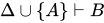


The deduction theorem holds for all first-order theories with the usual[3] deductive systems for first-order logic.[4] However, there are first-order systems in which new inference rules are added for which the deduction theorem fails.[5] Most notably, the deduction theorem fails to hold in Birkhoff–von Neumann quantum logic, because the linear subspaces of a Hilbert space form a non-distributive lattice.
Examples of deduction
[edit]- "Prove" axiom 1: P→(Q→P) [6]
- P 1. hypothesis
- Q 2. hypothesis
- P 3. reiteration of 1
- Q→P 4. deduction from 2 to 3
- P 1. hypothesis
- P→(Q→P) 5. deduction from 1 to 4 QED
- "Prove" axiom 2: (P→(Q→R))→((P→Q)→(P→R))
- P→(Q→R) 1. hypothesis
- P→Q 2. hypothesis
- P 3. hypothesis
- Q 4. modus ponens 3,2
- Q→R 5. modus ponens 3,1
- R 6. modus ponens 4,5
- P→R 7. deduction from 3 to 6
- P→Q 2. hypothesis
- (P→Q)→(P→R) 8. deduction from 2 to 7
- P→(Q→R) 1. hypothesis
- (P→(Q→R))→((P→Q)→(P→R)) 9. deduction from 1 to 8 QED
- Using axiom 1 to show ((P→(Q→P))→R)→R:
- (P→(Q→P))→R 1. hypothesis
- P→(Q→P) 2. axiom 1
- R 3. modus ponens 2,1
- ((P→(Q→P))→R)→R 4. deduction from 1 to 3 QED
Virtual rules of inference
[edit]From the examples, one can see that we have added three virtual (or extra and temporary) rules of inference to our normal axiomatic logic. These are "hypothesis", "reiteration", and "deduction". The normal rules of inference (i.e. "modus ponens" and the various axioms) remain available.
1. Hypothesis is a step where one adds an additional premise to those already available. So, if the previous step S was deduced as:

then one adds another premise H and gets:

This is symbolized by moving from the n-th level of indentation to the n+1-th level and saying[9]
- S previous step
- H hypothesis
- S previous step
2. Reiteration is a step where one re-uses a previous step. In practice, this is only necessary when one wants to take a hypothesis that is not the most recent hypothesis and use it as the final step before a deduction step.
3. Deduction is a step where one removes the most recent hypothesis (still available) and prefixes it to the previous step. This is shown by unindenting one level as follows:[9]
- H hypothesis
- ......... (other steps)
- C (conclusion drawn from H)
- H→C deduction
Conversion from proof using the deduction meta-theorem to axiomatic proof
[edit]In axiomatic versions of propositional logic, one usually has among the axiom schemas (where P, Q, and R are replaced by any propositions):
- Axiom 1 is: P→(Q→P)
- Axiom 2 is: (P→(Q→R))→((P→Q)→(P→R))
- Modus ponens is: from P and P→Q infer Q
These axiom schemas are chosen to enable one to derive the deduction theorem from them easily. So it might seem that we are begging the question. However, they can be justified by checking that they are tautologies using truth tables and that modus ponens preserves truth.
From these axiom schemas one can quickly deduce the theorem schema P→P (reflexivity of implication), which is used below:
- (P→((Q→P)→P))→((P→(Q→P))→(P→P)) from axiom schema 2 with P, (Q→P), P
- P→((Q→P)→P) from axiom schema 1 with P, (Q→P)
- (P→(Q→P))→(P→P) from modus ponens applied to step 2 and step 1
- P→(Q→P) from axiom schema 1 with P, Q
- P→P from modus ponens applied to step 4 and step 3
Suppose that we have that Γ and H together prove C, and we wish to show that Γ proves H→C. For each step S in the deduction that is a premise in Γ (a reiteration step) or an axiom, we can apply modus ponens to the axiom 1, S→(H→S), to get H→S. If the step is H itself (a hypothesis step), we apply the theorem schema to get H→H. If the step is the result of applying modus ponens to A and A→S, we first make sure that these have been converted to H→A and H→(A→S) and then we take the axiom 2, (H→(A→S))→((H→A)→(H→S)), and apply modus ponens to get (H→A)→(H→S) and then again to get H→S. At the end of the proof we will have H→C as required, except that now it only depends on Γ, not on H. So the deduction step will disappear, consolidated into the previous step which was the conclusion derived from H.
To minimize the complexity of the resulting proof, some preprocessing should be done before the conversion. Any steps (other than the conclusion) that do not actually depend on H should be moved up before the hypothesis step and unindented one level. And any other unnecessary steps (which are not used to get the conclusion or can be bypassed), such as reiterations that are not the conclusion, should be eliminated.
During the conversion, it may be useful to put all the applications of modus ponens to axiom 1 at the beginning of the deduction (right after the H→H step).
When converting a modus ponens, if A is outside the scope of H, then it will be necessary to apply axiom 1, A→(H→A), and modus ponens to get H→A. Similarly, if A→S is outside the scope of H, apply axiom 1, (A→S)→(H→(A→S)), and modus ponens to get H→(A→S). It should not be necessary to do both of these, unless the modus ponens step is the conclusion, because if both are outside the scope, then the modus ponens should have been moved up before H and thus be outside the scope also.
Under the Curry–Howard correspondence, the above conversion process for the deduction meta-theorem is analogous to the conversion process from lambda calculus terms to terms of combinatory logic, where axiom 1 corresponds to the K combinator, and axiom 2 corresponds to the S combinator. Note that the I combinator corresponds to the theorem schema P→P.
Helpful theorems
[edit]If one intends to convert a complicated proof using the deduction theorem to a straight-line proof not using the deduction theorem, then it would probably be useful to prove these theorems once and for all at the beginning and then use them to help with the conversion:

helps convert the hypothesis steps.

helps convert modus ponens when the major premise is not dependent on the hypothesis, replaces axiom 2 while avoiding a use of axiom 1.

helps convert modus ponens when the minor premise is not dependent on the hypothesis, replaces axiom 2 while avoiding a use of axiom 1.
These two theorems jointly can be used in lieu of axiom 2, although the converted proof would be more complicated:


Peirce's law is not a consequence of the deduction theorem, but it can be used with the deduction theorem to prove things that one might not otherwise be able to prove.

It can also be used to get the second of the two theorems, which can be used in lieu of axiom 2.
Proof of the deduction theorem
[edit]We prove the deduction theorem in a Hilbert-style deductive system of propositional calculus.[10]
Let be a set of formulas and and formulas, such that . We want to prove that .
Since , there is a proof of from . We prove the theorem by induction on the proof length n; thus the induction hypothesis is that for any , and such that there is a proof of from of length up to n, holds.
If n = 1 then is member of the set of formulas . Thus either , in which case is simply , which is derivable by substitution from p → p, which is derivable from the axioms, and hence also , or is in , in which case ; it follows from axiom p → (q → p) with substitution that and hence by modus ponens that .



Now let us assume the induction hypothesis for proofs of length up to n, and let be a formula provable from with a proof of length n+1. Then there are two possibilities:
- is member of the set of formulas ; in this case we proceed as for n=1.
- is arrived at by using modus ponens. Then there is a formula C such that proves and , and modus ponens is then used to prove . The proofs of and are with at most n steps, and by the induction hypothesis we have and . By the axiom (p → (q → r)) → ((p → q) → (p → r)) with substitution it follows that , and by using modus ponens twice we have .




Thus in all cases the theorem holds also for n+1, and by induction the deduction theorem is proven.
The deduction theorem in predicate logic
[edit]The deduction theorem is also valid in first-order logic in the following form:
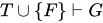

Here, the symbol means "is a syntactical consequence of." We indicate below how the proof of this deduction theorem differs from that of the deduction theorem in propositional calculus.

In the most common versions of the notion of formal proof, there are, in addition to the axiom schemes of propositional calculus (or the understanding that all tautologies of propositional calculus are to be taken as axiom schemes in their own right), quantifier axioms, and in addition to modus ponens, one additional rule of inference, known as the rule of generalization: "From K, infer ∀vK."
In order to convert a proof of G from T∪{F} to one of F→G from T, one deals with steps of the proof of G that are axioms or result from application of modus ponens in the same way as for proofs in propositional logic. Steps that result from application of the rule of generalization are dealt with via the following quantifier axiom (valid whenever the variable v is not free in formula H):
- (∀v(H→K))→(H→∀vK).
Since in our case F is assumed to be closed, we can take H to be F. This axiom allows one to deduce F→∀vK from F→K and generalization, which is just what is needed whenever the rule of generalization is applied to some K in the proof of G.
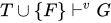
In first-order logic, the restriction of that F be a closed formula can be relaxed given that the free variables in F has not been varied in the deduction of G from . In the case that a free variable v in F has been varied in the deduction, we write (the superscript in the turnstile indicating that v has been varied) and the corresponding form of the deduction theorem is .[11]


Example of conversion
[edit]To illustrate how one can convert a natural deduction to the axiomatic form of proof, we apply it to the tautology Q→((Q→R)→R). In practice, it is usually enough to know that we could do this. We normally use the natural-deductive form in place of the much longer axiomatic proof.
First, we write a proof using a natural-deduction like method:
- Q 1. hypothesis
- Q→R 2. hypothesis
- R 3. modus ponens 1,2
- (Q→R)→R 4. deduction from 2 to 3
- Q 1. hypothesis
- Q→((Q→R)→R) 5. deduction from 1 to 4 QED
Second, we convert the inner deduction to an axiomatic proof:
- (Q→R)→(Q→R) 1. theorem schema (A→A)
- ((Q→R)→(Q→R))→(((Q→R)→Q)→((Q→R)→R)) 2. axiom 2
- ((Q→R)→Q)→((Q→R)→R) 3. modus ponens 1,2
- Q→((Q→R)→Q) 4. axiom 1
- Q 5. hypothesis
- (Q→R)→Q 6. modus ponens 5,4
- (Q→R)→R 7. modus ponens 6,3
- Q→((Q→R)→R) 8. deduction from 5 to 7 QED
Third, we convert the outer deduction to an axiomatic proof:
- (Q→R)→(Q→R) 1. theorem schema (A→A)
- ((Q→R)→(Q→R))→(((Q→R)→Q)→((Q→R)→R)) 2. axiom 2
- ((Q→R)→Q)→((Q→R)→R) 3. modus ponens 1,2
- Q→((Q→R)→Q) 4. axiom 1
- [((Q→R)→Q)→((Q→R)→R)]→[Q→(((Q→R)→Q)→((Q→R)→R))] 5. axiom 1
- Q→(((Q→R)→Q)→((Q→R)→R)) 6. modus ponens 3,5
- [Q→(((Q→R)→Q)→((Q→R)→R))]→([Q→((Q→R)→Q)]→[Q→((Q→R)→R)]) 7. axiom 2
- [Q→((Q→R)→Q)]→[Q→((Q→R)→R)] 8. modus ponens 6,7
- Q→((Q→R)→R) 9. modus ponens 4,8 QED
These three steps can be stated succinctly using the Curry–Howard correspondence:
- first, in lambda calculus, the function f = λa. λb. b a has type q → (q → r) → r
- second, by lambda elimination on b, f = λa. s i (k a)
- third, by lambda elimination on a, f = s (k (s i)) k
See also
[edit]Notes
[edit]- ^ Kleene 2002, p. 39,112.
- ^ Shoenfield 2001, p. 33.
- ^ For example, Hilbert-style deductive systems, natural deduction, the sequent calculus, the tableaux method, and resolution —see First order logic
- ^ An explicit verification of this result may be found in https://github.com/georgydunaev/VerifiedMathFoundations/blob/master/SHEN.v
- ^ Kohlenbach 2008, p. 148.
- ^ See explanation of Notation § below.
- ^ Fitch 1952.
- ^ Smith 2010, pp. 5 and following.
- ^ a b Hypothesis is denoted by indentation, and Conclusion is denoted by unindentation[7] as cited by Peter Smith (2010)[8]
- ^ Franks.
- ^ Kleene 1980, pp. 102–106.
References
[edit]- Fitch, Frederic Brenton (1952). Symbolic Logic: An introduction. New York: The Ronald Press Company. LCCN 52006196.
- Franks, Curtis. "Deduction Theorem" (PDF). University of Notre Dame. Retrieved 21 July 2020.
- Hewitt, Carl (2008). "ORGs for Scalable, Robust, Privacy-Friendly Client Cloud Computing". IEEE Internet Computing. 12 (5): 96–99. doi:10.1109/MIC.2008.107. S2CID 27828219. September/October 2008
- Kleene, Stephen Cole (2002) [1967]. Mathematical logic. New York: Dover Publications. ISBN 978-0-486-42533-7. MR 1950307.
- Kleene, Stephen Cole (1980). Introduction to meta-mathematics. North Holland. ISBN 9780720421033.
- Kohlenbach, Ulrich (2008). Applied proof theory: proof interpretations and their use in mathematics. Springer Monographs in Mathematics. Berlin, New York: Springer-Verlag. ISBN 978-3-540-77532-4. MR 2445721.
- Rautenberg, Wolfgang (2010). A Concise Introduction to Mathematical Logic (3rd ed.). New York: Springer Science+Business Media. doi:10.1007/978-1-4419-1221-3. ISBN 978-1-4419-1220-6..
- Shoenfield, Joseph R. (2001) [1967]. Mathematical Logic (2nd ed.). A K Peters. ISBN 978-1-56881-135-2.
- Smith, Peter (13 October 2010). "Types of proof system" (PDF). Logic Matters. Retrieved 29 May 2025.
External links
[edit]- Introduction to Mathematical Logic by Vilnis Detlovs and Karlis Podnieks is a comprehensive tutorial. See Section 1.5.
- "Deduction Theorem"
Deduction theorem
View on GrokipediaOverview
Definition and Statement
The Deduction Theorem is a fundamental meta-theorem in mathematical logic that establishes a correspondence between conditional proofs and the introduction of implications in formal deductive systems. Formally, in a deductive system equipped with the implication connective (→) and the modus ponens rule, it states that for any set of premises Γ, and formulas A and B, if Γ ∪ {A} ⊢ B (meaning B is derivable from Γ together with the assumption A), then Γ ⊢ A → B (meaning the implication A → B is derivable from Γ alone).[3] This equivalence holds in both directions under appropriate conditions, providing a bidirectional link between hypothetical derivability and unconditional provability of conditionals.[1] As a meta-theorem, the Deduction Theorem operates at a level above the object language of the logical system, justifying the practice of hypothetical reasoning by demonstrating that temporary assumptions can be systematically discharged through the formation of implications. It was first rigorously formulated by Jacques Herbrand in 1930 for classical propositional logic and independently by Alfred Tarski for sentential systems, highlighting its role in validating structural rules of inference without altering the underlying axioms.[1] This meta-level property enables the transformation of proofs involving assumptions into pure theorems, streamlining the construction of formal derivations. The theorem's scope is primarily within formal systems that include implication as a primitive connective and modus ponens as an inference rule, such as Hilbert-style axiomatic systems for classical propositional logic. It extends naturally to first-order predicate logic and certain non-classical logics like intuitionistic systems, provided the underlying proof theory supports the necessary structural features.[4] Intuitively, the Deduction Theorem bridges localized deductions made under specific assumptions to globally valid theorems, encapsulating the logical intuition that "if assuming A leads to B, then A implies B" in a precise, system-independent manner.[3]Historical Development
The idea was anticipated semantically by Bernard Bolzano in the early 19th century in his Wissenschaftslehre, though without a syntactic proof.[1] The roots of the deduction theorem trace back to the early 20th-century axiomatic program initiated by David Hilbert, which emphasized rigorous formalization of mathematics through finite proofs from axioms, implicitly relying on principles akin to the theorem for handling hypothetical reasoning. Earlier, implicit uses appeared in Gottlob Frege's Begriffsschrift (1879), where formal deductions assumed the equivalence between assuming a premise and deriving a conditional conclusion without explicit proof. Similarly, Bertrand Russell and Alfred North Whitehead's Principia Mathematica (1910–1913) employed such reasoning in their development of type theory and propositional logic, treating implication introduction as a natural step in axiomatic derivations. The deduction theorem was first rigorously proved by Jacques Herbrand in his 1930 thesis and independently formulated by Alfred Tarski in his 1930 work on deductive systems, where he axiomatized it as a property ensuring that if a formula follows from a set of assumptions including a hypothesis, then the conditional formed by that hypothesis implies the formula follows from the remaining assumptions. Tarski refined this in his 1936 Polish monograph, later translated as Introduction to Logic and to the Methodology of Deductive Sciences (1941 English edition), establishing it as a cornerstone for analyzing logical consequence relations. Popularization occurred through influential textbooks, notably David Hilbert and Paul Bernays' Grundlagen der Mathematik (Volume I, 1934; Volume II, 1939), which integrated the theorem into Hilbert-style axiomatic proofs for classical logic, and Elliott Mendelson's Introduction to Mathematical Logic (first edition, 1964), which presented it as a standard tool for both propositional and predicate logics in pedagogical contexts. In proof theory, the deduction theorem facilitated the separation of meta-level reasoning about proofs from object-level logical derivations, influencing structural developments like Gentzen's natural deduction systems (1934–1935) and enabling consistency proofs in formal systems. Since the 1950s, it has become integral to automated theorem proving, underpinning resolution-based methods (e.g., J.A. Robinson, 1965) for efficient proof search in first-order logic, and to type theory, where it supports the Curry-Howard isomorphism linking proofs to lambda terms in constructive logics (e.g., as in Per Martin-Löf's intuitionistic type theory, 1970s onward).Propositional Logic
Proof in Propositional Logic
The deduction theorem for classical propositional logic asserts that if a set of formulas together with an additional formula derives a formula (denoted ), then alone derives the implication (denoted ). This holds in a standard Hilbert-style axiomatic system for propositional logic, which uses implication and negation as connectives, along with the following axiom schemata for all formulas , , and :- If is an instance of one of the axioms, say , then follows from axioms 1 and 2: specifically, axiom 1 yields by appropriate substitution, and further applications of axiom 2 and MP derive the required implication directly.[5]
- If , then since , the same derivation as above yields via axiom 1, and MP (if is used as a premise) gives .[5]
- If (the added assumption), then is provable: axiom 1 with gives , and axiom 2 instantiated appropriately (with suitable MP steps) eliminates the outer implication to obtain .[5]
- If is an axiom or in , reduce to the base case.[5]
- Otherwise, by the inductive hypothesis applied to the subproofs of and , we have and . Now, axiom 2 yields . Applying MP with gives . Finally, applying MP with derives .[5]
Examples in Propositional Logic
To illustrate the deduction theorem in propositional logic, consider a basic application where an assumption is discharged to form an implication. Suppose we have a derivation from the singleton set {P} that establishes Q → P using modus ponens and standard axioms for implication. By the deduction theorem, this yields a theorem without the assumption: ⊢ P → (Q → P). This example demonstrates the "currying" effect, transforming a conditional consequence into a nested implication, which is a tautology in classical propositional logic.[1] A more involved conditional proof highlights how the theorem facilitates deriving implications from temporary assumptions. Assume A as a hypothesis and derive B using the axioms of propositional logic, such as the standard axioms for implication or equivalent systems supporting modus ponens. Once B is obtained under the assumption A, the deduction theorem discharges A to conclude ⊢ A → B, allowing the proof to proceed unconditionally thereafter. This process is essential for building complex theorems by layering implications without retaining extraneous assumptions.[6] For nested assumptions, the theorem enables contraposition derivations. Given the context Γ = {A → B}, assume ¬B and derive ¬A using modus ponens on the given implication and rules for negation. Applying the deduction theorem discharges ¬B, yielding Γ ⊢ ¬B → ¬A. A second application, leveraging the double negation elimination or equivalent, further transforms this to Γ ⊢ B → A, illustrating contraposition. This stepwise discharge shows how the theorem handles layered hypotheses in proofs involving multiple connectives.[7] Common pitfalls in applying the deduction theorem arise when the proof system lacks full support for implication introduction or modus ponens, as these are prerequisites for valid discharge. For instance, the theorem does not directly apply to conjunctions without additional steps to encode them via implications, potentially leading to invalid generalizations. Users must verify that the system is Hilbert-style or natural deduction-based with these rules to avoid errors in assumption elimination.[1] Visualizing the impact, consider a proof tree before and after applying the theorem. Prior to discharge, the tree branches from an assumption node (e.g., A) leading to derived nodes for B via intermediate steps like modus ponens applications. Post-theorem, the assumption node closes, collapsing the branch into a single implication node A → B at the root, shortening the unconditional proof and emphasizing modularity in logical derivations. This transformation is depicted in natural deduction formats, where subproofs under assumptions resolve into implication rules.[6]Proof Systems and Techniques
Virtual Rules of Inference
The deduction theorem facilitates the use of virtual rules of inference, which permit the temporary assumption of a formula to derive another formula , followed by the discharge of to conclude , in contrast to primitive rules that operate solely on established premises without such hypothetical introductions.[1] These virtual rules, also termed hypothetical or discharge rules, enable modular proof construction by encapsulating subderivations under assumptions, thereby streamlining the representation of conditional reasoning.[1] In natural deduction systems, virtual rules manifest as the implication introduction rule (-introduction), where if is derived from the assumption (possibly alongside other premises ), then may be inferred, discharging .[8] Similarly, in sequent calculus, the right implication rule (R) achieves this by deriving from , effectively discharging the added assumption on the antecedent side.[9] This implementation aligns directly with the deduction theorem, embedding its logic into the core inference apparatus of these systems. The primary advantages of virtual rules lie in their ability to simplify proof construction through modular, assumption-based reasoning, which mirrors intuitive human argumentation and reduces dependence on a large set of axioms by focusing on connective-specific introduction and elimination rules.[1] For instance, proofs become more structured and readable, as subproofs can be nested hierarchically without proliferating global axioms, enhancing both pedagogical clarity and computational efficiency in automated theorem proving.[1] Formally, the deduction theorem establishes the equivalence between derivations using virtual rules and those in purely axiomatic systems: a derivation of from using virtual rules corresponds to an axiomatic derivation of from , ensuring that the former can always be transformed into the latter without loss of validity.[1] This equivalence, proven via induction on proof structure, validates the use of virtual rules as a conservative extension.[1] However, virtual rules operate at a meta-level in axiomatic frameworks like Hilbert-style systems, where they are not primitive but justified by the deduction theorem; thus, any proof employing them must be expandable into a sequence of primitive inferences and axioms if a fully axiomatic form is required.[1]Conversion to Axiomatic Proofs
The conversion to axiomatic proofs leverages the deduction theorem to transform a derivation of a formula from a set of axioms together with an additional assumption into a derivation of solely from , without relying on the assumption . This process is constructive and proceeds by induction on the length of the original proof, ensuring that each step in the assumed proof is mirrored by a corresponding step in the implication-prefixed proof using only axioms and modus ponens (MP).[10] The algorithm begins with the base cases of the induction. If the last step of the proof is the assumption itself, then follows directly from the axiom schema of reflexivity (often denoted as the identity axiom). If the last step is an axiom from , then is an instance of the axiom schema of prefixing (such as ), and applying MP yields from . For the inductive step, suppose the last step applies MP to derive from and , both previously derived under . By the induction hypothesis, and ; then, using the axiom schema of suffixing (such as ) and two applications of MP, it follows that . This recursive wrapping effectively prefixes the assumption to every line of the proof, building the implication outward.[10] For proofs involving multiple nested assumptions, such as deriving from , the process iterates recursively: first convert the subproof under to , then apply the theorem again to obtain . This currying-like propagation replaces conjunctions of assumptions with nested implications, as the implication connective serves to discharge assumptions in sequence. In a skeletal example, suppose a proof under assumption consists of lines ; the converted proof constructs lines by applying the above inductive rules to each .[10] The resulting axiomatic proof preserves soundness because the deduction theorem establishes an equivalence between derivability with assumptions and conditional derivability without them, maintaining logical validity throughout the transformation. However, this conversion incurs a cost in proof length: each application of the theorem roughly doubles the number of steps due to the additional MP inferences and axiom instantiations, leading to exponential growth in the worst case when discharging deeply nested assumptions.[10][11]Supporting Theorems
The weakening theorem, a fundamental property of monotonic consequence relations in axiomatic proof systems, states that if a formula is derivable from a set of premises , then remains derivable upon adding any additional formulas to the premises. Formally, implies for any . This theorem ensures that proof systems are robust to the inclusion of irrelevant assumptions, facilitating modular reasoning and the extension of existing derivations without invalidating conclusions. It is a direct consequence of the structural rules in systems like those developed by Hilbert and Ackermann, where entailment is preserved under premise expansion.[12] Closely related is the contraction theorem, which addresses redundancy by allowing the elimination of duplicate premises. It asserts that if , then . This property handles repeated uses of the same assumption in derivations, streamlining proofs in axiomatic frameworks and aligning with the contraction rule in sequent calculi, where multiple occurrences of a formula can be consolidated into one without loss of derivability. In classical propositional logic, contraction complements weakening to maintain the idempotence of entailment over premise sets. Monotonicity serves as an immediate corollary of the weakening theorem, reinforcing that the derivability relation in standard logical systems is upward closed with respect to premises: adding formulas to cannot undermine an established derivation . This monotonic behavior is intrinsic to the deduction theorem's application, as it guarantees that conditional proofs from extended contexts yield equivalent implications, supporting the theorem's role in transforming hypothetical derivations into unconditional ones.[12] The deduction theorem further relates to cut-elimination in sequent calculi, where it aids in demonstrating that any proof involving a cut rule—a binary inference combining two subproofs—can be transformed into an equivalent cut-free proof. By leveraging the theorem to manage premise dependencies during cut reduction, this process preserves derivability while enforcing the subformula property, a key insight in Gentzen's framework for analyzing proof complexity and consistency.[13] Collectively, these supporting theorems ensure the deduction theorem's robust applicability across varying premise configurations in axiomatic systems, enabling reliable manipulations of assumptions and inferences without compromising logical validity. They underpin transformations between proof formats, such as from natural deduction to axiomatic styles, by providing the structural guarantees needed for premise adjustments.Extensions and Variants
Adaptation to Predicate Logic
The deduction theorem extends to first-order predicate logic, but requires adjustments to account for quantifiers and the handling of free variables. In this setting, assuming a Hilbert-style proof system, if a set of formulas Γ union {A} derives B—where A and B may contain free variables—and the proof employs the generalization rule only on variables not free in A, then Γ derives A → B.[14] This formulation ensures that the implication is valid without unintended variable bindings. A variant incorporates universal generalization: if x is not free in Γ, then Γ derives ∀x (A → B), provided the proof satisfies the free variable condition.[15] This adaptation applies specifically to Hilbert-style systems equipped with standard quantifier axioms, such as the universal instantiation axiom ∀x φ(x) → φ(t) (where t is free for x in φ) and the distribution axiom ∀x (φ → ψ) → (φ → ∀x ψ) when x is not free in φ.[15] The proof rules include modus ponens and generalization (∀-introduction), with the latter restricted to avoid applying it over variables that appear free in assumptions like A. These axioms and rules enable the theorem's validity while preserving soundness in the presence of quantifiers. The proof proceeds by induction on the length of the derivation from Γ ∪ {A} to B, extending the propositional case. For the base step, if B is an axiom or from Γ, the implication A → B follows directly via propositional tautologies or the deduction lemma for independent formulas. In the inductive step, for modus ponens, assume prior implications hold and apply the rule accordingly; for generalization to ∀x C (with x not free in A), the induction hypothesis yields Γ ⊢ A → C, followed by generalization to Γ ⊢ ∀x (A → C) and use of the distribution axiom to obtain Γ ⊢ A → ∀x C. This structure mirrors the propositional induction but incorporates quantifier handling.[14][15] Key challenges in this extension arise from free variable restrictions, which prevent variable capture during generalization—for instance, deriving ∀x P(x) from P(x) succeeds, but claiming P(x) → ∀x P(x) fails without the condition, as x would be improperly bound. The eigenvariable condition enforces that generalized variables act as "fresh" placeholders, akin to eigenvalues in proof theory, ensuring no dependency on assumption-bound variables. These precautions maintain the theorem's reliability amid quantifier shifts.[15]Example Application in Predicate Logic
A key application of the deduction theorem in predicate logic arises in proving the valid inference ∀x (P(x) → Q(x)) ⊢ ∀x P(x) → ∀x Q(x), which distributes the universal quantifier over implication under the given premise.[16] To demonstrate, first extend the premises with the assumption ∀x P(x) and derive ∀x Q(x) using natural deduction rules, careful with variable handling to satisfy the theorem's conditions in predicate logic (no generalization over free variables from the discharged assumption). Select a fresh variable y not occurring in the premises or assumption to avoid capture.- Instantiate ∀x P(x) to P(y).
- Instantiate the premise ∀x (P(x) → Q(x)) to P(y) → Q(y).
- Apply modus ponens to P(y) and P(y) → Q(y), yielding Q(y).
- Generalize over y (valid since y is fresh), obtaining ∀x Q(x).