


Community hub
Recent from talks
Contribute something
Nothing was collected or created yet.
Delisle scale
View on Wikipedia| from Delisle | to Delisle | |
|---|---|---|
| Celsius | x °De ≘ (100 − x × 2/3) °C | x °C ≘ (100 − x) × 3/2 °De |
| Fahrenheit | x °De ≘ (212 − x × 6/5) °F | x °F ≘ (212 − x) × 5/6 °De |
| Kelvin | x °De ≘ (373.15 − x × 2/3) K | x K ≘ (373.15 − x) × 3/2 °De |
| Rankine | x °De ≘ (671.67 − x × 6/5) °R | x °R ≘ (671.67 − x) × 5/6 °De |
| For temperature intervals rather than specific temperatures, 1 °De = 2/3 °C = 1.2 °F Conversion between temperature scales | ||

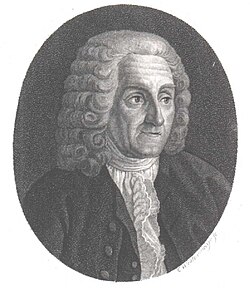
The Delisle scale is a temperature scale invented in 1732 by the French astronomer Joseph-Nicolas Delisle (1688–1768).[1] The Delisle scale is notable as one of the few temperature scales that are inverted from the amount of thermal energy they measure; unlike most other temperature scales, higher measurements in degrees Delisle are colder, while lower measurements are warmer.[a]
History
[edit]In 1732, Delisle built a thermometer that used mercury as a working fluid. Delisle chose his scale using the temperature of boiling water as the fixed zero point and measured the contraction of the mercury (with lower temperatures) in hundred-thousandths.[1] Delisle thermometers usually had 2400 or 2700 gradations, appropriate for the winter in St. Petersburg,[2] as he had been invited by Peter the Great to the city to found an observatory in 1725.[3] In 1738, Josias Weitbrecht (1702–47) recalibrated the Delisle thermometer with two fixed points, keeping 0 degrees as the boiling point and adding 150 degrees as the freezing point of water. He then sent this calibrated thermometer to various scholars, including Anders Celsius.[1] The Celsius scale, like the Delisle scale, originally ran from zero for boiling water down to 100 for freezing water. This was reversed to its modern order after his death, in part at the instigation of Swedish botanist Carl Linnaeus and the manufacturer of Linnaeus thermometers, Daniel Ekström.[4]
The Delisle thermometer remained in use for almost 100 years in Russia.[citation needed] One of its users was Mikhail Lomonosov, who reversed it in his own work, measuring the freezing point of water as 0 °D and the boiling point as 150 °D.[citation needed]
Conversion table between the different temperature units
[edit]




See also
[edit]Notes
[edit]References
[edit]- ^ a b c Camuffo, Dario (2002). Improved Understanding of Past Climatic Variability from Early Daily European Instrumental Sources. Kluwer Academic Publishers. p. 314.
- ^ W. E. Knowles Middleton (1966). A history of the thermometer and its use in meteorology. Johns Hopkins Press. p. 88.
- ^ John Lankford, ed. (1997). History of Astronomy: An Encyclopedia. Taylor & Francis. p. 191. ISBN 9780815303220.
- ^ Gunnar Tibell, ed. (2008). "Linnaeus' thermometer". Uppsala Universitet. Archived from the original on 2021-02-10. Retrieved 2024-10-22.
{{cite web}}: CS1 maint: bot: original URL status unknown (link)
External links
[edit]- Photo of an antique thermometer backing board c. 1758—marked in four scales; the second is Delisle (spelled "de Lisle").

Delisle scale
View on GrokipediaOverview and Definition
Basic Principles
Temperature scales are systems designed to quantify thermal energy by measuring the expansion or contraction of materials in response to changes in heat, typically using the behavior of substances like liquids in thermometers or the physical properties of solids and gases.[7] These scales provide a standardized way to compare temperatures across different conditions, with reference points often anchored to the freezing and boiling points of water under standard atmospheric pressure.[8] The Delisle scale (°D), invented by French astronomer Joseph-Nicolas Delisle in 1732 with the boiling point of water defined as 0°D, was recalibrated in 1738 by Josias Weitbrecht to set the freezing point at 150°D at standard atmospheric pressure.[9][10] Unlike conventional scales such as Celsius or Fahrenheit, where numerical values increase with rising temperature, the Delisle scale operates inversely: as actual temperature decreases, the Delisle reading increases, reflecting a progression from hotter to colder conditions.[11] This inverse structure spans 150 degrees across the interval from water's boiling to freezing points, emphasizing a counterintuitive calibration where lower numerical values indicate higher thermal states.[12] The scale's design thus inverts the typical thermal progression, requiring users to interpret readings in reverse for intuitive understanding of heat levels.[13]Scale Characteristics
The Delisle scale is an inverse temperature scale, where numerical values increase as the actual temperature decreases, distinguishing it from direct scales like Celsius or Fahrenheit. This design sets the boiling point of water at 0°D and the freezing point at 150°D under standard atmospheric pressure, creating a total range of 150 degrees Delisle for the 100-degree Celsius interval between these fixed points.[10] The inverse property arises from measuring the contraction of a liquid, such as mercury, from the boiling reference; as temperature drops, the column contracts further, yielding higher scale readings.[14][15] The degree size on the Delisle scale is defined such that each Delisle degree (°D) equals of a Celsius degree, resulting from the 150°D span over a 100°C range: the temperature difference in Kelvin (100 K) is scaled by a factor of to produce 150°D. This finer subdivision allows for potentially higher granularity in measurements compared to the coarser 1:1 °C steps over the same physical range, though practical accuracy depends on the thermometer's construction and resolution. In thermometry, this smaller degree size can enhance precision for subtle temperature variations but demands instruments calibrated to the inverse progression to minimize reading errors.[14] Notation for the Delisle scale uses the symbol °D or °De, with readings interpreted inversely: a higher numerical value indicates a colder temperature, such that 100°D corresponds to a warmer condition than 50°D. For calibration, the reversed fixed points—boiling at 0°D (hot end) and freezing at 150°D (cold end)—require thermometers to be graduated starting from zero at the expanded liquid position and increasing along the contracting direction, which can complicate standardization but ties directly to observable phase changes in water for reference.[14][15]Historical Development
Invention and Context
The Delisle scale was invented in 1732 by French astronomer Joseph-Nicolas Delisle (1688–1768), who constructed a mercury-in-glass thermometer with boiling water defined as 0°.[1] Delisle developed the scale while serving as professor of astronomy at the St. Petersburg Academy of Sciences, a position he assumed after arriving in Russia in 1725 to establish and direct its observatory and school of astronomy. His work there focused on advancing observational astronomy, including meteorological measurements that supported precise timing and instrument calibration amid the region's extreme climate.[16] This invention occurred during the Enlightenment era, a period of scientific innovation when competing temperature scales, such as Daniel Gabriel Fahrenheit's (introduced in 1714) and René Antoine Ferchault de Réaumur's (1730), were emerging to standardize thermometric measurements across Europe.[1] Delisle's scale was motivated by the need for a reliable instrument suited to the harsh Russian environment, where thermometers required an extended range to capture temperatures as low as those in St. Petersburg's severe winters, often necessitating 2400 to 2700 graduations below the freezing point.[1] The scale's initial purpose centered on meteorological and astronomical applications, such as recording air temperatures to account for their influence on telescopic observations and celestial calculations, rather than general household or medical thermometry.[1] Delisle's background in astronomy, including his earlier studies under prominent French scholars and his role in training Russian observers, underscored the scale's alignment with Enlightenment efforts to quantify natural phenomena for scientific progress.[16]Adoption and Decline
Following its invention in 1732, the Delisle scale saw early adoption primarily within Russian scientific communities during the mid-18th century, where Joseph-Nicolas Delisle, having been invited to Russia by Tsar Peter the Great, applied it to mercury thermometers for weather recording and astronomical observations suited to St. Petersburg's harsh winters.[9][17] The scale was recalibrated in 1738 by physician Josias Weitbrecht, establishing 0°D at the boiling point of water and 150°D at the freezing point, which facilitated its use in academic settings for precise measurements of temperature contraction.[9][4] Throughout the 18th century, the Delisle scale received brief mentions in European scientific texts, notably influencing Anders Celsius, who employed a Delisle thermometer in developing his own scale in 1742, though its application remained confined to scholarly and institutional contexts without leading to widespread production of commercial thermometers.[18] In Russia, it persisted in scientific use for nearly a century, extending into the 19th century for meteorological and astronomical purposes, but saw no significant expansion beyond elite academic circles.[4][9] The scale's decline began in the 1740s with the rise of the Celsius scale, originally proposed by Anders Celsius in 1742 with 0° at boiling and 100° at freezing, but inverted posthumously to 0° at freezing and 100° at boiling, which proved more practical and easier to adopt internationally for avoiding negative values in temperate climates.[19] Delisle's death in 1768 further diminished active promotion, as his direct influence waned, leaving the scale without strong advocates amid growing standardization efforts.[20] Contributing to its obscurity was the scale's inverse logic—where higher degrees indicated colder temperatures—which often confused users, coupled with a lack of international alignment following the metric system's adoption in Europe from the late 18th century onward, ultimately favoring Celsius for global scientific consistency.[4][11]Conversion Methods
Formulas to Celsius and Fahrenheit
The Delisle scale is defined with fixed points at the boiling point of water, set to 0°De corresponding to 100°C, and the freezing point of water, set to 150°De corresponding to 0°C.[6] This inverse relationship means that as the Delisle reading increases, the actual temperature decreases.[21] To derive the conversion formula from Delisle to Celsius, consider the temperature span between these fixed points: the full range of 150°De represents a drop of 100°C. Thus, each degree on the Delisle scale corresponds to a temperature change of °C, but in the opposite direction.[5] Starting from the zero point of the Delisle scale at 100°C, the Celsius temperature decreases linearly with increasing °De. The formula is therefore obtained by subtracting the scaled Delisle value from 100°C: Equivalently, this can be expressed using the span from the freezing point: Both forms yield the same result, as .[21] For conversion to Fahrenheit, first apply the Delisle-to-Celsius formula, then use the standard Celsius-to-Fahrenheit relation .[22] Substituting the Celsius expression gives: Simplifying the coefficients: , and , so: This direct formula aligns with the fixed points: at 0°De, it yields 212°F (equivalent to 100°C), and at 150°De, it yields 32°F (equivalent to 0°C).[22] As an example, consider 75°De. Using the Celsius formula: °C. Then, to Fahrenheit: °F. Alternatively, directly: °F.[5][22]Conversion Table
The following table provides a quick reference for converting selected Delisle (°D) temperatures to Celsius (°C) and Fahrenheit (°F) equivalents, with values ranging from -50°D to 200°D in 25°D increments. These conversions are derived from the standard Delisle scale formulas, where °C = 100 - (2/3) × °D and °F = (°C × 9/5) + 32.[21]| °D | °C | °F |
|---|---|---|
| -50 | 133.3 | 272 |
| -25 | 116.7 | 242 |
| 0 | 100.0 | 212 |
| 25 | 83.3 | 182 |
| 50 | 66.7 | 152 |
| 75 | 50.0 | 122 |
| 100 | 33.3 | 92 |
| 125 | 16.7 | 62 |
| 150 | 0.0 | 32 |
| 175 | -16.7 | 2 |
| 200 | -33.3 | -28 |