Hubbry Logo
search
logo
1452301

Dengfeng

logo
Community Hub0 Subscribers
Read side by side
from Wikipedia

Dengfeng (Chinese: 登封; pinyin: Dēngfēng; postal: Tengfeng) is a county-level city of Henan Province, China. It is under the administration of the prefecture-level city of Zhengzhou. In ancient times, it was known as Yangcheng (traditional Chinese: 陽城; simplified Chinese: 阳城; pinyin: Yángchéng).[citation needed]

Key Information

Dengfeng has an area of 1,220 km2 (470 sq mi) and a population of 630,000.[2] It occupies the southwestern corner of Zhengzhou and is its westernmost county-level division.

Dengfeng is located at the foot of the Mount Song, one of the most sacred mountains in China. The city is one of the most renowned spiritual centers of China, and is home to various religious institutions and famous temples such as the Taoist Zhongyue Temple, the Buddhist Shaolin Temple (a renowned center for martial arts), as well as the Confucian Songyang Academy and the Gaocheng Observatory, hence its poetic expression derived from Chinese literature as the spiritual "center of heaven and earth".[3] Parts of the city were inscribed on the UNESCO World Heritage List in 2010.[3]

History

[edit]

The first Xia dynasty capital, Yangcheng, was built west of Gaocheng Township on the Ying River under the sacred Mount Song.

The famous Shaolin Monastery, traditionally considered the origin of Zen, is located in Dengfeng where they teach adults as well as children martial arts. It is also a famous tourist attraction.

Administrative divisions

[edit]

As of 2012, the city is divided to 3 subdistricts, 8 towns and 5 townships.[4]

Subdistricts
Towns
Townships

UNESCO World Heritage Site

[edit]
Shaolin Temple

In 2010, UNESCO inscribed several of the most renowned sites of Dengfeng onto its World Heritage List under the title "Historic Monuments of Dengfeng in 'The Center of Heaven and Earth'."[5] The World Heritage Site includes several historic gates, temples, a Confucian academy and the Gaocheng Observatory:[6]

  • Taishi Que (太室闕) Gates: Gates built in front of what would become the Zhongyue Temple in 118 AD, with carved reliefs of animals, trees, and spirits.[7]
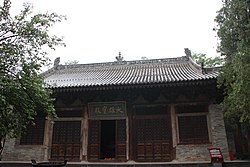
  • Zhongyue Temple: A Taoist temple constructed in the 5th century, during Kou Qianzhi's reforms. Includes Juni Hall, a large hall for sacrificing to the gods, two stone statues built in 118 AD that are the oldest surviving stone statues in China.[7]
  • Shaoshi Que Gates: Han dynasty gates (dating to 123 AD), with pictures of horses galloping, a circus, and cuju, and ancient football game.[7]
  • Qimu Que Gates: A pair of gates built in 123 AD, with images that depict scenes of cockfights, floods, and visitation by the Roman Empire[7]
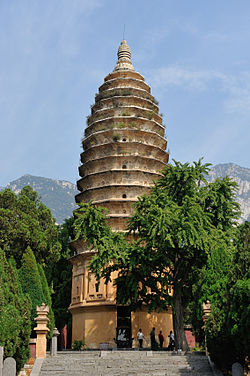
  • Songyue Temple Pagoda: Built between 508 and 511, it had very innovative architecture and became a template for many future pagodas.[7]
  • Shaolin Monastery and its Pagoda Forest: A complex of temples and over 240 pagodas, built over 1300 years starting in the 5th century. A major sacred site for Buddhism.[7]
  • Huishan Temple: A wooden temple built in the 12th century on the site of the astronomer Yi Xing's residence.[7]
  • Songyang Academy: Created in the Tang dynasty, it was considered one of the four greatest academies of classical learning in China. Contributed to the dissemination of Confucianism across China.[7]
  • Gaocheng Astronomical Observatory: an observatory built in the 13th century to accurately measure the world and create precise calendars.[3]

Other notable sites in Dengfeng include the Fawang Temple, a Buddhist temple built in the Tang dynasty.

Climate

[edit]
Climate data for Dengfeng, elevation 427 m (1,401 ft), (1991–2020 normals, extremes 1981–present)
Month Jan Feb Mar Apr May Jun Jul Aug Sep Oct Nov Dec Year
Record high °C (°F) 18.8
(65.8)
21.8
(71.2)
31.8
(89.2)
38.5
(101.3)
38.0
(100.4)
40.1
(104.2)
39.4
(102.9)
37.0
(98.6)
37.6
(99.7)
31.2
(88.2)
27.4
(81.3)
21.4
(70.5)
40.1
(104.2)
Mean daily maximum °C (°F) 5.6
(42.1)
9.1
(48.4)
14.8
(58.6)
21.7
(71.1)
26.8
(80.2)
30.7
(87.3)
31.1
(88.0)
29.7
(85.5)
25.7
(78.3)
20.6
(69.1)
13.7
(56.7)
7.7
(45.9)
19.8
(67.6)
Daily mean °C (°F) 1.1
(34.0)
4.1
(39.4)
9.5
(49.1)
16.1
(61.0)
21.5
(70.7)
25.6
(78.1)
26.6
(79.9)
25.3
(77.5)
21.1
(70.0)
15.8
(60.4)
9.0
(48.2)
3.2
(37.8)
14.9
(58.8)
Mean daily minimum °C (°F) −2.5
(27.5)
0.2
(32.4)
5.0
(41.0)
10.9
(51.6)
16.3
(61.3)
20.6
(69.1)
22.8
(73.0)
21.6
(70.9)
17.1
(62.8)
11.7
(53.1)
5.2
(41.4)
−0.3
(31.5)
10.7
(51.3)
Record low °C (°F) −9.9
(14.2)
−10.1
(13.8)
−5.4
(22.3)
−0.2
(31.6)
7.2
(45.0)
12.8
(55.0)
17.4
(63.3)
11.3
(52.3)
9.8
(49.6)
0.6
(33.1)
−4.3
(24.3)
−9.3
(15.3)
−10.1
(13.8)
Average precipitation mm (inches) 9.5
(0.37)
11.5
(0.45)
19.8
(0.78)
35.9
(1.41)
57.2
(2.25)
65.6
(2.58)
133.1
(5.24)
102.1
(4.02)
69.6
(2.74)
38.5
(1.52)
24.8
(0.98)
7.4
(0.29)
575
(22.63)
Average precipitation days (≥ 0.1 mm) 4.1 4.2 5.7 6.1 7.5 8.2 11.8 11.0 9.0 6.8 5.3 3.6 83.3
Average snowy days 5.0 4.1 2.2 0.3 0 0 0 0 0 0 1.5 3.6 16.7
Average relative humidity (%) 50 53 52 53 54 58 72 74 67 59 56 49 58
Mean monthly sunshine hours 140.0 143.5 178.8 207.2 219.6 207.1 181.7 177.9 159.4 166.0 151.0 151.5 2,083.7
Percentage possible sunshine 45 46 48 53 51 48 42 43 43 48 49 50 47
Source: China Meteorological Administration[8][9]

Transportation

[edit]
[edit]

See also

[edit]

References

[edit]
[edit]
Revisions and contributorsEdit on WikipediaRead on Wikipedia
from Grokipedia
Dengfeng is a county-level city located in the southwestern part of Zhengzhou, Henan Province, central China, renowned as the home of the Shaolin Temple and Mount Songshan, one of China's Five Great Mountains.[1][2] It covers an area of 1,220 square kilometers and had a population of approximately 734,000 as of 2020, with estimates around 650,000 in 2024.[3][2][4] Situated at the foot of Mount Songshan, which rises to about 1,500 meters, Dengfeng has been regarded since ancient times as the "centre of heaven and earth" in Chinese cosmology, symbolizing the intersection of the cardinal directions and serving as a focal point for imperial rituals and astronomical observations.[1] The city's historical significance spans over 1,500 years, with structures dating back to the earliest religious edifices in China, reflecting advancements in ritual, science, technology, and education across nine dynasties.[1] In 2010, the Historic Monuments of Dengfeng were inscribed on the UNESCO World Heritage List under criteria (iii) and (vi) for their outstanding testimony to Chinese cultural traditions tied to mountain worship, imperial patronage, and the integration of sacred and secular architecture.[1] The most iconic site is the Shaolin Temple, founded in 495 CE, which is the birthplace of Chan (Zen) Buddhism and Shaolin Kung Fu, attracting millions of visitors annually for its martial arts heritage and serene mountain setting.[1] Other key components of the UNESCO site include eight clusters of monuments spread over 40 square kilometers, such as the Taishi Que Gates, Zhongyue Temple (a major Taoist center), the Zhougong Sundial Platform for solar measurements, and the Dengfeng Observatory (Gaocheng), built in the Yuan Dynasty and one of the oldest extant observatories in Asia, used for calendrical and astronomical purposes; the area has evidence of observations since ancient times including the Han Dynasty.[1] Dengfeng's ancient name was Yangcheng, with archaeological evidence tracing human activity in the region to over 4,000 years ago, with traditional associations to the semi-legendary Xia Dynasty, whose purported capital was located here.[5] Administratively, Dengfeng functions as a satellite city to Zhengzhou, benefiting from its proximity to major transportation hubs while preserving its cultural identity through protected heritage zones.[2] The local economy blends tourism—driven by martial arts performances, temple visits, and hiking in Songshan Scenic Area—with agriculture and light industry, though rapid urbanization has prompted efforts to balance development with conservation.[6] As a spiritual and educational hub, Dengfeng continues to influence global perceptions of Chinese martial arts and philosophy, hosting international kung fu festivals and research on ancient sciences.[7]

Geography

Location and Topography

Dengfeng is a county-level city situated in the southwestern part of Zhengzhou, the capital of Henan Province in central China, encompassing an area of 1,220 square kilometers.[3][8] Its geographical coordinates are approximately 34°27′ N latitude and 113°02′ E longitude, placing it within the administrative jurisdiction of Zhengzhou while forming part of the broader Henan provincial boundaries.[9] The city lies about 75 kilometers south of Zhengzhou, serving as a key gateway to the mountainous regions of central China due to its strategic position along transportation routes connecting the North China Plain to elevated terrains.[10] The topography of Dengfeng is dominated by the southern foothills of Mount Songshan, one of China's Five Great Mountains, which rises to a peak elevation of 1,512 meters and shapes the region's core landscape features.[11] The city's average elevation is around 364 meters above sea level, with variations that include rugged mountains and hills in the north transitioning to plateaus, basins, and fertile valley plains in the south.[12] These diverse terrains, interspersed with rivers such as the Ying River, have historically influenced settlement patterns by concentrating human activity in the more accessible plains and valleys, where agriculture and urban development are feasible, while the mountainous areas remain largely preserved for natural and cultural sites.[13] Mount Songshan's prominence not only defines Dengfeng's physical identity but also underscores its role as a center of ancient astronomical and spiritual observations, as recognized in UNESCO's World Heritage listing for the area's historic monuments.[1] This varied topography contributes to the city's unique environmental mosaic, blending elevated ridges with lowland expanses that support both ecological diversity and localized economic activities.[13]

Climate

Dengfeng experiences a humid subtropical climate with dry winters, classified as Köppen Cwa, characterized by four distinct seasons.[14] The region features hot, humid summers and cold, relatively dry winters, with transitional spring and autumn periods. Average temperatures range from a low of about 1.5°C in January, the coldest month, to a high of approximately 27.5°C in July, the hottest month, based on long-term observations. Annual precipitation totals around 614 mm, with the majority—over 50%—occurring during the summer months from June to August due to monsoon influences.[15] Extreme temperatures underscore the climate's variability, with a record high of 41.6°C recorded in June 2022 and historical lows reaching below -10°C during winter cold snaps, drawing from meteorological records spanning decades. Climate normals from 1991–2020 indicate consistent seasonal patterns, with summer rainfall supporting local agriculture while winter dryness limits water availability.[16][17] The varied topography of Dengfeng, including the proximity to Mount Songshan, influences local microclimates, resulting in cooler temperatures and higher humidity in elevated mountainous areas compared to the warmer, drier plains below. Mount Songshan's elevation contributes to orographic effects, enhancing rainfall on its windward slopes during monsoon periods.

History

Ancient and Imperial Periods

Dengfeng's historical significance traces back to the legendary Xia dynasty (c. 2070–1600 BCE), where it served as the site of Yangcheng, the first capital established by Yu the Great west of present-day Gaocheng Township along the Yin River, beneath the sacred Mount Songshan. Archaeological evidence from sites like Wangchenggang in Dengfeng supports early urban development in the region during this period, with rammed-earth walls and settlements indicating organized state activity potentially linked to proto-Xia or transitional cultures. Subsequent dynasties reinforced Dengfeng's centrality; during the Shang dynasty (c. 1600–1046 BCE), nearby walled sites such as the Zhengzhou Shang City are interpreted as possible early capitals or administrative centers, while in the Zhou dynasty (1046–256 BCE), the area around Mount Songshan became a key ritual and political hub, exemplified by the Zhougong Sundial Platform attributed to the Duke of Zhou for astronomical measurements.[1][18][19] Mount Songshan emerged as a pivotal sacred site integrating Taoism, Confucianism, and Buddhism from the early first millennium BCE, symbolizing the "center of heaven and earth" in Chinese cosmology and attracting imperial rituals to legitimize rule. The Zhongyue Temple, dedicated to the Taoist deity of the central peak, was established during the Eastern Zhou period (c. 770–256 BCE) and evolved over subsequent dynasties as a major center for Taoist worship, housing ancient steles and structures that reflect the mountain's role in geomancy and spiritual practices. By the Northern Wei dynasty (386–535 CE), Confucian academies like the Songyang Academy (established in 484 CE) further embedded the site's educational and philosophical importance, fostering syncretic traditions across the three teachings.[1][20] The founding of the Shaolin Monastery in 495 CE under the Northern Wei dynasty (386–535 CE) marked a transformative moment, initiated by Emperor Xiaowen to honor the Indian monk Batuo, establishing it as a cradle for Chan (Zen) Buddhism at the foot of Mount Songshan. The monastery flourished under Tang dynasty (618–907 CE) patronage, particularly after its monks aided Emperor Li Shimin (Taizong, r. 626–649 CE) in quelling a rebellion in 621 CE, leading to imperial grants of land and exemptions that elevated its status and integrated it into state religious networks.[1][21] Dengfeng's role in imperial cosmology and astronomy is exemplified by key events and structures, including Emperor Taizong's multiple visits to the Shaolin Monastery to engage with Buddhist philosophy and reinforce Tang orthodoxy. The site hosted early observatories, such as the Zhougong Sundial Platform from the Zhou era for solar measurements and the Dengfeng Observatory from the Yuan dynasty (1271–1368 CE), but its astronomical tradition dates to imperial rituals under Mount Songshan, where emperors conducted celestial observations to calibrate calendars and affirm cosmic harmony. These elements underscore Dengfeng's enduring position as a nexus of ritual authority through the imperial era.[1][22]

Modern Era

The 1911 Revolution overthrew the Qing dynasty, establishing the Republic of China and initiating a shift from imperial to republican governance across regions including Dengfeng, where local administrative structures transitioned to support the new national framework.[23] During the Republican era, Dengfeng experienced ongoing instability amid warlord conflicts and civil unrest, which strained local economy and administration. The Second Sino-Japanese War (1937–1945) brought direct impacts, as Japanese forces occupied parts of Henan province; the Shaolin Temple in Dengfeng suffered additional damage during this period, exacerbating prior destruction from the 1928 arson by warlord Shi Yousan.[24] The war's disruptions, including military campaigns and the 1938 Yellow River flood, contributed to severe economic hardship and famine in Henan, severely affecting Dengfeng's agricultural base and population.[25] Following the Communist victory in 1949, Dengfeng was incorporated into the People's Republic of China as part of Zhengzhou prefecture, aligning with national efforts to consolidate power and implement reforms. Land reforms from 1950 to 1953 redistributed property from landlords to tenant farmers, fundamentally altering Dengfeng's rural economy and social structure in line with the broader agrarian revolution that benefited over 300 million peasants nationwide.[26] Dengfeng was designated a county-level city on May 30, 1994, enhancing its administrative autonomy and supporting urban-rural integration under Zhengzhou's jurisdiction. The Cultural Revolution (1966–1976) profoundly impacted religious sites, with the Shaolin Temple closed, its monks dispersed into secular labor, and many artifacts destroyed as part of the campaign against "feudal superstitions," leaving the site largely abandoned.[27] Post-Mao reforms in the late 1970s enabled a revival of cultural heritage in the 1980s, as Dengfeng's temples reopened amid economic liberalization; the Shaolin Temple was restored starting in 1982, with rebuilding funded by donations and government support, revitalizing martial arts training and drawing initial tourists.[28] This resurgence positioned Dengfeng as a key cultural hub, briefly referencing its evolving administrative divisions that facilitated such recoveries. The 2010 UNESCO World Heritage inscription of the Historic Monuments of Dengfeng, encompassing sites like the Shaolin Temple and Zhongyue Temple, spurred enhanced preservation through updated management plans and protective regulations, safeguarding over 40 square kilometers of ancient structures.[1] Since then, urban expansion has accelerated, with post-2010 infrastructure projects—including improved road networks and tourism facilities—integrated into national initiatives like the "Beautiful China" campaign, promoting sustainable growth tied to heritage tourism while balancing development pressures on the surrounding landscape.[29]

Administration and Society

Administrative Divisions

Dengfeng is a county-level city under the administration of Zhengzhou, the prefecture-level city and capital of Henan Province in China. It was established on May 30, 1994, when the former Dengfeng County was abolished and upgraded to county-level city status by State Council approval, transitioning from rural county governance to urban municipal administration.[30][31] The city's administrative structure comprises 4 subdistricts, 8 towns, and 3 townships, reflecting adjustments to accommodate urban growth and tourism development, with the most recent change in 2021 converting Ludian Town into a subdistrict. The subdistricts—Songyang, Shaolin, Zhongyue, and Ludian—serve as the primary urban cores, handling denser residential and commercial activities. The towns—Yingyang, Dajindian, Gaocheng, Daye, Xuanhua, Donghua, Xuzhuang, and Tangzhuang—focus on mixed rural-urban economies, including agriculture and light industry. The townships—Junzhao, Shidao, and Baiping—predominantly manage rural affairs such as farming and basic infrastructure.[32][33] Dengfeng's total population stood at 729,332 as of the 2020 census, with distribution skewed toward urban subdistricts that account for the majority of residents due to economic opportunities and infrastructure concentration. Urban centers are particularly dense around the Shaolin Subdistrict, home to the renowned Shaolin Temple, which drives tourism-related settlement and services, supporting over a significant portion of the city's non-rural populace. Recent estimates place the population at around 650,000–670,000 as of 2023–2025.[34][35][36] The Dengfeng City People's Government functions as the executive authority, responsible for local policy execution, public service delivery, economic planning, and heritage preservation in coordination with Zhengzhou authorities. It is headed by the mayor, who oversees overall administration and intergovernmental relations.[37]

Demographics

Dengfeng's total population stood at 729,332 as of the 2020 census, attributed in part to economic opportunities in tourism. The urban-rural split shows about 58% of the population residing in urban areas, with 426,700 urban residents compared to 302,600 in rural areas.[2][35] The ethnic composition of Dengfeng is predominantly Han Chinese, accounting for 99.9% of the population, with small minorities including Hui, Korean, Li, Uyghur, Miao, Bai, Tu, Jingpo, Naxi, and She comprising the remaining 0.1%. This homogeneity aligns with broader patterns in Henan Province, where Han residents form over 98% of the total.[13] Dengfeng's age structure mirrors national demographic shifts, characterized by a low birth rate and an aging population. The national birth rate in 2020 was 8.52 per 1,000 people, contributing to a median age rising toward 40 years and an increasing proportion of residents over 60. Projections indicate that, consistent with China's trends, the elderly population (aged 65 and above) in areas like Dengfeng will reach 20-25% by 2040, driven by improved healthcare and declining fertility.[35][35] Migration patterns in Dengfeng feature notable internal movement from rural to urban areas, particularly post-2010, as tourism expansion around sites like the Shaolin Temple has created jobs in hospitality, guiding, and related services, drawing workers from surrounding rural townships. This influx supports slight population growth amid national urbanization pressures.[13]

Economy

Key Sectors

Dengfeng's economy relies heavily on agriculture as a foundational sector, particularly in its fertile plains regions where wheat and corn are the primary staple crops, alongside potatoes, oilseed rape, and fruits such as walnuts. These agricultural activities ensure local food security by meeting domestic needs and contribute to regional exports, with Henan province—where Dengfeng is located—ranking as China's leading producer of wheat and a major supplier of corn and fruits.[38][39][40] Industrial development in Dengfeng centers on small-scale manufacturing, focusing on sectors like electronics, machinery, new materials, and building products, concentrated in industrial parks such as the Dengfeng Circular Economy Industry Park in Donghua Town and specialized zones for green potato and walnut processing in Gaocheng Town. In 2020, total GDP reached 48.1 billion yuan, underscoring its role in driving local output through over 80 enterprises, including 27 above designated size.[38] Post-2020, Dengfeng has pursued shifts toward sustainable green industries, including renewable energy initiatives on the peripheries of Mount Songshan, such as the operating Songshan wind farm, which supports ecological goals and low-carbon development.[41] Agriculture in Dengfeng faces challenges from water scarcity, which limits yields in the region's semi-arid conditions, prompting government subsidies for modernization, including enhanced irrigation and drought-resistant practices to bolster farming resilience.[42][43]

Tourism Industry

Dengfeng's tourism industry is a cornerstone of the local economy, primarily driven by its rich cultural heritage sites. The Shaolin Temple attracts approximately 3 million tourists each year.[44] By 2023, visitor numbers had recovered significantly amid national tourism resurgence efforts, reaching levels that supported robust economic activity, though exact figures for that year indicate a rebound toward pre-pandemic volumes. In 2024, Dengfeng hosted over 31 million tourists, generating 32.5 billion CNY in revenue; the city's GDP stood at 47.84 billion CNY as of 2022.[6] Key revenue streams include entrance fees to major attractions like the Shaolin Temple and other UNESCO-listed sites, alongside expenditures on hospitality services such as hotels, guesthouses, and local handicrafts featuring martial arts memorabilia and traditional crafts. These sources not only provide direct income but also stimulate ancillary sectors, with tourism-related spending accounting for a substantial portion of the city's fiscal inflows.[44] Following the 2020 pandemic disruptions, Dengfeng implemented several innovations to enhance visitor experience and sustainability, including the introduction of digital ticketing systems to streamline access and reduce queues at high-traffic sites. Eco-tourism initiatives have also gained traction, such as cultural and health tourism projects at the southern foot of Mount Song, incorporating tea gardens, art workshops, and low-impact nature experiences to promote environmental preservation. Additionally, the city has integrated its offerings into national promotions like the "Silk Road" cultural routes, leveraging Henan's historical position to attract international visitors through themed tours.[6][45] The tourism sector serves as a major economic multiplier, creating over 100,000 direct and indirect jobs in areas ranging from guiding and hospitality to transportation and retail, thereby supporting local livelihoods and reducing rural-urban migration pressures. However, rapid growth has presented challenges, including overtourism management at core sites, where authorities have introduced capacity controls, upgraded infrastructure like expanded parking and bus networks, and visitor education programs to mitigate environmental strain and ensure cultural site integrity.[46]

Cultural Heritage and Attractions

UNESCO World Heritage Sites

In 2010, the "Historic Monuments of Dengfeng in 'The Centre of Heaven and Earth'" was inscribed on the UNESCO World Heritage List under criteria (iii) and (vi), recognizing the site's exceptional testimony to ancient Chinese cultural traditions and its association with outstanding universal ideas about cosmology and imperial legitimacy.[1] This cultural property encompasses eight clusters of historic buildings and sites spanning 825 hectares, illustrating the profound significance of Mount Songshan as the perceived center of heaven and earth in Chinese philosophy.[1] The ensemble reflects a continuum of construction across multiple dynasties, from the Han period onward, dedicated to ritual, astronomy, education, and religion.[1] Key components include the Zhongyue Temple, a major Taoist complex embodying imperial worship of the sacred mountain; the Shaolin Monastery, renowned for its architectural evolution as a center of Chan Buddhism; the Taishi Mountain observatory site with its ancient ritual gates; and the Gaocheng Astronomical Observatory, the oldest surviving facility of its kind in China, constructed in 1276 CE for precise solstice measurements.[1][47] Together, these elements demonstrate ancient Chinese cosmological views, where the alignment of heaven and earth was ritually and scientifically mapped at this central location, while also exemplifying multi-religious harmony through the coexistence of Taoist, Buddhist, and Confucian practices.[1] The property is buffered by a 3,438-hectare zone to safeguard its integrity, integrated with the Mount Songshan National Park under a 2009–2025 master plan that regulates development and tourism.[48] Preservation is overseen by the Zhengzhou and Dengfeng municipal governments, with most monuments designated as national protected sites since the 1960s, supported by a dedicated cultural heritage administration established in 1990.[48] Ongoing restorations, often involving rebuilding to original layouts, are funded through national programs to maintain authenticity amid environmental and visitor pressures.[48]

Shaolin Temple and Martial Arts

The Shaolin Temple, located at the foot of Mount Songshan in a forested setting, exemplifies ancient Chinese Buddhist architecture with its timber and stone structures featuring red-painted exteriors and green accents. The complex includes seven main halls aligned on a central axis, such as the Mahavira Hall dedicated to Sakyamuni Buddha and the Hall of Heavenly Kings symbolizing harmony and prosperity, surrounded by courtyards that facilitate monastic life and rituals. Adjacent to the main temple is the Pagoda Forest, a cemetery spanning about 21,000 square meters containing over 228 brick and stone stupas and pagodas built as memorials for deceased monks from the Tang Dynasty (starting around 791 CE) through the Qing Dynasty (up to 1803 CE), showcasing evolving architectural styles across more than a millennium.[49][50][51] The origins of Shaolin kung fu trace back to the temple's early history, influenced by the legendary Indian monk Bodhidharma, who arrived around 527 CE and is credited with introducing meditative exercises that evolved into physical training to strengthen the monks' bodies for prolonged Zen (Chan) practice. This blending of Zen Buddhism's emphasis on mindfulness with combat techniques developed further during the Tang Dynasty (618–907 CE), when the temple's monks gained renown for military prowess, incorporating defensive arts into their regimen to protect the monastery. By the 13th century, during the Song and Yuan periods, these practices had formalized into distinct Shaolin styles, integrating internal energy cultivation (qi) with external strikes, forms, and weapons training, as documented in temple records and later martial manuals.[52][53] Shaolin kung fu's global influence expanded dramatically in the 20th century through martial arts films and international academies, popularizing its dynamic forms and philosophy worldwide. Iconic movies like the 1982 film Shaolin Temple, starring Jet Li and filmed on location, not only revitalized the monastery after years of neglect but also introduced authentic Shaolin techniques to audiences, inspiring a surge in interest that led to the establishment of training centers abroad. Today, over 60 martial arts schools in Dengfeng, including major academies like Tagou and the Shaolin Temple Kung Fu Academy, train more than 60,000 students annually from China and overseas, exporting Shaolin styles through demonstrations, certifications, and cultural exchanges that emphasize discipline, ethics, and holistic development.[54][55][56] In July 2025, the temple's longtime abbot Shi Yongxin was removed from his position amid investigations into allegations of embezzlement and improper personal conduct, with his arrest approved by authorities in November 2025.[57] Cultural festivals play a vital role in preserving Shaolin traditions, with the annual Zhengzhou International Shaolin Wushu Festival held in Dengfeng showcasing performances that highlight the intangible heritage of kung fu. The 2024 edition, the 13th since 1991, drew over 2,500 practitioners for competitions in traditional forms, international fights, and demonstrations, fostering global participation while honoring the temple's 1,500-year legacy of martial and spiritual arts.[58]

Transportation

Road and Rail Networks

Dengfeng's road network is integrated into Henan's broader highway system, with key expressways providing efficient connectivity to regional centers and tourist destinations. The S85 Zhengzhou–Shaolinsi Expressway directly links Zhengzhou, the provincial capital, to the Shaolin Temple area in Dengfeng, spanning approximately 60 kilometers and enabling a drive of about 1 hour from Zhengzhou to the temple. This route, operational since 2003, supports seamless access for visitors and residents by connecting urban hubs to cultural sites along the way. Additionally, the G30 Lianyungang–Khorgas Expressway, a major national artery traversing Henan, intersects with local roads near Zhengzhou, facilitating broader regional travel to and from Dengfeng, which lies roughly 90 kilometers southwest of the city. Rail infrastructure in Dengfeng includes the Dengfeng East Railway Station, served by the Zhengzhou–Wanzhou high-speed rail line, offering quick connections to Zhengzhou in approximately 30 minutes.[59] The station integrates with the national high-speed network, allowing passengers to transfer to lines like the Zhengzhou–Xi'an route for further travel. Local rail services complement this by linking administrative areas to key attractions, though high-speed operations primarily handle intercity traffic. While specific annual passenger figures for the station are not publicly detailed, the broader Henan rail system, including routes through Dengfeng, contributes to millions of trips supporting tourism and commerce. Local bus and shuttle systems form the backbone of intra-city transport in Dengfeng, with a network of routes such as buses No. 1, 2, 3, 6, 8, 9, 10, and 11 operating daily to connect residential divisions, commercial zones, and major tourist sites like the Shaolin Temple and Zhongyue Temple. Direct shuttles from Dengfeng's bus stations to these attractions run frequently, taking about 30 minutes to the temple from the city center, and provide affordable access for both locals and visitors. These services are supplemented by minibuses to nearby cities like Luoyang and Gongyi, enhancing mobility within the region. In the 2020s, Dengfeng has benefited from Henan's provincial transportation upgrades, including expansions in electric vehicle infrastructure and smart traffic management systems as part of broader sustainability initiatives. These enhancements, aligned with national efforts to modernize highways and integrate AI for congestion control, have improved road safety and efficiency around high-traffic areas like the Shaolin scenic zone, though specific local metrics remain integrated into provincial reports.

Air and Other Access

The primary aerial gateway to Dengfeng is Zhengzhou Xinzheng International Airport (CGO), situated approximately 85 kilometers northeast in Zhengzhou, the provincial capital of Henan. This major international hub handles extensive air traffic, offering direct flights to more than 100 domestic and international destinations, including major cities like Beijing, Shanghai, Seoul, and Bangkok, making it a convenient entry point for visitors heading to Dengfeng's cultural sites. Travelers can reach Dengfeng from the airport via taxi or shuttle bus in about 1 hour, with costs ranging from CNY 200 to 300 for a taxi.[60][61][62] A secondary option is Luoyang Beijiao Airport (LYA), located roughly 80 kilometers west of Dengfeng, which serves regional flights primarily to domestic locations such as Beijing and Xi'an. While smaller than Zhengzhou's facility, it provides an alternative for those arriving from western China, with transfer times to Dengfeng around 1 hour by car. Recent expansions at both airports, including new routes post-2023, have improved connectivity, though Dengfeng itself lacks a dedicated commercial airport and relies on these regional hubs.[63][62] Beyond air travel, supplementary access includes integration with popular ride-sharing services like Didi, which operate widely in Henan Province for seamless last-mile connectivity from airport pickups to heritage sites in Dengfeng. Additionally, China's national push for barrier-free environments, enacted through a 2023 law, has led to ongoing enhancements in tourist facilities, such as accessible pathways and services at major attractions, with further implementations targeted for 2024-2025 to better accommodate diverse visitors. Local options like electric bicycles are increasingly available for short explorations around sites, complementing pedestrian-friendly routes without overlapping with broader rail networks.[64][65]

References

User Avatar
No comments yet.