Hubbry Logo
Detroit WolverinesDetroit WolverinesMain
Open search
Detroit Wolverines
Community hub
Detroit Wolverines
logo
8 pages, 0 posts
0 subscribers
Be the first to start a discussion here.
Detroit Wolverines
Detroit Wolverines
from Wikipedia

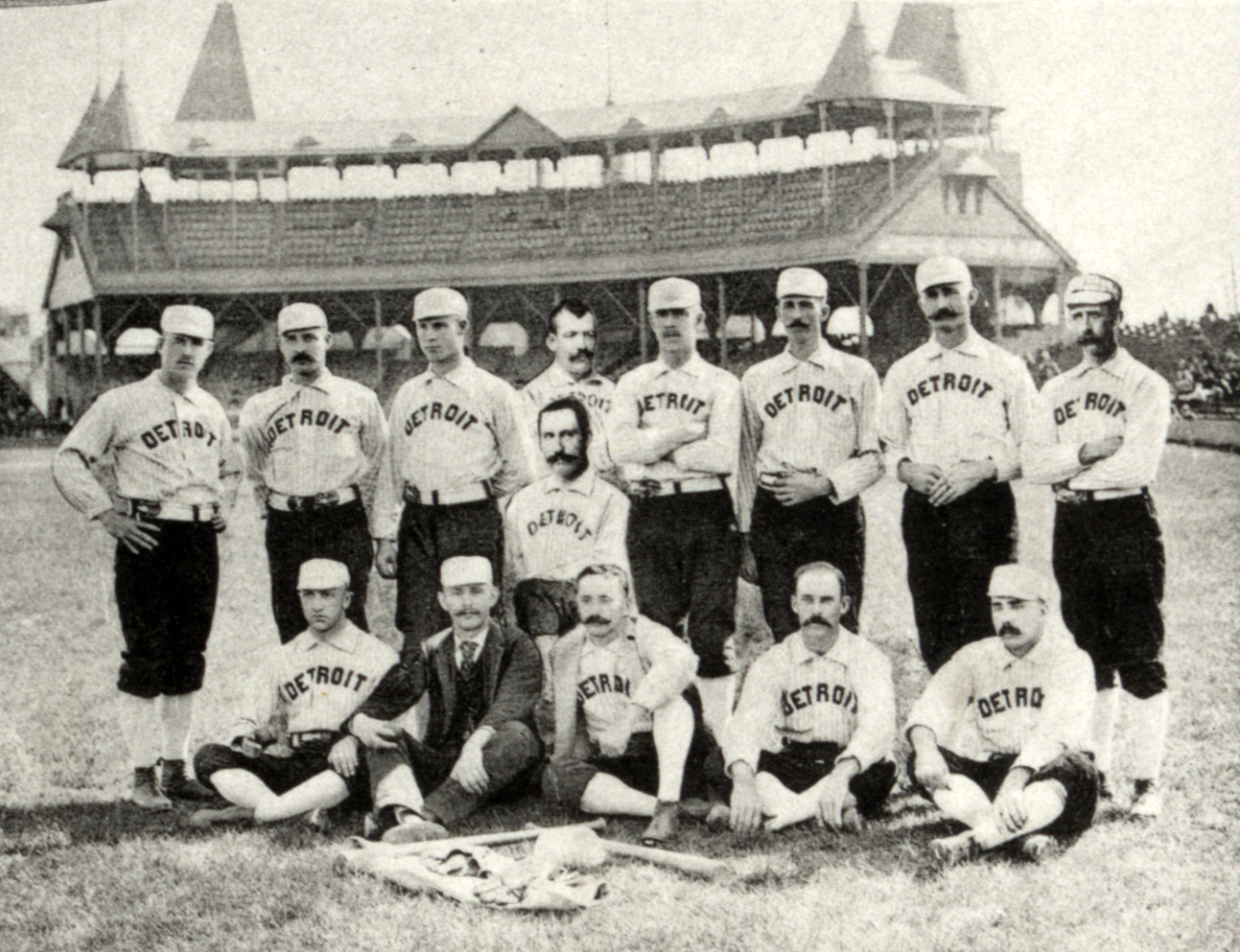
The Detroit Wolverines were a 19th-century Major League Baseball team that played in the National League from 1881 to 1888 in the city of Detroit, Michigan. In total, they won 426 games and lost 437, taking their lone pennant (and winning the pre-modern World Series) in 1887. The team was disbanded following the 1888 season.

Key Information

Franchise history

[edit]

Founded at the suggestion of Detroit mayor William G. Thompson, the Wolverines played the first game of major league baseball in Detroit on May 2, 1881, in front of 1,286 fans. Their home field was called Recreation Park, and it consisted of a wooden grandstand located between Brady Street and Willis Avenue. This stadium was demolished in 1894, though its location is indicated by a historical marker in what was once left field. The name of the ball club derives from Michigan being known as "The Wolverine State;" although the team name "Wolverines" is now primarily associated with University of Michigan sports, there was no connection between the University and the Detroit baseball team.

Though they folded after only eight seasons, the Wolverines occupy an important place in baseball history. On September 6, 1883, they conceded 18 runs in a single inning against the Chicago White Stockings, the most ever in MLB. In 1885, new owner Frederick Kimball Stearns began spending heavily in an attempt to create a 'super-team' by buying high-priced players. Most notably, he purchased the entire Buffalo Bisons franchise that August, to secure the services of its stars: Dan Brouthers, Jack Rowe, Hardy Richardson, and Deacon White, the so-called "Big Four". This strategy quickly met resistance from his fellow owners, who changed the league's rules governing the splitting of gate receipts, reducing the visiting team's maximum share to $125 per game. Detroit was not yet the Motor City, and its population was too small to support a highly paid team. The Wolverines' home gate receipts were not sufficient to sustain their payroll, and Stearns was forced to sell his stars to other clubs and disband the team after the 1888 season. The franchise's place in the National League was taken by the Cleveland Spiders in 1889.

The Wolverines' most successful season came in 1887, when they were crowned as the champion of the National League with a record of 79 wins and 45 losses. After the season, they defeated the St. Louis Browns, champion of the rival American Association, in a series of exhibition matches, winning ten of the fifteen games played. These games were a predecessor to the modern World Series, which did not begin until 1903.

Three Detroit players hit for the cycle: George Wood on June 13, 1885, Mox McQuery on September 28, 1885, and Jack Rowe on August 21, 1886.

Prominent players

[edit]
Hardy Richardson of the Detroit Wolverines, circa 1887

Baseball Hall of Famers

[edit]
Detroit Wolverines Hall of Famers
Inductee Position Seasons Inducted
Dan Brouthers 1B 1886–1888 1945
Ned Hanlon CF 1881–1888 1996
Deacon White 3B/C 1886–1888 2013
Sam Thompson RF 1885–1888 1974

See also

[edit]
[edit]
Revisions and contributorsEdit on WikipediaRead on Wikipedia
from Grokipedia
The Detroit Wolverines were a team that competed in Major League Baseball's National League from 1881 to 1888, based in , , and serving as the city's first major league franchise before the arrival of the Detroit Tigers. Over their eight seasons, the Wolverines compiled an overall record of 426 wins and 437 losses, achieving a .494 , with notable players including Hall of Famers Sam Thompson, , and . The team reached its pinnacle in 1887 under manager Bill Watkins, posting a 79-45-3 record to claim the National League pennant and then defeating the of the American Association 10 games to 5 in the era's first fully played , a series recognized today as MLB's inaugural postseason championship. Despite this triumph, financial difficulties and internal conflicts led to the franchise's dissolution after the 1888 season, marking the end of Detroit's initial foray into big-league baseball. The Wolverines also hold the distinction of allowing the most runs in a single in MLB , when the Chicago White Stockings scored 18 against them on September 6, 1883.

Franchise overview

Founding and league affiliation

The Detroit Wolverines were established in 1881 as Detroit's first franchise, formed by a group of local businessmen led by William G. Thompson, who served as the team's principal owner and president. Thompson, then serving as mayor of , organized the club following the collapse of a short-lived professional team in the during 1879, capitalizing on the momentum of professional baseball's expansion in the post-Civil War era. This venture represented a significant in the for the rapidly industrializing , positioning the Wolverines as a key part of Detroit's emerging cultural and recreational landscape. On December 8, 1880, the National League admitted the Wolverines as an for the 1881 season, replacing the , which had been expelled from the league for violating rules on games and alcohol sales. The franchise entered a competitive circuit that included powerhouse clubs like the Chicago White Stockings, the Boston Red Caps, and the , marking Detroit's debut in the senior circuit amid a league that had stabilized to eight teams after early turbulence. Under the guidance of manager Frank Bancroft, the Wolverines aimed to establish a foothold in this established league, drawing on the city's growing population and economic vitality to build fan support. The initial roster was assembled primarily by acquiring a majority of players from the disbanded , supplemented by talent from local amateur clubs and minor league circuits to form a balanced squad capable of contending in the National League. This strategic recruitment focused on creating a competitive unit suited to the demands of major league play, emphasizing versatile fielders and pitchers to represent Detroit's burgeoning industrial workforce and foster community pride. The approach allowed the team to field a respectable lineup from the outset, setting for their integration into the league's schedule. The Wolverines played their inaugural major league game on May 2, 1881, hosting the at Recreation Park in , where they fell 6-5 in front of 1,286 spectators. This matchup highlighted the team's readiness to engage with league rivals, launching an era that would see the Wolverines compete through 1888.

Overall record and achievements

The Detroit Wolverines competed in the National League from 1881 to 1888, compiling an overall record of 426 wins, 437 losses, and 17 ties, for a .494 . This middling performance belied their brief moment of glory in 1887, when they captured their sole NL pennant with a 79-45-3 regular-season mark, finishing three and a half games ahead of the second-place Stockings. The team's crowning achievement came in the postseason, as they defeated the of the American Association 10 games to 5 in the 1887 World's Championship Series, a 15-game matchup between the league champions that is regarded as one of the earliest precursors to the modern . Among their notable single-game records, the Wolverines hold the unfortunate distinction of conceding 18 runs in a single —the most in major league history—to the Chicago White Stockings during a 26-6 loss on September 6, 1883. Attendance peaked during the championship 1887 season, with approximately 95,000 fans attending home games at Recreation Park, underscoring the team's surging popularity in Detroit amid the era's growing interest in professional baseball. However, financial challenges persisted, as the high salaries paid to star players like Dan Brouthers and Sam Thompson strained the franchise's resources, contributing to its eventual disbandment after the 1888 season despite the prior year's success.

Historical seasons

Early years (1881–1884)

The Detroit Wolverines joined the National League as an expansion franchise in 1881, posting a 41–43 record and finishing fourth in the eight-team league. Under manager Frank Bancroft, the team, largely composed of players acquired from the defunct , faced the challenges of adapting to the extended travel demands of the National League schedule, which required cross-country trips by rail, and the league's stricter rules on gameplay and player conduct. In , the Wolverines achieved their first winning record at 42–41–3, placing fifth, still managed by Bancroft. The season highlighted pitching inconsistencies, with the staff posting a collective above the league average, and defensive lapses that prevented higher finishes despite a balanced offense. Player turnover was evident, as the roster saw several midseason changes amid the era's fluid contracts and disputes. The 1883 campaign marked a downturn, with the team finishing 40–58–3 and seventh under new manager Jack Chapman, following an ownership shift from founder William G. Thompson to businessman Joseph Marsh prior to the season. Defensive issues plagued the squad, exemplified on when the Chicago White Stockings erupted for 18 runs in the seventh —a major league record that underscored the Wolverines' fielding woes and contributed to their middling offensive output relative to leaders. The 1884 season represented the nadir of the early years, as the Wolverines compiled a franchise-worst 28–84–2 mark and last place under Chapman. High player turnover exacerbated pitching and defensive shortcomings, while low attendance amid Detroit's competitive sporting landscape and economic fluctuations in its growing industrial economy strained finances, leading to discussions of withdrawing from the National League.

Rise to prominence (1885–1886)

The 1885 season marked a transitional period for the Detroit Wolverines, as the team finished with a 41–67 record, placing sixth in the National League, an improvement from their 28–84–2 mark the previous year. Mid-season, the club acquired outfielder Sam Thompson from the , who debuted on July 2 and contributed a .303 over 63 games, signaling the emergence of young talent. Managerial instability persisted, with Charlie Morton starting the year but posting a 7–31 record before Bill Watkins assumed control on June 25, guiding the team to a 34–36 finish and instilling a focus on fundamentals. In a pivotal late-September move, new club director Frederick K. Stearns orchestrated the purchase of ' star infielders—the "Big Four" of , Hardy Richardson, Jack Rowe, and —for $7,000, circumventing the league's salary limits to bolster the lineup for the following year. The team's overall stood at .243, reflecting modest gains in offensive output. The 1886 campaign represented a dramatic rise, with the Wolverines compiling an 87–36–3 record and securing second place in the National League, just 2.5 games behind the Chicago White Stockings. The integration of the Big Four transformed the offense, as Brouthers led with a .370 average, 11 home runs, and 139 runs scored, while holdovers like Thompson (.310 average, 8 home runs, 89 RBI) and Ned Hanlon (now team captain, playing 126 games) solidified the outfield; the squad's collective climbed to .279, emphasizing power and consistency. Under Watkins' continued leadership, the manager emphasized disciplined play, imposing $10 fines for fielding errors and stricter penalties for off-field indiscretions to foster accountability, while actively scouting and acquiring talents like Fred Dunlap in August for $4,700 to address infield needs. Despite minor setbacks, such as Rowe's finger injury from a foul tip, the team's strategic depth and emergence of stars like Thompson positioned them as contenders. Off the field, the Wolverines enjoyed growing local enthusiasm in , drawing crowds of up to 5,000 for the season opener and building rivalries with powerhouses like the Chicago White Stockings and that heightened regional interest. These developments, including Stearns' aggressive investments, laid the groundwork for the team's pennant victory.

Championship season (1887)

The 1887 season marked the pinnacle of the Detroit Wolverines' success in the National League, as the team compiled a record of 79 wins, 45 losses, and 3 ties to claim the pennant. Under manager Bill Watkins, the Wolverines maintained sole possession of first place from the opening day through the season's end, a feat unmatched in league history at the time. Their dominance was driven by a formidable pitching staff anchored by Charlie Getzien, who posted a 29-13 record with 41 complete games, supported by contributions from Pete Conway (12-5) and others who limited opponents to a league-low 3.98 runs per game. Offensively, the team led the National League with 969 runs scored, powered by outfielder Sam Thompson's league-leading 166 RBIs and 171 hits, including a .372 that showcased his prowess as a . A cornerstone of the Wolverines' lineup was the veteran infield known as the "Big Four"—first baseman , second/third baseman Hardy Richardson, catcher/third baseman , and shortstop Jack Rowe—acquired together from the in 1885 and providing continuity and power through 1887. topped the league with 118 runs scored and a .423 , while Richardson added 124 runs and White contributed steady defense behind the plate, allowing the infield to form the backbone of Detroit's strategy emphasizing disciplined hitting and error-free play. This unit's cohesion enabled the Wolverines to outscore opponents by an average margin and secure key victories. Following the regular season, the Wolverines faced the of the American Association in a best-of-15 , ultimately prevailing 10 games to 5 in a matchup played across multiple cities from October 10 to 26. Detroit's victory was highlighted by Thompson's two home runs during the series, including a pivotal blast in Game 8 on October 18 that helped secure a 7-1 win, underscoring his role as the offensive standout amid the grueling schedule. Getzien's pitching proved decisive in several contests, including complete games in Games 3 and 7, while the infield's reliability minimized St. Louis's running game led by stars like . The series clinched on October 26 in with a 9-3 Detroit win, marking the franchise's only championship. The triumph ignited widespread celebrations in upon the team's return, with thousands lining the streets for parades and public receptions that fostered a surge in civic pride during a period of economic challenges. Fans honored players like Thompson and Brouthers with ovations at Recreation Park, transforming the victory into a symbol of local resilience amid broader labor tensions in the industrial city.

Final season and disbandment (1888)

The 1888 season marked a sharp decline for the Detroit Wolverines following their triumphant 1887 championship, as the team struggled with injuries, roster instability, and a midseason managerial change, ultimately finishing fifth in the National League with a 68–63–3 record, 17 games behind the pennant-winning . Despite an early surge that saw them hold a one-game lead in late July, the Wolverines faltered after Sam Thompson suffered a season-altering injury, embarking on a 12-game losing streak that derailed their contention. Manager Bill Watkins, who had guided the team to 49 wins in 94 decisions, was replaced in late August by Bob Leadley for the final stretch, but the change failed to reverse the momentum. The team's underperformance was exacerbated by ongoing player holdouts and salary disputes, remnants of the high payroll commitments from the previous year's success, which strained operations amid growing competition from rival leagues. Key contributors like and Charlie Bennett remained, providing solid production, but the overall roster lacked the depth that had propelled the 1887 pennant win. Attendance at Recreation Park plummeted due to the lack of pennant contention, dropping precipitously from the record highs of the championship season and failing to cover operational costs despite the league's 30% road gate receipts sharing. Financial pressures culminated in a collapse, with owner Frederick Stearns facing mounting debts from the 1887 expenditures and insufficient home gate receipts to sustain the roster. In October 1888, following the season's end, Stearns announced the franchise's disbandment, auctioning off star players to other National League clubs to recoup losses; notable dispersals included Brouthers, Hardy Richardson, and Bennett to , Thompson to , and pitchers Pete Conway and Ned Hanlon to . The move effectively ended in for the time being, with a minor league club briefly organized in the city for 1889 to fill the void.

Players and personnel

Managers and ownership

The Detroit Wolverines were founded in 1881 by William G. Thompson, a mayor and businessman who served as the team's principal owner and president through the 1882 season, acquiring players from the defunct to stock the inaugural roster. Thompson sold the franchise prior to the 1883 campaign to Joseph Marsh, a local businessman who owned the team until the end of 1885 and oversaw modest improvements in performance during a period of league expansion. In 1886, pharmaceutical magnate Frederick K. Stearns assumed primary ownership, investing heavily in talent acquisition—including the landmark $7,000 purchase of the entire franchise in late 1885 to secure the star "Big Four" infielders , Hardy Richardson, Jack Rowe, and —which propelled the Wolverines to contention but strained finances due to elevated payrolls. Stearns' aggressive spending strategy funded roster enhancements that culminated in the 1887 National League pennant, yet insufficient gate receipts failed to offset costs, leading to mounting debts; by 1888, he was compelled to disperse key players to other clubs, resulting in the franchise's contraction and disbandment after the season. Managerial leadership evolved alongside ownership changes, with early hires focusing on stability before shifting toward competitive aggression. Frank Bancroft, a veteran from the Worcester Ruby Legs, guided the team from its inception through 1882, compiling a 83-84 record while emphasizing disciplined play and importing talent from his prior clubs, though the Wolverines hovered around .500. Jack Chapman took over for 1883 and 1884, posting a combined 68-142 mark amid defensive lapses and roster turnover, but his tenure laid groundwork for future acquisitions by prioritizing versatile fielders. In 1885, Charlie Morton managed the first 38 games (7-31) before Bill Watkins assumed control midseason, inheriting a last-place club and implementing bold tactics such as player trades and positional shifts to integrate high-profile additions like the Big Four, which ignited a turnaround with 34 wins under his management that year (team total 41-67). Watkins retained the role through 1887 and into 1888, achieving a 249-161 record overall (.607 winning percentage) by fostering aggressive base-running and power hitting, strategies that secured the 1887 title; he was replaced late in 1888 by Bob Leadley, who handled the final 40 games (19-19-2) as financial pressures mounted and veterans departed. Amid rising tensions in baseball's labor landscape, the Wolverines' navigated player contracts cautiously during the 1887 season, when the National League introduced a salary classification system to preempt unrest from the newly assertive Players' Brotherhood, founded in 1885 and led by . Owner Stearns prioritized revenue protections for his championship-caliber roster, advocating for better postseason splits while granting premium salaries—exceeding $2,000 annually for stars like Brouthers and Thompson—to retain talent and avert defections, though this exacerbated financial vulnerabilities as the Brotherhood pushed for reforms that would culminate in the 1890 revolt.

Notable players

The Detroit Wolverines featured several standout players who were instrumental in the team's rise and 1887 championship success, particularly through their offensive firepower and pitching dominance. Among the outfielders, Sam Thompson emerged as a key and run producer. In 1887, Thompson batted .372 with 10 home runs and a league-leading 166 RBIs, helping drive the Wolverines' potent lineup to the National League pennant. His contributions extended to the postseason, where he hit .362 in the victory over the . In the infield, first baseman Dan Brouthers provided consistent power and on-base skills. During the 1887 season, Brouthers hit .338 with 12 home runs and 101 RBIs, anchoring the team's batting order with 153 runs scored and leading the league in on-base percentage at .426. His slugging prowess, including 36 doubles and 20 triples, was vital to the Wolverines' offensive output that year. Catcher , acquired as part of the "Big Four," offered veteran leadership and solid hitting. In 1887, White batted .324 with 5 home runs and 78 RBIs while catching 78 , providing stability behind the plate for the pennant-winning staff. The pitching staff was led by right-hander Charlie Getzein, who delivered 29 wins in 1887 with a .690 winning percentage, pacing the [National League](/page/National League) and anchoring the rotation for the pennant-winning campaign. Complementing him was left-hander Lady Baldwin, whose 1886 season included a dominant 42-13 record, 323 strikeouts, and a 2.24 over 487 , setting the stage for the team's subsequent success despite finishing second that year. Baldwin's endurance and control were hallmarks of his Wolverines tenure. Behind the plate and in utility roles, Ned Hanlon excelled in defense and base-running. In 1887, Hanlon stole a team-high 69 bases while batting .274 with 4 home runs and 69 RBIs, contributing to the club's speed and versatility on the basepaths. His sure-handed play in the outfield and catching duties bolstered the team's overall defensive stability.

Baseball Hall of Famers

The Detroit Wolverines boast four individuals enshrined in the National Baseball Hall of Fame who contributed significantly as players to the team's 1887 National League pennant and subsequent victory (Ned Hanlon was primarily inducted for his managerial career). These inductees highlight the franchise's talent during its brief but impactful existence in the late . Dan Brouthers, a dominant , played for the Wolverines from 1886 to 1888 and was inducted into the Hall of Fame in 1945 by the Old Timers Committee. During his tenure with Detroit, Brouthers maintained a .337 across 373 games, anchoring the infield with his power hitting and defensive prowess; in 1887, he led the National League with 153 runs scored and 68 extra-base hits, helping propel the team to the championship. His contributions underscored the Wolverines' offensive strength, as he slugged .562 that season while driving in 101 runs. Sam Thompson, an outfielder renowned for his speed and slugging, spent his first four professional seasons with the Wolverines from 1885 to 1888 before his induction in 1974 by the Veterans Committee. Thompson batted over .300 in three of those years, compiling a .334 average overall with Detroit, and showcased his base-stealing ability with 22 steals in 1887 alone. In the 1887 World Series against the St. Louis Browns, he led all players with a .362 batting average, including seven RBIs across the 15-game series, proving instrumental in the Wolverines' 10-5 victory. Deacon White, a pioneering catcher and hitter, played for the Wolverines from 1886 to 1888 as part of the "Big Four" and was inducted in 2013 by the Veterans Committee. In 1887, White hit .324 with 78 RBIs and caught 78 games, providing defensive reliability and offensive support (.397 OBP) to the championship team. His career spanned the early professional era, and his Wolverines tenure added to his legacy as one of baseball's first stars. Ned Hanlon, versatile across outfield and infield positions, played for the Wolverines throughout their entire existence from 1881 to 1888 and was inducted in 1996 primarily for his managerial career, though his playing contributions were notable. As team captain in 1887, Hanlon appeared in 118 games, batting .274 with 69 stolen bases and providing leadership that complemented the star-studded lineup; his positional flexibility, including stints at second base and alongside center field, bolstered Detroit's defensive alignment during the pennant-winning campaign.

Legacy and facilities

Impact on Detroit baseball

The Detroit Wolverines provided Detroit with its first exposure to from 1881 to 1888, establishing as a fixture in the city's burgeoning sports culture. Their 1887 National League pennant and victory marked the city's inaugural championship, igniting widespread celebrations including parades and public dinners that fostered deep community engagement. This triumph boosted local pride amid Detroit's rapid industrialization in the late , when the population swelled to around 200,000 and the city emerged as a manufacturing hub, inspiring a dedicated fan base that endured despite the team's later struggles. Following the Wolverines' disbandment after the 1888 season due to financial difficulties, their legacy paved the way for the return of in . The city secured a franchise in the Western League in 1894, initially adopting the Wolverines nickname before evolving into the Detroit Tigers upon joining the in 1901, thus continuing the tradition of big-league play in the Motor City. The Wolverines' on-field exploits left enduring marks in MLB record books, including holding the all-time record for the most runs allowed in a single when they surrendered 18 to the Chicago White Stockings on September 6, 1883—a feat still recognized as the benchmark for offensive explosions. To bridge the gap after their major-league exit, a new iteration of the Wolverines competed in minor-league circuits, playing in the International Association in 1889 and 1890 (where they captured the pennant both years) before shifting to the Northwestern League in 1891, maintaining the team's name and local interest until its early disbandment that June.

Home ballparks and operations

The Detroit Wolverines played all their home games at Recreation Park, a wooden ballpark located between Michigan Avenue, Brady Street, and Willis Avenue in , from their inaugural season in 1881 through their final year in 1888. The venue featured a modest roofed behind home plate that extended unevenly along the baselines, with additional in right field and open standing room in for overflow crowds. As a typical 19th-century facility, its seating was limited to about 13 rows in the grandstand, accommodating roughly 5,000 spectators at full capacity, though actual usage often relied on informal arrangements for larger turnouts. Recreation Park also served as the site for several games in the 1887 against the , including the pivotal middle contests that helped secure the Wolverines' victory. Overall, the team's operations centered on rail travel for road trips, a necessity enabled by the expansion of regional railroads that connected distant National League cities and facilitated the sport's national growth. Equipment, including official baseballs and bats, was supplied by A.G. Spalding & Bros., the league's designated manufacturer since 1878, ensuring standardized gear for all contests. Average attendance ranged from 1,200 to 2,000 fans per home game across the franchise's run, peaking in with 95,000 total spectators for 60 contests during the championship campaign. Maintenance proved challenging for the wooden structure, which carried inherent fire risks common to era ballparks—many similar venues burned down due to dry timber and crowded conditions—while unpredictable weather, including heavy rains and cold snaps, frequently delayed or shortened early-season games.

References

Add your contribution
Related Hubs
User Avatar
No comments yet.