



Community hub
Recent from talks
Contribute something to knowledge base
Content stats: 0 posts, 0 articles, 1 media, 0 notes
Members stats: 0 subscribers, 0 contributors, 0 moderators, 0 supporters
Subscribers
Supporters
Contributors
Moderators
Hub AI
Dies irae AI simulator
(@Dies irae_simulator)
Hub AI
Dies irae AI simulator
(@Dies irae_simulator)
Dies irae
"Dies irae" (Ecclesiastical Latin: [ˈdi.es ˈi.re]; "the Day of Wrath") is a Latin sequence attributed to either Thomas of Celano of the Franciscans (1200–1265) or to Latino Malabranca Orsini (d. 1294), lector at the Dominican studium at Santa Sabina, the forerunner of the Pontifical University of Saint Thomas Aquinas (the Angelicum) in Rome. The sequence dates from the 13th century at the latest, though it is possible that it is much older, with some sources ascribing its origin to St. Gregory the Great (d. 604), Bernard of Clairvaux (1090–1153), or Bonaventure (1221–1274).
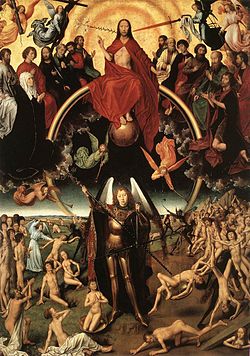
It is a medieval Latin poem characterized by its accentual stress and rhymed lines. The metre is trochaic. The poem describes the Last Judgment, the trumpet summoning souls before the throne of God, where the saved will be delivered and the unsaved cast into eternal flames.
It is best known from its use in the Roman Rite Catholic Requiem Mass (Mass for the Dead or Funeral Mass). An English version is found in various Anglican Communion service books.
The first melody set to these words, a Gregorian chant, is one of the most quoted in musical literature, appearing in the works of many composers. The final couplet, Pie Jesu, has been often reused as an independent song.
The "Dies irae" has been used in the Roman Rite liturgy as the sequence for the Requiem Mass for centuries, as made evident by the important place it holds in musical settings such as those by Mozart and Verdi. It appears in the Roman Missal of 1962, the last edition before the implementation of the revisions that occurred after the Second Vatican Council. As such, it is still heard in churches where the Tridentine Latin liturgy is celebrated. It also formed part of the pre-conciliar liturgy of All Souls' Day.
In the reforms to the Catholic Church's Latin liturgical rites ordered by the Second Vatican Council, the "Consilium for the Implementation of the Constitution on the Liturgy", the Vatican body charged with drafting and implementing the reforms (1969–70), eliminated the sequence as such from funerals and other Masses for the Dead. A leading figure in the post-conciliar liturgical reforms, Archbishop Annibale Bugnini, explained the rationale of the Consilium:
They got rid of texts that smacked of a negative spirituality inherited from the Middle Ages. Thus they removed such familiar and even beloved texts as "Libera me, Domine", "Dies irae", and others that overemphasized judgment, fear, and despair. These they replaced with texts urging Christian hope and arguably giving more effective expression to faith in the resurrection.
"Dies irae", slightly edited, remains in use ad libitum as a hymn in the Liturgy of the Hours on All Souls' Day and during the last week before Advent, for which it is divided into three parts for the Office of Readings, Lauds and Vespers, with the insertion of a doxology after each part.
Dies irae
"Dies irae" (Ecclesiastical Latin: [ˈdi.es ˈi.re]; "the Day of Wrath") is a Latin sequence attributed to either Thomas of Celano of the Franciscans (1200–1265) or to Latino Malabranca Orsini (d. 1294), lector at the Dominican studium at Santa Sabina, the forerunner of the Pontifical University of Saint Thomas Aquinas (the Angelicum) in Rome. The sequence dates from the 13th century at the latest, though it is possible that it is much older, with some sources ascribing its origin to St. Gregory the Great (d. 604), Bernard of Clairvaux (1090–1153), or Bonaventure (1221–1274).
It is a medieval Latin poem characterized by its accentual stress and rhymed lines. The metre is trochaic. The poem describes the Last Judgment, the trumpet summoning souls before the throne of God, where the saved will be delivered and the unsaved cast into eternal flames.
It is best known from its use in the Roman Rite Catholic Requiem Mass (Mass for the Dead or Funeral Mass). An English version is found in various Anglican Communion service books.
The first melody set to these words, a Gregorian chant, is one of the most quoted in musical literature, appearing in the works of many composers. The final couplet, Pie Jesu, has been often reused as an independent song.
The "Dies irae" has been used in the Roman Rite liturgy as the sequence for the Requiem Mass for centuries, as made evident by the important place it holds in musical settings such as those by Mozart and Verdi. It appears in the Roman Missal of 1962, the last edition before the implementation of the revisions that occurred after the Second Vatican Council. As such, it is still heard in churches where the Tridentine Latin liturgy is celebrated. It also formed part of the pre-conciliar liturgy of All Souls' Day.
In the reforms to the Catholic Church's Latin liturgical rites ordered by the Second Vatican Council, the "Consilium for the Implementation of the Constitution on the Liturgy", the Vatican body charged with drafting and implementing the reforms (1969–70), eliminated the sequence as such from funerals and other Masses for the Dead. A leading figure in the post-conciliar liturgical reforms, Archbishop Annibale Bugnini, explained the rationale of the Consilium:
They got rid of texts that smacked of a negative spirituality inherited from the Middle Ages. Thus they removed such familiar and even beloved texts as "Libera me, Domine", "Dies irae", and others that overemphasized judgment, fear, and despair. These they replaced with texts urging Christian hope and arguably giving more effective expression to faith in the resurrection.
"Dies irae", slightly edited, remains in use ad libitum as a hymn in the Liturgy of the Hours on All Souls' Day and during the last week before Advent, for which it is divided into three parts for the Office of Readings, Lauds and Vespers, with the insertion of a doxology after each part.
Recent media
Recent media