


Community hub
Recent from talks
Contribute something
Nothing was collected or created yet.
Ecclesiastical Latin
View on Wikipedia| Ecclesiastical Latin | |
|---|---|
| Church Latin, Liturgical Latin | |
| Native to | Never spoken as a native language; other uses vary widely by period and location |
| Extinct | Still used for many purposes, mostly as a liturgical language of the Latin liturgical rites of the Catholic Church, and (rarely) in Anglicanism and Lutheranism.[1] Also used in the Western Rite of the Eastern Orthodox Church.[2] |
Indo-European
| |
Early form | |
| Latin | |
| Language codes | |
| ISO 639-3 | – |
| Glottolog | None |
| IETF | la-VA |

Ecclesiastical Latin, also called Church Latin or Liturgical Latin, is a form of Latin developed to discuss Christian thought in Late antiquity and used in Christian liturgy, theology, and church administration to the present day, especially in the Catholic Church. It includes words from Vulgar Latin and Classical Latin (as well as Greek and Hebrew) re-purposed with Christian meaning.[3] It is less stylized and rigid in form than Classical Latin, sharing vocabulary, forms, and syntax, while at the same time incorporating informal elements which had always been with the language but which were excluded by the literary authors of Classical Latin.[4]
Its pronunciation was partly standardized in the late 8th century during the Carolingian Renaissance as part of Charlemagne's educational reforms, and this new letter-by-letter pronunciation, used in France and England, was adopted in Iberia and Italy a couple of centuries afterwards.[5] As time passed, pronunciation diverged depending on the local vernacular language, giving rise to even highly divergent forms such as the traditional English pronunciation of Latin, which has now been largely abandoned for reading Latin texts. Within the Catholic Church and in certain Protestant churches, such as the Anglican Church, a pronunciation based on modern Italian phonology, known as Italianate Latin, has become common since the late 19th century.
Ecclesiastical Latin is the language of liturgical rites in the Latin Church, as well as the Western Rite of the Eastern Orthodox Church.[2] It is occasionally used in Anglican Church and Lutheran Church liturgies as well.[1] Today, ecclesiastical Latin is primarily used in official documents of the Catholic Church, in the Tridentine Mass, and it is still learned by clergy.[3][1]
The Ecclesiastical Latin that is used in theological works, liturgical rites and dogmatic proclamations varies in style: syntactically simple in the Vulgate Bible, hieratic (very restrained) in the Roman Canon of the Mass, terse and technical in Thomas Aquinas's Summa Theologica, and Ciceronian (syntactically complex) in Pope John Paul II's encyclical letter Fides et Ratio.
Usage
[edit]Late antique usage
[edit]The use of Latin in the Church started in the late fourth century[6] with the split of the Roman Empire after Emperor Theodosius in 395. Before this split, Greek was the primary language of the Church (the New Testament was written in Greek and the Septuagint – a Greek translation of the Hebrew bible – was in widespread use among both Christians and Hellenized Jews) as well as the language of the eastern half of the Roman Empire. Following the split, early theologians like Jerome translated Greek and Hebrew texts into Latin, the dominant language of the Western Roman Empire. The loss of Greek in the Western half of the Roman Empire, and the loss of Latin in the Eastern half of the Roman Empire were not immediate, but changed the culture of language as well as the development of the Church.[7] What especially differentiates Ecclesiastical Latin from Classical Latin is the consequences of its use as a language for translating, since it has borrowed and assimilated constructions and vocabulary from the koine Greek, while adapting the meanings of some Latin words to those of the koine Greek originals, which are sometimes themselves translations of Hebrew originals.[6]
Medieval usage
[edit]At first there was no distinction between Latin and the actual Romance vernacular, the former being just the traditional written form of the latter. For instance, in ninth-century Spain ⟨saeculum⟩ was simply the correct way to spell [sjeɡlo], meaning 'century'. The writer would not have actually read it aloud as /sɛkulum/ any more than an English speaker today would pronounce ⟨knight⟩ as */knɪxt/.[8]
The spoken version of Ecclesiastical Latin was created later during the Carolingian Renaissance. The English scholar Alcuin, tasked by Charlemagne with improving the standards of Latin writing in France, prescribed a pronunciation based on a fairly literal interpretation of Latin spelling. For example, in a radical break from the traditional system, a word such as ⟨viridiarium⟩ 'orchard' now had to be read aloud precisely as it was spelled rather than */verdʒjær/ (later spelled as Old French vergier). The Carolingian reforms soon brought the new Church Latin from France to other lands where Romance was spoken.
Usage during the Reformation and in modern Protestant churches
[edit]The use of Latin in the Western Church continued into the Early modern period. One of Martin Luther's tenets during the Reformation was to have services and religious texts in the common tongue, rather than Latin, a language that at the time, many did not understand. Protestants refrained from using Latin in services, however Protestant clergy had to learn and understand Latin as it was the language of higher learning and theological thought until the 18th century.[9] After the Reformation, in the Lutheran churches, Latin was retained as the language of the Mass for weekdays, although for the Sunday Sabbath, the Deutsche Messe was to be said.[10] In Geneva, among the Reformed churches, "persons called before the consistory to prove their faith answered by reciting the Paternoster, the Ave Maria, and the Credo in Latin."[10] In the Anglican Church, the Book of Common Prayer was published in Latin, alongside English.[1] John Wesley, the founder of the Methodist churches, "used Latin text in doctrinal writings",[1] as Martin Luther and John Calvin did in their era.[1] In the training of Protestant clergy in Württemberg, as well as in the Rhineland, universities instructed divinity students in Latin and their examinations were conducted in this language.[10] The University of Montauban, under Reformed auspices, required that seminarians complete two theses, with one being in Latin; thus Reformed ministers were "Latinist by training", comparable to Catholic seminarians.[10]
Modern Catholic usage
[edit]Ecclesiastical Latin continues to be the official language of the Catholic Church. The Second Vatican Council (1962–1965) allowed the Mass to be celebrated in vernacular languages, leaving the option to celebrate the Mass in Latin to the celebrating priest.[11] The Church produces liturgical texts in Latin, which provide a single clear point of reference for translations into all other languages. The same holds for the texts of canon law.[3] Pope Benedict XVI gave his unexpected resignation speech in Latin.[12]
The Holy See has for some centuries usually drafted documents in a modern language, but the authoritative text, published in the Acta Apostolicae Sedis, is usually in Latin. Some texts may be published initially in a modern language and be later revised, according to a Latin version (or "editio typica"), after this Latin version is published. For example, the Catechism of the Catholic Church was drafted and published, in 1992, in French. The Latin text appeared five years later, in 1997, and the French text was corrected to match the Latin version, which is regarded as the official text. The Latin-language department of the Vatican Secretariat of State (formerly the Secretaria brevium ad principes et epistolarum latinarum) is charged with the preparation in Latin of papal and curial documents. Sometimes, the official text is published in a modern language, e.g., the well-known edict Tra le sollecitudini[13] (1903) by Pope Pius X (in Italian) and Mit brennender Sorge (1937) by Pope Pius XI (in German).
Comparison with Classical Latin
[edit]There are not many differences between Classical Latin and Church Latin. One can understand Church Latin knowing the Latin of classical texts, as the main differences between the two are in pronunciation and spelling, as well as vocabulary.[citation needed][clarification needed]
In many countries, those who speak Latin for liturgical or other ecclesiastical purposes use the pronunciation that has become traditional in Rome by giving the letters the value they have in modern Italian but without distinguishing between open and close ⟨e⟩ and ⟨o⟩.[clarification needed] ⟨ae⟩ and ⟨oe⟩ coalesce with ⟨e⟩. ⟨c⟩ and ⟨g⟩ before ⟨ae⟩, ⟨oe⟩, ⟨e⟩, ⟨y⟩ and ⟨i⟩ are pronounced /t͡ʃ/ (English ⟨ch⟩) and /d͡ʒ/ (English ⟨j⟩), respectively. ⟨ti⟩ before a vowel is generally pronounced /tsi/ (unless preceded by ⟨s⟩, ⟨d⟩ or ⟨t⟩). Such speakers pronounce consonantal ⟨v⟩ (not written as ⟨u⟩) as /v/ as in English, not as Classical /w/. Like in Classical Latin, double consonants are pronounced with gemination.[citation needed]
The distinction in Classical Latin between long and short vowels is ignored, and instead of the 'macron' or 'apex', lines to mark the long vowel, an acute accent is used for stress. The first syllable of two-syllable words is stressed; in longer words, an acute accent is placed over the stressed vowel: adorémus 'let us adore'; Dómini 'of the Lord'.[14]
Language materials
[edit]The complete text of the Bible in Latin, the revised Vulgate, appears at Nova Vulgata – Bibliorum Sacrorum Editio.[15] New Advent[16] gives the entire Bible, in the Douay version, verse by verse, accompanied by the Vulgate Latin of each verse.
In 1976, the Latinitas Foundation[17] (Opus Fundatum Latinitas in Latin) was established by Pope Paul VI to promote the study and use of Latin. Its headquarters are in Vatican City. The foundation publishes an eponymous quarterly in Latin. The foundation also published a 15,000-word Italian-Latin Lexicon Recentis Latinitatis (Dictionary of Recent Latin), which provides Latin coinages for modern concepts, such as a bicycle (birota), a cigarette (fistula nicotiana), a computer (instrumentum computatorium), a cowboy (armentarius), a motel (deversorium autocineticum), shampoo (capitilavium), a strike (operistitium), a terrorist (tromocrates), a trademark (ergasterii nota), an unemployed person (invite otiosus), a waltz (chorea Vindobonensis), and even a miniskirt (tunicula minima) and hot pants (brevissimae bracae femineae). Some 600 such terms extracted from the book appear on a page[18] of the Vatican website. The Latinitas Foundation was superseded by the Pontifical Academy for Latin (Latin: Pontificia Academia Latinitatis) in 2012.
Current use
[edit]Latin remains an oft-used language of the Holy See and the Latin liturgical rites of the Catholic Church.[19] Until the 1960s and still later in Roman colleges like the Gregorian, Catholic priests studied theology using Latin textbooks and the language of instruction in many seminaries was also Latin, which was seen as the language of the Church Fathers. The use of Latin in pedagogy and in theological research, however, has since declined. Nevertheless, canon law requires for seminary formation to provide for a thorough training in Latin,[20] though "the use of Latin in seminaries and pontifical universities has now dwindled to the point of extinction."[21] Latin was still spoken in recent international gatherings of Catholic leaders, such as the Second Vatican Council, and it is still used at conclaves to elect a new Pope. The Tenth Ordinary General Assembly of the Synod of Bishops in 2004 was the most recent to have a Latin-language group for discussions.
Although Latin is the traditional liturgical language of the Western (Latin) Church, the liturgical use of the vernacular has predominated since the liturgical reforms that followed the Second Vatican Council: liturgical law for the Latin Church states that Mass may be celebrated either in Latin or another language in which the liturgical texts, translated from Latin, have been legitimately approved.[22] The permission granted for continued use of the Tridentine Mass in its 1962 form authorizes use of the vernacular language in proclaiming the Scripture readings after they are first read in Latin.[23]
In historic Protestant churches, such as the Anglican Communion and Lutheran churches, Ecclesiastical Latin is occasionally employed in sung celebrations of the Mass.[1]
References
[edit]Citations
[edit]- ^ a b c d e f g Cross, Frank Leslie; Livingstone, Elizabeth A. (2005). The Oxford Dictionary of the Christian Church. Oxford University Press. p. 961. ISBN 9780192802903.
The Second Vatican Council declared that the use of Latin was to be maintained in the liturgy, though permission was granted for some use of the vernacular; in the outcome, the use of the vernacular has almost entirely triumphed, although the official books continue to be published in Latin. In the Church of England the Latin versions of the Book of Common Prayer have never been widely used, though, for instance, John Wesley used Latin text in doctrinal writings. The option of using traditional Latin texts in sung worship has been retained by choirs in both the Anglican and Lutheran Churches.
- ^ a b "On the Western Rite Liturgy | Antiochian Orthodox Christian Archdiocese". antiochian.org. Retrieved 2017-12-30.
- ^ a b c "CATHOLIC ENCYCLOPEDIA: Church Latin". www.newadvent.org. Retrieved 2018-11-27.
- ^ Collins, Primer of Ecclesiastical Latin, pg. vi
- ^ Wright, Roger (1982). Late Latin and Early Romance in Spain and Carolingian France. ARCA (Classical & Medieval Texts, Papers & Monographs). Vol. 8. Liverpool: Francis Cairns. ISBN 9780905205120.
- ^ a b Collins, Primer of Ecclesiastical Latin, pg. vi
- ^ Leonhardt, Jürgen (2013). Latin: Story of a World Language. Munich: Harvard University Press. p. 94. ISBN 978-0-674-05807-1.
- ^ Wright, Roger (1982). Late Latin and Early Romance in Spain and Carolingian France. Liverpool: Francis Cairns. pp. 44–50. ISBN 0-905205-12-X.
- ^ Janson, Tore (2007). Natural History of Latin: The Story of the World's Most Successful Language. Oxford University Press. p. 126. ISBN 978-0199214051.
- ^ a b c d Waquet, Françoise (2002). Latin, Or, The Empire of a Sign: From the Sixteenth to the Twentieth Centuries. Verso. p. 78. ISBN 9781859844021.
- ^ "Second Vatican Council | Roman Catholic history [1962–1965]". Encyclopedia Britannica. Retrieved 2018-11-27.
- ^ See it at the Catholic News Service channel.
- ^ "Tra Le Sollecitudini Instruction on Sacred Music". Adoremus Bulletin. November 22, 1903. Archived from the original on February 9, 2020. Retrieved July 22, 2019.
- ^ Roman Missal
- ^ "Nova Vulgata – Bibliorum Sacrorum Editio". www.vatican.va.
- ^ "HOLY BIBLE: Genesis 1". www.newadvent.org.
- ^ "Latinitas, Opus Fundatum in Civitate Vaticana". www.vatican.va.
- ^ "Lexicon Recentis Latinitatis, parvum verborum novatorum Léxicum". www.vatican.va.
- ^ Official documents are frequently published in other languages. The Holy See's diplomatic languages are French and Latin (such as letters of credence from Vatican ambassadors to other countries are written in Latin Fr. Reginald Foster, on Vatican Radio, 4 June 2005]). Laws and official regulations of Vatican City, which is an entity that is distinct from the Holy See, are issued in Italian.
- ^ Can. 249, 1983 CIC
- ^ Cross, Frank Leslie; Livingstone, Elizabeth A. (2005). The Oxford Dictionary of the Christian Church. Oxford University Press. p. 961. ISBN 9780192802903.
- ^ Can. 928 Archived December 4, 2010, at the Wayback Machine, 1983 CIC
- ^ ["Apostolic Letter: On the Use of the Roman Liturgy Prior to the 1970 Reform". Archived from the original on 2015-01-01. Retrieved 2015-03-27 – via vatican.va. Motu proprio Summorum Pontificum, article 6
Sources
[edit]- Baumeister, Edmund J. The New Missal Latin. St. Mary's, KS: St. Mary's Publishing.
- Byrne, Carol (1999). "Simplicissimus". The Latin Mass Society of England and Wales. Archived from the original on 25 February 2014. Retrieved 20 April 2011. (A course in ecclesiastical Latin.)
Further reading
[edit]- A Primer of Ecclesiastical Latin by John F. Collins, (Catholic University of America Press, 1985) ISBN 0-8132-0667-7. A learner's first textbook, comparable in style, layout, and coverage to Wheelock's Latin, but featuring text selections from the liturgy and the Vulgate: unlike Wheelock, it also contains translation and composition exercises.
- Mohrmann, Christine (1957). Liturgical Latin, Its Origins and Character: Three Lectures. Washington, DC: Catholic University of America Press.
- Scarre, Annie Mary (1933). An Introduction to Liturgical Latin. Ditchling: Saint Dominic's Press.
- Nunn, H. P. G. (1922). Introduction to Ecclesiastical Latin. Cambridge: Cambridge University Press. pp. 186.
External links
[edit]


Latin and the Catholic Church
[edit]- Pope John XXIII (1999) [1962]. "Veterum Sapientia: Apostolic Constitution on the Promotion of the Study of Latin". Adoremus: Society for the Renewal of the Sacred Liturgy. (in Latin here)
- "What the Church Says on the Latin Language". Michael Martin.
- Catechism of the Catholic Church in Latin
- Fr. Nikolaus Gihr, The Holy Sacrifice of the Mass "The Language Used in the Celebration of the Holy Mass Archived 2011-06-05 at the Wayback Machine"
Bibles
[edit]- The Latin Vulgate version of the Bible
- NewAdvent.org Side-by-side comparisons of the Ancient Greek, English, and Latin Vulgate Bibles.
- Ordo Missae of the 1970 Roman Missal, Latin and English texts, rubrics in English only
- Latin-English Study Bible Side-by-side of the Vulgate Latin and English
- Parallel Latin-English Psalter Archived 2015-11-21 at the Wayback Machine
Breviaries
[edit]Other documents
[edit]- "Documenta Latina". The Holy See. Retrieved 13 October 2009.
- "Documenta Catholica Omnia"—Multi-language Catholic eBook database of all the writings of Holy Popes, Councils, Church Fathers and Doctors, and Allied Auctors. Retrieved November 2018.
- "Thesaurus Precum Latinarum: Treasury of Latin Prayers". Michael Martin. Retrieved 13 October 2009.
- The Christian Latin Library—a collection of ecclesiastical Latin texts by Christian authors. Retrieved November 2018.
- Complete Latin works of St. Augustine
- Latin Logos Library—contains Classical, Medieval, and Ecclesiastical texts.
- The Logic Museum—a collection of ecclesiastical Latin. Retrieved November 18.
- Pope Benedict XVI's First Message with interlinear Latin-English translations
Course
[edit]- "First Experience Latin with Fr. Reginald Foster", an ecclesiastical Latin course. Retrieved November 2018.
- The Vatican's Lexicon Retrieved November 2018.
- Latin Dictionary and Grammar Aid Archived 2012-01-30 at the Wayback Machine. Retrieved November 2018.
| Sacraments | |||||||||||
|---|---|---|---|---|---|---|---|---|---|---|---|
| Eucharistic liturgies | |||||||||||
| Canonical hours, Liturgical hours | |||||||||||
| Other liturgical services | |||||||||||
| Liturgical literature | |||||||||||
| Liturgical language | |||||||||||
| Liturgical rites |
| ||||||||||
| Patriarchates (by order of precedence) |
| ||||||
|---|---|---|---|---|---|---|---|
| History |
| ||||||
| Language | |||||||
| Liturgical rites Liturgical days |
| ||||||
| See also | |||||||
| |||||||


Ecclesiastical Latin
View on GrokipediaOrigins and Development
Emergence from Late Antique Latin
Ecclesiastical Latin developed during the 3rd to 5th centuries AD as the Western Church adapted the spoken Latin of the late Roman Empire, often termed Vulgar or popular Latin, for Christian doctrine, liturgy, and administration. This form diverged from classical standards by drawing on everyday speech patterns prevalent in provinces like North Africa and Italy, while introducing vocabulary for concepts unique to Christianity, such as ecclesia for assembly or church, baptisma for immersion rite, and pascha for Easter, which lacked direct equivalents in pagan literature.[5] These adaptations reflected the needs of a growing ecclesiastical community, where Latin supplanted Greek as the primary language in the West by the early 3rd century.[5] Quintus Septimius Florens Tertullianus (c. 160–220 AD), a North African theologian writing in Carthage, is regarded as a foundational figure in shaping this variant through his extensive corpus on apologetics and theology. Tertullian coined terms like trinitas to articulate the threefold nature of God and repurposed words such as sacramentum from its military sense of oath to denote sacred mysteries, thereby establishing idiomatic precedents for theological discourse.[5] His style, blending rhetorical flourish with colloquial vigor, influenced subsequent writers by prioritizing clarity in expressing novel Christian ideas over strict classical purity.[5] In the late 4th century, efforts toward uniformity accelerated under Pope Damasus I (r. 366–384 AD), who sought to resolve discrepancies in Latin scriptural readings used in liturgy. In 382 AD, Damasus commissioned Eusebius Sophronius Hieronymus (Jerome) to revise the Old Latin versions of the Gospels, aiming to produce a standardized text for ecclesiastical recitation across diverse regions.[6] This revision addressed textual variations arising from oral transmission and regional dialects, fostering a more cohesive liturgical Latin that prioritized fidelity to Greek originals while accommodating contemporary pronunciation and syntax.[7] Meanwhile, Ambrose of Milan (c. 340–397 AD) contributed through sermons, hymns, and exegetical works that embedded rhythmic and mnemonic elements suited to congregational use, further embedding Christian-specific phrasing into the evolving tradition.[5]Influence of the Vulgate and Patristic Writings
St. Jerome's Vulgate, a Latin translation of the Bible commissioned by Pope Damasus I in 382 AD and substantially completed by 405 AD, profoundly shaped Ecclesiastical Latin by integrating Hebrew and Greek scriptural terminology into the Latin lexicon, thereby adapting it for precise conveyance of Christian doctrine. Jerome rendered the Old Testament primarily from Hebrew originals and the New Testament from Greek, departing from earlier Vetus Latina versions to achieve greater fidelity, which introduced neologisms and semantic shifts such as the retention of Greek-derived "ecclesia" to denote church assemblies, reflecting communal and hierarchical connotations absent in classical equivalents like coetus. This blending fostered a vocabulary attuned to theological nuances, with terms like baptisma and sacramentum acquiring ritualistic depths derived from source languages, establishing a standardized corpus that prioritized doctrinal clarity over classical elegance.[8][5] Patristic authors, building on the Vulgate's foundation, further molded Ecclesiastical Latin's syntax toward accessibility and rhetorical directness suited to sermonic and exegetical purposes. In works such as Augustine of Hippo's Confessions (composed circa 397–400 AD), Latin exhibits a more explicit structure—employing frequent prepositions, reduced indirect discourse, and periodic sentences influenced by Vulgate phrasing—to facilitate comprehension among diverse audiences, diverging from classical concision while retaining rhetorical vigor. Other Fathers, including Ambrose and Hilary of Poitiers, similarly employed this evolving idiom in treatises, embedding biblical phraseology that reinforced syntactic patterns like parataxis for emphatic doctrinal assertions, thus embedding scriptural rhythms into prose.[9][10] The Vulgate and patristic corpus causally entrenched Latin as the Western Church's lingua franca amid the Roman Empire's fragmentation post-476 AD, enabling doctrinal uniformity across linguistically diversifying regions from Gaul to North Africa. By providing a cohesive textual authority resistant to vernacular fragmentation, these works countered translation variances in pre-Vulgate versions, fostering cross-cultural consistency in theology and canon law; Jerome's edition, iteratively refined through patristic commentary, became the referential standard, with its phraseology permeating conciliar documents and scholastic exegesis for centuries.[11][12]Linguistic Features
Pronunciation and Phonology
Ecclesiastical Latin pronunciation, often termed the Italianate or Roman pronunciation, evolved from the spoken Latin of late antiquity in Italy, adapting to the phonetic shifts observed in Romance languages while serving liturgical and chant purposes. This living tradition, documented in monastic manuscripts and preserved through oral transmission in church settings, contrasts with the reconstructed Classical pronunciation by incorporating palatalized consonants and simplified diphthongs for melodic euphony rather than adherence to Augustan-era metrics.[1][13] Key consonant features include the palatalization of ⟨c⟩ to [tʃ] (as in English "church") before front vowels ⟨e⟩, ⟨i⟩, ⟨y⟩, ⟨ae⟩, and ⟨oe⟩, yielding caelum as [ˈtʃɛ.lum]; before back vowels, it remains .[14] Similarly, ⟨g⟩ softens to [dʒ] (as in "judge") before those front vowels, as in genitum [dʒɛˈni.tum], while staying hard [ɡ] elsewhere.[14] The letter ⟨v⟩ is pronounced , akin to modern Italian; ⟨h⟩ is typically silent, except in interjections like mihi [ˈmi.ki]; and clusters like ⟨gn⟩ yield [ɲ] (as in "canyon"), ⟨sc⟩ before front vowels becomes [ʃ], and ⟨ti⟩ followed by a vowel (except after ⟨s⟩, ⟨x⟩) affricates to [tsi].[1][14] Vowel qualities align closely with Italian, with ⟨a⟩ as , ⟨e⟩ short [ɛ] or long , ⟨i⟩ , ⟨o⟩ short [ɔ] or long , and ⟨u⟩ ; length distinctions persist but are less phonemic than in Classical Latin, facilitating chant rhythm.[14] Diphthongs simplify markedly: ⟨ae⟩ and ⟨oe⟩ merge to (e.g., saeculum [ˈsɛ.ku.lum]), while ⟨au⟩ and ⟨eu⟩ retain distinct vowel sequences without classical reduction to monophthongs.[1] This phonology, rooted in 9th-century Carolingian reforms and refined through Renaissance polyphony, evidences empirical continuity via recordings of Vatican choirs and texts like the Missale Romanum, where auditory flow supersedes quantitative scansion.[1][13]Vocabulary, Syntax, and Grammar
Ecclesiastical Latin expanded its lexicon to accommodate Christian theology by incorporating loanwords from Greek and Hebrew, alongside semantic shifts in existing terms. The noun baptisma, derived from the Greek βάπτισμα meaning immersion or washing, entered Latin via early Christian texts to denote the rite of baptism, a concept foreign to pagan rituals.[15] Similarly, alleluia was transliterated directly from Hebrew הַלְלוּיָהּ (hallelu Yah), praising Yahweh, and retained in liturgical chants without translation. Classical words like sacramentum, originally signifying a military oath or sacred deposit, were repurposed to describe the seven sacraments, emphasizing mystery and efficacy over classical legal connotations. Theological neologisms emerged to articulate doctrines, such as trinitas, first attested in Tertullian's Adversus Praxean around 213 AD, combining trinus (threefold) with the abstract suffix -itas to express the unity of three divine persons.[16] Other innovations include persona extended from theatrical masks to divine hypostases, and incarnatio for the Word made flesh, filling gaps in classical vocabulary for incarnation and hypostatic union. These additions, often calqued or adapted from Greek precedents like hypostasis, enabled precise doctrinal formulation in patristic and conciliar texts. Syntactically, ecclesiastical Latin favored constructions suited to liturgical rhythm and oral delivery, including frequent use of the accusative-infinitive for reported speech in prayers, as in Credo in unum Deum sequences invoking belief. Simpler clause chaining via parataxis—coordinating independent clauses with et or asyndeton—prevailed over classical hypotaxis with heavy subordination, enhancing memorability and chantability in the Mass and Divine Office. Paired antitheses, such as sine macula et ruga (without spot or wrinkle), structured supplications for rhetorical balance.[17] Grammatically, ecclesiastical Latin preserved the classical framework of five noun declensions, six cases, and four conjugations, with no substantive innovations in morphology; ablative absolutes and gerunds persisted unchanged for conciseness.[18] Verb tenses adhered to indicative, subjunctive, and imperative moods, though periphrastic futures like futurus sum appeared more readily under Vulgar Latin pressures. Word order exhibited flexibility, shifting toward subject-verb-object patterns akin to emerging Romance vernaculars, while case endings ensured semantic clarity amid this variation.[19] This conservatism maintained mutual intelligibility with classical models, adapting minimally for ecclesiastical prose's devotional aims.Comparison with Classical Latin
Key Phonetic and Orthographic Differences
Ecclesiastical Latin prioritizes phonetic features suited to melodic recitation in liturgy, diverging from Classical norms reconstructed from ancient grammarians and inscriptions, which emphasize philological accuracy over practical vocalization. These differences emerged gradually from late antique spoken forms, standardized around the 9th-century Carolingian reforms for uniformity in chant across the Western Church.[1][20] Orthographically, Ecclesiastical Latin retains Classical spelling conventions, including digraphs like ph, th, and ch, as well as diphthong markers ae and oe, but medieval scribal practices often simplified ae to e in manuscripts to reflect merged pronunciations, prioritizing legibility in liturgical texts over etymological fidelity.[1] This consistency in core orthography—using the 23-letter Latin alphabet without the Classical-era distinctions in aspiration markers—facilitated rapid copying of texts like the Vulgate, though pronunciation adapted to regional evolutions rather than strict adherence to Republican-era rules.[21] Phonetically, Ecclesiastical Latin exhibits palatalization and fricativization absent in Classical, such as c and g before front vowels (e, i, ae, oe) rendered as /tʃ/ (like "church") and /dʒ/ (like "giant"), respectively, matching Vulgar Latin shifts evidenced in 9th-century spellings like cc for /ts/ before e/i.[21][20] Aspirated consonants lose distinction: ph as /f/ (e.g., philosophia as "filosofía"), th as /t/, and ch as /k/, reflecting early medieval loss of Greek-influenced aspiration for smoother chant flow, unlike Classical /pʰ/, /tʰ/, /kʰ/.[21] V shifts from Classical /w/ to /v/, sc before front vowels to /ʃ/ (like "ship"), and gn to /ɲ/ (like "canyon"), aligning with Italianate developments from Vulgar Latin rather than restored Classical phonology.[1] Vowels in Ecclesiastical Latin maintain purity without Classical length-based phonemic contrasts, treating long and short variants similarly in stress-accented recitation, which aids rhythmic Gregorian chant notations from the 9th century onward.[22] Diphthongs simplify: ae and oe as /e/ (e.g., caelum as "ché-lum"), diverging from Classical /ai/ and /oi/, a merger traceable to Vulgar Latin vowel reductions observable in Romance descendants like Italian.[1] These traits, verifiable through variant spellings in medieval liturgical manuscripts indicating palatal and fricative sounds, underscore Ecclesiastical's proximity to spoken late Latin evolutions over idealized Classical restoration.[20]| Feature | Classical Pronunciation | Ecclesiastical Pronunciation |
|---|---|---|
| C before e/i | /k/ (e.g., caelum: "kai-lum") | /tʃ/ (e.g., "ché-lum") |
| G before e/i | /ɡ/ (e.g., genius: "guh-ni-us") | /dʒ/ (e.g., "jé-ni-us") |
| V | /w/ (e.g., vinum: "wee-num") | /v/ (e.g., "vee-num") |
| Ph/Th/Ch | Aspirated /pʰ tʰ kʰ/ | /f t k/ |
| Ae/Oe | Diphthongs /ai oi/ | Monophthong /e/ |
Stylistic and Lexical Divergences
Ecclesiastical Latin diverged lexically from Classical Latin by incorporating and redefining terms to encapsulate Christian doctrines, particularly those absent in pagan antiquity. The noun gratia, denoting interpersonal favor or aesthetic charm in Classical usage, evolved in ecclesiastical contexts to emphasize unmerited divine favor, as articulated in patristic writings and liturgical texts where it signifies sanctifying grace bestowed by God. Similarly, sacramentum—originally a classical term for a soldier's oath or legal deposit—expanded to denote the seven church sacraments, reflecting theological innovations that required precise nominal adaptations for rituals like baptism (baptismus) and Eucharist (eucharistia), often drawn from Greek via Vulgate translations.[1] These lexical shifts, numbering in the thousands according to specialized dictionaries, enabled the church to articulate concepts like trinitarian theology (trinitas, coined by Tertullian around 200 AD) without reliance on vernacular ambiguities.[23] Stylistically, Ecclesiastical Latin prioritized devotional rhythm over Classical eloquence's rhetorical balance, adopting biblical cadences from the Vulgate's Hebraic-Greek influences, which favored parallelism and repetition for mnemonic and liturgical efficacy. Hymns, such as the fourth-century Ambrosian compositions, introduced accentual meter and end-rhyme—e.g., in Te Deum laudamus, where paired lines echo for auditory resonance—contrasting Classical quantitative prosody and periodic sentences exemplified in Cicero's orations.[24] This rhythmic emphasis, evident in Gregorian chant texts by the ninth century, enhanced communal recitation and doctrinal retention, as rhyme reinforced key phrases across illiterate congregations.[25] These divergences stemmed from the medium's functional demands: Ecclesiastical Latin's adaptations ensured causal fidelity in transmitting immutable truths, circumventing the semantic drift inherent in evolving vernaculars, thus maintaining doctrinal uniformity from late antiquity onward.[1] Classical stylistic rigor, suited to persuasive discourse, yielded to a plainer, scripture-mirroring syntax with increased prepositional phrases for clarity, as in Vulgate constructions like in principio creavit over elliptical Classical variants.Historical Usage in the Church
Medieval and Scholastic Periods
Ecclesiastical Latin dominated medieval theological scholarship, serving as the lingua franca for synthesizing Aristotelian logic with Christian revelation in Scholastic works. Thomas Aquinas's Summa Theologica, composed between 1265 and 1274, exemplifies this, employing Latin's grammatical precision to structure dialectical arguments on topics from God's existence to sacramental efficacy, accessible to scholars from diverse regions without vernacular translation barriers.[26] This linguistic choice facilitated the High Middle Ages' intellectual revival, where universities like Paris and Oxford conducted disputations in Latin, fostering causal analyses of divine causality and human reason unencumbered by local dialects.[27] Monastic scriptoria, invigorated by the Carolingian reforms under Charlemagne (r. 768–814), standardized Ecclesiastical Latin through mass production of manuscripts in Caroline minuscule, a legible script developed around 780 by Alcuin of York. These efforts yielded approximately 7,000 surviving manuscripts from the 8th and 9th centuries, preserving theological treatises and administrative records amid post-Roman fragmentation, thereby enabling centralized church governance and knowledge transmission across feudal Europe.[28][29] In ecclesiastical administration, Ecclesiastical Latin underpinned innovations in canon law, as in Gratian's Decretum Gratiani (c. 1140), a compilation reconciling over 3,800 conflicting canons into a systematic juridical framework that guided church courts and papal decrees until Gregory IX's 1234 Decretals. This work's Latin formulation ensured doctrinal uniformity and legal enforceability, demonstrating medieval Latin's capacity for rigorous reconciliation of empirical discrepancies in sources, thus countering attributions of stasis by evidencing analytical progress in reconciling authority with equity.[30][31]Post-Tridentine Standardization
The Council of Trent, convened from 1545 to 1563, addressed the need for doctrinal clarity amid Reformation challenges by affirming the Latin Vulgate as the authentic edition of Scripture for the Church.[32] In its fourth session on April 8, 1546, the council decreed that the Vulgate, having been approved through long ecclesiastical use, should serve as the standard text in public readings, disputations, sermons, and expositions, thereby privileging its stability over proliferating vernacular translations that risked interpretive variances.[33] This endorsement extended to liturgical contexts, reinforcing Ecclesiastical Latin's role in safeguarding theological precision against Protestant innovations.[34] Following Trent's directives, Pope St. Pius V promulgated the Roman Missal on July 14, 1570, via the bull Quo Primum, mandating its use across the Latin Church to supplant local rite variations, except those with at least 200 years of uninterrupted custom.[35] This standardization, drawing directly from the Vulgate for scriptural elements, reduced liturgical discrepancies among dioceses and religious orders, fostering uniformity in the celebration of Mass.[36] The advent of the printing press facilitated widespread dissemination of this codified text, enabling consistent replication and distribution that linked regional practices to centralized Roman authority.[37] Post-Tridentine Ecclesiastical Latin maintained its function in papal encyclicals, which were routinely issued in Latin as the official language, and in subsequent ecumenical councils such as Vatican I (1869–1870), where proceedings and documents were conducted exclusively in Latin to ensure doctrinal continuity. This persistence countered claims of archaism by providing adaptive stability: the fixed lexicon preserved unchanging dogma while allowing integration with vernacular explanations in missionary contexts, as seen in the global expansion of Catholicism where Latin served as a lingua franca for clergy from diverse nations.[38] Far from isolation, this framework supported outreach, with standardized texts aiding evangelization in the Americas and Asia by minimizing translation errors in core rites.[39]Usage Beyond Catholicism
Reformation-Era Adaptations
Martin Luther's translation of the New Testament into German, published in 1522, and the full Bible in 1534, primarily drew from Hebrew and Greek originals rather than the Vulgate, marking a deliberate shift away from exclusive reliance on Ecclesiastical Latin texts while incorporating familiar phrasings derived from the latter to aid comprehension among German speakers.[40][41] This vernacularization rejected Latin's liturgical dominance in favor of direct accessibility, yet retained select Ecclesiastical elements in Protestant hymnody, such as Latin incipits or phrases in chorales composed by Luther and contemporaries like Paul Eber, preserving theological precision without full immersion in the language.[42] In the Anglican tradition, the Book of Common Prayer of 1549, compiled by Thomas Cranmer, adapted Ecclesiastical Latin sources including the Sarum Rite by translating and blending their vocabulary—terms like miserere echoed in English forms—into a vernacular liturgy intended for both elite and congregational use, thus modifying Catholic precedents for Protestant doctrinal emphasis on scripture and justification by faith.[43] This hybrid approach maintained rhetorical structures from Latin rites for elevated expression while prioritizing English to democratize worship, diverging from pure Ecclesiastical usage but retaining its syntactic influences for continuity in prayer forms. By the late 17th century, Latin's role in Protestant worship had declined precipitously, with services overwhelmingly vernacular following Reformation imperatives for lay understanding, as evidenced by the near-absence of Latin in Lutheran, Reformed, and Anglican parish records post-1650, in contrast to Catholic persistence for trans-national doctrinal uniformity.[44] This empirical shift, driven by causal priorities of sola scriptura and anti-clerical accessibility, limited adaptations to scholarly or occasional uses like confessional documents, underscoring Protestants' selective divergence from Ecclesiastical Latin's universality.[45]Protestant and Secular Applications
In Protestant theological education, Ecclesiastical Latin serves as a tool for accessing patristic writings and early modern confessional documents composed in the language. Lutheran seminaries and scholars emphasize its study to interpret sources from figures like Augustine and Melanchthon, with recommendations including H. P. V. Nunn's An Introduction to Ecclesiastical Latin (1958) specifically for 16th- and 17th-century Lutheran theology.[46] Institutions affiliated with the Lutheran Church–Missouri Synod have examined the tradition of Latin liturgies from Martin Luther's Formula Missae (1523) through the present, indicating niche scholarly and occasional liturgical engagement despite the Reformation's vernacular shift.[47] Secular academic pursuits employ Ecclesiastical Latin for analyzing medieval and early modern texts in fields like history, philosophy, and literature, where it preserves specialized Christian vocabulary absent in Classical forms. Universities offer dedicated resources, such as the University of Toronto's research guide on Ecclesiastical Latin, which supports examination of theological treatises and liturgical manuscripts in non-confessional contexts.[48] This usage underscores its role as a bridge to primary sources in Western intellectual history, taught alongside Classical Latin in classics departments to distinguish ecclesiastical idioms and syntax. In musical compositions outside ecclesiastical settings, Ecclesiastical Latin provides texts drawn from Catholic liturgy, valued for rhythmic flow and evocative imagery in choral and operatic works. Wolfgang Amadeus Mozart's Requiem in D minor (K. 626, 1791) utilizes standard requiem mass prose—such as "Dies irae" and "Lacrimosa"—adapted for dramatic concert performance, influencing subsequent secular renditions by composers like Verdi in his Messa da Requiem (1874).[49] These applications highlight the language's persistence in artistic repertoires, where its phonetic qualities in Italianate pronunciation enhance vocal expression independent of doctrinal intent.Role in Liturgy and Doctrine
Liturgical Texts and Practices
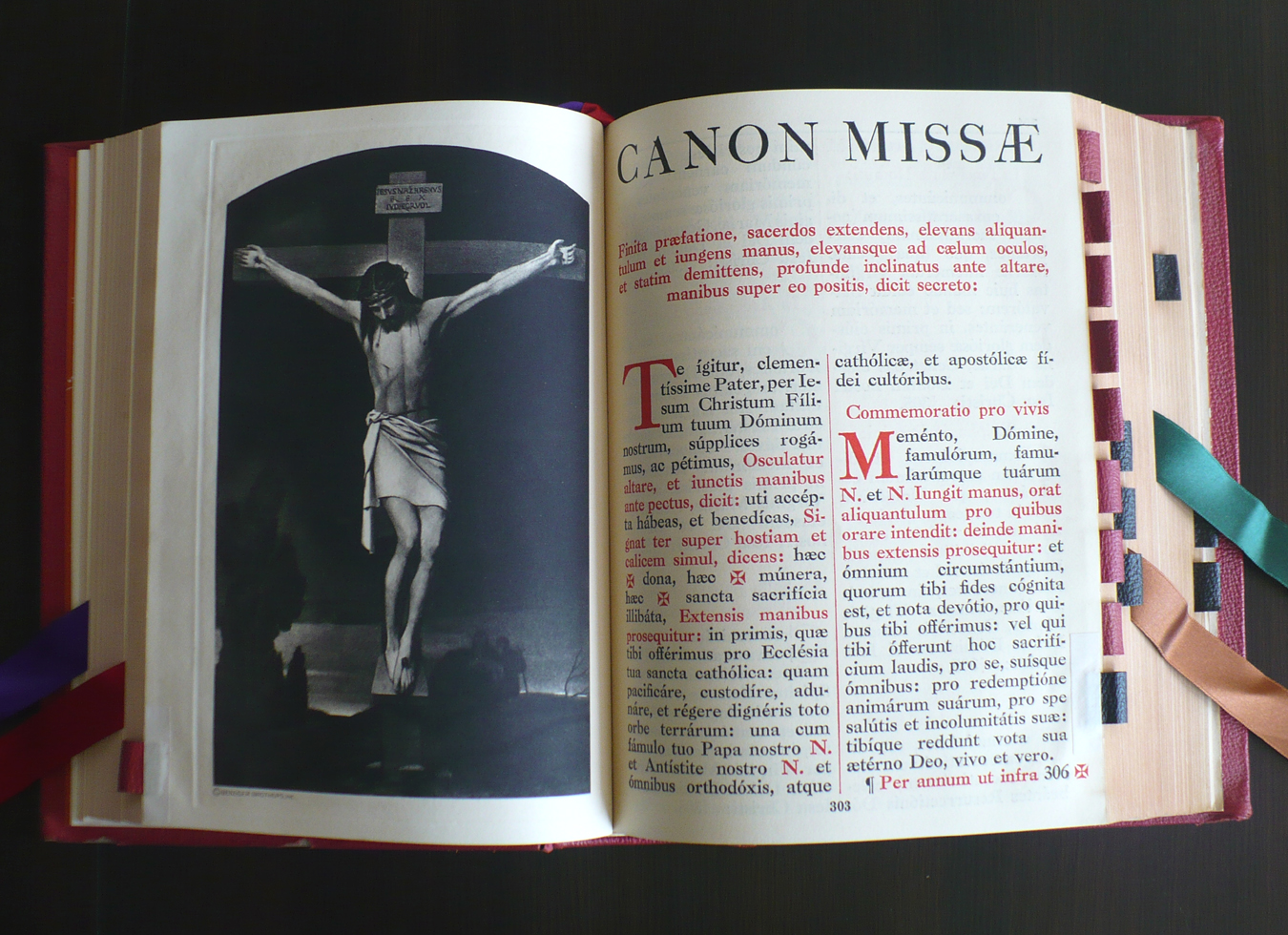
Ecclesiastical Latin constitutes the fixed language of central liturgical texts in the Roman Rite, most notably the Roman Canon, which the Council of Trent in 1563 mandated to remain unaltered from its ancient form to preserve doctrinal integrity and uniformity.[50] This invariance facilitates a singular, worldwide standard for priestly recitation during the Eucharistic Sacrifice, transcending national boundaries and enabling priests from varied linguistic backgrounds to perform the rite identically without translation ambiguities.[51] In sacraments such as baptism, confirmation, and extreme unction, Latin rubrics similarly enforce precise, unchanging formulas that underscore the rite's sacred objectivity over subjective vernacular renderings. Gregorian chant, deeply embedded in these practices, relies on Ecclesiastical Latin's pronunciation to harmonize syllabic stress with melodic phrasing, a tradition whose surviving manuscripts date to the 9th century amid Carolingian reforms.[52] This phonetic approach—featuring softened consonants and vowel qualities distinct from classical norms—supports the chant's free rhythm and unaccompanied solemnity, enhancing the liturgical atmosphere's contemplative depth as opposed to metered vernacular adaptations. Traditionalist analyses maintain that this integration elevates reverence by prioritizing auditory universality and historical continuity over localized musical preferences.[53] The employment of Latin in liturgy has served as a bulwark against interpretive deviations, as its immutable texts resist the doctrinal dilutions possible in vernacular versions prone to cultural reinterpretation or heretical ingress.[54] Proponents highlight its role in maintaining orthopraxy amid potential local variances, though detractors cite diminished accessibility for the faithful, potentially hindering immediate comprehension during rites. Empirical trends reveal higher participation rates pre-conciliar reforms, with U.S. Catholic weekly Mass attendance around 75% in 1958 dropping to approximately 45% by 1972 following vernacular introductions.[55] Economic modeling attributes part of this post-1965 decline—averaging 4 percentage points greater in Catholic-majority nations—to liturgical shifts, contrasting with steadier non-Catholic trajectories.[56]Preservation of Theological Precision
Ecclesiastical Latin's fixed lexicon and syntax provide a stable framework for articulating doctrinal truths, resisting the semantic shifts that vernacular languages undergo over time. Specialized terms, such as transsubstantiatio—coined by Hildebert of Tours around 1079 to denote the substantial conversion in the Eucharist—encapsulate precise metaphysical concepts that vernacular equivalents often fail to convey without loss of nuance.[57] This terminological immutability has preserved orthodoxy by anchoring theological discourse to unchanging formulations, as alterations in translation could introduce relativism or ambiguity in core beliefs like sacramental reality. Post-Vatican II experiences highlight this protective function, where vernacular translations of Latin originals occasionally diluted precision, prompting Vatican interventions to realign interpretations with the source texts. For example, ambiguities in rendering phrases from conciliar documents necessitated decrees emphasizing fidelity to Latin norms, thereby averting doctrinal drift in diverse linguistic contexts.[58] The language's universality ensures causal fidelity in propagating eternal principles, independent of cultural variances, as evidenced by its ongoing mandatory use in promulgating papal encyclicals and official acts via the Acta Apostolicae Sedis.[59][60] Critiques portraying Latin as elitist overlook the clerical education systems of the medieval era, where Latin literacy was a standard requirement for ordination and theological formation, fostering doctrinal uniformity across regions despite lay illiteracy.[61] This widespread proficiency among clergy—sustained through cathedral schools and monastic scriptoria—enabled precise transmission of teachings, countering claims of inaccessibility with empirical patterns of ecclesiastical scholarship.[62]Modern Reforms and Controversies
Vatican II and the Shift to Vernacular
The Second Vatican Council's Sacrosanctum Concilium, promulgated on December 4, 1963, articulated provisions for liturgical reform that retained Latin as the normative language of the Roman Rite while authorizing limited vernacular usage to promote fuller engagement. Article 36.1 mandated preservation of Latin, stating, "Particular law remaining in force, the use of the Latin language is to be preserved in the Latin rites," with vernacular permitted for elements like the liturgy of the word, intercessions, and some chants to aid comprehension and participation. The constitution's core aim was "full and active participation" by the faithful, prioritized above all other liturgical goals, through adaptations that encouraged responses, psalmody, and hymns in the mother tongue where beneficial.[63][63][63] Post-conciliar implementation unfolded from 1964 to 1970, guided by documents such as Inter Oecumenici (September 26, 1964), which expanded vernacular options, and culminating in Pope Paul VI's Missale Romanum (April 3, 1969), which introduced the Novus Ordo Missae effective November 30, 1969. Latin was affirmed as a "noble" medium for unity and universality, suitable for international assemblies, yet in praxis it receded to marginal roles like the Ordinary's chants or occasional invocations, supplanted by approved vernacular translations in routine celebrations. Liturgical analyses confirm that by the 1980s, vernacular dominated ordinary form Masses globally, with Latin's role contracting despite conciliar directives.[64][65][65] Intended to invigorate lay involvement via accessible rites, the shift yielded mixed results: enhanced immediate understanding for diverse congregations contrasted with observable declines in practice, such as U.S. weekly Mass attendance falling from about 75% in the 1950s to 23-29% by the 2010s-2020s. This temporal correlation, amid broader secularization, underscores trade-offs between localized accessibility and Latin's historical contributions to doctrinal precision and ecclesial cohesion across cultures.[66][67]Traditionalist Critiques and Responses
Traditionalist Catholics have critiqued the post-Vatican II shift to vernacular languages in liturgy as contributing to fragmentation and widespread abuses, particularly during the 1970s when experimental implementations led to irreverent practices such as casual alterations to the Mass structure and omissions of prescribed rites.[68][69] These critiques argue that the abandonment of Latin eroded the universal character of the Roman Rite, fostering local variations that diluted doctrinal precision and sacrality, with reports indicating minimal corrective actions against such deviations in the immediate aftermath of the reforms.[70] Proponents of restoring Latin emphasize its role in preserving theological clarity and liturgical unity, as Latin's fixed terminology avoids ambiguities inherent in translating nuanced concepts across languages. In 2007, Pope Benedict XVI issued Summorum Pontificum, which liberalized access to the 1962 Missal, recognizing the older form's spiritual riches and its appeal to those seeking continuity with tradition, thereby allowing priests to celebrate the Traditional Latin Mass (TLM) without prior episcopal permission.[71][72] This motu proprio aimed to reconcile diverse liturgical preferences while highlighting Latin's enduring value, evidenced by subsequent growth in TLM-attached communities like the Priestly Fraternity of St. Peter (FSSP), which reported record-high membership and seminarians by 2023, with ordinations increasing steadily post-2007.[73][74] In response to perceived divisions, Pope Francis promulgated Traditionis Custodes in 2021, restricting TLM celebrations to designated locations under diocesan oversight and requiring episcopal approval for the 1962 Missal, arguing that unrestricted access had been exploited to reject Vatican II's validity and undermine ecclesial unity.[75][76] Official rationale prioritizes vernacular's inclusivity for broader participation, yet traditionalists counter with empirical indicators like higher vocation rates in TLM settings—FSSP seminarians outnumbered diocesan averages in several regions—suggesting Latin fosters deeper reverence and priestly commitment amid declining overall numbers.[77] Progressive viewpoints maintain that vernacular accessibility aligns with conciliar goals of active engagement, though data on post-reform irreverence complaints underscores ongoing tensions between unity and tradition.[78]