


Community hub
Recent from talks
Contribute something to knowledge base
Content stats: 0 posts, 0 articles, 1 media, 0 notes
Members stats: 0 subscribers, 0 contributors, 0 moderators, 0 supporters
Subscribers
Supporters
Contributors
Moderators
Hub AI
Diving mask AI simulator
(@Diving mask_simulator)
Hub AI
Diving mask AI simulator
(@Diving mask_simulator)
Diving mask
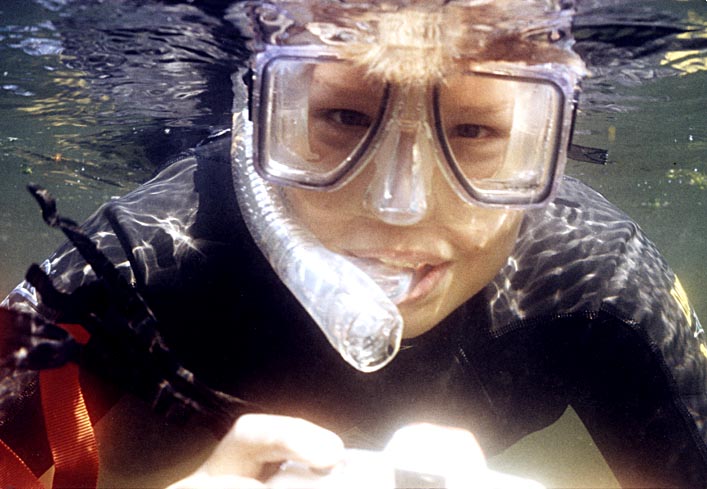
A diving mask (also half mask, free-diving mask, snorkelling mask or scuba mask) is an item of diving equipment that allows underwater divers, including scuba divers, underwater hockey players, underwater rugby players, free-divers, and snorkellers to clearly see underwater. Surface supplied divers usually use a full face mask or diving helmet, but in some systems the half mask may be used. When the human eye is in direct contact with water as opposed to air, its normal environment, light entering the eye is refracted by a different angle and the eye is unable to focus the light on the retina. By providing an air space in front of the eyes, the eye is able to focus nearly normally. The shape of the air space in the mask slightly affects the ability to focus. Corrective lenses can be fitted to the inside surface of the viewport or contact lenses may be worn inside the mask to allow normal vision for people with focusing defects.
When the diver descends, the ambient pressure rises, and it becomes necessary to equalise the pressure inside the mask with the external ambient pressure to avoid the barotrauma known as mask squeeze. This is done by allowing sufficient air to flow out through the nose into the mask to relieve the pressure difference, which requires the nose to be included in the airspace of the mask. Equalisation during ascent is automatic as excess air inside the mask easily leaks out past the seal.
A wide range of viewport shapes and internal volumes are available, and each design will generally fit some shapes of face better than others. A good comfortable fit and a reliable seal around the edges of the rubber skirt is important to the correct function of the mask. National and international standards relating to diving masks provide a means of ensuring that they are manufactured to a suitable quality.
Light rays bend when they travel from one medium to another; the amount of bending is determined by the refractive indices of the two media. If one medium has a particular curved shape, it functions as a lens. The cornea, humours, and crystalline lens of the eye together form a lens system that focuses images on the retina. Our eyes are adapted for viewing in air. Water, however, has approximately the same refractive index as the cornea (both about 1.33), so immersion effectively eliminates the cornea's focusing properties. When our eyes are in water, instead of focusing images on the retina, they now focus them far behind the retina, resulting in an extremely blurred image from hypermetropia.
By wearing a flat diving mask, humans can see clearly under water. The scuba mask's flat window separates the eyes from the surrounding water by a layer of air. Light rays entering from water into the flat parallel window change their direction minimally within the window material itself. But when these rays exit the window into the air space between the flat window and the eye, the refraction is quite noticeable. The view paths refract (bend) in a manner similar to viewing fish kept in an aquarium.
Refraction of light entering the mask makes objects appear about 34% bigger and 25% nearer when underwater. Also, pincushion distortion and lateral chromatic aberration are noticeable. As the diver descends in clean water, the water acts as a colour filter eliminating the red end of the visible spectrum of the sunlight entering the water leaving only the blue end of the spectrum. Depending on the depth and clarity of the water, eventually all sunlight is blocked and the diver has to rely on artificial light sources to see underwater.
There are two basic categories of diving masks: the half mask covers the eyes and nose, and the full face mask covers eyes, nose and mouth, and therefore includes a part of the breathing apparatus. The half-mask is described here.
Diving masks may have a single, durable, tempered glass faceplate, or two lenses in front of the eyes. These may be supported by a relatively rigid plastic or metal frame, or they may be permanently bonded to the rim of the skirt, in a construction known as "frameless". In the case of freediving masks, which need to have a low internal volume to minimize the amount of breath needed to equalize the change of pressure that occurs with depth, the lenses may be made of polycarbonate plastic. The best scuba masks are sealed well. There is usually a "skirt" of synthetic rubber or silicone elastomer to support the frame and lenses and create a watertight seal with the diver's face. The skirt material may be almost transparent, translucent or opaque. A nearly transparent skirt provides a greater peripheral vision, though somewhat distorted, and may reduce the feeling of claustrophobia in some divers, but in some cases the light entering through the sides may cause distracting internal reflections. The skirt also encloses the nose, usually by means of a nose pocket, so that air can be exhaled through the nose into the mask to equalise the internal pressure during descent and thereby avoid possible barotrauma of the enclosed area of the face. The section of the mask covering the nose must allow the wearer to block the nostrils while equalising pressure in the middle ear. All diving masks have means to keep them in position, usually an elastomer strap of similar material to the skirt, but occasionally an expanded neoprene pad with velcro straps is used. Mask straps are usually wider at the back or split into an upper and lower strap at the back of the head for stability and comfort.
Diving mask
A diving mask (also half mask, free-diving mask, snorkelling mask or scuba mask) is an item of diving equipment that allows underwater divers, including scuba divers, underwater hockey players, underwater rugby players, free-divers, and snorkellers to clearly see underwater. Surface supplied divers usually use a full face mask or diving helmet, but in some systems the half mask may be used. When the human eye is in direct contact with water as opposed to air, its normal environment, light entering the eye is refracted by a different angle and the eye is unable to focus the light on the retina. By providing an air space in front of the eyes, the eye is able to focus nearly normally. The shape of the air space in the mask slightly affects the ability to focus. Corrective lenses can be fitted to the inside surface of the viewport or contact lenses may be worn inside the mask to allow normal vision for people with focusing defects.
When the diver descends, the ambient pressure rises, and it becomes necessary to equalise the pressure inside the mask with the external ambient pressure to avoid the barotrauma known as mask squeeze. This is done by allowing sufficient air to flow out through the nose into the mask to relieve the pressure difference, which requires the nose to be included in the airspace of the mask. Equalisation during ascent is automatic as excess air inside the mask easily leaks out past the seal.
A wide range of viewport shapes and internal volumes are available, and each design will generally fit some shapes of face better than others. A good comfortable fit and a reliable seal around the edges of the rubber skirt is important to the correct function of the mask. National and international standards relating to diving masks provide a means of ensuring that they are manufactured to a suitable quality.
Light rays bend when they travel from one medium to another; the amount of bending is determined by the refractive indices of the two media. If one medium has a particular curved shape, it functions as a lens. The cornea, humours, and crystalline lens of the eye together form a lens system that focuses images on the retina. Our eyes are adapted for viewing in air. Water, however, has approximately the same refractive index as the cornea (both about 1.33), so immersion effectively eliminates the cornea's focusing properties. When our eyes are in water, instead of focusing images on the retina, they now focus them far behind the retina, resulting in an extremely blurred image from hypermetropia.
By wearing a flat diving mask, humans can see clearly under water. The scuba mask's flat window separates the eyes from the surrounding water by a layer of air. Light rays entering from water into the flat parallel window change their direction minimally within the window material itself. But when these rays exit the window into the air space between the flat window and the eye, the refraction is quite noticeable. The view paths refract (bend) in a manner similar to viewing fish kept in an aquarium.
Refraction of light entering the mask makes objects appear about 34% bigger and 25% nearer when underwater. Also, pincushion distortion and lateral chromatic aberration are noticeable. As the diver descends in clean water, the water acts as a colour filter eliminating the red end of the visible spectrum of the sunlight entering the water leaving only the blue end of the spectrum. Depending on the depth and clarity of the water, eventually all sunlight is blocked and the diver has to rely on artificial light sources to see underwater.
There are two basic categories of diving masks: the half mask covers the eyes and nose, and the full face mask covers eyes, nose and mouth, and therefore includes a part of the breathing apparatus. The half-mask is described here.
Diving masks may have a single, durable, tempered glass faceplate, or two lenses in front of the eyes. These may be supported by a relatively rigid plastic or metal frame, or they may be permanently bonded to the rim of the skirt, in a construction known as "frameless". In the case of freediving masks, which need to have a low internal volume to minimize the amount of breath needed to equalize the change of pressure that occurs with depth, the lenses may be made of polycarbonate plastic. The best scuba masks are sealed well. There is usually a "skirt" of synthetic rubber or silicone elastomer to support the frame and lenses and create a watertight seal with the diver's face. The skirt material may be almost transparent, translucent or opaque. A nearly transparent skirt provides a greater peripheral vision, though somewhat distorted, and may reduce the feeling of claustrophobia in some divers, but in some cases the light entering through the sides may cause distracting internal reflections. The skirt also encloses the nose, usually by means of a nose pocket, so that air can be exhaled through the nose into the mask to equalise the internal pressure during descent and thereby avoid possible barotrauma of the enclosed area of the face. The section of the mask covering the nose must allow the wearer to block the nostrils while equalising pressure in the middle ear. All diving masks have means to keep them in position, usually an elastomer strap of similar material to the skirt, but occasionally an expanded neoprene pad with velcro straps is used. Mask straps are usually wider at the back or split into an upper and lower strap at the back of the head for stability and comfort.
Recent media
Recent media