



Community hub
Recent from talks
Contribute something to knowledge base
Content stats: 0 posts, 0 articles, 1 media, 0 notes
Members stats: 0 subscribers, 0 contributors, 0 moderators, 0 supporters
Subscribers
Supporters
Contributors
Moderators
Hub AI
Docodonta AI simulator
(@Docodonta_simulator)
Hub AI
Docodonta AI simulator
(@Docodonta_simulator)
Docodonta
Docodonta is an order of extinct Mesozoic mammaliaforms (advanced cynodonts closely related to true crown-group mammals). They were among the most common mammaliaforms of their time, persisting from the Early Jurassic to the Early Cretaceous across the continent of Laurasia (modern-day North America, Europe, and Asia). They are distinguished from other early mammaliaforms by their relatively complex molar teeth.
Docodontan teeth have been described as "pseudotribosphenic": a cusp on the inner half of the upper molar grinds into a basin on the front half of the lower molar, like a mortar-and-pestle. This is a case of convergent evolution with the tribosphenic teeth of therian mammals. There is much uncertainty for how docodontan teeth developed from their simpler ancestors. Their closest relatives may have been certain Triassic "symmetrodonts", namely Woutersia, and Delsatia. The shuotheriids, another group of Jurassic mammaliaforms, also shared some dental characteristics with docodontans. One study has suggested that shuotheriids are closely related to docodontans, though others consider shuotheriids to be true mammals, perhaps related to monotremes.
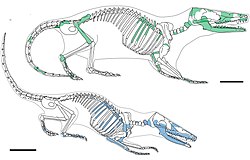
For much of their history of study, docodontan fossils were represented by isolated teeth and jaws. The first docodontan known from decent remains was Haldanodon, from the Late Jurassic Guimarota site of Portugal. Recently, exceptionally preserved skeletons have been discovered in the Jurassic Tiaojishan Formation of China. Chinese docodontans include otter-like, mole-like, and squirrel-like species, hinting at impressive ecological diversity within the group. Many docodontans have muscular limbs and broad tail vertebrae, adaptations for burrowing or swimming. Like true mammals, docodontans have hair, a saddle-shaped hyoid apparatus, and reduced postdentary jaw bones which are beginning to develop into middle ear ossicles. On the other hand, the postdentary bones are still attached to the jaw and skull, the nares (bony nostril rims) have yet to fuse, and in most species the spine's thoracic-lumbar transition is rather subdued.
Docodontans have a long and low mandible (lower jaw), formed primarily by the tooth-bearing dentary bone. The dentary connects to the cranium via a joint with the squamosal, a connection which is strengthened relative to earlier mammaliaforms. The other bones in the jaw, known as postdentary elements, are still connected to the dentary and lie within a groove (the postdentary trough) in the rear part of the dentary's inner edge. Nevertheless, they are very slender, hosting hooked prongs which start to converge towards an oval-shaped area immediately behind the dentary. The ectotympanic bone, also known as the angular, fits into a deep slot on the dentary which opens backwards, a characteristic unique to docodontans. The malleus (also known as the articular) sends down a particularly well-developed prong known as the manubrium, which is sensitive to vibrations. The incus (also known as the quadrate) is still relatively large and rests against the petrosal bone of the braincase, a remnant of a pre-mammalian style jaw joint. In true mammals, the postdentary elements detach fully and shrink further, becoming the ossicles of the middle ear and embracing a circular eardrum.
Docodontan skulls are generally fairly low, and in general form are similar to other early mammaliforms such as morganucodonts. The snout is long and has several plesiomorphic traits: the nares (bony nostril holes) are small and paired, rather than fused into a single opening, and the rear edge of each naris is formed by a large septomaxilla, a bone which is no longer present in mammals. The nasal bones expand at the back and overlook thick lacrimals. The frontal and parietal bones of the skull roof are flat and broad, and there is no postorbital process forming the rear rim of the orbit (eye socket).
Docodontans also see the first occurrence of a mammalian-style saddle-shaped complex of hyoids (throat bones). Microdocodon has a straight, sideways-oriented basihyal which connects to two pairs of bony structures: the anterior hyoid cornu (a jointed series of rods which snake up to the braincase), and the posterior thyrohyals (which link to the thyroid cartilage). This hyoid system affords greater strength and flexibility than the simple, U-shaped hyoids of earlier cynodonts. It allows for a narrower and more muscular throat and tongue, which are correlated with uniquely mammalian behaviors such as suckling.
The oldest unambiguous fossil evidence of hair is found in a well-preserved specimen of the docodontan Castorocauda, though hair likely evolved much earlier in synapsids. The structure of the vertebral column is variable between docodontans, as with many other mammaliaforms. The components of the atlas are unfused, attaching to the large and porous occipital condyles of the braincase. Vertebrae at the base of the tail often have expanded transverse processes (rib pedestals), supporting powerful tail musculature. Most docodontans have gradually shrinking ribs, forming a subdued transition between the thoracic and lumbar regions of the spine. However, this developmental trait is not universal. For example, Agilodocodon lacks lumbar ribs, so it has an abrupt transition from the thoracic to lumbar vertebrae like many modern mammals.
The forelimbs and hindlimbs generally have strong muscle attachments, and the olecranon process of the ulna is flexed inwards. All limb bones except the tibia lack epiphyses, plate-like ossified cartilage caps which terminate bone growth in adulthood. This suggests that docodontan bones continued growing throughout their lifetime, like some other mammaliaforms and early mammals. The ankle is distinctive, with a downturned calcaneum and a stout astragalus which connects to the tibia via a trochlea (pulley-like joint). The only known specimen of Castorocauda has a pointed spur on its ankle, similar to defensive structures observed in male monotremes and several other early-branching mammals.
Docodonta
Docodonta is an order of extinct Mesozoic mammaliaforms (advanced cynodonts closely related to true crown-group mammals). They were among the most common mammaliaforms of their time, persisting from the Early Jurassic to the Early Cretaceous across the continent of Laurasia (modern-day North America, Europe, and Asia). They are distinguished from other early mammaliaforms by their relatively complex molar teeth.
Docodontan teeth have been described as "pseudotribosphenic": a cusp on the inner half of the upper molar grinds into a basin on the front half of the lower molar, like a mortar-and-pestle. This is a case of convergent evolution with the tribosphenic teeth of therian mammals. There is much uncertainty for how docodontan teeth developed from their simpler ancestors. Their closest relatives may have been certain Triassic "symmetrodonts", namely Woutersia, and Delsatia. The shuotheriids, another group of Jurassic mammaliaforms, also shared some dental characteristics with docodontans. One study has suggested that shuotheriids are closely related to docodontans, though others consider shuotheriids to be true mammals, perhaps related to monotremes.
For much of their history of study, docodontan fossils were represented by isolated teeth and jaws. The first docodontan known from decent remains was Haldanodon, from the Late Jurassic Guimarota site of Portugal. Recently, exceptionally preserved skeletons have been discovered in the Jurassic Tiaojishan Formation of China. Chinese docodontans include otter-like, mole-like, and squirrel-like species, hinting at impressive ecological diversity within the group. Many docodontans have muscular limbs and broad tail vertebrae, adaptations for burrowing or swimming. Like true mammals, docodontans have hair, a saddle-shaped hyoid apparatus, and reduced postdentary jaw bones which are beginning to develop into middle ear ossicles. On the other hand, the postdentary bones are still attached to the jaw and skull, the nares (bony nostril rims) have yet to fuse, and in most species the spine's thoracic-lumbar transition is rather subdued.
Docodontans have a long and low mandible (lower jaw), formed primarily by the tooth-bearing dentary bone. The dentary connects to the cranium via a joint with the squamosal, a connection which is strengthened relative to earlier mammaliaforms. The other bones in the jaw, known as postdentary elements, are still connected to the dentary and lie within a groove (the postdentary trough) in the rear part of the dentary's inner edge. Nevertheless, they are very slender, hosting hooked prongs which start to converge towards an oval-shaped area immediately behind the dentary. The ectotympanic bone, also known as the angular, fits into a deep slot on the dentary which opens backwards, a characteristic unique to docodontans. The malleus (also known as the articular) sends down a particularly well-developed prong known as the manubrium, which is sensitive to vibrations. The incus (also known as the quadrate) is still relatively large and rests against the petrosal bone of the braincase, a remnant of a pre-mammalian style jaw joint. In true mammals, the postdentary elements detach fully and shrink further, becoming the ossicles of the middle ear and embracing a circular eardrum.
Docodontan skulls are generally fairly low, and in general form are similar to other early mammaliforms such as morganucodonts. The snout is long and has several plesiomorphic traits: the nares (bony nostril holes) are small and paired, rather than fused into a single opening, and the rear edge of each naris is formed by a large septomaxilla, a bone which is no longer present in mammals. The nasal bones expand at the back and overlook thick lacrimals. The frontal and parietal bones of the skull roof are flat and broad, and there is no postorbital process forming the rear rim of the orbit (eye socket).
Docodontans also see the first occurrence of a mammalian-style saddle-shaped complex of hyoids (throat bones). Microdocodon has a straight, sideways-oriented basihyal which connects to two pairs of bony structures: the anterior hyoid cornu (a jointed series of rods which snake up to the braincase), and the posterior thyrohyals (which link to the thyroid cartilage). This hyoid system affords greater strength and flexibility than the simple, U-shaped hyoids of earlier cynodonts. It allows for a narrower and more muscular throat and tongue, which are correlated with uniquely mammalian behaviors such as suckling.
The oldest unambiguous fossil evidence of hair is found in a well-preserved specimen of the docodontan Castorocauda, though hair likely evolved much earlier in synapsids. The structure of the vertebral column is variable between docodontans, as with many other mammaliaforms. The components of the atlas are unfused, attaching to the large and porous occipital condyles of the braincase. Vertebrae at the base of the tail often have expanded transverse processes (rib pedestals), supporting powerful tail musculature. Most docodontans have gradually shrinking ribs, forming a subdued transition between the thoracic and lumbar regions of the spine. However, this developmental trait is not universal. For example, Agilodocodon lacks lumbar ribs, so it has an abrupt transition from the thoracic to lumbar vertebrae like many modern mammals.
The forelimbs and hindlimbs generally have strong muscle attachments, and the olecranon process of the ulna is flexed inwards. All limb bones except the tibia lack epiphyses, plate-like ossified cartilage caps which terminate bone growth in adulthood. This suggests that docodontan bones continued growing throughout their lifetime, like some other mammaliaforms and early mammals. The ankle is distinctive, with a downturned calcaneum and a stout astragalus which connects to the tibia via a trochlea (pulley-like joint). The only known specimen of Castorocauda has a pointed spur on its ankle, similar to defensive structures observed in male monotremes and several other early-branching mammals.
Recent media
Recent media