Hubbry Logo
NostrilNostrilMain
Open search
Nostril
Community hub
Nostril
logo
8 pages, 0 posts
0 subscribers
Be the first to start a discussion here.
Nostril
Nostril
from Wikipedia
Nostril
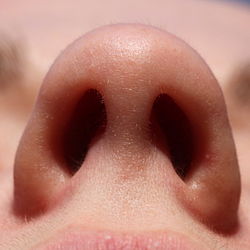
Human nostrils
Details
Part ofNose
SystemOlfactory system
Identifiers
Latinnaris
TA98A06.1.02.002
TA23166
Anatomical terminology

A nostril (or naris /ˈnɛərɪs/, pl.: nares /ˈnɛərz/) is either of the two orifices of the nose. They enable the entry and exit of air and other gasses through the nasal cavities. In birds and mammals, they contain branched bones or cartilages called turbinates, whose function is to warm air on inhalation and remove moisture on exhalation. Fish do not breathe through noses, but they do have two small holes used for smelling, which can also be referred to as nostrils (with the exception of Cyclostomi, which have just one nostril).

In humans, the nasal cycle is the normal ultradian cycle of each nostril's blood vessels becoming engorged in swelling, then shrinking.

The nostrils are separated by the septum. The septum can sometimes be deviated, causing one nostril to appear larger than the other. With extreme damage to the septum and columella, the two nostrils are no longer separated and form a single larger external opening.

Like other tetrapods, humans have two external nostrils (anterior nares) and two additional nostrils at the back of the nasal cavity, inside the head (posterior nares, posterior nasal apertures or choanae). They also connect the nose to the throat (the nasopharynx), aiding in respiration. Though all four nostrils were on the outside of the head of the aquatic ancestors of modern tetrapods, the nostrils for outgoing water (excurrent nostrils) migrated to the inside of the mouth, as evidenced by the discovery of Kenichthys campbelli, a 395-million-year-old fossilized lobe-finned fish which shows this migration in progress. It has two nostrils between its front teeth, similar to human embryos at an early stage. If these fail to join up, the result is a cleft palate.[1]

Each external nostril contains approximately 1,000 strands of nasal hair, which function to filter foreign particles such as pollen and dust.[2]

It is possible for humans to smell different olfactory inputs in the two nostrils and experience a perceptual rivalry akin to that of binocular rivalry when there are two different inputs to the two eyes.[3] Furthermore, scent information from the two nostrils leads to two types of neural activity[4] with the first cycle corresponding to the ipsilateral and the second cycle corresponding to the contralateral odor representations. In some cultures the extreme wide flaring of the nostrils accompanied by the baring of the upper teeth is often referred to as "doing the nostrils."

The Procellariiformes are distinguished from other birds by having tubular extensions of their nostrils.

Widely-spaced nostrils, like those of the hammerhead shark, may be useful in determining the direction of an odour's source.[5][6]

See also

[edit]

References

[edit]
[edit]
Revisions and contributorsEdit on WikipediaRead on Wikipedia
from Grokipedia
The nostrils, also known as the nares, are the paired external openings of the in humans and other vertebrates, located at the base of the and serving as the primary entry points for air into the . They are separated medially by the , a fleshy column formed by the medial crura of the lower lateral nasal cartilages, and bounded laterally by the alae nasi, which are the winged tissues of the . Immediately inside the nostrils lies the nasal vestibule, a dilated region lined with and vibrissae—coarse hairs that help filter out large particles from inhaled air. Anatomically, the nostrils form the anterior nares, or external , which transitions posteriorly into the main at the limen naris, where the changes to respiratory mucosa. The is supported by a combination of superiorly and cartilages inferiorly, including the septal and lower lateral cartilages, which provide flexibility and shape to the nasal tip. Variations in nostril shape and size occur across populations, often influenced by genetic and environmental factors; for instance, narrower nostrils are more common in populations from colder climates to enhance air warming and humidification efficiency. Functionally, the nostrils facilitate the of air, which is then conditioned by the through of dust and pathogens via and cilia, warming to body temperature, and humidification to prevent mucosal drying. They also contribute to olfaction by allowing odorant molecules to reach olfactory receptors in the upper , and their cyclical —known as the —alternates dominance between nostrils every few hours to optimize these processes and maintain mucosal health. In addition to respiration, the nostrils play a role in voice and through their dynamic structure.

Anatomy

External features

The nostrils, also known as the nares (singular: naris), are the paired external openings of the that serve as the primary entry points for air into the . These structures are located at the base of the , inferior to the nasal tip, and are bounded by cartilaginous and components that contribute to the overall external morphology of the . In adults, the nostrils typically exhibit an oval or pear-shaped (teardrop) form, with average dimensions of approximately 1.1 cm in width at the nostril floor and 1.5–2 cm in vertical height, though these measurements can vary based on individual and ethnic background. The lateral margins of each nostril are formed by the alae nasi, wing-like extensions supported by the alar cartilage, which provide structural definition and flexibility to the outer edges. Medially, the nostrils are separated by the columella nasi, the visible external portion of the , consisting of and that creates a central divider between the two openings. The immediate internal extension of the nostrils, known as the nasal vestibule, is lined with resembling skin, which includes vibrissae—coarse nasal hairs that act as a preliminary filter for trapping larger airborne particles such as and . This region also contains sebaceous glands that secrete sebum to lubricate the area and prevent dryness. In humans, the nostrils are oriented slightly inferiorly (downward), a configuration that facilitates efficient entry while helping to reduce the accumulation of environmental debris through gravitational assistance.

Internal anatomy and relations

The internal anatomy of the nostril begins at the external nares, which open into the , a dilated anterior chamber that serves as the initial segment of the . The is bounded laterally by the alar cartilages, medially by the , superiorly by the limen nasi, and inferiorly by the nasal floor, with its walls supported by and containing vibrissae (nasal hairs) for filtration. Lined primarily with keratinized , the vestibule transitions posteriorly to pseudostratified ciliated columnar epithelium at the limen nasi, marking the boundary to the main . A key internal feature is the nasal valve, the narrowest point of the nasal passage located approximately 1-1.5 cm from the nostril, formed by the upper lateral cartilages laterally, the medially, the nasal floor inferiorly, and the anterior head of the inferior turbinate. The limen nasi, a mucosal , delineates the superior limit of the vestibule and the entry to the broader proper. The external shape of the nostril can influence the initial direction of airflow into this internal region. Internally, the nostrils are divided by the , which consists of the anteriorly, the perpendicular plate of the superiorly, and the inferiorly, potentially subject to deviation that narrows one side. The vestibule and adjacent cavity maintain close relations with the nasal conchae (turbinates) on the lateral walls, which project into the cavity to increase surface area; the , which drain via ostia into the meatuses between conchae; and the , which opens into the inferior meatus near the vestibule. Blood supply to the internal nostril structures arises primarily from branches of the , including the (via the ), which supplies the posterior and lateral wall through the , and contributions from the internal carotid via the anterior and posterior ethmoidal arteries for the anterior and superior regions. Sensory innervation is provided by the , with the ophthalmic division (V1) supplying the anterior superior areas via anterior ethmoidal nerves and the maxillary division (V2) innervating the posterior and inferior regions via nasopalatine and posterior superior nasal nerves.

Physiology

Role in respiration

The nostrils function as the primary entry and exit points for air during and in nasal respiration. This anterior nasal region, extending from the nostrils to the nasal valve—a structural narrowing that contributes to overall dynamics—accounts for a substantial portion of total nasal resistance, often estimated at around 50% of nasal impedance. through the nostrils is modulated by the , a physiological process involving alternating congestion and decongestion between the two nostrils, typically occurring every 1 to 6 hours. This cycle is regulated by the , which influences vascular tone in the to shift dominance from one side to the other, optimizing respiratory without conscious control. In addition to directing , the nostrils play a key role in conditioning inhaled air through , warming, and . Coarse vibrissae (nasal hairs) at the nostril entrance, along with the sticky layer, trap particulate matter and pathogens, preventing them from reaching deeper respiratory structures. As air passes through, the warms it to approximately 37°C and increases relative to nearly 100%, ensuring optimal conditions for in the lungs. During increased respiratory demand, such as exercise or cold exposure, the nostrils adapt by dilating through contraction of the alar muscles, which enlarges the nasal and reduces resistance to significantly boost airflow. This response helps maintain adequate ventilation under stress. An important protective mechanism involves the sneezing reflex, which is triggered when irritants contact the sensitive mucosa at the nostril entrance, resulting in a rapid, forceful expulsion of air to clear the pathway.

Role in olfaction

The nostrils serve as the primary entry point for air carrying odorants into the , where these molecules follow a specific pathway to reach the . Inhaled air enters through the nostrils and flows upward, passing through the olfactory cleft—a narrow space above the superior turbinate—before accessing the located in the roof of the . This positioning ensures that odorants are directed toward the specialized sensory region, comprising the superior , superior turbinate, and adjacent area. Sniffing enhances detection by actively dilating the nostrils and generating turbulent during , which increases the capture and delivery of odorants to the . This mechanism boosts odorant uptake flux by creating higher rates, often exceeding 300 ml/s per nostril, compared to quiet , thereby improving sensitivity to low-concentration odors. Nasal hairs (vibrissae) at the nostril entrance aid in initial filtration, preventing larger particles from entering while allowing odorants to proceed. Within the olfactory epithelium, soluble odorants dissolve into the mucus layer covering the cilia of olfactory sensory neurons, enabling them to bind to G-protein-coupled receptors on these neurons. Approximately 6 million olfactory neurons per nostril detect these bound odorants, initiating that conveys olfactory information to the via the . This process allows humans to discriminate over 1 distinct odors, far exceeding earlier estimates of olfactory capacity. The bilateral positioning of the nostrils facilitates stereoscopic olfaction, where slight differences in odorant concentration and timing between the left and right sides enable spatial localization of odor sources. This binasal disparity provides subconscious cues for and source identification, akin to in other sensory systems. Olfaction also interacts with the (cranial nerve V), which innervates the and detects irritants, contributing to sensations of in many odorants. At higher concentrations, odorants can activate trigeminal free nerve endings, eliciting protective responses like sneezing while modulating olfactory perception through cross-talk between the two systems.

Development and variations

Embryological origins

The development of the nostrils begins during the fourth week of human gestation, when olfactory placodes emerge as localized thickenings of the surface on either side of the developing frontonasal prominence. These placodes, derived from the anterior neural ridge and influenced by signaling from the underlying , represent the initial sites of formation. By the fifth week, the olfactory placodes invaginate to form nasal pits, which deepen and separate the surrounding tissue into medial and lateral nasal processes, establishing the foundational structure for the nasal cavities. This process is driven by epithelial-mesenchymal interactions, where neural crest-derived supports the ectodermal folding. The nasal pits continue to deepen into nasal sacs by the sixth week, marking the transition from superficial depressions to internalized structures. During the sixth and seventh weeks, the nasal pits migrate medially as the maxillary processes of the first expand, leading to the fusion of the medial nasal processes with the frontonasal prominence and the underlying maxillary prominences. This fusion event closes the bucconasal groove and forms the and primary palate, while the external nares—the visible nostrils—begin to delineate by the end of the seventh week, initially occluded by temporary epithelial plugs that dissolve around weeks 13-15. The , which partitions the bilateral nasal cavities and defines the definitive nostrils, develops through mesenchymal fusion starting in the sixth week, with precartilaginous condensations in the frontonasal extending inferiorly to meet the palatal shelves. By the eighth week, this fusion completes the cartilaginous , derived primarily from cells, establishing the separated nasal airways. Genetic regulation plays a critical role in these early stages, with genes such as DLX5 and FGF8 essential for placode specification and invagination; DLX5 is expressed broadly in the to activate placode-specific transcription factors, while FGF8 signaling from the frontonasal promotes differentiation and morphogenesis. Disruptions in these processes can lead to , a condition involving failure of the posterior nasal passages to open due to persistent oronasal membrane remnants, occurring in approximately 1 in 5,000 to 8,000 live births.

Anatomical variations across populations and species

Anatomical variations in nostril structure are notably influenced by climatic adaptations across populations, as described by Thomson's nose rule, which proposes that narrower nostrils evolved in cold, dry environments to efficiently warm and humidify inhaled air, whereas broader nostrils developed in warm, humid climates to accommodate higher volumes. This rule, originally formulated by anatomist Arthur Thomson in the late , has been supported by modern 3D imaging studies showing significant correlations between nostril width and environmental (p = 2.37 × 10^{-3}) and absolute humidity (p = 6.97 × 10^{-3}). For instance, populations from warmer equatorial regions, such as those of West African ancestry, exhibit broader nares widths averaging 18.2 mm in females, compared to 15.3 mm in females of Northern European ancestry, reflecting adaptations for enhanced respiratory efficiency in tropical conditions. These differences primarily affect the external features of the nostrils, such as alar base width, providing a baseline for understanding inter-population diversity in nasal dynamics. Among specific ethnic groups, Asian populations display distinct nostril configurations, including a higher tendency for alar flaring and wide nostril floors, which can involve vestibular structures requiring targeted adjustments in surgical contexts, with excisions of 2-7 mm of vestibular floor commonly noted to address flaring. This variation contributes to the overall broader or more flared nostril appearance in East and South Asian individuals compared to European groups, though intermediate to West African widths in some metrics. In across species, nostril orientation and shape diverge significantly to suit ecological niches; for example, in dogs, nostrils are positioned forward on the to optimize detection and tracking during ground-level foraging. integrate their nostrils into the distal end of the trunk, allowing an upward-facing configuration that enables respiration while the head is lowered for feeding or drinking. Cats, by contrast, possess slit-like, vertically oriented nostrils that minimize airflow resistance and maintain a low profile for stealthy hunting. A striking evolutionary modification occurs in cetaceans, where ancestral nostrils have repositioned dorsally to form blowholes on the head's surface, facilitating rapid surfacing breaths in aquatic environments without fully emerging. This adaptation evolved gradually from forward-facing nares in terrestrial ancestors, with mysticetes retaining paired blowholes akin to bilateral nostrils. Among , the inferior orientation of nostrils represents an evolutionary trait aiding arboreal lifestyles, as downward-pointing nares in catarrhines help prevent debris or moisture accumulation during tree-dwelling activities and align with upright postures. This configuration contrasts with more coronal orientations in non-human primates like chimpanzees, highlighting progressive deflection in hominids.

Clinical significance

Associated disorders

Nasal vestibulitis is a localized bacterial of the hair-bearing nasal vestibule, most commonly caused by , leading to symptoms such as , redness, crusting, and swelling at the nostril entrance. This condition arises from factors like , hair plucking, or , and it can progress to furunculosis if untreated, potentially causing more severe complications due to the vascular proximity to the . Epistaxis, or nosebleeds, frequently originates from the anterior nasal vessels within the nostrils, particularly , accounting for approximately 90% of cases. These bleeds are often triggered by local trauma, dry air, or vascular fragility, resulting in unilateral or bilateral bleeding from the nostril, with a lifetime of about 60% in the general . Structural abnormalities affecting the nostrils include deviated , which causes unilateral nostril obstruction by displacing the septum toward one side, mildly impacting up to 80% of individuals without severe symptoms. This deviation often develops from trauma or congenital factors, leading to asymmetric and recurrent infections on the obstructed side. represents a congenital blockage of the posterior nasal apertures (choanae) due to bony or membranous obstruction, resulting from failed embryonic canalization of the nasal passages. It manifests as unilateral purulent discharge and chronic obstruction in milder cases or acute respiratory distress in bilateral forms, with symptoms appearing shortly after birth, thereby affecting overall nasal through the nostrils. Inflammatory conditions like involve IgE-mediated responses to allergens, causing nostril swelling, clear , and itching as an early symptom, affecting 10-30% of the global adult population. This leads to chronic and irritation at the nostril openings, exacerbated by environmental triggers such as or dust mites. Other disorders include nasal polyps, which are benign inflammatory growths of the sinonasal mucosa that can protrude from the nostrils, causing obstruction, reduced smell, and recurrent infections. These often stem from chronic rhinosinusitis or allergies, with larger polyps blocking airflow through the nostrils. Foreign body impaction in the nostrils is common in children, peaking between ages 1 and 3 years, due to exploratory behavior leading to unilateral obstruction, foul discharge, and potential infection if prolonged.

Diagnostic and therapeutic procedures

Diagnostic procedures for nostril-related issues begin with anterior rhinoscopy, a straightforward examination using a nasal speculum to visualize the anterior , including the nostrils and vestibule, allowing identification of visible abnormalities such as or bleeding sources. For more detailed internal assessment, nasal endoscopy employs a thin, flexible inserted through the nostril to examine the nasal passages and sinuses, providing magnified views of structures beyond the initial vestibule. Imaging modalities like computed tomography (CT) scans are utilized to detect structural anomalies, such as deviations or congenital deformities affecting nostril patency, offering three-dimensional visualization of bony and soft tissue elements. Therapeutic approaches for nostril conditions often start with conservative measures; for instance, nasal vestibulitis is typically managed with topical antibiotics like mupirocin ointment applied twice daily for five days to eradicate bacterial infections in the vestibule. Recurrent epistaxis originating from the anterior nostril region responds well to cauterization, with chemical or electrocautery achieving hemostasis in approximately 80-90% of cases, minimizing the need for more invasive interventions. Surgical options address structural issues impacting nostril function; corrects nasal septal deviation through an outpatient procedure performed endonasally, straightening the to improve airflow and reduce obstruction by up to 70% in symptomatic patients. For nostril narrowing or , vestibuloplasty involves reconstructing the nasal vestibule using local flaps or grafts to widen the aperture and restore patency, particularly in cases of post-traumatic or iatrogenic narrowing. Rhinoplasty frequently incorporates nostril refinement via alar base reduction, excising excess tissue at the nostril base to achieve symmetrical, aesthetically pleasing contours, though complications such as occur in 5-10% of cases. Emerging techniques include for removal, which uses precise energy delivery to ablate polyps within the while minimizing intraoperative bleeding and postoperative recovery time compared to traditional excision methods.

References

Add your contribution
Related Hubs
User Avatar
No comments yet.