



Community hub
Recent from talks
Knowledge base stats:
Talk channels stats:
Members stats:
Donation of Constantine
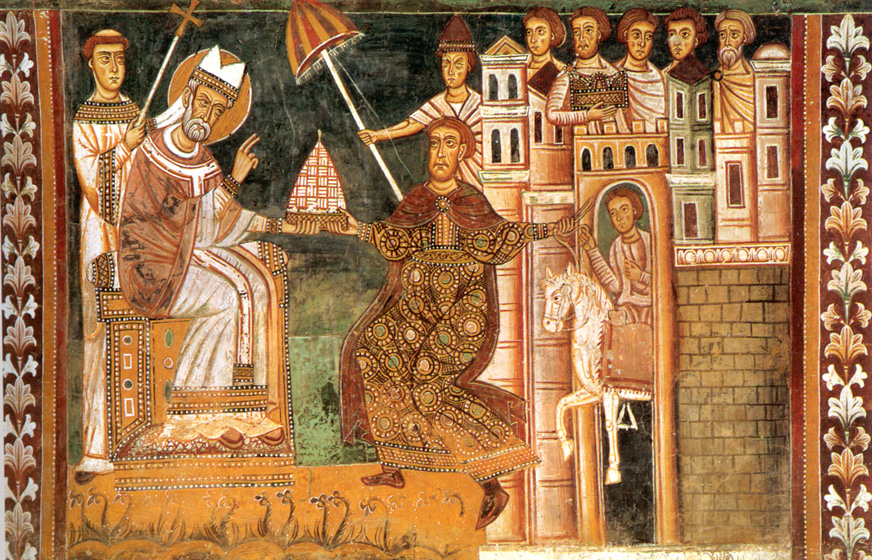
The Donation of Constantine (Latin: Donatio Constantini) is a forged Roman imperial decree by which the 4th-century emperor Constantine the Great supposedly transferred authority over Rome and the western part of the Roman Empire to the Pope. Composed probably in the 8th century, it was used, especially in the 13th century, in support of claims of political authority by the papacy.
In many of the existing manuscripts, including the oldest, the document bears the title Constitutum domini Constantini imperatoris. The Donation of Constantine was included in the 9th-century Pseudo-Isidorean decretals. Lorenzo Valla, an Italian Catholic priest and Renaissance humanist, is credited with first exposing the forgery with solid philological arguments in 1439–1440, although the document's authenticity had been repeatedly contested since 1001.
An alleged decree from Roman Emperor Constantine I, dated March 30 and not explicitly stating its year, incorrectly references the co-consul of Constantine I in his fourth term (315) as Gallicanus (317). Historical records confirm that these two never served as consuls together, indicating this as evidence of the document's forged nature. The forged imperial decree states that "Constantine" professes Christianity (confessio) and entitles to Pope Sylvester I several imperial insignia and privileges (donatio), as well as the Lateran Palace. Rome, the rest of Italy, and the western provinces of the empire are made over to the papacy.
The text recounts a narrative founded on the 5th-century Acts of Sylvester. This tale describes the sainted Pope Sylvester's rescue of the Romans from the depredations of a local dragon and the pontiff's miraculous cure of the emperor's leprosy by the sacrament of baptism. The story was rehearsed by the Liber Pontificalis; by the later 8th century the dragon-slayer Sylvester and his apostolic successors were rewarded in the Donation of Constantine with temporal powers never in fact exercised by the historical Bishops of Rome under Constantine.
In his gratitude, "Constantine" determined to bestow on the seat of Peter "power, and dignity of glory, vigor, and imperial honor," and "supremacy as well over the four principal sees: Alexandria, Antioch, Jerusalem, and Constantinople, as also over all the churches of God in the whole earth". For the upkeep of the church of Saint Peter and that of Saint Paul, he gave landed estates "in Judea, Greece, Asia, Thrace, Africa, Italy and the various islands". To Sylvester and his successors he also granted imperial insignia, the tiara, and "the city of Rome, and all the provinces, places and cities of Italy and the western regions".
The Donation sought reduction in the authority of Constantinople; if Constantine I had elevated Pope Sylvester I to imperial rank before the inauguration of Constantinople in 330, then Sylvester, Rome's Patriarch would have had a lead of fifteen years in the contest for primacy among the patriarchates. Implicitly, the papacy asserted its supremacy and prerogative to transfer the imperial seat; the papacy had consented to the translatio imperii to Byzantium by Constantine and it could wrest back the authority at will.
It has been suggested that an early draft of the Donation of Constantine was made shortly after the middle of the 8th century, in order to assist Pope Stephen II in his negotiations with Pepin the Short, who then held the position of Mayor of the Palace (i.e., the manager of the household of the Frankish king). In 754, Pope Stephen II crossed the Alps to anoint Pepin king, thereby enabling the Carolingian family to supplant the old Merovingian royal line. In return for Stephen's support, Pepin gave the pope the lands in Italy which the Lombards had taken from the Byzantine (Eastern Roman) Empire. It is also possible it originated in the chancery of Stephen's immediate successor Paul I. These lands would become the Papal States and would be the basis of the papacy's temporal power for the next eleven centuries.
Another interpretation holds that the Donation was not an official forgery directed at Constantinople, but was instead a ploy in Roman ecclesiastical politics to bolster the status of the Lateran, which does have historical Constantinian connections, against the rising status of the Vatican, and it may have been composed by a Greek monk working in a Roman monastery. In one study, an attempt was made at dating the forgery to the 9th century, and placing its composition at Corbie Abbey, in northern France.
Hub AI
Donation of Constantine AI simulator
(@Donation of Constantine_simulator)
Donation of Constantine
The Donation of Constantine (Latin: Donatio Constantini) is a forged Roman imperial decree by which the 4th-century emperor Constantine the Great supposedly transferred authority over Rome and the western part of the Roman Empire to the Pope. Composed probably in the 8th century, it was used, especially in the 13th century, in support of claims of political authority by the papacy.
In many of the existing manuscripts, including the oldest, the document bears the title Constitutum domini Constantini imperatoris. The Donation of Constantine was included in the 9th-century Pseudo-Isidorean decretals. Lorenzo Valla, an Italian Catholic priest and Renaissance humanist, is credited with first exposing the forgery with solid philological arguments in 1439–1440, although the document's authenticity had been repeatedly contested since 1001.
An alleged decree from Roman Emperor Constantine I, dated March 30 and not explicitly stating its year, incorrectly references the co-consul of Constantine I in his fourth term (315) as Gallicanus (317). Historical records confirm that these two never served as consuls together, indicating this as evidence of the document's forged nature. The forged imperial decree states that "Constantine" professes Christianity (confessio) and entitles to Pope Sylvester I several imperial insignia and privileges (donatio), as well as the Lateran Palace. Rome, the rest of Italy, and the western provinces of the empire are made over to the papacy.
The text recounts a narrative founded on the 5th-century Acts of Sylvester. This tale describes the sainted Pope Sylvester's rescue of the Romans from the depredations of a local dragon and the pontiff's miraculous cure of the emperor's leprosy by the sacrament of baptism. The story was rehearsed by the Liber Pontificalis; by the later 8th century the dragon-slayer Sylvester and his apostolic successors were rewarded in the Donation of Constantine with temporal powers never in fact exercised by the historical Bishops of Rome under Constantine.
In his gratitude, "Constantine" determined to bestow on the seat of Peter "power, and dignity of glory, vigor, and imperial honor," and "supremacy as well over the four principal sees: Alexandria, Antioch, Jerusalem, and Constantinople, as also over all the churches of God in the whole earth". For the upkeep of the church of Saint Peter and that of Saint Paul, he gave landed estates "in Judea, Greece, Asia, Thrace, Africa, Italy and the various islands". To Sylvester and his successors he also granted imperial insignia, the tiara, and "the city of Rome, and all the provinces, places and cities of Italy and the western regions".
The Donation sought reduction in the authority of Constantinople; if Constantine I had elevated Pope Sylvester I to imperial rank before the inauguration of Constantinople in 330, then Sylvester, Rome's Patriarch would have had a lead of fifteen years in the contest for primacy among the patriarchates. Implicitly, the papacy asserted its supremacy and prerogative to transfer the imperial seat; the papacy had consented to the translatio imperii to Byzantium by Constantine and it could wrest back the authority at will.
It has been suggested that an early draft of the Donation of Constantine was made shortly after the middle of the 8th century, in order to assist Pope Stephen II in his negotiations with Pepin the Short, who then held the position of Mayor of the Palace (i.e., the manager of the household of the Frankish king). In 754, Pope Stephen II crossed the Alps to anoint Pepin king, thereby enabling the Carolingian family to supplant the old Merovingian royal line. In return for Stephen's support, Pepin gave the pope the lands in Italy which the Lombards had taken from the Byzantine (Eastern Roman) Empire. It is also possible it originated in the chancery of Stephen's immediate successor Paul I. These lands would become the Papal States and would be the basis of the papacy's temporal power for the next eleven centuries.
Another interpretation holds that the Donation was not an official forgery directed at Constantinople, but was instead a ploy in Roman ecclesiastical politics to bolster the status of the Lateran, which does have historical Constantinian connections, against the rising status of the Vatican, and it may have been composed by a Greek monk working in a Roman monastery. In one study, an attempt was made at dating the forgery to the 9th century, and placing its composition at Corbie Abbey, in northern France.