Hubbry Logo
DragoneraDragoneraMain
Open search
Dragonera
Community hub
Dragonera
logo
8 pages, 0 posts
0 subscribers
Be the first to start a discussion here.
Dragonera
Dragonera
from Wikipedia

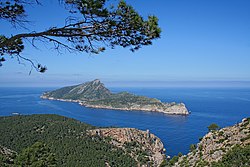
Dragonera (Balearic Catalan: [dɾəɣoˈneɾə]; Spanish: [dɾaɣoˈneɾa]; "Dragon Island"), also called Sa Dragonera, is an uninhabited islet in the Balearic Islands, Spain, located just off the west coast of Majorca. It is currently a natural park, Parc Natural Sa Dragonera.[1]

Key Information

Geography

[edit]

Geologically speaking, Dragonera is an emerged part of the geologic system running southwest-northeast in the Iberian Peninsula. It runs from the Málaga province through Cap de la Nau and then gets submerged under the Mediterranean Sea. It surfaces again to form the island of Ibiza, the Tramuntana Range in the island of Majorca and Sa Dragonera itself. The silhouette of the mountain range vaguely resembles a dragon, hence its name.[2]

Dragonera is approximately 3,200 metres in length and has a maximum width of 500 metres. Although its highest hill Pico Popi is only 360 metres high, the island's overall relief is very abrupt, especially considering its small size, which made the islet of little importance in historic times.

The island is a part of the municipality of Andratx, which is, along with Sant Elm (both in nearby Majorca), the closest towns to the island.

Dragonera has a small natural port in the Cala Lladó area.

History

[edit]

The name of Dragonera comes from Dragon that was associated to the shape that the island has from a specific perspective, and from the large number of endemic Lilford's wall lizards.[3]

There is an Ancient Roman necropolis in the Es Lladó area, but there are no other signs of historical permanent settling.

During the 18th century, two defensive watchtowers were built on the island in order to watch for the numerous Barbary pirates operating in the area.

In 1910 the lighthouses of Tramuntana (north) and Llebeig (southwest) began to operate, replacing the Faro Viejo or old lighthouse, which was built in a lower part of the island, in an area often surrounded by mist.

In 1941 Juan Flexas bought the islet and started farming activities in the Es Lladó area.

By the mid 20th century, the islet was often used by estraperlo smugglers for their illegal activities.

Between 1960 and 1975 the lighthouses were improved and became automatic, which meant that the only permanent and tiny population (that of the lighthouse keeper and family) left the islet.

In 1974 the islet was bought by a Spanish company in order to build a touristic resort. The original plan included a luxury residential, an hotel, a casino and, to serve all these, a manmade port. These plans were heavily contested by the ecologist movements and a harsh and long legal battle followed. The ecologists managed to get all the plans on hold until the legal controversy was cleared. It only finished ten years after, in 1984, when the Audiencia Nacional finally barred any building activities on the uninhabited islet.

Part of the 1982 film adapting Agatha Christie's mystery Evil Under the Sun was shot in Dragonera, presented as an island of the fictional Tyrania by the Adriatic.

Then, in 1987, the Consell Insular de Mallorca bought the islet. In 1995 the Balearic regional Government declared the islet to have natural park status along with the nearby islets of Pantaleu and Isla Mediana.

Dragonera is the island referred to as "Dragon Island" in chapter eight of Patrick O'Brian's historical novel Master and Commander.

[edit]

References

[edit]
[edit]
Revisions and contributorsEdit on WikipediaRead on Wikipedia
from Grokipedia
Sa Dragonera is an uninhabited limestone islet located off the western coast of in the archipelago of , measuring approximately six kilometers in length and featuring steep cliffs rising up to 300 meters. Designated as a natural park in 1995 by the Balearic regional government following its acquisition by the Consell de Mallorca in 1987 to avert commercial development, the island serves as a protected refuge for unique , including over 360 plant species with 18 endemics to the Balearics and such as loggerhead . Its terrestrial fauna highlights the endemic Lilford's wall lizard (Podarcis lilfordi), one of the oldest vertebrate lineages on the islands, alongside breeding colonies of seabirds like and . Access is regulated with mandatory adherence to marked trails, prohibitions on feeding wildlife, fires, and drones to maintain ecological integrity, while a historic at Cap Llebeig offers panoramic views accessible via guided paths.

Geography

Location and Extent

Sa Dragonera lies in the at coordinates approximately 39°34′N 2°20′E, positioned as an uninhabited islet directly west of Majorca's municipality. Geologically, it represents a westward submarine extension of Majorca's , with its southern end at Cap de Llebeig aligning opposite the mainland cape of the same name. The primary islet measures 4.2 km in length and up to 900 m in width, encompassing 2.88 km². Including the adjacent islets of Illot de sa Mitjana and Illot des Pantaleu, the total terrestrial extent of the Sa Dragonera Natural Park reaches 274 hectares. The highest point stands at 353 m above on Puig de Na Pòpia. Sa Dragonera is separated from Majorca by a narrow channel averaging under 1 km wide, with the closest approach near Cap Llebeig at about 700–800 m, and the Cap de Llebeig positioned roughly 700 m offshore.

Topography and

Sa Dragonera consists primarily of and limestones, which form a classic landscape characterized by soluble rock dissolution features such as karren, sinkholes, and an extensive network of caves and crevices. These formations dominate the islet's , contributing to its resistance to rapid erosion while promoting selective karstic sculpturing through rainwater acidity and Mediterranean climatic influences. The minimal soil development over these limestones results from ongoing surface dissolution and limited sediment accumulation, exacerbating the barren, rocky appearance of much of the terrain. The topography is markedly rugged, with the islet extending approximately 4 kilometers in length and reaching a maximum elevation of 352 meters at Puig des Far. Steep marine cliffs, plunging vertically up to 350 meters on the western and northern coasts, define the dramatic silhouette, while the eastern side features gentler slopes descending to small coves like Cala Lladó. The northern ridge hosts defensive structures such as Torre de Llebeig, constructed in 1786 atop the karstic heights, underscoring the elevated, exposed nature of this spine. Erosion patterns are dominated by subaerial processes and coastal wave action, producing notches, hollows, and littoral caves without significant due to the coherent bedding. The Balearic region, including Sa Dragonera, exhibits low tectonic activity, with seismic events typically below magnitude 3.0, fostering long-term geomorphic stability and preservation of these features over millennia.

Climate and Hydrology

Sa Dragonera exhibits a typical , with mild winters and hot, dry summers. Average monthly temperatures range from lows of approximately 5°C in to highs of 30°C in , based on data from 1991–2020, reflecting a warming trend of up to 1.6°C in summer highs compared to 1961–1990 baselines. Annual mean temperatures hover around 18°C, moderated by the surrounding , which influences local microclimates through persistent sea breezes and currents that prevent extreme temperature fluctuations. Precipitation is modest, averaging 400–500 mm annually, with the majority concentrated in the autumn months of to November; records the highest monthly totals at about 70 mm, while sees minimal rainfall around 7 mm. This pattern aligns with broader trends, where high inter-annual variability leads to frequent dry spells. Data from nearby stations, such as those near Palma, confirm similar distributions, with total yearly rainfall often falling below 470 mm in coastal areas. Hydrologically, the islet lacks permanent freshwater sources such as rivers or lakes, owing to its small size (about 1.14 km²) and karstic geology that promotes rapid infiltration rather than . Water availability depends on episodic rainfall infiltrating shallow soils and aquifers, supplemented by occasional formation in cooler nights, though quantitative reliance on dew remains undocumented locally. Post-2000 trends indicate increasing severity, with severe drought months rising from 25 (1961–1990) to 33 (1986–2015), exacerbated by reduced in key wet months and prolonged dry sequences up to 13 months; recent events, including the driest June since 1961 in 2025, have prompted regional alerts. Marine hydrology is shaped by Balearic currents driving coastal and wave patterns, which indirectly affect and nutrient inflows but do not provide direct freshwater.

Ecology and Biodiversity

Flora and Vegetation

The vegetation of Sa Dragonera is characterized by drought-adapted Mediterranean shrublands, including maquis and formations dominated by sclerophyllous species resilient to , poor soils, and periodic fires. These communities feature low, dense shrubs such as (mastic tree), Rosmarinus officinalis (rosemary), and (French lavender), which thrive in the island's xeric conditions with annual precipitation below 400 mm and strong insolation. Botanical inventories record at least 481 vascular plant species across the 274-hectare archipelago, reflecting a flora shaped by isolation and historical disturbances rather than exceptional richness for the region. Of these, 23 species are endemic to the Balearic Islands, including rare taxa confined to coastal cliffs and rocky outcrops. Plant zonation progresses from saline-tolerant halophytes like Tamarix africana (African tamarisk) along exposed shorelines, where salt spray and substrate instability favor prostrate growth forms, to interior garigues on higher elevations dominated by thymes (Thymus) and rockroses (Cistus). Historical by introduced , documented from Roman times through the mid-20th century, suppressed woody regeneration and favored herbaceous opportunists, resulting in patchy cover and reduced density observed in pre-protection surveys. Eradication of herbivores since the park's establishment in has enabled encroachment and post-disturbance recovery, with denser maquis recolonizing former pastures as evidenced by aerial imagery and plot-based monitoring showing increased canopy closure over decades. Fire-prone species like mastic exhibit resprouting capabilities, contributing to transient dynamics in this low-biomass .

Fauna and Wildlife

The islet of Sa Dragonera hosts a high density of the endemic subspecies Podarcis lilfordi gigliolii, a wall lizard adapted to insular conditions, with population densities reaching up to 8,000 individuals per hectare in optimal habitats across Balearic islet populations, though averages around 1,500 per hectare. This subspecies exhibits behavioral adaptations such as reduced territoriality due to overcrowding, promoting communal basking and foraging on invertebrates and vegetation. No native terrestrial mammals beyond bats occur, attributable to the islet's small size (approximately 278 hectares) and historical isolation, which limited colonization by larger species; introduced rats (Rattus rattus) were eradicated in 2012 to restore native fauna. Sa Dragonera supports breeding colonies of seabirds, including (Falco eleonorae), which forms concentrated populations on the cliffs, preying on migratory passerines during the autumn migration. Audouin's gulls (Ichthyaetus audouinii) also nest here, contributing to the site's role in Mediterranean seabird conservation. The islet serves as a key stopover for raptors and passerines, with nocturnal migration monitoring documenting significant passages, facilitated by its position in the western Mediterranean . Surrounding waters feature Posidonia oceanica seagrass meadows extending southward, providing habitat for over 50 fish species, including juveniles using the meadows as nurseries, and cephalopods that forage among the rhizomes. These ecosystems support diverse and , with the meadows' structural complexity enhancing despite regional pressures.

Conservation Status and Efforts

Sa Dragonera was declared a Natural Park by the Government of the on January 26, 1995, encompassing approximately 908 hectares, including the main island, the islets of Pantaleu and Sa Mitjana, and surrounding marine areas up to 1 offshore. The site is also designated as a Special Area of Conservation (LIC) and Special Protection Area for Birds (ZEPA) under code ES0000221, prioritizing the protection of endemic flora, seabird colonies such as the vulnerable Balearic shearwater (Puffinus mauretanicus), and coastal habitats. Conservation efforts have focused on invasive species removal to restore native ecosystems, with feral goats (Capra hircus) eradicated in 1975 after decades of that suppressed regeneration. Black rats (Rattus rattus) and house mice (Mus musculus), which preyed on eggs and chicks, were targeted through aerial broadcasting of in 2012, following unsuccessful ground-based controls; post-eradication monitoring confirmed near-total elimination, enabling recovery in breeding success and cover. The Consell de oversees ongoing monitoring, including annual censuses and of primary productivity, which has shown increased density and synchronicity with nearby rat-free sites since rat removal, indicating ecosystem stabilization without large herbivores. In 2025, marking the 30th anniversary of the park's designation, the Consell de Mallorca and regional authorities initiated enhanced habitat restoration and public awareness campaigns, including educational workshops on impacts and EU-funded projects for mapping around the island. These build on prior interventions, such as the 2015 marine reserve declaration process, to sustain measurable gains in metrics like shrub cover expansion observed via .

Human History

Prehistoric and Ancient Use

The earliest evidence of human activity on Sa Dragonera pertains to the Talayotic culture, a society indigenous to the that flourished from roughly the 13th to the 5th century BCE. Archaeological remains from this period, including structures and artifacts indicative of settlement or resource use, have been identified at Cala Lledó, the islet's sheltered natural harbor on its eastern coast. These constitute the oldest confirmed traces of occupation, reflecting adaptation to the island's coastal features for maritime or subsistence purposes amid a regional pattern of talayot tower construction and communal sites. No verified artifacts or megalithic features, such as those associated with earlier Balearic migrations around 3000–2000 BCE, have been documented on Sa Dragonera, likely attributable to the islet's small size, exposure to erosion, and restricted excavation efforts compared to mainland . During the Phoenician and Punic eras (circa 6th–2nd century BCE), Sa Dragonera's proximity to major trade routes suggests transient maritime utilization, potentially as a navigational or temporary anchorage, though no sherds, watchposts, or other direct artifacts from these cultures have been recovered on the itself—unlike adjacent coastal sites on . Roman influence (from the 2nd century BCE onward) appears similarly negligible, with no confirmed villas, ports, or epigraphic evidence; the islet's role, if any, was probably limited to ad hoc signaling or refuge along imperial sea lanes, as broader Balearic archaeology emphasizes mainland and settlements over peripheral islets. This paucity of finds underscores Sa Dragonera's marginal habitability and preservation challenges for ancient material culture.

Medieval and Maritime Era

Following the by in 1229–1231, during which Sa Dragonera served as a strategic staging base for the invading forces, the islet fell under the control of the Crown of Aragon. This integration aligned the island with broader Aragonese maritime defenses in the western Mediterranean, where its position off Majorca's coast facilitated navigational oversight amid ongoing threats from North African raiders. By the 14th century, Sa Dragonera functioned as a signal station to counter Barbary corsair incursions, with a documented lookout post established at Na Pòpia in 1342 for early warning of pirate approaches. Persistent raids through the 16th–18th centuries exploited the island's sheltered coves as refuges for corsairs, who used them to ambush shipping routes; in response, vigilance structures proliferated, including the Na Pòpia watchtower erected in 1581 and the Llebeig watchtower in 1585, enabling beacon signals to alert coastal garrisons on Majorca. These defenses underscored the islet's role in a decentralized network of coastal fortifications against Ottoman-backed privateers, whose activities peaked in the 16th century with documented attacks on Balearic waters. Economic exploitation remained peripheral, centered on seasonal fishing outposts and limited resource extraction such as charcoal production and lime quarrying via rudimentary kilns, supporting minor maritime provisioning without permanent settlements. for raptors and rudimentary crafts like basketry supplemented these activities, as evidenced by archaeological traces of ceramics and tools, though the island's isolation precluded large-scale operations.

Modern Protection and Events

In 1977, nearly 50 environmental activists from groups such as Terra i Llibertat and Talaiot Corcat occupied Sa Dragonera for several days to protest planned urbanization, including hotel construction, which threatened the island's ecosystems. This action marked a pivotal moment in local conservation efforts, generating widespread awareness and pressuring authorities to intervene against private development schemes. The occupation catalyzed policy responses, culminating in the Consell Insular de Mallorca's purchase of the island in 1987 for 280 million pesetas from private owners like Pamesa, which halted imminent commercialization. In 1995, the Balearic Government formally declared Sa Dragonera a natural park, encompassing 274 hectares of land and adjacent marine zones, thereby establishing legal barriers to and prioritizing preservation. Subsequent marine protections addressed overfishing pressures; monitoring of commercial in associated marine areas began around 2000, with the formal establishment of the Sa Dragonera Island Marine Reserve in 2020 to enforce stricter no-take zones and sustainable practices. In 2025, the park's 30th anniversary was observed on January 26 through commemorative events underscoring activist legacies, while organized open-water swims, including Neda el Món's 9.5K challenge near the island, highlighted ongoing public engagement with its protected waters.

Tourism and Economy

Access and Visitor Facilities

Access to Sa Dragonera Natural Park is exclusively by sea, with no land connections to . Regular ferry services operate from Sant Elm, a short 15-minute crossing, as well as from Port d'Andratx, , and Peguera, with trips from the latter ports taking approximately 20-30 minutes. Ferries run daily during the high season (May to October), with departures from Sant Elm at least hourly, adhering to park visiting hours of 10:00 a.m. to 6:00 p.m. on weekends and holidays, and adjusted times on weekdays. Private boat landings are prohibited at key sites like Cala Lladó to minimize environmental impact, requiring visitors to use authorized passenger ferries. Upon arrival at the designated dock in Cala Lladó, park rangers provide a mandatory briefing on regulations, including staying on marked . Basic on-site facilities include informational signage and access to four signposted paths originating from the landing area, such as the medium-difficulty to Far Vell , measuring about 4.55 km round-trip. Visitor numbers are capped at 200 individuals simultaneously to preserve the site's , enforced through ticketed quotas. For yachts and private vessels, mooring is regulated within the surrounding marine reserve, where anchoring is permitted in designated zones near Sant Elm but prohibited in protected coastal areas without permits; professional oversight ensures compliance with artisanal fishing and nautical activity restrictions. Access for such craft focuses on observation from , without disembarkation privileges extended to passengers.

Activities and Recreation

Hiking serves as the foremost low-impact activity on Sa Dragonera, with four marked self-guided trails accommodating varying levels of exertion and leading to key sites such as the Na Miranda viewpoint, Far de Tramuntana lighthouse, Far Vell lighthouse, and Far de Llebeig lighthouse. These paths, totaling several kilometers, traverse the islet's calcareous terrain and cliffs, offering opportunities for wildlife observation including the endemic Balearic wall lizard (Podarcis lilfordi) and seabirds. integrates seamlessly with , peaking from spring to autumn when species like the (Ichthyaetus audouinii), Balearic shearwater (Puffinus mauretanicus), and peregrine falcon (Falco peregrinus) are most active along coastal routes. Visitors must adhere to trails for safety amid steep drops and uneven ground, with no other land-based sports permitted to preserve the habitat. Snorkeling and scuba diving attract enthusiasts to the clear waters encircling the islets, where Posidonia oceanica seagrass meadows sustain rich marine life including groupers, octopuses, and rays, with visibility often exceeding 10 meters in coves like Cala Lladó. Activities occur within the marine reserve's zones, allowing access island-wide but restricting operations in high-protection areas to prevent habitat disruption; divers must use designated entry points and avoid contact with seagrass. Empirical data indicate these pursuits draw a portion of the park's approximately 37,000 annual visitors as of 2022, underscoring the emphasis on guided or equipped sessions to mitigate risks like currents and depth variations. Boat excursions from Majorcan ports such as Sant Elm or Port d'Andratx facilitate access for most participants, typically lasting 15-30 minutes one-way and incorporating 1-2 hour island stops for combined or . Operators enforce protocols against anchoring on beds—requiring mooring buoys, sandy bottoms, or depths over 30 meters—to avert chain drag damage, aligning with Balearic-wide protections for the . These trips prioritize , with daily visitor caps aiding in dispersing foot traffic and reducing overcrowding during peak summer months.

Economic Impacts and Management

The Parc Natural de sa Dragonera generates indirect economic benefits for the municipality primarily through ferry operations from Port d'Andratx and associated services, including seasonal guiding and hospitality, though comprehensive revenue quantification remains limited in public records. These activities support local employment, estimated in broader Balearic natural park contexts at dozens to low hundreds of seasonal positions, but specific job data for sa Dragonera are not delineated. Management of the park is financed by the Consell de Mallorca, with the 2023 budget reaching €1,129,000—a 77% increase from prior allocations—to cover conservation, surveillance, habitat restoration, and visitor infrastructure maintenance. Earlier budgets, such as €424,000 in 2021, funded similar operations including interpretive centers and trail upkeep, reflecting escalating costs for ecological oversight amid rising regional pressures. Enforcement mechanisms include fines for infractions like illegal anchoring in the adjacent Freu de sa Dragonera marine reserve, where violations damaging protected seagrass () can incur penalties up to €3,000, aiding cost recovery and deterrence. Balancing these preservation expenditures against tourism gains involves trade-offs, as regulated access—limited to boat arrivals without overnight stays—curbs direct revenue while mitigating . Foot traffic on trails poses erosion risks to fragile soils and endemic vegetation, prompting ongoing monitoring and path reinforcements funded within the ; unchecked increases could amplify these hazards without proportional economic uplift, given the park's emphasis on low-impact visitation over mass . Debates persist on potential cap expansions to enhance local income, weighed against heightened operational costs and ecological strain, though official policy prioritizes sustainability over growth.

Controversies and Debates

Development Proposals and Protests

In the and , private developers, including a , proposed transforming Sa Dragonera into a high-end tourist featuring hotels and a sports harbor, aiming to capitalize on the Balearic Islands' growing mass tourism boom. These plans envisioned extensive construction on the uninhabited islet, which proponents argued would generate employment and infrastructure in the underdeveloped region, where local economies relied heavily on agriculture and fishing with limited diversification. Opponents, including environmental groups, countered that such development would irreversibly damage the island's pristine habitats, citing its role as a refuge for endemic species like the Balearic wall lizard (Podarcis lilfordi) and seabirds, with no comparable compensatory sites available. The pivotal resistance occurred on July 7, 1977, when approximately 50 activists from the nascent Mallorcan , organized by groups like Grup Balear d'Ornitologia, occupied Sa Dragonera for several days in a non-violent to block the projects. This action, one of the first major post-Franco protests against coastal exploitation in , drew media attention and public support by emphasizing the ecological irreplaceability of the 3.1 km² islet, which featured unique Mediterranean and cliffs supporting rare and vulnerable to . The occupation pressured authorities to intervene; following negotiations, the proposals were shelved, and the Balearic government acquired the privately held island in subsequent years to prevent further commercialization, marking an early victory for conservation over unchecked expansion. After Sa Dragonera's designation as a natural in , which legally barred permanent structures, sporadic revival attempts surfaced in the amid broader Balearic debates on "sustainable" models. Advocates for limited eco-lodges or low-impact facilities argued they could retain more revenue locally—reducing "leakage" where day-trip operators from mainland capture most visitor spending—while creating year-round jobs in eco-guiding and maintenance, potentially numbering in the dozens without exceeding park carrying capacities. Conservationists rebutted with evidence from analogous Balearic developments, such as coastal on nearby islets, which correlated with up to 50% declines in endemic species populations due to loss, introduction, and increased human disturbance. These proposals were ultimately rejected by regional authorities, prioritizing preservation amid rising pressures elsewhere in the , though they underscored ongoing tensions between economic imperatives and safeguards.

Environmental Management Challenges

Feral goats, introduced historically, severely overgrazed Sa Dragonera's vegetation prior to their eradication in the mid-1970s, resulting in denuded slopes and significant that persisted into the late . This overgrazing mimicked the role of extinct endemic species like the cave goat but at detrimental intensities, altering ecosystem dynamics for millennia until removal efforts restored balance. Black rats (Rattus rattus), house mice, and rabbits posed ongoing threats through predation on seabirds and native flora until a successful single-day aerial broadcast in eradicated them across the island—the largest such operation in the Mediterranean to date. Post-eradication monitoring via camera traps and tracking tunnels confirmed absence, with data showing enhanced vegetation productivity and recovery by 2021, though dense regrowth has raised concerns for certain habitat-dependent species. Prior control efforts achieved variable densities reductions, but full eradication exceeded 95% efficacy in eliminating populations without reintroduction. Climate change exacerbates vulnerabilities, with Mediterranean sea-level rise—averaging 3-4 mm annually—encroaching on seagrass meadows surrounding the island, fragmenting critical marine essential for . Prolonged droughts and warming temperatures further stress endemic Lilford's wall lizards (Podarcis lilfordi), restricting activity periods and elevating risks through reduced thermal tolerances and habitat suitability. The Sa Dragonera Blava project, launched in the early 2020s by Save the Med Foundation, coordinates community-driven monitoring and regeneration efforts for both terrestrial and marine ecosystems, emphasizing enforcement and biodiversity restoration amid these pressures. Debates persist over balancing caps—enforced to limit and disturbance—with revenue generation for conservation, as visitor influxes strain fragile trails and nesting sites. Illegal , including unreported near protected waters, undermines , with regional reports documenting violations that evade fines and deplete , necessitating enhanced patrols despite limited data on Dragonera-specific incidents exceeding 10 annually.

References

Add your contribution
Related Hubs
User Avatar
No comments yet.