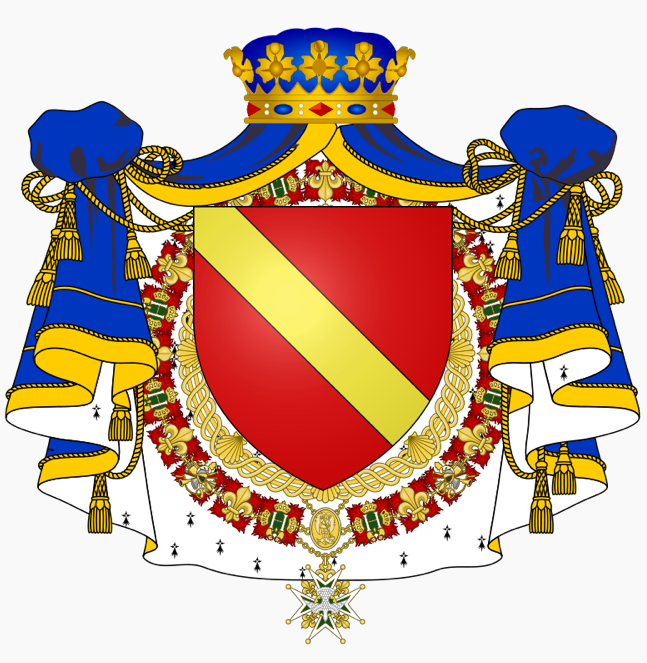

Duke of Noailles
View on WikipediaThe title of Duke of Noailles is a French peerage created in 1663 for Anne de Noailles, Count of Ayen.
Key Information


History
[edit]Noailles is the name of a prominent French noble family, derived from the castle of Noailles in the territory of Ayen, between Brive and Turenne in Limousin, and claiming to date back to the 11th century. The family did not obtain fame until the 16th century, when its head, Antoine de Noailles (1504–1562), became admiral of France and was ambassador in England during three important years (1553–1556), maintaining a gallant but unsuccessful rivalry with the Spanish ambassador, Simon Renard. Henri de Noailles (1554–1623), son of Antoine, was a commander in the religious wars and was made comte d'Ayen by Henry IV of France in 1593.[1]
Anne de Noailles (died 1678), the grandson of the first count, played an important part in the Fronde and the early years of the reign of Louis XIV, became captain-general of the newly won province of Roussillon, and in 1663 was made Duke of Noailles and a peer of France.[2]
The sons of the first duke raised the family to its greatest fame. The eldest son, Anne Jules de Noailles (1650–1708), was one of the chief generals of France towards the end of the reign of Louis XIV. After raising the regiment of Noailles in 1689, he commanded in Spain during the War of the Spanish Succession and was made Marshal of France in 1693. A younger son, Louis Antoine de Noailles (1651–1729), was in 1695 made archbishop of Paris and hence also Duke of Saint-Cloud and peer of France in his own right, holding these high dignities until his death; he was made a cardinal in 1699.[3]
The name of Noailles continued to be prominent throughout the 18th century. Adrien Maurice (1678–1766), the third duke, served in all the most important wars of the reign of Louis XV in Italy and Germany, and became a marshal in 1734. His last command was in the War of the Austrian Succession, when he was beaten by the English at the battle of Dettingen in 1743. He married Françoise Charlotte d'Aubigné, a niece of Madame de Maintenon, and two of his sons also attained the rank of Marshal of France.[3]
The elder son of Adrien Maurice, Louis (1713–1793), who bore the title of "duc d'Ayen" (title created in 1737 and since then used for the heir apparent of the Duke of Noailles) until his father's death in 1766, when he became Duke of Noailles, served in most of the wars of the 18th century without particular distinction, but was nevertheless made a marshal in 1775. He refused to emigrate during the Revolution, but escaped the guillotine by dying in August 1793, before the Terror reached its height. On the 4th Thermidor (July 22), the aged duchesse de Noailles was executed with her daughter-in-law, the duchesse d'Ayen, and her granddaughter, the vicomtesse de Noailles.[3] His younger brother, Philippe (1715–1794), comte de Noailles, afterwards Duke of Mouchy, was a more distinguished soldier than his brother.[3]
Jean Paul François (1739–1824), the fifth duke, was in the army, but his tastes were scientific, and for his eminence as a chemist he was elected a member of the Academy of Sciences in 1777. He became Duke of Ayen in 1766 on his grandfather's death, and Duke of Noailles on his father's in 1793. Having emigrated in 1792, he lived in Switzerland until the Restoration in 1814, when he took his seat as a peer of France.[3]
He had no son, and was succeeded as Duke of Noailles by his grand-nephew, Paul (1802–1885), who won some reputation as an author and who became a member of the French Academy in the place of Chateaubriand in 1849. The grandfather of Paul de Noailles, and brother of the fifth duke, Emmanuel Marie Louis (1743–1822), marquis de Noailles, was ambassador at Amsterdam from 1770 to 1776, at London from 1776 to 1783, and at Vienna from 1783 to 1792.[3]
Dukes of Noailles (1663)
[edit]| No. | From | To | Portrait | Duke of Noailles | Notes |
|---|---|---|---|---|---|
| 1 | 1663 | 1678 | 
|
Anne | Also Count of Ayen |
| 2 | 1678 | 1708 | 
|
Anne Jules | Also Marshal of France |
| 3 | 1708 | 1766 | 
|
Adrian Maurice | Also Marshal of France; married Françoise Charlotte d'Aubigné, niece of Madame de Maintenon. |
| 4 | 1766 | 1793 | ,_Marshal_of_France,_(%C3%89cole_Fran%C3%A7aise).jpg)
|
Louis | Also Marshal of France |
| 5 | 1793 | 1824 | John Louis | ||
| 6 | 1824 | 1885 | 
|
Paul | |
| 7 | 1885 | 1895 | Jules Charles | ||
| 8 | 1895 | 1953 | Adrian Maurice | ||
| 9 | 1953 | 2009 | Francis Agenor | ||
| 10 | 2009 | present | Hélie Marie Auguste Jacques Bertrand Philippe |
Other notable family members
[edit]
- Antoine, 1st comte de Noailles (1504–1562), admiral of France
- Henri de Noailles (1554–1623)
- Louis-Antoine, Cardinal de Noailles (1651–1720), archbishop of Paris
- Philippe de Noailles, duc de Mouchy (1715–1794), Marshal of France, younger brother of Louis, 4th duc de Noailles and father of Louis-Marie, vicomte de Noailles and Philippe-Louis-Marc-Antoine de Noailles, 1st Duke of Mouchy
- Emmanuel-Marie-Louis, marquis de Noailles (1743–1822)
- Philippe-Louis-Marc-Antoine de Noailles, 1st duc de Mouchy (1752–1819)
- Louis-Marie, vicomte de Noailles (1756–1804), soldier and politician
- Marie Adrienne Françoise de Noailles (1759–1807), wife of Gilbert du Motier, marquis de Lafayette
- Emmanuel-Henri-Victurnien, marquis de Noailles (1830–1909), diplomat
- Anna de Noailles (1876–1933), writer, poet, and figure in Parisian high society. Wife of a son of the 7th Duke of Noailles.
- Charles de Noailles (1891–1981), son of the 10th Prince of Poix, and his wife Marie-Laure de Noailles (born Marie-Laure Henriette Anne Bischoffsheim; 1902–1970), patrons of the arts.
See also
[edit]- Dukes of Mouchy (the cadet branch)
Notes
[edit]- ^ Chisholm 1911, p. 722.
- ^ Chisholm 1911, pp. 722–723.
- ^ a b c d e f Chisholm 1911, p. 723.
References
[edit]Attribution:
- This article incorporates text from a publication now in the public domain: Chisholm, Hugh, ed. (1911). "Noailles". Encyclopædia Britannica. Vol. 19 (11th ed.). Cambridge University Press. pp. 722–723.

this template shows the Dukes of Noailles but not all male line descendants | |||||||||||
|  | ||||||||||
|
| |||||||||||
| |||||||||||
| |||||||||||
| |||||||||||
| |||||||||||
| |||||||||||
| |||||||||||
| |||||||||||
Duke of Noailles
View on GrokipediaOrigins and Early History
Rise of the Noailles Family in the 16th Century
The Noailles family, deriving its name from the castle of Noailles in the Limousin region (present-day Corrèze), traced its noble lineage to at least the 13th century but maintained a primarily provincial status among the regional nobility until the mid-16th century. The family's early prominence was limited to local landholdings and minor feudal roles, with limited integration into the central royal court or high military commands under the Valois kings prior to the reign of Henry II (1547–1559).[10] The ascent began with Antoine de Noailles (1504–1562), one of 19 siblings from a Limousin branch, who leveraged military service and diplomacy to secure elevated offices. Under Henry II, Antoine advanced in the French navy, earning appointment as Admiral of France around 1547 amid ongoing conflicts in the Italian Wars against Habsburg forces.[8] His diplomatic career peaked as ambassador to England from April 1553 to June 1556, where he navigated intrigues during the reigns of Edward VI, Mary I, and early Elizabeth I, including efforts to counter Anglo-Habsburg alliances and support French interests in Scotland.[11] These roles culminated in his ennoblement as the 1st Comte de Noailles, granting the family hereditary status and access to royal patronage networks, which facilitated acquisitions of lands in Guienne and proximity to court circles. Antoine's brother, François de Noailles (1519–1585), complemented this rise through ecclesiastical advancement, becoming Bishop of Dax in 1556 and serving as ambassador to Venice in the 1560s, resigning his see by 1562.[12] This dual trajectory—Antoine's secular offices yielding military and administrative leverage, François's church positions providing fiscal revenues and influence—enabled strategic marriages and clientage ties, elevating the family from regional ecuyers to participants in national affairs within a generation.[10] Antoine's son, Henri (1554–1623), further consolidated gains as a commander in the French Wars of Religion, inheriting the comté and extending familial military roles.[13] By Antoine's death in 1562, the Noailles had transitioned from Limousin obscurity to holders of governorships, such as Antoine's later post as Lieutenant-General of Guienne and Governor of Bordeaux, marking the foundation for 17th-century ducal elevations.[8]Role During the Fronde and Early Louis XIV Era
Anne de Noailles (1613–1678), later the first holder of the ducal title, maintained loyalty to the French monarchy throughout the Fronde (1648–1653), a series of civil uprisings challenging the authority of Cardinal Mazarin and the regency of Anne of Austria during Louis XIV's minority. Serving as a military commander, Noailles aligned with royal forces against the rebellious parlements and discontented nobles, leveraging his experience from prior campaigns against Spain to bolster crown defenses.[14][15] This fidelity positioned Noailles as a protégé of Mazarin, facilitating his ascent in the royal household upon Louis XIV's assumption of personal rule in 1661. He was appointed premier captain of the king's bodyguard, a role that underscored his proximity to power and responsibility for the monarch's security amid lingering post-Fronde tensions.[14] In the early years of Louis XIV's reign, Noailles extended his military contributions beyond domestic pacification, participating in the concluding phases of the Franco-Spanish War. Following the decisive victory at the Battle of the Dunes in 1658 and the Treaty of the Pyrenees in 1659, which ceded Roussillon to France, Noailles was installed as captain-general of the province on November 7, 1659, tasked with administering the territory, suppressing local resistance, and ensuring fiscal compliance with royal demands.[14] His governance there exemplified the crown's strategy of entrusting border regions to reliable nobles to consolidate territorial gains and prevent resurgence of separatist sentiments.[14]Creation of the Dukedom
Establishment of the Title in 1663
The title of Duke of Noailles was created by King Louis XIV of France on 15 December 1663 through letters patent, elevating the existing viscounty of Noailles to a dukedom and granting it peerage status as a reward for loyal service during the turbulent early years of the reign.[16][17] The recipient was Anne de Noailles (c. 1613–1678), a nobleman previously known as the Count (or Viscount) of Ayen, whose family originated from the Noailles region in Corrèze and had risen through military and administrative roles under the French crown.[14][18] This elevation came amid Louis XIV's consolidation of absolute monarchy, where new peerages were selectively bestowed to secure allegiance from key aristocrats who had navigated the Fronde rebellions (1648–1653) without irreparable disloyalty. Anne de Noailles had demonstrated fidelity by serving as premier captain of the king's bodyguard from 1648 and as captain-general (governor) of the newly acquired province of Roussillon after its conquest in the 1659 Treaty of the Pyrenees, roles that underscored his value in maintaining border security and royal authority.[14] The dukedom's peerage privileges included precedence in the Parlement of Paris and ceremonial rights, binding the Noailles family more tightly to the court's hierarchy while extending their influence over lands in southern France.[1]Associated Peerage Privileges and Responsibilities
The elevation of the county of Noailles to a dukedom-peerage (duché-pairie) via letters patent of Louis XIV dated 4 February 1663 conferred upon Anne de Noailles, 1st Duke, and his male-line successors the core privileges of the French lay peerage, which emphasized ceremonial precedence, advisory roles, and jurisdictional protections under the Ancien Régime. Peers held the right to be summoned to royal assemblies such as lits de justice, where they could deliberate on major edicts and provide counsel to the monarch on governance and justice, reflecting their medieval origins as "pairs" tasked with sharing the king's burdens in temporal affairs. This advisory function extended to participation in peerage trials within the Parlement de Paris, ensuring that peers judged their equals in cases involving high nobility. Judicial privileges distinguished peers from lesser nobles, as they were exempt from ordinary civil and criminal courts for serious offenses; instead, arrest required direct royal order, and trials occurred via special commissions or peer assemblies to preserve dignity and prevent subjection to roturier judges. Ducs-pairs like Noailles also enjoyed fiscal exemptions inherited from noble status, such as immunity from the taille (direct tax on non-nobles), alongside seigneurial rights over the Noailles estate, including high justice (bailliage-level courts) to adjudicate felonies and civil disputes among vassals, generating revenues from feudal dues and fines. Ceremonial honors included precedence in court processions, the privilege of remaining covered (hat on) during certain audiences with the king after initial reverence, and roles in coronations, such as bearing the king's regalia or sword among the six lay peers.[19] Responsibilities mirrored these privileges, binding peers to unwavering loyalty and service to the crown, including mandatory military participation in royal wars—often in high command—as noblesse d'épée, with the Noailles dukes exemplifying this through repeated marshalates and governorships, though not uniquely tied to the title. Peers were obligated to maintain the peerage's prestige by upholding estate revenues sufficient for ducal dignity, avoiding derogation through commerce, and rendering impartial justice in their domains to prevent unrest, all while advising on state matters to counterbalance royal absolutism without challenging it. Failure to fulfill these could lead to royal revocation of summons or honors, though hereditary transmission by primogeniture ensured continuity unless altered by royal dispensation.[19][20]Succession of the Dukes
List of Dukes and Key Succession Events
The dukedom of Noailles was held by the following individuals, primarily passing from father to eldest legitimate son under French noble primogeniture rules.| # | Name | Lifespan | Key Succession Details and Events |
|---|---|---|---|
| 1 | Anne de Noailles | d. 15 February 1678 | Title erected as a peerage-duchy by Louis XIV on 15 December 1663 from the county of Ayen; marshal of France (1676). Succeeded by his son.[14] |
| 2 | Anne-Jules de Noailles | 5 February 1650 – 2 October 1708 | Inherited upon father's death in 1678; marshal of France (1693); raised Noailles Dragoons regiment (1689). Succeeded by his son.[5] |
| 3 | Adrien-Maurice de Noailles | 29 September 1678 – 24 June 1766 | Inherited in 1708; marshal of France (1734); commanded in War of Spanish Succession, War of Polish Succession, and War of Austrian Succession (defeat at Dettingen, 1743). Succeeded by his eldest son.[6] |
| 4 | Louis de Noailles | 21 April 1713 – 22 August 1793 | Duc d'Ayen until 1766, then 4th duke; marshal of France (1775); guillotined during French Revolution after refusing to emigrate despite family persecution. Nominal succession disrupted by 1790 abolition of nobility; his eldest son Louis Marie (1756–1804) emigrated to United States (1793–1798), served informally without formal title recognition amid revolutionary chaos, and died without male heirs, passing claim to younger brother.[7] |
| 5 | Jean-Louis-Paul-François de Noailles | 26 October 1739 – 20 October 1824 | Younger son of 4th duke; inherited post-Revolution upon brother's line failure (c. 1804) and Bourbon Restoration (1814) reinstatement of peerages; chemist elected to Académie des Sciences; childless, leading to collateral succession.[9] |
| 6 | Paul de Noailles | 4 January 1802 – 29 May 1885 | Grand-nephew of 5th duke (son of niece); inherited 1824; historian and peer of France; authored works on family history; childless, succeeded by son. |