
Hubbry Logo
Lung complianceLung complianceMain
Open search
Lung compliance
Community hub
Lung compliance
logo
7 pages, 0 posts
0 subscribers
Be the first to start a discussion here.
Lung compliance
Lung compliance
from Wikipedia

Lung compliance, or pulmonary compliance, is a measure of the lung's ability to stretch and expand (distensibility of elastic tissue). In clinical practice it is separated into two different measurements, static compliance and dynamic compliance. Static lung compliance is the change in volume for any given applied pressure.[1] Dynamic lung compliance is the compliance of the lung at any given time during actual movement of air.

Low compliance indicates a stiff lung (one with high elastic recoil) and can be thought of as a thick balloon – this is the case often seen in fibrosis. High compliance indicates a pliable lung (one with low elastic recoil) and can be thought of as a grocery bag – this is the case often seen in emphysema. Compliance is highest at moderate lung volumes, and much lower at volumes which are very low or very high. The compliance of the lungs demonstrate lung hysteresis; that is, the compliance is different on inspiration and expiration for identical volume.

Calculation

[edit]

Pulmonary compliance is calculated using the following equation, where ΔV is the change in volume, and ΔP is the change in pleural pressure:
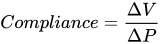
For example, if a patient inhales 500 mL of air from a spirometer with an intrapleural pressure before inspiration of −5 cm H2O and −10 cm H2O at the end of inspiration. Then:

Static compliance (Cstat)

[edit]

Static compliance represents pulmonary compliance during periods without gas flow, such as during an inspiratory pause. It can be calculated with the formula:
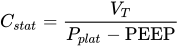
where

VT = tidal volume;
Pplat = plateau pressure;
PEEP = positive end-expiratory pressure.

Pplat is measured at the end of inhalation and prior to exhalation by using an inspiratory hold maneuver. During this maneuver, airflow is transiently (~0.5 sec) discontinued, which eliminates the effects of airway resistance. Pplat is never bigger than PIP and is typically <10 cm H2O lower than PIP when airway resistance is not elevated.

Dynamic compliance (Cdyn)

[edit]

Dynamic compliance represents pulmonary compliance during periods of gas flow, such as during active inspiration. Dynamic compliance is always lesser than or equal to static lung compliance because PIP − PEEP is always greater than Pplat − PEEP. It can be calculated using the following equation,
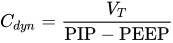
where

Cdyn = Dynamic compliance;
VT = tidal volume;
PIP = Peak inspiratory pressure (the maximum pressure during inspiration);
PEEP = Positive End Expiratory Pressure:

Alterations in airway resistance, lung compliance and chest wall compliance influence Cdyn.

Dimensionality and physical analogues

[edit]

The dimensions of compliance in respiratory physiology are inconsistent with the dimensions of compliance in physics-based applications. In physiology,

whereas in newtonian physics, compliance is defined as the inverse of the elastic stiffness constant k,

Pulmonary compliance is analogous to capacitance.

Clinical significance

[edit]

Lung compliance is an important measurement in respiratory physiology.[2][3]

  • Decreased pulmonary compliance may be associated with fibrosis.
  • Increased pulmonary compliance may be associated with COPD and emphysema due to loss of alveolar and elastic tissue.

Pulmonary surfactant increases compliance by decreasing the surface tension of water. The internal surface of the alveolus is covered with a thin coat of fluid. The water in this fluid has a high surface tension, and provides a force that could collapse the alveolus. The presence of surfactant in this fluid breaks up the surface tension of water, making it less likely that the alveolus can collapse inward. If the alveolus were to collapse, a great force would be required to open it, meaning that compliance would decrease drastically. Lung volume at any given pressure during inhalation is less than the lung volume at any given pressure during exhalation, which is called hysteresis.[4]

Functional significance of abnormally high or low compliance

[edit]

Low compliance indicates a stiff lung and means extra work is required to bring in a normal volume of air. This occurs as the lungs in this case become fibrotic, lose their distensibility and become stiffer.

In a highly compliant lung, as in emphysema, the elastic tissue is damaged by enzymes. These enzymes are secreted by leukocytes (white blood cells) in response to a variety of inhaled irritants, such as cigarette smoke. Patients with emphysema have a very high lung compliance due to the poor elastic recoil. They have extreme difficulty exhaling air. In this condition extra work is required to get air out of the lungs. In addition, patients often have difficulties inhaling air as well. This is due to the fact that a highly compliant lung results in many Atelectasis which makes inflation difficult.[further explanation needed] Compliance also increases with increasing age.

Both peak inspiratory and plateau pressure increase when elastic resistance increases or when pulmonary compliance decreases (e.g. during abdominal insufflation, ascites, intrinsic lung disease, obesity, pulmonary edema, tension pneumothorax). On the other hand, only peak inspiratory pressure increases (plateau pressure unchanged) when airway resistance increases (e.g. airway compression, bronchospasm, mucous plug, kinked tube, secretions, foreign body).[5]

Compliance decreases in the following cases:

References

[edit]
Revisions and contributorsEdit on WikipediaRead on Wikipedia
from Grokipedia
Lung compliance, or pulmonary compliance, refers to the distensibility of the , quantifying their ability to expand and stretch in response to changes in . It is mathematically defined as the change in volume per unit change in (C = ΔV / ΔP), where normal static compliance for both in an is approximately 200 mL/cm H₂O. This property is essential for efficient ventilation, as it determines the ease with which air can enter the alveoli during inspiration and allows for during expiration. Lung compliance is influenced primarily by two factors: the elastic recoil of lung tissue and the surface tension at the air-liquid interface within alveoli. Elastic fibers, such as , provide the structural framework that enables lung expansion, while —a of and proteins secreted by type II alveolar cells—reduces to prevent alveolar collapse and enhance compliance. Without adequate surfactant, as seen in conditions like respiratory distress syndrome, surface tension increases, leading to decreased compliance and higher . Compliance is not constant but varies with lung volume; it is maximal at mid-volumes (around ) and decreases at low or high volumes due to alveolar interdependence and elastic limits. Compliance can be measured as static (assessed during no , such as an inspiratory pause, to reflect true elastic properties) or dynamic (measured during active breathing, incorporating ). Static compliance is calculated from pressure-volume curves obtained via esophageal balloon or data, while dynamic compliance is derived from divided by the pressure difference between peak inspiration and end-expiration. In clinical settings, pulmonary function tests like provide indirect assessments, though direct measurement is common in mechanically ventilated patients to guide therapy. Alterations in lung compliance are hallmarks of various respiratory disorders; decreased compliance (stiff lungs) occurs in pulmonary fibrosis, acute respiratory distress syndrome (ARDS), or pneumothorax, increasing the effort required for ventilation, whereas increased compliance (overly distensible lungs) is seen in emphysema due to loss of elastic tissue. Aging also reduces compliance through decreased elastic recoil and surfactant function, while obesity or chest wall deformities like scoliosis can indirectly affect it by altering total respiratory system mechanics. Understanding compliance is crucial for diagnosing restrictive versus obstructive lung diseases and optimizing interventions such as mechanical ventilation or surfactant replacement therapy.

Definition and Physiological Basis

Definition of Lung Compliance

Lung compliance, denoted as CLC_L, is defined as the change in lung volume (ΔV\Delta V) per unit change in (ΔPL\Delta P_L), mathematically expressed as CL=ΔVΔPLC_L = \frac{\Delta V}{\Delta P_L} where ΔV\Delta V is typically measured in milliliters and ΔPL\Delta P_L in centimeters of water (cmH₂O) or millimeters of mercury (mmHg). This measure quantifies the elastic distensibility of the lungs, reflecting their ability to expand under without excessive resistance from tissue elasticity or . Transpulmonary pressure (PLP_L), the key pressure differential in this , is the difference between alveolar (PalvP_{alv}) and pleural (PplP_{pl}), calculated as PL=PalvPplP_L = P_{alv} - P_{pl}. During inspiration, a more negative pleural relative to alveolar facilitates lung expansion, while positive can promote collapse; this gradient is essential for assessing the s' elastic recoil properties independent of external forces. The concept of lung compliance emerged from early 20th-century studies on respiratory mechanics, with foundational work on lung elasticity and contributions described by Kurt von Neergaard in 1929 through comparisons of air- and saline-filled lungs. Significant advancements in the 1950s, including measurement techniques for related mechanics, were pioneered by researchers such as Arthur B. DuBois and Julius H. Comroe Jr., whose 1956 development of body plethysmography enabled precise assessments of lung volumes and airway properties, laying groundwork for modern compliance evaluations. Lung compliance specifically evaluates the intrinsic elastic properties of the lung tissue alone, whereas compliance encompasses the combined expandability of both the lungs and the chest wall, incorporating opposing forces from thoracic structures like the diaphragm and at . This distinction is critical, as lung compliance and chest wall compliance are each approximately 200 mL/cmH₂O in healthy adults, resulting in a total compliance of about 100 mL/cmH₂O since they act in parallel.

Role in Respiratory Mechanics

Lung compliance integrates with and chest wall compliance to determine the overall mechanics of the . The total respiratory system compliance (Crs) is the combined effect of lung compliance (Cl) and chest wall compliance (Ccw), calculated as parallel compliances: Crs = (Cl × Ccw) / (Cl + Ccw). This integration influences the required to achieve a given , where contributes to flow-dependent opposition during inspiration and expiration. In normal , these properties ensure coordinated expansion of the lungs and chest wall, minimizing the needed for ventilation. Lung compliance plays a central role in the by representing the elastic component of respiratory effort, accounting for approximately 65% of the total energy expended during quiet breathing. Higher lung compliance facilitates easier inflation, reducing the muscular work required to generate the necessary gradients for inspiration, as the change in volume per unit (ΔV/ΔP) is greater. Conversely, reduced compliance increases the elastic work, elevating overall energy demands and potentially leading to respiratory fatigue if uncompensated. adds a resistive component to this work, but compliance's elastic influence predominates in determining the baseline efficiency of tidal ventilation. In healthy adults, lung compliance is approximately 200 mL/cm H₂O, reflecting the combined compliance of both lungs. This value varies with age, increasing slightly due to age-related loss of in lung tissue; with sex, where females typically exhibit lower absolute values due to smaller lung volumes; and with body size, showing positive correlations with height and . These variations ensure adaptability across populations, maintaining functional respiratory mechanics. Physiologically, lung compliance enables efficient changes during quiet breathing by allowing substantial volume expansion (typically 500 mL) with minimal pressure gradients (around 1-2 cm H₂O), optimizing without excessive strain on respiratory muscles. This property supports the balance between and inspiratory effort, contributing to the low in healthy individuals and facilitating spontaneous ventilation.

Measurement and Calculation Methods

Static Lung Compliance

Static lung compliance, denoted as CstatC_{stat}, quantifies the elastic properties of the lungs under conditions of no , representing the change in lung volume (ΔV\Delta V) per unit change in (ΔPL\Delta P_L), where is the difference between alveolar pressure and pleural pressure. This measurement isolates the purely of tissue and eliminates contributions from , typically assessed during breath-holding or quasi-static maneuvers such as slow inflation or end-inspiratory pauses. In healthy adults, static compliance averages approximately 200 mL/cm H₂O, providing a baseline for evaluating distensibility. To calculate CstatC_{stat}, lung volume is divided by the transpulmonary pressure difference, often derived from plateau pressure (the pressure at end-inspiration with no flow) minus (PEEP) in ventilated patients: Cstat=ΔV/(PplatPEEP)C_{stat} = \Delta V / (P_{plat} - PEEP). Accurate assessment requires estimating pleural pressure, commonly achieved using an esophageal balloon catheter inserted into the lower third of the esophagus to approximate pleural pressure via the balloon's response to surrounding pressure changes. This method allows computation of as alveolar pressure minus esophageal pressure, enabling precise isolation of lung elasticity. Measurement of static lung compliance frequently involves generating pressure-volume (PV) curves through inflation-deflation maneuvers, which plot lung volume against transpulmonary pressure to reveal the characteristic sigmoidal shape and between inflation and deflation paths. These curves, obtained under relaxed conditions with minimal , highlight the elastic of the s and chest wall; the of the linear portion corresponds to compliance. In non-ventilated individuals, such assessments are typically measured using an esophageal to estimate pleural , combined with to record volume changes during relaxed, quasi-static maneuvers. In clinical settings, particularly intensive care units (ICUs), static compliance is evaluated using ventilator tracings during , where an end-inspiratory hold maneuver captures plateau pressure after equilibration of alveolar and airway pressures. This approach, supported by modern with built-in transducers, facilitates bedside monitoring and adjustments to minimize ventilator-induced lung injury by targeting optimal compliance values. Esophageal monitoring enhances accuracy in critically ill patients by accounting for chest wall contributions to total compliance.

Dynamic Lung Compliance

Dynamic lung compliance, denoted as CdynC_{dyn}, represents the change in lung volume (ΔV\Delta V) per unit change in (ΔPL\Delta P_L) measured at instants of zero during tidal cycles. This metric captures the lung's distensibility under conditions of active respiration, incorporating both and resistive forces. Unlike measures taken in quasi-static conditions, CdynC_{dyn} is calculated using readings at the onset and end of inspiration, where flow is momentarily zero, to isolate volume-pressure relationships amid ongoing ventilation. Key differences from static compliance arise because dynamic measurements occur during airflow, resulting in systematically lower values due to and time-dependent phenomena such as viscoelastic in lung tissue and uneven ventilation across lung units with varying time constants. refers to the energy dissipation during tidal cycling, which lags pressure equilibration, while uneven ventilation amplifies resistive losses, particularly in heterogeneous lung regions. These factors cause CdynC_{dyn} to decrease further with increasing respiratory frequency, as shorter cycle times limit equilibration and heighten the influence of peripheral . Measurement of dynamic lung compliance typically involves simultaneous monitoring of tidal volume via spirometry and airway or alveolar pressure using transducers, often integrated into ventilator systems or body plethysmographs for precise zero-flow point identification. In clinical settings, pressure-volume loops from mechanical ventilators provide real-time calculations, with Cdyn=VT/(PipPEEP)C_{dyn} = V_T / (P_{ip} - PEEP), where PipP_{ip} is the airway pressure at the end-inspiratory zero-flow point (often approximated by peak inspiratory pressure in clinical practice). Advanced techniques, such as forced oscillation applied at varying frequencies (e.g., 5–25 Hz), reveal frequency dependence by assessing compliance shifts, which is particularly useful for detecting small airway dysfunction. In healthy adults, dynamic lung compliance typically ranges from 100 to 200 mL/cm H₂O during quiet , though values decline with higher frequencies or in mechanically ventilated patients, varying with body size, posture, and ventilatory mode.

Units, Analogues, and Derived Measures

Lung compliance is conventionally measured in liters per centimeter of (L/cm H₂O) or, more commonly for precision, milliliters per centimeter of (mL/cm H₂O), reflecting the change in lung volume per unit change in . In the (SI), the equivalent is cubic meters per pascal (m³/Pa), where 1 L/cm H₂O corresponds to approximately 0.0102 m³/kPa, derived from the pressure conversion factor of 1 cm H₂O ≈ 98.07 Pa. These units originated from early physiological measurements using manometers, with cm H₂O remaining a standard in respiratory despite the adoption of SI units in broader scientific contexts. Physically, lung compliance can be analogized to the behavior of a spring, where the lung's elastic properties allow it to deform under and return to its original shape upon release. This analogy aligns with , which states that the force FF required to extend or compress a spring is proportional to the displacement xx (F=kxF = -kx), with kk as the spring constant representing stiffness. In respiratory terms, compliance CC is the reciprocal of stiffness (C=1/kC = 1/k), such that the change in volume ΔV\Delta V is proportional to the change in ΔP\Delta P (ΔV=CΔP\Delta V = C \cdot \Delta P), mirroring the linear elastic response observed in the lung's pressure-volume relationship over physiological ranges. This model underscores the lung's viscoelastic nature, though deviations occur at extreme volumes due to nonlinear tissue properties. Derived measures extend basic compliance to account for physiological variability. Specific lung compliance normalizes absolute compliance CLC_L by the (FRC), yielding Csp=CL/FRCC_{sp} = C_L / \text{FRC}, typically expressed in units of cm H₂O⁻¹; this adjustment allows comparisons across individuals with differing lung sizes, such as children versus adults, where normal values approximate 0.06–0.08 cm H₂O⁻¹ (based on CL200C_L \approx 200 mL/cm H₂O and FRC ≈ 2.5–3 L). Total respiratory system compliance CrsC_{rs}, which incorporates both lung and chest contributions in series, is calculated as Crs=CLCcwCL+CcwC_{rs} = \frac{C_L \cdot C_{cw}}{C_L + C_{cw}}, where CcwC_{cw} is chest compliance; under normal conditions, with CL200C_L \approx 200 mL/cm H₂O and Ccw200C_{cw} \approx 200 mL/cm H₂O, CrsC_{rs} is approximately 100 mL/cm H₂O. These derivations facilitate clinical assessments by isolating lung-specific effects from overall respiratory mechanics.

Factors Affecting Lung Compliance

Pulmonary Factors

Pulmonary surfactant is a complex mixture of lipids and proteins secreted by type II alveolar cells that significantly influences lung compliance by minimizing surface tension at the air-liquid interfaces within the alveoli. The primary lipid component, dipalmitoylphosphatidylcholine (DPPC), accounts for approximately 50% of the phospholipid fraction and forms a monolayer that stabilizes alveolar structures during respiration, preventing collapse and allowing for greater volume change per unit pressure. This reduction in surface tension enhances static lung compliance, as higher surface tension without surfactant would require substantially more pressure to inflate the lungs. In conditions such as infant respiratory distress syndrome (IRDS), surfactant deficiency elevates surface tension, promotes atelectasis, and markedly reduces compliance, necessitating mechanical ventilation or exogenous surfactant replacement to restore normal mechanics. Lung tissue elasticity, governed by the interplay of collagen and elastin fibers in the alveolar walls and interstitium, is a fundamental determinant of compliance. Elastin fibers provide the reversible recoil essential for efficient expiration, while collagen fibers maintain structural integrity and limit excessive expansion. Degradation of elastin, as occurs in emphysema due to protease-antiprotease imbalance, diminishes elastic recoil and increases overall lung compliance, shifting the pressure-volume relationship to favor easier inflation at the expense of air trapping. This alteration reflects a loss of the lung's inherent stiffness, allowing greater distensibility but impairing ventilatory efficiency. Alveolar recruitment and derecruitment profoundly affect lung compliance through their impact on the volume-pressure (PV) curve, which describes the relationship between transpulmonary pressure and lung volume. Atelectasis, characterized by collapsed alveoli, reduces the recruitable lung volume and flattens the lower portion of the PV curve, requiring higher pressures to reopen alveoli and thereby decreasing compliance. Conversely, overdistension at high lung volumes compresses alveolar walls and reduces the slope of the upper PV curve, also impairing compliance by limiting further volume expansion. Effective recruitment, such as through positive end-expiratory pressure, reopens collapsed units, steepens the PV curve, and improves compliance by maximizing the aerated lung volume. Age-related changes in pulmonary structure contribute to increased lung compliance, primarily through loss of elastic recoil, although increased deposition of collagen and cross-linking may stiffen lung tissue at a microstructural level. These changes result in easier inflation but reduced recoil, contributing to age-associated declines in respiratory function.

Extrapulmonary and Systemic Influences

Extrapulmonary and systemic factors significantly influence overall respiratory system compliance by altering the mechanical properties of the chest wall, pleural space, and respiratory muscles, independent of intrinsic lung parenchyma changes. The chest wall, comprising the rib cage, diaphragm, and abdominal contents, normally contributes about one-third to total respiratory system elastance, meaning reduced chest wall compliance can disproportionately affect ventilation efficiency. These influences often manifest as increased pleural pressure or diminished thoracic expansion, leading to restrictive patterns in lung volume recruitment. Chest wall compliance is determined by the elasticity of the and diaphragm, which facilitate thoracic expansion during inspiration. In conditions like , structural deformities stiffen the chest wall, reducing its compliance and impairing respiratory mechanics, which can progress to chronic . Similarly, decreases chest wall compliance through increased soft tissue mass and mechanical loading, resulting in substantially lower compliance (often 40-50% reduced) compared to non-obese individuals, even in eucapnic states. This reduction elevates the and predisposes to hypoventilation syndromes. Elevated abdominal pressure, as seen in or , transmits forces to the , elevating pleural pressure and diminishing effective compliance. In , intra-abdominal hypertension cephaladly displaces the diaphragm, reducing lung volumes such as total lung capacity and by up to 40%, thereby shifting the respiratory system's pressure-volume curve. During , the gravid increases intra-abdominal pressure, which is partially transmitted to the (about 50%), decreasing chest wall compliance and while promoting diaphragmatic elevation. Neuromuscular influences, such as weakness in , indirectly lower effective compliance by impairing muscle-driven thoracic expansion despite preserved elastic properties. Respiratory and weakness in neuromuscular diseases lead to reduced lung volumes and progressive declines in system compliance, often compounded by restrictive thoracic changes. This manifests as rapid and increased elastic load, heightening the risk of without altering lung tissue stiffness directly. Pharmacological agents, including anesthetics and muscle relaxants, alter chest wall dynamics by relaxing respiratory musculature and disrupting normal . General induction decreases by 15-25% through loss of , which imbalances and chest wall compliance, impairing overall compliance. Neuromuscular blockade from muscle relaxants causes immediate deterioration in compliance, as eliminates active chest expansion, increasing reliance on passive elastic forces and elevating the incidence of ventilation challenges.

Clinical Applications and Abnormalities

Diagnostic Significance

Lung compliance measurements play a crucial role in diagnosing (ARDS), where reduced compliance, often below 40 mL/cm H₂O, signifies stiff lungs due to alveolar flooding and inflammation. This low static compliance (C_stat) value helps clinicians confirm the severity of lung injury and guides therapeutic interventions, such as (PEEP) titration using compliance curves to optimize alveolar recruitment while avoiding overdistension. In ARDS management, these curves allow for personalized PEEP settings that maximize compliance, improving oxygenation and reducing ventilator-induced lung injury risk. Compliance assessments also aid in differentiating restrictive from obstructive lung diseases; for instance, typically presents with low C_stat due to fibrotic stiffening of lung tissue, whereas (COPD), particularly , shows increased compliance from loss of . This contrast in compliance patterns—decreased in fibrosis and elevated in COPD—enables precise diagnosis through , helping to distinguish parenchymal restriction from airway obstruction without relying solely on or . At the bedside in intensive care units (ICUs), dynamic lung compliance (C_dyn) is monitored in real-time via graphics, providing immediate insights into , patient- synchrony, and evolving lung mechanics during . These graphical displays of pressure-volume loops and flow waveforms allow clinicians to detect changes in compliance promptly, facilitating adjustments to settings for conditions like or evolving acute lung injury. Serial measurements of lung compliance offer prognostic value in predicting success from , with improving dynamic compliance indicating readiness for extubation and reduced risk of failure. In critically ill patients, trends in compliance over time correlate with outcomes, where sustained values above thresholds like 35 mL/cm H₂O are associated with higher successful rates compared to persistent low compliance. This approach enhances decision-making by integrating compliance data with other indices, minimizing reintubation risks in prolonged ventilation scenarios.

Pathophysiological Impacts of Altered Compliance

Decreased lung compliance, characteristic of restrictive lung diseases such as , results in stiffer lung tissue that resists expansion during inspiration, thereby increasing the and promoting rapid patterns. This heightened respiratory effort can lead to respiratory , particularly in conditions like , where reduces lung volumes and exacerbates dyspnea. Additionally, the reduced compliance impairs alveolar recruitment, contributing to and ventilation-perfusion (V/Q) mismatches that foster due to inefficient CO2 elimination. In contrast, increased lung compliance, as seen in obstructive diseases like , arises from the destruction of alveolar walls and loss of , allowing excessive lung expansion and . This overdistension elevates residual volume and total lung capacity, leading to dynamic that flattens the diaphragm and further impairs inspiratory mechanics. The resultant V/Q mismatch, stemming from uneven ventilation and preserved perfusion in poorly ventilated areas, promotes and chronic , worsening overall efficiency. To mitigate the severe consequences of low compliance in (ARDS), compensatory strategies such as maneuvers—sustained inflations to reopen collapsed alveoli—and (PEEP) titration are employed to restore aerated volume and improve oxygenation. In refractory cases with profoundly reduced compliance, veno-venous (ECMO) serves as a rescue therapy, allowing -protective ventilation by offloading demands and preventing further ventilator-induced . These interventions aim to preserve recruitable regions, which can vary widely (up to 59% of weight in responsive patients), thereby reducing the risk of immediate . Chronic low compliance from progressive imposes long-term cardiopulmonary strain, often culminating in cor pulmonale through sustained driven by hypoxemia-induced and vascular remodeling. This right and eventual failure increase morbidity, with accounting for a significant portion of chronic cor pulmonale cases via elevated . Emerging 2020s research on post-COVID highlights its role in persistent reduced compliance, affecting 20-30% of severe survivors through cytokine-mediated scarring that diminishes forced and exercise tolerance, though some resolution occurs over 6-12 months in non-idiopathic forms.

References

Add your contribution
Related Hubs
User Avatar
No comments yet.