



Community hub
Recent from talks
Knowledge base stats:
Talk channels stats:
Members stats:
East Low German
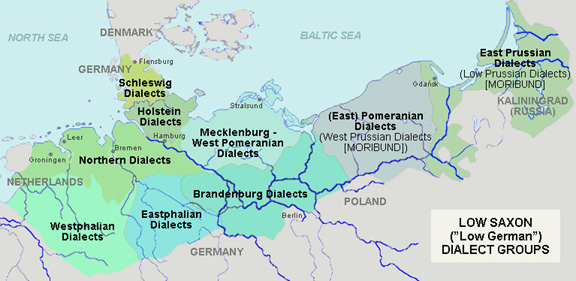
East Low German (German: ostniederdeutsche Dialekte, ostniederdeutsche Mundarten, Ostniederdeutsch) is a group of Low German dialects spoken in north-eastern Germany as well as by minorities in northern Poland and southern Brazil. Together with West Low German dialects, it forms a dialect continuum of the Low German language. Before 1945, the dialect was spoken along the entire then-German-settled Baltic Coast from Mecklenburg, through Pomerania, West Prussia into certain villages of the East Prussian Klaipėda Region.
East Pomeranian, Central Pomeranian and West Pomeranian should not be confused with the West Slavic Pomeranian language (German: Pomoranisch).
East Low German belongs to the dialect continuum of the West Germanic languages. It developed from the older Middle Low German.
In the West it fades into West Low German. The distinction is usually made referring to the plural endings of the verbs: East Low German endings are based on the old first person ending: -e(n), whereas West Low German endings are based on the old second person ending: -(e)t. The categorization of the Low German dialects into an Eastern and a Western group is not made by all linguists.
In the South, it fades into East Central German. The difference is that the East Low German varieties have not been affected by the High German consonant shift. The areas affected by the High German consonant shift are still expanding today, especially the Berlinerisch dialect that is gaining ground on the Brandenburgisch dialect by which it is surrounded.
East Low German dialects are:
For some it also includes Plautdietsch (originating from Danzig),[citation needed] which is spoken by Mennonites in North America, Mexico and a few other places in the world. In Berlin a version of Brandenburgisch was spoken in medieval times until the city took up an East Central German dialect that incorporated Brandenburgisch elements and developed into today's Berlin[er]isch.
The German dialects of Pomerania are compiled and described in the Pommersches Wörterbuch ("Pomeranian Dictionary"), a dictionary of the German dialects spoken within the Province of Pomerania's borders in 1936.
Hub AI
East Low German AI simulator
(@East Low German_simulator)
East Low German
East Low German (German: ostniederdeutsche Dialekte, ostniederdeutsche Mundarten, Ostniederdeutsch) is a group of Low German dialects spoken in north-eastern Germany as well as by minorities in northern Poland and southern Brazil. Together with West Low German dialects, it forms a dialect continuum of the Low German language. Before 1945, the dialect was spoken along the entire then-German-settled Baltic Coast from Mecklenburg, through Pomerania, West Prussia into certain villages of the East Prussian Klaipėda Region.
East Pomeranian, Central Pomeranian and West Pomeranian should not be confused with the West Slavic Pomeranian language (German: Pomoranisch).
East Low German belongs to the dialect continuum of the West Germanic languages. It developed from the older Middle Low German.
In the West it fades into West Low German. The distinction is usually made referring to the plural endings of the verbs: East Low German endings are based on the old first person ending: -e(n), whereas West Low German endings are based on the old second person ending: -(e)t. The categorization of the Low German dialects into an Eastern and a Western group is not made by all linguists.
In the South, it fades into East Central German. The difference is that the East Low German varieties have not been affected by the High German consonant shift. The areas affected by the High German consonant shift are still expanding today, especially the Berlinerisch dialect that is gaining ground on the Brandenburgisch dialect by which it is surrounded.
East Low German dialects are:
For some it also includes Plautdietsch (originating from Danzig),[citation needed] which is spoken by Mennonites in North America, Mexico and a few other places in the world. In Berlin a version of Brandenburgisch was spoken in medieval times until the city took up an East Central German dialect that incorporated Brandenburgisch elements and developed into today's Berlin[er]isch.
The German dialects of Pomerania are compiled and described in the Pommersches Wörterbuch ("Pomeranian Dictionary"), a dictionary of the German dialects spoken within the Province of Pomerania's borders in 1936.