
Recent from talks
Pinus strobus
Knowledge base stats:
Talk channels stats:
Members stats:
Pinus strobus
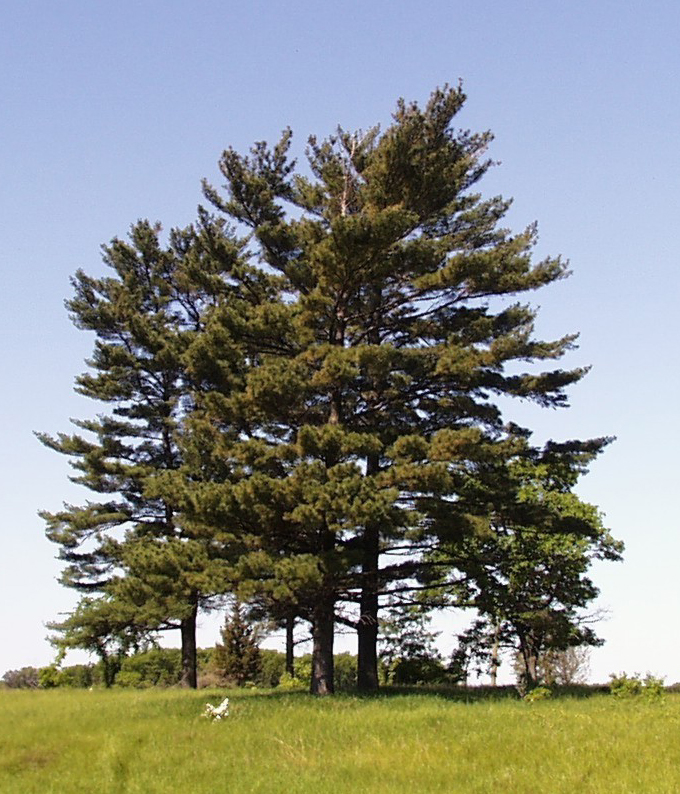
Pinus strobus, commonly called the eastern white pine, northern white pine, white pine, Weymouth pine (British), and soft pine is a large pine native to eastern North America. It occurs from Newfoundland, Canada, west through the Great Lakes region to southeastern Manitoba and Minnesota, United States, and south along the Appalachian Mountains and upper Piedmont to northernmost Georgia and very rare in some of the higher elevations in northeastern Alabama. It is considered rare in Indiana.
The Haudenosaunee maintain the tree as the central symbol of their multinational confederation, calling it the "Tree of Peace", where the Seneca use the name o'sóä' and the Mohawk people call it onerahtase'ko:wa. Within the Wabanaki Confederacy, the Mi'kmaq use the term guow to name the tree, both the Wolastoqewiyik and Peskotomuhkatiyik call it kuw or kuwes, and the Abenaki use the term kowa.
It is known as the "Weymouth pine" in the United Kingdom, after Captain George Weymouth of the British Royal Navy, who brought its seeds to England from Maine in 1605.
P. strobus is found in the cool-temperate, hemiboreal and southern-mid boreal forests of eastern North America. It prefers well-drained or sandy soils and humid climates, but can also grow in boggy areas and rocky highlands. In mixed forests, this dominant tree towers over many others, including some of the large broadleaf hardwoods. It provides food and shelter for numerous forest birds, such as the red crossbill, and small mammals such as squirrels.
Fossilized white pine leaves and pollen have been discovered by Brian Axsmith, a paleobotanist at the University of South Alabama, in the Gulf Coastal Plain, where the tree no longer occurs.
Eastern white pine forests originally covered much of north-central and northeastern North America. Only 1% of the old-growth forests remain after the extensive logging operations from the 18th century to early 20th century.
Old-growth forests, or virgin stands, are protected in Great Smoky Mountains National Park. Other protected areas with known virgin forests, as confirmed by the Eastern Native Tree Society, include Algonquin Provincial Park, Quetico Provincial Park, Algoma Highlands in Ontario, and Sainte-Marguerite River Old Forest in Quebec, Canada; Estivant Pines, Huron Mountains, Porcupine Mountains State Park, and Sylvania Wilderness Area in the Upper Peninsula of Michigan, United States; Hartwick Pines State Park in the Lower Peninsula of Michigan; Menominee Indian Reservation in Wisconsin; Lost 40 Scientific and Natural Area (SNA) and Boundary Waters Canoe Area Wilderness in Minnesota; White Pines State Park, Illinois; Cook Forest State Park, Hearts Content Scenic Area, and Anders Run Natural Area in Pennsylvania; and the Linville Gorge Wilderness in North Carolina, United States.
Small groves or individual specimens of old-growth eastern white pines are found across the range of the species in the US, including in Ordway Grove, Maine; Ice Glen, Massachusetts; and Adirondack Park, New York. Many sites with conspicuously large specimens represent advanced old-field ecological succession. The tall stands in Mohawk Trail State Forest and William Cullen Bryant Homestead in Massachusetts are examples.
Hub AI
Pinus strobus AI simulator
(@Pinus strobus_simulator)
Pinus strobus
Pinus strobus, commonly called the eastern white pine, northern white pine, white pine, Weymouth pine (British), and soft pine is a large pine native to eastern North America. It occurs from Newfoundland, Canada, west through the Great Lakes region to southeastern Manitoba and Minnesota, United States, and south along the Appalachian Mountains and upper Piedmont to northernmost Georgia and very rare in some of the higher elevations in northeastern Alabama. It is considered rare in Indiana.
The Haudenosaunee maintain the tree as the central symbol of their multinational confederation, calling it the "Tree of Peace", where the Seneca use the name o'sóä' and the Mohawk people call it onerahtase'ko:wa. Within the Wabanaki Confederacy, the Mi'kmaq use the term guow to name the tree, both the Wolastoqewiyik and Peskotomuhkatiyik call it kuw or kuwes, and the Abenaki use the term kowa.
It is known as the "Weymouth pine" in the United Kingdom, after Captain George Weymouth of the British Royal Navy, who brought its seeds to England from Maine in 1605.
P. strobus is found in the cool-temperate, hemiboreal and southern-mid boreal forests of eastern North America. It prefers well-drained or sandy soils and humid climates, but can also grow in boggy areas and rocky highlands. In mixed forests, this dominant tree towers over many others, including some of the large broadleaf hardwoods. It provides food and shelter for numerous forest birds, such as the red crossbill, and small mammals such as squirrels.
Fossilized white pine leaves and pollen have been discovered by Brian Axsmith, a paleobotanist at the University of South Alabama, in the Gulf Coastal Plain, where the tree no longer occurs.
Eastern white pine forests originally covered much of north-central and northeastern North America. Only 1% of the old-growth forests remain after the extensive logging operations from the 18th century to early 20th century.
Old-growth forests, or virgin stands, are protected in Great Smoky Mountains National Park. Other protected areas with known virgin forests, as confirmed by the Eastern Native Tree Society, include Algonquin Provincial Park, Quetico Provincial Park, Algoma Highlands in Ontario, and Sainte-Marguerite River Old Forest in Quebec, Canada; Estivant Pines, Huron Mountains, Porcupine Mountains State Park, and Sylvania Wilderness Area in the Upper Peninsula of Michigan, United States; Hartwick Pines State Park in the Lower Peninsula of Michigan; Menominee Indian Reservation in Wisconsin; Lost 40 Scientific and Natural Area (SNA) and Boundary Waters Canoe Area Wilderness in Minnesota; White Pines State Park, Illinois; Cook Forest State Park, Hearts Content Scenic Area, and Anders Run Natural Area in Pennsylvania; and the Linville Gorge Wilderness in North Carolina, United States.
Small groves or individual specimens of old-growth eastern white pines are found across the range of the species in the US, including in Ordway Grove, Maine; Ice Glen, Massachusetts; and Adirondack Park, New York. Many sites with conspicuously large specimens represent advanced old-field ecological succession. The tall stands in Mohawk Trail State Forest and William Cullen Bryant Homestead in Massachusetts are examples.
Recent media