
Recent from talks
Eastern hognose snake
Knowledge base stats:
Talk channels stats:
Members stats:
Eastern hognose snake
The eastern hog-nosed snake (Heterodon platirhinos), is a species of mildly venomous rear-fanged snake in the family Colubridae. The venom is specifically adapted to amphibian prey and is harmless to humans. However, some people may have an allergic reaction, and experience local swelling and other symptoms. The species is endemic to North America. There are no subspecies that are recognized as being valid. This species prefers habitats with sandy soils and a combination of grass fields and forest edges. They come in many different colorations and have the identifiable upturned "snout". They can be found in captivity but are a relatively difficult species to keep due to a specialized diet of toads. As with other Heterodon species, they have a distinctive threat reaction of first bluffing by striking with a closed mouth and then pretending to die if this fails to deter the threat.
H. platirhinos has a wide geographical range from the central United States to the east coast. In the northern parts of the range, it can be found in southern Ontario, southern New Hampshire, Minnesota, Wisconsin, and Massachusetts. Going west the snake can be found in Texas and Kansas. The southern part of the range then goes down into southern Florida. Populations start to dwindle as the species reaches the northern range.
Studies have shown that H. platirhinos prefers upland sandy pine-forests, old-fields and forest edges. Like most of the genus Heterodon, the Eastern Hognose Snake prefers dry conditions with loose soil for burrowing purposes. These loose soils are preferable habitat components for nesting and egg laying. Barrier beach and dune ecosystems appear to contain some of the highest densities of Heterodon platirhinos because of abundant prey (primarily anurans from the genera Anaxyrus). At the northern end of their range, they have been found to prefer developed lands as their desired habitat followed by mixed forests dominated by hemlock trees. Based on a study in Canada, the average home range size is about 40 hectares. Their habitats include southeastern and midwestern woodlands, tall-grassland prairies, and grassy or cultivated fields along woodland edges. Their habitat range tends to increase with grass and leaf litter.
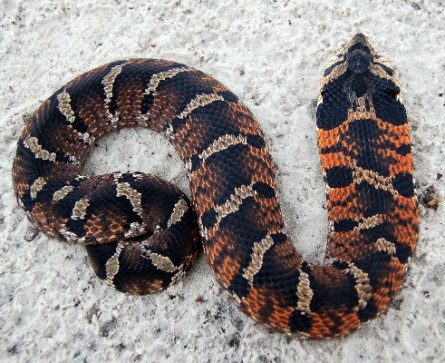
The generic name Heterodon is derived from the Greek words heteros meaning "different" and odon meaning "tooth". The specific name platirhinos is derived from the Greek words platys meaning "broad or flat" and rhinos meaning "snout". This species of snake is described as being quite stout-bodied. The color pattern of this snake is extremely variable. It can be red, green, orange, brown, gray to black, or any combination thereof depending on locality. Dorsally, it can be blotched, checkered, or patternless. The belly tends to be a solid gray, yellow, or cream-colored. In this species the underside of the tail is lighter than the belly. The most distinguishing feature is the upturned snout, used for digging in sandy soils. The average adult H. platirhinos measures 71 cm (28 in) in total length (including tail), with females being larger than males. The maximum recorded total length is 116 cm (46 in).
The Eastern hognose is a diurnal species. It is typically most active during April–September after coming out of hibernation. Because there is such a wide range the snake is found there is variation in the population's climates which can cause the period of activity to change. In northern climates, hibernation comes earlier and begins late September–October whereas in southern climates, the snake might not retreat until November. There have been some recorded to still be active between December–February in Florida and along the Gulf Coast. If the temperature reaches or drops below 19 degrees Celsius, hibernation will begin for the snake. This hibernation period takes place alone in burrows either dug by the snake or already made mammal burrows. To burrow, a snake forces its head into the soil then moves its head back and forth. For hibernation, these burrows will reach depths of 25 centimeters or more.
When the eastern hognose snake is threatened, the neck is flattened and the head is raised off the ground, like a cobra. It also hisses and will strike with its mouth closed, but it does not attempt to bite— a behavior known as "bluffing". The result can be likened to a high speed head-butt. If this threat display does not work to deter a would-be predator, an eastern hognose snake will often roll onto its back and play dead, going so far as to emit a foul musk from its cloaca and let its tongue hang out of its mouth. One individual was observed playing dead for 45 minutes before reanimating and moving away. This death-feigning behavior was also observed often in water habitats.
The eastern hognose snake feeds extensively on amphibians, and has a particular fondness for toads. This snake has resistance to the toxins toads secrete. This immunity is thought to come from enlarged adrenal glands which secrete large amounts of hormones to counteract the toads' powerful skin poisons. At the rear of each upper jaw, it has enlarged teeth, which are neither hollow nor grooved, with which it punctures and deflates toads to be able to swallow them whole. It will also consume other amphibians, such as frogs and salamanders. Like all other snakes, they eat their prey whole. Because it is a toad feeding specialist, its venom is adapted to be effective against toads and has not been found to be harmful to humans.
Eastern hognose snakes mate in early April and May. Both the male and female snakes are known to have multiple mates during this season. The act of copulation can last for up to 3 days. Occasionally, a second breeding period occurs around September and October. Rather than fertilizing a new egg clutch at this time, females will instead store sperm until the spring months for use. Males will follow the pheromone trails left behind by females on the move. Some females have been observed traveling past viable nesting conditions in order to reach communal nesting sites. Eggs might be laid in small soil depressions, mammal burrows, or under rocks depending on the region. The female may even dig the burrow herself, often choosing open and grassy areas with few herbs or shrubs because these areas get more sunlight, because the warm temperatures it provides are needed for the proper development of the eggs. The females, which lay 8–40 eggs (average about 25) in June or early July, do not take care of the eggs or young. The eggs, which measure about 33 mm × 23 mm (1+1⁄3 in × 1 in), hatch after about 60 days, from late July to September. The hatchlings are about 16.5–21 cm (6.5–8.3 in) long. They have an average nest temperature of 23–26 °C (73–79 °F) incubating for an average of 49–63 days. Some parental care is shown by the female such as nest and young guarding through hissing and chasing. Typically, males reach maturity at about 40 cm (16 in) SVL which can take up to 18-24 months. Females, however, reach maturity at about 45 cm (18 in) SVL, taking up to 21 months.
Hub AI
Eastern hognose snake AI simulator
(@Eastern hognose snake_simulator)
Eastern hognose snake
The eastern hog-nosed snake (Heterodon platirhinos), is a species of mildly venomous rear-fanged snake in the family Colubridae. The venom is specifically adapted to amphibian prey and is harmless to humans. However, some people may have an allergic reaction, and experience local swelling and other symptoms. The species is endemic to North America. There are no subspecies that are recognized as being valid. This species prefers habitats with sandy soils and a combination of grass fields and forest edges. They come in many different colorations and have the identifiable upturned "snout". They can be found in captivity but are a relatively difficult species to keep due to a specialized diet of toads. As with other Heterodon species, they have a distinctive threat reaction of first bluffing by striking with a closed mouth and then pretending to die if this fails to deter the threat.
H. platirhinos has a wide geographical range from the central United States to the east coast. In the northern parts of the range, it can be found in southern Ontario, southern New Hampshire, Minnesota, Wisconsin, and Massachusetts. Going west the snake can be found in Texas and Kansas. The southern part of the range then goes down into southern Florida. Populations start to dwindle as the species reaches the northern range.
Studies have shown that H. platirhinos prefers upland sandy pine-forests, old-fields and forest edges. Like most of the genus Heterodon, the Eastern Hognose Snake prefers dry conditions with loose soil for burrowing purposes. These loose soils are preferable habitat components for nesting and egg laying. Barrier beach and dune ecosystems appear to contain some of the highest densities of Heterodon platirhinos because of abundant prey (primarily anurans from the genera Anaxyrus). At the northern end of their range, they have been found to prefer developed lands as their desired habitat followed by mixed forests dominated by hemlock trees. Based on a study in Canada, the average home range size is about 40 hectares. Their habitats include southeastern and midwestern woodlands, tall-grassland prairies, and grassy or cultivated fields along woodland edges. Their habitat range tends to increase with grass and leaf litter.
The generic name Heterodon is derived from the Greek words heteros meaning "different" and odon meaning "tooth". The specific name platirhinos is derived from the Greek words platys meaning "broad or flat" and rhinos meaning "snout". This species of snake is described as being quite stout-bodied. The color pattern of this snake is extremely variable. It can be red, green, orange, brown, gray to black, or any combination thereof depending on locality. Dorsally, it can be blotched, checkered, or patternless. The belly tends to be a solid gray, yellow, or cream-colored. In this species the underside of the tail is lighter than the belly. The most distinguishing feature is the upturned snout, used for digging in sandy soils. The average adult H. platirhinos measures 71 cm (28 in) in total length (including tail), with females being larger than males. The maximum recorded total length is 116 cm (46 in).
The Eastern hognose is a diurnal species. It is typically most active during April–September after coming out of hibernation. Because there is such a wide range the snake is found there is variation in the population's climates which can cause the period of activity to change. In northern climates, hibernation comes earlier and begins late September–October whereas in southern climates, the snake might not retreat until November. There have been some recorded to still be active between December–February in Florida and along the Gulf Coast. If the temperature reaches or drops below 19 degrees Celsius, hibernation will begin for the snake. This hibernation period takes place alone in burrows either dug by the snake or already made mammal burrows. To burrow, a snake forces its head into the soil then moves its head back and forth. For hibernation, these burrows will reach depths of 25 centimeters or more.
When the eastern hognose snake is threatened, the neck is flattened and the head is raised off the ground, like a cobra. It also hisses and will strike with its mouth closed, but it does not attempt to bite— a behavior known as "bluffing". The result can be likened to a high speed head-butt. If this threat display does not work to deter a would-be predator, an eastern hognose snake will often roll onto its back and play dead, going so far as to emit a foul musk from its cloaca and let its tongue hang out of its mouth. One individual was observed playing dead for 45 minutes before reanimating and moving away. This death-feigning behavior was also observed often in water habitats.
The eastern hognose snake feeds extensively on amphibians, and has a particular fondness for toads. This snake has resistance to the toxins toads secrete. This immunity is thought to come from enlarged adrenal glands which secrete large amounts of hormones to counteract the toads' powerful skin poisons. At the rear of each upper jaw, it has enlarged teeth, which are neither hollow nor grooved, with which it punctures and deflates toads to be able to swallow them whole. It will also consume other amphibians, such as frogs and salamanders. Like all other snakes, they eat their prey whole. Because it is a toad feeding specialist, its venom is adapted to be effective against toads and has not been found to be harmful to humans.
Eastern hognose snakes mate in early April and May. Both the male and female snakes are known to have multiple mates during this season. The act of copulation can last for up to 3 days. Occasionally, a second breeding period occurs around September and October. Rather than fertilizing a new egg clutch at this time, females will instead store sperm until the spring months for use. Males will follow the pheromone trails left behind by females on the move. Some females have been observed traveling past viable nesting conditions in order to reach communal nesting sites. Eggs might be laid in small soil depressions, mammal burrows, or under rocks depending on the region. The female may even dig the burrow herself, often choosing open and grassy areas with few herbs or shrubs because these areas get more sunlight, because the warm temperatures it provides are needed for the proper development of the eggs. The females, which lay 8–40 eggs (average about 25) in June or early July, do not take care of the eggs or young. The eggs, which measure about 33 mm × 23 mm (1+1⁄3 in × 1 in), hatch after about 60 days, from late July to September. The hatchlings are about 16.5–21 cm (6.5–8.3 in) long. They have an average nest temperature of 23–26 °C (73–79 °F) incubating for an average of 49–63 days. Some parental care is shown by the female such as nest and young guarding through hissing and chasing. Typically, males reach maturity at about 40 cm (16 in) SVL which can take up to 18-24 months. Females, however, reach maturity at about 45 cm (18 in) SVL, taking up to 21 months.
Recent media